THE EFFECTS OF THE OVERSIGHT ROLE OF LEGISLATURES IN PROMOTING GOOD GOVERNANCE IN SOUTH AFRICA WITH SPECIFIC REFERENCE TO
THE GAUTENG LEGISLATURE
by
ANTHONY TSHWARELO MALAPANE
Submitted in fulfilment of the requirements of the degree of DOCTOR OF ADMINISTRATION
in
PUBLIC ADMINISTRATION in the
FACULTY OF MANAGEMENT AND LAW (School of Economics and Management)
at the
UNIVERSITY OF LIMPOPO
SUPERVISOR: PROF SM MADUE CO-SUPERVISOR: PROF MP SEBOLA
2019
i DECLARATION
I Anthony Tshwarelo Malapane hereby declare that research titled “the effects of the oversight role of legislatures in promoting good governance in South Africa with specific reference to the Gauteng Legislature” submitted to the University of Limpopo, for the degree Doctor of Administration in the subject field of Public Administration is my own original work and has not previously been submitted by me at this or any other institution of higher education. I further declare that all materials and sources utilised are specified and acknowledged by means of a comprehensive list of references.
Malapane A. T Date
Signature………. ……….
Copyright@ University of Limpopo 2019
ii ACKNOWLEDGEMENTS
I would like to express my sincere gratitude and deepest appreciation to the following persons who contributed in different ways towards the journey travelled and the completion of this study:
• Prof Steve Madue (Supervisor) and Prof Mokoko Sebola (Co-Supervisor) for having been outstanding supervisors and mentors during the planning and writing of this thesis. The guidance you provided is much appreciated.
• Special thanks goes to the Gauteng Provincial Legislature for the support in allowing me access to conduct this study. To all the Members of the Gauteng Provincial Legislature and the staff who participated in this study, I appreciate your contribution.
• The University of Limpopo for opening its doors for me, and more especially, the Department of Public Administration under the stewardship of Prof Mokoko Sebola. And not forgetting the Department’s Assistant, Ms Patience Mabule for always availing herself to respond to my queries and calls for assistance.
• To some of my mentors and colleagues, Prof David Mello, Dr Ricky Mukonza, Mr Vusi Vilakazi, Mr Kagiso Pooe, Mr Kgapane Sebidi and Ms Minah Makhubele for the support and encouragement.
• The support received from my cousins Petra and Gladness Makaringe; my brothers Johannes and Ismael Nyoni, Elvis Bruno Malapane; Pa Frans Malapane; and my friend Petrus Nyathi as well as our family friend Ms Eneth Marule. This serves to remember where it all began when I moved to Gauteng from Bushbuckridge chasing my dream.
• To all my siblings, it is all possible with God on our side.
Lastly, to all my friends and family (not mentioned) who played direct and indirect roles to ensure that the study becomes a success. In addition, thanks to the environment for giving me courage, criticism, pressure and ability to continue doing my best and believing in myself.
“Be bold. Be brave. Be courageous” commands the Lord – Joshua 1:9
iii DEDICATION
I dedicate this study to my mother Juliet Mosuma and my late father Leonard Malapane for their patience and love in shaping me into the kind of person I am today. To my wife Kgopotso Mary and son Tshenolo Malapane, thank you for giving me all the support, love and for your patience during my busiest days going through this journey, this study is also dedicated to you. Furthermore, may this study be an inspiration and motivation to all young South Africans who have passion and love for education, and the welfare of the country.
iv ABSTRACT
South Africa continues to experiment with democracy after 23 years since its rebirth in 1994. The country’s democracy is still developing towards greater transparency, full participation and accountability. Development depends on the existence of strong and vibrant institutions of accountability in the face of the challenges that threaten to reverse the gains made since the advent of democracy. Among such institutions is the legislature, which is the focus of this study. The study probes the oversight role of legislatures in South Africa. Oversight has become a subject of interest in the field of Public Administration as it is viewed as the mandate of legislatures to hold the government to account for managing public resources in the course of conducting public affairs. This study broadens the understanding of oversight by examining crucial relations between the legislature and the executive, and by providing insight into the legislature’s ability and capacity to carry out the oversight mandate. This is mainly because in most developing countries, the legislative sector, and particularly African legislatures have been categorised as weak. They are generally censured to have institutional weaknesses and limited decision-making role. There are, however, common challenges, including but not limited to lack of capacity, the dominance of the executive and its reluctance to cooperate, and lack of political will attributed to various factors. These challenges are intensified by the legislature’s perceived inability to deal with emerging issues. Studies previously conducted in the Gauteng Legislature have affirmed some of these challenges, including among others, lack of independence and capacity issues when exercising its oversight role. However, the literature pointed to increased oversight activities in democratic legislatures over the years. Although increase in oversight activities is acknowledged in the study, literature on oversight effectiveness is scant.
From the foregoing, the aim of the study was to examine whether the oversight role of legislatures has effects in terms of the promotion of good governance, particularly executive transparency and accountability as well as public involvement. In addition to focusing on the relationship between the executive and the legislature, ability and capacity of the legislature, the study also set out to determine the extent to which the public participates in oversight processes of legislatures. The study concentrated on the Gauteng Legislature, and focused on the work of Portfolio Committees as they are responsible for the day to day oversight work of legislatures. The literature reviewed
v points out to the complex nature of the legislative oversight setting based on the systems of governance adopted in a country, which has an influence on the relationship between the executive and the legislature, and in turn, on oversight. The study has employed a qualitative approach, with the data collected utilising semi- structured in-depth personal interviews, participant observation and document analysis. Semi-structured personal interviews were the main data collection tool utilised to collect primary data from the participants. The participants were selected utilising non-probability (purposive) sampling to target participants with knowledge and experience on the subject matter to attain the objectives of the study. In addition, the participant observation and document analysis were used to collect both primary and secondary data to supplement the interviews with the respondents. This was mainly to respond to the contention of this study.
The study argues that the legislature through its oversight role has the ability and capacity to promote transparency and accountability as well as public involvement.
The findings of this study suggest that to a certain extent, the oversight role might have positive effects on promoting executive transparency and accountability. However, the findings have pointed out some serious shortcomings regarding the extent to which the public participates in the oversight work of the legislature. This is regardless of the efforts made by the legislature to establish platforms to ensure that the public participates in the oversight role to hold the executive accountable. Furthermore, the study has found that Portfolio Committees are a suitable mechanism to hold the executive to account as among others, the Members of the Provincial Legislature (MPLs) work well together. There are improved relations between the Gauteng government departments and committees. The departments are responsive; yet there are still challenges leading to the elusion of accountability, with limited or no consequences. The study recommends inter alia, follow-up on oversight activities;
committee action against the executive’s reluctance; strengthening the role of research; and regular interactions between the executive and the legislature.
Keywords
Accountability, Committees, Democracy, Executive, Government, Governance, Good Governance, Legislature, Performance, Public Participation, Service Delivery, Transparency, Political Parties, and Oversight.
vi TABLE OF CONTENTS
DECLARATION ...i
ACKNOWLEDGEMENTS ………...….…………...ii
DEDICATION………...iii
ABSTRACT……….…...………. iv
LIST OF TABLES ……...………….………….….….….….….…...….…….…………. xiii
LIST OF FIGURES…………...……….………...………. xiii
KEY ACRONYMS ……….…….……….………. xiv
CHAPTER 1 GENERAL ORIENTATION OF THE STUDY 1.1 INTRODUCTION AND BACKGROUND TO THE STUDY…….….….….….…….1
1.2 STATEMENT OF THE PROBLEM……….….….….……….……….…….…. 3
1.3 AIM AND OBJECTIVES…….……...….……....……….... 5
1.4 RESEARCH QUESTIONS……….……….…….…. …..……….….…….... 5
1.5 MOTIVATION……….…….…….…….……...………... 6
1.6 SIGNIFICANCE OF THE STUDY….……….…….…….………….….……… 7
1.7 SCOPE OF THE RESEARCH……….………... ….…. 8
1.8 ETHICAL CONSIDERATION….….….…....…. …..…..………..….….……...…. 8
1.9 CLARIFICATION OF CONCEPTS……….…….……...………….…10
1.10 STUDY CHAPTER LAYOUT.……….……….... 11
1.11 CONCLUSION………15
CHAPTER 2 OVERVIEW OF SYSTEMS OF GOVERNANCE AND THEORETICAL FOUNDATIONS FOR THE LEGISLATIVE-EXECUTIVE RELATIONS ON OVERSIGHT 2.1 INTRODUCTION.……….…….…….………... 16
2.2 CONTEXT OF POLITICAL SYSTEM……….……….…….…….………. 16
2.3 DEMOCRACY AS POLITICAL SYSTEM……….…….……… 18
2.3.1 The evolution of political party systems………...……. 21
2.3.1.1 Types of party systems….……….………… 22
vii
2.3.1.2 Party systems change………...23
2.3.1.3 Multi-party systems in Africa…….……….………...25
2.3.1.4 The dominant party system…….…….………. 26
2.3.2 Contextualising political parties.……….….28
2.3.2.1 The role of political parties.………...……… 29
2.3.2.2 Opposition political parties……….……….31
2.3.3 Electoral systems in democracy.………...32
2.3.3.1 The nature of electoral systems……….33
2.3.3.2 Proportional representation systems………...…….35
2.3.3.3 The influence of electoral systems………....36
2.3.4 Forms of government….……….………. 38
2.3.4.1 Parliamentary system...………...39
2.3.4.2 Presidential system………. 41
2.3.4.3 Semi-presidential system………... 42
2.4 THEORETICAL FOUNDATIONS DISCOURSE……….….….…... 43
2.4.1 Politics-Administration dichotomy discourse………... 44
2.4.2 Separation of powers doctrine………... 46
2.4.3 Principal-Agent theory……….………... 54
2.5 CONCLUSION……….…….…….……… 57
CHAPTER 3 THE OVERSIGHT ROLE OF LEGISLATURES, AND THE LEGISLATURE’S ABILITY AND CAPACITY TO HOLD THE EXECUTIVE ACCOUNTABLE 3.1 INTRODUCTION……….……….………... 59
3.2 CONCEPTUALISATION AND CONTEXTUALISATION OF OVERSIGHT... 61
3.3 THE ROLE AND IMPORTANCE OF OVERSIGHT………….……...…………. 66
3.4 CONDITIONS OF EFFECTIVE OVERSIGHT IN MODERN LEGISLATURES…... 67
3.5 INEFFECTIVE OVERSIGHT BY LEGISLATURES...…….…...…….….…….71
3.6 EXECUTIVE-LEGISLATIVE RELATIONS ON OVERSIGHT IN PARLIAMENTARY SYSTEM……… 72
3.7 POLITICAL WILL VIS-À-VIS INCENTIVES FOR OVERSIGHT.….……. …....77
viii 3.8 THE INFLUENCE OF PARTY DISCIPLINE AND PARTY UNITY ON
OVERSIGHT ...………... 78
3.9 LEGISLATIVE OVERSIGHT TOOLS AND EFFECTIVE OVERSIGHT...…… 82
3.9.1 Committee system………...………... 86
3.9.2 Budget oversight as a tool ………. 90
3.9.3 Questions as an oversight tool ………. 94
3.10 CHALLENGES AND CONSTRAINTS IN OVERSIGHT ….………….….... 98
3.11 PUBLIC INVOLVEMENT IN THE OVERSIGHT ROLE OF SOUTH AFRICAN LEGISLATURES ……….….….………... 100
3.12 SYNTHESIS ……….….…….…….……101
3.13 CONCLUSION ……….….….……….………102
CHAPTER 4 THE INSTITUTIONAL FRAMEWORK, PERFORMANCE MANAGEMENT AND PUBLIC PARTICIPATION IN PROMOTING TRANSPARENCY AND ACCOUNTABILITY 4.1 INTRODUCTION ………....….….….………….….…….….…….104
4.2 OVERVIEW OF GOVERNMENT ………. ….….……..……. …….……105
4.3 THE SOUTH AFRICAN PROVINCIAL GOVERNMENT ….….…….……... 108
4.3.1 Provincial constitutional structures and functions….…….………... 109
4.4 GOVERNANCE AND GOOD GOVERNANCE ……….…….…….…... 113
4.4.1 The concept of accountability ……….……….………….117
4.4.1.1 Merits of accountability...……….……… 118
4.4.1.2 Characteristics and components of accountability ………. 119
4.4.1.3 Accountability in the South African public sector...……….….……….120
4.4.2 The concept of transparency...………….……….…………122
4.4.2.1 The role of transparency ……….……….…...123
4.4.2.2 Complexities of transparency ………. 124
4.5 PERFORMANCE MANAGEMENT IN THE PUBLIC SECTOR ………... 125
4.5.1 Performance and performance management ………127
4.5.2 Performance information ………...129
4.5.3 Role and functions of performance management ……….131
ix
4.5.4 Performance measurement ……….……….133
4.5.4.1 Economy ……….134
4.5.4.2 Efficiency ………... 135
4.5.4.3 Effectiveness ……….………136
4.5.5 The Relationship between the 3Es (Economy, Efficiency & effectiveness) ...137
4.6 PUBLIC PARTICIPATION IN THE CONTEXT OF THE STUDY ……….139
4.6.1 The role and purpose of public participation ……….……….141
4.6.2 Perspective on mechanisms for public participation ……….144
4.7 LINKING PERFORMANCE MANAGEMENT AND PUBLIC PARTICIPATION……….……….….147
4.8 LEGISLATION AND POLICY FRAMEWORK FOR REPORTING IN SOUTH AFRICA ….………...149
4.8.1 The Constitution of the Republic of South Africa 1996 ……….….….…….149
4.8.2 The Public Finance Management Act, 29 of 1999 …….…….…….……….150
4.8.3 Framework for managing programme performance information ……...151
4.8.4 Oversight model of South African legislatures ……….…….152
4.8.5 Guideline for legislative oversight through annual reports ………….…….152
4.9 CONCLUSION ……….153
CHAPTER 5 RESEARCH METHODOLOGY AND DESIGN 5.1 INTRODUCTION ……….155
5.2 RESEARCH METHODOLOGY AND DESIGN ……….…….……... 156
5.2.1 Qualitative research...……….158
5.2.2 Literature review ……… 159
5.3 DESCRIPTION OF THE STUDY AREA.…………...……….………….161
5.4 TARGET POPULATION ….……….…….…….………...162
5.5 SAMPLING DESIGN ……….……...………….……… 163
5.6 DATA COLLECTION METHODS ………….……….…….…….……….164
5.6.1 Semi-structured personal interviews ……….……….……….164
5.6.2 Observation ……….….……….…….………….165
x 5.6.3 Document analysis ……….……….…….……….166 5.7 DATA ANALYSIS ……….……….………….…….……...………….167 5.8 RELIABILITY AND VALIDITY ….………….…….….…...…....….….………….168 5.9 CONCLUSION ……….….….….….…….….…….169
CHAPTER 6
RESEARCH FINDINGS, ANALYSIS AND INTERPRETATION
6.1 INTRODUCTION ……….171 6.2 PRESENTATION OF FINDINGS……….….…….…….…….…. 171 6.2.1 The relationship between the legislature and the executive.….…...……….173 6.2.1.1 Understanding the oversight role of the legislature and its
significance………...173 6.2.1.2 The nature of the relationship between the executive and the
legislature on oversight………...……….……....……….…175 6.2.1.2.1 Building trust through shared responsibilities……….…….….…...177 6.2.1.3 The executive’s responsiveness to the requests of the legislature……….178 6.2.1.4 Actions taken for the executive’s reluctance to cooperate and
respond to requests by committees....…….….….…....…….….…………...180 6.2.1.5 The influence of partisanship in the decisions of committees
when conducting oversight over the executive…...…...…………...…181 6.2.1.5.1 Protective relations between committee chairpersons and
Members of the Executive Council……….…….…….………183 6.2.2 The legislature’s ability and capacity to promote transparency and
hold the executive accountable……….……….…….…….…………....185 6.2.2.1 The levels of education and experience, and its relevance to the
work of committees……….………185 6.2.2.2 Knowledge and familiarity with the oversight role of the legislature……...186 6.2.2.3 The adequacy of staff complements and capacity to support the work
of committees of legislatures……….………….…….….….…………...186 6.2.2.4 The benefits of having many tools of conducting oversight………...188 6.2.2.5 Views, opinions and experiences on the effectiveness/usefulness of
the oversight role and oversight tools utilised by committees……….……...189
xi 6.2.2.6 The legislature’s ability and capacity to generate own information……....190 6.2.2.7 Challenges contributing to weaknesses in the oversight role of
the legislature……….……….…….…………...191 6.2.2.7.1 Lack of understanding roles and responsibilities……….193 6.2.2.7.2 Programming and time constraints ……….194 6.2.3 The extent to which the public participate in the activities of the
legislature to monitor the performance of the executive………….………195 6.2.3.1 The ways in which the public, in particular stakeholders are
involved in oversight work of committees……….………...196 6.2.3.1.1 Stakeholder identification and mobilisation……….…...………….197 6.2.3.2 Views on stakeholders participating from an informed position
provided with timely, accessible and adequate information………….……199 6.2.3.3 The extent of stakeholders effecting the oversight role of the
legislature to hold the executive to account positively…….……...…….….200 6.2.3.4 Opinion on the effectiveness of approaches used to involve
stakeholders in the oversight role of the legislature……….………….……203 6.3 DISCUSSION OF THE RESULTS ON OVERSIGHT
EFFECTIVENESS……….205 6.3.1 The Gauteng Provincial Legislature as the representative body
of the people ... ………205 6.3.2 Oversight and effectiveness of the legislature: 2009 to 2019 ………….…...208 6.3.2.1 Oversight effectiveness and oversight models/guidelines ….…...…...…...212 6.3.3 Committees in the legislature and oversight effectiveness ….……….……214 6.3.3.1 Day to day work of committees ……….….………….……….214 6.3.3.2 Key role players ……….……….215 6.3.4 Methods of oversight for oversight potential and effectiveness …………...221 6.3.4.1 Oversight effectiveness and Gauteng Provincial Government
departmental performance reports……….……...………...……….221 6.3.4.2 Oversight effectiveness and Focused Intervention Study………224 6.3.4.3 Oversight effectiveness, independent verification and
fieldwork research……….…….…….………...227 6.4 CONCLUSION ……….…….…….………… ……233
xii CHAPTER 7
SUMMARY OF FINDINGS, RECOMMENDATIONS AND CONCLUSIONS
7.1 INTRODUCTION ……….…….…….……….….….….….….…...…234
7.2 SUMMARY OF FINDINGS………...….…….….………...235
7.3 RECOMMENDATIONS……….…….…….…….……...…...239
7.4 LIMITATIONS OF THE STUDY….….….….….….….……....……….……243
7.5 AREAS FOR FURTHER RESEARCH……….….….………. ….. ….244
7.6 CONCLUSION………...…….….….………....………...244
REFERENCES……….……….………….….…....246
Annexure A: Semi-structured personal interview questions.…….….…….….…...278
Annexure B: University ethical clearance letter ……….…….……….….... 286
Annexure C: Editing certificate……….……….287
Annexure D: Letter of permission to conduct research……….288
xiii
LIST OF TABLES
Table 2.1: Various forms of party systems……….……….…….… 23
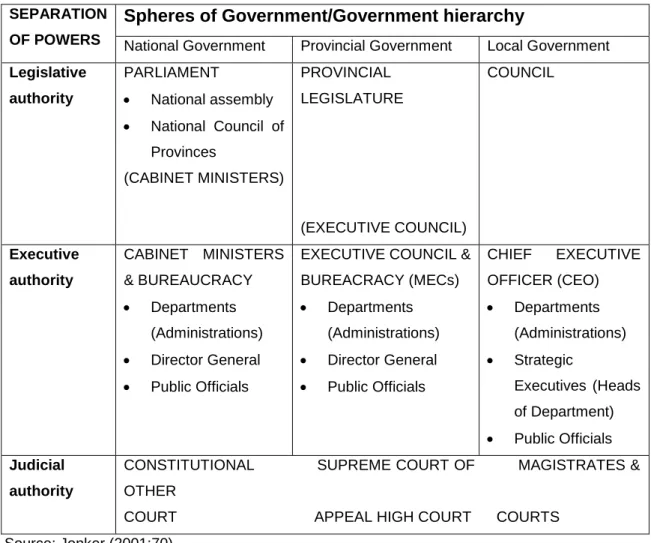
Table 2.2 Matrix of separation of powers and spheres of government.…….……. 48
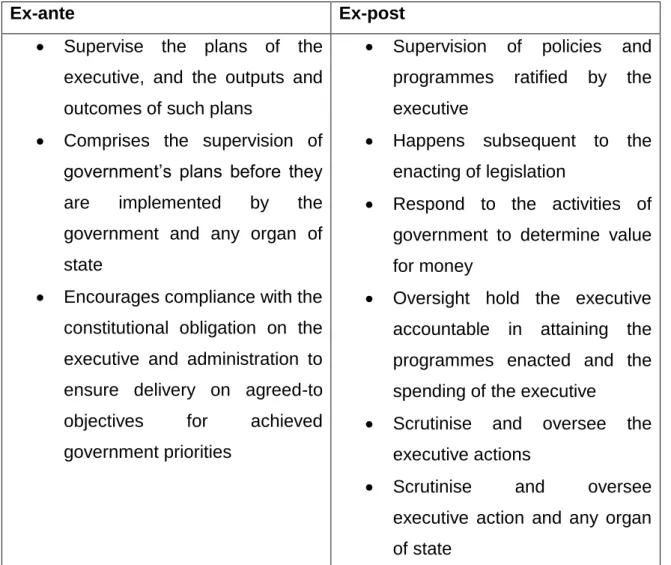
Table 3.1: Summary of the definitions of oversight discussed……….…….……….65
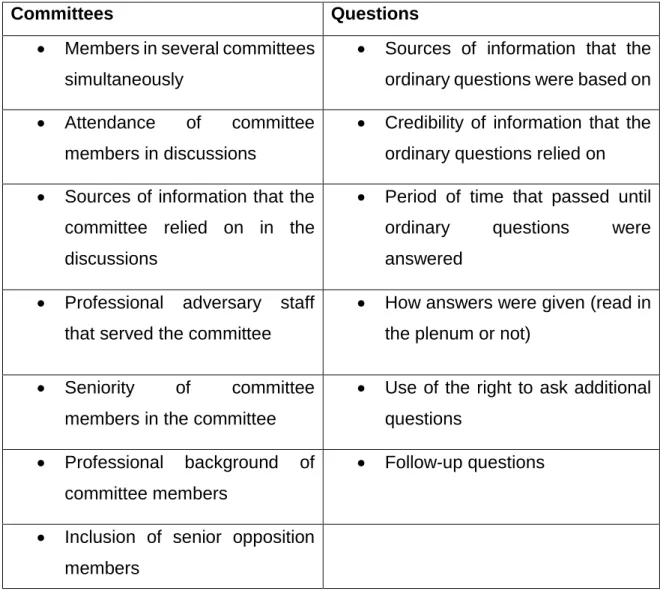
Table 3.2: Parameters to examine oversight potential……….….……. 84
Table 3.3: Different types of committee systems………….…….…….………. 87
Table 4.1: Government functions…….….….………….……....….…………...……112
Table 6.1: The respondents interviewed in the GPL………172
LIST OF FIGURES
Figure 2.1: A model of a political system……….………….….….………. 17Figure 4.1: Provincial executive structure……….……….…....…... 111
Figure 4.2: Key performance information concepts………...…….………. 130
Figure 4.3: Relationship between the 3Es………. 138
Figure 4.4: Ladder model of participation………....…….………. 143
Figure 6.1: Representation of political parties in the GPL…….…….……….…… 206
xiv
KEY ACRONYMS
AG Auditor-General
AGSA Auditor-General South Africa ANC African National Congress BCM Budget Cycle Model DA Democratic Alliance
EFF Economic Freedom Fighters FIS Focused Intervention Study GPG Gauteng Provincial Government GPL Gauteng Provincial Legislature IMF International Monetary Fund MEC Member of Executive Council MPLs Members of Provincial Legislatures MPs Members of Parliament
NGO Non-Governmental Organization PA Principal-Agent
PEBA Performance Evaluation and Budget Analysis PR Proportional Representation
PSOM Public Sector Oversight Model
SADC Southern African Development Community SCOPA Standing Committee on Public Accounts SOM Sector Oversight Model
WBI World Bank Institute
1
CHAPTER 1
GENERAL ORIENTATION OF THE STUDY
1.1 INTRODUCTION AND BACKGROUND TO THE STUDY
In general, democracy is about building structures and institutions, and more importantly, the participation of the people in governance. It has been over 23 years since the advent of a democratic South Africa. The milestone highlights, in part, that the country’s democracy is maturing. However, it is argued that the true test of a mature democracy will be determined by the degree of the government’s response to the needs of the people (Mbeki, 2006). Mattes and Bratton (2007:192) state,
“democracy, above all, is a system of rules and procedures by which leaders, groups and parties compete for power, in which free and equal people elect representatives to make binding decisions”. It is generally referred to as the government of the people by the people. Mpehle (2012) emphasises that democracy is not restricted to elections, but should aim to benefit the public. Nonetheless, the country is still facing numerous challenges in its effort to respond to the needs of the people, which include but not limited to maladministration and misuse of public funds (Plaatjies, 2013).
The challenges occur regardless of the existence of democratic institutions such as parliament and provincial legislatures. These institutions are entrusted with the obligation to ensure good governance and to promote the welfare of the local communities (Shija, 2012), as acknowledged through the principle of trias politica, which recognises the separation of powers of the state. Good governance is well defined in the literature as relating to effective problem solving, decision making or the efficient allocation and management of public resources (Coston, 1998). Moreover, other scholars discussed good governance in the context of its attributes, transparency and accountability as well as public involvement, which is preserved through the separation of powers (Graham, Amos & Plumptree, 2003; Mwanza, Mwitwa &
Mukunto, 2014). The separation of powers is between the legislative, executive and judiciary branches of government to promote systematic checks and balances in
2 observing basic values and principles of good governance enshrined in Section 195(1) of the Constitution of the Republic of South Africa, 1996.
It emphasises that every arm of the state has been allocated its own constitutional powers to exercise. For instance, oversight is a central mandate of the legislative branch of government (Murray & Nijzink, 2004 in Madue, 2012), although it is not the sole mandate. Other mandates include law-making, facilitating public participation and promoting corporative governance. Oversight as a point of contention in this study is a constitutional obligation in terms of the doctrine of the separation of powers. Section 114(2)(b) of the Constitution of the Republic of South Africa, 1996 stipulates that the legislature has the role of overseeing the actions of the executive, in particular government departments and other organs of the state such as government agencies and public entities. The role is to promote accountability, transparency and compliance in the executive’s service delivery performance to satisfy the needs of the people.
Legislatures have an oversight role to ensure that the executive effectively conducts and manages public affairs and resources (Johnson & Nakamura, 1999). It entails that legislatures should monitor the executive’s activities in the rendering of goods and services to the people. It is important to understand the significance of the oversight role of legislatures in the provisioning of public goods and services. Ngwakwe (2012) argues that the discussions of service delivery and financial accountability are inseparable. This assertion is based on the fact that there cannot be effective provision of services to communities without sound financial management. Financial accountability and transparency are important facets in conducting public affairs and managing public resources (Madue, 2012). This emphasises the significance of the oversight role of legislatures. Of course, questions are still raised about the capacity of legislatures to hold the executive accountable (Abellera, 2011; Pelizzo &
Stapenhurst, 2014). According to Shija (2012:5), “effective oversight must be to the benefit of all the people and promote social equality”. It means that the oversight role of the legislature should be mostly focused in promoting the effective provision of services to the local communities, and oversight should be the true test of South Africa’s maturing democracy.
Thus, in considering the fifth legislature, the study is concerned with the effects that legislative oversight might have in promoting good governance, in particular
3 transparency and accountability as well as public involvement. Noting the foregoing, the literature revealed that a gap still exists regarding the link between legislative oversight and executive performance. In consideration of recent developments in the public discourse adversely affecting the South African legislatures, predominantly the National Parliament (Seedat & Naidoo, 2015:3), legislatures have been facing public scrutiny. It gives the impression that legislatures are unable to fulfil their oversight role to hold the executive to account for managing public resources and conducting public affairs. The literature reviewed points out that not much has been done with regard to the effects of the oversight role. As a result, it is difficult to draw a conclusion on the merits and demerits of the oversight role. The lacuna in the existing scholarship dictates a thorough systematic and scientific investigation on the subject to address the research problem of the study.
1.2 STATEMENT OF THE PROBLEM
There is a general view that legislatures of most developing countries, and in particular African legislatures have always been categorised as weak (Nijzink, Mozaffar &
Azevedo, 2006; Pelizzo & Stapenhurst, 2014). The legislatures are characterised based on their institutional weaknesses and limited decision-making role. This is despite developments in most developing countries to ensure that legislatures are independent, capacitated and have the ability to execute their oversight role to promote good governance, in particular transparency and accountability as well as public involvement. The initiatives are advocated by the World Bank Institute (WBI), and Commonwealth Parliamentary Association (CPA), among others. This is also recognising that there are still common challenges facing legislatures, including but not limited to lack of capacity, the dominance of the executive and its reluctance to cooperate, and lack of political will attributed to party political dynamics (Pelizzo &
Stapenhurst, 2006; Shenga, 2007; Zvoma, 2010). The challenges are exacerbated by legislatures’ perceived inability to deal with emerging issues.
The foregoing is prevalent in South Africa. The South African government still faces challenges related to the provision of public goods and services, including but not limited to maladministration and misuse of taxpayers’ money as well as poor service delivery. The challenges threaten to reverse some of the gains made since the advent
4 of democracy, and in turn there have been calls, among others, from the Auditor General of South Africa (AGSA)’s report to strengthen oversight. In stressing the pertinent matter of operation clean audits, the report asserts that the government slightly improves the reliability and usefulness of service delivery reporting, but this does not necessarily mean that there is enhanced service delivery performance (AGSA, 2012/13). The call was for other institutions of oversight and in particular the legislature as the elected representatives to strengthen its oversight role. It is because of weaknesses in the implementation of programmes in key national and provincial departments such as health, education and economic development.
The calls however come during an intricate period where the oversight role of legislatures in South Africa, in particular parliament is under scrutiny in the public discourse and domain. The challenges faced by the country’s legislatures have placed doubt in their ability to oversee the executive. Such challenges questioned the separation of powers in some instances wherein the judiciary has to intervene to instil good governance in among others the Nkandla debacle (Malapane, 2015; Business Live, 2016). On the one hand, it remains clear in terms of the separation of powers that oversight is the mandate of legislatures. On the other hand, it is for this perception and reasoning that “the extent in which legislatures play their oversight role in promoting good governance is currently being debated” (Abellera, 2011:294). The debates continue because there is a dearth of literature in oversight and good governance, particularly in South Africa. This is regardless of what the scholarly work reviewed refer to as renewed interest in the study of the oversight role of legislatures.
According to the Gauteng Legislature’s 20 years review report (2015:7), “the Gauteng Legislature is considered a centre of excellence within the global legislative community, and since 1994, it has always promoted transparent and responsive government as well as being the first point of contact for the people of Gauteng”. This is interesting, yet it raises questions noting the current debates and limited literature as well as studies conducted in the Gauteng Legislature, confirming some of the challenges underscored, inter alia, lack of independence, capacity issues and ineffectiveness (Rapoo, 2004; 2005). The studies, however, have their own limitations as none focused on the effects of oversight. This study therefore seeks to make a contribution to the body of knowledge on how legislatures in South Africa have effects
5 in promoting good governance, focusing on the Gauteng legislature. Given the background provided above, the research problem to be investigated in this study is:
What effects does the oversight role of the Gauteng Legislature have on promoting good governance, in particular executive transparency and accountability as well as public involvement?
1.3 AIM AND OBJECTIVES
The aim of the study is to examine the effects of the oversight role of legislatures in promoting good governance in South Africa with specific reference to the Gauteng Legislature. The objectives that guide this study are to:
• examine the relationship between the legislature and the executive on oversight in the Gauteng Legislature, focusing on their power relations;
• assess the legislature’s ability and capacity to promote transparency and hold the executive accountable;
• determine the extent to which the public participate in the activities of the legislature to monitor the performance of the executive and in turn promote transparency and accountability; and
• draw conclusions and make recommendations that could assist to improve executive transparency and accountability through the oversight role of the legislature, and in turn promote good governance.
1.4 RESEARCH QUESTIONS
This study is guided by the following research questions:
• what is the state of the relationship between the legislature and the executive in the Gauteng Legislature, and to what extent does it influence the oversight role of the legislature in promoting good governance?
• does the Gauteng Legislature have ability and capacity to oversee the activities of the executive to promote transparency and accountability?
6
• to what extent does the public participate in the oversight role of the legislature to monitor the performance of the executive and in turn promote accountability and transparency?
• what practical actions could be taken at institutional level to ensure executive accountability and transparency?
1.5 MOTIVATION
As an emerging scholar with a professional interest on legislative studies, the researcher felt motivated to study the oversight role of legislatures in South Africa.
Globally, developments regarding the oversight role of legislatures with emphasis on supporting and capacitating democratic legislatures both national parliaments and provincial legislatures to be in a position to effectively fulfil their constitutional mandate have been noted (Stapenhurst & Pelizzo, 2006; Malapane, 2015; 2016). Legislatures, in particular through their oversight role, are viewed as an important pillar of democracy in developed and developing countries. In the wake of South Africa relishing the milestone of over 23 years since the advent of democracy in 1994, and the inception of the Constitution of the Republic of South Africa, 1996, such developments are crucial for the maturity of the country’s democracy. As South Africa’s democracy matures, the oversight role of democratic institutions such as parliament and provincial legislatures becomes more important (AGSA, 2012/13). For this reason, more attention has been directed on the role played by legislatures. The role of legislatures, in particular oversight has been under the spotlight in the public domain. This however has not meant that legislatures in the country are performing their oversight role effectively; instead they have been dominating the public discourse and domain for reasons that have placed doubt on their ability to effectively perform their oversight role. It is therefore important to acknowledge that oversight is a constitutional mandate, and it should be effectively carried out, hence the need to study its effects on promoting good governance, particularly executive transparency and accountability, among others. Therefore, the significance of this study is to examine the effects of the oversight role in the Gauteng Legislature.
7 1.6 SIGNIFICANCE OF THE STUDY
The importance of the oversight role of legislatures has been underscored in the discussions. Oversight has, however, been a disputed terrain where it was regarded as the role and responsibility of opposition parties (Oversight and Accountability Model, 2009:7). Notwithstanding, having ushered in the fifth legislature and over 23 years of democracy, it is important to examine the role of the legislature as a democratic institution. It is noted that oversight is not the sole responsibility of opposition parties, but the mandate of the legislative branch. It is a constitutional mandate that needs to be effectively carried out. The forgoing may point out to various scenarios in terms of oversight. On the one hand, this may entail that there has been asymmetric understanding or lack of oversight thereof. On the other hand, it underscores a significant gap on knowledge which could obstruct oversight.
It is argued that as the country’s democracy matures, the oversight role of democratic institutions such as parliament and provincial legislatures becomes of critical importance (AGSA, 2012/13). Thus, in part, preliminary literature suggested that little has been done with regard to the oversight role of legislatures in developing countries, particularly in the South African context. While there is an acknowledgement by some studies on oversight and what is termed “a renewed interest in the subject”, little focus has been put on the effects of oversight. The study was set out to explore the causal relation between legislative oversight and the executive’s performance. The study of this nature is, therefore, essential to the study and practice of Public Administration, thereby contributing towards strengthening legislatures as democratic institutions.
The results of this study would therefore contribute new insights in enhancing the oversight role of legislatures, and in turn the executive’s performance. They (the results) are meant to assist legislators to improve their understanding of the ability to conduct effective oversight. This study also makes a meaningful contribution to the knowledge field of legislative studies. This is attained through responses to the research questions, and through proposals to improve theories and approaches of conducting effective oversight. Furthermore, in the process of completing this study, the researcher has produced conference papers and published journal articles on the subject matter that might contribute towards bridging the literature gap. To attain the significance of the study, the scope of the research is outlined in the next session.
8 1.7 SCOPE OF THE RESEARCH
The research investigated the effects that legislative oversight might have on promoting executive transparency and accountability as well as public involvement, with specific reference to the Gauteng Legislature. The study has mostly paid attention to the fourth term of legislative business (2009-2014) building towards the 23 years of a democratic South Africa and beyond, which speaks to the current term (2014-2019).
It focused on the legislature as it is responsible to oversee and monitor the activities of the executive, which is tasked with the mandate of managing public resources and conducting public affairs. Thus, the unit of analysis of the study is the Gauteng Legislature. The focus is on committees in the legislature, because according to the literature, most of the oversight work is carried out by committees, in particular Portfolio Committees. The study focused on Members of the Provincial Legislature (MPLs) and Key staff supporting Portfolio Committees overseeing provincial service delivery departments as prioritised, including among others, Economic Development, Health, Education, Social Development, and Cooperative Governance and Human Settlements. This was due to the time frames available, costs and manageability of the study as oversight in the legislature is conducted through the House and its Committees. There are 17 committees in the GPL (11 Portfolio Committees responsible for overseeing departments and 6 standing committees not attached to departments). This, however, did not negatively affect the study as its findings (in chapter 6) attained the aim and objectives as outlined in section 1.3. Thus, the next section outlines the research ethics taken into consideration when the study was conducted since it took place in a natural setting and involved the researcher working together with the respondents.
1.8 ETHICAL CONSIDERATION
Ethical issues are a prerequisite in scientific research. Ethics generally entails what is right or wrong when conducting research. It has to do with the standards and norms.
The researcher in this study has complied with the accepted norms and values because this study involves individuals as respondents (Mouton, 2001). These set of principles are outlined by the scientific community to determine what is suitable in
9 doing research. Amongst others, Goddard and Melville (2001) stipulate that the researcher should, to a certain extent, select a topic of research which satisfies ethical requirements; and this has been complied with.
As discussed in chapter 5, the researcher has further ensured that the research methods employed in conducting the research took into consideration ethical issues.
In scientific research, ethical issues should prevail from the selection of the topic, research design and method as well as compiling the research report. Brynard and Hanekom (2006) are of the view that the main issues to consider in ethics are honesty and confidentiality. Birley and Moreland (1998) are of the opinion that there are varied issues in research ethics, and the study has to comply and consider these issues. The following are ethical issues considered in this study:
• The researcher has ensured that the study respects the confidentiality of the information provided, and the right of the respondents to remain anonymous or to withdraw from participation. Some of the respondents were also afforded an opportunity to validate the information provided, particularly through follow-up questions for clarity purposes.
• From the above point, the data collected was analysed immediately after the data collection to avoid a situation of misinterpreting the data collected and to regress from utilising biased information.
• The study has openly outlined the research methodology and tools to be utilised to collect data so that readers of the study are able to know how the results were realised (see chapter 5 of this study).
• Some of the data collected was recorded subject to the permission granted by the respondents and stored to enable validity and reliability checks to be done.
This has enabled the researcher to undertake an accurate analysis of the study and to revisit the data for clarity (Birley & Moreland, 1998).
The study has observed the above ethical principles by, among others, being subjected to the Ethics Committee of the Faculty of Law and Management – School of Economics and Management. The integrity of the University of Limpopo, the Gauteng Legislature and the researcher have been protected throughout the proceedings of the study. Furthermore, permission to conduct the study as required by the university was requested and approved by the Office of the Secretary to the
10 Gauteng Legislature. The confidentially aspects and other rights were explained to the participants, with the emphasis that they are free to withdraw their participation should they have the need to do so. Having articulated the ethical considerations, the next section clarifies key concepts applicable to the study.
1.9 CLARIFICATION OF CONCEPTS
This section provides the clarification of the key concepts utilised in the study.
Although the concepts are clarified in detail in the discussions of the theoretical chapters (chapter 2, 3 & 4), it is important to provide a synopsis of what the concepts mean in relation to the study.
Accountability: Mwanza, Mwitwa and Mukunto (2014) assert that accountability is the obligation of power holders to take responsibility for their actions. It serves as an instrument to monitor the use of power by those who have been delegated the responsibility, and in turn ensure that government effectively carries its day to day function.
Democracy: Choi and Raleigh (2015) assert that it is in the nature of democracy for people and groups previously marginalised to participate in decision-making and integrated into decision-making bodies and emphasises limits on the executive powers.
Good Governance: Mwanza et al. (2014:82) refer to good governance as the
“…accountability and transparency of the government to its citizens and the general participation of the citizens in the government process”. The foregoing definition of good governance is utilised in the study for reference.
Performance: Performance refers “…to the productive organisation, i.e. one that has capacity to perform and converts this capacity into results –outputs and outcomes”
(Van Dooren, Bouckaert & Halligan, 2010:4).
Public Participation: The constitution highlights the role of committees in the legislature in involving the public in the oversight and law-making processes of
11 legislatures. The foregoing assertion is supported by Jacobs and Jones (2009:15) that
“the elements of legislative representative bodies such as Parliamentary Committees play an important role in securing public legitimacy for the political systems”.
Committees of legislatures should provide the people with an opportunity to have a say in the spending of their resources (Le Roux, 2010).
Transparency: Callamard (2010:1220) states that “…the Non-Governmental Organisation (NGO) Transparency International has defined transparency as a principle that allows those affected by administrative decisions, business transactions or charitable work to know not only the basic facts and figures but also the mechanisms and processes”.
Oversight: Sector Oversight Model (2012:4) defines the concept of oversight as
“…the proactive interaction initiated by a legislature with the executive and administrative organs…that encourages compliance with the constitutional obligation on the executive and administration to ensure delivery on agreed-to objectives for achieved of government priorities”. Oversight in this study can be defined as “the process carried-out by legislatures to scrutinise, monitor and review the actions planned and performed by the executive to promote transparency and accountability in managing resources and conducting affairs in the interests of the people”.
1.10 STUDY CHAPTER LAYOUT
This section outlines the summary of the chapters constituting this study. This study is demarcated into 7 chapters, with each chapter dedicated to discussing a specific theme in responding to the objectives of the study. Therefore, the chapters of this study are outlined starting with the introductory chapter.
Chapter 1
Chapter one of the study, also known as the introductory chapter, is an important chapter aimed at introducing the study, in particular the rationale for conducting the study. The chapter provides the introduction and background to the study. It introduces the topic of the study, and the statement of the problem. It sets the tone with regard to
12 the main contention of the study. The study focuses on the effects of the oversight role of legislatures in promoting good governance in South Africa with reference to Gauteng Legislature. The contention of the study is centred on whether the oversight role of the Gauteng Legislature has effects on executive transparency and accountability as well as public involvement. The chapter has also outlined the research questions and objectives of the study. In addition, it has provided the scope and ethical considerations observed. More importantly, it has provided the significance of the study. This alludes to the importance of the study in terms of its contribution to knowledge, amongst others, as it is mostly emphasised in doctoral theses.
Furthermore, the chapter discussed the ethical considerations and the clarification of key concepts.
Chapter 2
The chapter provides the overview of governance systems and theoretical foundations relevant to define the relationship between the legislature and the executive. It discusses the historical overview of the systems of governance, providing a global picture and South African experiences. The chapter is premised on the discussion about the political system espoused in the country after the 1994 multi-party democratic elections. This opened the way to the discussion on other various systems which are important to the discourse on the relationship between the legislature and the executive. This talks to systems such political party and electoral systems, with particular focus on various types, and the influence and choice of the kind of systems adopted in the South African context. The influence of the systems in the executive- legislative power relations is the main focus that dominates the discussion. The chapter also outlines the forms of government-presidential, semi-presidential and parliamentary which are crucial to define the relationship in terms of how the legislature and the executive are established in each form of government. In addition, the chapter provides the theoretical foundations dominant in the study of the relationship between the executive and the legislature. It further outlines the theoretical theory adopted in the study, which is the principal-agent theory.
13 Chapter 3
The chapter presents the literature review on the oversight role of legislatures, and the ability and capacity of the legislature to hold the executive accountable. The review of existing literature aims to, among others, establish a theoretical basis and to identify gaps in the literature to justify this study. The chapter starts by conceptualising and contextualising oversight to establish clarity on the meaning of oversight. There are asymmetries in the understanding of oversight by various scholars, and this assists in reaching a common ground on the understanding of the concept. The chapter also discusses the executive-legislative relations in the parliamentary form of government utilised in South Africa. In addition, the chapter outlines the influence of politics on oversight, and the dominant oversight tools utilised by legislatures globally, and in the South African context. This considers the challenges and constraints that legislatures face in executing their oversight role. The chapter further presents a broader discussion on public involvement in the oversight role of legislatures. Lastly, a synthesis and conclusion are drawn from the discussion.
Chapter 4
The chapter outlines the institutional framework, performance management and public participation in promoting transparency and accountability. It discusses the overview of government, government structures, powers and functions in particular, focusing on the provincial government. This relates to the contention of the study, which focuses mainly on the provincial government, with emphasis on the relationship between the legislature and the executive in the delivery of services to the people. The chapter discusses good governance in the context of this study, focusing on its key principles, transparency and accountability. In addition, performance management and public participation are discussed. The emphasis is on performance management, inter alia, performance management and performance measurement, and moreover the importance of performance information. The link between performance management and public participation is underlined. The chapter further outlines the reporting legislative and policy framework in South Africa.
14 Chapter 5
The chapter presents detailed discussions on the research methodology adopted and utilised in the study. According to Mouton (2001), the research methodology chapter discusses the how part of the study towards the attainment of its findings. The chapter provides both the theoretical and the empirical aspects of the research methodology.
This is to assist in justifying the research methodology and designs adopted for the study. The chapter discusses issues such as the research design, sampling design, sampling methods and size. The data collection instruments are discussed, especially those utilised in the study, i.e. semi-structured interviews, document analysis and participant observation. Furthermore, the chapter outlines how the data collected was analysed, and how the study ensured validity and reliability. Lastly, the chapter discusses the study area and the population of the study. The chapter further paved a way for the discussion of the chapter on data analysis.
Chapter 6
The chapter provides analysis of the findings using the research methodology discussed in chapter 5. This is for the data collected in the GPL from the MPLs and Support Staff serving various committees. The findings are interpreted and presented through common themes. The findings are interpreted and presented in relation to addressing the objectives of the study. Furthermore, the research findings may be used to assist legislatures, in particular the GPL to improve their oversight role.
Chapter 7
The chapter presents a summary of the findings and the conclusions. It further provides recommendations for the implementation of the findings. Most importantly, the chapter identifies areas for further research. The conclusion on this study does not necessarily signal the end of research on this topic. It may be viewed as a contribution of new knowledge in Public Administration, and may thus be one of the important tools in the continuing research journey into the oversight role of legislature in promoting good governance in the South African context.
15 1.11 CONCLUSION
The chapter has outlined the rationale for conducting the study on the oversight role of legislatures in South Africa in promoting good governance, in particular transparency and accountability as well as public involvement. The aim of the study was to explore the effects of the oversight role of legislatures in South Africa in promoting good governance (transparency, accountability and public involvement) with specific reference to the Gauteng Legislature. The chapter has also presented an introductory overview which sets the tone for the overall study.
The chapter has explained the statement of the problem, aim and objectives, and the research questions of the study. The statement of the problem is concerned with the effects of the oversight role of legislatures in promoting good governance. A general view exists that legislatures of developing countries are weak, and unable to deal with emerging challenges and opportunities, among others.
Chapter 1 has paved the way for the next chapter, which deals with the theoretical framework of the study. Based on the power relations, Chapter 2 discusses the overview of systems of governance and theoretical foundations discourse for the executive-legislative relations on the oversight role. It focuses on, amongst others, the political system, party systems, forms of government and the theoretical framework relevant to the study.
16
CHAPTER 2
OVERVIEW OF SYSTEMS OF GOVERNANCE AND THEORETICAL FOUNDATIONS FOR THE LEGISLATIVE-EXECUTIVE RELATIONS
ON OVERSIGHT
2.1 INTRODUCTION
South Africa’s transition from the colonial past to the post-colonial administration has brought changes on how the government of the country functions. This is in terms of systems, structures and processes of governance. The transition has resulted in the development of new democratic systems and structures, inter alia, electoral and party systems, and new forms of political parties. These systems and structures as well as related processes are important in the study of the role of legislatures. Legislatures are an essential part of democratic governance, and thus, outlining systems and structures is set out to assist to establish a context on which to base the study. Chapter 2, therefore, provides an overview of systems of governance and relevant theoretical foundations in Public Administration. The first section of the chapter focuses on the discussion of the systems and structures that include, among others, democracy, party systems, electoral systems and political parties.
The second section reviews theoretical underpinnings in Public Administration on which the study is based. The relevant theoretical foundations covered in this chapter include the relevance of politics-administration dichotomy, the doctrine of the separation of powers, and the application of Principal-Agent theory. These theoretical frameworks will assist in analysing the relationship between the legislature and the executive within the espoused political system thus, as a point of departure, an overview of a political system is outlined.
2.2 CONTEXT OF POLITICAL SYSTEM
In studying the role of institutions like legislatures, it is important to understand the nature of the political system of their countries for the purpose of establishing a context
17 on which to base the study. It is recognised that different countries have adopted different political systems, and this results from various factors. Factors such as history, liberation and popular choice, population and size, geography, culture, foreign domination, and power, among others, influence the choice and development of a political system in various countries (Crumpacker, 2006:7). They highlight the complex nature of a political system of any type adopted in a certain country. Veenendaal (2015) puts emphasis on colonial history, international politics, and geography as having an impact on the development of a political system. The commonality in the factors discussed is history, which will be pivotal in further discussions. Hogstrom (2011:2) alludes to the fact that in the centre of a political system are institutions, which are crucial in ensuring that society realises its goals. These institutions include structures such as legislatures, political parties, bureaucracies and the judiciary responsible for specific activities. The nature of structures or institutions that exist within a nation is defined by the type of a political system.
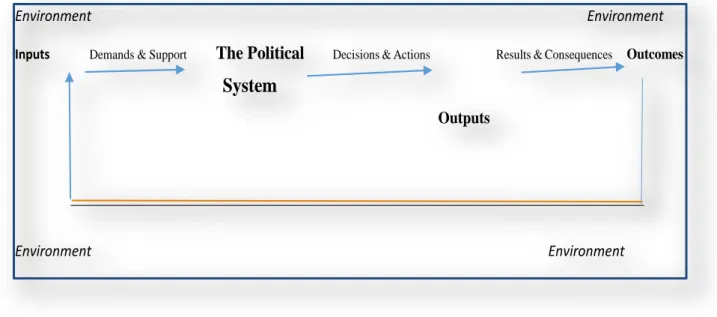
From the foregoing, there is a general understanding that the development of a political system at most is influenced by the external environment. In emphasising factors which influence the development of a political system, Hogstrom (2011) presents a model of a political system cited from Easton (1965:32), as illustrated in Figure 2.1 below.
Figure 2.1: A Model of a Political system
Source: Easton (1965:32) in Hogstrom (2011:2)
Environment Environment
Inputs Demands & Support The Political Decisions & Actions Results & Consequences Outcomes System
Outputs
Environment Environment
18 Figure 1 illustrates the influence of the external forces in the development of a political system. Doces and Nega (2013) underscored the influence that external factors have on the development of a political system. However, for the establishment of a political system to succeed, there should be demand and support internally in a country in pursuance of change. Chrumpacker (2006:4) asserts that “… a political system is interest-based politics, and its purpose is to permit an appropriate degree of social change within an appropriate degree of stability”. Over the years, South Africa and most African countries have undergone historic political transitions from authoritarian governance or military rule towards multi-party political dispensations (Matlosa, 2004), and this is referred to as the advent of democracy. With this in mind, it is important to discuss democracy as a political system in general, and in particular in the context of the study – South Africa.
2.3 DEMOCRACY AS POLITICAL SYSTEM
Scholars of varied disciplines such as Public Administration, Political Science and Development Studies have studied, conceptualised and contextualised democracy as a political system. For example, Chipkin (2009) is of the opinion that democracy is about the people. This is in part related to the definition provided by Mattes and Bratton (2007:192) that democracy “… is a system of rules and procedures by which leaders, groups and parties compete for power, in which free and equal people elect representatives to make binding decisions”. The definition provides a narrow denotation of democracy, which is confined only to voting, often referred to as electoral democracy. Electoral democracy is, however, to a certain degree, the only legitimate way to acquire political power (Dahlberg, Linde & Holmberg, 2015), because the political regime requires ratification from the majority of the people in a nation (see Mattes & Bratton, 2007:193). Kiwuwa (2013:269) states that “…a minimal conception of democracy is where the majority have a say in the political decision-making process signifying the role and centrality of the masses in the democratic process itself”. The conception outlined is important as it broadens the definition of democracy, asserting the role of the majority as both an instrument of change and legitimating actors.
Although democracy as a political system is broadly defined around voting, it should not be confined to voting because people should have a say in the political decision-
19 making process. It is for this reason that Di Palma (1990) in Kiwuwa (2013:272) argues that the good of a democracy is echoed on its institutions because when a nation is building democracy, it builds institutions. Izah (2013) mentions that institutions of democracy include, among others, electoral institutions, political parties, civil governments, and legislatures in relation to the contention of this study on the oversight role. Democracy can help build institutions that promote the rule of law, and implement rules and procedures that constrain and make leaders accountable. Pelizzo and Stapenhurst (2006:2) emphasise that “… in a democracy, the government’s action is subject to scrutiny and control, the probability that a country is democratic should be influenced by the legislature’s potential to oversee the government”. Mattes and Bratton (2007:192) hold a similar view that democracy is a system of rules and processes to promote accountability through, among others, the participation of people in the decision-making process. Choi and Raleigh (2015:160) assert that it is in the nature of democracy for people and groups previously marginalised to participate in decision-making, be integrated into decision-making bodies and to limit the executive powers. The authors elaborate that this is about promoting open and transparent transitions which is a system of good governance, and it is the goal of transitional states.
Matlosa (2004:19) conceptualises transition as “… simply a change from one type of political regime or order to another that is fairly or largely different from the old one in both form and content”. This conceptualisation provides a premise to contextualise the transition of most states to democracy focusing on African states, and in particular South Africa, for the purpose of this study. Dahlberg et al. (2015) assert that there has been a considerable increase in the number of democracies worldwide in the last decades. Many of those new democracies have been peaceful transitions, and fortunately mostly happened in the African continent. Although some African states experienced democracy way before the 1990s, Emmanuel (2012:75) writes that democracy has been promoted in Africa since the early 1990s as an instrument for implementing positive change in Africa’s political regimes. Izah (2013) asserts that most West African countries went through democratic transitions to civil governments in the past two decades. It is stated that “… most of the African states come from a long history of people’s struggle for freedom from the days of resistance against colonial subjugation, post Second World War national struggles, and postcolonial
20 struggles against authoritarian single party/military rule” (Cheru, 2012:265). However, Cheru (2012) argues that democracy in Africa is unstable as it has not moved beyond the holding of multi-party elections. This is a broad view, which needs to be further substantiated in the discussion as the failure of one state to move beyond elections does not represent the failure of the other as political systems develop differently from country to country (see section 2.2).
Emmanuel (2012:78) argues that holding elections is one thing, while building institutions and political foundations for democracy is the other. He also argues that democracy is fairly stable in some states than others; Mauritius, Botswana, Nambia, South Africa and Ghana are stable as compared to Kenya, Zimbabwe and Cote d’voire. Schneider and Jere (2015:15) stress that democracy remains a developing process in Africa regardless of so many decades of independence. However, this is a global issue as no country in the globe has attained total democracy encompassing transparency, full participation and responsible politics alone. The independence from the apartheid system was not enough to bring freedom in the continent, yet democracy was ushered in the continent and particularly in South Africa. Matlosa (2004:18) argues that South Africa’s independence from the colonial rule was an important facet for the Southern African Development Community (SADC) region’s transition from colonialism to multi-party political pluralism.
South Africa’s transition in the early years of 1990 led to the achievement of a peaceful and stable transition to democracy that is recognised globally. The transition was different from other Southern African countries, including Mozambique in 1975, Zimbabwe in 1980 and Namibia in 1990 regarded as the first, second and third waves of African decolonisation, respectively (Saunders, 2004). South Africa was regarded as the fourth and final wave, which brought political independence to Southern African countries such as Botswana, Swaziland and Lesotho. This change for the region came in the early 1990s when almost the entire Sub-Saharan Africa held one form of election, excluding Eritrea and Somalia (Emannuel, 2012:75). This highlights that democracy developed differently in each country as Emannuel (2012) suggests that there was no one-size-fits-all on the types of election held in each country, even though the emphasis is on multi-party elections.