UNIVERSITY OF KWAZULU-NATAL
EMPLOYMENT EQUITY PRACTICES AT ETHEKWINI MUNICIPALITY
By
Bhekithemba Goodwill Sithole
9405369
A dissertation submitted in partial fulfilment of the requirements for the degree
Of
Master of Business Administration
Graduate School of Business and Leadership College of Law and Management Studies
Supervisor: Rakshana Nageshar
2014
i
DECLARATION
I, Bhekithemba Goodwill Sithole declare that
i. The research reported in this dissertation, except where otherwise indicated, is my original work
ii. This dissertation has not been submitted for any degree or examination at any other university
iii. This dissertation does not contain other persons’ data, pictures, graphs or other information, unless specifically acknowledged as being sourced from other persons.
iv. This dissertation does not contain other persons’ writing, unless specifically acknowledged as being sourced from other researchers.
Where other written sources have been quoted, then:
a) their words have been re-written but the general information attributed to them has been referenced;
b) where their exact words have been used, their writing has been placed inside quotation marks, and referenced.
v. Where I have reproduced a publication or which I am an author, co-author or editor, I have indicated in detail which part of the publication was actually written by myself alone and have fully referenced such publications.
vi. This dissertation does not contain text, graphics or table copied and pasted from the internet, unless specifically acknowledged, and the source being detailed in the dissertation and in the references sections.
Signed:
ii
ACKNOWLEDGEMENTS
I would like to express my gratitude and appreciation to the following individuals for the contribution made to me. Your meaningful contributions go a long way in helping our country produce skills that are much needed. Without your contributions I would not have been at this level of my studies.
i. My supervisors, Rakshana Nageshar and Alec Bozas for believing in me and pushing me to break new grounds, and for your guidance and support.
ii. My patient wife Babongile, thank you for your continued support, encouragement, patience and understanding throughout the MBA course.
iii. My Children Andiswa and Bayanda, thank you for understanding and sacrificing play time during the completion of this dissertation
iv. My entire family for your motivation and encouragement.
v. Municipal Manager of eThekwini Municipality for granting permission to conduct the study.
vi. God, Almighty, for granting me the strength, wisdom and perseverance to study this course to completion. It would have not been possible without His grace.
iii
ABSTRACT
This research focused on the Employment Equity Act in order to determine whether the eThekwini Municipality was achieving the Employment Equity Targets. This was researched through a data mining process. Employment Equity is an integral part of workplace transformation in the post-apartheid era. The democratic government introduced the Employment Equity Act No. 55 of 1998 as a vehicle to drive transformation in a highly divided South African workforce market. The common method of implementing the employment equity has been affirmative action policies. The success of the implementation of the employment equity depends upon the commitment by government departments of Labour and Justice, all designated employers, employees, trade unions, shareholders and customers. The Employment Equity Act mandate designated employers to prepare and implement the Employment Equity Plan. This study focused on the implementation of Employment Equity at eThekwini Municipality. The research involved the detailed analysis of eThekwini Municipality Employment Equity Plan, Affirmative Action policies, annual numeric targets, and progress reports submitted to which was qualitative in nature. The research process involved mining official records to obtain the necessary data. The findings revealed that the eThekwini municipality was compliant with the Act in terms of developing an Employment Equity Plan and implementing Affirmative Action policies. It was noted that the municipality was making steady progress towards equity. The pace of transformation was not convincing and it was skewed in favour of male employees. The woman and people with disability were not sufficiently represented in all job levels of the organisation. The also study find that racial distribution was not representative of the eThekwini area demographics, there was an influx of Black employees at the low job levels which somehow increased the percentage of the overall Black employees in the Municipality.
The Municipality seems to have numerous programmes in place such as Talent Management and policies such as disability policy that seek to redress past-imbalances. The effects of such initiatives are yet to produce noticeable and meaningful results. The findings of the study conducted at eThekwini are not very different to the general findings by the 2012 / 2013 Commission for Employment Equity. Indeed there is a great need for eThekwini municipality not only to comply with the Act administratively but also to meet its annual numeric targets.
This research has yielded recommendations to address the municipality’s shortfalls.
iv CHAPTER ONE
INTRODUCTION TO THE RESEARCH
1.1 Introduction 1
1.2 Background of the Research 1
1.3 Research Objectives 2
1.4 Motivation for the Research 2
1.5 Problem Statement 3
1.6 Value of the Study 3
1.7 Research Methodology 3
1.8 Data Analysis 3
1.9 Limitations of the Study 3
1.10 Structure of the Research 4
1.11 Conclusion 4
v CHAPTER TWO
LITERATURE REVIEW
2.1 Introduction 5
2.2 Background to Employment Equity in South Africa 6
2.2.1 Discrimination 6
2.2.2 Equity 7
2.3 The Employment Equity Act 8
2.4 Affirmative Action 10
2.5 Challenges of Employment Equity and Affirmative Action 11 2.5.1 Research on the Implementation and Impact of Employment Equity 13
2.6 Implementation of Employment Equity 14
2.6.1 Monitoring and Enforcement 15
2.6.2 Commission for Employment Equity 16
2.7 Implementation of Affirmative Action 16
2.7.1 Disability Management 16
2.7.2 Training and Development 17
2.7.3 Talent Management 18
2.8 The Commission for Employment Equity (CEE) Report 2012 – 2013 19
2.8.1 Recruitment and Promotion 21
2.8.2 Commission for Employment Equity 2012 -2013 Remarks 21 2.9 Assessment of Compliance with the Employment Equity Act 22
2.10 Conclusion 23
vi CHAPTER THREE
RESEARCH METHODOLOGY
3.1 Introduction 24
3.2 The Aims and Objectives of the Study 24
3.3 Participants and Location of the Study 25
3.4 Data Collection Strategies 25
3.5 Research Design 25
3.6 Qualitative Research 26
3.7 Quantitative Research 26
3.8 Case Study Research Method 27
3.9 The Approach Adopted for this Study 27
3.10 Geographic Area 28
3.11 Population and Sampling 28
3.12 Fieldwork 29
3.13 Reliability and Validity 29
3.13.1 Reliability 29
3.13.2 Validity 30
3.14 Ethical Consideration 31
3.15 Limitations 32
3.16 Conclusion 32
vii CHAPTER FOUR
ETHEKWINI MUNICIPALITY EMPLOYMENT EQUITY STRATEGY
4.1 Introduction 33
4.2 Background to eThekwini Municipality 33
4.3 eThekwini Area Population Demographics 33
4.4 Socio-Economic Status 34
4.5 eThekwini Municipality Workforce Profile 35
4.5.1 Top Management 36
4.5.2 Senior Management 37
4.5.3 Middle Management 38
4.5.4 Junior Management 39
4.5.5 Supervisory Employees 40
4.5.6 Unskilled Employees 41
4.6 eThekwini Municipality Employment Equity Plan 42
4.6.1 Statement of Intent 42
4.7 Affirmative Action Measures 43
4.8 Areas in which Affirmative Action Measures have been implemented: 44
4.8.1 Human Resources Practices and Procedures 44
4.8.2 Advertising positions 45
4.8.3 Selection Criteria 45
4.8.4 Job Classification and Grading 46
4.8.5 Remuneration 46
4.8.6 Conditions of Service 46
4.8.7 Promotions 46
4.8.8 Opportunities for Gaining Higher Level Experience 46
4.8.9 Community Investment and Bridging Programme 47
4.8.10 Retention Measures 47
4.8.11 Employee Grievances 47
viii
4.9 Talent Management 47
4.10 Skills Development Measures 49
4.10.1 Qualification Profile 50
4.10.2 Skills Audit 50
4.10.3 Induction Programme 51
4.10.4 Occupational Levels 5 & 6: ABET Programmes and Trainee Programme 51 4.10.5 Occupational Level 4: Supervisory Programme / Emerging Managers 52
Programme / Skilled / Technical Programmes 52
4.10.6 Occupational Level 3: Professional Development Programmes 52 4.10.7 Occupational Levels 1 &2: Management Development Programmes 53
4.11 Policy on People with Disability 53
4.11.1 Problem Statement 53
4.11.2 Purpose 54
4.11.3 Recruitment and Selection of Staff with Disability 54 4.11.4 Work Environment and Facilities: Disabled Employees 55
4.12 Reporting to the Department of Labour 55
4.13 Consultation 55
4.14 eThekwini Municipality Numerical Targets for 2009 to 2013 55
4.15 Conclusion 58
ix CHAPTER 5
EVALUATION OF ETHEKWINI MUNICIPALITY EMPLOYMENT EQUITY TARGETS AND COMPLIANCE WITH THE EEA 55 OF 1998
51. Introduction 59
5.2 Compliance with the main sections of the Employment Equity Act 59
5.2.1 Equity Plan (Section 20) 60
5.2.2 Reporting (Section 21) 60
5.2.3 Affirmative Action Measures (Section 15) 60
5.2.4 Consultation (Section 16) 60
5.2.5 Employment of Equity Manager (Section 24) 61
5.2.6 Duty to Inform (Section 25) 61
5.2.7 Publication of the Report (Section 22) 61
5.2.8 Elimination of Unfair Discrimination (Section 5) 61 5.3 Elimination of eThekwini Municipality Numeric Targets 61
5.3.1 Workforce Profiles 62
5.3.2 Racial and Gender Distribution 2009 63
5.3.3 Total Employees with Disability 64
5.3.4 Total Recruitment 66
5.3.5 Racial Distribution 66
5.3.6 Management Recruitment 67
5.3.7 Terminations 68
5.3.8 Disciplinary Action 72
5.3.9 Summary of Findings 73
x CHAPTER SIX
REMARKS AND CONCLUSION 76
6.1 Introduction 76
6.2 Recommendations and Implications of this Study 76
6.3 Recommendations Based on Findings 77
6.3.1 Advertising of Positions 77
6.3.2 Recruitment 77
6.3.3 Selection Criteria 77
6.3.4 Work Environment and Criteria 78
6.3.5 Training and Development 78
6.3.6 Succession Planning 78
6.3.7 Disciplinary Hearing 79
6.3.8 Recommendations and Future Studies 79
6.4 Recommendations for future studies 79
6.5 Concluding Remarks 80
Bibliography 81
xi List of Figures
Number Description Page
5.1 Workforce Profiles 62
5.2 Racial and Gender Distribution 2009 63
5.3 Total Employees with Disability 64
5.4 Employee Recruitment 2009 to 2013 66
5.5 Recruitment Trends 2009 to 2013 67
5.6 Management Recruitment 68
xii List of Tables
Number Description Page
4.1 Percentages by Gender 33
4.2 Percentages by Race 34
4.3 Percentages of Disabled Population 34
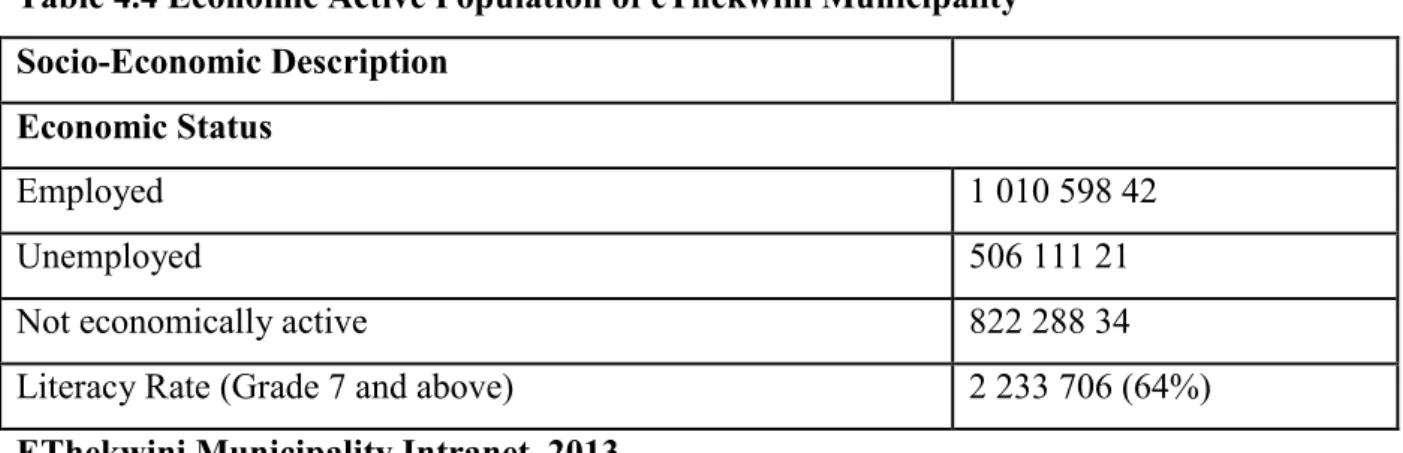
4.4 Economic Active Population 35
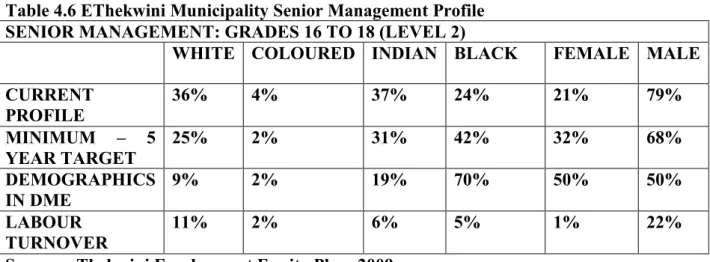
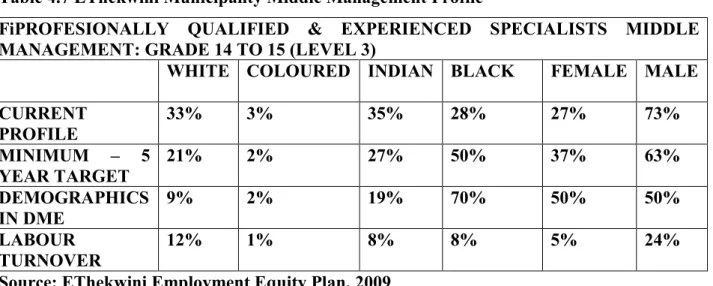
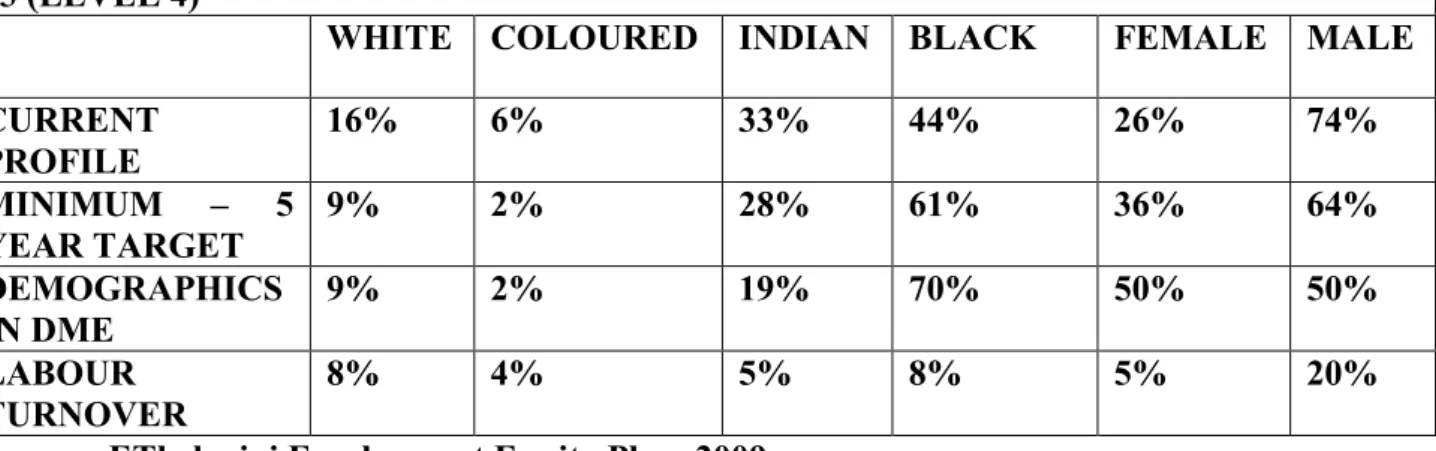
4.5 eThekwini Municipality Top Management Profile 36 4.6 eThekwini Municipality Senior Management Profile 37 4.7 eThekwini Municipality Middle Management Profile 38 4.8 eThekwini Municipality Junior Management Profile 39
4.9 eThekwini Municipality Supervisory Profile 40
4.10 eThekwini Municipality Unskilled Employees Profile 41
4.11 Top Management Grades 19 to 25 (Level 1) 56
4.12 Senior Management Grades 16 to 18 (Level 2) 56 4.13 Middle Management Grades 14 to 17 (Level 3) 56 4.14 Junior Management Grades 09 to 13 (Level 4) 57
4.15 General Skilled Grade 04 to 08 57
4.16 Unskilled & Defined Decision Making 01 to 03 57
5.1 Employee Terminations 2009 69
5.2 Employee Terminations 2010 70
5.3 Employee Terminations 2011 70
5.4 Employee Terminations 2012 71
xiii
5.5 Employee Terminations 2013 71
5.6 Disciplinary Action 2009 72
5.7 Disciplinary Action 2010 73
5.8 Disciplinary Action 2011 73
5.9 Disciplinary Action 2012 73
5.10 Disciplinary Action 2013 73
1
CHAPTER ONE
INTRODUCTION TO THE RESEARCH
1.1 Introduction
With the advent of democracy in South Africa in 1994, the newly elected government adopted laws and policies that advocated for the prevention of and elimination of unfair employment discrimination against racial groups, women and people with disabilities (Section 6, Employment Equity Act of 1998). A number of statutes were passed post 1994 aimed at improving the conditions of the previously, historically disadvantaged. The statutes included the Labour Relations Act of 1995, the Basic Conditions of Employment Act of 1997 and the Employment Equity Act No 55 of 1998 (EE).
These pieces of legislation were founded on the basis of the Republic of South African Constitution, 1996. The South African Constitution aims to create a society that is founded on principles of equality, dignity and freedom. Section 9 of the constitution protects the right to equality and enshrines the constitutional guarantee that the law will protect and benefit people equally and prohibit unfair discrimination.
The Employment Equity Act (Sections 20 and 21) prescribes that all designated employers must develop and submit Employment Equity Plans to the Department of Labour in order to ensure that unfair discrimination is eliminated in the workplace and affirmative action measures are taken to provide employment opportunities to the people from the designated groups.
1.2 Background of the Research
The local government sector is one of the sectors affected by workplace discrimination. This is because during the apartheid era, all sectors of governance were controlled politically and promoted discrimination in the workplace and other areas. The effects of workplace discrimination were clearly visible in top management and senior management positions as they were occupied mostly by white males.
2
EThekwini municipality had its fair percentage of workplace discrimination as it was governed by the same political party that promoted inequality and discrimination.
Noting the above, it was therefore imperative that eThekwini municipality developed and implemented an Employment Equity Strategy to undo the past imbalance and ensure that employee profile was in line with the demographics of the eThekwini area and the country. It was necessary/mandatory for organisations to increase equity efforts in the Post-Apartheid South Africa (EEA).
1.3 Research Objectives
The study was to critically analyse and evaluate eThekwini Municipality’s Employment Equity Plan against legislated employment equity practices in order to:
1. Establish if the eThekwini Municipality’s Employment Equity Plan was in line with the EEA No. 55 of 1998.
2. Ascertain if the implementation of the Employment Equity Plan was bearing the expected results in all job levels within eThekwini workforce.
3. Establish if eThekwini Municipality Employment Equity Plan have programmes to address the workforce imbalances and bring about workforce equity.
1.4 Motivation for the Research
The research was to investigate the impact that the Employment Equity Act has had on the municipal sector, specifically, eThekwini municipality. The research may unpack the situation within eThekwini municipality. It may provide an opportunity to learn about the transformation process in the municipal sector. The research findings would be shared with the employer so as to encourage healthy engagement on transformation issues and hopefully contribute to the overall transformation of the eThekwini municipality.
3 1.5 Problem Statement
In view of the legislation requiring compliance with the Employment Equity Act No 55 of 1998. This research was conducted in order to ascertain the extent to which the eThekwini municipality has been implementing employment equity.
1.6 Value of Study
The study would serve as a working document for decision making by eThekwini municipality with regards to its future recruitment in order to ensure Employment Equity. It would enable eThekwini municipality to provide its employees with equal and fair opportunities within the ambit of Employment Equity Act. It would help bridge the gap between eThekwini municipality’s targeted and actual figures with regards to its Employment Equity Strategy, if needed.
1.7 Research Methodology
The study adopted a qualitative research methodology. The research is an evaluative case study. The research focused strictly on eThekwini municipality as an employer, evaluating its Employment Equity Plan. The research analysed various documents relevant to the study.
The secondary data analysed in the study was obtained from official eThekwini municipality sources.
1.8 Data Analysis
The first step in this exploratory study was data mining, search for primary data. Secondary data for studies made by other researchers on eThekwini was obtained and analysed. It took the form of historical data and reports from prior research studies. Conclusions and recommendations were made based on the findings.
1.9 Limitations of the Study
The research is limited to eThekwini municipality. The study took into account five years of historical Employment Equity data (2009-2013) within the municipality. This limited period may not be sufficient therefore not conclusive in measuring whether eThekwini municipality was meeting its Employment Equity targets. The data may have been limited but it was a
4
reliable base for forecasting future employment equity trends, on which the author’s recommendations were based. The study explored a diverse and controversial topic that warranted that the information be obtained from reliable sources within eThekwini municipality. All data used was reliable as it was obtained from reliable official sources.
1.10 Structure of the Research
Chapter 2 would review literature relevant to employment equity. Literature review focused on equity reports submitted to the department of labour by the eThekwini municipality, academic literature, books and journals reviewed. The discussion contained a discussion on the EEA and its affirmative action policies. The research methodology utilised in the study was discussed in detail. The discussion entailed information on type of research, the actual design. It clarified and explained the reliability and validity of the study, and justified the choice of the research methodology. Chapter 4 of the study presented eThekwini municipality employment equity strategy. The following Chapter 5 conducted an analysis and evaluation of the eThekwini employment equity strategy to ascertain if it is in line with the EEA and if it was meeting set targets. The last chapter 6 of the research provided recommendations and conclusions.
1.11 Conclusion
Chapter 1 provided a summary of the research itself highlighting the motivation, objectives right up to the structure and limitations of the research. The next chapter 2 focuses on the literature review.
5
CHAPTER TWO
LITERATURE REVIEW
2.1 Introduction
The Employment Equity Act (EEA) No. 55 of 1998 was passed by parliament in 1999 in order to deal with the disparities in the South African labour market that had been created by the apartheid system of government. The EEA aimed to achieve employment equity by eliminating unfair discrimination, and implement affirmative action measures in order to redress past imbalances that existed in employment, present equal employment opportunity to designated groups, in order to transform the South African Workforce and ensure equity in all occupational categories and levels.
According to Albert and Jali (2013) the eThekwini municipality faced a high unemployment rate of 20.6%. This has not dropped below 20% during the last 15 years but it was 1.2%
lower than the figure released on 2010 statistics as indicated on the above paragraph. A large portion of unemployed people (56%) in eThekwini had been unemployed for a year or more.
A high percentage (80%) of the unemployed in eThekwini was youth (aged 15 to 35 years old). This was higher than the national proportions (Albert, Forrest and O’Leary, 2013).
According to Heaton (2012) the South African Statistics report for 2012 revealed that the KwaZulu-Natal Population is constituted of Blacks (85.2%), Indians (8.3%), Whites (5%), and Coloureds (1.5%). It further indicated that people with disability are 4.6 % in total, male are 4.6%, and female 5%. The eThekwini Municipality Integrated Development Plan (IDP) 2009/2010 revealed that eThekwini population comprise of Blacks (68%), Indians (20%), Whites (9%) and Coloureds (3%). It further indicated that the working age group constitutes 68% of the eThekwini population; eThekwini contributes 53.4% of the provincial employment percentage.
This chapter is a review of literature relevant to Employment Equity. Affirmative Action is dealt with extensively. This chapter presents and defines relevant terms and highlights challenges in the implementation of the provisions of the act.
6
2.2 Background to Employment Equity in South Africa
The South African labour market was beset with inequality in terms of access to education, skills levels and access to managerial and professional positions. Labour practices were based on race and ethnicity instead of talent, creativity and endeavour (Sookul, 2003).
According to Beinart and Dubow (2013) the introduction of the 1911 Mines Work Act saw the beginning of legislation which was designed to divide people. They further argued that segregation was more than panoply of restrictive legislation. They saw segregation as an ideology and a set of practices seeking to legitimise social differences and economic inequality in every aspect of life. They noted that segregation laws excluded Blacks from skilled work and especially from the exercise of supervisory functions over whites.
According to Durrheim (2010:31) apartheid policies in South Africa put a system of race- based exploitation and marginalisation into operation, according to which ‘black’ (Africans, Indians, Coloureds) people were provided with segregated, inferior and inadequate education and healthcare. Blacks were barred from certain categories of employment, as well as from accessing recourses such as land, housing and finance. He further stated that the policies of apartheid, and colonialism before them, laid the framework for an extensive system of affirmative action for whites, which left in its wake widespread race-based poverty, exclusion and inequality.
Coovadia, Jewkes, Barron, Sanders, and McIntyre (2009) stated that South Africa is a country of political resistance; after 82 years, the organised multiracial struggle against unjust rule by apartheid government finally won democracy in 1994, along with a constitution that established the foundation for democratic institutions and legislation such as the Labour Relations Act, Employment Equity Act (EEA) that seek to uphold wide-ranging human rights.
2.2.1 Discrimination
Desseler (2013) defined discrimination to mean taking specific actions toward or against the person based on the person’s group. Ehrenberg and Smith (2009) stated that labour market discrimination was said to exist when individual workers who have identical productive
7
characteristics were treated differently because of the demographic groups to which they belong.
According to Venter (2011), the international labour organisation (ILO) fact sheet pointed out that the new forms of discrimination had emerged. He further indicated that the additional forms of discrimination were based on lifestyle and health status. Other types of discrimination took the form of social isolation, violence and verbal harassment and abuse (Venter, 2011). According to Grogan (2011), there are two types of discrimination in the work place. He named them as direct and indirect discrimination.
Grogan (2011) explained that direct discrimination occurs when adverse action is taken against people precisely because they possess one of the characteristics. He then explained that indirect discrimination occurs when seemingly objective or neutral barriers are placed before people which exclude members of particular groups merely because they happen to be members of those groups. Section 6(2) of the EEA states that it is not unfair discrimination to take affirmative action measures consistent with the purpose of this act or distinguish, exclude or prefer any person on the basis of the inherent requirements of a job.
Venter (2011) stated that unfair discrimination occurs in any employment policy or practice on one or more grounds including race, gender, colour, sexual orientation, age, disability, religion, HIV status, conscience, belief, political opinion, culture, language, and birth. Kopel (2009) stated that the Amended Code of Good Practice on the handling of Sexual Harassment Cases in the workplace considers sexual harassment as a form unfair discrimination.
2.2.2 Equity
The concept of equity is well entrenched in international law. Lauren argued that Universal Declaration of Human Rights stated that the recognition of the inherent dignity and of the equal and inalienable rights of all members of the human family is the foundation of freedom, justice and peace in the world (Lauren, 2011).
Falk et al (1993:2) stated that “Equity derives from a concept of social justice. It represents a belief that there are some things which people should have, that there are basic needs that should be fulfilled, that burdens and rewards should not be spread too divergently across the
8
community, and that policy should be directed with impartiality, fairness and justice towards these ends”.
According to Burger and Jafta (2010) equality can involve a formal notion of treating everyone who is in a similar position the same. They argued further that equity invokes the requirement of ‘fair’ treatment in order to achieve substantive equality as an outcome in the workplace, equal treatment and equal opportunity, like equality, subjects everyone to the same rules without distinction.
Schumidt and Block (2010) explained that there was a difference between equity and equality. They argued that equality suggested that everyone should be treated the same and equity recognised that certain groups have unearned power and privilege that needed to be mitigated to ensure fair participation.
According to Rossouw (2010), Equality means that everyone is everyone is equal before the law and has the right to equal protection and benefit of the law. He further argued that equality includes the full and equal enjoyment of all rights and freedoms. Rossouw further stated that to promote the achievement of equality, legislative and other measures designed to protect or advance persons or categories of persons disadvantaged by unfair discrimination may be taken.
2.3 The Employment Equity Act
Grogan (2011:8) stated that the preamble of EEA reads as “Recognising that as result of apartheid and other discriminatory laws and practices, there are disparities in employment, occupation and income within the national labour market; and that those disparities create such pronounced disadvantages for certain categories of people that they cannot be addressed simply by replacing discriminatory laws”.
According to Bendix (2011), the Employment Equity Act formed third major legislative innovation in labour law. The Presidential Labour Market Commission was established upon an Act passed by Parliament on September 14, 1995, with terms of reference which included, inter alia, the proposal of mechanisms to redress discrimination in the labour market, the commission recommended the promulgation of the Employment Equity Act (Burger and
9
Jafta, 2010). The construct of EEA was based on Canadian legislation, though it borrowed from other legislation (Bendix, 2010).
According to Swanepoel (2012), employees of the South African Defence Force (SANDF), National Intelligence (NIA) and South African Secrete Services are excluded from the provisions of the EEA.
Bendix (2010) stated that the main objective of the Act was the elimination of discrimination in the workplace and promotion of affirmative action. Grogan (2011) stated that the Act was designed to contribute in the transformation of the labour market by ensuring that employers promote the constitutional right of equality and the exercise of true democracy, eliminate unfair discrimination in employment, ensure the implementation of employment equity to redress the effects of discrimination, achieve a diverse workforce broadly representative of our people, Promote economic development and efficiency in the workplace, and give effect to the obligations of the Republic as a member of the Institutional Labour. Thus achieving these objectives meant confronting a 1egacy of unequal education, job reservation, racism and discrimination in the workp1ace (Nel, 2012).
Grogan (2011) stated that one of the goals of Employment Equity Act is to ensure that the nation’s working population reflects the demographics of the South African population as a whole. Finnemore (2009) argued that the Employment Equity Act would add to the enhancement of a diverse and productive workforce. According to Desseler (2013), diverse workforce referred to workforce comprised of two or more groups of employees with various racial, ethnic, gender, cultural, national origin, handicap, age, and religious background.
Finnemore (2009) stated that the Employment Equity Act further entrenched the constitutional rights to protection against unfair discrimination, the promotion of affirmative action, and to fair labour practice. The EEA through affirmative action provided a platform for suitable qualified candidates from designated groups to compete for relevant positions they are qualified (Bendix, 2010).
According to Bendix (2010) designated groups refers to Blacks, Females, and people with Disability. She further explained that in terms of the Act, 'Black people' is a generic term, which means Africans, Coloureds and Indians. Bendix (2010) continued explaining further
10
that 'People with disabilities' is defined as people who have a long-term or recurring physical or mental impairment, which substantially limits their prospects of entry into, or advancement in, employment. Kopel (2009) stated that the definition of designated groups has been limited to natural persons who are citizens of South Africa by birth, descent or by naturalisation.
Kopel continued to explain that the effect is that foreigners, who otherwise fit the definition of belonging to designated groups, will not count towards a designated employer’s numbers for the purposes of employment equity.
According to Kopel (2009), the Pretoria High Court held that South African Chinese people fall within the definition of ‘Black People’ for the purposes of the Employment Equity Act and Broad-based Black Economic Empowerment Act. He explained further that designated employers have to consider South African Chinese for future employment as they officially fall under the designated employees’ category.
Venter (2011) stated that Section 13 of the EEA describes a designated employer as someone that employs 50 or more employees, a person employs fewer than 50 employees but who has an annual turn-over greater than the level defined in schedule 4 of the EEA. He further stated that the definition excludes the National Defence Force, the National Intelligence Agency, the South African Secret Services and an employer bound by collective agreement in terms of section 23 or 31 of the Labour Relations Act.
2.4 Affirmative Action
According to Van der Westhuizen and Wessels (2011) the concept of Affirmative Action was first used in the United States of America in the Wagner Act of 1935. Erasmus (2010) stated that Affirmative Action (AA) is the protection and advancement of the interest of persons disadvantaged by the past unfair discrimination, further explained that affirmative action is a labour market policy aimed at redressing past imbalances that are a direct result of discrimination. Affirmative Action policies aimed to achieve a diverse workforce broadly representative of the population in all occupational categories and levels through the appointment of suitably qualified people from the disadvantaged groups (Finnemore, 2009).
Bendix (2010) argued that problems surrounding affirmative action emanate from the manner in which affirmative action was being implemented. She believed that companies had merely
11
enforced affirmative action because it is a 'political imperative'. She further argued that some organisations failed to see Affirmative Action as a business objective, which needed to be sustainable within the framework of the organisation objectives in total.
Pojman (2010) stated that there are two types of affirmative action, weak affirmative action which seeks to provide fair opportunity to all citizens and strong affirmative action which enjoined preferential treatment to groups who had been underrepresented in social positions, concluded that while weak affirmative action is morally required, strong affirmative action is morally wrong.
Muriel, Camit and Lise (2013) argued that affirmative action helped organisations to transform. They further argued that affirmative action did not take away opportunities from those who are not part of designated groups. They acknowledged that in some sectors of society Affirmative Action is seen to be taking opportunities away from those who are not considered part of the designated group by the EEA. They insisted that if employers chose the best candidate from a pool of applicants, affirmative action could boost the talent and improve workforce demographics.
Muttarak (2013) noted that in Northern Ireland, affirmative action was put into statute with the introduction of the Fair Employment Act of 1989 and came into operation on 1 January 1990, became an important feature of employment from the 1980s and has been a key building block of the Peace Process.
2.5 Challenges of Employment Equity and Affirmative Action
Herring and Henderson (2012) stated that affirmative action has been under sustained assault for more than a decade. They further stated that it had been questioned in courts, legislatures, and the media, opponents have condemned it as an unprincipled program of racial and gender preferences that threatens fundamental American values of fairness, equality, and democratic opportunity.
According to Durrheim (2010), the Employment Equity Act and Affirmative Action have attracted a lot of attention. He stated that a number of commentators including political parties such as the Democratic Alliance (DA) and the Freedom Front Plus (FF+), as well as
12
labour organisations such as Solidarity have voiced strong opposition to affirmative action and other similar policies, arguing that they constitute a form of reverse discrimination against whites, lead to inefficiency and a drop in standards and re-racialise South African society. Van der Westhuizen and Wessels (2011) argued that affirmative action was not discrimination in reverse. They further stated that it was not appropriate to apply the same requirements of neutrality, applicable in the domain of antidiscrimination regulation, to affirmative action.
Hinks (2010) argued in his study on “job satisfaction” that race related arguments in the South African labour market were complicated by affirmative action. Hinks noted that implementation of affirmative action reasonably diminished job satisfaction of whites. By job satisfaction he referred to job earnings, job security, and work environment in general. The study also discovered that coloured workers were not too happy with employment equity and affirmative action as they indicated that not all groups that should be benefiting from post- Apartheid legislation are doing so.
Grobler and Warnich (2006) raised their concern about the women and people with disability in particular. They believe that women had done considerably less well than their male counterparts in obtaining promotion to higher levels of employment. They also highlighted that employment of people with disabilities had been especially low. They are not criticising employment equity as a concept. Their concern is more specific to the lack of women and persons with disability in higher positions.
In another separate case involving the Western Cape it was clear that employers are battling to find the right skill and experience to consider for senior management positions. According to the news-paper report Sapa (April 17 2013 18:21), Premier Helen Zille stated that the Western Cape has a small pool of qualified people to consider for senior management positions, regardless of race,. She told reporters in Cape Town only 10% of the Province's economically active population had a three-year-degree, one of the requirements of a senior management position.
13
2.5.1 Research on the Implementation and Impact of Employment Equity
Department of Labour commissioned a study on the implementation of employment equity in 2008. The research conducted at University of the Witwatersrand, Sociology of Work Unit by Bischoff, Buhlungu and Lewins. The study titled ‘Tracking progress on the implementation and impact of the Employment Equity Act since its inception’ some of the findings are presented.
According to Bezuidenhout, Bischoff, Buhlungu and Lewins (2008), the study find that in the majority of the workplaces disability was unfortunately overlooked as an issue in employment equity. In addition when recruitment takes place for a position to be filled by a person with a disability, it was reported that no applications were received from disabled applicants. In many of the workplaces visited it was reported that they had never been visited by a representative of the Department of Labour in the form of an inspector. The respondents indicated unanimously that they had never received any help from the Department of Labour on their EEA2 forms. Another respondent raised her opinion by saying that her idea of the Employment Equity reports and the Department of Labour is that it is a “black hole within which EEA2’s disappear into.
Furthermore, the respondent questioned how the Department of Labour monitors and engages with what is submitted to them in a meaningful way, as companies devote resources and time to these reports.
Bezuidenhout et al (2008) continued stating that another problem encountered lies in the Employment Equity Registry itself, often the EE Registry could not find all the EE Reports for the workplaces of the same company and there were gaps in the information over the years.
Added to the woes of the Commission of Employment Equity Registry, it is widely believed that a large number of employers simply do not submit their reports. In 2005, it was reported that twenty five municipalities (for example the metropolitan councils like Tshwane and Johannesburg), thirteen provincial government departments, nine national government departments, the South African parliament and the director of public prosecutions failed to submit their reports to the Department of Labour that year (Bezuidenhout et al., 2008).
Trade Union Solidarity brought a case of affirmative action on behalf of 10 Coloureds employees to Judge Hilary Rabkin-Naicker in Cape Town Labour Court on 24 April 2013.
The union claimed that the department is pursuing a "blatant policy of absolute racial
14
representation" when it comes to appointing job applicants to positions. Protesters held up posters with the messages "Employment Equity is Racism", "Staan Saam Bruin Mense"
(Stand together, brown people), and "Job Reservation is Apartheid". Many of the protesters wore orange, sleeveless safety vests, of the type worn by construction workers. Written on the front were the words "Post 94, Not Black Enough", and on the back, "Pre 94, Not White Enough". It claims this is "unfair, irrational and unlawful". The union said that in all cases
"the persons concerned had been identified as the best candidates for the positions they had applied for, and their skin colour was the only reason why they were not appointed" (Sapa, Jul 29 2013 15:41).
Sapa (2013) continued stating that the Public service regulations required a university degree and five years of relevant management experience. According to statistics compiled by Zille's department, 6% of whites, 2.1% of coloureds, 1.7% of blacks and 0.3% of Indians in the province had at least a three-year-degree (Sapa, 2013). According to Sapa (2013) Zille had indicated that the figures above would be even narrower if one included the relevant experience, which many young graduates did not have. The racial representation of the 75 senior managers in the 80 000 strong government workforce was therefore a moot point. The challenge also lay in hiring professionally qualified specialists. "These skills, and the necessary experience to work effectively at high levels of government, take years to develop.
That is why the Constitution and the law make the skills pool a key criterion, and that is why employment equity plans need to focus on building the requisite skills pools." A recent media report attacked Zille over Employment Equity (EE) figures for senior management positions that were released in Parliament.
2.6 Implementation of Employment Equity
Nel and Holtzhausen (2008) stated that there five steps involved in the implementation of employment equity. The steps include consulting with employees, conducting an analysis, preparing an employment equity plan, and reporting to Director-General of the Department of Labour on annual achievements and progress made.
Venter and Levy (2009) stated that the decision making level of senior management must be informed of the requirements of the legislation. The managing director should assume responsibility for the process and for the development of the employment equity plan. They
15
further stated that policies should also be developed to prohibit unfair discrimination. It was necessary to establish equity committee and it must be inclusive of labour or employee representatives.
Venter and Levy further stated that the employee committee must be trained as required by the Act. It was imperative that management consult with the employee’s structure regarding the design and outcomes of the analysis and the audit. It was critical that the employee committee should be informed what barriers to employment for designated groups have been identified by management. The employee committee should also be informed of management proposed plans to address such barriers.
Venter and levy (2009) further explained that management structure should determine numerical target to achieve employment equity, and decide on time frames to achieve their objectives. It was of critical importance that management appoint equity manager and assign responsibility for the management of the Employment Equity Plan. Management is expected to complete the employment equity plan on forms prescribed by the department of labour, the form must be submitted to the department and the copy be kept where accessible to any employee.
2.6.1 Monitoring and Enforcement
According to Bezuidenhout et al., (2008), the EEA developed 7 various Codes of Good Practice. The purpose of the Codes is to serve as a guide to employers, employees and trade unions to understand and implement the key principles of the EEA on the employment of people across the designated groups. These codes included ‘the Preparation, Implementation and Monitoring of Employment Equity Plans, the Key aspects of HIV and AIDS and Employment, the Employment of People with Disabilities, the Integration of Employment Equity into Human Resource Policies and Practices, the Code of Good Practice for the Basic Conditions of Employment and Pregnancy, the Code of Good Practice on the Handling of Sexual Harassment Cases, and the Code of Good Practice on the Arrangement of working time’.
16
According to Swanepoel, Erasmus and Schenk (2008), the general monitoring of an employer’s conformance with the EEA is left primarily to employees, shop-stewards, trade unions, workplace forums, labour inspectors, and the Director General of Labour.
2.6.2 Commission for Employment Equity
The functions of the Commission for Employment Equity include to advice organisations on codes of good practice, regulations and policy matters, to conduct research and report to the Minister on any matter related to the Employment Equity Act (Bendix, 2010).
2.7 Implementation of Affirmative Action Measures
Venter and Levy (2009) stated that employers needed to implement affirmative measures.
They continued stating that these measures include making reasonable accommodation for people from designated groups, measures to ensure that equitable representation of suitable qualified people from designated groups in all occupational levels in the workforce, and measures to retain and develop people from designated groups and to implement appropriate training measures.
According to Bezuidenhout et al. (2008:4), inequity in the labour market under colonialism and apartheid was a result of policy interventions in all these policy realms. In order to make this legacy thus requires a range of concerted policy interventions that are sensitive to the interplay between the role and functions of various government departments, the private sector and civil society formations.
2.7.1 Disability Management
It is imperative when implementing affirmative action to consider policies and programs set to deal specifically with job seekers and employees with special needs. Employers are expected in terms of the constitution and EEA to address the issue of people with disabilities.
Grobler et al., (2006) indicated that the definition of designated groups by EEA included people with disabilities. According to World Health Organisation (WHO) ‘disabilities’ is an umbrella term, covering impairments, activity limitations, and participation restrictions.
WHO further explained that impairment is a problem in body function or structure; an activity limitation is a difficulty encountered by an individual in executing a task or action;
17
while a participation restriction is a problem experienced by an individual in involvement in life situations.
Disability is thus not just a health problem, it is a complex phenomenon, reflecting the interaction between features of a person’s body and features of the society in which he or she lives, and overcoming the difficulties faced by people with disabilities requires interventions to remove environmental and social barriers (WHO).
Employers must take reasonable measures to accommodate people from designated groups, these measures included providing an enabling environment for workers with disabilities so that they may participate fully and, in so doing, improve productivity (Grobler et al., 2006).
2.7.2 Training and Development
According to Buger and Jafta (2010), the human resource development category weighs 30%
in the scorecard and consists of a skills development and an employment equity component, The Department of Trade and Industry’s balanced scorecard counts the percentage of black people in the organisation's total work force and allocates 15% to this factor.
Venter (2004) explained that the government introduced the skills Development Act 97 of 1998. He further argued that the Act created an institutional framework to advise national, sectoral, and workplace strategies to develop skills of the workforce, this Act was closely related to the Employment Equity Act, The Act aims to increase levels of investment in education and training the labour market.
Jones and George (2008), referred to classroom training and on-the-job training. They further stated that training and development help to ensure that organisational members have the knowledge and skills needed to perform jobs effectively, take on new responsibilities, and adapt to changing environment.
Nel et al (2009) argued that training is important for employers, employees and trade unions.
They continued arguing that effective training leads to more productive workers and greater personal satisfaction, job enrichment, and a feeling among employees that the organisation is interested in their advancement. Grobler and Warnich, (2006), stated that the effectiveness of
18
an organisation depends on the effectiveness of its employees. The main aim of training in the workplace is the improvement of Employees skills, knowledge and attitude so that they can perform their duties according to standard (Swanepoel, et al. 2008).
Another development approach is mentoring (Jones et al. 2008). They further argued that having a mentor can help managers seek out work experiences and assignments that will contribute to their development and can enable them to gain the most possible from varied work experiences. Werner, Bagraim, Cunningham, Pieterse-Landman, Pogieter and Viedge (2011:42), defined mentoring as a process through which an experienced person exposes a less experienced person to learning opportunities in the organisation. They continued explaining that can be a formal or informal process, but it gives a valuable opportunity to monitoring and influences the personal experiences of the protégé (Mentor). Formal mentoring programmes ensure that mentoring takes place in an organisation, structure the process, and make sure that diverse organisational members have equal access to mentors (Jones and George, 2008:492).
Gorrel and Hoover, (2009) stated that coaching is about identifying high potential leaders inside organisations and engages them with skilled coaches early on, they developed a coaching model called Contextual Coaching model. They further stated that contextual model coaching produces simultaneous growth and development opportunities for the organisations and the executives.
2.7.3 Talent Management
Talent management is an integral aspect of employment equity and affirmative action. Talent management is introduced in this study as one of the policies that could be adopted by organisations to address shortages of members of designated in key organisational positions.
Talent management is an important topic that has just attracted attention. Many organisations have talent management related programmes and use talent management systems but the problem lies in the definition. Collings and Mellahi (2009:1) defined “strategic talent management are activities and processes that involved the systematic identification of key positions which differentially contributed to the organisation's sustainable competitive advantage”. Talent management involves development of a talent pool of high potential and
19
high performing incumbents to fill key roles in organisations. Collings and Mellahi further stated that Talent Management involves the development of differentiated human resource architecture to facilitate filling of positions with competent incumbents and to ensure their continued commitment to the organisation.
In order for strategic or pivotal jobs to have a differential impact on organisational performance, it is important that such jobs are filled with high performing or high potential employees (Collings and Mellahi, 2009). When planning organisations needed to consider contingency plans appropriate to their needs, talent management could be that contingency plan (Tansley, Kirk and Tietze, 2013).
2.8 The Commission for Employment Equity (CEE) Report 2012 - 2013
The report reflected on the status of employment equity in South Africa covering the period from 1 April 2012 to 31 March 2013, it was submitted to the Minister by the Commission for Employment Equity (CEE) in terms of Section 33.
It was critical to note that there was still a great need for employment equity in South Africa, the challenge lies in the approach, the spirit of the EE Act ought to be brought back, the
“designated group” members who are now in senior management and top management have yet to flex their muscle, their impact is not showing in terms of the trends (CEE, 2012 – 2013).
CCE (2012 – 2013), noted that the percentage of African people in top management declined between 2010 and 2012; between 2002 and 2012 the progress have been staggered and at one point (2008) the percentage representation of Whites in top management went up; whilst that of Africans and Coloureds went down.
The time-series data pointed to a steady and positive increase in the percentage of “foreign nationals” and Indians at the top management and senior management levels, the biggest employer in terms of the representation of Indians at top and senior management has been the government, including parastatals (CEE, 2012 – 2013).
20
The “movement statistics” showed no evidence of an effort to train more designated groups.
The employment space in South Africa is also characterised by gender discrimination, it was evident from the Report that at all levels of management, male outnumbered female, it seem that employers have not shifted from the old behaviour in terms of recruitment; skills development and promotion (CEE, 2012 – 2013).
The analyses revealed a major transformational challenge among “Educational Institutions”
as a sector; they tend to have an over-representation of White females and White males at their top management and senior management echelons. They indicated that in 2012, on aggregate more White males and females were recruited; skilled and promoted into Senior and top management than any other group (CEE, 2012 – 2013).
Large employers accounted for 21.9% (4 831) and small employers accounted for 78.1% (17 181) of reports analysed in 2012. The workforce of large employers amounted to 5 299 134 (86.1%) employees and the workforce for small employers amounted to 854 200 (13.9%) employees of a total workforce of 6 153 334 (100%). It can be noticed that although large employers on the one hand accounted for nearly a quarter of the reports analysed. They accounted for most of the employees. On the other hand, small employers accounted for nearly three-quarters of the reports received, but accounted for far less than a quarter of the workers accounted. This appears to be a growing trend that is positively influenced by the demands made by the BBBEE Act and its Codes forcing designated employers to comply (CEE, 2012 – 2013).
In 2010, the ILO adopted recommendations concerning HIV and AIDS and the world of work to guide member States on key principles to be taken into consideration when developing and implementing legislation, policies and programmes, South Africa has now reviewed its Code of Good Practice on Key Aspects of HIV/AIDS and Employment of 2000 and it’s Technical Assistance Guidelines (TAG) of 2003 in order to ensure alignment to the ILO Recommendations of 2010 (CEE, 2012 – 2013).
Indian males and females are comfortably in the lead in KwaZulu-Natal with respect to top management representation; where they constitute 16% and 4.5% respectively, African females do best in the top management echelons of Provincial Government where they constitute 30.2%, followed by Local Government (23.5%) as well as National Government
21
(23.5%), African males have their best bet in Local Government sector, where they constitute 48.3% of top management; followed by Provincial Government (45.1%); then parastatals at 42.8% (CEE, 2012 – 2013).
2.8.1 Recruitment and Promotion
According to CEE (2012 – 2013) a close analysis of the statistics for recruitment; promotion and skills development for 2012, for all employers reveals the following patterns:
At senior management level, the highest percentage of skills development goes to White males (47.7%); the highest recruitment into top management in 2012 was largely for White males (47.4%) (Versus Africans: 14.8%; Coloureds: 3.7%; and Indians: 5.6%). This practice was not in line with equity as more whites were trained and promoted to senior management positions.
The CEE report indicated that more white employees were either hired or promoted to management positions than any other race groups. This elevation into higher positions was closely related to the skills acquired from training as they were sent to training courses that equipped them with much needed skills. Promotional opportunities tend to increase for employees equipped with correct skills.
This report is important in that it indicates the extent to which employers continued to ignore EEA. The high percentage of white employees being recruited and trained for skills that will help them occupy high positions undermines the efforts to bring about equity in the workplace. Employers continue to ignore employees from designated groups. The low percentage of African employees and females recruited to senior position is testimony to the above argument. Employment equity will not be achieved in an environment where white employees are continuously recruited to senior position when they are already over represented.
2.8.2 CEE 2012 – 2013 Remarks
The commission noted that the legislation has not induced the serious transformation in the decision-making processes, the amendments that were under Parliamentary review for EE came at a better time, the proof will be on the enforcement as it was noticed that the current approach had not generated the necessary momentum or transformation, even as the country
22
approaches 20 years of post-apartheid democracy and after more than 10 years of EE legislation, with all its reports and requirements, the spirit and ethos of employment equity needed to be revived so that true fragmentation underpinned forward movement could be located and dealt with in an appropriate manner, the government needed to increase monitoring and enforcement (CEE, 2012 – 2013).
2.9 Assessment of Compliance with the EE Act
Section 42 of the EEA, sets out the following criteria, which must be taken into consideration by the Director-General of Labour in determining whether designated employers: are implementing employment equity in compliance with the Act, the extent to which suitably qualified people from designated groups are equitably represented in all occupational categories and levels in line with the demographic profile of the national and regional economically active population, the pool of suitably qualified people from the designated groups from which the employer may reasonably be expected to promote or appoint employees, the economic and financial factors relevant to the sector in which the employer operates, the present and anticipated economic and financial circumstances of the employer, and the number of present and planned vacancies that exist in the various categories and levels, analysing the labour turnover, track progress made in implementing employment equity by other designated employers operating in the same sector under comparable circumstances, the designated employer was making reasonable efforts to implement the employment equity plan, assess the extent to which the designated employer has made progress in eliminating employment barriers that adversely affect the designated groups, and any other factor prescribed by regulation.
According to Bendix (2010:189), the criteria for assessment of compliance include:
‘The extent to which the workforce reflects the demographic profile of the national and regional economically active population; the pool of suitable qualified people from designated groups available for employment; Economic and financial factors relevant to the sector. The employer’s present and anticipated financial circumstances; the employer’s labour turn-over; the number of present and planned vacancies that exist in the organization;
Progress made by other employers in comparable circumstances and in the same sector;
reasonable effects made by the employer himself or herself, and Progress towards the elimination of barriers adversely affecting the employment of designated groups’.
23 2.10 Conclusion
The discussion provided a historical background of the employment structure and policies existed prior to the promulgation of the Employment Equity Act post-apartheid period after 1994 national democratic election. The review looked at the available literature on equity and EEA. The study commissioned by the Department of Labour in 2008 to track the implementation of employment equity revealed that not much is being done by designated employers to implement affirmative action. The CEE (2012 – 2013) also noted that little progress has been made to transform the labour force in this country.
It was evident from the literature review that legislation existed and guidelines were made available to designated employers. It was noted that the government departments as well as parastatals were seen to be going the opposite direction of the EEA. This raised concerns as government as an employer is generally expected to champion the implementation of its own policies and legislations. The monitoring and enforcement aspects of the implementation EEA and affirmative action leaves a lot of unanswered questions about the seriousness of the state, the ministers and Departments of Labour and Justice, employers, employees and unions.
The next Chapter 3 discusses the research methodology instituted in the study.
24
CHAPTER THREE
RESEARCH METHODOLOGY
3.1 Introduction
This chapter discusses the research methodology utilised in this research and it provides insight into the research. It focuses on the aims and objectives of the study, discusses the research approach and other related matters. Research is defined as a systematic attempt to provide answers to questions. The research results may yield abstract and general answers, as basic research often do (Tuckman and Harper, 2012).
The nature and characteristics of the study did not include all elements of typical academic research such as the population, the sample and a questionnaire. This is because the design was one of data mining and the research dealt with the facts as they are stated on eThekwini municipality’s official documents and reports. The geographic area of the study was within eThekwini municipality boundaries as defined by Statistics South Africa’s 2007 report. Even though the study dealt with eThekwini Municipality employees as a population, it did not have a sample. The data collected was both quantitative and qualitative in nature.
3.2 The Aim and Objectives of the Study
The aim of the study was to critically analyse and evaluate eThekwini municipality's employment equity plan against legislated employment equity practices in order to:
1. Establish if the eThekwini Municipality’s Employment Equity Plan was in line with the EEA No. 55 of 1998.
2. Ascertain if the implementation of the Employment Equity Plan was bearing the expected results in all job levels within eThekwini workforce.
3. Establish if eThekwini Municipality Employment Equity Plan have programmes to address the workforce imbalances and bring about workforce equity.
25
To conduct the research, the study focused on the above objectives and relevant aspects of the Employment Equity Act and compliance with relevant, related issues such as affirmative action policies, talent management, skills development, disability policy, numeric targets amongst others as discussed in the literature review in chapter 2.
3.3 Participants and Location of the Study
The study reviewed and analysed eThekwini municipality documents, Employment Equity reports and literature. The location of the study was within the municipality.
3.4 Data Collection Strategies
The data used in the study was requested from eThekwini municipality’s employment equity office. It was provided in the form of annual reports submitted by the municipality to the Department of Labour and written documents containing facts about the municipality.
Various eThekwini municipality policy documents were also made available for the study.
The eThekwini municipal intranet and internet provided useful data. Other readily available academic literature and reports from credible sources such as Statistics South Africa were used in the study.
3.5 Research Design
It is imperative to note that any research or study intend to solve a puzzle or answer a question. The research question is the objective of the study, the uncertainty the research wants to resolve (Hulley, Cummings, Browner, Grady, Newman, 2013). Depending on the approach, answering the research question is done in different ways (Neuman, 2011).
According to Neuman (2011) there are two forms of research; they are quantitative and qualitative research. Denzin and Lincoln (2013) argue that some research warrants a combined approach of qualitative and quantitative methods as the cover a broad spectrum of issues.
According to Denzin and Lincoln (2013) social researchers mainly conduct research in order to evaluate a programme or process with the intention of establishing facts about effectiveness of such a programme or process. Neuman (2011) says that the research is conducted not only to establish the extent of the problem but also to find solutions.