This criticism is rooted in the traditional elite character of both the media and environmentalists. He searched for truths not in philosophy or history, but in the pages of the New York Times. When I decided on a research topic months later, I realized that I could both seek answers to my own ideological questions and test McDonald's claim through an examination of environmental issues in the South African media.
Hopefully this will help generate ideas for other students interested in conducting studies on environmental issues in the media. As interest in and impact of environmental challenges increases, diverse societies become immersed in the debate.
LITERATURE REVIEW
Environmental Discourses
The relatively recent controversy surrounding the North's influence on the South's media is examined in the third section. The transition to democratic governance has generally resulted in the open separation of the media from political powers. It is followed by a subsection which discusses research on media influences.
The nature of the media has influenced the way environmental issues are reported. Information about the backgrounds and ideology of the journalists themselves therefore contributes to understanding environmental awareness in the media. Boateng and Akosua's chapter in the aforementioned compilation is the most comprehensive in weighing the potential impact of the media.
The debate between environment and development is much more pronounced in the Indian media than in the UK media.
Role of the Media in Setting the Environmental Agenda
The media in Trinidad contrasts with that of Guinea, especially in the presence of formal debates about environmental policies. Gooch's (1996) study first points out the contrasting conclusions reached by different authors regarding the media's influence on public opinion. However, the research provides key insights into the role played by the media in shaping public opinion on environmental issues.
The results confirm the hypothesis that the issues represented in the media influence the public's concern for the environment. Another chapter in the collection uses Kenya as an example to detail the practical challenges facing the media in Africa. As with many other factors of society in South Africa, the role of the media has changed significantly in recent years.
The work begins with an overview of four perspectives on the role of the media in South Africa. Steenveld (2002) takes a slightly different approach by defining the media's role as strengthening citizenship. After his description of the different perspectives on transformation, Berger (1999) reviews the changes that have taken place in the media.
Arguments made by Tomaselli (1997) and Boloka and Krabill (2000) acknowledge that there have been changes in the racial profile of the media industry. Debates are predominantly theoretical and abstract because few studies have been conducted on whether or not the actual messages in the media have become more representative of the public. Barnett follows Gamson's line of inquiry by citing three questions that can explain the role of the media in supporting democratic participation.
The State of the Media
Framing the issue in the way activists would like, directly linking South Durban's industries to health problems, would jeopardize the newspaper's economic interests. In an interview in Going Green: People, Politics and the Environment in South Africa (Cock and Koch 1991), activist Chris Albertyn notes that his environmental awareness grew when he worked for Natal Witness in the late 1980s. The media began to pay more attention in the following years, as the same work also refers to press coverage of the mercury leak at Thor Chemical in 1989.
Although many environmental texts are mentioned in the media, studies regarding the amount and type of environmental coverage are few. Guy Berger, professor in the Department of Journalism and Media Studies at Rhodes University, raises a number of questions about environmental coverage in South Africa. Another key point raised in the study is that the role in which the newspaper sees itself affects the way the news is covered.
The shift in focus from traditional 'green' conservation issues to a 'brown' agenda which appeals to a wider range of South Africans parallels a shift in the media industry towards covering issues of importance to the general public. However, generalizations have been made which seem to successfully describe the popularization of environmental issues in the North. There is much less research and much less understanding about media attention to environmental issues in the South.
Environmental conditions and needs in these regions often differ markedly from those documented in the north. There are also differences in stories, levels of exposure and attitudes towards the media. Therefore, there is a need to assess media coverage of environmental issues in these societies on an individual basis in order to gain a better understanding of what and how the information is presented.
METHODOLOGY
Co TENT A ALYSIS
- Defining the 'Environment'
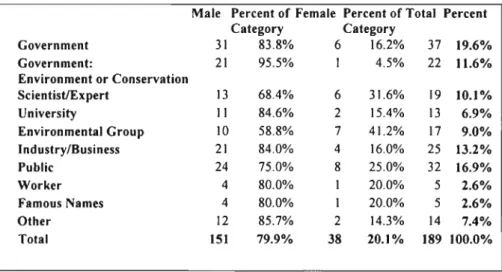
This research firstly provides a content analysis of the Natal Witness, documenting which environmental issues are covered and the sources of this information. Guedes' article defines environmental news as "any item that deals primarily with the environment and its physical degradation and the economic, political and social aspects of the environmental debate". A notable addition is the classification of the race and gender of the sources and actors depicted.
These are unique study criteria in an environmental context; none of the research included in the literature review was documented. Second, a discourse analysis was conducted to obtain a more detailed examination of the message of the articles. Classifying discourses is a challenging, subjective process, and the way categories are selected and delineated affects research results.
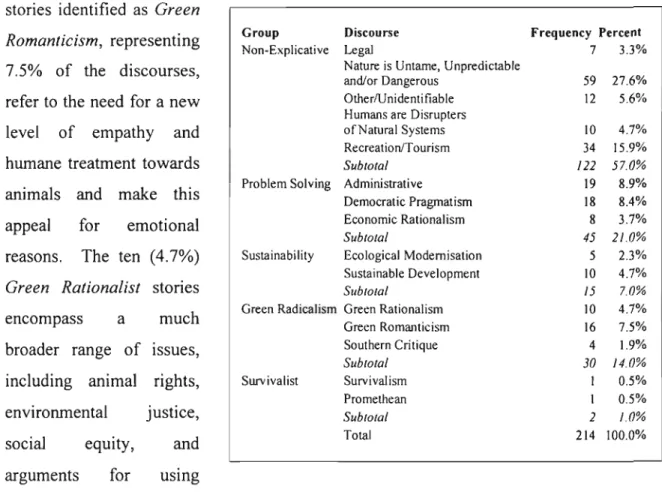
It is used to classify articles that implicitly advocate the protection of the environment for human enjoyment, emphasizing the "why" but not the "how." The next four categories are those described by Dryzek (1997), with the addition of Southern Critique discourse to the 'Radical Discourses' category. Other questions surrounded the journalist's opinion on the quantity and representativeness of environmental reporting.
This method was chosen to better understand the issues presented to a single audience. The purpose of this study is to document content, and the researcher was concerned that analyzing more than one article would result in a focus on the difference between content and discourse rather than the independent results of the analysis. While the researcher recognizes that this is a crucial part of the study of media, documenting text comprehension was beyond the scope of this project.
Agriculture: Includes stories referring to genetic engineering, chemical applications, organic farming, food and ornamental gardens, non-commercial tree plantings, ecosystem impacts of commercial agriculture and timber, and the impact of weather on crops; stories about other new technologies and the economic status of agriculture. Animals: Includes all wildlife stories as well as articles focusing on animal rights. Climate and Weather: Includes events such as famine and drought, as well as stories about other extremes of weather.
Stories about the impact of drought on crops were included, but stories focusing on other tangential effects such as road accidents caused by rain or food aid due to famine were not included. Disease: Stories about diseases caused by environmental conditions such as poor sanitation are included. However, for this analysis only articles dealing with ideas of land use and stewardship are included; those relating to land claims and equity are not unless they specifically refer to the degradation of the land.
Mining: Stories about new developments or accidents with explicit environmental consequences are included, but stories with an economic, political or other focus are not. Natural Disaster: Stories about deaths or injuries that are the direct result of a natural disaster are included, but stories emphasizing secondary effects are not. Nuclear Concerns: Stories about nuclear energy are included; stories about nuclear war, weapons or political intent are not included.
Protected Areas: Stories about the areas themselves are included, but stories focusing on specific recreational activities (hiking, recreational fishing) or crime on the property are not included. Poverty: Although often related to environmental conditions, stories about poverty that do not explicitly mention environmental degradation are not included. Water: Stories about water quality are included, as well as those about service. provisions that have an explicit connection to the environment.
COMPONENTB
It contributes to the understanding of the underlying messages and related ideologies of the articles. Together, these goals describe the picture of the environment as presented by the Witness. One of the fundamental controversies that remains in academic circles and practitioners in this field is the definition of media norms.
One of the NGO panelists who supported this perspective argued that the role of the NGO is to 'sell' itself to the media (EnviroMedia 2004). In Britain the emphasis has been on 'green' issues, while environmental problems also tend to occur in other parts of the world. Unfortunately, mainstream media coverage of the environment in South Africa is still dominated by conventional, green issues.
The audience of the Witness tends to be upper-middle class, as evidenced by White. Human disruptors of nature: description of the negative impacts humans have had on the environment. The majority of stories under this theme were located in the province and were rarely written as hard news.
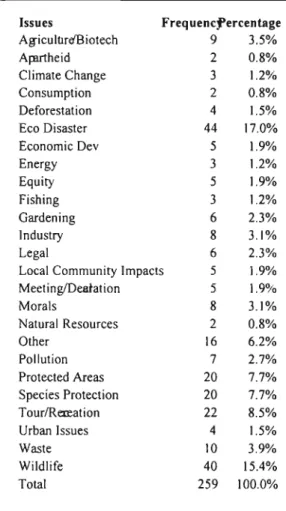
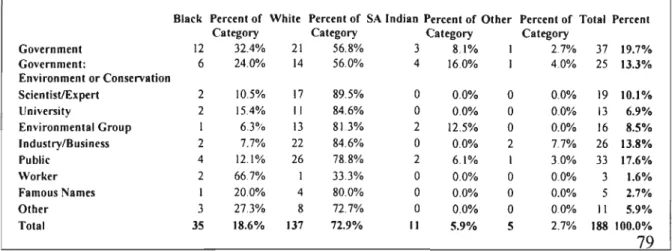
The most common theme in the stories listed is 'Ecological disaster', 15.9% of the total number of calculated themes. First, the majority of the 'Government: Environment and Conservation' sources and actors represent conservation concerns. It is recognized that the role of the newspaper is not always comprehensive, detailed texts.
But each of the other speeches proved to illustrate that the witness gives voice to a wide range of environmental ideologies. Medium for practitioners in the press, radio, film and television, advertising, public relations, media studies and diplomacy.