An evaluation of availability of traction power for tillage and its effects on food security of smallholder farmers’ households in KwaZulu-Natal, South Africa
Patience Refilwe Motokolo
Submitted in fulfilment of the academic requirements of the degree Master of Science in Agriculture (Agricultural Economics)
School of Agriculture, Earth and Environmental Sciences College of Agriculture, Engineering and Science
University of KwaZulu-Natal Pietermaritzburg
South Africa
2018
DEDICATION
I dedicate this thesis to my mother, partner, brothers and daughter.
DECLARATION 1: PLAGIARISM
I Patience Refilwe Motokolo, declare that;
1. The research reported in this thesis, except where otherwise indicated, is my own original research.
2. This thesis has not been submitted for any degree or examination at any other university.
3. This thesis does not comprise other persons’ data, pictures, graphs or other
information, unless specifically acknowledged as being obtained from those persons.
4. This thesis does not comprise other authors’ writing, unless specifically recognized as being sourced from other authors. Where other written sources have been quoted, then:
a) Their words have been re-written, but the general information accredited to them has been referenced; or
b) Where their words have been used, their writing has been placed inside quotation marks, and referenced.
5. This thesis does not comprise text, graphics or tables copied and pasted from the Internet, unless specifically recognized, and the source being detailed in the thesis and in the references section.
Signed ____________________ Date__________________________
As candidate’s main supervisor, I, M Mudhara, agree to submission of the thesis Signed_____________________ Date__________________________
As candidate’s co-supervisor, I, P Chaminuka, agree to submission of this thesis Signed_____________________ Date__________________________
DECLARATION 2: PUBLICATIONS
My role in each paper and presentation is indicated. The * indicates corresponding author.
Manuscript 1-Chapter 3
Motokolo, P.R*., M. Mudhara, and P. Chaminuka. 2017. Factors influencing farmers’ choice of traction power source for tillage in KwaZulu-Natal, South Africa (submitted for review:
Agrekon).
Manuscript 2 -Chapter 6
Motokolo, P.R*., M. Mudhara, and P. Chaminuka. 2016. The effect of traction power availability on food security in smallholder farmers’ households, KwaZulu-Natal, South Africa (submitted for review: Food Security Journal).
Motokolo, P.R*., M. Mudhara, and P. Chaminuka. The effect of traction power availability on food security in smallholder farmers’ households, KwaZulu-Natal, South Africa. Presented at the Agricultural Economics Association of South Africa (AEASA) Conference, Elangeni Hotel, Durban, South Africa, 19-21 September 2017. Presented by PR Motokolo.
_______________________________
Signed: Patience
Date: ____________________________
ABSTRACT
Agricultural input availability remains an impediment to poverty reduction and achievement of food security in Sub-Saharan African countries. Timely availability of traction power is important in crop production, yet its availability is limited among smallholder farmers due to capital constraints, location bias of government traction power programmes and relatively small landholding. The circumstances facing households influence their traction power choice. An understanding of the determinants of their choices and the effect of traction power availability on crop productivity as well as food security can allow policy makers to develop appropriate strategies and programmes to enhance the productivity of smallholder farmers.
This study aimed to contribute to the literature in two ways. The first objective of this study was to determine the factors influencing choice of alternative traction power source for tillage. Secondly, the study sought to evaluate the effect of traction power availability on maize productivity as well as household food security. The study focused on six villages from Okhahlamba Local Municipality, KwaZulu-Natal in South Africa. A Multistage probability sampling was used to select villages and households, whereby 207 households were surveyed. The study identified three main groups of tillage categories that smallholder farmers use, i.e., tractor, animal power, and a combination of the two sources. The multinomial regression results identified household characteristics significantly influencing the choice of traction power source for tillage.
The results from Cobb-Douglass production function and multinomial endogenous treatment effect model show that traction power availability affects maize productivity as well as food security. Using animal power and a combination of mechanical and animal power showed a positive effect on maize productivity as well as food security. The results suggest that the policies and programmes affecting traction power availability directly or indirectly through ownership, hire or government services should be improved as they affect crop productivity and food security. Also, there is need to enforce gender equity strategies in rural areas to ensure equal access to inputs and participation in government programmes. There is also a need to consider the introduction of tillage power suitable for the relatively small land sizes that smallholder farmers operate.
Key words: Smallholder farmers, Traction power source, Tillage, Food Security, Crop productivity, Multinomial endogenous treatment effect model.
LIST OF ACRONYMS
AP Animal Power
AIDS Acquired Immune Deficiency Syndrome ANOVA Analysis of Variance
CASP Comprehensive Agricultural Support Programme COSMEC Commonwealth Secretariat
DAFF Department of Agriculture, Forest and Fisheries DoA Department of Agriculture
FAO Food and Agricultural Organization FSG Farmer Support Group
GSA Grain South Africa
Ha Hectare
HIV Human Immunodeficiency Virus IIA Independence of Irrelevant Alternatives
Kg Kilogram
KZN KwaZulu-Natal
MNL Multinomial Logistic Regression Model
MP Mechanical Power
MPAP Mechanical and Animal Power OLS Ordinary Least Squares PRB Population Reference Bureau
SPSS Statistical Package for Social Science StatsSA Statistics South Africa
SACU Southern African Custom Union SSA Sub-Saharan Africa
US United States
USEAP Use Animal Power
USEMPAP Use Mechanical and Animal Power VIF Variance Inflator Factor
ACKNOWLEDGMENTS
First and foremost, I would like to thank the Almighty Jehovah, for his faithfulness and the blessings He has showered into my life. I never would have made it to where I am today without Him. I thank God for His endless love for me and my family.
Special thanks to the Agricultural Research Council for the financial support. I would also like to express my unsounded and genuine appreciation to my supervisors, Dr. M Mudhara and Dr. P. Chaminuka for their academic guidance, dedication and patience, which made it possible for me to complete this study.
To the Farmer Support Group, thank you for introducing me to the farmers in Okahlamba municipality, your assistance is much appreciated than you realize. Further thanks are extended to community members who participated in the study and the team members who assisted in administering the questionnaires.
I would also like to thank Unity, Gideon, Temitope, Njabulo and the rest of my colleagues in office 336 for their support.
I would like to appreciate my family for the great support and the encouragement that they have given me from the initiation of this project until the end. Special thanks go to my mother M.R Motokolo, my brothers T.L Motokolo, P.J Motokolo and my daughter M.T.J Motokolo, for their persistent support and sacrifices that made it possible for me to achieve my academic goals.
Lastly, but not least I would like to express my utmost gratitude to my partner George Peta, your endless support, love , encouragement and sacrifices carried me through this emotional journey of my life.
TABLE OF CONTENTS
Page
DEDICATION ... ii
DECLARATION 1: PLAGIARISM ... iii
DECLARATION 2: PUBLICATIONS ... iv
ABSTRACT… ... ………v
LIST OF ACRONYMS ... vi
ACKNOWLEDGMENTS ... vii
TABLE OF CONTENTS ... viii
LIST OF TABLES ... xi
LIST OF FIGURES ... xii
CHAPTER 1. INTRODUCTION ... 1
1.1 Background ... 1
1.2 Problem Statement ... 2
1.3 Study objectives ... 3
1.4 Organization of the study ... 4
CHAPTER 2. LITERATURE REVIEW ... 5
2.1 Introduction ... 5
2.2 Definition of concepts used in the study ... 5
2.2.1 Traction power sources ... 5
2.2.2 Tillage ... 6
2.2.3 Crop productivity ... 7
2.2.4 Food security ... 8
2.3 Linkage between agricultural productivity and food security in developing countries ... 9
2.4 Farmers’ perception of alternative traction power sources for tillage ... 10
2.5 Availability of tillage power in SSA ... 10
2.6 Transformation of the available traction power sources for tillage in SSA ... 12
2.7 Factors influencing the choice of alternative traction power source for tillage ... 14
2.8 The effect of tillage traction power availability on crop productivity as well as food security ... 19
2.9 Summary ... 21
CHAPTER 3. FACTORS INFLUENCING FARMERS’ CHOICE OF TRACTION POWER SOURCE FOR TILLAGE IN KWAZULU-NATAL, SOUTH AFRICA ... 22
3.1 Abstract ... 22
3.2 Introduction ... 22
3.3 Research methods ... 24
3.3.1 Study area ... 24
3.3.2 Data collection procedure ... 26
3.4 Conceptual framework ... 26
3.5 Econometric estimation –Multinomial logistic model (MNL) ... 27
3.6 Description of variables ... 28
3.7 Empirical results and discussion ... 31
3.7.1 Descriptive statistics ... 31
3.7.2 Factors influencing the choice of alternative traction power source for tillage ... 33
3.8 Conclusion ... 37
CHAPTER 4. THE EFFECT OF TRACTION POWER AVAILABILITY ON MAIZE PRODUCTIVITY OF SMALLHOLDER FARMERS IN KWAZULUNATAL, SOUTH AFRICA…… .. ………..39
4.1 Abstract ... 39
4.2 Introduction ... 39
4.3 Research methods ... 41
4.3.1 Study area ... 41
4.3.2 Data collection procedure ... 41
4.4 Conceptual framework ... 41
4.5 Econometric estimation – Production Function ... 42
4.6 Description of variables ... 42
4.7 Empirical results and discussion ... 46
4.7.1 Descriptive statistics ... 46
4.7.2 The effect of tillage traction power availability on maize productivity ... 49
4.8 Conclusion ... 53
CHAPTER 5. THE EFFECT OF TILLAGE TRACTION POWER AVAILABILITY ON FOOD SECURITY IN SMALLHOLDER FARMERS’ HOUSEHOLDS, KWAZULU- NATAL, SOUTH AFRICA ... 54
5.1 Abstract ... 54
5.2 Introduction ... 54
5.3 Research methods ... 56
5.3.1 Study area ... 56
5.3.2 Data collection procedure ... 56
5.4 Conceptual framework ... 56
5.5 Econometric estimation –Multinomial endogenous treatment effect model ... 57
5.6 Description of variables ... 58
5.7 Empirical results and discussion ... 60
5.7.1 Descriptive statistics ... 60
5.7.2 Factors influencing the choice of alternative traction power source for tillage ... 62
5.8 Conclusion ... 65
CHAPTER 6. CONCLUSION AND POLICY RECOMMENDATION... 66
6.1 Re-capping the purpose of the study ... 66
6.2 Conclusion ... 67
6.3 Policy Recommendations ... 67
6.4 Limitations of the study and suggestion for future research ... 68
REFERENCES ... 69
APPENDICES ... 81
Appendix A: Questionnaire ... 81
Appendix B: Key informant guide ... 92
Appendix C: VIF ... 93
Appendix D: OLS results for AP ... 94
Appendix E: OLS results for MPAP ... 94
Appendix F: Ethical Clearance ... 95
LIST OF TABLES
Page
Table 2.1 Alternative power used in selected countries ... 11
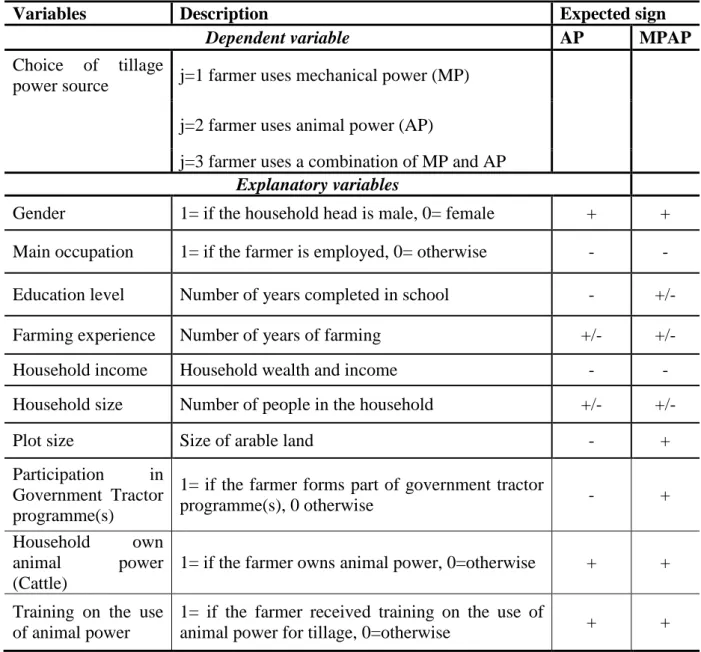
Table 3.1 Definition of variables used in MNL model ... 28
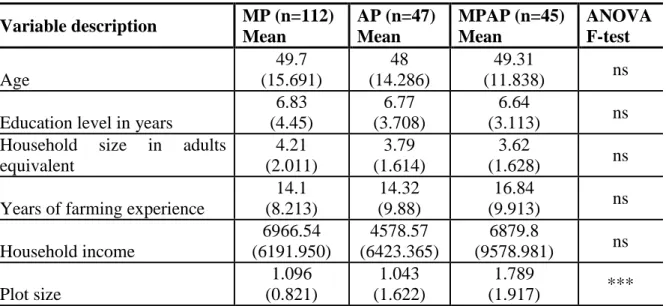
Table 3.2 ANOVA descriptive statistics from continuous variables ... 31
Table 3.3 Pairwise descriptive statistics from continuous variables ... 32
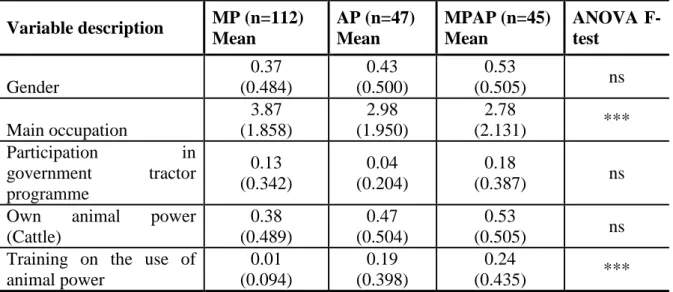
Table 3.4 ANOVA descriptive statistics from categorical variables ... 32
Table 3.5 Pairwise descriptive statistics from categorical variables ... 33
Table 3.6 Determinants of traction power choice-MNL model ... 34
Table 4.1 Description of variables used in the production function ... 43
Table 4.2 ANOVA descriptive from continuous variables ... 47
Table 4.3 Pairwise descriptive statistics from continuous variables ... 47
Table 4.4 ANOVA descriptive from categorical variables ... 48
Table 4.5 Pairwise descriptive statistics from categorical variables ... 49
Table 4.6 Effect of traction power availability on maize productivity ... 50
Table 5.1 Description of variables used in multinomial endogenous treatment effect model . 58 Table 5.2 ANOVA descriptive statistics from continuous variables ... 61
Table 5.3 Pairwise descriptive statistics from continuous variables ... 61
Table 5.4 ANOVA descriptive statistics from categorical variables ... 62
Table 5.5 Pairwise descriptive statistics from categorical variables ... 62
Table 5.6 Effect of tillage traction power availability on food security ... 64
LIST OF FIGURES
Page Figure 3.1 Okhahlamba local municipality within KwaZulu-Natal, South Africa. The red colour represents smallholder agricultural production while the green represents commercial. ... 25
CHAPTER 1. INTRODUCTION
1.1 Background
The world is experiencing several developmental problems, including poverty and food insecurity (FAO, 2016). There is progress in the fight against poverty and food insecurity, but there continue to be many people who lack food and other basic needs to live a healthy and active life. According to Gonzalez (2015), food insecurity results from poverty rather than food scarcity. Globally, almost one billion people are experiencing food insecurity because they do not have enough money to buy food in the market or agricultural inputs to produce the food they need (Gonzalez, 2015). Rural populations suffer most from the developmental problems because of their substantial reliance on the underdeveloped agricultural sector (McGranahan and Beale, 2002; Muyanga and Jayne, 2014). According to FAO (2016), about 80% of the world's food insecure are rural people, ironically, who cultivate at least 70% of the world's food.
Rural populations in Sub-Saharan Africa (SSA) countries are more food insecure and poor than those in other countries within the African continent (World Bank, 2008). World Bank (2008) reported that three in every four people in SSA lives in rural areas, are disadvantaged, food insecure and depend directly or indirectly on agriculture for their livelihoods. Most of these SSA countries invest in improving agricultural productivity since it has a potential of addressing the developmental challenges through job creation, provision of food and raw materials. Regardless of these efforts, input availability remains an impediment to improved crop productivity, consequently food security (Baiphethi, 2009; Ramaila et al., 2011).
In South Africa, the agricultural sector continues to be dominated by resource-poor farmers characterized by low-income, small landholdings, unavailability of traction power and lack of other improved inputs (Lahiff and Cousins, 2005; Maliwichi et al., 2010; Oni et al., 2011). As a result, attaining rapid growth in crop productivity and food security by these smallholder farmers remains a challenge. Household food insecurity persists in South Africa, and there has been minimal progress in reducing it (Hart, 2009; De Cock, 2013). Increase in area under cultivation and crop productivity, for household consumption and sale can enhance food security (Hart, 2009; Ambagna, 2012; Chitja, 2014). Several authors (Topps et al., 1999;
Yadav, 2003; Srivastava, 2004; Ajah, 2014; Mehta et al., 2014; Sims and Kienzle, 2015;
Takeshima, 2016) concur that availability of traction power has a positive impact on crop
productivity. Traction power availability can allow the use of fallow and virgin arable land to increase the area under cultivation (Mudhara, 2010; Kansanga, 2016). Even though the South Africa government has introduced mechanization programmes to address traction power problems, timely availability remains a challenge. Timely available traction power for tillage is one of the most critical inputs in crop production, yet is not readily available to smallholder farmers due to capital constraints, location bias of government traction power programmes and relatively small landholding. As a result, farmers end up not planting at all in a particular season or planting late, hence realizing low productivity and food insecurity.
The circumstances that smallholder farmers face influence their choice and affordability of traction power source for tillage. Previous studies found that household characteristics and institutional factors significantly influence the choice of alternative traction power for tillage (Ghosh, 2010; Mabuza et al., 2013; Manta and Aduba, 2013; Challa, 2014; Van Eerdewijk and Danielsen, 2015; Kansanga, 2016). For example, Ghosh (2010) and Challa (2014) found that relatively small farm size discourages farmers to use a tractor since it is not economically viable. Mabuza et al. (2013) indicated that households with relatively high income could invest in tractor purchases or hire for cultivation purposes. Manta and Aduba (2013) and Kansanga (2016) emphasized that institutional factors, especially government programmes regarding traction power services, influence the traction power availability and choice. Van Eerdewijk and Danielsen (2015) revealed that the gender of household head influences the choice of traction power source, especially in rural areas where gender equity is still a challenge.
A few studies (e.g.,Chisango, 2010; Rampokanyo, 2012; Tanaka et al., 2013) proved that traction power availability has a significant effect on crop productivity. Although there is limited research on the effect of traction power availability on household food security, previous impact studies (e.g.,Cunguara and Darnhofer, 2011; Nkegbe et al., 2017) found that traction power availability affects household food security. In this section of the study;
problem statement, study objectives and organization of the study will be presented.
1.2 Problem Statement
Several studies show the importance of rural agricultural production in achieving food security and reducing poverty, but the productivity of this sector remains low. As a result, people abandon agricultural production and rely on limited non-farm income (Baiphethi and
Jacobs, 2009). Evenson and Gollin (2003) and Yengoh (2012) mentioned that the low productivity occurs due to limited availability of improved inputs. Increasing the availability and access of inputs can significantly increase crop productivity and food security. Several authors (Srivastava, 2004; Ajah, 2014; Mehta et al., 2014; Sims and Kienzle, 2015;
Takeshima, 2016) agree that traction power is the most crucial input in the agricultural crop production process. Studies conducted in different countries (including Bangladesh, China, Ethiopia, Ghana, Mozambique and Zimbabwe) shows that traction power availability significantly contributes to improved crop productivity as well as food security in smallholder farms (Beyene and Muche, 2010; Obi, 2010; Cunguara and Darnhofer, 2011; Bedeke, 2012;
Abafita and Kim, 2013; Hossain, 2014; Yuyan et al., 2015; Nkegbe et al., 2017).
In South Africa, several impact studies have been conducted on the effect of the availability of improved seeds and fertilizer on crop productivity and food security (Baiphethi, 2009;
Ramaila et al., 2011; Goldblatt, 2010; Fischer et al., 2015). However, there has been limited/
no studies on the effect of timely availability of tillage power on crop productivity as well as food security. Traction power availability and its effect on crop productivity as well as food security have so far received little attention although it is the most critical input in most studies. Therefore, this study determines factors influencing the choice of traction power source for tillage and the effect of traction power availability on crop productivity as well as food security.
1.3 Study objectives
The main objective of the study was to evaluate traction power availability for tillage on smallholder farms and its effect on crop productivity, as well as food security.
a) To identify alternative traction power sources available for tillage and their relative uses by smallholder farmers.
b) To identify factors that determines the use of alternative traction power sources for tillage.
c) To determine the effect of alternative traction power sources on smallholder farmers’
crop production as well as food security.
1.4 Organization of the study
The thesis is organized into six chapters. Chapter one provides the background of the study and the problem context, objectives. The second chapter presents the literature on factors influencing the choice of traction power source for tillage. Chapter 2 also provides a review of the effect of traction power availability on crop productivity as well as food security. Chapter 3 determine factors influencing the choice of alternative traction power source used for tillage by rural households. Chapter 4 evaluates the effect of traction power availability on maize productivity. Chapter 5 evaluates the effect of traction power availability on household consumption expenditure as a proxy of food security. Finally, chapter 6 presents the conclusion, policy recommendations and implications for further research.
CHAPTER 2. LITERATURE REVIEW
2.1 Introduction
Traction power is essential for pulling tools, equipment, and machinery in agricultural production. This chapter reviews the theoretical and empirical literature relating to the choice of traction power for tillage and the effect of its availability on crop productivity as well as food security. The chapter starts by defining some concepts of the study, namely, traction power source, tillage, crop productivity and food security. The chapter also reviews the literature on the factors influencing the choice of traction power source in developing countries. This is followed by a discussion of literature on the effect of traction power availability on crop productivity as well as food security.
2.2 Definition of concepts used in the study
2.2.1 Traction power sources
Tools, implements and powered machinery are needed to support production and productivity within the agricultural sector (Mandal, 2014). Traction power is the most crucial input that aids in the operation of tools, implements and powered machinery used during various farm operations (Sims, 2012). The source of power used on these tools and implements may be human, animals or mechanical. The power source used for tillage varies between households, depending on availability of alternative power sources and financial resources for hiring power externally. Sims (2012), indicate that in SSA, human power dominates by 65% as a source of power, then animal and mechanical power constitute 25% and 10%, respectively.
Animal power source is derived from domestic animal muscle to perform farming operations (Rijk, 1999). Using this power source requires less labour, is less time-consuming, and it reduces human drudgery (Karugia et al., 2007). Furthermore, animal power eases dependence on mechanical power and the reliance of agricultural production on limited petroleum products (Fuller and Aye, 2012). Different types of animals such as cattle's, buffaloes, horses, mules, donkeys, and camels are used as power sources in various parts of the world (Sims and Kienzle, 2006; Umaru et al., 2013). Animal power is renewable and easily accessible to smallholder farmers, who are the principal crop producers in developing countries. Although the use of animal power is cheap and reduces human drudgery, factors such hot weather, hard
soil as disease and drought reduce their performance (Srivastava, 2004). Moreover, there may be shortage of feeds during dry periods making their active use during the farming season difficult.
On the other hand, mechanical power is the latest technology that encompasses all agricultural machinery which obtains its central power from sources other than muscles (Rijk, 1999). This power source ensures timely execution of farm operations and increases cropping intensity in case large land needs to be prepared (Srivastava, 2004; Manjengwa, 2011). The four-wheeled tractor is commonly used for pulling farming implements (Sharma and Soni, 2006; Sims and Kienzle, 2006).
2.2.2 Tillage
Tillage is amongst the fundamental and vital operations in crop production that influence soil properties and crop productivity (Sharma and Abrol, 2012; Alam et al., 2014). Apart from being the most crucial activity in crop production, it requires more power than other activities (Thierfelder et al., 2012). Mabuza et al. (2013) identified poor tillage as one of the factors causing low agricultural productivity in smallholder farms. Mannering and Fenster (1983) defined tillage as an activity that takes account of all the operations from seedbed preparation to enhance soil and environmental conditions for seed germination, seed establishment, and crop growth. Bajracharya (2001) and Anerua-Yakubu (2014) defined tillage as a form of soil disturbance aimed at creating favourable conditions for planting, germination, emergence, growth, and development of crops.
Previous studies (e.g. Akter and Gathala, 2014; Brouder and Gomez-Macpherson, 2014;
Grabowski et al., 2014; Ngoma et al., 2015) identify two types of tillage, namely conservation and conventional tillage. These tillage types differ in the degree of soil disturbance, which then affects the rate of organic matter decomposition. Conservation tillage involves leaving at least 30% of the crop residue in the soil/field (Brouder and Gomez-Macpherson, 2014). This practice results in reduced power requirements for tillage, favourable soil temperatures, increased soil organic matter and conservation of soil moisture. It is also environmentally non-degrading, technically appropriate, economically viable and socially acceptable (Hobbs et al., 2008). However, these benefits come at the cost of high weed management. (Hobbs et al., 2008; Hoogmoed, 2009; Temesgen et al., 2009; Chiputwa et al., 2011; Mathew et al., 2012;
Bisangwa, 2013; Akter and Gathala, 2014; Grabowski et al., 2014). Previous studies
(Kabamba and Muimba-Kankolongo, 2009; Marakoglu and Carman, 2012) indicate that conservation tillage method has a positive influence on crop productivity when combined with early tillage as compared to conventional practice.
On the other hand, conventional tillage includes methods such as ploughing, disking and harrowing that leave most of the crop residues in the soil. It is commonly used in smallholder production (Brouder and Gomez-Macpherson, 2014). This practice results in soil physical degradation, increased erosion, high organic matter decomposition, increased labour, time and energy requirements (Temesgen et al., 2009; Sessiz et al., 2010; Chiputwa et al., 2011;
Bisangwa, 2013).
2.2.3 Crop productivity
Productivity is one of the most important indicators of growth within the small-scale agricultural sector. It is also a significant tool that policy-makers use since it improves the living standards of country’s households through enhanced livelihoods as well as food security (Maseatile, 2011; Valerio, 2014). Bringing fallow land into cultivation and achieving high productivity on existing farms can aid in sustaining better living standards. Improved productivity has several benefits such as lower food prices, improved country’s competitiveness and increased flow of employment opportunities from the agriculture to other sectors of the economy. It can be measured using single input (factor or partial productivity) or multiple inputs (multiple factors or total factor productivity) (Ahmed et al., 2005; Coelli et al., 2005; Valerio, 2014).
Crop productivity is defined differently across agricultural disciplines. The definition has been improved from time to time because of the shortcomings that various researchers identified. The standard definition of crop productivity is output per unit of land cultivated (Coelli et al., 2005; Valerio, 2014). Other authors criticized this definition as it partially measures productivity and it disregards the contribution of different physical, socio-economic and technological inputs used in the production process. For this reason, researchers refined the definition to ensure that it does not give misleading estimations. For example, Reynolds et al. (2015) pointed that environmental factors also have an impact on crop productivity. As such, measuring crop productivity should consider these factors. Cassidy et al. (2013) alluded that accuracy in measuring productivity can be achieved by defining crop productivity as the number of people fed per hector of land planted.
This study will adopt the economics definition by ((Ahmed et al., 2005; Coelli et al., 2005;
Valerio, 2014), who defined crop productivity as the quantity of output produced for a given amount of production input used. It measures the efficiency of input use in the production process.
2.2.4 Food security
Food security is defined as the situation where all people, at all times, have physical and economic access to sufficient, safe and nutritious food to live a healthy and active life (FAO, 2006). The commonly accepted definition comprises the following pillars: availability, access, utilization, and stability. Food availability implies the availability of sufficient quantities of appropriate, necessary types of food from domestic production or imports (Napoli et al., 2011). Food availability assumes that increasing the amount of food available will reduce malnutrition levels.
Food access refers to the ability of households to procure and acquire quality food in a socially acceptable way (Napoli et al., 2011; FAO, 2015b). The availability and accessibility of food are not enough if the food is not safe and nutritious. The third pillar of utilization covers a range of aspects such as safe and nutritious food, clean drinking water, and sanitation for people to live a healthy and active lifestyle. The last pillar of food security, stability, emphasizes that households' or individuals should have access to safe and nutritious food at all times. Households' or individuals should not live in fear of experiencing either transitory or chronic food insecurity (Napoli et al., 2011).
Measuring food security remains complicated and expensive, with data limitation and/or availability making things worse (Hendriks, 2005; Tandon et al., 2017). Hendriks (2005) explains that the multiple dimensions of food security make measurement difficult. Studies use either direct and/or proxy indicators as to measure food security. The direct indicators include the use of households perceptions of food security and food security index (Tandon et al., 2017). However, using the direct indicators makes measuring food security even more complicated due to high cost and measurement errors.
2.3 Linkage between agricultural productivity and food security in developing countries A large proportion of the population in most developing countries relies directly or indirectly on agriculture for its livelihoods (McGranahan and Beale, 2002; Muyanga and Jayne, 2014).
According to the World Bank (2008), at least 3 billion people in developing countries lives in rural areas. An estimated 2.5 billion are in households involved in agriculture, and 1.5 billion are in smallholder households. Many of these households suffer from persisting poverty and food insecurity (World Bank, 2008). Several studies (Simbi, 1998; Pingali, 2002; Muchopa et al., 2004; Baiphethi and Jacobs, 2009; Daniels et al., 2013) agree that agricultural production can be of great importance in improving the livelihoods of rural households. For this reason, increased agricultural productivity has the potential of reducing poverty and food insecurity in the rural households (Verma, 2008; World Bank, 2008; Mozumdar, 2012; Elias et al., 2013).
Growth in agricultural productivity correlates positively with lower food prices, better nutritional intake and increased capital flow from agriculture to different sectors of the economy (World Food Summit, 1996; Timmer, 2002; Mozumdar, 2012). Agricultural growth in developing countries is vital for helping the poor reduce poverty and enhance food security.
Furthermore, increased agricultural productivity can also improve the country’s economy (Shapouri et al., 2009; Schneider and Gugerty, 2011; Fuglie and Rada, 2013). Consequently, the sustained growth in agricultural productivity can contribute to combating hunger, reducing dependence on imported food and increasing overall food security.
Most developing countries, notably those in SSA, are still experiencing slow growth in agricultural productivity (Shapouri et al., 2009; Fuglie and Rada, 2013). The level of poverty and food insecurity in SSA is the same as it was 30 years ago, with about one-third of the population suffering from severe food insecurity and poverty (Sasson, 2012; FAO, 2015a).
Ahmed (2015) stresses that agricultural productivity in smallholder farms remains low because most farmers still rely on relatively limited human, animal and mechanical power sources for tillage and planting, which delays timely execution of crop production activities.
Hence, attaining improved agricultural productivity remains one of the most significant challenges in most countries.
2.4 Farmers’ perception of alternative traction power sources for tillage
The attributes associated with each power source influence the perception of farmers towards alternative power sources (Nwaobiala and Ezeh, 2012). According to Ranjan et al. (2014) and Pathak and Rao (2015), the noted advantages of alternative power sources include time- saving, labour saving, simplicity, accessibility, and improvement of work quality. For example, Belal et al. (2015) and Umaru et al. (2013) discovered that farmers perceive that animal power is more available, affordable, reduce drudgery and time spent on a particular production task.
Akila and Chander (2009) evaluated farmers' attitude towards utilization of animal power in India. The study found that apart from the advantages associated with each alternative traction power source, ownership and dependence on a particular power source also influence farmers' perception of its attributes. The study showed that most farmers who owned or relied highly on animal power had favourable perceptions of its attributes relative to the alternatives. The results of the study conducted by Belal et al. (2015) revealed that animal power was perceived to have benefits such as increased area under cultivation and crop productivity compared to tractors. Bisangwa (2013) also found that farmers relate the use of animal power with increases in maize yield.
Comparing farmers using ox and those using tractors, Conroy and Teweldmehidin (2010) found that farmers perceived the use oxen for production to be cost-effective than using a tractor. By contrast, Ghosh (2010) studied the determinants of farm mechanization in modern agriculture in Burdwan districts of West Bengal and found that most farmers used hired tractors for tillage although they owned bullock for animal power. This is because they perceived tractors to be less costly, save labour and time. Instead, they used animal power mainly for transportation and a source of food.
2.5 Availability of tillage power in SSA
Tillage is the dominant user of traction power in crop production, hence its availability is critical. Availability of traction power sources incorporates the ability of farmers to own or easily hire traction power for timely execution of tillage and other activities in crop production. Any factor that decreases the availability of traction power source for tillage
threatens farmers’ livelihoods by reducing area cultivated, crop productivity and food security level (Bishop-Sambrook et al., 2004; Anerua-Yakubu, 2014).
According to Srivastava (2004), there is a close relationship between the availability of traction power, timely execution of farm operations and productivity. Farmers who own or can easily hire alternative traction power can realize improved crop productivity and food security. Improved crop productivity requires the availability of adequate traction power for tillage and other activities, but this is a challenge in SSA (Abdu-Raheem and Worth, 2011;
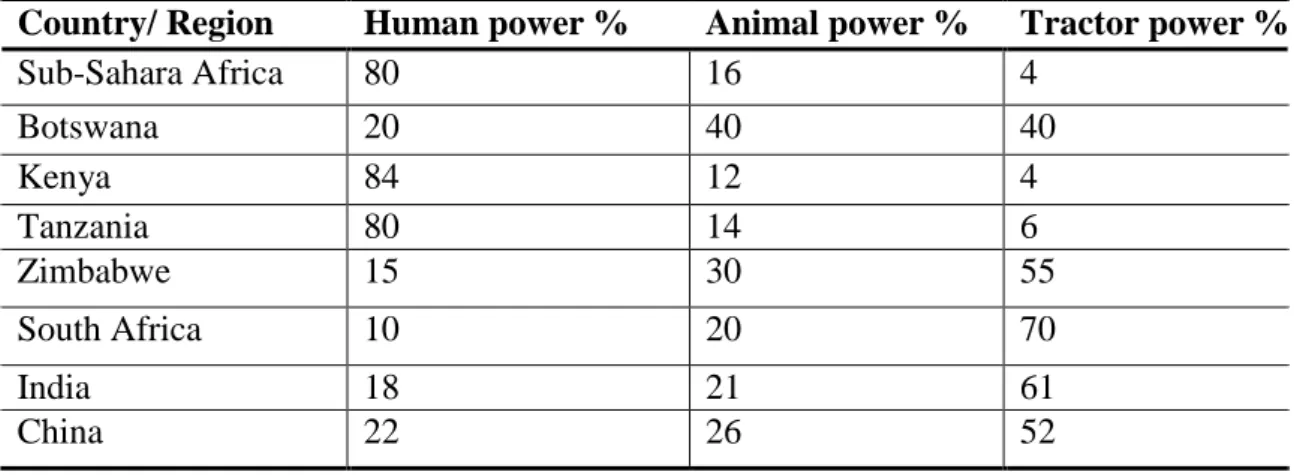
Houmy, 2013; Baudron et al., 2015; Sims and Kienzle, 2015).
Table 2.1 Alternative power used in selected countries
Country/ Region Human power % Animal power % Tractor power %
Sub-Sahara Africa 80 16 4
Botswana 20 40 40
Kenya 84 12 4
Tanzania 80 14 6
Zimbabwe 15 30 55
South Africa 10 20 70
India 18 21 61
China 22 26 52
Source: (COSMEC (1992) cited by Manjengwa, 2011)
Human power: The use of human muscle as a source of power for tillage persists in some Sub-Saharan African countries (Table 2.1) (COSMEC (1992) cited by Manjengwa, 2011).
However, several challenges result in the poor availability of labour and weak labour force for tillage and other farming activities. Firstly, HIV/AIDS pandemic depletes the available human power source for tillage. According to Sims (2012), HIV/AIDS has the observable impact on men than women. This incident leaves females with a burden of tillage and other farm activities for agricultural production to take place. This is because, apart from working on the farms, they have various household responsibilities such as childcare, cooking, collecting wood, fetching water and giving birth. These duties reduce the availability of labour and time allocated for tillage during the farming season (Meinzen-Dick et al., 2011; Croppenstedt et al., 2013). Rural-urban migration further exacerbates human power depletion. Rural people continuously migrate to urban areas in search for better job opportunities or education to improve their livelihoods. According to FAO (2011) cited in Sims (2012), 70% of the population will comprise urban people by the year 2050. These statistics show an expected
significant decline in human power source for agricultural operations in rural areas. In 2016, about 54% of the global population comprise of urban people.
Animal power: An alternative to human power for tillage is the animal power. Animal power is available for use by smallholder farmers in two ways: the farmer either owns or hires the animals from fellow community members (Umaru et al., 2013). Farmers who own a pair of animals have readily available power for farm operations. However, Oladeji (2012) reported that farmers lack knowledge and skills on how to use animals efficiently. Furthermore, diseases, climate change, and limited grazing land because of the high population growth result in a decline in availability of animal power for tillage. These challenges delay timely execution of tillage, regardless of whether the farmer owns or hires. Another critical problem is that animals no longer have the strength to carry out the operation because of very high temperature during the farming season due to climate change (Ellenberg, 2000; Umaru et al., 2013; Lohan et al., 2015).
Mechanical power: Like animal power, farmers use the mechanical power source that is available through ownership or hire. Nevertheless, it is challenging and not always economically possible for smallholder farmers to own mechanical power. For this reason, farmers mostly rely on private or government tractor hiring services for tillage. The difficulty with accessing credit or acquiring sufficient capital to become private tractor service providers limit private tractors service supply in rural communities (Ajah, 2014; Takeshima, 2015). Furthermore, government tractor hiring schemes fail because of their poor maintenance and other difficulties causing a decline in the availability and use of tractor by smallholder in Sub-Saharan Africa (Bishop-Sambrook, 2005).
2.6 Transformation of the available traction power sources for tillage in SSA
The history and direction of farm power change influenced various factors such as land and labour availability in an economy, demand for non-agricultural labour and the demand conditions for agricultural products (Pingali, 2007).The transition started from human power through to traction power sources such as animal and mechanical power (Paman et al., 2012).
Historically, human power was the primary source of power for tillage (Bishop-Sambrook, 2005; Houmy, 2013). According to Bishop-Sambrook (2005), during the early 1900s, almost all farmers in Sub-Saharan Africa relied solely on human power for tillage. However, with
time there was limitations and drudgery concerning the area that can be cultivated. Also, labour cost seemed to be high as the farming intensity increased (Vergnani, 2013). The domestication of animals provided enough traction to undertake crop production was used to overcome human drudgery problem (Pingali, 2007).
The change from human to animal power resulted in the expansion of area cultivated, higher yields, reduced labour requirement, and the development of animal husbandry (Opara, 2004;
Houmy, 2013). Likewise, animal power had problems such as diseases and poor veterinary services that made its use expensive (Makki, 2014). Also, the imported equipment was often too heavy for the animals to pull. Moreover, the size of oxen, and the competition between land use for grazing and crop production because of intensification of agriculture further discouraged the use of animal power in sub-Saharan countries (Bishop-Sambrook, 2005). Due to these problems, there was an introduction and adoption of mechanical power.
Use of mechanical power took place after the First World War, which led to a gradual decline in the use of animal power (Manjengwa, 2011). Mechanical power ensured timely tillage and improved overall agricultural productivity (Verma, 2008; Houmy, 2013). Despite the benefits associated with mechanical power, most smallholder farmers retained the use of animal power as compared to commercial farmers who reduced its use. The behaviour of smallholder farmers was because of the lower suitability of tractor power for use in small farming operations (Pingali, 2007; Manjengwa, 2011).
Nevertheless, there has been an increased use of tractors followed by a slow decline across some SSA countries since the year 1945. The provision of most tractors for tillage was through cooperative farms, state farms or tractor hire services (Bishop-Sambrook, 2005).
Between 1960s-1970s, some farmers combined the use of animal and mechanical power sources. During this period, the use of animal and mechanical power was high but followed by a decline during the 1980s. According to Anerua-Yakubu (2014), high running costs of tractors and implements, and fuel scarcity are some of the factors that reduced tractors use.
Bishop-Sambrook (2005) also indicates that government-designed hiring schemes were unsustainable and therefore, lead to a decline in the use of tractors.
Most smallholder farmers in SSA countries currently rely on human power, mostly from female, elderly people and children, for tillage (Langford, 2015). Despite this dependence on
human power, they face a dilemma of labour shortages due to diseases such as HIV/AIDS and rural-urban migration (Bishop-Sambrook, 2005).
2.7 Factors influencing the choice of alternative traction power source for tillage
Most previous studies found that household characteristics significantly influence the use of alternative traction power for tillage (Shapiro, 1990; Chisango, 2010; Chiputwa et al., 2011;
Beaman and Dillon, 2012; Mabuza et al., 2013; Ajah, 2014), and these are reviewed below.
Education
Farmers’ ability to fully understand and use various agricultural technologies depends highly on their educational level. In studying factors limiting small-scale farmers’ access and utilization of tractors for mechanization in Nigeria, Ajah (2014) found that the majority of farmers had only primary education, which constrained the use of tractors and encouraging the use of hand or animal tools. Tractors, as newly developed and improved technologies within the agricultural sector, are relatively knowledge intensive such that farmers with a high level of education are more likely to use them (Maliwichi et al., 2010; Burton, 2014; Kolade and Harpham, 2014). This view implies that there is a positive relationship between farmers’
level of education and the use of improved agricultural technologies (Challa, 2014).
According to Langyintuo and Mungoma (2008), educated farmers can acquire and process information about available technologies and their benefits. On the other hand, Sanni (2008) studied animal traction among farming communities in Nigeria using binary logistic model and found education level to have an insignificant influence on the use of animal power. This outcome suggests that a farmer can use animal power for tillage whether educated or not.
Training on animal power use
Training is necessary to encourage adoption of various innovations and technologies. Training provides knowledge and exposure to hands-on experience on how to perform and use specific tools, innovations, and equipment in agriculture (Mulanda et al., 1999). There is a definite relationship between agricultural training and the use of technologies. For this reason, farmers who receive agricultural training are more likely to use technologies. Natarajan et al. (2016) reported that farmers could keep livestock for consumption purpose, yet not take advantage of the additional benefits such as a power source for crop production activities and
transportation. They suggested that use of the animal power can only be achieved when farmers receive training in this area. However, Akila and Chander (2012) indicate that the majority of farmers are not interested in getting training on animal utilization and management. Akila and Chander (2012), Oladeji (2012) and Ghosal and Behera (2013) assume that this might be due to the lack of awareness on benefits of using the animal power source for farm operations. Nevertheless, on overall, few farmers who receive training on animal use for tillage use less mechanical power. These studies concur that there is a need for awareness and training on draught animal utilization and management. Makki et al. (2016) partly attributed this to the limited availability of experienced staff and precise curricular training content on the usage of animal power.
Household size
Household size partly reflects access to family labour supply for production, which is critical for smallholder production. A household comprises people living in the same dwelling space, share a household head and work together in an agricultural plot other income-generating activity (Beaman and Dillon, 2012). A large household size usually implies readily available labour to perform farm operations (Adikwu, 2014). Larger households comprised of adults may be less interested in hiring tractors for tillage because of available human power (Ajah, 2014), which creates an opportunity for them to reduce inputs cost (Laxmi and Mishra, 2007).
On the other hand large households may prefer using less labour intensive technologies for tillage and transfer extra labour to off-farm income generating activities. Chisango (2010) studied agricultural mechanization for sustainable agriculture and food security in Zimbabwe using a production function approach and established a positive relationship between household size and the use of mechanical power for tillage. Shapiro (1990) observed a decline in cultivated area per worker as household size increases. This observation suggests that households would instead use tractors for cultivation and use the saved labour for off-farm activities or leisure. Sanni (2008) also indicates that the use of animal power increases with an increase in the household size.
Farming experience
Farming experience and age of household head are challenging factors to link with adoption or use of agricultural technologies (Burton, 2014; Abrha, 2015). According to Laxmi and
Mishra (2007) and Chiputwa et al. (2011), the number of years of farming experience can positively or negatively influence adoption of new agricultural technologies. Farmers with more years of farming experience can certainly/quickly adopt new technologies since they have accumulated capital, knowledge, and skills that can be used to take advantage of the new technologies. On the other hand, the very same farmers may be reluctant to change techniques they have been using for many years (Laxmi and Mishra, 2007). According to Ajah (2014), farmers with more years of experience use mechanical power for farm operations. More years of experience is usually associated with the availability of capital to invest in the use of mechanization and aware of the benefits associated with using it. Likewise, according to Sanni (2008), older farmers are more likely to adopt the animal power technology since they have greater access to institutional assistance and may be in control of more wealth.
Gender
Gender matter in the use of alternative traction power source for farm operations since it influences access to agricultural resources and inputs. Compared to men, women are less likely to own agricultural resources such as land, livestock, and are less likely to have access to credit, education, extension services and adopt new technologies (Ragasa et al., 2013).
Women adopt technologies more slowly than men due to their differences regarding access to inputs and services because of social and cultural norms (Hart and Aliber, 2015; Van Eerdewijk and Danielsen, 2015). Additionally, women usually have low education levels which constrain them from taking advantage of opportunities and innovations in the agricultural sector. Amutha (2012) highlights that although there are various programmes to encourage women’s access to productive agricultural resources, different institutional (formal and informal) rules serve as obstacles; for example, women have poor access to land. In cases where they have access to land, its productivity is low. In studying gender issues regarding livestock production in Zimbabwe, Mupawaenda et al. (2009) found that stereotypes with regards to cattle ownership of by women worsen things. The belief is that, if women own cattle their productivity will be low. Because of these institutional rules and stereotypes, female-headed households usually use the human power source for tillage. Additionally, it is rare to find women who own and use tractors for farm operations in Sub-Saharan Africa.
Women are less mechanized and rely on labour-intensive technologies, or employ workers.
Female farmers who own or can afford to and/or hire are more likely to use mechanical or animal power for tillage (Van Eerdewijk and Danielsen, 2015).
Household income and wealth
Household income indicates the economic status of households. It also plays an essential role in guiding decisions in the agricultural production process. Previous studies (Langyintuo and Mungoma, 2008; Mabuza et al., 2013) measured household wealth based on the availability of assets such as televisions, decoders, cell phones, refrigerator, radio, car ownership, materials for the house and source of energy for cooking. Wealthy households can take the risk of investing in agricultural technologies such as tractor since they have the means of bearing the negative impacts that might arise (Awotide et al., 2012; Edirisinghe, 2015; Negeri et al., 2015). According to Chiputwa et al. (2011), wealthy farmers can own or hire mechanical power source for tillage as opposed to the disadvantaged ones. The underprivileged farmers settle for using zero tillage that eventually has a disadvantage of high labour requirement for weeding. Evidence from Mabuza et al. (2013), in studying factors influencing the use of alternative land cultivation technologies in Swaziland, also indicate that household wealth and income significantly influences the use of tractor for tillage. As the farm income increases, farmers tend to use hired tractors for tillage and not animal power.
Another study by Shapiro (1990) shows that wealthy households cultivate relatively large areas because of better access and affordability of required inputs such as a tractor. They also have the seeds and fertilizer necessary for the production process.
Land characteristics
Land is the most crucial input in crop production. Nevertheless, most smallholder farmers operate on relatively small landholdings. According to Livingstone et al. (2011) and Gollin (2014), the average land size of smallholder farmers' is one to two hectares. The size of landholdings continues to fall due to increasing population growth and demand for communal grazing land. Labour intensive tillage technologies are suitable for relatively these small plots (Challa, 2014). Therefore, farmers with small land holding tend to rely on human power for tillage while those with relatively large land holding use less labour-intensive technologies such as mechanical and animal traction power sources. However, in some cases, smallholder farmers do have access to large landholdings but lack adequate resources to work the land. In cases where the farm size is large, the manual labour is not an appropriate power source for tillage. Therefore farmers usually resort to cultivating gardens only (Van den Berg et al., 2007).
Van der Veen (2005) identifies gardens and field plots as two types of land were agricultural production can take place. The garden plots are relatively small, located close to households, require low inputs and technologies for production activities. On the contrary, field plots are usually large, found far from homes; they need high inputs and technologies (Manual, 2005).
According to Ndwandwe and Mudhara (2014), farmers who are tilling gardens find it economically beneficial to use human muscle as a source of power while when it comes to field plots either animal or mechanical power is used depending on availability and ease of access.
Ownership of animal power
Animal power has been used over the years as a source of power to perform agricultural operation such as tillage, planting, weeding, transportation, etc. (Manjengwa, 2011; Umaru et al., 2013). Most of the smallholder farmers cannot afford to use the tractor as owners or through hiring. For this reason, some farmers who own animal power use it as it reduces human drudgery and ensures timely tillage (Sikhwari, 2009; Ahmad and Abubakar, 2010;
Amadi et al., 2013; Houssou et al., 2014). The ownership of oxen determines farmers' ability to perform farm operations because if farmers do not have oxen, they would be obliged (i) to rent out their land to other farmers, (ii) hire oxen from fellow members of the community, (iii) hire tractor from government or private service providers (Simalenga et al., 2000; Ahmed, 2014; Okello et al., 2015). According to Dijkman et al. (2000), farmers can either have short term or long term ownership of traction animals. In terms short-term ownership, farmers can buy a pair of oxen for a certain cropping season, once the season ends they then sell them.
Ownership of these traction animals reduces farmers’ dependence on hiring which in most cases do not allow timely execution activities in crop production. Similarly, Mabuza et al.
(2013) support this by emphasizing that, farmers who own pair(s) of traction animals find it cheaper to use them for tillage than alternative technologies.
Government traction power programme(s)
Governments of various countries have introduced agricultural programmes and projects with a mandate of achieving rural and agricultural development, more especially the developing countries (World Bank, 2008; DAFF, 2012; DAFF, 2013). However, the programme(s) sometimes face a challenge of providing farmers with equal chances of receiving traction services when needed. According to Ajah (2014), this problem arises because of improper
maintenance of government tractors. Also, many tractors are available, but there are only a few implements to be mounted on the tractors. In South Africa, the government introduced public tractor services with a mandate of bringing land that has long been fallow under cultivation through the provision of mechanization services and other inputs (DAFF, 2012;
DAFF, 2013; Zwane et al., 2015). Therefore, farmers participating in government tractor programme(s) are more likely to use mechanical power for tillage.
2.8 The effect of tillage traction power availability on crop productivity as well as food security
There is a consensus that smallholder farmers crop productivity and food security are positively correlated (Aliber, 2009; Jacobs and Baiphethi, 2015). This concurrence exists because crop productivity increases the availability of food for household consumption and sale. It also reduces households’ dependence on food markets, leading to a reduction in household food consumption expenditure.
The use of alternative traction power sources help farmers cultivate relatively large land and thus generate high income from sale; this consequently translates to improved food security.
Hossain (2014) conducted a study to evaluate the impact of project enhancement of agricultural and rural employment, the findings of the study indicate that the availability of alternative traction power sources enhances crop production and productivity due to timeliness and better-quality operations. The productivity increases correlate with increased farm income and consequently household food security. The availability of alternative traction power source also allows for expansion of agricultural production ensuring marketable surplus to generate income. Moreover, it enables household members to engage in non-farm jobs and other income-generating activities (Verma, 2008; Sims, 2012; Houmy, 2013; Hossain, 2014).
According to Obi (2010), the use of mechanical power is one of the critical contributors to the growth of smallholder farmers' income. Farmers using tractors generate more income than farmers using other traction power sources. The high income generated plays an important role in improving the food security status of the farmers' households. However, when farm sizes are small tractor use and ownership is not economically feasible. Yuyan et al. (2015) also found a positive association between household food security and mechanical power availability, when studying factors influencing food security in China.
Cunguara and Darnhofer (2011) assessed the impact of improved agricultural technologies on household income in rural Mozambique. These authors used three econometric approaches:
doubly robust estimator, sub-classification regression and treatment effect model to ensure robustness. The study found a significant influence of tillage power availability on household income, and consequently, consumption expenditure. However, the effect differs from one quintile of the surveyed households to another. These authors also found that the use of mechanical or animal power is profitable in large cropped areas. Farmers using the two- traction power source on large land size can obtain high household income from production as compared to those who use them on relatively small land. This finding implies that farmers who use mechanical or animal power for tillage in large plots can attain high crop productivity as well as food security.
Nkegbe et al. (2017) employed ordered probit model in estimating the determinants of food security in the savannah accelerated development authority zone of Ghana. The study emphasized that households that own or can easily access mechanized farm equipment are more likely to be food secure. On the other hand, farmers who own large livestock that is capable of being used as traction power are less likely to be food secure than those who do not own. The large livestock tends to form part of the household expenditure rather than an income generating mechanism or traction power source to undertake crop production activities.
Bedeke (2012) used a binary logistic model to measure food security and coping strategy in East Hararghe, Ethiopia. The study found that the availability of ox in the household is an essential contributor to food security since it is a critical production factor. In examining the determinants of food security, Abafita and Kim (2013) confirm the importance of the availability of animal power to food security by indicating that it is closely related to production especially in Ethiopia where farmers use it as the primary power source. Beyene and Muche (2010) discovered that timely available animal power ensures that farms perform better and can achieve sustainable food security.
Restrictions regarding access to land and other farming inputs are the primary reason for persisting poverty and food insecurity in rural areas (Moyo, 2008; Abdu-Raheem and Worth, 2011). Abrha (2015) investigated factors affecting the agricultural production of farm households in the regional state of Tigray, Ethiopia, using OLS. The study discovered that
households with large landholding are food secure as opposed to those with small landholding. However, there are cases whereby farmers have large landholdings but still obtain low crop productivity. This situation happens in cases where farmers with large landholding rely on human power source in the production process (Adesoji and Farinde, 2006). This makes the availability of traction power sources such as mechanical and animal power important in achieving improved production.
Animal power ownership correlates with crop productivity and, household income generation especially if farmers hire them out. According to studies conducted by (Simalenga and Jongisa, 2000; Conroy and Teweldmehidin, 2010; Rampokanyo, 2012; Umaru et al., 2013;
Okello et al., 2015; Karugia, 2017) animal power ownership significantly contributes to crop productivity and food security. Other studies related to factors affecting crop productivity (Xu et al., 2009; Kibaara and Kavoi, 2012; Nazir et al., 2013; Tanaka et al., 2013; Abrha, 2015) indicated that traction power availability significantly contributes to efficiency in crop production.
2.9 Summary
Traction power availability plays a vital role in ensuring timeliness and quality operations in crop production and consequently crop productivity as well as food security. In this chapter some key concepts of the study, namely, traction power source, tillage, crop productivity and food security. This chapter also reviews the theoretical and empirical literature on the factors influencing the choice of traction power for tillage. The reviewed literature shows that farmers' socioeconomic and institutional factors play a significant role in the choice of traction power source they use for tillage. This chapter also reviewed the literature on the effect of traction power availability on crop productivity as well as food security. The reviewed studies showed that traction power availability is essential if improved crop productivity, as well as household food security, is to be achieved. The studies show that in general availability of traction power enhances timeliness and quality operation which is vital in improving crop productivity. The improved crop productivity gives an incentive for market participation for income generation through the sale of surplus produce.
CHAPTER 3. FACTORS INFLUENCING FARMERS’ CHOICE OF TRACTION POWER SOURCE FOR TILLAGE IN KWAZULU-NATAL,
SOUTH AFRICA
3.1 Abstract
The challenge with traction power availability is amongst factors responsible for poor tillage and late planting among smallholder farmers. Smallholder farmers confront a dilemma of either not planting at all or planting late because traction power is not readily available for tillage. The problem with timely availability of alternative traction power source and other socioeconomic factors influence farmers’ choice of traction power used for tillage. An understanding of the basis for farmers’ choice is crucial in developing strategies and programmes to address traction power availability problems. This chapter aimed to determine the factors influencing the choice of alternative traction power source for tillage in smallholder farms. Using a sample of 204 households selected from six rural villages in the Okhahlamba Municipality, KwaZulu-Natal, data were analysed using the multinomial logistic regression (MNL). Three categories of traction power used by farmers for tillage include:
mechanical power, animal power and a combination of the two-power source. The results from the MNL model reveal that the probability of choosing alternative traction power is influenced by gender, main occupation, income, farming experience, farm size, participation in government tractor programme(s), own animal power and training on the use of animal power. There is a need to consider socio-economic and institutional factors in developing programmes to ensure timely available tillage power source.
Keywords: Smallholder farmers, choice, traction power source, tillage, Multinomial logistic regression
3.2 Introduction
The global population in 2016 was 7.4 billion and is expected to reach approximately 9.6 billion in 2050 (Sims, 2012; Mottaleb et al., 2016). As a result, food consumption is expected to continue rising with the increase in population, especially in developing countries. To ensure food security as population increases, growth in productivity of smallholder farmers is required since they dominate production in most areas vulnerable to food insecurity (Tilman et al., 2011; Gerland et al., 2014). This situation is complicated by smallholder farmers’