
All participating respondents were caregivers who cared for abused women at the time of the study. Semi-structured interviews with open-ended questions were conducted with care workers who care for abused women.
Introduction
The aim of the study
The main aim of this research study was to examine the experiences of carers who care for abused women in the Durban area, in the hope of informing policy decisions and training programs in this field. In this case, the interest was focused on a group of caregivers who cared for abused women, meaning that they had desirable characteristics and knowledge that would fit the study's purpose.
Chapter Division
The participants were selected using purposive sampling, which is defined by Neuman (2006:p. 267) as "the type of sampling where you select people with [your] desired characteristics". The challenges experienced in carrying out the study and the limitations that emerged are highlighted.
Chapter Summary
Chapter Four: Results - This chapter presents a discussion of the results obtained during the study. The study report concludes by offering thought-provoking recommendations that, among other things, should stimulate future studies in this area.
Introduction
Conceptualisation of terms 1 Abuse
- The abuse of women
- Forms of women abuse
- Causes of women abuse
- Consequences of women abuse
According to Wilson and Richard (2010), long-term experiences of abuse result in low self-esteem and high feelings of self-esteem. According to Egnes et al. 2012), most women do not report abuse by their partners in the first year after giving birth.
The vulnerability of different groups of women to abuse
Age groups
According to Umbuyeyi et al. 2016), battered women who do not report or leave a relationship are held back by socio-economic and cultural factors. In particular, they refer to gender role socialization models that describe abuse of women as resulting from “men's control and maintenance of power over women and that masculinity and expectations placed on men regarding gender-related behavior constitute an interpersonal undergo dynamics that lead to abuse.” ” (Nicolson & Wilson, 2004).
Social status
However, according to Malcoe, Duran, & Montgomery, (2004), the role of social status variables in the prevalence of female abuse remains elusive. This is because many of them are staying in the country illegally and have no documents to validate their stay.
Personal disabilities
Bengston and Saveman (2009) explain that women with special needs or mental illness are more vulnerable to exposure to abuse such as sexual and physical violence, threats and verbal harassment. It is argued that women with disabilities stay or choose to stay in abusive relationships for the sake of partnership and survival.
Care Workers
Characteristics of a care worker
Forset and Sandel (2010) argue that caregivers and abused women are a team, each with different strengths. Hamberiger, Ambuci, and Guse (2007) examined racial differences between abused women and their caregivers.
Role of a care worker
Therefore, it can be argued that being a carer looking after battered women is about providing personal and practical support to help individuals live their lives. It is about supporting them to maintain their independence, dignity and ability to take control of their own lives.
The caring process
36 intimate partner violence; "it raises the basic issues related to gender asymmetry and power relations and therefore convinces [the] intensive involvement of the worker" (Jewkes, Abraham and Mvo, 2001). These authors also emphasize the importance of the relationship between the caregiver and the abused woman. Tops, Saveman and Tops (2009) explain that the abuse of women with a mental illness is one of the most unrecognized features by workers within care and support services.
Experiences of Care Workers Who Work with Abused Women
Similarly, Goldblatt and Buchbinder (2003) explain that caregivers caring for abused women "may experience vicarious trauma, stress, and burnout." Long-term care policies shape the rewards and stressors of the caregiving relationship that individuals experience as caregivers. With a lack of finances, they are forced to have a small number of carers, while the demand for care by victims of abuse is high (Wilson, 2004).
Theoretical Framework
According to different objectives, the arguments of the current study were related to this theory. Kurt Lewin's field theory according to Adaier and Mowsesian (2006) also perceives learning as one of the most important skills to adopt as a care worker. In conclusion, the application of this theory was intended to explain the purpose of the study on the experiences of caregivers who cared for abused women.
Introduction
Research Approach and Methodology
The purpose of qualitative research is to explore and discover questions about the problem under investigation and also to help researchers understand individuals and the social and cultural circumstances in which they live (Cohen & Cabtree, 2006). The type of qualitative research used was a phenomenological inquiry, which is explained by Neuman (2006) as “the study of subjective experiences [as] it derives from a school of thought that emphasizes a focus on people's subjective experiences and interpretations of the world ". The qualitative research design was chosen because the purpose of such research was to understand the subjective meanings behind or the realization of how the subject affects the object.
Research Paradigm
47 According to (Neuman, 2006), people's actions are conscious: they can think and understand the world based on their experiences. People's behavior “can therefore be a response to external stimuli, but is also determined by their previous experiences and the context in which they find themselves (Neuman, 2006). According to Braun and Clarke (2008:p. 85), interpretive research is also called “a phenomenological approach that aims to understand people”.
Research Participants
In this study, the researcher looked at the lives of caregivers who cared for battered women and examined how their daily experiences with the victims influenced their perceptions of their jobs. In this study, the researcher only focused on the experiences of caregivers who cared for battered women, not everyone who had been subjected to violence. After receiving permission from the gatekeepers, caregivers were identified and contacted to volunteer for this research study.
Data Collection
One-on-one interviews
During these interviews, some of the responses allowed the interviewer to shift from the topic as the respondents were free to speak and even add more information that they felt affected them when working with victims of abuse. For ethical purposes, the real identity of study participants is obscured in the data presentation of this report by assigning a code to each participant. The following table shows an overview of the interview schedule in terms of dates and times when each interview was conducted.
Reliability and Validity
Trustworthiness
Credibility is defined by Neuman (2006:p.207) as “the relevant term used in qualitative research as a measure of research quality. This was because purposive sampling was used, meaning that the selection of participants was made with the desired characteristics in mind, which in this case required care workers who cared for abused women. Credibility is also achieved by providing the reader with an open statement of the techniques used to collect and analyze the data (Blanche et al., 2006).
Data Analysis
- Familiarizing yourself with the data
- Generating initial codes
- Reviewing themes
- Defining and naming themes
This step is defined by Braun and Clarke (2008) as the phase in which the researcher, after conducting the interviews, begins transcribing the data. After formulating the themes, the data was matched with that from the literature review to discover similarities and differences. In this study, after data had been collected through both interviews and literature review, the themes that emerged were combined.
Ethical Considerations
Bran and Clarke (2008) state that the report, or dissertation, is the concluding aspect of a research project and involves the selection of intense, compelling excerpts from the research and connecting the analyzes of the findings to the research questions and the literature. During this process, an academic report of the findings and analyzes is generated (Bran & Clarke, 2008). The informed consent stated that the study would be conducted for academic purposes only.
Chapter Summary
According to Beins (2009), this design is suitable for investigating social phenomena in their normal context, when a researcher tries to understand or understand phenomena in relation to the meanings individuals attach to their world and experiences. Thus, such a study proposes "to penetrate the deeper meaning that the object of research assigns to the subject being researched" (Beins, 2009:p.120). The results are discussed by looking at similarities and differences in the views of the participants and in comparison with results from other studies that were reported in the literature.
Table: Themes and Sub-Themes
This chapter presents the findings based on the data collected during the interviews.
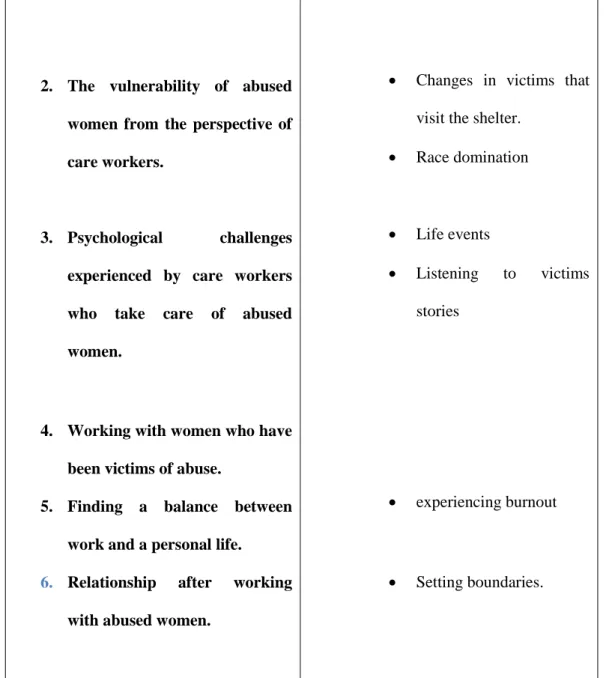
Discussion of Results
- General challenges encountered when working with abused women
- The vulnerability of abused women from the perspective of care workers
- Psychological challenges experienced by care workers
- Finding a balance between work and a personal life
- Relationships with abused women after their stay at care centres
Furthermore, one of the care workers mentioned that the arrival of different groups to the shelters was seasonal. Some of the caregivers mentioned challenges that the victims encountered rather than those they encountered. In contrast, some of the nursing staff have; mentioned how they were influenced by the stories they listened to.
Chapter Summary
I find that many people, once they leave Kerr House and have moved on, come back and visit and some don't. They have moved on and they don't want people to know they were here, but yes, we encourage the ladies to come back and visit, yes” (KH1). We have a proper routine that people do, so there is no such thing as being too cozy with people [ie, patients], although we do try to create a friendly environment.
Introduction
Themes
Theme 1: General challenges encountered when working with abused women
Some care workers claimed that abuse occurred more often among black women than among others. Caregivers also emphasized the importance of education to sensitize caregivers to the reasons and ways of dealing with abused women. In the literature, Felton (1998) explains that burnout is one of the main experiences faced by caregivers who care for abused women.
Theme 4: Experiences of working with abused women
Caregivers also often changed their views on the correct way to counsel female patients who were faced with abuse (Pack, 2014). For example, Bullock et al. 1999), strongly suggest that a lack of knowledge and training in issues relating to the abuse of women contributes to the inability of care workers to recognize and correctly interpret abuse-related behaviour. 1999) explain that if caregivers are not trained, caregivers cannot identify, assess, document and manage the care of patients who have been victims of abuse.
Theme 5: Creating a balance between work and personal life
This objective aimed to explore the experiences of caregivers caring for battered women. The purpose of this objective was to uncover what caregivers saw as the main cause of abuse in their experience of working with battered women. Information in the literature showed fairly similar results to those that emerged from the interviews with the nursing staff.
Recommendations
92 In the literature, Harris et al (2001) argued that it is important for care workers to understand the help-seeking process from service providers across all sectors. In the process of caring for battered women, more interventions should be considered to address the needs of caregivers, as the focus in this area seems to be placed primarily on victims rather than caregivers. In order to avoid issues such as job dissatisfaction and stressful family situations due to care workers' inability to distance themselves from work-related stress at home, focus group workshops, rather than general workshops, should attended by both victims and their care workers.
Challenges and Limitations
By prompting and pointing back in the desired direction, more appropriate responses were offered. The scope of the study was limited to ten female caregiver respondents and three abused women care centers in the Durban area. The total population of care workers and care centers in the Durban area is much larger and more extensive.
Chapter Summary
95 cannot be generalized to the entire South African population of caregivers and care centers for battered women.
Challenging gender roles: The impact of women social work students on working with abused women. How care workers manage to maintain the professional relationship after work with abused women. I am interested in learning about the different experiences faced by care workers or people caring for abused women in the Durban area.
