THE EXPERIENCES OF HELP RECEIVED BY CHILDREN IN THE AFTERMATH OF RAPE
LTNDELANILYNETTEITABOR
A thesis submitted in partial fulfillment of the requirements for the degree of
MASTERS IN PSYCHOLOGY
UNIVERSITY OF KWAZULU-NATAL 2007
DECLARATION
I declare that this research report is my own, unaided work. It is being submitted for the degree of Masters in Psychology, of the University of KwaZulu-Natal, Durban. It has not been submitted before for any degree or examination in any other university.
„4^T. /p Daoeen
2Q07ACKNOWLEDGMENTS
I would like to express my sincere gratitude to the following people:
My God, the Creator for giving me wisdom and understanding.
My supervisor, Professor Steven Collings for his guidance and patience throughout the study.
The manager and staff of Bobby Bear for allowing us to use the centre.
The parents and the children at Bobby Bear for allowing us to interview them.
My colleagues, especially Dr. Smith for his help, encouragement and his belief in me.
My family, my daughter Bongeka, my son Nkosiyapha and my niece Hlengiwe for their patience and support.
List of Abbreviations
1. NICRO - National Institute for Crime Prevention and Rehabilitation.
2. CSA - Child Sexual Abuse.
3. HSRC - Human Sciences Research Council.
4. SAHRC - South African Human Rights Council.
5. SAPS - South African Police Services.
ABSTRACT
The aim of the study was to explore and describe the experiences of children who have been raped. It is a known fact that children are raped every day in South Africa, but how the consequences are experienced by the child victims of rape is another matter.
Specifically, the researcher wanted to determine whether these children receive the support that is their constitutional right and whether or not they are subjected tc secondary victimization.
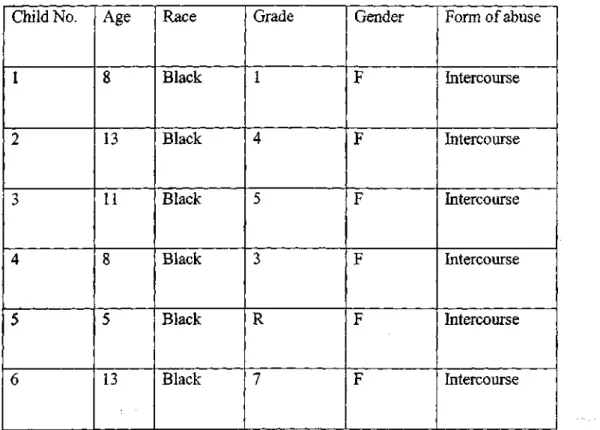
The sampling strategy employed was purposive sampling. This type of sampling wai selected, as the researcher was looking for a particular type of participant, that is, children who had disclosed rape. The sample consisted of six female children between the ages of 5 and 17years. Participants' parents were consulted for their consent at c counseling centre for abused children in Durban, where participants attended group counseling and individual sessions.
The data were collected by means of semi-structured interviews and analyzed usin^
thematic analysis. Unstructured interviews were tape recorded and transcribed. Thesi transcriptions were coded for descriptive themes and were analyzed using thematic conten analysis.
The research findings suggest that children have mixed views regarding the quality of the help they receive; some had positive experiences and some had negative experiences.
Despite the fact that most participants experienced a sense of being interrogated and had feelings of being not involved during discussions, two participants reported that although rape is an atrocious experience there were positive consequences for them. For example, getting attention from significant people in their lives was one of their positive experiences.
It was the experience of the researcher that there is a lack of research pertaining to the experiences of children who are rape victims, especially research focusing on the quality of support that rape victims ought to receive. Further research is recommended to clarify and measure the prevalence of typical feelings and experiences of children who have been raped.
TABLE OF CONTENTS
Page
Abstract v
Chapter 1
1.1 Introduction 1 1.2 Definitions of terms and concepts 2
1.3 Objectives 3 1.4 Rationale for the study 4
1.5 Ethical Considerations 5
1.6 Chapter outline 6
Chapter 2
2.1. Literature review 7 2.1.1 Introduction 7 2.1.2 What is child sexual abuse? 8
2.1.3 Specific types of child abuse 9 2.1.4 People who molest children 13
2.15 Rape prevalence 14 2.1.6 Consequences of rape 15
2.1.7 Social perceptions of rape 17
2.1.8 Disclosure 18 2.1.9 Secondary victimization 20
2.1.10 Are rape victims re-victimized 21 2.1.11 An overview of the legal process 24 2.1.12 Do legal proceedings re-traumatize crime victims? 25
2.1.13 Bail hearings 25 2.1.14 Legal services 26 2.1.14.1 Availability 28 2.1.14.2 Accessibility 28 2.1.15 Medical services 29 2.1.16 Psychological effects 30 2.1.17 Motivation for the study 33
2.1.18 Chapter outline 35
Chapter 3
3.1 Theoretical framework 36
3.1.1 Introduction 36 3.2 An ecological approach 36
3.2.1 Secondary victimization at the Macro systemic level 41 3.2.2 Secondary victimization at the exo systemic level 42
3.2.3 Secondary victimization at micro-systemic level of interpersonal
relationships 45 3.2.4 Secondary victimization at the level of ontogenic development 46
3.3 Summary of the theoretical framework 47
3.4 Chapter outline 49
Chapter 4
4. Methodology 50 4.1 Introduction 50 4.2 Strategy of inquiry 51
4.3 Sampling 53 4.4 Participants 53 4.5 Data collection 55 4.6 Procedure 55 4.7 Translation and transcription procedures 58
4.8 Chapter outline 59
Chapter 5
5. Data analysis & research findings 60
5.1 Introduction 60 5.2 Data analysis 60
5.3 Limitations of thematic analysis 62
5.4 Thematic analysis 62 5.5 Data verification 63 5.6 Ethical considerations 65
5.7 Themes 66 5.7.1 Theme 1: Treatment experienced by rape victims 68
5.7.2 Treatment experienced by children after rape 69
5.7.3 Theme 2: Children's feelings 71 5.7.4 Theme 3: Participants experiences 73
5.8 Conclusion 74 5.9 Chapter outline 75
Chapter 6
6. Discussion 76 6.1 Introduction 76 6.2 Discussion of the results from the themes 77
6.2.1 Secondary victimization at micro-systemic level 77 6.2.2 Secondary victimization at exo-systemic level 79 6.2.3 Secondary victimization at macro-systemic level 80
6.3 Limitations of the study 82 6.3.1 Expressive language barrier 83
6.3.2 Race 83 6.3.3 Social desirability 83
6.3.4 Sample size 83 6.3.5 Personality traits 84
6.3.6 Subject 84 6.4 Recommendations 84
6.5 Conclusion 85 6.6 Implications for the study 87
6.7 Reflections of the researcher 88
References 89 Appendix A 97 Appendix B 100 Appendix C 109
LIST OF FIGURES
Number Page 1. Multi -level model of risk factors that influence CSA 38
LIST OF TABLES
Number Pag, Table 1 - table describing participants 5-
Table 2 - theme 1 6 Table 3 - theme 2 7 Table 4 - theme 3 7
CHAPTER 1
1.1 INTRODUCTION
The purpose of this research was to explore the experiences of children after they have been raped. It was an assumption of the researcher that rape victims would suffer some degree of secondary victimization following disclosure of their abuse. Therefore it was important to examine the subjective experiences of rape victims in order to establish whether any secondary victimization is experienced at the hands of the service providers who are supposed to assist rape survivors. In South Africa, there have been no previous studies which have explored the experiences of child rape victims.
According to statistics provided by the National Institute for Crime Prevention and Rehabilitation (NICRO, 2002), it is estimated that only one in 20 rapes is reported to the police. On the basis of this estimate, it is calculated that one rape occurs every 83 seconds. The South African Police Services (SAPS) has recently presented an even bleaker picture when they suggest that one rape occurs every 35 seconds (Mail and Guardian, 17 August 2005).
Given the scope of the problem of child rape, new policies and procedures have been established to protect the rights of children and rape survivors. ]h spite of annual events which are held to educate society about violence against
1
women and children, child rape continues to threaten the fundamental rights of children. According to the Bill of Rights in the South African Constitution, a child's best interests are of paramount importance in every matter concerning the child and every child has the right to be protected from maltreatment, neglect, abuse or degradation. But what happens to rape survivors after they report their abuse to the authorities? Although numerous research studies have examined the prevalence of child rape, there has been no attempt to explore the lived experiences of South African rape victims.
1.2 DEFINITION OF TERMS AND CONCEPTS The following definitions were used in the study:
o Rape : unlawful forced sexual intercourse without consent.
o Child abuse : any interaction or lack of interaction : between a child and a person of authority : which results in a non- accidental harm in a : child's physical and /or developmental state.
o Child sexual abuse : involvement of children in sexual activities : which they do not understand and have not : given consent.
o Service providers : people who provide services to rape victims, o Secondary victimization : further victimization of children by not
providing required services,
o Rape survivors : people/children who have been raped.
o Children : any minor person under the age of 18.
o Community agencies : professionals who are providing services to rape victims,
o Trauma : an event which is perceived by an individual to be life threatening,
o Caregiver : a person taking care of a minor person.
1.3 OBJECTIVES
Although numerous research articles are available with regards to rape occurrence and its impact to rape victims, but no research has been conducted in South Africa which investigates the experiences of help children receive after rape. What are the expectations of children who are rape survivors regarding help that they ought to receive?
Therefore the research investigated the experiences of children from the point when they reported their cases to the police, to the point when cases reached the court of law. The researcher was interested in exploring the following: Are
the experiences of children negative or positive when they approach service providers? Do children benefit from consultation with community agencies?
1.4 RATIONALE FOR THE STUDY
No research has been conducted in South Africa regarding raped children's experiences when consulting community agencies (i.e. police, child protection units, medical institutions, child welfare and the department of justice).
Therefore, it is important to conduct this research so that community agencies can be informed of their shortcomings in accordance with children's rights and that they respond to children's needs appropriately. It is also important to investigate if current laws, policies and procedures adequately meet the needs of children who are rape survivors.
1.5 ETHICAL CONSIDERATIONS
Ethical clearance for the research was obtained from the Ethics Committee of the Faculty of Community and Development Disciplines at the University of Kwa-Zulu Natal.
1.6 CHAPTER OUTLINE
In the following chapter, literature on child abuse and secondary victimization will be evaluated. Firstly, child abuse will be examined with the emphasis on child sexual abuse (CSA). Thereafter, secondary victimization will be explored, during which an evaluation of the services rendered by service providers will be made in accordance with the expectations of the relevant communities.
CHAPTER 2
2.1 LITERATURE REVIEW 2.1.1 INTRODUCTION
Research findings indicate that many South African children are affected by trauma because of high levels of violence which occurs both within the home and in the wider community (Lewis, 1999). Children as young as just a few months old are abused both by family members as well as by members of the community. A 1997 South African government report revealed that rape and the sexual abuse of children are increasing rapidly and are matters of critical concern. According to the South African Police Service (SAPS, 2002) statistical analysis of reported rape cases, the victim age group reflecting the highest rape ratio per 100,000 of the female population is the category of 12 tol7 year olds, (471.7 per 100000). In the context of such high levels of child sexual abuse in South Africa, it becomes important to view how sexual abuse and secondary victimization affect children. The literature has been divided into three main sections: understanding what CSA is and its effects, secondary victimization, and the role of those who provide services for rape victims.
2.1.2 WHAT IS CHILD SEXUAL ABUSE?
Sexual abuse is defined by Kempe and Kempe (1984 in Bagley and King, 1991, p43) as "the involvement of dependent, developmentally immature children and adolescents in sexual activities which they do not fully comprehend and are unable to give informed consent to and that violate social taboos of family roles". Bagley and King (1991) further state that children cannot give informed consent to sex with adults because they lack information about the full social and biological meanings of sexuality. Another definition, provided by Sgroi (1978 in Calder, 1999, p.11) defines child sexual abuse as:
"a sexual act imposed on a child who lacks emotional, maturation and cognitive development". Sgroi (1978 in Calder, 1999) further states that a child is lured into a sexual relationship based on the power and dominant position of the adult or older adolescent, which contrasts with the child's age, dependency and subordinate position. It is authority and power which enables the perpetrator to implicitly coerce the child into sexual conformity. According to Faller (1988), most definitions of child sexual abuse include the following aspects:
• The child is sexually exploited by an adult.
• The exploitation is directed at the sexual gratification of the adult and can take various forms.
• The child is involved in sexual activities to which he/she cannot grant legal consent.
• The child's psychosocial level of development is ignored and disregarded, and the sexual transgression violates existing social and nurturing roles.
For the purpose of this research, the researcher will define CSA as a sexual act committed with a child by a person in a position of power over the child without the child's informed consent. Furthermore, rape will be defined as sexual penetration of minors without their informed consent which is characterized by an attack, assault, threats, intimidation, and aggression with the child being an object of hostility.
2.1.3 SPECIFIC TYPES OF SEXUAL ABUSE
To fully comprehend child sexual abuse and specific types of sexual abuse, a distinction between contact and non- contact sexual abuse can be made. Milner (1998, p. 149, in Richter, Dawes Higson-Smith, 2002), describes contact sexual abuse as "abuse that involves any form of physical contact during the commission of a sexually abusive act, ranging from non genital and genital touching to vaginal or anal sexual intercourse". According to Orton (1997),
contact abuse includes oral genital contact, attempted or actual intercourse or sodomy, and attempted or actual rape.
Milner (1998 cited in Richter 2002), describes non-contact sexual abuse as sexually abusive acts which may range from exhibitionism to being a non- contact agent in the use of children in pornography or prostitution. Orton (1997) provides specific examples of non-touching sexual abuse which include: removing bathroom and bedroom doors so adults can observe the child bathing and toileting and the child can observe the sexual activity of parents, disrobing in front of the child and many other forms of exhibitionism.
According to Faller (1988), there are various types of sexual abuse. They include the following:
a) Non-contact sexual abuse where the abuser does not touch the child.
• Sexy talk, in which the abuser makes statements regarding the child's sexual features.
• Exposure, for an example masturbating in front of the victim.
• Voyeurism, in which the perpetrator achieves sexual gratification when the victim undresses.
b) Sexual contact, including frotteurism, that is, when the perpetrator gets gratification by rubbing his private parts against the victim.
Sexual contact also "includes any touching of the intimate body parts"
(Faller, 1988 p. 13), like the private parts of the child.
c) Oral-genital sex: this act includes the perpetrator kissing, licking and sucking the victim's genitals.
d) Inter-femoral intercourse whereby the perpetrator places his genitals between the victim's thighs to obtain gratification.
e) Sexual penetration: four types are noted for child abuse ( Faller, 1988):
• Digital penetration, where fingers are used.
• Penetration with obj ects
• Genital intercourse
• Anal intercourse
f) Sexual exploitation according to Faller (1988) is when the child is exploited but the perpetrator has no direct contact with the child e.g.
child pornography.
g) Sexual abuse in combination with other abuse. This type of abuse is used in conjunction with other abuses which may include physical abuse and verbal abuse (Faller, 1988).
Summit and Kryso (1978, in Bagley and King 1991) present a 10 point spectrum for clinical analysis of child sexual abuse. According to Bagley and
King (1991), the categories that they have used are similar to those used by Bagley (1969). These categories include:
a) Incidental sexual contact, which is unplanned.
b) Ideological sexual contact, where adults encourage sexual exposure thinking that it will benefit the child's development.
c) Psychotic intrusion, where an adult suffers from confusion.
d) Sub-cultural environment where there are cultural value contradictions.
e) Endogamous incest, where a father chooses to eroticise the relationship with the daughter.
f) Misogynous incest, where the relationship is characterized by hatred or fear.
g) Imperious sexual abuse, where men act out their authority.
h) Paedophilic abuse, where there is an erotic fascination with children, i) Child rape, where the abuser needs to feel power and is violent towards
the child,
j) Perverse abuse, which is the most bizarre and destructive with emphasis on multiple partners and ritualistic torture.
2.1.4 PEOPLE WHO MOLEST CHILDREN
Geizer, (1979, in Everstine and Everstine 1989) state that most sexual offences involving children are perpetrated by men. Finkelhor (1982, in Everstine and Everstine, 1989) provides some factors which play a role in the socialization of men which may help in understanding the aetiology of this phenomenon:
o The first fact that Finkelhor (1982) provides is that men, unlike women, learn early in life to distinguish between sexual and non - sexual affection while men are not given opportunities to practice nurturing and to express dependency needs except through sex.
Therefore, when men need affection and are feeling dependent, there is a possibility that they will look for sexual gratification even if it is inappropriate. Women, on the other hand, will be able to satisfy such needs without sex coming into context,
o Another factor mentioned by Finkelhor (1982; 1987) is that men grow up to perceive heterosexual success as important to their gender identity. When they experience some failures in life, men are likely to reconfirm their adequacy by proving their manhood, even if it is with a child.
o The third factor stated by Finkelhor is that men are socialized to be able to focus their sexual interest around sexual acts isolated from the
context of a relationship and therefore could experience arousal because the partner, even though a child, has the right kind of genitals, o Lastly, Finkelhor (1982, 1987) states that men are socialized to see
their appropriate sexual partners as persons younger and smaller than themselves. "It is less of a contortion for a man to find a child sexually attractive, because it is merely an extension of the gradient along which his appetites are already focused" (1982, pg 101).
2.1.5 THE PREVALENCE OF RAPE
Rape and child sexual abuse (CSA) are not a uniquely South African problem but a global problem. In a study conducted by Magid, Houry, Koepsell, Ziller, Soules and Jenny (2004), it was estimated that in America one in five women will be sexually assaulted during their life-time. In America, between 1974 and 1991, it was found that there was a 60% increase in the incidence of sexual assault victims presenting for emergency medical care (Magid et al, 2004). Another issue noted by these researchers is that there are an increasing proportion of rapes involving oral and anal intercourse and that physical trauma in sexual assaults is also increasing. Dawes, Borel-Saladin and Parker (2004) maintain that it is difficult to obtain a precise estimate of the extent of child abuse although media reports suggest that the incidence of sexual abuse
is escalating. It is also important to note that police do not collect rape or child abuse data but they keep records of reported crimes; therefore, it is not possible to give numbers or indicate the prevalence of child abuse (Dawes et al, 2004). The shocking statistic is that only 10% of reported rape and attempted rape cases in South Africa in 2001 resulted in a conviction (Dawes et al, 2004).
2.1.6 CONSEQUENCES OF RAPE
According to Combrinck and Skepu (2003) if one wishes to fully comprehend and appreciate the consequences of sexual assault for the victim, it is important that rape and other forms of sexual assault should be understood as a traumatic event. Combrinck and Skepu (2003) perceive rape not just as unwanted sex but also as a highly traumatic experience, especially for children. Combrinck and Skepu (2003) state that in the aftermath of rape, rape victims complain of insomnia, nausea, startle responses, and nightmares as well as dissociative or numbing symptoms.
Orton (1997) states that there are extreme cases of sexual torture, such as being raped by the entire family, being violated with foreign objects placed in the penis or vagina or the rectum, or being subjected to extreme pain and
terror. These acts are known to contribute to severe mental illness and dissociative identity disorders (Orton, 1997).
According to Jewkes, Levin, Mbananga and Bradshaw (2002), child rape violates human rights and causes immediate and long term health problems for the child. In the 1998 South African Demographic and Health Survey, the frequency of rape was assessed in a nationally representative sample of 11 735 women aged 15- 49 years. It is found that 1.3% of the women interviewed reported rape before the age of 15.
Women sexually abused in childhood are at an increased risk of chronic and severe health conditions in adulthood (Weaver, Chard, Mechanic and Etzel, 2004). Burgess and Holstrom (1979 cited in Combrinck and Skepu 2003), state that rape victims experience terror and a pattern of psychological reactions which they termed the Rape Trauma Syndrome. Ledray (1999 in Combrinck and Skepu, 2003) distinguishes the following four general phases of response to rape:
• Shock and disbelief.
• Confusion, fear (including fear of seeing the rapist again), depression and anger.
• Resolution and coping.
• Long term adjustment.
For children it is believed that it is harder to deal with these responses as they lack the cognitive skills required to deal with the rape. Another aspect of rape is that it is under reported (Everstine and Everstine, 1989). Orton (1997) states that children who are forced into sexual relationships with a parent are robbed of developmentally appropriate sexuality. Such children are deprived of normal interactions with their peers, as they keep the rape to themselves because of a fear of non-supportive disclosure. Noll, Horowitz, Bonanno, Trickett and Putnam (2003) state that sexual assault and rape may teach a child an inappropriate repertoire of sexual behaviours in addition to confusion regarding sexual morality.
2.1.7 SOCIAL PERCEPTIONS OF RAPE
It is important to understand how people view victims of rape. Such attitudes are frequently characterised by victim blaming. Attitudes toward rape seem to be linked to traditional gender role stereotypes, in particular those related to sexual behaviour (Acock and Ireland, 1983, in Frees, Moya and Megias, 2004). Social tolerance of rape has several extremely important consequences for the victim, as she is more likely to blame herself for the assault, which then has an important impact on her recovery (Everstine and Everstine, 1989).
17
2.1.8 DISCLOSURE
"A supportive reaction to children who disclose abuse cannot be taken as a given" (Collings, in Mail and Guardian, 2005). Parents react in different ways, some of which further traumatize the child. There is evidence that 25% of parents who are non-offenders are not supportive of their children's disclosure of rape, 31% are partially supportive and 41% are fully supportive (Collings, in Mail and Guardian, 2005). For such reasons, many children choose not to disclose that they have been raped.
Carey (2005) provides the following reasons for children failing to disclose:
• Fear of further abuse.
• Fear of disintegration of the family.
• Pressure from the perpetrator to keep the abuse a secret.
• Child's perception that abuse was her fault or that she provoked the abuser.
• Staying in the same house as the perpetrator and being isolated from people who might help the child.
• Poor self-esteem and shame.
• Use of drugs which might alter awareness.
According to Bolen and Lamb (2004), there is often uncertainty on the part of non-offending guardians as to how to respond on becoming aware of the sexual abuse of their child. Such guardians often fail to respond appropriately, with non-supportive reactions to disclosure making it difficult for children to disclose.
Support from non-offending guardians after disclosure of their child's sexual abuse is a significant concern in the child sexual abuse literature for a number of reasons. Children of more supportive non-offending guardians have more optimal outcomes (Williams & Finkelhor, 1993). Elliot and Carnes (2001) found that most mothers partially or fully believed their children's disclosures and were therefore partially or fully supportive.
Brookes and Higson-Smith (2004) state that a study conducted by the Human Sciences Research Council (HSRC), revealed that children have difficulty in disclosing to both teachers and other adults including their parents. They state that for children to be at ease with adults the following three factors are required:
• Adults should take the disclosure seriously.
• Adults should recognise the child's need for privacy.
• Adults need to be perceived as able to do something.
19
It is unfortunate that some adults interpret children's disclosure as an attention- seeking ploy or as an excuse for truancy, and hence hinder children's ability to disclose the abuse. In these instances molesters go free.
2.1.9 SECONDARY VICTIMIZATION
Holmstrom and Burgess (1978 cited in Combrinck and Skepu 2003), state that rape does not end with the departure of the perpetrator. The processes involved in the reporting of the case, the medical examination, follow-up counselling, and court procedures can be equally devastating for the victim.
Combrinck and Skepu (2003) describe the phenomenon of secondary victimization as the unsympathetic, disbelieving and inappropriate responses that victims of sexual assault experience at the hands of society in general and at each stage of the criminal justice process (p.11). Such responses which are often based on stereotypical perceptions of rape and on perceptions of how rape victims should behave, serve to exacerbate the effects of sexual assault on the victims. Williams (1984 cited in Campbell and Raja 1999), defines secondary victimization "as a prolonged and compounded consequence of certain behaviours; it results from negative, judgmental attitudes (and behaviours) directed toward the victim, which results in a lack of support, perhaps even condemnation and / or alienation of the victim" (p.67).
2.1.10 ARE RAPE VICTIMS RE-VICTIMISED?
Since this proposed study will focus on the experiences of children after they have been raped (i.e. when they and their care-givers consult service providers who are meant to assist them to overcome their traumatic experiences), it is essential to explore how service providers are able to assist the victims of rape.
To date, rape victimology literature has focused primarily on assessing the prevalence of rape and its impact on developing effective therapeutic interventions (Campbell et al., 1999). A growing body of research suggests that communities deny rape survivors help, and when they do receive help, the help may often leave them feeling re-victimized. Such negative experiences have been termed "the second rape" or secondary victimization by Williams (1984, in Campbell et al. 1999).
To date no research on the experiences of children after rape has been conducted in South Africa, except for the study conducted by Suffla in Gauteng. In this study Suffla (2001) investigated the after-care services available to adult women who are rape survivors at 26 medico legal centres and found that the system was increasingly engaged in developing and improving service delivery, but she states that the medical and legal agencies remain flawed. Suffla (2001) further states that according to the South African Human Rights Council (SAHRC), there are findings that imply that sexual
violence against women and children occurs because the criminal justice system is hostile towards women and children which further traumatizes them.
Most of such studies have been conducted in other countries, and tend to involve adult women rather than children.
According to Campbell et al. (2001), there is limited research on secondary victimization, but the research which has been conducted has concentrated on victims' experiences with the legal and medical systems. In the 2001 study, Campbell and her colleagues expanded the capacity of the research to consider multiple community systems, instead of concentrating on the legal and medical, but also mental health, rape crisis centers and religious institutions.
Available research suggests that rape survivors may experience victim- blaming treatment from system personnel. Some of the research on rape myth acceptance suggests that systems personnel may be treating victims in an unacceptable manner. When police, prosecutors, judges and doctors are questioned, many are found to demonstrate victim-blaming attitudes, such as believing that women provoke rape and that they often lie about the occurrence of rape. Campbell (2001) also states that rape myth acceptance does not necessarily constitute or produce secondary victimization but reports of victims' accounts have indicated that a substantial number of survivors have been directly told by service providers that their accounts were not believable
or credible, and even in the absence of such direct communication, many women still feel doubted in their interactions with system personnel.
Another study conducted in America (Logan, Evans, Stevenson and Jordan, 2005) examined issues of affordabihty, availability, accessibility and acceptability with regards to services rendered to rape survivors. Focus groups were held in which the women discussed nine areas of services that they expected. Those areas were:
• Services participants they thought were available to help them with rape experiences.
• Services participants they thought were available to help them immediately after the incident.
• Services to help them cope.
• Positive and negative experiences that they had.
• Barriers that kept women with sexual assault experiences from using health and mental services.
• If they had reported the crime and their experiences thereof.
• Received police negative and positive attitudes towards the women.
• Criminal justice experiences that they experienced.
• How the services could be improved.
23
The findings of the study revealed that issues of affordability, availability and accessibility of services for rape victims impacted on the acceptability of the services rendered.
2.1.11 AN OVERVIEW OF THE LEGAL PROCESS
An overview of how rape cases are reported is provided below:
The crime is reported
Investigation and building of the case Arrest of the alleged perpetrator
The alleged perpetrator is charged and a bail hearing is held Trial: plea, evidence in chief, cross examination, re-examination Verdict (guilty, not guilty or a dismissal)
The accused is set free or sentenced Possibilities for appeal
Adapted from Lewis (1999)
2.1.12 DO LEGAL PROCEEDINGS RE-TRAUMATIZE CRIME VICTIMS?
Serious psychological consequences have been linked to secondary victimization of victims in criminal trials (Davis, Taylor & Lurigio, 1996 in Orth & Maercker 2004). Epidemiological studies show that the prevalence of post-traumatic stress disorder is high among victims of violent crimes.
It is a matter of controversy that attendance at trials of perpetrators frequently leads to severe psychological stress among crime victims (Lewis, 1999).
However, occasionally it is stated that trials could be traumatizing for the crime victims involved (Orth & Maercker, 2004). In particular, reference is made to victim testimony, which requires detailed recall and the report of the traumatic event as well as to the frequency of victim blaming by judges or defenders (Orth & Maercker, 2004).
2.1.13 BAIL HEARINGS
Combrinck and Skepu (2003) endeavoured to reduce secondary victimization of sexual assault victims by ensuring that their interests are adequately represented during bail hearings. In their study, focus group discussions with counsellors were held to obtain information about the experiences of their clients. They held workshops with magistrates, prosecutors and police officials
25
as well as with representatives from various non-governmental organisations working in the area of sexual assault in order to investigate these structures to treat rape victims with sensitivity and to avoid secondary victimization. Even though such endeavours have occurred, research still shows that women, and especially children, still suffer in the hands of the above service providers when cases of rape are presented in court (Combrinck & Skepu, 2003).
2.1.14 LEGAL SERVICES
Secondary victimization may occur not only because of what service providers do, but because of what they fail to do. A study by Campbell (1998) found that even for survivors who had the assistance of a rape victim advocate, 67% had their legal cases dismissed, and in more than 80% of cases this decision was made by legal personnel and contradicted the victims' wishes to prosecute the assault. In the South African context, this matter could even be worse as the majority of people in this country cannot afford legal fees. For those rape victims who are able to obtain desired services, it is not known if this assistance is actually helpful. Campbell (2001) states that the procedures of legal prosecution are often harmful to women's well-being. Furthermore, Campbell (2001) found that rape victims, whose cases were prosecuted, were more distressed than those whose cases were not prosecuted. If the
perpetrators of sexual abuse and rape are not prosecuted, more and more women and children will suffer from sexual abuse. By contrast, Frazzier and Haney (1996 in Campbell and Raja, 1999) found that survivors held positive attitudes toward investigating officers but were frustrated by the overall response of the criminal justice system. According to Campbell et al. (1999) most rape survivors never get their day in court and only 25% of reported rapes are accepted for prosecution, 12% of defendants are actually found guilty, and 7% of all cases result in a prison term. These findings suggest that ' the type of help offered to some rape victims by the legal system may not be perceived as help but instead may be experienced as stressful and traumatic.
The results of a study on preventing the "Second Rape", conducted by Campbell et al. (2001) revealed substantial gaps in legal and medical service delivery. Ethnic minority women and victims of non-stranger rape are at particular risk of experiencing difficulty when trying to obtain needed services.
In addition, many survivors reported that their contact with system personnel during the provision of services was hurtful in its own right. Thus preventive interventions must also address how service providers treat victims who come forward for assistance. Based on these findings, three preventive approaches are recommended:
• Increased involvement in service provision by rape crisis centers;
27
• Increased training for all service providers; and
• Development of coordinated care service programmes.
Orth and Maercker (2004) list the following as aspects that cause secondary victimization in a court of law for the victims:
• The long wait in between the report of crime and the day of the trial, which might be remanded a number of times.
• Victim's experience of being blamed for the crime.
• The court decision being perceived as outrageous.
• Negative assessments of procedural justice.
A study by Logan, Evans, Stevenson and Jordan (2005) concluded as follows:
Availability
• There were limited police services available to give the expected assistance to survivors of rape, especially for rural residents.
Accessibility
• There are areas that police are reluctant to service.
• Police are incompetent and cannot prioritize and appreciate the urgency of the CSA.
28
2.1.15 MEDICAL SERVICES
A similar picture has emerged for the medical system where some women expressed that they were not informed of health risks they will encounter after the rape (Campbell and Raja, 1999). In another study, 55% of rape victims surveyed revealed that women were not given information on HIV testing and one third did not receive information about other sexually transmitted infections (Schultz, 2000). Most rape victims are not advised about pregnancy and STD/HIV risk during the emergency room medical examination, and only 20% receive information about the health effects of sexual assault (Campbell and Raja, 1999). Victims wanted these services, but system personnel did not provide them. These difficulties in obtaining needed resources may be another factor contributing to the secondary victimization of rape survivors. The same picture has emerged from a study by Logan, Evans, Stevenson and Jordan (2005), who investigated barriers to services. In this study, respondents revealed that there were limited health care services, especially in the rural areas where clinics are not accessible at certain times because they close. It was also found that victim services were non-existent in rural areas and survivors had no one to turn to if they need assistance.
29
2.1.16 PSYCHOLOGICAL EFFECTS
Another study of community services for rape survivors conducted by Campbell et al. (1999) found that sexual assault has widespread effects on women's psychological and physical health and, as result, rape victims may contact several community agencies for assistance such as legal, medical, and mental health services. Services provided by the systems are often difficult to access and are potentially stressful for rape survivors. In addition, Campbell et al. (1999) maintain that rape is not only a criminal event but also a health risk.
As a result, many rape survivors turn to the medical system for assistance to obtain a physical examination, to detect and treat injuries, for the collection of forensic evidence, for screening and treatment for sexually transmitted infections, and for pregnancy testing and prevention. Despite these diverse medical needs, research suggests that many survivors are not receiving adequate care. Even if rape survivors are able to obtain needed medical care, there have been concerns expressed in the literature that the services themselves may be quite traumatizing. The physical intrusiveness of the rape examination procedures often leave many women feeling violated and re- raped (Parrot, 1991, cited in Campbell et al., 1999).
The services provided by the medical system, like those offered by the legal system, may provide assistance to some rape survivors but, for others, may
actually increase trauma. Another area of concern identified by Campbell et al.
(1999) is the area of mental health workers. They state that because of the trauma associated with rape, mental health workers are also called on to help victims. However, not all mental health practitioners use established successful techniques and some feminist therapists have argued that traditional psychotherapy may be victim blaming (Campbell, 1999). In the South African context, both the health and the legal systems have been found to be flawed though some work has been done to improve them (Combrinck and Skepu, 2003).
The study by Campbell et al. (1999) found that rape is quite devastating to women's psychological and physical health. Campbell et al. (1999) states that some rape victims have positive experiences with social systems.
Nevertheless, for many other survivors, particularly victims of non-stranger rape (which is more common than stranger rape), contact with social systems add to their trauma (Campbell et al., 1999). According to Campbell et al.
(1999) most women who had contact with the legal and / or medical systems manifested at least two secondary victimization behaviours. It was also found that most commonly, system personnel have informed the victims that their stories were unbelievable or even that their cases were not serious enough to pursue in courts (Campbell et al, 1999).
31
The majority of the mental health professionals in the study conducted by Campbell and Raja (1999) believed that rape victims could be further traumatized by their contact with community professionals. For example, therapists tend to agree that the behaviours and practices of community health professionals could be harmful to rape survivors (Campbell and Raja, 1999).
An analysis of interaction between victims and social systems may uncover ways to promote a communication response that is psychologically beneficial to victimized women.
In other research conducted by Wasco, Campbell, Howard, Mason, Stags, Schewe, and Riger (2004), the services used by rape survivors in Illinois (United States of America) were evaluated to ascertain the extent to which service providers were effective in the services that they provide. The results of the study show that some evaluation methods were not appropriate for crisis intervention, such as hotline and advocacy services, and it was also found that clients were not happy with the services which they were receiving. Another study, also conducted in United States of America by Logan, Evans, Stevenson and Jordan (2005), examined the barriers to services for rural and urban survivors of rape. In this study, the utilization of health and mental services by survivors of rape was found to be low because both were not accessible for the survivors of rape. Tjaden and Thoennes (2000 in Logan et al, (2005) established that 31% of women reporting rape had a rape-related
injury and only 6% of those women had been able to receive medical care. In the same study, it was found that between 16%-39% of victims had the strength to report to the police services what had happened to them and the majority was too scared to report rape.
2.1.17 MOTIVATION FOR THE STUDY
From all the sources that were consulted, it is apparent that children need to be protected from the hands of molesters. What is more important is that if the child has had an experience of suffering abuse, it is important that the child gets all the services that she deserves. According to the Bill of Rights in the South African Constitution (1996) a child's best interests are of paramount importance in every matter concerning the child and every child has the right to be protected from maltreatment, neglect, abuse or degradation. In most cases children cannot fight for themselves but their liberation from persons who abuse them requires studies such as this one which are designed to reveal whether children suffer at the hands of the service providers. From the studies consulted, it is clear that some rape survivors are not satisfied with community agencies and the services that that they provide. It is also clear that secondary victimization is prevalent. According to Schultz (2000) who reviewed the
33
study conducted by Campbell and Raja (1999), the personal beliefs and behaviors of social service workers are sources of secondary victimization:
> Belief in rape myths that blame the victim for the assault and which result in providers voicing doubt about the authenticity of victims' accounts.
> Neglecting to offer or outright denial of important services such as pregnancy testing, informing rape survivors about HIV/AIDS and other sexually transmitted diseases, and legal prosecution of the sexual assault.
> The performance of services in ways that leave victims feeling
"violated and re-raped" or which otherwise damage victims' psychological well being.
34
2.1.18 CHAPTER OUTLINE
In the following chapter, a theoretical framework is discussed in order to understand the experiences of the victims of CSA.
35
CHAPTER 3
3.1 THEORETICAL FRAMEWORK 3.1.1 INTRODUCTION
It is important to investigate the experiences of rape victims and how they are affected by secondary victimization. There are some theories which attempt to explain the experiences of rape victims. The theory selected in this research project on child sexual abuse is based mainly on the work of Brofenbrenner (1995).
3.2 AN ECOLOGICAL APPROACH
The model proposed by Townsend and Dawes in Richter et al (2004), is multifaceted as it looks at individual, societal and environmental factors associated with CSA. Brofenbrenner calls the same theory the ecological systems theory. In this study, Brofenbrenner's theory will be used to understand the experiences of rape victims and how they experience secondary victimization. According to Bukakto & Daehler (2001), Brofenbrenner studied the relevance of children's social environment through his approach of the ecology of human development where he describes and studies the impact of children's environment without losing the importance of children's individuality. For example, this theory will investigate each system and how
36
children are treated in different systems. Brofenbrenner also saw the influences of heredity and environment as interacting hence there was no need to argue whether one level was more important than the other (Bukakto and Daehler, 2001). Each of these is discussed independently, though the factors overlap.
Included in the discussion of this theory is a diagram which seeks to simplify the model.
One of Brofenbrenner's major theoretical contributions has come from his comprehensive portrait of the environment, which are the ecological forces and systems that exist at several different but interrelated levels (Bukakto and Daehler, 2001). According to this theory, at the centre, is the child's biological and psychological make up, including the child's cognitive capacities and socio-emotional predispositions. This first level is called the level of ontogenic development, which refers to the characteristics that adults bring to the family setting and their roles as parents (Gil, 1996).
The child's biological and psychological makeup continues to be affected and modified by the child's immediate physical and social environment. The settings in the level of micro-systemic include the home and the members of the household, social and educational circumstances. In terms of secondary victimization and child sexual abuse, the victim experiences victimization
37
within the home, if parents are non supportive, when other family members are blaming the child for the abuse and when the child is not given support and stigmatized in the school by other children and the school community.
The next level called the micro-system includes the many relationships among the various settings within the level of ontogenic development. For example, the relationships amongst family members and the members of the community. In some cases where a member of the community has raped a child especially in Black communities, a person who is believed to have taken one's virginity has to pay damages by giving the family a cow (Magwaza, 1997 in Townsend and Dawes, 2004). Therefore, the victim's feelings are never considered and this shows how much communities are not educated about secondary victimization.
According to Brofenbrenner (1995 in Bukakto and Daehler, 2001), social, economic, political, religious and other settings in which the child is not personally involved but that directly bear on those who interact with the child can impact on the secondary victimization of the rape survivor. These wider contexts make up the exosysteni.. Since children are seldom part of their parents work environment, a parent who encounters difficulties at work may bring frustrations home and express them through angry exchanges with the
38
members of the family. This is worsened if the child has to disclose sexual abuse as the parent's problem would be doubled and thus the parent could fail to support the child.
The broadest context is the macrosystem, which includes the spiritual and religious values, legal and political practices, ceremonies and customs shared by a cultural group. Cultural beliefs about child rearing, the role of schools and family in education, tolerance for different cultures, and the ethical and moral conventions of a society affect the child both directly and indirectly. For example, Magwaza (1997 in Townsend and Dawes, 2004) state that non consensual sexual relations are tolerated by Nguni cultures in South Africa if the abuser pays the family for the damages (ukuqhoyisa).
39
Ontogenic development- Individual Micro-system -
Interpersonal contexts Exo-system-.
Informal and formal structures
Macro- system- Maso-svstem
Multi-level model of risk factors that influence CSA (Adapted from Townsend and Dawes in Richter at al (2004).
3.2.1 SECONDARY VICTIMIZATION AT THE MACROSYSTEMIC LEVEL
The macro-system represents the cultural values and beliefs that impinge directly or indirectly upon the ontogenic development of individual-members, the micro-system, and the exosystem. Of particular relevance at this level are society attitudes toward violence, corporal punishment and the status of children. At this level, it is therefore important to explore how secondary victimization is experienced by rape victims.
Victims of rape have to deal with the reactions of their parents, siblings, relatives, neighbours, community members and then the service providers after disclosure and the reporting of the case. This is a long process for the rape victims. At the macro-system, the major secondary victimization is culturally orientated. Children have no voice in terms of their feelings and all decision- making because African culture does not allow children to be assertive toward adults; instead assertiveness is regarded as disobedience. For example, if a child from a rural area is raped, culturally the crime is not committed against the child but against the family. This has long term implications because when bride price (lobola) is paid one cow is subtracted when a woman is not a virgin (Magwaza, 1997 in Townsend and Dawes, 2004). Thus secondary
41
victimization may not be an event which occurs after rape but may involve a process which has long-term implications.
3.2.2 SECONDARY VICTIMIZATION AT EXO-SYSTEM LEVEL As the exo-system encompasses the informal and formal social structures including all the areas where rape victims obtain assistance, these are investigated as to whether there is secondary victimization or not. Therefore, the services offered by the medical staff and legal systems will be discussed.
There is some evidence which suggests that service providers often deny rape survivors help, and when they do receive help, the help may often leave them feeling re-victimized (Campbell, 2001).
In the research conducted by Campbell (2001), it was established that when police, prosecutors, judges and doctors were questioned, many were found to demonstrate victim-blaming attitudes, such as believing that women are to blame for the rape and that they often lied about being raped. Though Campbell (2001) states that rape myth acceptance does not necessarily constitute or produce secondary victimization but victims have indicated that a substantial number of survivors have been directly told by service providers that their cases were not believable or credible, and sometimes such attitudes are directly communicated, but many women still felt doubted in their interactions with service providers
Furthermore, rape survivors experience secondary victimization when they have to go to court and especially when the case is remanded a number of times. It is stated that trials could be traumatizing for the rape victims (Orth &
Maercker, 2004). In particular, reference is made to victim testimony, which requires detailed recall and the report of the traumatic event as well as to the frequency of victim blaming by judges or defenders (Orth & Maercker, 2004).
Children are traumatized more because of their lack of language skills. It takes a long wait and a long process for rape victims before the perpetrator is finally put behind bars, if the alleged perpetrator is finally convicted. Campbell (2001) states that the procedures of legal prosecution are often harmful to women's well-being. Furthermore, Campbell (2001) found that rape victims, whose cases were prosecuted, were more distressed than those whose cases were not prosecuted. This proves that legal prosecution process causes secondary victimization.
In terms of the medical staff, secondary victimization is experienced by rape survivors when it comes to information given by the medical staff. The following are rape victims' experiences at the exo-system level:
• A study of rape victims revealed that women were not given information on HIV testing and were not given information about other Sexually Transmitted Infections (Schultz, 2000).
43
• Most rape victims were not advised about pregnancy and STD/HIV risk during the emergency room medical examination, and only 20%
received information about the health effects of sexual assault (Campbell and Raja, 1999).
• Victims wanted health services, but system personnel did not provide them. The difficulty in obtaining needed resources is another factor contributing to the secondary victimization of rape survivors (Campbell and Raja, 1999).
• Rape survivors revealed that there were limited health care services, especially in the rural areas where clinics are not accessible at certain times because they close (Campbell and Raja, 1999).
• Victim services were non-existent in rural areas and survivors had no one to turn to if they needed assistance (Campbell and Raja, 1999).
3.2.3 SECONDARY VICTIMIZATION AT THE MICROSYSTEMIC LEVEL OF INTERPERSONAL RELATIONSHIPS
Relations within the family system play a significant role. Lewis (1999) states that adults need to focus on supporting the child in a non-blaming way, believing and protecting the child and emphasising the child's strengths and ability to recover from the trauma of CSA. According to Carter and Parker (1991) CSA victims fear to report CSA because of the fear of public authorities especially the Child Protection Unit (CPU). They further state that if the mother was already involved with CPU and does not want to lose the custody of the abused children, they then keep the rape within the family. This has devastating results for the victim because the mother would decide not to report the abuse and the child will feel re-traumatized.
Within the family relationships some parents blame the victims for the removal of the offender and in such cases the victim blames herself for that.
Wright in Patton (1991) states that victims are blamed for the marriage break- ups even if the relations had already broken down even before the girl was abused by the father or even a relative. Many women prefer to keep the crime of incest a family secret in order to avoid family stigmatisation by the wider community (Guma & Henda in Richter et al., 2004). Therefore, it becomes very difficult for a girl to live in such circumstances if adults feel that the
family will look differently if CSA has been reported is known by the community.
Continuing with secondary victimization at the micro system, Brookes and Higson-Smith (2004) further state that a study done by the Human Sciences Research Council (HSRC) revealed that children have difficulty in disclosing to both teachers and other adults including their parents. They state that for children to be at ease with adults, adults should be trustworthy.
3.2.4 SECONDARY VICTIMIZATION AT THE ONTOGENIC DEVELOPMENT
At the individual level, rape victims feel re-traumatized because of the obstacles that they face. The obstacles that rape victims face at this level are influenced by secondary victimization at other levels. According to Everstine and Everstine (1989) one of the experiences of children after rape is the lack of support which leads to mistrust. As children grow they have an assumption that the world is a good place and they will not be harmed. When they are raped, these assumptions are often shattered and lose trust in others.
Another source of confusion that children who are rape victims struggle with is the question of "why did this happen to me?" Adolescents tend to be
narcissistic and egocentric and view causality in terms of themselves and hence land to self-blame (Everstine and Everstine, 1989). This dilemma is worsened by lack of support in the family and society. If the community and everybody around them blame them for what happened to them and they are likely to resort to self-blame.
The devastating experience of the aftermath of rape involves a sense of loss of personal integrity or wholeness, especially for adolescents, since they are in a stage of development where they have a deep need to perceive themselves as whole and separate people (Everstine and Everstine, 1989). According to Everstine and Everstine, there are three situations in which bodies of human beings are penetrated against their will, i.e. when they are shot, stabbed and raped. Therefore it is common for victims to feel fragmented and disorientated caused by disruption of territorial boundary.
3.3 SUMMARY OF THE THEORETICAL FRAMEWORK
In summary, the ecological approach was employed in order to gain insight into the experiences of children who are CSA victims. The approach examines the experiences of children from the individual level which is called the micro- system. The factors examined at this level investigate how children experience the shame and stigma attached to the rape experience from within them, trust
47
issues, self-blame for the occurrence of the rape and some sense of loss which is caused by being violated.
With regards to the exo-system, the interpersonal context was examined where the family members and their reactions have an impact on the CSA experience. When a victim of CSA discloses feelings of victimization, it is important that she gets appropriate responses and corresponding support from the family members. If not, then the person will likely experience secondary victimization (Campbell and Raja, 1999). Therefore, reactions and responses of others after disclosure are examined as experiences of CSA victims. At this level sometimes the rape perpetrator is a member of the family, giving rise to conflicts in the family and the victim is then further traumatized by such conflicts. At some stage the perpetrator has to be removed from the home and the victim is blamed for that. Therefore, the systems were explored in order to determine how CSA victims experience secondary victimization.
3.4 CHAPTER OUTLINE
In the following chapter, the research methodology is discussed, the strategy of inquiry is outlined, and the sampling type and sample size are described.
Finally participants, data collection, and the procedure followed in the research are discussed.
49
CHAPTER 4
4. METHODOLOGY 4.1 INTRODUCTION
The purpose of this study was to investigate the experiences of child rape victims after their abuse in order to determine, whether they received the necessary services that are essential after rape. The aim of this study was to describe the extent to which secondary victimization occurs in child rape so as to evaluate the impact of the services rape victims received. Therefore it was important to ascertain through this study the programmes dealing with rape survivors are evaluated. Potter in Terre Blanche and Durrheim (1999) state that programme evaluation is being done in South Africa but to a less extent if a comparison is made to other countries.
The study is descriptive in nature as the aim of the study is to describe the experiences of children who are rape survivors after they have reported the incidence of rape as well as their experiences of secondary victimization at the hands of the police, prosecutors, child protection unit, medical personnel and the courts.
50
4. 2 STRATEGY OF ENQUIRY
This study was conducted within the domain of qualitative research. Denzin and Lincoln (1994) define qualitative research as being multi-method in focus and involving an interpretive, naturalistic approach to its subject matter.
Furthermore, Denzin and Lincoln (1994) state that qualitative methodology attempts to understand thoughts, feelings and emotions by getting to know people's values, beliefs, symbols and emotions. This method produces a wealth of detailed information and is capable of capturing the richness of the learners' experiences in their own words. Qualitative researchers therefore aim to describe, make sense of, interpret, or reconstruct phenomena in terms of the meanings that the subjects attach to it (de Vos, Strydom, Fouche and Delport, 2002).
The researcher decided to employ a qualitative approach for the following reasons. First, the researcher is interested in phenomenon for which the relevant variables have yet to be identified. At present there is insufficient research that provides information concerning the effects of secondary victimization among rape survivors, especially children. Thus the researcher had to rely on the experiences and descriptions that the children in this research gave concerning their experiences of rape and secondary victimization.
51