
The purpose of the study was to gain insight into the experiences of abused husbands. The results of the study have shown that the participants experienced all forms of abuse.
Theoretical Framework Guiding the Study
The family or couple had to adapt to changes experienced either within the system itself (other family members) or due to changes outside the family system. However, system maintenance was more important than issues of conflict, and the system tended to maintain itself despite experienced conflicts.
Rationale for the Study
Forty-one percent of all women killed in South Africa are killed by their partners (Nowrojee and Manby cited by Angless in Gray, 1998). Park, Peters and De Sa (in Park, Fedler and Dangor, 2000) asserted that figures such as those cited above result in South Africa having one of the highest rates of domestic violence, rape and child abuse. children in the world.
Value of the study
It is also an attempt to fill the gap that exists in literature and contribute to the limited amount of knowledge on the subject of domestic violence, especially in South Africa. Like other marginalized groups, male victims of domestic violence will then become a priority for service delivery.
Purpose and Objectives of the Study
The study will also raise awareness of husband abuse in wider society and hopefully have implications for current societal attitudes and the way the media understands and portrays domestic violence. The researcher also predicts that society will become more intolerant of domestic violence and will mobilize to eradicate this evil from our society.
Research Questions
Conclusion
Most victims of abuse have stated that the worst forms of abuse were verbal and emotional (Browne, in Cardarelli, 1997). In the researcher's experience, economic abuse was generally not recognized by victims as a form of abuse.
The Incidence and Prevalence of Female Perpetrated Violence
They added that if one used the same figures used to determine that a woman is hit every 15 seconds (in the US), the same statistics would show that a man is hit every 14 seconds (0 HYPERLlNK mailto: [email protected]. EDU [email protected] According to the chairman of the Chatsworth Alive Development Project, 1 in 3 men were abused by their wives.
Why the limited Focus on Female Perpetrated Violence?
Socio-cultural scripts
People generally did not believe that women could be violent or that men could be in a position of subordination in relation to women. Even Jukes (1999) who disagreed that men are the victims of domestic violence, conceded that women are more likely to abuse children than men.
Lack of research
As Wiehe (1994) rightly pointed out, it should not surprise us that women were so violent towards their husbands when one considers that it is a generally accepted fact that women are more likely than men to be child abusers. According to Department of Justice statistics, nearly 700 boyfriends and husbands were murdered by their girlfriends and wives each year, while 1,400 girlfriends and wives were murdered by their boyfriends and husbands (Gelles, 1997).
Why Husband Abuse is not Reported?
- Lack of media attention
- Private problem
- Cost/benefit ratio
- Stigma
- Acceptance of responsibility
- Awareness of services
- Ineffective police responses
- Gender roles and sexist stereotypes
Wiehe (1994) emphasized that the stigma attached to the concept of abuse prevented victims from reporting the abuse. Cannings (cited by Wiehe, 1994) stated that the police's perception of who was responsible for the abuse had a huge effect on whether the victim will call for help again.
Conclusions
The limited focus on husband abuse as a social issue is largely related to the lack of media attention on the issue. General societal perceptions of the gender roles of men and women have contributed to the lack of seriousness with which this issue is treated.
Introduction
Explanations for Domestic Violence
- Pathological/Personality theories
- Social learning theories
- Socio-economic theories
- Power imbalances
Such behavior by the perpetrator rather indicates that he/she has the abuse under control. The abuser often claimed that he had no memory of the abuse and therefore did not need to take responsibility.
Possible Effects of Husband Battery on the Victim
In addition, Browne (in Cardarella, 1997) found that the victim experienced shock, denial, confusion, and a sense of helplessness. Wiehe (1994) found that a victim may have difficulty developing relationships with others because they are afraid of getting close to other people and being taken advantage of.
Why ~ictims Remain in the Abusive Relationship?
- Abuse as an exception
- Honeymoon Phase
- Low self-esteem
- Depression
- Lack of finances
- Past experiences of violence
Usually the perpetrator was forgiven and the victim believed that the abuse would not happen again. Gelles (cited in Bolton & Bolton, 1987) found that the amount of violence a victim was exposed to as a child influenced whether or not they would leave the relationship.
Services for Victims
- Shelters
- Counselling
- Groups
- The legal system
- Clergy
Caringella-MacDonald (in Cardarelli, 1997) felt strongly that victims of domestic violence have historically been revictimized by the criminal justice system. Victims of domestic violence often reported that the process of obtaining a protective order was lengthy and difficult.
Concll,Jsion
CHAPTER FOUR: METHODOLOGY
Introduction
Strategy
In support of Patton (1980), Marlow (1998) and Bailey (1987), claimed that researcher neutrality was more important than being subjective or objective. Mann found that the qualitative approach was particularly appropriate when studying domestic violence, as the approach allowed the researcher.
Design
34;exploring participants' perceptions and experiences, the salience of contextual issues and the dynamics of abusive practices".
Sampling
Purposive sampling therefore lent itself very well to the qualitative approach and descriptive design of the study. Of the other 19 abused men who agreed to participate in the study, four did not meet the selection criteria defined for the study.
Data Collection
- Data collection methods
- Data collection instrument
- Data collection process
The researcher acknowledged ~ the sensitivity of the researched topic and her efforts not to judge the participants and to be empathetic. The researcher asked neutral questions so that the participants' answers did not favor or disfavor the researcher.
Data Analysis
At this point the researcher consulted Hycner (1985) and Kvale (1996), who suggested that the researcher return to the research participants with a summary of the individual interviews and the themes that had emerged. Clarity was gained and gaps in the data were filled, ensuring that the data collected was a true reflection of the participants' experiences, thoughts and feelings.
Limitations of the Study
The fact that none of the researcher's other contact information, such as a physical address, was available to the public may have made people suspicious. Such factors have limited the researcher's ability to generalize the study's findings to the population.
Reliability and Validity of Findings
The researcher followed Bostwick and Kyte's suggestions (in Grinnel, 1988) to increase the external validity of the research instrument. The researcher only asked relevant questions, so the participant spent less time answering questions.
Ethical Concerns
Participants were assured that the general public and their partners would not know about their involvement in the study. During the preliminary interviews the researcher fully informed all participants about the details of the study.
Conclusion
ANALYSIS
- Introduction
- Outline of Participants' Marital Circumstances
- Myths Regarding Domestic Violence
- The Cycle of Abuse
- Types of Abuse
The other major difficulty the couple had experienced had been infidelity on the part of his wife. Although they were separated at the time of the investigation, Ravi felt that he was still controlled by his wife.
TYPES OF ABUSE
Physical Abuse
Wiehe (1994) stated that the degree of injury was not a criterion for determining whether abuse occurred. Therefore, we should focus on the impact of violent acts on the victim and the marriage rather than the extent of the injury.
Emotional and Verbal Abuse
Their wives threatened to leave them and take the children with them if they did not give in to what they wanted. These participants felt that their wives used the children to hurt or manipulate them.
Sexual Abuse
His wife called him a "bastard" and accused him of having extramarital affairs whenever he didn't want to have sex with her. As the abuse became more frequent, on one occasion he retaliated to stop the abuse, only to find that it only made the situation worse.
Financial Abuse
Once the money was deposited into her account, however, his wife maintained a firm grip on the finances. His wife, however, spent the money lavishly and bought various items for herself and her family.
Effects of Abuse
- Psychological effects
- Effects on physical health
- Effects on self-esteem
- Effects on the marital relationship
- Effects on work performance
- Effects on relationships with other women
Most of the participants had suicidal thoughts when they felt unable to cope with the abuse. This was similar to the majority of participants who thought about suicide at some point during the abuse.
Victims' Explanations of Husband Abuse
Mark's explanation was that his wife had had negative experiences with men in the past where she had been treated badly. Chris expressed the view that his wife, and women in general, abused as a show of superiority.
Conclusion
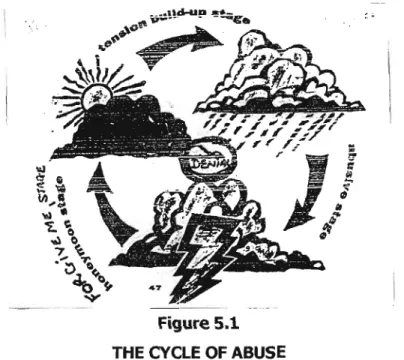
The most striking difference between the cycle of abuse in female-abusing relationships and in male-abusing relationships was during the honeymoon period. Certain myths surrounding abuse were identified to have been prevalent in the study participant's explanations of abuse.
Introduction
Why do Men Stay?
The graph below represents those reasons that the participants cited for staying in the marriage. FAMSA (1997) and Mullender (1996) also found that the abuser was usually very emotionally dependent on the victim and rarely wanted to end the relationship.
Victims' Coping Mechanisms
In addition, Ferraro (in Cardarelli, 1997) found that turning to the law did not necessarily provide protection for the victim. He discovered that by understanding the abuse, he could deal with it better.
Help Sought by Participants
- Religious/Cultural leaders
- Criminal justice system
- Professional counselling
Andrew was so stunned by "the lies" his wife told during the trial to finalize the protection order that he did not tell the magistrate about the abuse he was experiencing. Fineman and Mykitink (1994) and Edwards (1989) supported these findings and added that the police were rarely helpful to victims of domestic violence.
APPROPRIATE SERVICES
Conclusion
The main conclusion of the study was that husband abuse was similar to wife abuse in many ways. The research participants were physically, emotionally, sexually, financially and verbally abused by the perpetrators.
Recommendations
What becomes clear is that the implementation of the Domestic Violence Act was hugely problematic. Such training and retraining will also limit the level of secondary victimization experienced by victims of domestic violence.
Conclusion
Petretic-Jackson, P.A &Jackson, T.(1996).Mental health interventions with battered women.ln Roberts, AR.(Ed).HELPING BATTERED WOMEN. In Cardarelli, AP.(Ed).
DEVELOPMENTAL SOCIAL WORK IN SOUTH AFRICA: THEORY AND PRACTICE.David Philip Publishers: Cape Town
I am currently studying for a Master's Degree in Social Sciences at the University of Natal (Dbn), and researching male abuse in the greater Durban area. The research study aims to explore and understand these men's experiences, in order to help professionals effectively help victims of male abuse.
