The most important limitation was the listed peanut rosette disease, which was widespread in the region. Determining genotypic variability among landraces for agromorphological traits and walnut rosette disease resistance.
LITERATURE REVIEW
Introduction
Origin and distribution of groundnut
Groundnut botany
- Taxonomy
- Reproduction in groundnuts
- Genetics of groundnuts
The flower is inserted at the top of a pedicel which bends down and pushes the flower to the ground after pollination and fertilization where it produces the seed (Stalker, 1997). The flower petals fall and the fertilized ovary elongates after fertilization, forming the spike (Beattie and Beattie, 1943; Rao and Murty, 1994).
Groundnut production
- Importance of groundnut
- Groundnut production constraints in Mozambique
In addition, herbicide application, when available, is also recommended for weed control (Kokalis-Burelle et al., 1997). Not only the yield of peanut, but also the quality of products decreases under drought stress (Rucker et al. 1995).
Groundnut rosette disease
1992) reported three types of groundnut rosette, namely chlorotic, green and mosaic, while Naidu et al. 1999) reported that there are two predominant types of rosette disease symptoms of peanut, namely chlorotic rosette and green rosette. Different satellite RNA variants of peanut rosette virus are responsible for chlorotic and green forms of peanut rosette disease (Murant and Kumar, 1990).
Resistance to groundnut rosette disease
In chlorotic rosette, the leaves show a bright yellow chlorosis (the limbs of the leaves are chlorotic with green spots and the veins are green and conspicuous) that can affect the entire leaf or only parts of the leaf. Such genotypes are not immune, do not develop symptoms and can be overcome under high disease pressure or adverse environmental conditions (Bock et al., 1990).
Breeding for resistance to groundnut rosette disease
Methods for detecting groundnut rosette virus
Such genotypes are not immune, do not develop symptoms and can be overcome under high disease pressure or adverse environmental conditions (Bock et al., 1990). symptomatology and transmission tests) and intrinsic properties of the virus itself (coat protein and nucleic acid). The new techniques enable the detection of the complex of the three agents involved in the groundnut rust disease, namely GRV, GRAV and sat RNA (Naidu et al., 1999).
Groundnut rosette management
About a week after the emergence of the seedlings in the field, raised rose diseased plants in the greenhouse, heavily attacked by A. Cultural methods have been shown to be effective in reducing the incidence of peanut rose disease (Ntare et al., 2007). .
Mating design
The use of cultivars resistant to peanut rosette disease can enable peanut growers to save money that would otherwise be spent on insecticide purchase and application. Also, reducing insecticide use can avoid environmental contamination as well as allow the growth of natural enemies of virus vectors.
The diallel cross
If parental homozygosity is assumed and no multiple allelism is also assumed, then the additive genetic variance can be partitioned into further components (Mather and Jinks, 1971).
Combining ability analysis
Combining ability studies in groundnut
Different variants of the satellite of peanut rust virus are responsible for the chlorotic and green forms of peanut rust disease. Groundnut rosette: Disease response and inheritance of resistance of groundnut genotypes to groundnut rosette virus and groundnut rosette Assistor Virus.
GROUNDNUT (ARACHIS HYPOGAEA L.) PRODUCTION CONSTRAINTS
Introduction
Similar reasons for low adoption of new groundnut cultivars were reported by Ntare et al. The participatory approaches involve supporting communities in their efforts to set and achieve their own development goals (Hagmann et al., 1999).
Materials and methods
- Study area
- Data collection
- Data analysis
In addition, a survey was conducted to determine the prevalence of groundnut rust disease in the region. In addition, a groundnut rust survey was conducted between March and early April in the 2010/2011 growing season in the region.

Results
- Gender and age distribution
- Area under cultivation and crops grown
- Groundnut production
- Preferred traits for groundnut cultivars
- Groundnut production constraints
- Groundnut rosette disease prevalence in the Northern region of
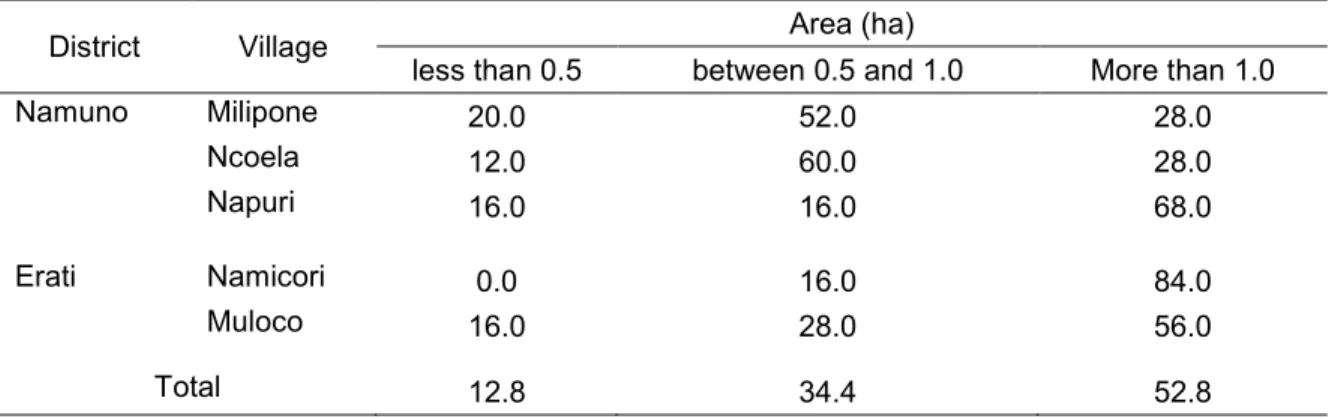
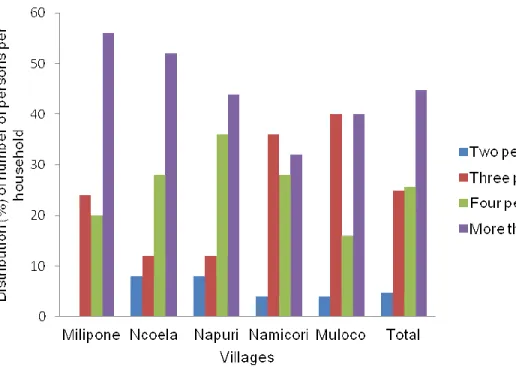
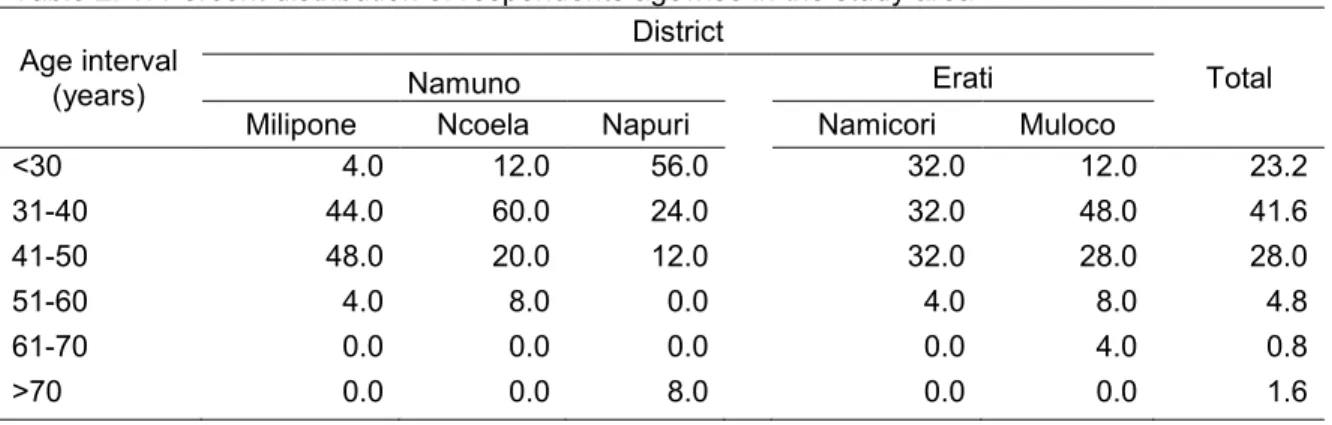
The percentage distribution of the number of people per household in the study area is shown in Figure 2.3. Several production constraints affecting groundnut production were mentioned by farmers in the two districts (Table 2.5). Lack of new improved varieties was ranked fifth out of approx. 8% of women and a sixth of approx. 9% of men as a problem affecting groundnut production in the two districts.
Discussion
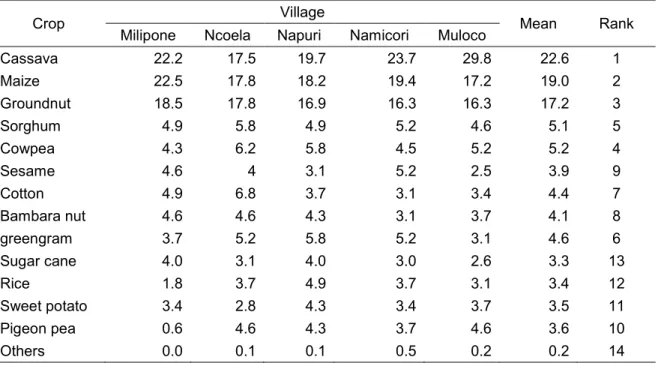
Intercropping (mixed cropping) was found to be the most common cropping system practiced by farmers in both the districts. Métier (2005a, b) confirmed that groundnuts were grown in all three main cultivation systems described in Namuno and Erati, which is an indication of the importance of groundnut crops in the region. This is an indication that crops grown in the region, although important for food security, were grown in small fields.
Conclusions
They must feel that they are active partners in the research, and they must lead the direction of the research. Rethinking the farmer's role in plant breeding: local bean experts and on-station selection in Rwanda. Breeding raifed rice for drought-prone environments: integrating conventional and participatory plant breeding in South and Southeast Asia, Center for Arid Zone Studies (CAZS), University of Wales, Gwynedd, LL57 2UW, UK, Los Banos, Laguna, Philippines.
EVALUATION OF NORTHERN MOZAMBIQUE GROUNDNUT (ARACHIS
Introduction
The identification of genotypes resistant to groundnut rosette disease would be an important part of genetic improvement of groundnuts in Sub-Saharan Africa, including Mozambique, where the disease is endemic. Sources of resistance to groundnut rosette disease have been identified at ICRISAT (ICRISAT, 1991; Ntare et al., 2007). Therefore, it is necessary to evaluate a number of landraces to identify genotypes with desirable traits such as resistance to groundnut rosette disease, medium to large seed size, early maturity and high oil content.
Materials and methods
- Groundnut genotypes
- Study area
- Field establishment
- Data collection
- Data analysis
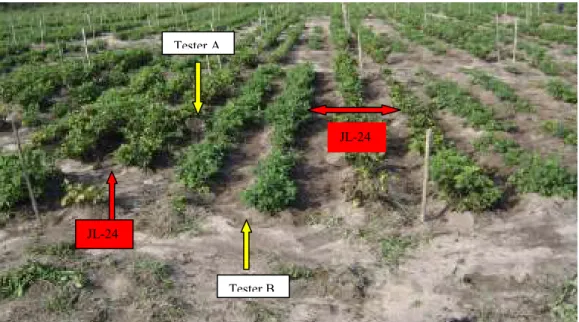
Two replicates were used to keep the experiment size manageable due to the number of accessions and the design of the infector bar, where each test line is surrounded by an infector, which made the experiment quite large. Yield was determined for each peanut genotype at the end of the maturity period by shelling and weighing the sun-dried seeds. Pod narrowing 0=none; 3=slight; 5=moderate; 7=deep; 9=very deep. Taken from fully ripe pods. Pod beak 0=none; 3=slight; 5=moderate; 7=visible; 9=very distinct record holder from fully ripe pods Stem color* 1=purple; 2=green; 3=mixture of both Recorded on mature main stem.
Results
- Phenotypic variation among groundnut landraces
- Yield and yield components
- Clustering based on agro-morphological traits
- Correlations among quantitative traits
- Evaluation under high groundnut rosette disease pressure
- Correlations among quantitative traits under disease pressure
- Classification of genotypes with respect to resistance to groundnut rosette
The mean yield and yield components were significantly (P<0.05) different between the groundnut genotypes (Table 3.3 and Appendix 3). There were significant (P<0.05) differences between the genotypes in the incidence of groundnut rosette disease (Table 3.6 and Appendix 4). Four genotypes (PAN-4, Imponge-4, Pambara-3 and Metarica Joao) had an incidence of groundnut rosette disease of less than 10.
Discussion
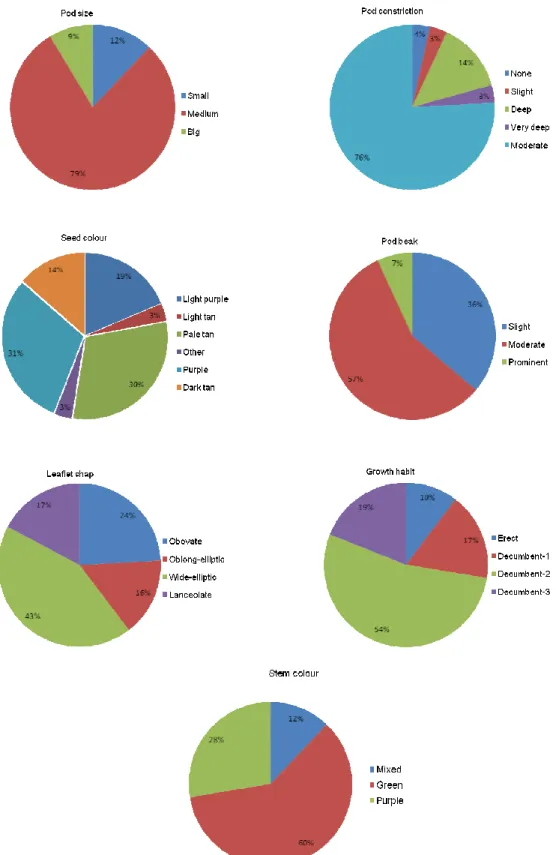
This suggests that the genotypes show high phenotypic diversity and therefore can be used in hybridization and selection programs for various traits (Swamya et al., 2003) in addition to walnut rosette disease resistance. Groundnut genotypes were classified into resistance groups based on disease incidence (Waliyar et al., 2007). Genotype reactions observed during the experiment consisted of symptomless plants, deformed leaves, stunted plants and chlorotic plants (Dollet et al., 1986).
Conclusion
Based on this grouping, genotypes PAN-4, Imponge-4, Pambara-3, Metarica Joao were classified as resistant to groundnut rust disease. Fourth Meeting of the Consultative Group on Collaborative Research on Groundnut Rosette Virus Disease, ICRISAT, Montpellier, France. A satellite RNA of peanut rust virus largely responsible for symptoms of peanut rust disease.
MULTILOCATIONAL EVALUATION OF ADVANCED GROUNDNUT LINES
Introduction
Groundnuts are one of the main cash crops and the main source of vegetable protein for more than 90% of rural households in Mozambique (ADAP-SF, 2006). Groundnut production in Mozambique fluctuates annually due to the uncertain rainfall pattern and the sensitive behavior of genotypes to different environmental conditions. The main objective of this study was to determine the yield stability and response pattern of advanced lines in environments in northern Mozambique.
Materials and methods
- Study area
- Groundnut genotypes evaluated
- Field establishment
- Data collection
- Data analysis
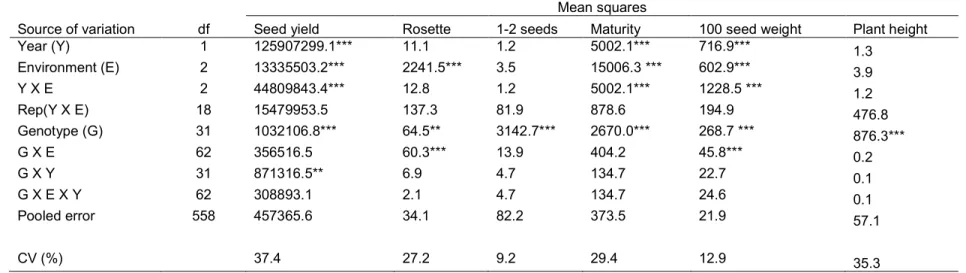
The number of pods in each of the two groups was counted and the data converted into percentages. The yield was determined for each advanced line at the end of the ripening period by shelling and weighing the dried seeds. GYjl = Interaction effect of lth genotype and jth year; GEYijl = Interaction effect of lth genotype, ith environment and jth year; εijkl = Experimental error.
Results
- Combined data across locations and seasons
- Analysis of variance
- Phenotypic variation
- Yield, yield components and rosette disease incidence
- Data for individual locations
- Analysis of variance
- Mean yield, yield components and rosette disease incidence
- Correlations among agro-morphological traits
- GGE biplot and stability analysis for yield across locations
Average seed yield, 100 seed weight, pod maturity and groundnut rust disease incidence are shown in Table 4.3 and Appendix 5. Groundnut rust disease incidence at the three sites over two years was generally very low and varied between 0.4 and 6.5. Average yield and 100 seed weight over the two years across locations are shown in Table 4.5a.
Discussion
Eberhart and Russell (1966) also indicated that a genotype is stable if the regression coefficient is equal to or close to unity. In this study, six genotypes (4A, 35B, 13A, 16A, 15A and 27A) had a regression coefficient around unity, suggesting that these genotypes could be grown in a wide range of environments. 2009) reported similar results in Pakistan, with genotype ICGV-92040 being stable across environments, as it had above-average yield performance, small variance deviation, high coefficient of determination value and regression coefficient around unity.
Conclusion
Stability analysis for yield and yield components of selected groundnut breeding lines (Arachis hypogaea L.) in the northern province of Cameroon.
INHERITANCE OF RESISTANCE TO GROUNDNUT ROSETTE DISEASE IN
- Introduction
- Materials and methods
- Study area
- Germplasm development and field establishment
- Data collection and analysis
- Results
- Combining ability analysis for groundnut rosette disease incidence
- Segregation for groundnut rosette disease incidence
- Discussion
- Conclusion
This indicated the dominance of additive gene action in the inheritance of resistance to groundnut rust disease. The resistance to groundnut rust disease is controlled by two recessive genes (Nigam and Bock, 1990; This indicated the dominance of additive gene action in the inheritance of groundnut rust disease.
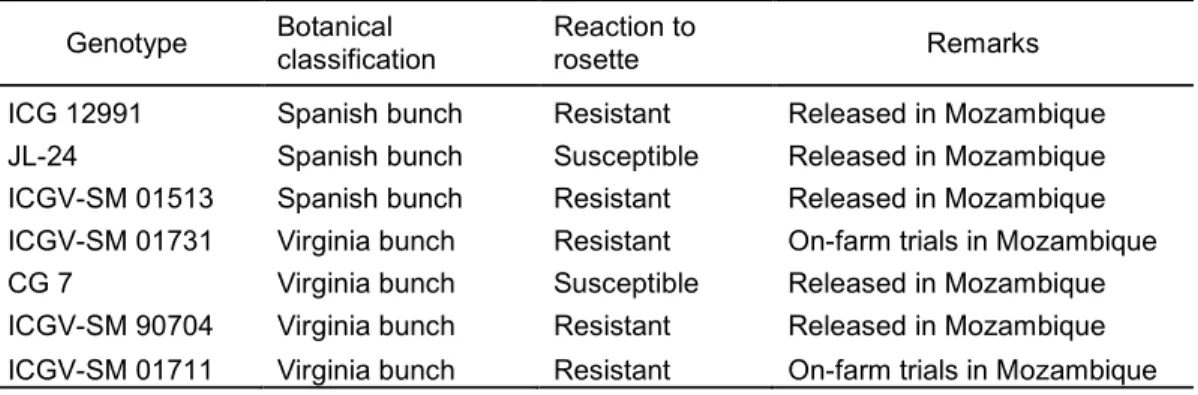
GENERAL OVERVIEW
75B Light Violet Yellow-Orange Lanceolate Decumbent-2 Medium Moderate Light Violet Cuamba Lurio Eugenio Light Violet Yellow-Orange Broad Elliptic Prostrate-2 Medium Deep Moderate Green. Nacate-2 Dark Brown Yellow-Orange Broadly Elliptic Oblong-1 Medium Moderate Moderate Green Nacate_3 Pale Brown Yellow-Orange Obovate Oblong-3 Medium Moderate Prominent Mixed Namuno-1 Dark Brown Yellow-Orange Oblong-Elliptic Oblong-2 Small Moderate Moderate Green . Pambara-5 Purple Yellow-Orange Broad Elliptic Oblique-1 Medium Moderate Moderate Purple Pambara-6 Purple Yellow-Orange Oblong Elliptical Oblique-2 Medium Moderate Moderate Purple.
Participatory rural appraisal questionnaire
Morphological variation of local groundnut landraces
Yield and yield components of local groundnut landraces
Combined ANOVA for advanced groundnut lines