Green Zone Nation: The Securitisation and Militarisation of the 2010 FIFA World Cup, South Africa
A thesis submitted in fulfillment of the requirements of the degree of
DOCTOR OF PHILOSOPHY
of
RHODES UNIVERSITY
by
CHRISTOPHER BRYDEN McMICHAEL
May 2012
i
ii Abstract
This thesis explores the relationship between the safety and security measures for the 2010 FIFA World Cup and the militarisation of urban space and policing in post-apartheid South Africa. In particular, it focuses upon how the South African state and FIFA, the owners of the World Cup franchise, worked to present the World Cup as an event which required exceptional levels of security – resulting in a historically unprecedented joint police and military operation across host cities.
However, in contrast with previous research on these security measures, this thesis aims to interrogate the political and commercial forces which constructed security and positions them against a backdrop of intensified state violence and social exclusion in South Africa. Concurrently, the South African case was indicative of an international militarisation of major events, with policing operations comparable to national states of emergency. This is representative of the ‘new military urbanism’ in which everyday urban life is rendered as a site of ubiquitous risk, leading to the increased diffusion of military tactics and doctrines in policing and policy. While the interpenetration between urbanism and militarism has often been studied against the context of the ‘war on terror’, in the case of South Africa this has primarily been accelerated by a pervasive social fear of violent crime, which has resulted in the securitisation of cities, the remilitarisation of policing and the intensification of a historical legacy of socio-spatial inequalities. The South African government aimed to use the World Cup to ‘rebrand’
the country’s violent international image, while promising that security measures would leave a legacy of safer cities for ordinary South Africans. The concept of legacies was also responsive to the commercial imperatives of FIFA and a range of other security actors, including foreign governments and the private security industry. However these policing measures were primarily cosmetic and designed to allay the fears of foreign tourists and the national middle class. In practice security measures pivoted around the enforcement of social control and urban marginalisation while serving as a training ground for an increasingly repressive state security apparatus. Security was as much a matter of fortifying islands of privilege and aiding a project of financial extraction as protecting the public from harm.
iii Table of Contents
Abstract ii
Table of Contents iii
List of Abbreviations iv
List of Figures vi
Acknowledgements vii
Chapter One: The Construction of Security and Academic Responses to the 2010 FIFA World Cup 1 Chapter Two: Emerging Critical Perspectives on Mega-Event Security 27
Chapter Three: Mega-Events and the Fortress City 52 Chapter Four: Cities of Fear and the New Military Urbanism 63
Chapter Five: Methodology 78
Chapter Six: The Security Governance of the 2010 FIFA World Cup, South Africa 81 Chapter Seven: Manufactured ‘Exception’ and the Securitisation of the 2010 World Cup 119
Chapter Eight: The 2010 World Cup – Occupation or Convergence? 147
Chapter Nine: The Militarisation of the 2010 World Cup 180
Conclusion 218
References 229
iv List of Abbreviations
ACSA Airports Company South Africa ANC African National Congress APCO Association of Chief Police Officers APP Advanced Passenger Processing
ATA Anti-Terrorism Assistance Program
AWB Afrikaner Weerstandsbeweging (Afrikaner Resistance Movement) CBRNE Chemical Biological Radiological Nuclear Explosives
COSATU Congress of South African Trade Unions
CSVR Centre for the Study of Violence and Reconciliation CPA Coalition Provisional Authority
CTED United Nations Security Council’s Counter Terrorism Executive Directorate
DA Democratic Alliance
DLF Democratic Left Front
ESKOM Electricity Supply Commission
FIFA Fédération Internationale de Football Association GCIS Government Communication and Information System GIS Geographic Information System
IAEA International Atomic Energy Agency ICC International Convention Centre
IMEST INTERPOL Major Event Support Team INTERPOL International Criminal Police Organisation IOC International Olympic Committee
IPO International Permanent Observatory (on Security During Major Events) ISS Institute for Security Studies
JCPS Justice Crime Prevention and Security Cluster JIM Joint, Interdepartmental and Multinational Exercises
KZN KwaZulu-Natal
LOC Local Organising Committee
LOCJOINTS Local Joint Operational and Intelligence Structure
v MCS Movement Control System
NATJOINTS National Joint Operational and Intelligence Structure NED National Endowment for Democracy
NIA National Intelligence Agency
OCED Organisation for Economic Co-Operation and Development OIC Office for Interception Centres
PMG Parliamentary Monitoring Group POP Public Order Policy
POPCRU Police and Prisons Civil Rights Union
PROVJOINTS Provincial Joint Operational and Intelligence Structure ROV Remote Operated Vehicle
SAAF South African Air Force SAS Special Air Services
SAAS South African Secret Service
SACAA South African Civil Aviation Authority SADC South African Development Community SAFA South African Football Association SAIRR South African Institute for Race Relations SAN South African Navy
SANDF South African National Defence Force SAPA South African Press Association SAPS South African Police Service
SARPCCO Southern African Regional Police Chiefs Cooperation Organisation SIGNET Signals Intelligence
SOCOM United States Special Operation Command SWAT Special Weapons and Tactics Team TRA Temporary Relocation Area
TETRA Terrestrial Trunked Radio TRT Tactical Response Team UAV Unmanned Aerial Vehicle
vi List of Figures
1. Safety hard hats in the boardroom of the Nelson Mandela Stadium, 2009. Christopher McMichael,
2009 100
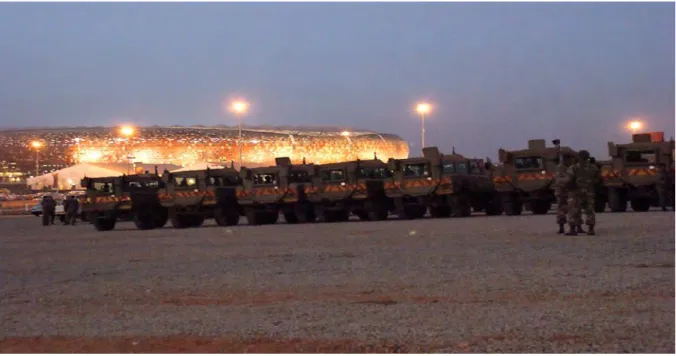
2. SAPS officers inside the Cape Town Exclusion Zone. Christopher McMichael, 2010 100 3. Stallion Security guards preparing to go on strike, Cape Town. Christopher McMichael, 2010 115 4 a and b. Two faces of policing. SAPS Corporate Branding and Design, 2010 128-129 5. Metro police vehicle purchased for the 2010 World Cup. Christopher McMichael, 2010 155 6. Security checkpoint at Cape Town stadium. Christopher McMichael, 2010 164 7. SANDF armoured personal carriers outside Soccer City. David Durbach, 2010 170
8. SAPS officers in ‘Robocop’ body armour. David Durbach, 2010 170
9. Security stop and search at the Nelson Mandela Bay Stadium, May 2010. Christopher McMichael,
2010 195
10 and 11. Security checklists on official tickets and outside stadiums. Christopher McMichael, 2010 196
12. Joint SAPS and SANDF training mission. defenceWeb, 2010 208
13. SAPS officers with ‘Robocop’ armour at COP 17, Durban, 2011. Jeanne Hefez, 2011 213
vii Acknowledgements
At Rhodes University, I would like to thank my supervisor Louise Vincent, for her guidance and support and for always pushing me to improve my writing. I would also like to thank the Department of Political and International Studies and the Post-Graduate Finance Division, and in particular John Gilliam, for funding my research. Richard Pithouse’s continual mentorship was also instrumental in seeing the thesis through, especially during some rough periods.
This thesis would have also not been possible if not for the continued support of my parents and my brother Luke.
I would also like to thank Chris Gaffney, Carolyn Smith, Jane Duncan and Mark Neocleous for their comments, suggestions and encouragement. I am also very grateful to Marcelo Lopes de Souza and Kevin Haggerty for kindly providing me with access to pre-publication materials. Special thanks also to Mabake Masweneng for the great interview. I would also like to thank Andy Grewar for his editing and Dave Durbach and Jeanne Hefez for letting me use their photos.
Parts of the thesis, in very different form, have appeared in Freedom Press, The KZN Mercury, Mahala, Thoughtleader and openDemocracy. I would like to thank the editors at these publications for providing me with a platform to test early versions of the work included here.
There are far too many friends who have supported me over the last three years to list here. But in particular I would like to thank Lauren Edwards and Nicholas Kerr. In Cape Town, I would like to once again thank Matthew Barge, Bridget Calder and Alain and Andre Van Heerden for their amazing hospitality. In Grahamstown and further afield, I would like to thank everyone from Students for Social Justice and the Unemployed People’s Movement. Also deserving of special mention are Robert Cairns, Scott Chapman, Liane Halton, Liam Brickhill, Jarret Erasmus, Etai Even-Zahav, Kb Ninjurai, Iain Coughtrie, Tarqyn Human, Thapelo Tselapedi, John Bazley, Joni Els, Tim Gabb, Shameez Joubert, Simon Kerr, Jared Sacks, Alex Lenferna, Ben Fogel, Simone Levy and Ayanda Kota.
viii
State-of-the-art information and communications military technology is being used to secure the tournament. The investments you see today and will be seeing during the tournament will continue to assist the police in their crime-fighting initiatives long after the World Cup is over. Because after all, we still want our visitors to come and experience the beautiful beaches, restaurants, hotels, stadia and the warmth of the people of our land.
– Minister of Police Nathi Mthethwa, May 31, 2010.
Arthur: ... his subconscious has militarised. It should have shown in the research.
– Inception. Directed by Christopher Nolan, 2010.
1
Chapter One: The Construction of Security and Academic Responses to the 2010 FIFA World Cup
Introduction
As Mark Neocleous (2011: 192) argues, the perceived need to ‘secure insecurity’ is one of the key political tropes of our age and is fundamental to every aspect of contemporary society. ‘Security’ is a concept which occupies a central place in international, national and local political agendas.
Increasingly intersecting and fusing both public and private institutions, ‘security’ has become a catch-all phrase which refers to a staggering range of activities and policies.
But as this thesis aims to argue, ‘security’ is not a neutral, explanatory term but is a contested social terrain and a source of considerable political and economic power. This introductory chapter will begin by arguing for a theoretical framework in which security is discussed as a constructed concept used to advance specific political and economic projects. Central to this advancement is the
‘securitisation’ of issues which are treated by authorities as existential threats which, in turn, are utilised to win public support for exceptional policy measures. This chapter will focus on how the discursive creation of a security ‘narrative’ is a central foundation in the deployment of these
measures, and will use ‘terrorism’ as the key exemplar of a contemporary existential threat. This will use a ‘conflict theory’ approach which emphasises the role of security in upholding unequal power relations in society.
The chapter then moves to a case study of how political commentators and security ‘experts’
interpreted the security measures for the 2010 FIFA World Cup, the international tournament for men’s association football held in South Africa between the 11 June and 11 July, and will argue that it is surprising that the security measures for the tournament have inspired relatively little critical academic interest in South Africa. Notably, the security operations in place during the event have not been linked to the on-going militarisation and increased influence of the state security apparatus on public policy. As a comparison point, I will discuss how this absence contrasts with the large body of critical literature on the socio-economic and developmental implications of the 2010 World Cup.
Instead, security was presented as a transcendent social good, which was mostly separate from political manipulation and economic exploitation.
As evidence I will use the available research which analysed the security measures surrounding the event. In particular, I will focus on the output of the Institute for Security Studies and the South African Institute for Race Relations, two ‘think tanks’ often cited as expert sources in both the national and international media. Besides providing a survey of the literature on the 2010 World Cup
2 security measures, this will be used to show how the discursive framework for security is influenced and shaped by political and ideological structures, systems and assumptions. In conclusion, I will argue that the 2010 World Cup security measures demand a greater level of academic scrutiny and, with this in mind, I will formulate a research question which aims to establish a framework for addressing this discrepancy. The chapter is primarily based on journal articles, research monographs, conference proceedings and a statement made to the media, and is informed by secondary literature from political philosophy, urban theory, international relations and history.
Security as Power Securitisation
Traditionally, academic studies on security have largely been motivated by a set of materialist and instrumentalist assumptions: namely, that ‘security’ refers to already existing phenomena and that the role of research is to identify manners in which governments and other authorities can better control and combat risks (Edjus, 2009). By contrast, the securitisation model associated with the Copenhagen School of international relations theory focuses on security as a ‘speech act’, in which actors
transform a particular issue into a security matter (Buzan, Waever and de Wilde, 1998). Such a model can elucidate how a securitising agent (for example, the South African government) defines an object or event as being threatened (the 2010 World Cup) with the purpose of convincing an audience (the South African public) that an issue needs to be regarded as a security concern. The securitisation of an issue does not necessarily entail a state of crisis or widespread threats to public safety. For example, the state may securitise issues which only effect very limited groups, such as in the efforts to police copyrights and trademark violations. Thus, security becomes ‘a self-referential practice, because it is in this practice that the issue becomes a security issue – not necessarily because a real existential threat exists but because the issue is presented as such a threat’ (Buzan, Waever and de Wilde, 1998:
24).
It is also important to point out that while the term securitisation is often used as a synonym for militarisation, in its original iteration it was a term meant to denote a ‘nominalist signification’
(Bernhard and Martin, 2011: 44). Daniel Bernhard and Aaron Martin argue that securitisation goes beyond physical and governmental signifiers, such as the militarisation of urban areas, and into the complex interactions that determine how ‘threats’ are turned into security matters. They suggest that
‘we must look to perceived threats, representations of danger, the thing declared endangered, and the societal consensus that allows governments to take exceptional measures and emergency action’ (43- 44).
3 Crucially, in ‘saying security’ or performing the action of securitisation, issues are presented as an existential threat to the state as well as the established social order. In practice, however, this often amounts to the declaration of emergency conditions in order to claim the right to take any available means necessary to control or block an emergent threat. The ‘security move’ is used to frame an issue
‘either as a special kind of politics or as above politics’, with the concomitant effect of presenting the risk as beyond debate or discussion (Buzan, Waever and de Wilde, 1998:23). The importance of emergency measures to securitisation overlaps with Giorgio Agamben’s (2005) work on ‘exception’, in which the suspension of established legal, political and social checks on state power are legitimated by reference to their supposedly temporary and conditional nature. Once established, however, these
‘emergency’ powers become normalised as everyday techniques of governance. As security works to redraw and redefine the boundaries of power and to shift the upper limit of what is permissible, politics can then be seen to ‘work towards the production of emergencies’ (Agamben, 2001). The securitisation of an issue does not necessarily mean that the state will push past established political and legal thresholds; rather, the discourse created around a security issue means that enough
resonance is created for such emergency measures to be presented as a possible and justified response (Buzan, Waever and de Wilde, 1998: 5).
Positioning security in these terms allows for a move from an instrumentalist conception of security – in which the role of academics and theorists is to critique the actions of securitising agents in order to offer advice for more ‘effective’ future policing and military actions – towards a more constructivist approach which argues that security is not an objective area of analysis or development. Security can be reframed as a set of critical questions: which power relations determine how certain issues are securitised, and which actors benefit from this level of securitisation? Such questions become all the more pertinent when we consider the extent to which security serves as a legitimating factor in the power of a range of interlinked social actors.
Two aspects in particular demand attention. Firstly, critical studies of security have moved away from the state-centric focus of the Cold War towards a more multi-faceted understanding of the diffuse alliances and convergences between the state and the private sector. For example, Peter Gill (2006) has traced the contours of ‘global security networks’ which intersect across local, national and transnational scales. These networks link the state, the corporate sector and communitarian actors (such as NGOs) who perform a range of security functions in the contexts of both military actions and civilian policing (30). The ‘broadening’ of security governance is ‘deepened’ by transnational security developments, which can have an immediate impact on the national scale (ibid). For example, the
‘global war on terror’ has had a profound effect on security doctrines and practices internationally, which began almost immediately after the events of September 11th 2001. The globally interlinked nature of security has also been accelerated by the creation of what the Organisation for Economic
4 Cooperation and Development (OCED) (2004) calls the ‘new security economy’, as risk prevention services become an increasingly prominent motor for economic development. The role of the private sector has sparked considerable controversy due to the extent to which security is linked to private profit.
However, Marcelo Lopes de Souza (2011) has argued for a more expansive definition of the ‘industry of fear’ by linking this industry to three key actors:
a) Political and government groupings such as state security services, the legal system and political parties;
b) The security industry, which Souza defines as including everything from the manufacturers of surveillance equipment to spatial constructs such as gated communities;
c) The mass media, which circulate official security discourse and often rely on sensationalist reporting of risk to increase circulation.
Security is a saleable and lucrative product and increasingly intersects the nation state with
transnational bodies and private institutions. In addition, the manner in which aspects and elements of social life are treated as security concerns also has a psychological aspect, as the combined ‘industry of fear’ responds to political and economic anxieties and pathologies.
The production of security
The sheer scope of actors involved in ‘delivering’ security leads to a second key point: securitisation measures do not arise sui generis in reaction to objective, given phenomena but are rather identified and shaped by institutions and organisations. This is underpinned by the creation of knowledge, as actors attempt to capture public opinion and popularise security agendas. In a critique of ‘think tanks’, Peter Vale and Jonathan Carter (2008) argue that such institutions aim to market knowledge through framing social issues as security ‘problems’. Such institutions gain a great deal of traction in the media by offering slickly packaged ‘technical’ advice to explain complex issues, from rising crime rates to geopolitical conflict. However, this ‘expert’ advice often conceals ideological bias as well as widespread support from networks of donors and foundations eager to shift the discursive terrain of security in their favour. Vale and Carter contrast the proselytising of the self-interested forms of knowledge produced by think tanks with the ‘serious scholarship’ of ‘mainstream academic work’, suggesting that the public is not readily able to draw distinctions between the work produced by for- profit think tanks and that created by universities
5 But neither is the position of ‘mainstream’ academia unassailable. In his essay Objectivity and Liberal Scholarship, Noam Chomsky (1969) famously argues that the academic intelligentsia is just as often driven by political and ideological motives, citing the justifications used by scholars for US military interventions as evidence. Rather than critically and objectively studying government policy, academics may use specialist knowledge to legitimate autocratic rule, which is further entrenched in some cases by academic proximity to governments and foreign and public policy making. In
particular, Chomsky suggests that a fear of direct democracy and public control over decision making is shared by elites, on both the right and the left, who may otherwise appear actively oppositional towards each other. In this sense, ‘security’ provides an umbrella under which competing elites can cohere as similar authoritarian dispositions are folded into otherwise very different ideologies and belief systems. Chomsky cites historical cases such as the Spanish Revolution – where liberal, conservative and Stalinist intellectuals all denigrated and impugned the centrality of the anarchist movement – as an example of this type of convergence.
A more contemporary example can be located in the ‘war on terror’, in which the security measures justified by an ‘existential threat’ have been adopted by governments the world over and reinforced by elements of the media and academia who, in other cases, may appear to share little common ground on other political and economic issues. By adapting William Connolly’s (2005) model of
‘resonance machines’, it can be suggested that the sharing of security agendas by different actors works to sustain and amplify a powerful assemblage of opinion. The continual re-articulation of opinion creates a powerful bulwark to augment official security narratives in serving to present these discourses as existing independently of social and political construction. The presentation of security as an arcane knowledge base that is interpreted and relayed by experts and pundits also performs a powerful control function in delimiting public discourse.
Terrorism as existential threat
As the securitisation thesis highlights, the declaration of emergency is used to present ‘existential risks’ as outside of political causality and understanding. Once again, terrorism provides an example:
the post-9/11 panic around terrorism has ensured that commentators who write about the phenomenon with ‘anything less than total horror and condemnation’ may find themselves attacked as ‘conspiracy theorists’ or guilty of ‘moral equivalence’ (Carr, interviewed by Barrett, 2007). But as with ‘security’, terrorism is a fluid and often contentious concept. As Matt Carr (2007) argues in his exhaustive history of terrorism, the political violence used by small groups is often overshadowed by the extreme overreactions of governments. The official portrayal of international networks of terror cells
continually working to destroy civilisation, which stretches back to panics about a ‘black
international’ of nihilist and anarchist bombers in the late 19th century, has historically been adopted
6 by the state to increase repression, to delegitimise oppositional forces and in some cases to disguise official complicity in political violence.
Since the events of 9/11, the war on terror (or more specifically, the ‘war’ on Islamic extremism) has become the premier existential threat of our age within global political rhetoric. Politicians and commentators often discuss terrorism as a static concept in which a single entity such as al-Qaeda controls an international network of violence. But Jason Burke (2007:13) argues that the phenomenon of al-Qaeda is actually fluid and protean, as it refers both to a factitious coalition of competing radical Islamist groups and to a particular world view and set of methods within the ‘most extreme end of Islamic militancy’. However, the official portrait of a linked international conspiracy has been used by governments to garner international support for internal repression through claiming that their
opponents are linked to al-Qaeda (15). The securitisation of ‘terror’ transcribes specific acts of violence into a cosmic narrative of menace in which often unrelated phenomena are woven together.
Political violence in Chechnya, Israel, Columbia and Sri Lanka are presented as flashpoints in a continuous global battlefield. Although this violence is, in reality, bounded by specific historical and social contexts, the idea of a transnational menace to civilisation allows security actors to package their own agendas into a global security narrative. The apparently boundless nature of terrorism also legitimates threat assessments which are grounded in speculation and imagination (Furedi, 2007).
Official claims that security must be used to protect against unknowable future threats serves to underline and reinforce narratives of fear by communicating the signal that exceptional measures are required to deal with ‘serious’ yet speculative dangers (Lipschutz, 1999: 11). This often results in a flattening of ‘all violent challenges to established states into one-dimensional condemnation of insurgencies against the “civilised” norm’ which ‘are pathologised, ripped from context or reason’
(Smith, 2005: 159). In turn, this is used to justify exceptional measures and to pre-empt criticism by placing the burden of proof on accounts which challenge official narratives. The concept of security may therefore serve a vital role in the maintenance of political and economic power relations.
Security as social conflict
Increasingly, this politically constructed understanding has led critical scholars to question the idea of security as a discrete entity which can be separated from other aspects of state power and governance.
For instance, Mariana Valverde (2011) has argued that even literature which is highly critical of the repressive uses of security has treated the concept as a singular, if polysemic entity. As a result projects which seek to ensure security are often unstable and contradictory. For example, the
7 increased use of home security technology creates insecurity in other areas as criminals move their activities to less guarded targets. As a result, different kinds of security are visible in different
temporal and spatial scales and these projects may actively work against each other. In turn, Valverde (5) argues that ‘all we can know about security is what people do in its name’ and that research should focus on the practises of governance which are used to ensure security in different contexts.
In an on-going series of works, Mark Neocleous (2000, 2006, 2007, 2011) has developed a critique of the very concept of security. Neocleous argues that ‘security’ is not a composite term to describe a universal human need for protection from risk and danger but is rather a political technology central to the construction of both the modern state and capitalism. Liberal political philosophy has often presented a dichotomy between liberty and security, as evidenced by contemporary debates about how much civil liberty society should be prepared to sacrifice to attain security in the context of the war on terror (Neocleous, 2007). Neocleous suggests that rather than being in conflict, security and the liberal idea of freedom are two sides of the same coin. Liberty (in the sense of higher production,
maximisation of profits and the creation of new opportunities for accumulation) is reliant on security (in the sense of maximising state control, communications and surveillance). Security performs linked functions as it works both to reorder society and to contain the inherent insecurity created by the ever changing nature of capitalist production and accumulation (Berman, 1983). From this standpoint,
‘police power’ is a mechanism for securing class society (Neocleous, 2000). As a result, liberal thinkers have often readily accepted the necessity of absolutist power to ensure both the order and the social subjectivity of capitalist society.
To develop this radical claim, Neocleous argues that the central thread of security since the beginning of European colonialism in the 15th century has been ‘pacification’ (Neocleous, 2011). Although drawn from the terminology of US military planners during the Vietnam War, Neocleous deploys it as a euphemised term that includes the brute force of the colonial wars, which accumulated the resource base for the emergence of capitalism, modern military interventions and the violent suppression of domestic dissent. However, other forms of more subtle coercion are as important to the maintenance of capitalist order, particularly policies which attempt to enforce self-regulation, such as in social security and welfare programmes which attempt to instil thrift and ‘self-reliance’. In practical application, security straddles the boundaries between the domestic and the international as warfare abroad becomes linked to the maintenance of order at home, as can be seen in the extension of internal police powers legitimated by current ‘wars’ on drugs and crime. These become wars where the real battleground is everyday life, in which on-going ‘pacification security jobs’ (2011: 203) are the mechanism for the reproduction of social order. These interlinked security measures – which attempt to maintain order across a range of scales and contexts – suggest that security politics is itself
8 underpinned by structural violence, both overt and inconspicuous, which is central to the maintenance of class society. Security both enforces and orders political and economic power relations.
In doing so, it may expose these power relations as well as the ideas, beliefs and anxieties which underlie them. At the urban scale, for example, Francesc Muñoz (cited in Marcuse, 2007) argues that security becomes:
… a strategy for making visible, through security infrastructure and regulations, which spaces of the city are more valuable and which other spaces are less important or appreciable. In other words, which spaces are economically successful and deserve to be inhabited, visited, consumed and remarked on the city map.
At the same time, the intensity and ferocity with which such containment measures are applied also highlights the role of security as a reaction to popular resistance and struggle. In other words, this is not simply a top-down imposition of control but rather an on-going civil war played out through a range of linked operational theatres (Neocleous, 2011). As Peter Hallward (2010:130) argues: ‘ever since the revolutionary upheavals in late eighteen-century France and Haiti, the history of the modern world has been shaped above all by the determination of our ruling classes to pacify the people they rule’. Securitisation reveals profound anxieties on the part of elites as efforts to exert greater control over social order correspond with the pre-emption of political upheaval.
Using the rubric of class power, Neocleous argues that the conception of security as a transcendent goal mystifies the social processes which create instability and fear. For example, ‘environmental security’ obscures the role of the capitalist system in creating environmental degradation (Neocleous, 2000). Securitisation is inherently depoliticising in the way it frames issues in terms of ‘risk’ and
‘countermeasures’ and shifts discourse away from the political and economic roots of threat and crisis. The ring-fencing of an issue as ‘beyond’ or ‘above’ politics may then be used as a tool to create political docility (Buzan, Waever and de Wilde, 1998). From this standpoint, Neocleous (2000) suggests that recent academic attempts to replace the dominant paradigms of national security with a more representative framework of ‘human security’ replicate many of the authoritarian discourses which they attempt to supplant, and he maintains that critical scholarship should aim to repoliticise issues which have been securitised. This, in turn, accords with the emerging critique of ‘police fetishism’ in critical criminology, which positions security services as a constituent part of societal violence rather than as purely ameliorating institutions (Reiner, 2007).
The pacification model provides a useful point of departure for further research. As Neocleous ( 2011:
192 ) argues, distinct conceptual appropriations of security within different disciplines often leads to a theoretical log-jam, as seen in the ‘range of work which starts with crime-fighting and war-fighting as distinct processes – that is, the “criminological model” and the “military model” – and then struggles
9 to work out how they might be connected’ . In other words, scholars sense that phenomena such as the militarisation of urban space, the privatisation of security, penal forms of social welfare and
regulation, the increased use of surveillance systems and the expansion of punitive state powers at the domestic scale are linked to global processes but have struggled to articulate the exact connections.
Academic Responses to the 2010 World Cup
I will leave these points in the background for the time being, turning instead to a representative case study of how the security measures for the 2010 FIFA World Cup in South Africa were interpreted, discussed and criticised by private security ‘specialists’ and within academic literature and the research output of security think tanks.
In May 2004 Nick Buckles, CE of Group 4 Securicor (G4S), claimed that his company refused to work at the 2010 FIFA Soccer World Cup on the basis of concerns about the tournament’s organisation (Bowker, 2009). Buckles said that his company considered South Africa as the most dangerous country for its employees to work in, ahead of war zones in Afghanistan and Iraq:
South Africa … is a tough, tough place to do business. The whole society is different from anywhere else in the world. We do what we can in terms of protecting the crew, but they get attacked by 16, 17 people at a time sometimes. That’s just the kind of culture they have there
… people don’t really think that security is that key and it should be. It will get better … it’s about educating the market.
Buckles’s dramatic claims were quickly picked up by the international media, which, in the lead-up to the first football World Cup held on African soil, circulated stories of South Africa as both exotic and dangerous (Hammett, 2011). This fearful portrayal was immediately denied by representatives of the South African government and the Local Organising Committee (LOC), who suggested that G4S’s position was motivated by hidden interests. Indeed, G4S’s ‘refusal’ to work in the 2010 World Cup may not have been a matter of choice. In 2007, trade unions around the world called for a protest against the company due to its labour practices in Africa. According to reports, their transgressions included the disregard of labour laws, abusive and unsafe conditions for employees and the refusal to recognise worker organisations (Alliance for Justice at Group 4 Securicor, 2007). As a result of this, unions called for the LOC to boycott the G4S bid to provide stadium security during the 2010 World Cup, with the contract eventually being granted to Stallion Security, a South African-based firm (Bhoola, 2009). Nevertheless, G4S has been successful in winning a 100 million pound contract to provide guards for the 2012 London Olympics (Gibson and Taylor, 2011). However, Southern Africa is not the only region in which the company has been followed by controversy. As a result of the companies close links to government figures, G4S was awarded lucrative contracts for the detention and deportation of asylum seekers and ‘terror suspects’ by the UK government. Their tenure was
10 characterised by the hiring of inexperienced prison guards, the brutal handling of suspects, losing defendants during transfer to trial, the falsification of records about suspect movements and the failure to monitor individuals they were contracted to keep under surveillance (Hughes, 2007: 25-37). More recently, the company acquired further unwanted publicity as a result of the death of Angolan deportee Jimmy Mubenga while in custody, which G4S whistle-blowers attribute to a ‘macho corporate culture that ostracised staff who showed compassion towards detainees or questioned the safety of their treatment’ (Lewis and Taylor, 2011). Despite such ‘shortcomings’, G4S is a private security behemoth, which is the second biggest private employer in the world and the largest in Africa (Careers in Africa, 2011). This incident highlights how the concept of security can be used, and distorted, to pursue economic or political strategies. But while this would appear to provide space for critical research which dissected and exposed the political and economic forces behind the
securitisation of the tournament, this was not to be the case.
Critical perspectives on the 2010 World Cup
Much analysis and discussion has been done on the political and economic underpinnings of other aspects of the 2010 World Cup preparations. Since the tournament was awarded to South Africa in 2004 (after a failed bid in 2000), the government maintained that the World Cup would be a seminal event for both the country and for the African continent. More pertinently, it was claimed that the tournament would leverage major developmental and economic opportunities for host cities. In addition, the 2010 World Cup was pictured as a symbolic victory for Africa. As former president Thabo Mbeki (cited in Desai and Vahed, 2010: 154) wrote in 2003:
This is not a dream. It is a practical policy … the successful hosting of the FIFA World Cup™ in Africa will provide a powerful, irresistible momentum to [the] African renaissance.
… We want, on behalf of our continent, to stage an event that will send ripples of confidence from the Cape to Cairo – an event that will create social and economic opportunities
throughout Africa. We want to ensure that one day, historians will reflect upon the 2010 World Cup as a moment when Africa stood tall and resolutely turned the tide on centuries of poverty and conflict. We want to show that Africa’s time has come.
Such claims inspired a range of critical interventions which discussed the socio-economic impacts of the event. In the edited volume Development and Dreams: The Urban Legacy of the 2010 Football World Cup (Pillay, Tomlinson and Bass, 2009) – the only academic collection to focus exclusively on the tournament prior to 2010 – three main viewpoints emerged on the legacy offered by the event). As with other mega-events around the world, it was argued that direct contributions of the tournament to economic development were overstated. In particular, serious doubts were expressed about the long- term sustainability of the stadiums built or upgraded for the 2010 World Cup. Secondly, however, it was suggested that government spending on transport and communication ahead of the tournament could create economic benefits for the host cities. Finally, despite the questionable claims made about
11 the financial opportunities, the intangible legacy offered by the 2010 World Cup offered an
opportunity to reduce ‘afro-pessimism’ and to improve South Africa’s global standing: ‘the measure of success will lie not only in being able to manage the 2010 World Cup to world class standards, but also in the ability to assert and embrace a contemporary African culture and identity both at home and on a global stage’ (15).
However, as Du Plessis and Maennig (2009) note in the same volume, the flow of benefits associated with a World Cup are overwhelmingly determined by the contracts which host nations sign with FIFA. This means, in effect, that public money was being used to finance a private project. The role of FIFA in determining the nature of 2010 World Cup preparations is highlighted in the book by a telling incident in 2007, where the organisation claimed that as a result of delayed ‘construction times due to strikes’, cities which had not finished stadiums by ‘required deadlines’ would not be included in the event (Davies, 2009: 37). While Development and Dreams acknowledges the hyperbole which accompanied government claims about the benefits of hosting, the political significance of FIFA’s ability to continually extract concessions from the South African state is never fully explored. Indeed, the dichotomy between the public expenditure and the profits posted by FIFA is assumed as an inevitable component of mega-events. This raises the question of whether the failure of the 2010 World Cup to deliver on many of the initially stated benefits was not so much a matter of missed opportunities as it was an outcome predetermined by the underlying ownership structure of the event.
A range of other work has focused on this relationship and argued that the 2010 World Cup was a characteristically neoliberal project in which sport and non-sport related corporate actors are able to determine the trajectory of public policy. For example, Scarlett Cornelissen (2010) argues that the lack of economic benefits for South Africa was predetermined by the proprietary structure of the FIFA World Cup. The political and economic structures of international sport mean that it is difficult for national authorities to negotiate developmental gains. Brij Maharaj (2011) argues that the
corporate domination of mega-events prevents any direct government intervention that could
potentially restructure tournaments to provide wider societal benefits. In the case of South Africa, he suggests that FIFA was subliminally presented as a philanthropic organisation, which disguised the fact that socio-economic benefits for the majority of South Africans were deliberately exaggerated (see also Du Plessis and Maennig, 2010). This is echoed by labour expert Eddie Cottle (2010:12), who argued that FIFA’s ‘sport exploitation complex’ results in the misuse of public resources and the mistreatment of stadium construction workers. In the case of South Africa, benefits were ‘greatly exaggerated to legitimise a major rip-off and profiteering by FIFA, its corporate partners and local monopoly capitalists’ in particular the construction industry (ibid).
12 As a result, it has been argued that South Africa incurred a substantial loss from hosting the
tournament and that the exertion of more control over hosting arrangements could have leveraged far more direct economic benefits for the state (Sylvester and Harju, 2010). Significantly, all these works portray the South African state as being controlled or directed by FIFA and its corporate partners, rather than an autonomous participant in the planning and implementation of the 2010 World Cup.
The apparently skewed nature of the 2010 World Cup hosting agreements also inspired several polemical accounts, in which FIFA was presented as an essentially criminal organisation which used the government as a vessel for exploitation. Ashwin Desai and Goolam Vahed (2010: 163) claimed that the LOC and the ANC-led government had been steamrolled by the combined power of FIFA and an alliance of local ‘old white capital and the new politically connected black elite who have joined hands in securing lucrative contracts’ and that the state’s opportunity to challenge the unequal power relations of international football had been missed. Putting it more bluntly, Patrick Bond (2010) claimed that FIFA were ‘tsotsis’, a colloquial South African term for a criminal or street thug.
By contrast, political commentator Andile Mngxitama (2010:2) argued that the 2010 World Cup was the high-water mark of a neo-colonial transition in which ‘1994 was a mere change of the drivers of the same state system that was designed to serve a white minority settler population’ and where the apparent submission of the state to FIFA and its partners is a pragmatic ‘ritual’ that is necessary for an elite project of ‘acceptance’ into the ‘white world’ of geopolitical and economic power . Following this, ‘the ANC government, FIFA, our local media, the commentators, academics, and even our own artists ganged up against the people to produce the most elaborate dispossession in modern times’
(ibid).
Critical scholarship has dissected much of the official rhetoric around the 2010 World Cup and concluded that many of the stated benefits were used as a sheath for a project of corporate
accumulation. However, this literature has paid little attention to the safety and security measures.
Although the advertising restrictions enforced as a component of the security measures have been cited as an example of FIFA’s overweening influence over the state (Bond, 2010), even accounts that maintained a pronounced scepticism about the developmental impacts of the 2010 World Cup have presented security as one of the few tangible achievements of the tournament (Cottle, 2010: 6).
Research on security measures
By contrast, direct research on the security measures took an almost entirely descriptive and non- analytical approach towards the unprecedented police and military mobilisation. While studies of the socio-economic impacts of the 2010 World Cup focused on the question of which power groups
13 benefited from the event, the literature addressing security measures pivoted around how the
government could secure the event and whether this could make South Africa safer in the future.
While there were critical voices around the negative socio-economic impact of the 2010 World Cup, the established mainstream of academic security research failed to provide a deeper analysis of the causes of mega-event securitisation.
In the build-up to the tournament, research focused on how the South African government could best implement security measures to allay the fears of tourists and change the international perception of the country as crime-ridden. Ronnie Donaldson and Sanette Ferreira (2007:368) argued that surveys of foreign tourists found that they generally possessed negative impressions of crime in South Africa prior to visiting the country but, by the end of their visits, their perceptions had grown more positive.
Through ‘merging’ safe and secure environments with tourism and leisure spaces, government could capitalise on the economic opportunities offered by tourism (ibid). It was imperative that security was ensured throughout the country during the event in order to create a ‘platform for a complete
transformation of the tourism industry, if dealt with effectively’ (369).
Writing in 2009, Andre Horn and Gregory Breetzke (21) speculated that, while impressive in scope, the ‘iron fist’ security measures that were then in the planning stages had to be constrained by considerations of international branding, as an overly militarised approach may ‘spoil the fun of the tournament for football fanatics and team supporters’. Focusing on the area around the Loftus Versveld stadium in the Tshwane metropolitan municipality, they contended that police measures could be improved by a more localised focus on crime prevention around stadiums rather than the replication of national plans in all host cities. Towards the end of their paper (31), an intriguing speculative point is raised: ‘the crime security plan for the tournament is merely a “strong arm”
tactical plan following the iron fist approach of the existing National Crime Combating Strategy. Is such a police-state approach sustainable after 2010 and is it befitting a democratic society?’. This is presented as a uniquely South African problem due to a perceived inability of the state to formulate an effective crime fighting strategy. However, this significant question about the possibly negative implications of the security measures is not developed further in the paper. Instead, the 2010 World Cup is assumed to be a pivotal opportunity for South Africa. The primary focus for Horn and
Breetzke is the extent to which organisers had incorporated specific locational and spatial knowledge into planning in order to create the conditions for the ‘best’ World Cup ever.
The negative portrayals of South Africa which circulated through the international media and questioned the country’s ability to host a secure World Cup also inspired research which aimed at proving the efficacy of government security measures. The South African branch of the Rosa Luxemburg Foundation (2010) – a research group associated with the German Left Party – aimed to
14 combat perceived stereotyping by producing a research document highlighting the level of
preparations. Citing government and think tank information, the report suggests that despite high crime rates, tourists have historically been insulated from violence when in South Africa. It does, however, raise the speculative possibility of violence aimed at capitalising on the media attention created by the 2010 World Cup:
[although] terrorism is a remote and almost unreal threat [for most South Africans] … terrorism as a potential menace to the World Cup could be vastly underestimated. According to studies, both criminals and terrorists could use the symbolic value of the event to attract or achieve their goals by either carrying out direct attacks, targeting citizens of specific nations (USA and the UK and Denmark and the Netherlands), or setting their sights on less popular venues such as Rustenburg or Nelspruit (3).
The report concludes on an optimistic note by suggesting that many of the security concerns expressed by the media were exaggerated. As a guide to further reading, the report suggests
information from two primary sources: the Institute for Security Studies (ISS) and the South African Institute for Race Relations (SAIRR). These two institutions both produced a substantial amount of literature on the security measures for the 2010 World Cup. In particular, the media traction held by both the ISS and SAIRR meant that their representatives were continually cited in media reports on the 2010 World Cup security measures. Due to their prominence in publicly disseminating, criticising and interpreting policing preparations to the public, their output demands a specific focus.
The ISS and the 2010 World Cup
The ISS is an applied policy research institute with offices throughout Africa. Its self-proclaimed mission (ISS, n.d) is to influence ‘decision makers’ through ‘providing timely, empirical research and contextual analysis of relevant human security issues to policy makers, area specialists, advocacy groups, and the media’. The ISS produces a formidable output of books, monographs, reports and magazines covering the entire range of security issues in Africa. Notably, its personnel are often asked to comment on security concerns in the South African media. The ISS is registered as a non-profit trust, and its funding partners (as of 2009) include the European Union, the governments of China and Japan, and the United Nations (ISS, 2009). The ISS was founded by ex-members of the former South African Defence Force (SADF) in the early 1990s: originally called the Institute for Defence Policy, it changed to its current name in 1996 (Cilliers, 2009).
The ISS maintains strong institutional links to the South African security services, and their conferences on security in South Africa are often attended by high ranking police and military officials. As a result, the ISS is often privy to insider information which is not available from other sources. For example, in the period before the 2010 World Cup, its 2007 ‘Policing in South Africa Conference’ saw detailed presentations on operational planning and strategy by SAPS officials, while
15 a follow-up conference in 2010 was addressed by the Minister of Police Nathi Mthethwa and the Deputy National Commissioner of the South African Police Service (SAPS), Andre Pruis. This level of access also entailed that ISS researchers were able to detail many of the problems accompanying security planning. While the government and the LOC would publicly claim that their coordination on security was seamless and that all role-players were totally committed to success, one ISS monograph (Omar, 2007: 66) recorded that the original liaison committee between the security services and the LOC’s security directorate ‘fell away’ due to officials not attending meetings and a lack of follow-up on agreements. This candid admission was communicated directly by the South African Football Association’s (SAFA) national head of safety and security.
As early as 2006, the ISS held a seminar on safety and security during the 2010 World Cup, which was addressed by the divisional commander of the SAPS’s operational response services (ISS, 2006).
Johan Burger (2007) – an ISS researcher and former assistant commissioner in the SAPS – argued that the 2010 World Cup was a ‘golden goal’ for South Africa. While confident that the security services would be successful in light of their past record of deployment around events such as the 2003 Cricket World Cup, he warned that internal restructuring within the SAPS ‘should not be allowed in any way to impair the ability of the police to perform according to their proven ability’ (6).
In a follow-up seminar, Burger and fellow researcher Bilkis Omar (2009: 9) concluded that while there was some concern about the capacity of the SAPS to deal with crime as well as ‘the protests, strikes and the xenophobic violence which breaks out from time to time’, the planning and success of security services during the 2009 Confederations Cup boded well for the following year. Burger was cited as an expert on World Cup security by major international media outlets such as the BBC (2010a), where he maintained that the ‘impressive’ policing measures put in place would, for the most part, contain criminal violence within specific, poor ‘social context[s]’.
In 2007, the ISS organised a conference on key issues in South African policing ahead of the 2010 World Cup with the full participation of the SAPS, including presentations by international and national police officials. Superintendent Helmut Bayerl (2007) of the Munich Police addressed the audience on the security experience of the 2006 World Cup in Germany. In particular (9), he claimed that security preparations and exercises which tested ‘the limits of feasibility’ prior to the event ensured the success of the coordinated police and military measures. These policing measures focused on crime, hooliganism and terrorism. Notably, this included pre-emptive surveillance on ‘persons classified as dangerous in terms of Islamic extremism/terrorism’ (10). According to the presentation given by SAPS director Frans Gibson (2007:11), the government had already compiled an operational plan ‘based on FIFA’s standards’ and were determined to use security to ‘change the image of the country’ .
16 ISS researchers also produced specialist studies on South Africa’s vulnerability to terrorism. In an online article Anneli Botha (2010) claimed it was prudent to ‘rather overestimate than underestimate’
the threat of terrorism, as attackers often target ‘the event and not the country’. Botha speculated that ethnic communities within South African society could become an internal breeding ground for terrorist organisations, such as Tamil communities sympathetic to violent separatist groups in Sri Lanka or Afrikaners who support white supremacist groups. Specifically, she expressed ‘concerns’
about South Africa’s Muslim community and suggested that ‘pro-Palestinian’ sentiment ‘could be exploited by extremists’. In addition, South Africa’s ‘soft stance’ on counter-terrorism and its commitment to ‘principles associated with a liberal democracy’ raises the possibility that ‘sleeper cells’ have identified the country as an easy target. Botha suggests that people with close relationships to ‘potential suspects’ should attempt to identify tell-tale signs of terrorism, which include ‘isolation and detachment from friends and family members … sudden change[s] in behaviour’ and ‘irritability’.
Spectators at venues are urged to notice suspicious individuals exhibiting ‘nervous behaviour’ and wearing ‘excessive clothing’. While Botha presents her piece as a pragmatic, albeit speculative, guide to potential risk, it reveals the racism and paranoia that often accompanies the discourse of counter- terrorism. Entire groups, and in particular South African Muslims, are presented as a potential enemy within. The unexamined assertion that ‘pro-Palestinian’ sentiment is some form of precursor to supporting al-Qaeda reflects how the war on terror has been used to delegitimise certain political struggles. In this case, armed Palestinian resistance to the Israeli occupation is falsely conflated with an apparent ‘pan-Islamic’ conspiracy to ‘impose a Taliban style theocracy on the Western World’
(Carr, 2007:320). Botha also recycles the claim that civil liberties may undermine counter-terrorism methods. These suppositions are based on admitted over-estimation, using unsubstantiated claims legitimated through an appeal to expert knowledge.
However, other ISS research alluded to the gap between fear and reality which accompanies
securitisation, and how this ambiguity can be exploited by particular interests groups. Chandre Gould and Marlise Richter (2010) argued that the several anti-sex trafficking campaigns which had started ahead of the 2010 World Cup were based on an exaggerated projection of risk. In the case of the 2006 German World Cup, the media claimed that 40,000 women and children would be trafficked into the country for the event, but researchers were able to find evidence of only 5 actual cases of trafficking.
Similar claims were cut and pasted into the South African context with the ‘STOP 2010 Human Trafficking Campaign’, whose glossy internet advertising claimed that 100,000 people would fall victim to trafficking as a result of the tournament. Although the concerns about sex trafficking may have been well-intentioned, Gould and Richter argue that such inaccurate claims distort the public perception and discourse surrounding crime. This specific case raises a significant point about how security knowledge serves as a commodity, as the exaggeration of threat may be used to achieve legitimacy for the projects of institutional actors. If this can be applied to NGOs attempting to gain
17 attention, then it can reasonably be assumed that this also holds true for state and corporate projects.
In particular, security ‘facts’ released by governments and the private sector should be treated with circumspection, as they may employ the same level of exaggeration and dissimulation to advance their institutional agendas.
Towards the end of the 2010 World Cup, the ISS hosted a conference called ‘The Sum of All Fears:
Crime, Security and the World Cup Crisis That Was (n’t)’ which featured contributions from its researchers and the then Deputy Minister of Police, Fikile Mbalula (Spector, 2010). The researchers on the panel concluded that the event had been a security success but that this approach needed to be reconfigured into everyday policing. This corresponds with the stance taken by the ISS towards the 2010 World Cup, as researchers aimed to contribute towards the national effort by suggesting areas of the security strategy which could be improved, while also offering counters to negative portrayals of the government’s preparations. However, as seen in Botha’s piece on terrorism, such a technocratic approach to security, which focuses exclusively on issues of practical implementation, may disguise the power structures which create security and serve instead to further justify and reinforce accepted political wisdom. The proximity of researchers to state institutions may also circumscribe the parameters of accepted discussion.
The SAIRR and the 2010 World Cup
While the ISS generally presents itself as an information clearing house which assists the South African government, the South African Institute for Race Relations has a much a more overt and confrontational ideological standpoint. The SAIRR describes itself as an ‘independent think- tank…[who] seek to use a small amount of private donor money to influence the more effective spending of much larger amounts of public money’ (SAIRR,2011a). Unlike the ISS, it focuses
exclusively on South Africa and produces information on the spectrum of local political and economic affairs: ‘We benchmark ourselves on telling our subscribers today what they will read in the media in two or three years’ time’. Its local donors include foundations set up by powerful business and industrial interests including the Anglo-American Chairman’s fund and the Oppenheimer Trust (SAIRR, 2011b). International funders include the US-based National Endowment for Democracy (NED) and one of its beneficiary organisations, the International Republican Institute (NRI). The NED is funded by the US Federal government and was set up by the Reagan administration to channel funds into influencing elections and civil society in developing countries, which was part of a
diplomatic shift away from overtly supporting military dictatorships and client regimes (Robinson, 1996). The NED both funds and promotes advocacy groups and political parties sympathetic to US political and corporate interests. The SAIRR has received funding from the NED since 1994 (Hearn, 1999: 8). In addition, its NRI sponsor is affiliated to the Republican Party and has been accused of
18 fomenting and funding the 2004 coup d’état against the democratically elected government of Haiti (Blumenthal, 2004). Interestingly, for a non-profit ‘democracy advocacy’ group, the NRI spent $17 million a year on hiring guards from the private military firm Blackwater/Academi to protect its employees in Iraq (Scahill, 2009).
The SAIRR maintains a neoliberal stance on South African politics and advocates the lowering of corporate taxation, the reduction of the social welfare system and labour rights, the privatisation of state assets and the abandonment of the minimum wage (Jeffery, 2010). The SAIRR is particularly critical of the ANC, which in its publications is often described as corrupt, racist and incapable of managing a liberal democratic society. Indeed, SAIRR analysts have a tendency to describe South Africa as perilously close to social and economic collapse and advocate greater power for the private sector to avoid this dystopian scenario (Cronje, 2010a). Fundamental to this analysis is a polarisation between the roles attributed to the state (which is assumed to be bureaucratic and inept) and the corporate sector (which is presented as dynamic and self-regulating).
This was reflected in its employees’ commentaries on the security situation ahead of the 2010 World Cup. According to John Kane-Berman (2006), Chief Executive of the SAIRR, the ANC has exhibited a callous indifference to security and it was ‘a pity that the world soccer authorities did not make a drastic reduction in violent crime a condition of awarding the 2010 World Cup to South Africa’. In another opinion piece (2007), Berman predicted that while policing measures would be successful for the event this would result in the ‘redeployment’ of crime elsewhere, thus adding to the impression
‘that the safety of visitors to the country is of more concern to the authorities than the safety of South Africans’. Ironically, this observation seems closely connected to the left wing critique of the 2010 World Cup as a raid on public spending. After the tournament, however, Berman (2010) praised the safety and security measures for ensuring ‘bobbies on the beat’ and the expeditious assessment of
‘what might undermine the World Cup and [the] steps … taken to minimise the threats’. This success is not attributed so much to the South African government but to the positive ‘colonial rule’ of FIFA, which Berman depicts as enforcing a regime of high standards which had to be adhered to. What this analysis does not make clear is the extent to which FIFA’s ‘regime’ was itself dependent on state planning and resources. Berman echoed a comment made by controversial politician Julius Malema, who the SAIRR has often described as the bête noire of decency and stability in South Africa.
Malema labelled the tournament as an ‘imperialistic activity [by] which people the people come here to exploit the resources of our country’ but added that this was ‘no problem’ as it highlighted South Africa’s capacity to host major events (IOL, 2010a).
In the aftermath of the January 2010 machine gun attack on a bus transporting Togo’s national football team by a separatist militia in Angola, in which the driver, assistant coach and team media
19 liaison were killed, deputy CEO of the SAIRR Frans Cronje (2010b) produced a widely disseminated piece on the threat posed to South Africa by terrorism . According to Cronje, porous and unguarded national borders and a ‘corrupt’ intelligence service meant that South Africa was an attractive target for an attack. Furthermore, the ‘strong Islamic influence’ running along the African coastal belt from Somalia to Cape Town ‘provides ample opportunity for the concealment of terror cells’. Cronje is quick to qualify that this should not be taken to imply that South African Muslims are complicit in terrorism and that ‘in almost every respect the factors that South Africa can control in arranging the World Cup appear to be well under control’. His conclusion reveals an underlying security logic in which the absence of evidence is not evidence of absence:
That is not to say that such an attack will occur or that it is even likely …. But international terrorism is not something over which we have the capacity to exercise much control. In addition, one of the most effective assets that any terrorist group can possess is to convince its next target that they are no longer at risk. South Africans should therefore be a little less hasty to dismiss the risk of the World Cup being targeted and realise that the scourge of global terror applies to all societies and particularly under circumstances such as those pointed out above.
As a result of this piece, Cronje was cited as a ‘security expert’ in media reports on terrorism and the 2010 World Cup. For instance in May 2010, Saudi born Abdullah Azam Saleh al-Qahtani was detained by the Iraqi police. The Iraqi security services revealed that a note found in his house detailed plans for an attack on the tournament and al-Qahtani claimed that ‘We discussed the possibility of taking revenge for the insults of the prophet by attacking Denmark and Holland. The goal was to attack the Danish and the Dutch teams and their fans. If we were not able to reach the teams, then we’d target the fans’ (Abdul-Zahara, 2010). However, al-Qahtani also said that the plan had not been presented to al-Qaeda leadership, while the Iraqi police noted that no steps had been taken to organise for an attack. South African police officials claimed that the Iraqi authorities had not contacted them about any possible attack, while FIFA deferred comment to the South African security services. Essentially, the plans appeared to be nothing more than a wish list, and the highly fantastical nature of the threat undermined the credibility of an al-Qaeda-related security scare at the tournament (Chulov, 2010).
Despite this, Cronje maintained that South Africa was under threat compounded by its apparent pariah status in the international intelligence community due to corruption, as well as former Intelligence Minsters Ronnie Kasril’s public criticism of Israel’s occupation of Palestine (Kirk, 2010). In particular it was suggested that the public displays of security readiness which were being held simultaneously in tournament host cities played into al-Qaeda’s hands:
One does not fight terrorism by abseiling down buildings with machine guns and playing cowboys. One fights terrorism in back rooms in operations that are never made public. Once an attack or hostage situation is under way it is already too late. The terrorists have won. …