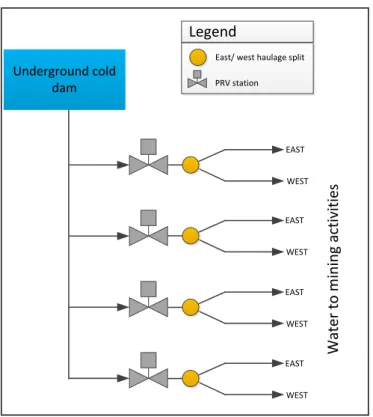
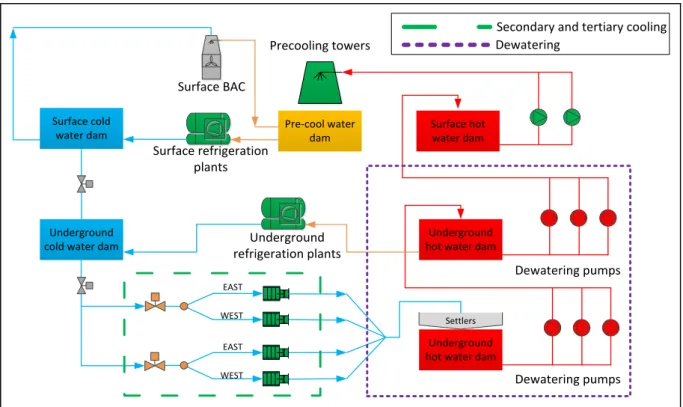
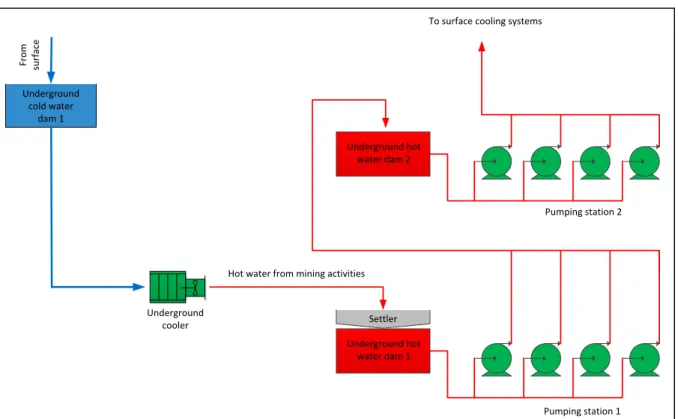
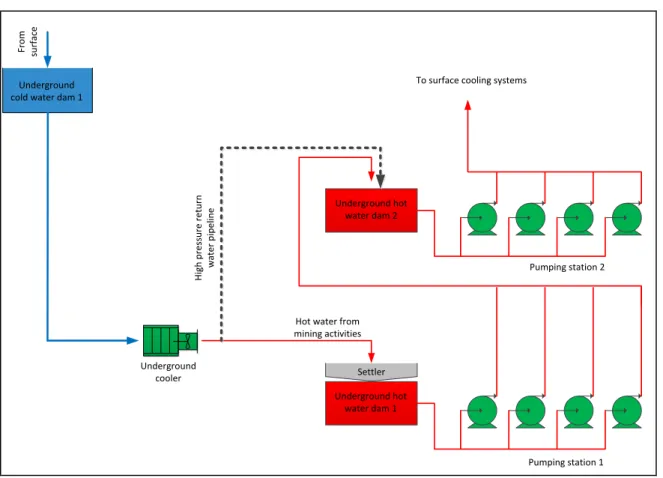
High temperatures underground can be attributed to inconsistent water flow through centralized bulk air coolers (CBACs) due to the complex network of underground users. Therefore, scope was identified to use a high-pressure u-tube system to supply production CBACs with the correct amount of chilled water to improve subsurface cooling conditions without adding additional pumping costs.
Background
However, it has become critical to reduce energy consumption and lower operating costs due to the ever-increasing cost of electricity. ESCos have been implementing and managing energy saving initiatives to reduce energy consumption since the start of South Africa's energy crisis in 2008.
![Figure 2: Eskom tariffs against inflation (CPI) [6] [7]](https://thumb-ap.123doks.com/thumbv2/pubpdfnet/10395661.0/17.892.107.791.376.700/figure-2-eskom-tariffs-against-inflation-cpi-6.webp)
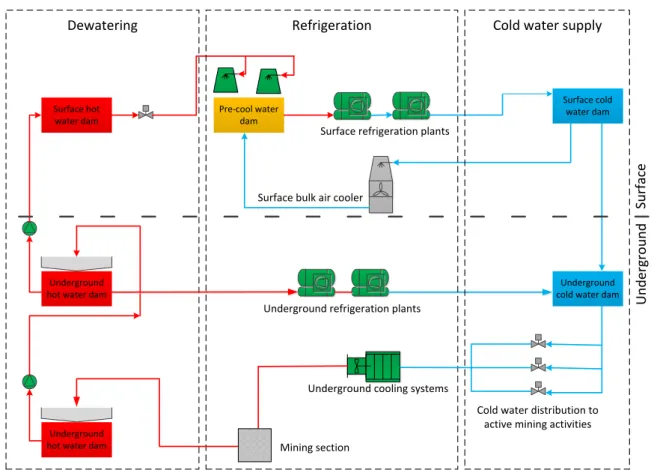
Deep-level mine water reticulation systems
A pressure difference exists between the cold water from the surface and the warm water from underground activities due to the pressure head of the water. The water pressure in the chamber is equal to that of the cold water of the surface (equalization phase).
Literature on cooling systems and/or strategies
He did not focus on increasing the water supply to cooling systems and providing cooling even when no mining operations were taking place. The research did not focus on controlling water flow through cooling systems to increase their cooling duties. His research did not increase water flow through cooling systems to improve cooling function, but simply reconfigured it to operate in a closed system.
Viljoen and Ranasinghe redesigned the two cooling systems to provide the same amount of cooling while saving energy. However, this study did not fully focus on controlling the flow of water through the cooling systems to provide additional cooling.
Literature on water management strategies
Although Van Rooyen improved the cooling of the CBAC by managing foulants, he did not focus on the water flow through these systems to lower temperatures even further. However, these control valves can be used to develop a strategy to increase water flow through cooling systems. He reduced the total amount of water and did not increase the water flow to achieve increased cooling loads for underground cooling systems.
This required matching cooling supply with demand by controlling water flow. By doing this, Buys achieved an annual cost saving of R12.5 million, as these VSDs improved the efficiency of auxiliary cooling equipment by controlling the water flow rate based on the cooling supply.
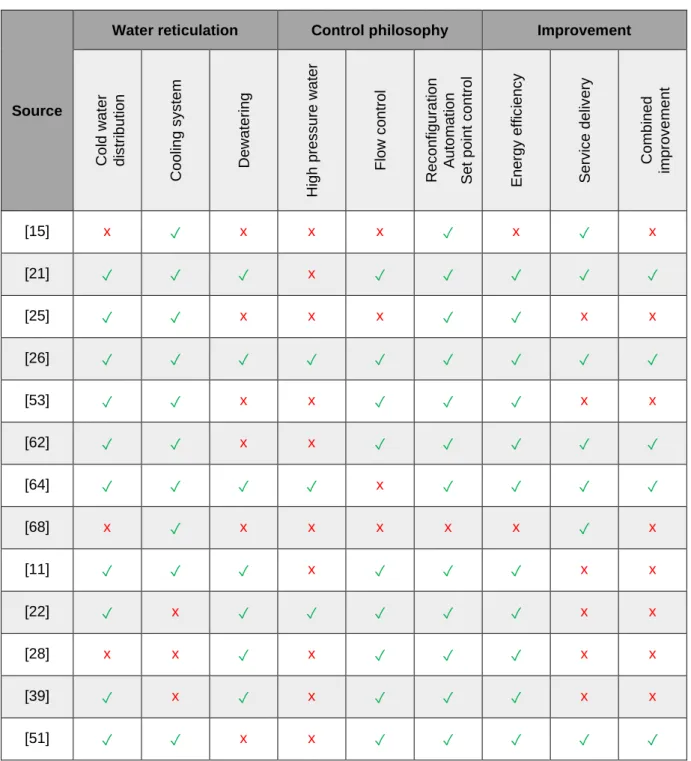
Literature study summary
High-pressure water supply strategy for bulk air coolers in mines 38 Table 3: State-of-the-art table. Cold water distribution Cooling system Dewatering High pressure water Flow control Reconfiguration Automation Set point control Energy efficiency Service delivery Combined improvement. Only three studies used high-pressure water to improve subsurface cooling, but they did not include the control of high-pressure water to provide design cooling.
However, research has shown that an increase in water flow through secondary cooling systems can result in improved air temperatures. Therefore, there is a need to increase cold water flow through secondary cooling systems to improve underground conditions while maintaining energy efficiency even when equipment is not in use.
Need for the study
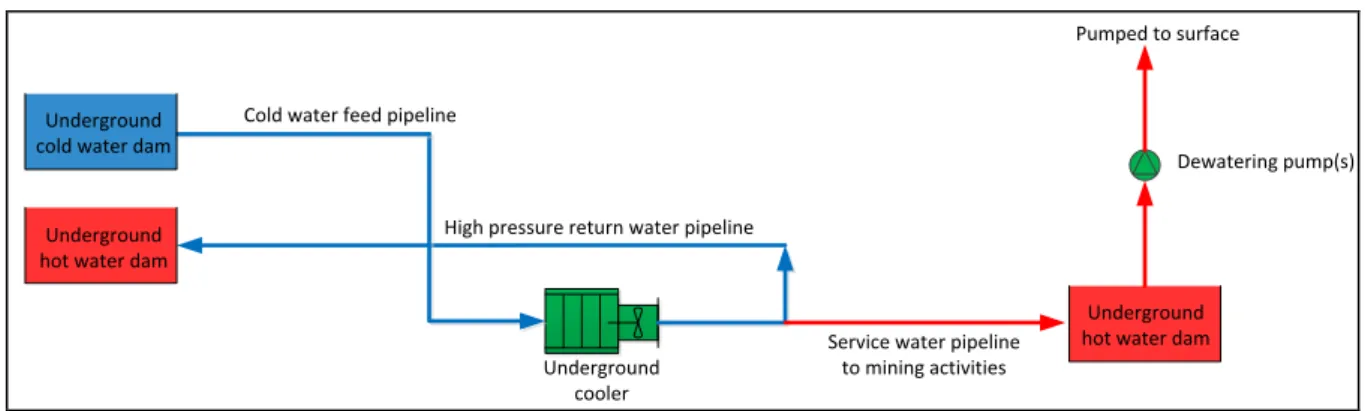
Previous studies mostly reduced cold water to realize energy savings, leading to increased underground temperatures. Furthermore, it should be kept in mind that too high flow rates can lead to reduced efficiency [62]. Deep-level mines use closed-loop high-pressure u-tube systems to dewater the water used for cooling.
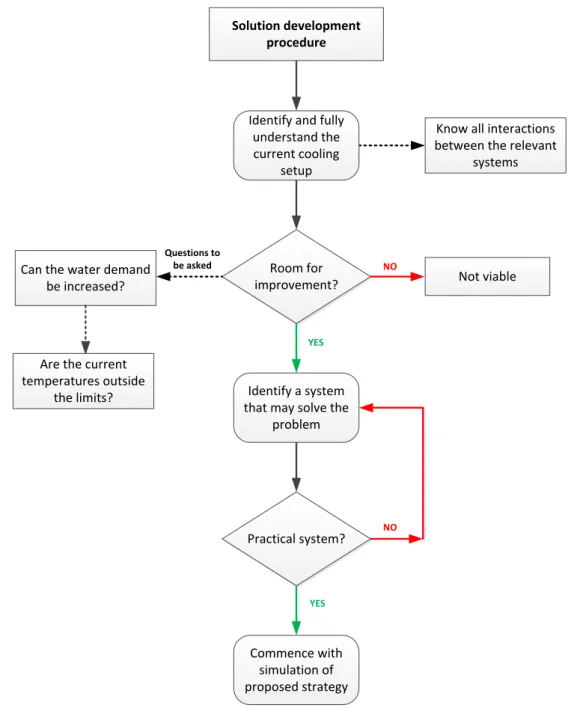
Develop a supply strategy to increase cold water flow through CBACs even when no water is being consumed in the mine block. The study proposes to develop a water supply strategy that will increase cold water flow through production BACs.
Chapter overview
The used water is either fed back into the system or used by mining activities. However, the use of these systems is very limited as the systems are not applicable for altitude differences of more than 1,000 m.
Introduction
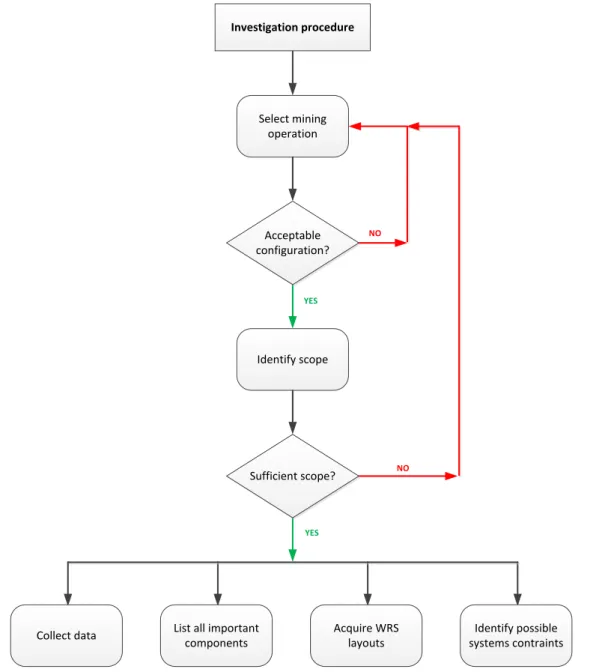
This includes identifying scope to increase chilled water supply through CBACs, gathering the necessary data and submissions, and determining all system constraints. When a clear understanding of the entire system is achieved, together with sufficient data and layout, a proposed water supply strategy can be developed. Implementation results should be captured and evaluated to determine the success of the strategy developed.
Investigation
Use Table 4 to identify which mine shaft could be used to implement the proposed strategy to increase the cold water supply to the underground CBAC. Doing so simplifies the process of determining whether the specific operation can be adapted to include increased chilled water supply through CBACs. Before developing a strategy, the next step is to assess the system to identify any constraints that may prevent the implementation of the proposed water supply strategy.
Increasing the cold water supply through CBAC will affect certain systems in current operation. Therefore, increasing the water supply will not necessarily lower the outlet air temperature if soiling occurs.
Development of a water supply strategy
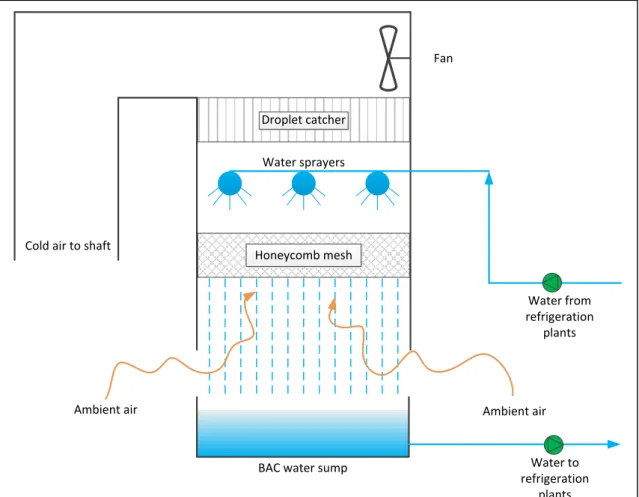
The water is used for cooling the air and then goes to the mining sector. A high-pressure u-tube system is a typical system that uses high-pressure water to improve cooling performance. This is achieved as the water is transferred within the pipeline at high pressure and is not pumped by typical sump pumps.
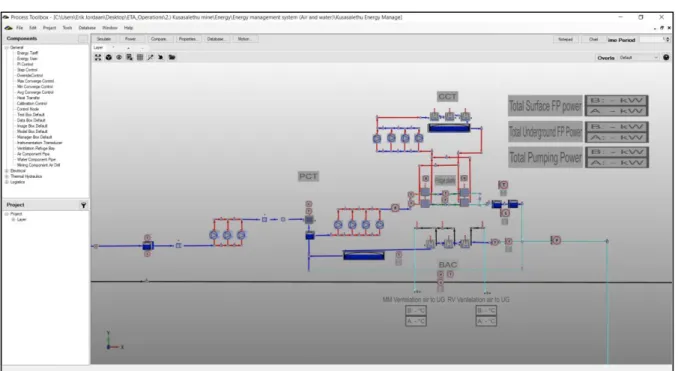
An EMS package should be used to monitor/control the flow of water through the CBAC. The EMS package can help develop a strategy to control the flow of water through the CBAC.
Simulation of the developed control strategy
High pressure water supply strategy for mine bulk air coolers 58 Figure 31: Simplified example of a PTB thermal hydraulic system. The data collected in Section 2.2.4 is used to replicate the existing WRS for the specific mining operation. The verification of the simulation involves comparing the actual historical data with the obtained simulated results.
The identified KPIs as well as impact data are simulated to ensure that they remain below the prescribed limits, which will confirm the viability of the proposed strategy. Furthermore, the obtained simulation results must comply with the constraints specified in Section 2.2.6.
Validation of the developed control strategy
Implementation of the validated strategy
Evaluation of the study
Validation of the study
Conclusion
Introduction
Investigation
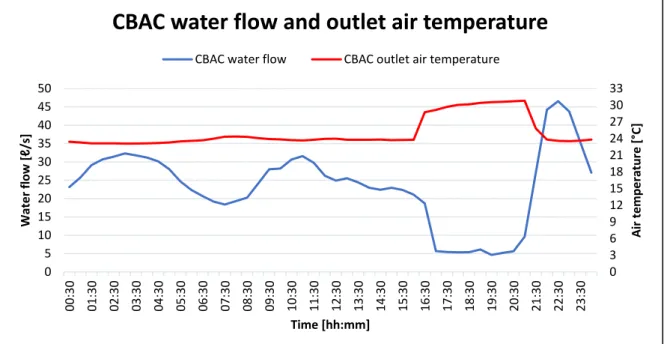
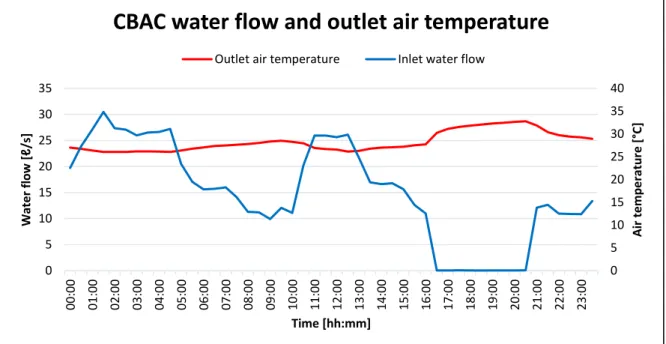
Therefore, the cold water flow through the CBACs must be above 35 ℓ/s and somewhere close to the design flow of 60 ℓ/s. High pressure water supply strategy for mine mass air coolers 67 Figure 35: Percentage extent to increase cold water supply through CBACs. High pressure cold water is sent to the CBACs to cool the ventilation air.
Increasing the cold water supply through CBAC would affect certain systems currently in operation. High pressure water supply strategy for mine air coolers 82 Figure 48: Simulated cold water dam level 71 L compared to baseline.
Validation of developed water supply strategy
High Pressure Water Supply Strategy for Bulk Air Coolers in Mines 87 Figure 54: Actual CBAC outlet air temperature compared to the simulation results. High Pressure Water Supply Strategy for Bulk Air Coolers in Mines 88 Figure 55: Actual level of 100 liter hot water dams compared to the simulation results. The initial dam level again differed based on the initial dam level set in the simulation.
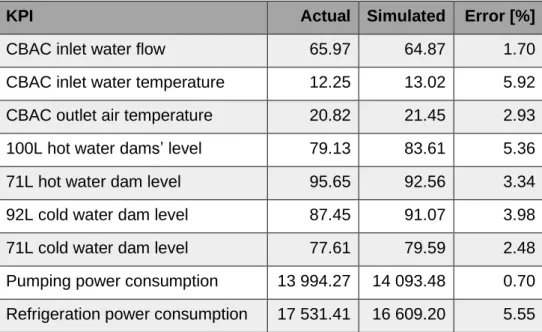
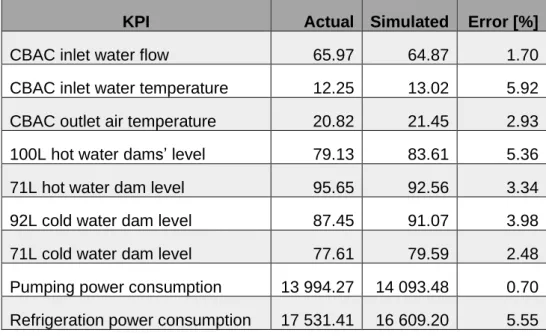
An average error of 5.55% was observed between the actual results and the simulation results due to the simulation of on/off cooling plants based on a set temperature point. High pressure water supply strategy for mining bulk air coolers 91 Figure 60: Actual cooling energy consumption compared to simulation results.
Implementation of the validated strategy
High-pressure water supply strategy for air coolers in mines 92 Figure 61: Transport temperatures after implementation. The water supply strategy improved the CBAC outlet temperature by about 3 °C while maintaining energy efficiency. This was achieved by increasing the inlet water flow through the unit above the critical water flow and somewhere within the design specification range.
Thus, the cooler water, which was closer to the design specifications, was sent to the CBAC.
Evaluation of the study
However, the cold return water mixed with the warm service water in the 100L hot water dams, warming the water slightly. All dam levels remained within acceptable limits and were able to accommodate increased water demand. This was achieved by using a high pressure u-tube system to displace the water used for cooling.
Even with the reduced pump power consumption and increased cooling energy consumption, the implemented strategy still achieved energy efficiency. Based on the results shown above, it can be concluded that the strategy did not affect the KPIs to a problem.
Validation of the study
Chapter conclusion
The predicted results of the simulation were validated by comparing the actual results obtained from tests performed with the simulation results. The developed strategy increased water flow through the CBACs to reduce subsurface air temperatures even when mining was not taking place.
Executive summary
The validation step provided an average error of 3.55%; therefore, the simulation was judged to be accurate and the strategy was implemented at the WRS of Mine A. After implementation, it was found that underground conditions improved with a decrease in air temperature of approximately 1 °C at the end of development. The tests found that increasing the inlet water flow through the CBAC reduced the outlet air temperature.
High pressure water supply strategy for mine mass air coolers 99 Figure 62: Impacts of strategy implementation. Consequently, it was determined that the strategy could be implemented on all deep level mines with suitable underground cooling configuration and CBACs.
Recommendations
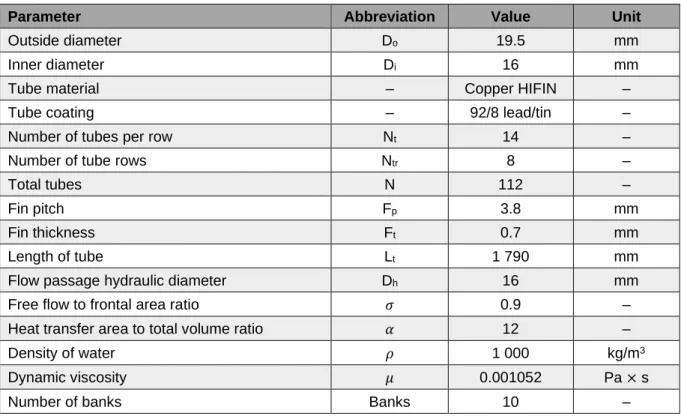
High pressure water supply strategy for mine bulk air coolers 109 Table 15: Surface cooling plant specifications. High pressure water supply strategy for mine bulk air coolers 112 Table 20: Hot/cold water pond specifications. High Pressure Water Supply Strategy for Mine Mass Air Coolers 115 Figure 63: CBAC inlet water flow verification.
High pressure water supply strategy for my bulk air coolers 117 Figure 67: Verification of 71L hot water dam level. High pressure water supply strategy for my bulk air coolers 118 Figure 69: Verification of 71L cold water dam level.
Hydraulic pressure
BAC cooling duty
Reynolds number calculation
Potential scope to increase the CBAC’s water flow
Pressure head calculation