The Impact of a Public Broadcasting Service Mandate on the Competitiveness and Sustainability
of Broadcasting in South Africa.
A case study: SABC 2
r •
'.
Robyn J. Smith
A research report submitted to the Graduate School of Business, University of Natal, Durban, in partial fulfilment of the requirements for
the Degree of Master of Business Management
June 2002
ABSTRACT
Radio and television broadcasting are among the most highly regulated industries in most countries. National governments have traditionally assumed responsibility for determining the structure of broadcasting in each country.
These state broadcasters have typically been financed from licence fee revenues collected from the owners of television and radio receiving sets, from direct parliamentary appropriations, or from both, although in some cases (e.g. Italy, The Netherlands and Finland) the income of the state broadcasting organisation has been supplemented by advertising revenue. The establishment of state broadcasters has enabled the government to exercise great influence over broadcasters, allowing the medium to be used as a mouthpiece for government sentiments and policy. In South Africa, the National Party governrnent'S;QntrQlled the airwaves and used it to entrench a
4. • • • , ~. ' •
repressive system of
Ap·art~~ld.·'FOlloWing
the new democracy in South Africa, a regulatory body was formed to oversee the freedom of the media. It was however recognised that broadcasting is one of the few opportunities for historically separated sectors of South African society to get to know each other, while celebrating cultural differences. SABe has been given a substantial public service mandate to fulfil the national goal of democracy, nation building and to provide information and entertainment in indigenous languages. As local programmes are more costly to produce; the mandate presents challenges to the broadcaster to still remain competitive for audience share and revenue. As the SABe does not receive a subsidy, does not have direct access to licence fees and often broadcasts to lower LSM's that do not traditionally deliver revenues, the challenge is to find a broadcasting mix that will ensure sustainability. The research concluded that SABe 2 (that has the biggest public service mandate) is still competitive when compared with another commercial broadcaster. The PBS mandate formed a distinctive strategy to hold audiences and be sustainable. A survey, using a questionnaire concluded that SABe 2 was seen as a public broadcaster but a government subsidy to offset losses of certain types of programming would be welcomed. Two structured interviews showed that the mandafe was closelyii
monitored and that management was constantly challenged to find the best programming/scheduling and revenue mix. A source of revenue that would be welcomed would be the partial allocation of licence fees to the channel for specific public service programming - such as state funerals and big national sporting events. This exploratory research made recommendations that will further enhance the competitiveness of SABC 2 and provide more synergies within the South African Broadcasting Corporation.
DECLARATION
I, Robyn Jay Smith, declare that this research report is my oWn, unaided work, except as indicated in the acknowledgements, the text and references. It is being submitted in partial fulfilment of the requirements for the degree of Master of Business Administration at the University of Natal, Durban, South Africa. It has not been submitted before, in whole, or in part for any degree or examination at any other institution.
Robyn Jay Smith (Student 201508585)
6 June 2003
iv
ACKNOWLEDGEMENTS
I would like to thank the following people for their assistance:
My parents, Ruth and Neville Smith for their unwavering patience and support.
Eisa Thompson for her supervision.
Aletta Alberts and Laura McKenzie - whose help and prompt assistance were inValuable
SABC staff who agreed to aid in the completion of this research.
TABLE OF CONTENTS
Abstract Declaration
Acknowledgements
Chapter 1: Introduction to the Research 1.1 Introduction
1.2 Background to the Study 1.3 Motivation for the Project 1.4 Value of the Research
1.5 The Problem Statement and Hypothesis 1.6 Objectives of the Research
1 .7 The Research Design and Methodology 1.7.1 Design and Analytical Techniques 1.8 Limitations of the Study
1.8.1 Internal Limitations 1.8.2 External Limitations 1.9 Structure of the Study 1.10 Summary
Chapter 2: Literature Review 2.1 Introduction
2.2 Key Concepts
2.3 A word on the Literature Sources 2.4 PBS models and principles
2.5 Challenges to the Broadcasting Industry 2.6 South African Broadcasting
2.6.1 Background to the South African Broadcasting Industry 2.6.2 The SABC in 2003
2.6.3 The SABC as a National Broadcaster 2.6.4 Regulation of the SABC
Page No
ii iv
v
1 1 1 2 3 4 4 5 5 6 6
6 7 8
9
9 9 10 11 13 14 14 15 16 16
2.7 SABC2
2.7.1 Vision and Strategy
2.8 A Comparison: SABC and the BBC 2.8.1 BBC Background
2.8.2 Operational Strategy
2.9 Operational Structure Comparison 2.10 The Research from Literature:
Garnham, Porter, Bakos, Mintzberg, Hamel and Pralahad, Treacy and Wiersma, Moore, Brandenburger and Nalebuff
2.11 Summary
Chapter 3: Research Methodology
3.1 Introduction 3.2 Research Aims
3.3 Research Design and Procedure 3.3.1 Research Questions
3.4 Quantitative Method 3.4.1 Hypothesis
3.4.2 Sample
3.4.3 Sampling Strategy
3.4.4 Data Collection Procedure 3.4.5 Ethical Considerations 3.4.6 Method Of Analysis 3.5 Qualitative Method 3.5.1 Primary Data 3.5.2 Secondary Data
3.5.3. Objective of Quantitative Method 3.5.4 Sampling Strategy
3.5.5 Questionnaire Respondents 3.5.6 The Survey Instrument 3.5.7 Interview Respondent 3.5.8 The Interview Questions 3.5.9 Ethical Considerations
17 17 20 20 21 22 24
35
36
36 36 37 37 37 38 38 38 40 40 41 41 41 42 42 43 43 44 44 45 45
3.6 Summary
Chapter: 4 Analysis and Discussion 4.1 Introduction
4.2 Quantitative Results 4.2.1 Statistical Procedure 4.2.2 Hypothesis
4.2.3 T-Test Results 4.3 Findings
4.4 Qualitative Results 4.4.1 Nature of Themes 4.4.2 Themes J-R 4.4.3 Themes S-Y
4.4.4 Interviews with Managers 4.4.4.1 Management Commitment 4.4.5 Management Interview Themes 4.4.6 Observations
4.4.6.1 Observations: PBS 4.4.6.2 Observations: Subsidy 4.7 Summary
Chapter 5: Conclusion and Recommendations 5.1 Introduction
5.2 Key Elements of Research 5.3 Resulting Conclusions
5.4 Recommendations for Future Studies 5.5 Recommendations for SABC 2 5.6 Conclusion
References Appendices
45
46 46 46 46 48 49 50 53 56 56 56 57 57 58 58 58 59 59
60 60 61 61 63 63 66
67
List of Tables
2.1 Comparison: BBC and SABC 23
4.1 Viewing patterns of SABC 2 47
4.2 Viewing Patterns of e-tv 47
4.3 Two independent sample t-test 49
4.4 A representation of the themes derived from responses to the
first qualitative question 54
4.5 A representation of the themes derived from responses to the
second qualitative question 55
4.6 A representation of the themes derived from responses to the
third qualitative question 55
4.7 Compliance report 57
List of Figures
2.1 SABC Milestones in the '90's 15
2.2 SABC 2 SWOT 18
2.3 SABC 2:Cost/Genre 19
2.4 UK TV Audiences 21
2.5 Porter's Five Forces 26
2.6 Porter's Value Chain 27
List of Appendices
Appendix 1 Survey Instrument 73
Appendix 2 Respondents Feedback: Interviews 77
Appendix 3 Survey of LSM Groups 88
Appendix 4 Questions: Focused Interview 90
Appendix 5 Replies to Question 8 91
Appendix 6 Replies to Question 10 94
Appendix 7 Replies to Question 13 95
CHAPTER 1
INTRODUCTION TO THE RESEARCH
1.1 Introduction
Public Service Broadcasting (PSB) or "public broadcasting" has played a significant role in the political and social institutions of countries. Historically, PSB organisations have occupied dominant or monopolistic positions in a number of European countries. Other countries have a strong PSB organisation operating alongside commercial broadcasters. The current status of PSB's worldwide is under pressure from a number of different fronts. These include the proliferation of television and radio channels made possible by satellite and cable programme distribution. As the number of commercial services increases, so does the service potential to provide the programming that was traditionally the reserve of the public broadcaster (McKinsey, 1999).
1.2 Background of the Study
Public broadcasters have existed as central, publicly funded national institutions providing services in the public interest (IBA, 1995). The advent of technology, pOlitical and economic events and resource constraints, have contested this monopolistic position. As a consequence, some public broadcasters have been transformed from bloated bureaucratic organisations into lean and efficient operations. In other cases, public broadcasters have been commercialised, privatised or marginalized. In Singapore, public broadcasting has been corporatised, in New Zealand commercialised and dependent on advertising, while in Brazil it has been marginalized and commands only one percent of advertising (ICASA, 2001).
It is in those countries where mixed economic prinCiples have been applied to the broadcasting system that public broadcasting has remained viable (IBA, 1995). Despite government funding cuts and competition from other media,
1
quality public broadcasting in Britain, Canada, Australia and the Scandinavian countries have survived in regulated competitive environments. -
The SABC is currently South Africa's national broadcaster and was established in 1936 under an Act of Parliament (www.docweb.pwv.gov.sa).
The SABC's internal reorganizations were widely perceived as part of the National Party strategy of protecting the SABC. At the same time several media and cultural groups tried to combat this strategy and establish an independent public broadcaster accountable to the people of South Africa.
Broadcasting is one of the few opportunities for historically separate sectors of South African society to get to know each other. In countries with high levels of illiteracy like South Africa, the role of broadcasting is all the more important in providing information for people to participate in the processes of development and nation building. While acknowledging the need for a public broadcaster in South Africa, the prospects for long-term viability of a broadcaster that does not follow market signals, are questionable. The public service mandate affects who the potential audience will be and therefore the revenue that flows from that audience. Market share comes directly from potential audiences and this affects the broadcaster's competitive position within the industry.
1.3 Motivation for the Project
SABC 2 is the channel with the largest footprint in South Africa and, according to its public service mandate, services primarily the Sotho and Afrikaans language markets. Secondary markets include English and Nguni. The historical role of the government in the broadcasting industry has changed. It provides no subsidy and the SABC has to generate its own revenues - primarily from advertising and programme sponsorship. The viability of the public broadcaster is integrated with its mandate and programme obligations.
This has a direct bearing on costs and determines its ability to attract and maintain audience share. All this is dependent on the way it structures its
business model, redefines its vision and objectives and strategises for the future. Strategy focused organisations have traditionally been organised around functioning specialities (Kaplan and Norton, 2001). Strategic themes such as the PBS mandate can be implemented across all departments of the organisation so that common objectives become the goals.
1.4 Value of the Research
The SABC takes up three quarters of the available television spectrum in South Africa with its three channels. With competition for advertising revenue from all the major players and increased competition in programme buying from the first free-to-air channel (e-tv) and the pay channels (Mnet, DStv), the SABC has to remain competitive, fund itself and deliver .on a national mandate (Enterprise,2000).
A change to its original business model with more emphasis on sustainability, strategy and execution is needed. The restructuring of the SABC in 1990 on business lines with a view to creating efficiency was in line with state strategy of privatizing parastatals to secure political and economic interests in the private sector.
The business model for the SABC has now evolved to that of a commercial broadcaster (SABC 3), a public broadcaster (SABC 2) and a combination of both (SABC 1). In all these instances, the three business. models must generate enough funds to be self-sustaining. The research from other countries show that the public service mandate for a broadcaster can be part of a competitive strategy and contribute to maintaining high standards of programming and delivery in an industry.
SABC 2 has to be self sustaining and profitable to ensure competitiveness and grow market share. This means that the previous strategies of relying on government funding - whether the channel was achieving audience share or not, have to change. Business principles have been implemented in the
marketing and sales departments and uses traditional financial concepts of profit and loss concepts (Enterprise, 2000). The study showed that changes in the business model and resulting strategic decisions can make the broadcaster profitable and make its mandate and business model completely different to others in the world such as the British Broadcasting Corporation (BBC) and the Canadian Broadcasting Corporation (CBC).
1.5 The Problem Statement and Hypotheses
• Problem Statement:
To what extent does SABC 2 use a business model to transform itself into a public broadcaster? What effect does this have on strategic decision-making geared towards sustainability and the aims of a national broadcaster? What changes should be made to its strategy to ensure long-term competitiveness.
• Hypothesis
1. SABC 2 has a business model that ensures sustainability.
2. Its strategy is geared to grow market share and make a profit.
3. Strategic management will execute the business model and tailor the organization to be more self-reliant and move from a government mouthpiece to a true national broadcaster.
4. Strategic management decisions are governed by the regulatory body or the government and not by audiences.
1.6 Objectives of the Research
The objective of the study was to identify the extent of the effects of the public service mandate on SABC 2's sustainability. The study also attempted to identify whether the mandate can be part of the broadcaster's competitive strategy. The SABC was bench marked against the BBC structure as a public broadcaster.
Two aims of the study can be identified.
• Does SABC 2's public service mandate make it uncompetitive?
• As the largest, legislated public service mandated television channel in South Africa - should SABC 2's performance and sustainability be judged individually or as part of the South African Broadcasting Corporation as a whole.
• What key elements should be included in the broadcasting business model for SABC 2?
The following sub-problems (or research questions) were derived from the aims listed above:
• How can SABC 2 become sustainable in the long term with relation to it not being subsidised and having a huge public service mandate?
• Sustainability/profitability or delivering on its national -mandate - a contradiction in terms?
1 .7 The Research Design and Methodology
The sampling frame used was the current population of managers at SABC together with the managers who head the major SABC 2 departments. The sample included managers from Human Resource, Programming, Finance, Market Intelligence, Airtime Sales, General Management, Marketing, Scheduling, Web/lT, Audience Research, On Air, Training and Development and Strategic Planning. The size of the population of managers at the SABC in Johannesburg was 32.
1.7.1 Design and Analytical Techniques
The research technique was both quantitative and qualitative and used historical data, structured questionnaires and semi-structured interviews. The method of data collection for the qualitative survey was respondent-completed questionnaires sent by email or hand delivered. Interviews were conducted at the offices of two SABC 2 managers. A cross sectional study was utilised and
5
all questionnaires were issued simultaneously. An ex post facto design was used in that the study was carried out in the natural s.etting without manipulation of variables by the researcher. Content analysis was used to distinguish themes from the responses. Historical data was gleaned from annual reports and surveys conducted by the Corporation and other research institutions. Experiential data in the form of unstructured interviews with two current managers at SABC 2 was collected to gain a deeper understanding of the changes in legislation, strategies, management decisions and goals. The quantitative research used historical data from SABC Audience Research and a t-test to show the statistical relevance of the effect of the public service mandate.
1.8 Limitations of the Study
1.8.1 Internal Limitations
• The channels have not operated with an explicit, documented business plan. The submission of a comprehensive business plan has been a recent development. Therefore no conclusive comparison could be conducted to evaluate the changes.
• The high turnover of management staff limits the amount of data that can be carried over in terms of hands-on experience and historical data in the form of story telling.
• Despite agreeing that SABC 1, 2 and 3 were not competing against each other, managers were still reluctant to reveal ele~ents of their competitive strategies - especially SABC 3. which is the commercial channel (PCBS - public commercial broadcasting service).
1.8.2 External Limitations
• The public service mandate has changed over the years. The Broadcasting Act does not quantify the public service mandate requirements. The SABC translates the mandate within the Corporation and sets targets, which the channels attempt to deliver.
• The proposed two new channels that will cater for indigenous language groups have not been finalised. It is believed that these channels will
become PBS channels. The uncertainty surrounding these channels limited the study, as managers were unwilling to reveal key channel operations until more information on the new channels became available.
1.9 Structure of the Study
Chapter 2 of the study contains a Literature Review. The chapter details a list of key concepts used in the broadcasting industry. A word on the literature sources surrounding Public Service Broadcasting (PSB) follows and includes a comparison of South Africa's largest PSB - SABC 2 and a foreign equivalent together with an investigation of the relevance of the writings of Michael Porter (1985), Yannis Bakos (1991) Henry Mintzberg (1994), Hamel and Pralahad (1994) on strategy, competition and sustainability. The chapter further explores the literature resources on SABC and public broadcasting with reference to Allan Brown and Martin Cave.
Chapter 3 contains the research methodology of the study. The research aims, design and procedure are described. The quantitative method (including the hypotheses, sampling strategy, procedure for data collection, ethical considerations and method of analysis are included. The chapter further describes the qualitative method and the component sampling strategy and a discussion on the ethical considerations.
Chapter 4 presents an analysis and discussion of the results obtained through the application of the procedures described in chapter 3. The chapter presents the findings of the quantitative results and discusses the implications thereof before presenting the results of the qualitative study gained from the interviews conducted.
Chapter 5 presents recommendations on the analysis that could lead to different strategies being implemented. The chapter concludes with a summary and suggested topics for further discussion and research.
1.10 Summary
The role of the public broadcaster in South Africa has significant implications for the nation as a whole. Language and cultural groups that had been marginalized in the past are now being catered for. The public service mandate is part of nation building, information and entertainment. Against this background, the study aims to consider the future of public service broadcasting in South Africa using SABC 2 as a case study. The study will investigate the effects of the PBS mandate on SABC2 in terms of its competitiveness and programming strategy. It also noted that the PBS mandate had an indirect effect on other broadcasters programming, scheduling and competitiveness. There were both internal and external limitations to the study. The research used qualitative and quantitative methods to evaluate data. The results are discussed and recommendations made as well as comments on future studies.
CHAPTER 2
LITERATURE REVIEW
2.1 Introduction
The literature review aims to present a critical review of the available literature pertaining to the main concepts of the study (Saunders, Lewis & Thornhill, 2000).
The Public Broadcasting Service concept and the South African Broadcasting Service (SABC) will be reviewed with particular reference to the channel with the biggest public service mandate. Its history, characteristics and nature will be outlined in order to provide an insight into the broadcasting environment and the prospects for the long-term sustainability or profitability of SABC 2.
Secondly, SABC 2 will be highlighted as a case study in the quantitative and qualitative section of the research. In particular, the economic environment in which SABC 2 operates will be reviewed, in order to gauge the long-term sustainability of a public service mandate.
2.2 Key Concepts
For the purposes of this literature review, certain important concepts are defined to aid the reader in the understanding of the industry.
Non-commercial broadcasting is known as "public broadcasting" in North America and "Public Service Broadcasting" (PS B) in the United Kingdom, Europe and Australia (Brown, 1996). In this research, the two terms are used interchangeably. While most of the literature refers to "PSB", the South African literature refers to the concept as PBS -public broadcasting service.
For the purpose of this research we will use the definition of a public service broadcaster as specified in Section 1 of the 1999 Broadcast Act, defining public service broadcasting as "any service, including a commercial service,
9
operated by the SABC", while Section 9(1) provides for a distinction between the 'public service' and 'commercial service' operated by the SA,BC. In terms of licensing, the IBA is required to distinguish between 'public', 'commercial'
and 'community' broadcasting services. It must be noted that several
European and American literature sources on broadcasting use "non commercial" to define a public service broadcaster.
Broadcasting is the transmitting of programmes to be heard simultaneously by an indefinitely large number of people (Curren and Seaton, 1981).
LSM is an acronym for Living Standards Measure and is a marketing tool designed to profile the market into relatively homogenous groups (Haupt, 2001). It is based on a set of marketing differentiators which grqup people according to their living standards, using criteria such as degree of
urbanisation and ownership of assets such as cars and major appliances.
(see Appendix 3)
2.3 A Word on the Literature Sources
Literature that has been published on the chosen area of research with regards to PSBs, their structures and impact on broadcasting environments has been taken from books, journals, media reports and studies analysing the broadcasting environment worldwide. The information from the sources relates directly to the research and is important to the study in terms of understanding the public service broadcasting mandate and the context in which it is carried out and regulated.
Various publications including The Journal of Media Economics and Harvard Business Review contained articles and summaries pertaining to the history and nature of PSB, the economic ramifications and environments in which these systems operate. Other articles contained information on management styles and the marketing environment in which PBS's operate.
ICASA (Independent Communication Authority of South Africa - formerly known as the Independent Broadcasting Authority - IBA) ~as published several papers and working documents relevant to the various stages of broadcasting. The IBA was the first independent regulatory body on broadcasting and telecommunications in South Africa and worked to regulate the airwaves as well as transform the national broadcaster (South African Broadcasting Corporation - the SABC) from a government mouthpiece to a public broadcaster (ICASA, 2002).
Media reports used are fairly critical of the PBS system. Reports on the British Broadcasting Corporation range from criticism of the Board's infrastructure and makeup to the overall structure of the broadcasting industry and concern over new competition. In this study we benchmark the SABC against the BBC.
2.4 PBS models and principles
At a very basic level there are two traditional models for broadcasting - the European model and the United States model (Brown, 1996). The European model is based mainly on large public broadcasters established, organised and (wholly or partly) funded by the State. The US model comprises mainly commercial broadcasters. In Britain, the Broadcasting Research Unit (1985) considered that PBSs embodied the eight fundamental principles of:
• Geographic universality
• Broadcasting must be directly funded by the viewing and listening audience
• Independence from government and vested interests
• Concern for national identity and community
• Catering for all interests and tastes
• Catering for minorities
• Quality of programming
• Creative freedom for programme makers
National governments have traditionally assumed responsibility for determining the structure of broadcasting in each country. To achieve their PSB objectives, most western European governments have legislated for public corporations to be established as the major or sole suppliers for broadcasting services (Brown, 1996). These state broadcasters have typically been financed from licence fee revenues collected from the owners of television and radio receiving sets, from direct parliamentary appropriations or from both, or a model that includes advertising fees (Siune, 1986).
According to the McKinsey Institute, Public Service Broadcasters (PSBs) were conceived in a world of one or two channels. The market evolution appears to have put pressure on the traditional PSB model, and in some markets fundamentally called into question its validity. Deregulation of terrestrial markets, the growth of multi-channel television and the emergence of strong pay television operators have fundamentally altered the competitive dynamics of many markets (McKinsey 1995).
PSB's are known as public broadcasting services (PBS's) in South Africa.
They have significant responsibility within their markets as they are the pace setters and set the tone for broadcasting. Healthy, functioning PBS's that have community support, can potential greatly enrich their broadcasting cultures and by extension the cultures of their nations.
The establishment of state broadcasting corporations has allowed governments to exercise significant influence over the socially powerful broadcasting media. Although this is sometimes lessened by internal and sometimes legislated principles to protect operating autonomy, indirect supervision is still retained by governments through financial allocations and appointments to Boards of Management (Hibberd, 2001). An analysis and comparison with a foreign broadcaster is utilised later.
Most PBS's are former monopolies that were originally designed to provide the entire supply of programming for the market (McKinsey, 1999). However,
since the advent of commercial terrestrial competition, multi-channels, cable, satellite and digital technology such as the Internet, PBSs have found themselves with an enormous challenge to be adaptive.
2.5 Challenges to the broadcasting industry
Broadcasting has become a fundamentally more competitive industry than it was 20 years ago and it faces several very specific challenges:
1. Increasing competition from commercial channels and multi-channel penetration.
2. Saturation of TV viewing and reach
3. Early evidence of substitution from new media - e.g. Internet users will surf the Web instead of watching television
4. Increasing costs of talent and key rights in genres such as sport 5. Pressure on funding as governments attempt to reduce the overall tax
burden and as increased competition reduces available advertising revenues.
As a result of these challenges and particularly the significant loss of share (and therefore influence) to the new commercial broadcaster, many analysts consider the PBS an outdated concept. The future, they argue will bring a multiplicity of channels - such as in the United States - with enormous variety (Tracey, 1991). Many PBS's are considered inefficient relics of an earlier state-dominated age (Brown, 1996).
PBSs tend to carry much higher overheads as they contain large production units, education departments and many other commitments that the more streamlined commercial broadcasters do not. The absence of competition makes many PBS's complacent and overstaffed. In addition, commercial broadcasters are often sophisticated in their use of commercial techniques.
The new commercial broadcasters are seen as more progressive and exciting than the staid familiar PBS (McKinsey, 1999).
2.6 South African Broadcasting
The research uses a case study of SABC 2 to explore the relationship between the public service mandate and the future sustainability of the SABC.
It is necessary to sketch the background of the broadcast industry in South Africa with particular reference to the SABC and its television initiatives. 2.6. 1 Background to South African Broadcasting
Broadcasting made its debut in South Africa when the South African Railways set up the first station in Johannesburg in December 1923. Seven months later, the Associated Scientific and Technical Club in Johannesburg took over the station and two months later a similar service was set up in Cape Town. A Durban organisation began broadcasting later that year. Reven,ue came from listener licence fees (Enterprise, 2000).
The coverage area of all three enterprises was limited, each functioned separately and revenue was low. The Schlesinger Broadcasting Company, with permission from the South African government, took over all three ventures to form the African Broadcasting Company. This new organisation had the sole rights to broadcasting in the country and used English as the broadcast language. Prime Minister General Hertzog ordered an inquiry into the broadcasting industry and the South African Broadcasting Corporation (SABC) was created under Act No 22 of 1936. (www.icasa.org.za) At first the new radio service was in English only but the Act had stipulated the inauguration of a parallel Afrikaans service. In 1937 a comprehensive transmission in both official languages became a reality. The English and Afrikaans Services were known as Radio South Africa and Radio Suid-Afrika respectively. Today they are known as SAFM and Radio Sonder Grense - each broadcasting 115, half hours of programmes a week.
In August 1952 the Re-diffusion Service was established to broadcast in three black 'anguages. The country launched its first television service on 5 January 1976. Originally modelled on the BBC, the SABC was controlled for many
years by a secret Afrikaner society called the Broederbond (Oder, 1991). It is believed that the ruling National Party resisted the advent of, television, as they feared that images of racial mixing and the promotion of the English language would follow.
2.6.2 The SABC in 2003
Today the SABC is South Africa's national public broadcaster with 20 internal radio stations broadcasting in 11 languages and an external radio service broadcasting in four languages. There are five television channels of which four are free-to-air including Bop TV and one satellite pay channel (www.sabc.co.za).
According to the South African Advertising Research Foundation, more than 18 million adults tune into the radio network every day and 16 million adults watch the SABC's channels - namely SABC 1, SABC 2 and SABC 3.
In Figure 2: 1, milestones in the SABC's history have been highlighted to provide an overview of developments from the beginning of the 1990's that fundamentally changed the broadcaster. These included the introduction of a sports channel, the first satellite broadcasts and the change in channel
identification and their subsequent re-launch under different names. The latter paved the way for the introduction of a public service mandate.
1991: TSS (Top Sport Surplus) introduced as official supplementary service. It was relayed on the spare capacity of the TV1 signal and carried sport programmes th'at could not be accommodated on the TV 1 schedule
1992: TV2, TV 3 and TV 4 channels were consolidated into one multi-cultural channel CCV-TV (Contemporary Community Values Television)
1995: Satellite broadcasts on the KU band Pas 4 satellite were introduced. This switched SABC's 3 TV channels and 11 public service radio stations to satellite making it available
to more South Africans.
1995: SABC launches analogue sports channels broadcasting from satellite 6 hours a day 1996: The SABC re-launched CCV-TV, TV1, and NNTV channels as SABC 1, 2 and 3
respectively.
Figure 2.1: Milestones In the 90 s ,
A comparative review of broadcasting systems operating within democratic contexts reveals several recurring principles. Canada is concerned with national identity, cultural integrity and integration while the US aims to create access and community participation. Britain is concerned with universality, independence and quality and Australia with national identity and cultural diversity (ICASA, 2002). Namibia is concerned with reconciliation and
development - while South Africa numbers a combination of these principles in securing what is of public interest.
2.6.3 The SABC's Role as the National Broadcaster
Since the fall of the Apartheid government in the 1990's, the new African National Congress-led government has made democracy a national goal, providing a political focus, and development - focusing on economic goals.
Nation building is primarily concerned with cultural issues. In a country with high levels of illiteracy like South Africa, the role of broadcasting is all the more important in providing information for people to participate in the processes of development and nation building. ICASA believes that in relation to development, broadcasting influences the provision of human rights, housing, public health and agricultural guidance to literacy and formal education, economic and financial analysis. In nation building the role of the South African broadcaster includes nurturing a sense of citizenship, reconciliation and tolerance while reflecting the rich cultural, language, religious and regional diversity of the South African population (IBA, 2000).
2.6.4 Regulation of the SABe
The Independent Communications Authority of South Africa (ICASA) is the regulator of the telecommunications and broadcasting sectors. It was established in July 2000 in terms of the Independent Communications Authority of South Africa Act No.13 of 2000. It took over the functions of two previous regulators, the South African Telecommunications Regulatory Authority (SATRA) and the Independent Broadcasting Authority (IBA). The two bodies were merged into ICASA to facilitate effective and seamless
regulation of telecommunications and broadcasting and to accommodate the convergence of technologies. ICASA derives its mandate from four statutes. These are the ICASA Act of 2000, The Independent Broadcasting Act of 1993, the Broadcasting Act of 1999 and the Telecommunications Authority Act No. 103 of 1996 (www.icasa.org.za).
2.7 SABC 2
SABC 2 has the biggest public service mandate of all the television channels in the broadcasting industry in South Africa. It receives no direct licence fee revenue, and no government subsidy. It relies solely on a mixture of classical advertising, programming sponsorship and revenue from sales (Enterprise 2000).
2.7.1 Vision and Strategy
The channel's vision is to be every South African's television home and heartland, a place where everyone feels at home. Its mission is primarily to commission and acquire compelling television programmes for the family, reflecting a common heritage across communities and cultures. The channel's target market includes All Households falling into the LSM 5-10 grouP. (SABC 2 - Business Plan, 2002). Within this market, the Sotho and Afrikaans
language markets form the largest portion of the country's public service mandate. Its content challenge is to provide real choice for viewers in African language programming.
The channel enjoys the same status as its sister channels SABC 1 and SABC 3 and is expected by the SABC Board to operate its day-to-day activities as an independent operator. Certain departments are leveraged across all three channels - e.g. News and Children's programming. However, in terms of costs, revenues, and daily operations, the channel is autonomous and accountable for its own financial, programming and staffing components.
Figure 2.2 shows a SWOT Analysis (Strengths, Weaknesses, Opportunities, Threats) to sum up SABC 2's current position in the industry.
•
Local language delivery•
Afrikaans stripped programming (7de Laan, Afrikaans News, unparalleled share of Afrikaans audience across this hour)•
Local dramas (7de Laan and Muvhango)•
19H30 Family series (LSM 8-10)•
Footprint•
No repeats in prime time•
SABC Africa• Development of programmes for LSM 5-8 audience, extend to weekends
• Use of SABC2 brand personalities for channel promotion to entrench the brand
• Improve access p rime to strengthen lead-in for 7de Laan
• Improve late prime and maintain LSM 5-8 audience from 21 hOO bulletin
• Synergies with radio
Figure 2.2: SABC 2: SWOT
•
Inability of 19h30 weekday slot to deliver cross-over audience due to loyalty toNews/Generations combination on SABC1
•
Language delivery for LSM 5-8 programming exclusive to Sotho (excludes large available audience)•
Revenues and audiences concentrated on Afrikaans programming•
Sotho News•
Mopani regional breakaway•
Late prime and non delivery of weekend programming for LSM 5-8•
Access prime•
Marketing• Increased competition for LSM 5-10 audience particularly over weekends
• SABC3 News moving to 19hOO
• Two new channels
• DSTV programme delivery for Afrikaans audience (Kyknet)
The information was adapted from an SABC 2 Strategy Presentation (2002)
The SWOT shows that most of SABC 2's Weaknesses result from the PBS mandate. These weaknesses include the failure of the channel to secure audiences targeted in their mandate - ie the Sotho and Afrikaans audience. The channel also battles to draw audiences from SABC 1 and loses audiences due to the poor quality of programming in the regional breakaway slots.
However, the Strengths also hinge on the PBS mandate. Locally produced dramas in indigenous languages (e.g Sewende Laan and Muvhango) draw audiences in large numbers while the Afrikaans news - - an acknowledged loss leader - draws viewership but not sufficient revenue to be self-sustaining.
Figure 2.3 shows at a glance a snapshot of minutes, costs and revenue allocation on SABC 2.
Minutes/Cost/Revenue Allocation per Genre
45%
4()O/0
350/0
300/0
250/0
20%
15%
10%
50/0
00/0
III I!! -t
E
c1J~
0III Co
..
Cl)Q file(
~oW Cl)C
zf
..
:::I UFigure 2.3 SABC 2: Cost /Genre
I II
Minutes % 11 Cost % 0 Revenue %I
oW c ...
Cl) ~
r:a;!
c1JE
u C ~ ...
.~~ t-ICI III
%.l!:l '-" %
C ILl
J9 ~ c Cl)
E :::I Q ~
c f
;g
.c U
c o
:§I ~
Adapted from SABC 2 Scheduling/Revenue Report 2003
oW .c
'2 Cl
..
o ~
c o
~ G
:::I 1:1 ILl
It is clear from the figure that although the cost of local dramas is high, the revenue generated from the genre is substantial in relation to other genres.
For example, news is costly to produce, enjoys 18 % time on the channel but does not generate enough revenue to be profitable. For any commercial channel the choice of a high cost and low revenue slot versus a lower cost high revenue slot would be a strictly business decision. The slot would be adapted to ensure more revenue. However, in the case of a public
19
fII
iO .~
Cl)
.E E
...
cbroadcaster, the bottom line is not the preferred outcome - the tenets of nation building and knowledge building are the cornerstones of the channel.
The channel therefore has to make sure that all the other slots are maximised for revenue generation while keeping the loss leaders.
2.8 A comparison: SABC and the BBC
The SABC was originally modelled on the British Broadcasting Corporation (BBC). The BBC is a successful broadcaster in Britain, and although protected by law, it still competes vigorously with other commercial broadcasters.
2.8.1 BBC Background
There are two accounts of the origins of the BBC (Curren and Seaton, 1981).
The first is that the Corporation was the personal achievement of John Reith and the second holds that the BBC's emergence was accidental. Both have a central flaw in that they disregard political and social change in the world outside broadcasting.
Television was the exclusive preserve of the BBC until the mid 1950's when advertiser-supported commercial stations came onto the scene (Cave 1996).
This form of competition for audiences and not for finance between two broadcasting sectors was termed a "comfortable duopoly". As changes occurred, the BBC maintained its traditional system of regulation - operating under a Royal Charter. In the 1950's there were two differently regulated television systems. The first was the publicly-owned BBC, funded by a licence fee that any household with a television set was required to pay, irrespective of the services used in that household. The second was the advertiser supported commercial broadcaster subject to regulation of programme content (Cain, 1992).
2.8.2 Operational Strategy
The BBC has no advertising revenues but gains limited profits from overseas programme sales and other commercial activities. It is a vertically integrated broadcaster and the majority of hours broadcast covers programmes made within the Corporation. Only 25 % of the non-news television programmes are required to be made by independent producers (Cave, 1996). The BBC also broadcasts four categories not shown on ITV or Channel 4 - single plays and TV films, religious programmes, contemporary music and classical music.
Variety programmes have fallen into the domain of ITV.
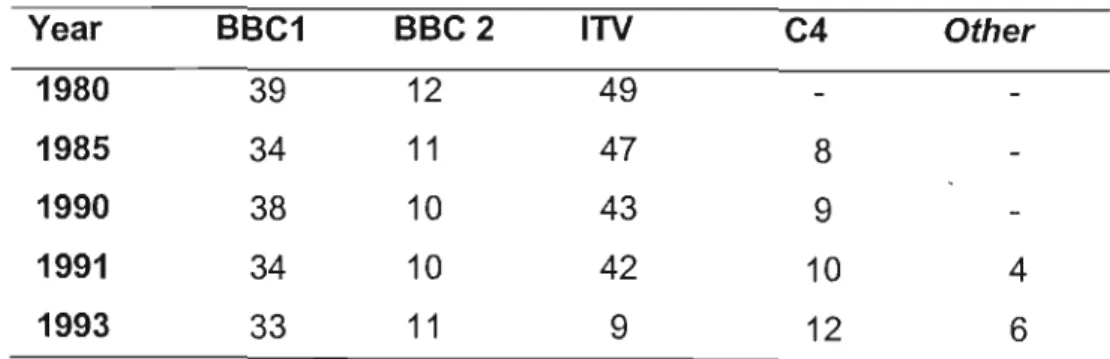
Figure 2.4 shows the television audience share in the UK over 13 years. It shows a decline in the share of BBC channels since 1980 as Channel 4 (C4) and cable and satellite became available.
U.K. Television Audience Share Data: Selected Years 1980-1993
Year BBC1 BBC2
1980 39 12
1985 34 11
1990 38 10
1991 34 10
1993 33 11
Figure 2.4: UK TV Audience Share '80 ·'93 (Note. Adapted from AGB Ratings)
ITV 49
47
43 42 9
C4 Other
8 9 10 12
4 6
The table shows that BBC 1 remained fairly stable over the years 1980 to 1993. ITV showed a big loss in the last three years recorded - which could be attributed to the advent of other channels being licensed for commercial broadcasting. BBC 1 audience declined slightly over the years but still remained a consistent competitor. The BBC channels are funded by licence fee revenues. Despite new competitors in the last three years .of the survey, the BBC retained its share, and in the case of BBC 2 even managed to grow it.
The BBC's public service mission embodies the following:
• Satisfy audiences with services which inform, educate, entertain and enrich the lives of audiences in ways which the market alone will not
• Bring people together for moments of celebration, common experience, and in times of crisis
• Help people broaden their horizons through learning and enriching their skills
• Reflect the nations, regions and communities of their market to themselves and the market as a whole (Curren and Seaton, 1981).
2.9 Operational Structure Comparison
Table 2.1 shows the differences in organisation structure of the SABC and the BBC. The BBC, like the SABC, had a monopoly on broadcasting for many years before commercial broadcasters were licensed. The mandate for the BBC appears to steer clear of political involvement. The SABC however has a political agenda as it is imbued with the role of nation building flowing from a new political dispensation in the country.
STRUCTURE UK: BBC SOUTH AFRICA: SABC Broadcasting In 1926 the BBC was founded Changes have occurred during Act/Environment under a Royal Charter. the past few years to bring the
1926-1954 the B BC had a SABC into line with the new monopoly on broadcasting. democratic dispensation and The BBC's mandate is to ensure that it serves all South provide broadcasting as a Africans. A new Broadcasting Act
"public service for was adopted in 1999 replacing disseminating education, the former 1976 Act.
information and entertainment". Board:
Term of appointment 5 years renewable Not to exceed 5 years
Power: Approve clear objectives and Controls the affairs of the SABC.
monitor compliance, ensure Specific obligations to protect the high standards of probity, independence and freed om of propriety and value for the SABC
money. Set overall strategy, ensure proper consultation, due regard for views of listeners, monitor legal and contractual obligations, appoint Director General.
Remuneration Determined by Secretary of Not set out in the governing State, from funds of the BBC legislation
No. of Members 12 members (or such number 12 members as well as CEO, as may be ordered under the COO and CFO
Royal Charter Table 2.1: Companson: BBC and SABC
The role of the Board also differs in the two organisations. At the BBC, the Board plays a guardianship and regulatory role whereas the SABC Board becomes directly involved in the running, structure and compliance with its national responsibilities.
23
2.10 The Research from Literature
The writings of Nicholas Garnham, Michael Porter, Yannis Bakos, Henry Mintzburg, Gary Hamel and CK Pralahad , Treacy and Wiersema and James Moore and their relevance regarding the impact of public service broadcasters, competitive strategy and sustainability are discussed.
• Nicholas Garnham (1996)
Garnham's research in the Economics of Television relates directly to the economics of broadcasting. Broadcast programmes are generally termed
"public goods". One person's consumption does not rival another's. If one person watches a programme - it does not stop anyone else from watching it.
There is therefore no need to ration by price. Moreover, once a programme has been made, the marginal cost of an extra viewer within a given transmission area is zero. The consumer welfare is therefore maximised, if the programme is offered at zero cost. Regarding the problem of "first copy"
costs - the fact that the costs of production are high in relation to the marginal costs of distribution - a programme costs the same amount to produce whether it is watched by one person or 20 million - constantly favours the search for the economies of scale that stem from audience maximisation. The pressure towards concentration is reinforced even further by the uncertainty of demand. Unlike normal consumer goods, a broadcast programme is basically selling novelty. This becomes obvious with audience dissatisfaction with repeat programming.
The problem exists that the consumer does not know in advance whether they will or will not be satisfied by the programme (Garnham, 1994). In turn, it is impossible for producers to know with any certainty in advance which programmes will be successful and which will not. Broadcasting therefore becomes an example of "flow production" - in which it establishes a regular relationship with an audience over time by supplying it with a constant flow of products at a fixed process out of which the consumer can pick - according to his/her interests. This model of production, however, depends largely on
establishing a high degree of channel or brand loyalty. Consumers are thus not purchasing individual programmes but the probability of regular satisfaction over time. An exception to the "flow production model" is the live transmission of an unique event where what is purchased is access to a unique moment in time, such as news.
The uncertainty of demand linked to economies of scale in distribution means that there is a weak relationship between the costs of production and the returns on that investment. In turn, this favours non-price competition and provides weak incentives to produce efficiency. Economic theory indicates that an unregulated, fully commercial system of broadcasting will result in market failure (Brown, 1996). This supports the case for some form of government intervention in broadcasting to ensure the provision of PSB programming
• Michael Porter
The study of theories of competitive advantage remains dominated by the work of Michael E. Porter (1980) who describes competition as ,"at the core of the success or failure of firms". He sees the choice of strategy leading to competitive advantage as being based on the attractiveness of the overall industry and the organization's competitive position within that industry,
Porter (1980) argues that there are three basic means by which an organisation can achieve a sustainable competitive advantage.
• A cost leadership strategy where a company sets out to be the low cost producer in its industry.
• A strategy of differentiation where a company seeks a premium price because of the uniqueness of its products.
• A focus strategy where a company focuses either cost or'differentiation strategies on a market segment or group of segments.
25
Porter stresses that a firm risks being "stuck in the middle" if it fails to select just one of the above strategies. SABC PBS is a cost leader in that it uses programme sponsorship to offset the price of programme making. This contrasts with the BBC, which relies solely on fixed licence fee money. The BBC also makes most of its programmes in-house, whereas the SABC primarily out-sources programme making. Differentiation is key to its
programming schedule - in comparison with other commercial broadcasters.
The focus for the PBS is on a mandate to a specific audience. In the case of SABC 2, it delivers primarily to the Sotho and Afrikaans markets with English as a secondary market. This differentiates it from its competitors and gives the channel access to the largest viewing audiences in South Africa.
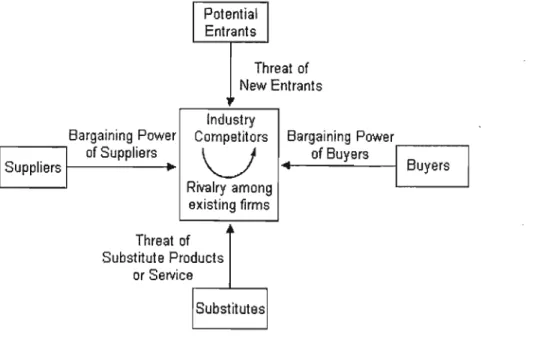
There are five forces that determine an industry's attractiveness according to Porter and illustrated below.
Threat of New Entrants
Bargaining Power
r - - - , of Suppliers
Industry Competitors Rivalry among
U
existing firms
Threat of Substitute Products
or Service
Figure 2.5 Porter's Five Forces
Bargaining Power
of Buyers r,-B---'
lit : uyars
Porter maintains that if we are to obtain a competitive advantage, we must pursue just one of the generic strategies with the aim of making new entrants, substitutes and rivals seem less attractive or increasing the firm's bargaining power by making it more attractive to buyers and suppliers.
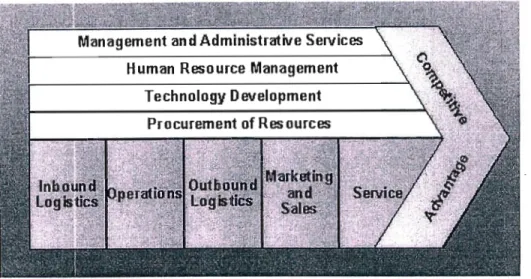
Porter describes a firm as a Value Chain (Figure 2.7) and points out that any firm must create value in excess of the cost of performing the Value Activities if it is to be profitable. He views the Value Chain of a company as part of a larger stream of activities that make up the Value System.
Management and Administrative Services Human Resource Management
Technology Development
Figure 2.7 Porter's Value Chain
By viewing the enterprise as a value chain we are better able to examine the linkages and seek efficiencies in those linkages thereby reducing costs or allowing differentiation. We may also wish to customise the value chain to support a generic strategy of focus.
Porter and Millar (1985) assert that Linkages not only connect Value Activities inside a company but also create interdependencies between its Value Chain and those of its suppliers and channels. He maintains that a company can create competitive advantage by optimising or coordinating these links to the outside.
In the case of a television station the obvious external linkages to examine are:
• Between the television station and its advertisers
• Between the television station and its audience
• Between the advertiser and the audience - through the television station.
In addition, the linkages can be seen within the SABC itself - creating synergies between SABC 1, SABC 2 and SABC 3. Technology and Human Resources shared across the Corporation create linkages that impact positively on cost. These linkages would seem likely to be important to achieving competitive advantage in a television station.
Porter's generic strategies alone do not seem to answer the question of how a television station can achieve a competitive advantage.
Clearly the station must first compete for viewers if it is to compete for advertising rands or share - thus the importance of the external linkages.
Cost is not an issue when competing for audience share as viewers receive the programmes for free.
Porter's views on the importance of a "strategic fit" are useful to. this study.
He says that an "array of interlocked activities" can be difficult for a competitor to match and can result in a sustained competitive advantage. A television station has two main interlocked activity sets - all the activities that go into securing and maintaining an audience and all those activities involved in selling and creating advertising. These are activity sets that the SABC can use but the BBC cannot, as they are unable to access advertising revenue.
• Yannis Bakos
Yannis Bakos's (1991) Causal Model of Competitive Advantage_suggests that the two factors influencing competitive advantage in inter-organisational systems are:
1. Bargaining Power
2. Comparative Efficiency
In reconciling Bakos' ideas with those of Porter's, comparative efficiency can be related to cost advantages and bargaining power with differentiation.
The differences between Porter and Bakos are that Bakos sees constant innovation as being possibly a sustainable competitive advantage but raises questions about the sustainability of advantages not based on unique resources. If an advantage is based on low cost it may be temp·orary - if based on differentiation (innovation) an advantage could also be fleeting unless the innovation is constant. As the SABC's PBS mandate continues to evolve, opportunities for sustainable competitive advantage based on this mandate has become a useful tool for innovation. SABC 2 is a pioneer in indigenous language broadcasting and this could lead to more novel and groundbreaking areas of production.
• Henry Mintzberg
Porter's teaching which emerged in the 1980s, that firms must either
differentiate or be a cost leader, and not be "stuck in the middle", was called into question when examples emerged of highly successful companies that appeared to be low cost and differentiated at the same time.
In "The Fall and Rise of Strategic Planning" (Harvard Business Review, 1994)
Henry Mintzberg challenged the concept of strategic planning and with it Porter's view that a company could plan its future strategy by following a formula or a set of rules. These rules can be likened to the set of mandated guidelines set out by the SABC Board and ICASA to ensure that SABC 2 follows a strict public service strategy.
• Hamel and Pralahad
In their 1994 publication "Competing for the Future" Gary Hamel and CK Pralahad suggested that traditional strategic theories were unrealistic. Hamel and Pralahad argued that the challengers had succeeded in creating entirely
29
new forms of competitive advantage and in dramatically re-writing the rules of engagement.
Hamel and Pralahad also advised managers to understand and develop their organization's core competencies, and to focus on the underlying
functionalities of their products and services and not just on the products and services themselves.
Applying their thinking on core competenCies to television, a station could secure a competitive advantage by changing the way it sees itself. The station should not see itself just as a broadcaster, but as an organisation with unique competencies in communicating with entertainment, local news and
information, advertising copy writing, recording and running sales and marketing promotions. There is no reason why SABC 2 should not embrace this concept as it is fundamentally a commercial broadcaster with public service components.
This more liberating view of the television station could lead to an expanded role and the rapid adoption and exploitation of new technologies.
• Treacy and Wiersema
Treacy and Wiersema's "The Discipline of Markets" (1995) dealt with the idea of securing an unassailable competitive advantage by dominating a m"arket.
As SABC - specifically SABC 2 - is targeting audiences that have been under-served in the past, it is dominating that market. The PBS mandate allows it to concentrate on an under-utilised market even though LSM's might show that it does not have significant return on investment with regard to advertising revenue. Treacy and Wiersema suggest that a company adopts just one of the three Value Disciplines of:
1. Operational Excellence 2. Product Leadership 3. Customer Intimacy
It would be possible to apply these concepts to television as follows:
• Operational Excellence
A station following this value discipline would concentrate on being a no frills station and with a focus on efficiency of effort and coordination. Operations and procedures would be optimised and streamlined and technology would be sophisticated.
• Product Leadership
Operating with a product leadership value discipline, a channel would be very creative and quick to adopt and commercialise new ideas. Its customers would be offered exciting new promotions and highly creative copy writing. Viewers would enjoy lots of original program material. This would be true for the SABC as they pioneer programming in indigenous languages using indigenous actors utilizing plots from local township life.
• Customer Intimacy
The channel that focuses on the value discipline of customer intimacy would value the tested and reliable over the new and untried. The channel would also pay a lot of attention to what its viewers wanted and would use surveys and focus groups to get close to the needs and wants of its audience.
In the same way that Porter urges firms to choose just one generic strategy, or risk being stuck in the middle, Treacy and Wiersema predict dire
consequences for companies that fail to choose a single value discipline.
They assert that choosing a discipline is the choice of winners. Not choosing means ending up in a muddle. The writers believe that not choosing means hybrid-operating models that are neither here nor there, that constantly cause confusion, tension and loss of energy. Treacy and Wiersema say that not making a choice means n ••• steering a rudderless ship, with no clear way to resolve conflicts or set priorities".
• James Moore
The thinking of James Moore appears much more ground breaking than that of Treacy and Wiersema in that Moore does not see competition as a game involving winners and losers but speculates whether we would not all be better off by cooperating (Moore, 1996). His argument is that innovation wins. Moore says that today cooperation is as important, or more important, than the winner-takes-all, head-to-head combat implied by Porter's approach.
Porter recognizes the existence of "good competitors", however Moore goes further and says ferocious competition is now dead and if you do not
recognize that your company is in trouble.
Moore urges managers to see their business environment as an-ecosystem. He defines an ecosystem as a "community of organisms interacting with one another plus the environment in which they live and with which they also interact" (Moore, 1996).
The three SABC channels are an example of an ecosystem. In many cases they use the same suppliers, advertisers and programme content suppliers although their audiences are different.
By focussing on the ecosystem, rather than the competition, the television station can seek to create new ecosystems to bring innovations to customers.
Instead of trying to win the game, try to change the game and create a new outcome. Judging the SABC's performance over three channels and not by the performance of each individual channel could make the SABC more innovative and competitive as a whole.
• Brandenburger and Nalebuff
Adam M. Brandenburger and Barry J. Nalebuff popularized the idea of applying game theory to business. In their 1996 book Coopetition they argue that business is a game, but a game with a difference.
"In business, your success doesn't require others to fail - there can be multiple winners" write Brandenburger and Nalebuff. Business is war, but it is also peace. You have to compete, but if you are smart you will also cooperate. They maintain that business is cooperation when it comes to creating a pie, and competition when it comes, to dividing it up. In other words, business is War and Peace. But it is not Tolstoy - endless cycles of war followed by peace followed by war. It's simultaneously war and peace.
As Ray Noorda, founder of the networking company Novell, explains that a company has to compete and cooperate at the same time. The combination makes for a more dynamic relationship than the words "competition" and
"cooperation" suggest individually (Brandenburger and Nalebuff, 1996).
Brandenburger and Nalebuff therefore coined the term "Co-opetition" and suggest that it is game theory that allows us to move beyond simple-ideas of competition and cooperation. The payoff from game theory, they say, is the chance to change the game to one of your own liking.
To change the game you need to change one or more of its elements. This means each of the five elements, Players, Added values, Rules, Tactics and Scope (PARTS) - gives companies a way to transform an existing game into an enti