THE IMPORTANCE OF THE INDIGENOUS GAMES AMONG THE BA-PHALABORWA OF THE LIMPOPO PROVINCE.
BY
MOHLAGO TRACEY MALESA
Submitted in partial fulfilment of the requirements for the degree:
Master of Arts in Folklore Studies
In the faculty of Humanities (School of Social Sciences)
UNIVERSITY OF LIMPOPO (Turfloop Campus)
Supervisor: Dr P.X Shilubane
Submission Date: July 2012
ACKNOWLEDGEMENTS
First of all, I would like to thank the Almighty God for his abundance love and mercy upon me through whom I conquered all the challenges I came across during my days of study . I thank God for his undivided love and attention all the time .
I would like to acknowledge with a great debt of gratitude and appreciation the following people who, through unmeasurable devotion , contributed to the success of this work :
Prof S.T Kgatla who, through his professional guidance guided me in this work before he retired .
My supervisor, Dr P.X Shilubane for his academic guidance, critical comments, motivation and patience.
Prof. S.N.C Mokgoatsane, whose inspiration guided me to the realization of my potential.
My beloved husband Samuel Junior Mandlazi for his understanding, love and unaparalleled support.
My beautiful sons Hlayiseka and Amukelani as well as daughter Mpho, for their support and typing part of this mini-dissertation.
Mrs Irene Phalane and Nel Monyela for the meticulous typing and professional organization of the entire work.
To my mother Sellina Maduka Malesa and my sister Manthate Joyce Khosa, thank you for the encouragement when the going got tough.
Mrs Phoshoko and Mthembu, the love and support you gave me is highly appreciated and had left an undellible mark in me.
And finally, my sister in Christ, Eugene for your prayers and support.
DEDICATION
This study is dedicated to my deceased father, Morape Phineas Malesa as well as my late son Mbio Mandlazi.
TABLE OF CONTENTS
Declaration i
Dedication ii
Acknowledgements iii
Summary of the study v
CHAPTER ONE
GENERAL BACKGROUND OF THE PROBLEM
1.1 INTRODUCTION 1
1.2 PROBLEM STATEMENT 2
1.3 AIM AND OBJECTIVES OF THE STUDY 4
1.3.1 Aim 4
1.3.2 Objectives 4
1.4 OPERATIONAL INDICATIONS AND DEFINITIONS 4
1.4.1 Indigenous game 4
1.4.2 Games 4
1.4.3 Ba-Phalaborwa 5
1.4.7 Kgati 6
1.5 SIGNIFICANCE OF THE STUDY 6
1.6 RESEARCH QUESTIONS 8
1.7 LITERATURE REVIEW 8
1.8 THEORATICAL FRAMEWORK 10
1.8.1 Interpretive framework 10
1.9 RESEARCH METHODOLOGY 11
1.9.1 Research design 11
1.9.2 Data collection 11
1.9.3 Sampling 12
1.9.4 Data analysis 12
1.10 BA-PHALABORWA MUNICIPALITY 13
1.11 PRESENTATION 13
CHAPTER TWO
THE INDIGENOUS GAMES AND HOW THEY ARE PLAYED 14
2.1 INTRODUCTION 14
2.2 MEMORY GAMES 15
2.2.1 ‘Kgati’ (Skipping rope) 15
2.2.2 ‘Diketo’ (Stone throwing) 20
2.3 SKILL GAMES 25
2.3.1 ‘Morabaraba’ (board game) 25 2.3.2 ‘Moruba’ (board game) 29
2.4 MOTIVATIONAL GAMES 31 2.4.1 ‘Melamo’ (Stick fighting) 32
2.4.1.1 ‘Thupa’ (Stick fighting) 33
2.4.1.2 ‘Kgati’ (Stick fighting) 33
2.4.1.3 ‘Molamo’ (Stick fighting) 34
2.4.2 ‘Matswele’ (Fist fighting) 35
2.5 CONCLUSION 37
CHAPTER THREE
VALUES AND USE OF THE GAMES 38
3.1 INTRODUCTION 38
3.2 SOCIAL VALUES 38
3.3 COMMUNICATION AS A SOCIAL PHENOMENON 40
3.4 HEALTH AND PHYSICAL VALUES 42
3.5 MORAL VALUES 44
3.7 POLITICAL VALUES 47
CHAPTER FOUR
FIELDWORK AND FINDINGS 48
4.1 INTRODUCTION 48
4.2 INTERVIEWS 48
4.2.1 When did you become interested in the indigenous games? 48 4.2.2 What are the problems you come across in reviving these games? 49
4.2.2.1 Lack of protection 50
4.2.2.2 Western games versus the indigenous games 51 4.2.2.3 Lack of funding and sponsorship 51
4.2.2.4 Lack of support 52
4.2.3 How can promoting the games benefit the community? 54 4.2.4 Which games are identified as indigenous? 55 4.2.5 What are the plans for the future regarding the games? 56
4.3 CONCLUSION 57
CHAPTER FIVE
CONCLUSIONS AND RECOMMENDATIONS 58 5.1 Conclusions 58
5.2 Recommendations 58
FIGURES
Figure 2 Schematic representation of ‘diketo’ (stone throwing) 20
Figure 3 Schematic representation of ‘morabaraba’ (board game) 25
Figure 4 Schematic representation of ‘moruba’ (board game) 29
Figure 5 Schematic representation of ‘melamo’ (stick fighting) 32
Figure 6 Schematic representation of ‘matswele’ (fist fighting) 35
REFERENCES 64
CHAPTER ONE
GENERAL BACKGROUND OF THE PROBLEM
1.1 Introduction
The indigenous games are as old as humankind itself. Many years before the colonisation of South Africa, people had their own indigenous games. The knowledge of indigenous games was passed on from generation to generation orally and practically. The rural children learned to play these games at home from their brothers and sisters before they could learn other games in the community because home is where informal education begins. Beashel and Taylor (1988:99) mention that people had always played and enjoyed their games. The desire to play has always been strong among Africans.
Adults used to play games like, ‘moruba’ and ‘morabaraba’ (board games) for relaxation and enjoyment.
The indigenous games in Africa have been an expression of local people’s culture and social realities.
According to Bellard (www.Sacs 2004) participation in indigenous games emphasizes physical development, skill training and maintenance, re-enforcement of values and interaction between communities. Booth (1988:68) says that each population group have their own ‘geopolitical home kind’
to develop their talents and skills from birth. The indigenous games have always acted as a vehicle of change in the reclamation of peoples’ culture; unfortunately African indigenous games are neglected.
According to MacMillan and Schumacher (1993: 6) in the early centuries, before reading and writing were common, individuals developed knowledge of the world around them through two means. One way was through personal experiences and observations of others’ experiences. They then passed their knowledge to the next generation in the form of story-telling. The second way was by means of games.
The knowledge of games too was passed on orally and in the form of play from generation to generation.
Games such as ‘moruba’ (board game), ‘diketo’ (pebble throwing), ‘kgati’ (rope skipping),
‘morabaraba’ (board game) and many others are the remnants of our infinite past which have been handed down from generation to generation by the members of community’s word of mouth and these games are still prevalent amongst the community of Phalaborwa.
1.2 Problem statement
Ntuli indicates that Mpofu, the provincial indigenous games co-ordinator in Limpopo says that research indicated that most of the province’s residence would like to rediscover the games as part of their lost culture (www.lowveldinfo 22.04.2004). After the demise of apartheid people needed to discover who they were and who they really are. This process of discovery can be a long one but it is very essential.
The study attempts to make input to this process of self-rediscovery.
One area where this study can make contribution is the rediscovery of indigenous African games.
These games are either ignored or vanishing and yet they were constituent part of African life and entertainment. Indigenous games can be viewed from a narrow perspective of play, enjoyment and recreational but, analysis of games reveals concerns that are not usually considered (Nyaki 22.04.
2004). The indigenous games should be equally sponsored like Western games.
Lack of acknowledgement of indigenous games by the leaders and policy-makers in the Limpopo Province and other provinces led to immense neglect of the games in the Province and South Africa at large. Ba-Phalaborwa like other South African communities, have knowledge of their traditional games but they do not draw enough benefit from them as they are looked down upon as primitive and insignificant.
These games form a part of people’s heritage as already stated. Odora Hoppers (2002:8) says that local communities are termed knowledge-rich, but economically poor. This means that local communities have resources that are not used to benefit them. Rural communities play the games for relaxation and
Recreation and language are intertwined. When games are played, people use language to communicate and to work well with each other. For people to enjoy and be entertained, language should take place.
Ba-Phalaborwa community like other South African disadvantaged communities are Africans who know little about Western languages, as such foreign languages may have contributed to the lack of knowledge of the indigenous games due to the fact that those who were knowledgeable about the games failed to express their ideas in foreign languages when the developers of the games approached them.
Ntuli (2002:53) points out that language as a conveyer of thoughts, philosophies and ideologies, was deployed to deprive African people of their right to define and express themselves and their sensibilities. Most people in Phalaborwa do not understand Western languages and as such, fail to communicate meaningfully in those languages. Learning these Western languages in order to understand their games is too costly. The domination of westernisation has undermined African culture to a large measure. In the remote rural areas the conflict between the traditional games and Western games is however, still observable.
To look at the history of sport is to look at the social history of a society. Sport reflects the society in which it is found (Beashel and Taylor 1988:99). The current games played around the Phalaborwa district, have been imported from the Western countries. Indigenous games are alienated because of Western games that are always traded with huge financial support. Coplan (1985:103) writes that sport was exported very successfully and greatly influenced the whole pattern of world sport development.
In South Africa games are not integrated even after democracy as sometimes claimed by sport authorities. Beashel and Taylor (1988:162) mention that the Sports Council group that travelled to South Africa to see for themselves the progress made towards multi-racial sport. They found that although South Africa claimed that much of its sports were integrated, in practice that was not the case.
African games are not written down; parents and community leaders have to orally transmit their knowledge to the offspring. Non-documentation may have contributed towards their vanishing. Ki- Zerbo (1990:239) quotes Amadou Hamparte Ba, who said; “when an elder dies in Africa, is a library
manuscript. On a day-to-day, such living manuscripts pass away and Africa’s school system thus loses more of the roots of its cultural truth. Global influences have a mark on the erosion and adaptation of the games. These games were neglected in historical and anthropological accounts of the western (Bellard: www.Sacs 2004).
1.3 Aim and objectives of the study
1.3.1 Aim
The aim of the study is to explore the importance of the indigenous games to the Ba- Phalaborwa.
1.3.2 Objectives
To investigate the importance of the indigenous games among the Ba-Phalaborwa.
To explore how the games have been marginalised.
To propose new ways of reviving the games.
1.4 Operational indicators and definitions
1.4.1 Indigenous game
Indigenous games are an integral component of indigenous knowledge systems. These games are usually viewed by players from the narrow perspective of play, enjoyment and recreation. Without games life can be dull and boring. People depend on the games as a means of entertainment.
1.4.2 Games
Game is a mental or physical contest played according to rules. Games are usually played for fun but
Probabilities of games may also require skills at guessing what players are thinking or an ability to visualise changing source patterns of pieces on a board (Grolier Incorporation 2000:71).
1.4.3 Ba-Phalaborwa
According to Ba-Phalaborwa Local Municipal Council (March: 2001) the name Phalaborwa gained its origin from Ba-Phalaborwa tribe who started mining copper in the area decades ago. They were successful traders in copper and they referred to the place as ‘Phalaborwa’ meaning ‘better than the south’ because of the minerals found in Phalaborwa. Ba-Phalaborwa therefore refers to the inhabitants of Phalaborwa.
1.4.4 ‘Diketo’
According to Makgamatha (2000: 43) the name ‘diketo’ is derived from the verb ‘hoketa’ (to knock against something). It is a game played with ‘diketo’ (pebbles). One stone is thrown into the air and instantly when the stone is in the air, the hand scoops ‘diketo’ (pebbles) out of the hole. The stone is thrown up again and the hand returns the pebbles in the hole excepting one pebble. Should all the pebbles be returned into the hole without leaving one behind, this is regarded as a default. ‘Diketo’ is a game which requires fast reflexes and good hand-eye co-ordination.
1.4.5 ‘Moruba’
‘Moruba’ is a men’s board game which requires all the mental agility and concentration like in chess or backgammon. It is particularly popular among the mining communities and is also played in neighbouring countries.
1.4.6 ‘Morabaraba’
‘Morabaraba’ is a game played in the holes dug on the ground. The holes are called ‘kraals’ and the pebbles ‘cows’ because the number of cows one owns still measures the wealth of an African person.
Westernised world. The ‘kraal’ is the homestead of the African village. It consists of round huts, usually made of grass or mud huts, which are placed in a circle. The king’s kraal obviously belonged to the head of the village.
1.4.7 ‘Kgati’
‘Kgati’ (skipping rope) is a vigorous rope skipping game played by young girls and women for fitness and weight loss. Masiea (1973: 43) indicates that the skipping rope game is basically an exercise for the legs and that the game is never played inside the village because it is believed that it may cause an epidemic or some other form of ill-luck to the residents. The researcher differs with Masiea on the view that a game of ‘kgati’ (skipping rope) is played inside the village. The way the games are played can differ from one place to the other.
1.5 Significance of the study
Games play a pivotal role in peoples’ lives to an extent that they are hard to die to date. They are played at homes, schools, taxi ranks and many other places around Phalaborwa yet they are on the verge of disappearing. The present study tries to establish the reasons for the observable disappearance of the games; investigates the significance of the games to the Ba- Phalaborwa and explores the ways in which they could be incorporated to school games in the Limpopo Province.
Because of historical dominance of western culture, the games run the risk of disappearing and yet these games sustained African communities for centuries. Bellard (www.Sacs 2004) points out that legends have it that African chiefs used to select the best ‘morabaraba’ (board game) players to serve as advisers in their traditional councils.
If the indigenous games can be reclaimed and be played and sponsored like most games such as soccer and swimming, poverty and crime can be alleviated. These games again can contribute greatly in
more people are not engaged in something, the more they are likely to commit crime, hence the undertaking of this study.
Moshoeledi (www.suntimes 2001) one of indigenous games players mentions that he got interested in the games because he had to concentrate a lot, and that had helped him pay more attention to school work and books. Maseko (www.suntimes 2001) adds that if this generation could learn how to play
‘morabaraba’ (board game), they would be able to have a longer attention span.
Maseko (www.suntimes 2001) mentions that it would be wonderful if the traditional games could be made into national sports and maybe the Olympics. He adds that it would be nice to know that people have taken skills that were passed on to them by older people and turned them into a sport that the whole world can take part in.
Nyaki says that whenever indigenous games are played, spectators become overwhelmed with joy as they are reminded of their olden days. He mentions that the former Minister of Sports, Makhenkhensi Stofile jumped up and down his seat, exhorting young participants to get stuck into each other as they competed at games which like so much of this country’s heritage, face extinction. As they watched, many of the elderly spectators doubtless experience flashback time to time when they too played those games in townships, streets and villages (www.inasp 2004). This statement shows that indigenous games are important as the study states.
A combination of promotion of games can serve as a vehicle for the elimination of poverty within rural communities because people can make use of playing games to earn a living. Indigenous games can also serve as a tool for the alleviation of the causes of crime as people will be engaged in games rather than idling.
The love of sports by Ba-Phalaborwa underlines the importance of the games to them. Research will culminate academic report on the crucial retention of knowledge of these games. It is also significant to note how these games persisted despite attacks from other games like tennis and so forth, to date.
Both elderly and leaders show enthusiasm when the games are played. It is in this context that this study attempts to explore the state of importance and relevance of the indigenous games among the Ba-
1.6 Research questions
The following research questions will be answered.
1.6.1 What is the impact of indigenous games on the life of Ba-Phalaborwa?
1.6.2 How can South African society benefit from the indigenous games?
1.6.3 What measures could be taken to protect, develop and promote indigenous games in South Africa today?
1.7 Literature review
Although other authors have written about games, little has been written about indigenous games played in rural areas of South Africa. Most games written about are Western. Masiea (1973:3) in his work indicates that the missionaries could not do much to preserve these traditions because they were still not part of the Bapedi culture at that stage.
Leedy and Ormrod (2001: 147) in their work indicate that centuries ago, when reading and writing were not yet developed, people shared their observations and experiences through detailed oral descriptions that were later combined into a series of stories. These stories helped others understand what was previously observed or experienced and provided a base for extending knowledge of new experiences. In the absence of enough noteworthy books on this subject, this study will depend on extensive research.
Although Booth (1988: 86) shows that the fact that each population group have their own ‘geopolitical homeland’ to develop their talents and skills from birth, Ba-Phalaborwa people had less chance to develop their talents and skills further on games due to lack of resources. As a result, the indigenous games were dominated by western games.
such as cricket, tennis and soccer. Communities should first compete in indigenous games among themselves, then make tournaments inviting nearby communities because they should take one step at a time.
Beashel and Taylor (1988: 99) indicate that sport reflects the society in which it is found. This is however, not the case among the Ba-Phalaborwa whose indigenous sports are dominated by Western games. For the society to gain their pride in the indigenous games they should first group themselves together; find ways and means on how they can reclaim the games as part of their heritage.
On the other hand, Coplan (1985:246) has shown concern that many semi-urban and rural areas of South Africa need to discover their past social history in order to embrace the process of cultural transformation. Although he does not mention how South Africans can rediscover their past, indigenous games are one of the tools that South Africans can make use of to rediscover their past.
Booth (1988:41) has discovered that the 1981 survey on ‘important problems’ among the Blacks identified lack of recreational facilities to be very high. Statement such as this shows some of the causative factors of the vanishing of the indigenous games. Although indigenous games are inexpensive, recreational facilities are a problem experienced by rural communities of this country even today. For the indigenous games to be on the limelight there should be facilities such as playgrounds and community halls where they could be played.
Africans at the time of colonisation had no writing skills until the missionaries created it. Games therefore, could not be documented to ensure their preservation for the future generation.
Cohen, Normann and Snyman (1993: 14) maintain that indigenous knowledge as local knowledge that is unique to a society. The indigenous games form part of Ba-Phalaborwa community’s local knowledge but, they are on the edge of vanishing and this leads to these communities’ shortage of some of their heritage. Indigenous games have been partly lost or forgotten hence, this study.
1.8 Theoretical framework
Borgatts and Chase (www.analytictech 2004) write that theoretical frameworks are also important in exploratory studies, where you really don’t know much about what is going on and are trying to learn more. Giddens (1993:705) mentions that sociology is about our own lives and our own behaviour and studying ourselves is the most complex and difficult endeavour. He further states that in all academic disciplines … there is far more disagreement over theoretical approaches. For this reason, the researcher has chosen interpretative framework as theoretical lenses through which the study could be undertaken.
1.8.1 Interpretive framework
Although there are many frameworks in anthropological research, the researcher finds interpretative framework suitable to the phenomenon under study. The researcher investigates that which is meaningful to the people being studied and how individuals experience their daily life regarding the indigenous games. In doing so an interpretative approach is adopted. As an exploratory study, the researcher deploys interpretative framework to understand the research topic and to be able to gather more information through investigations.
There will be social interactions between the researcher and the community under which the research will take place and through interpretative approach, the researcher will be able to interpret the situation and ways from the community, through which games can benefit them. People possess an internal sense of reality.
Social interactions and constructed meaningful systems explain much on the topic under research. The problem therefore is about the present status of the indigenous games in relation to the imported games in Phalaborwa. A new theory which may help in the integration of African and Western games may emerge from the study which may serve as a guiding formula for policy-makers.
1.9 Research methodology
The research process is qualitative in approach where little information exists on the topic. Through qualitative approach, the researcher was able to define the importance of the indigenous games.
Qualitative approach evolves around description, investigation, interpretation and evaluation. The researcher was able to gain insight about the nature of the games, develop the idea and discover the problem that exists within the indigenous games.
MacMillan and Schumacher (1993:14) point out that qualitative research is based more on what they call “naturalistic phenomenological” philosophy, which assumes that multiple realities are socially constructed through individual and collective definitions of the situation.
1.9.1 Research design
In order to get information from the participants during interviews, a plan on how research is going to take place should be done. Welman (1991:46) defines research design as the plan according to which one finds research participants and collect information from them. The researcher finds the participants and collects information from them by means of interviews.
1.9.2 Data collection
Leedy and Ormrod (2001: 147) mention that to answer some research questions, we cannot skim across the surface. We must dig deep to get a complete understanding of a phenomenon we are studying. In qualitative research one has indeed to dig deep; collect numerous forms of data and examine them from the various angles to construct a rich and meaningful picture of a complex, multifaceted situation.
The researcher used participant observation as a tool for data collection. Participant observation is cheap and enhances close contact. The researcher made close contact with the people and also take part in the games as they are played. Giddens (1993: 686) in his work indicates that fieldwork where it is successful provides much richer information about social life than most other research methods.
The researcher intermingled with the people to get an overall idea of the games. Key informants who provided information and insight to the indigenous games were identified. Neuman (2000: 71) states that the researcher shares the feelings and interpretations of the people he or she studies and sees things through their eyes. The researcher stayed with the community as an observer, interviewer and listener.
The notes were also taken by the researcher.
Data was collected in the form of interviews. The researcher conducted interviews to gather information and to gain insight about the topic under study. The games that the researcher focused on are ‘morabaraba’ (board game), ‘moruba’ (board game), ‘diketo’ (pebble throwing), ‘kgati’ (rope skipping) ‘melamo’ (stick fighting) and ‘matswele’ (fist fighting).
1.9.3 Sampling
Kerlinger (1986:198) describes sampling as the taking of any portion of a population or universe. As the purpose of sampling is to gather information about the games, the researcher’s sampling consisted of elderly people who have experience in the indigenous games and selected individuals for observation while the game was played as well as regular spectators.
1.9.4 Data analysis
Data collection and data analysis work hand in hand. Erlandson (1993: 341) points out that as data is gathered, it is analysed. The content of the recorded interviews were analysed by the researcher to see the importance of the games as an entertainment phenomenon.
Wolcott (2001:152) mentions that data collection and data analysis often occur simultaneously. The analysis typically often proceeds in description and interpretation. When the information has been collected the researcher organises it into a logical structure.
1.10 Ba-Phalaborwa Municipality
Ba-Phalaborwa Municipality is situated on the North-Eastern part of South Africa in the Limpopo Province. It is one of the four local municipalities in the Mopani District. The Municipality has a geographical area of 3,004.88km² that constitutes 27% of the Mopani District. The Municipality serves as a gateway to the Kruger National Park and the Transfontier Park through the Mozambique Channel.
The population of Ba-Phalaborwa as estimated in the late 2010 statistics was 109,468 with 25 villages (Ba-Phalaborwa Local Municipality Council, August 2011).
The Municipality is renowned for its mining activities. Copper and phosphate ores are the most mined natural resources in the area, produced by the Phalaborwa Mining Company (PMC) and FOSKOR (Ba- Phalaborwa Local Municipality Council, March 2001).
1.11 Presentation
Chapter one in this research is about the background of the problem. In chapter two, focus is laid on the importance of the indigenous games and how they are played. Chapter three discusses the values and uses of the games. Chapter four has to do with fieldwork and findings and the last chapter which is chapter five, is about conclusions and recommendations with regard to the topic under study.
CHAPTER TWO
THE INDIGENOUS GAMES AND HOW THEY ARE PLAYED
2.1 Introduction
The economic influence of the indigenous games bring along changes in the place of sports, although they have been neglected and some undergone modifications they still remain a heritage to the people of Phalaborwa. The games are still simple to play, accessible to people and inexpensive. They are part of oral culture amongst Ba-Phalaborwa.
The indigenous games are played at different times using different techniques and instruments.
Observations and imitations take a lead in learning how to play the games. The young males and females observe their brothers and sisters as the games are played. They in turn imitate them. The indigenous games are not articulated like other games. This could be because they were marginalized.
These games are not documented as alluded in the previous chapter, but passed on from generation to generation through the word of mouth, observation and participation. This process of assimilation has been ongoing for centuries unnumbered. Imitation is one way of learning. Imitation takes place for example, when girls observe their sisters and mothers play.
There are games that Ba-Phalaborwa play even to date. Games such as ‘kgati’ (skipping rope), ‘diketo’
(stone throwing), ‘moruba’ (a board game), ‘morabaraba’ (a board game) and ‘melamo’ (stick fighting) are prevalent in Phalaborwa. There are various types of games which are still played in Phalaborwa to date. The games here are categorized into groups. They are divided into memory games, skill games, and motivational games.
2.2 Memory games
Memory games are games which the style of playing, the time and aim thereof, remain the same. The ability and power of an individual player to remember how the game is played is embedded in this type of games. Memory games comprise of ‘kgati’ (skipping rope), ‘diketo’ (pebble throwing), and ‘dibeke’
(ball throwing).
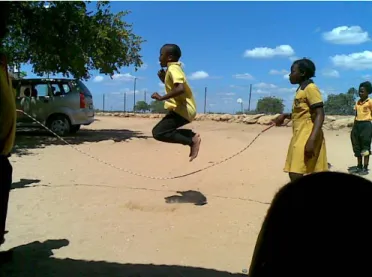
2.2.1. ‘Kgati’ (skipping rope)
Figure 1 Schematic representation of ‘kgati’ (skipping rope)
‘Kgati’ (skipping rope) is played by both boys and girls especially teenagers. According to Hellmann in Archer and Bouillon (1982:131) skipping rope is a favorite pastime of both boys and girls. Children play this game during the day. Women also play ‘kgati’ (skipping rope) for weight loss. Nowadays both men and women use this game for physical training in the morning and in the afternoon at their homes.
It is also a means of learning how to count in children. The aim of the game is to entertain, socialize, compete, exercise and win.
How the game is played
A bare hard place in the yard but where players cannot get hurt.
A rope of about three meters made out of plastic.
Three people are required. Two swing the rope and the third one skips it. If there are only two people, a tree or any planted pole can replace the third person. The rope can be tied against a tree.
Then the other person will swing the rope whereas the second one skips.
Two groups consisting of three, four or even ten members can play the game depending on the number of participants available and how long the rope could be.
The rules of the game
The rule of the game is that as the two swingers swing the rope, the participant skips the rope. Should the rope touch the body, especially on the ankles, the player is defaulted and disqualified.
The variations
One person swings and skips.
One person can swing the rope and skip at the same time. He or she skips as many times as he or she can or until he or she is tired. People who want to be fit mostly do this variation. It can be done by boys and girls, men and women.
Variations for young children
Children especially those in grade one to three use this variation to count skipping with both legs at the same time. When they skip the rope they sing children songs which comprise of small sentences which mostly repeat itself. In this variation children sing:
Ga tee, ga pedi’
(One, two Once, twice Once, twice Once, twice)
The variation assists the young children not to default when they skip count. They sing while the rope touches the ground before they skip. Then they get in, skip twice, and move away from the rope. They continue to do so until they have defaulted. The player wins the game if he / she skips the rope to a set period of time without being touched by the rope.
Counting up to hundred and over.
Children from grade four, five and six can skip and count up to hundred and over, using both legs. They can also count using one leg to skip.
Speed skipping
The swingers change the swinging speed. They swing faster than before and the participant should go with the speed. This exercise needs more energy and stamina. There is also more sweating.
Speed skipping and counting up to three
Children can play this variation in the lower grades. As the rope swings, the participant jumps in and counts: one, two, and three and gets off the swing. Gets back again counts and gets out until such time that the rope touches him or her.
Two participants skipping at the same time
Two players play facing each other or even holding hands. They can jump in silence, counting or singing.
Variation for older children
Older children of ten to fifteen years’ sing songs consisting of different sentences with their own meaning when they play the game. In this variation, a player skips the rope singing. She calls all members of her group one by one, each by name to get in and skip the rope. As she calls her group members, each member responds by asking questions, for example:
‘Tholi, Tholi O reng sebara?
Ke nna sebara O mang sebara?
Ke Manthate sebara Le bo mang sebara?
Le bo Mohlago sebara Le bo mang sebara Le bo Molatelo sebara’.
(Tholi, Tholi
What do you say brother-in-law?
It’s me brother-in-law
Who are you brother-in-law?
I am Manthate brother-in-law And who else brother- in- law?
The participant sings until all her group members are in. The ones who are touched by the rope will be sent out. They will wait until those who are playing, default one by one. Those who swing the rope will swing until the last person defaults. It is then that they will get a chance to play.
In the song, children sing about entering somebody’s home. They introduce themselves one by one as they enter. They learn how to greet when a person enters another persons home. One cannot just get in without greeting first. Greetings are learnt at a young age in Ba-Phalaborwa’s culture and tradition.
Defaulting
When rope swingers are tired of swinging and want to play, they deliberately cause the player to default by applying the following:
‘Go kgopisa’ (to default a person)
Those who swing the rope swing it so that it does not hit the ground; instead it hits the ankles of the player.
‘Go nganga’ (to pull the rope)
The rope swingers pull the rope so that it does not swing properly then, it defaults the player.
The myth surrounding kgati’’ (skipping rope)
The myth for this game is that ‘Yo a tšwago pele, o lewa ke dimpša’ (the first one to default will be eaten by dogs). They discourage laziness especially taking into consideration those who are obese.
They know that they will be the first to become tired. They want to encourage them to do more body exercise.
Another myth which they use on this game is that ‘Ge le bapala kgati ka gae, go tla betha tladi,’ (when you play skipping rope indoors, lightning will strike). The parents use this myth to avoid soil erosion and dust. On the same note Masiea (1973:43) says that the game is never played inside the village
does not mention what that implies in real-life situation. One can conclude that women use this myth to forbid girls playing near their fathers.
There is also a taboo used on girls playing ‘kgati’’ (skipping rope) near their fathers. On the same myth of ‘Ge le bapala ka gae go tla betha tladi’ (when you play skipping rope indoors, lightning will strike), women again avoid to see girls playing near their fathers because Ba-Phalaborwa believe that a male parent should not see his daughter’s underwear, they say ‘di a ila’ (it is a taboo). A female parent can see those of both boys and girls because she bathes, clothes them and washes both boys’ and girls’
underwear.
2.2.2. ‘Diketo’ (pebble throwing)
The game is usually played by girls between eight and twelve years old. The players learn to socialize, have fun, compete and win. The players play by means of collecting as many stones as they can without letting any stone falling. The playing period of the game is determined by the ability of a player to play longer and to sit for a long time. Archer and Bouillon (1982:131) indicate that stone games, in which pebbles have to be scooped from a hole in the ground is a popular game.
One player with the ability to throw the stone up and down, scooping the stones from the hole without losing the stone that is in the hand, can dominate the game as she wins game after another. Those who await their turn may feel bored and loose patience if the player does not get defaulted.
Material used
A round hole dug on the ground
Ten to twenty pebbles
Two or four players
A smooth pebble, carefully selected
The rules of the game
Two players, each with a pebble called ‘keto’ in the hand, play the game one at a time. The player throws the pebble up in the air and rapidly scoops the pebbles out of the hole before catching the pebble again. If she does not catch the pebble, she throws it into the air again and scotches the nine pebbles back into the hole and remain with the pebble, which she puts aside.
The game continues with the same process of subtraction and addition until to the last pebble. When all the pebbles are in her possession, she has won the game. To continue with the game, the player takes back the pebbles into the hole and starts playing the same way.
Variations
Retaining one pebble into a hole
Young girls aged between six and eight years prefer this variation as they learn to play the game. A player scoops two ‘diketo’ (pebbles) and snatches one back into the hole and remain with one. In this variation, ten pebbles are preferably used.
Retaining two, three or four pebbles
Girls aged ten and twelve years prefer these variations. The players can agree to retain two pebbles at a time. They can also retain three or four pebbles depending on them. In case they want to retain three stones, the hole also becomes bigger to accommodate thirty to forty pebbles. Older girls aged between twelve and fourteen years prefer playing with more than two pebbles when the game becomes tougher.
Defaulting
Retaining one or two pebbles
If the players have agreed that a player should retain one pebble and she only retains two, it is a default.
The same applies to when she should retain three stones and she instead retains two or four.
‘Keto’ (one pebble) retained
If all ‘diketo’ (pebbles) can be scotched back into a hole and none is retained, it is a default. The player here takes but one pebble she has collected, back into a hole.
Failure to catch a stone
Still on default, other players are capable of holding a stone with a small finger in such a way that the opponent can think that she has defaulted. Only when she takes it to the other stones she has collected that the opponent realizes she has not defaulted.
Myths surrounding ‘diketo’ (pebbles)
Sitting posture
‘Go fera seseka’ (to sit in a millipede way)
‘Go naba maoto, wa a fapantšha’ (to sit with the legs stretched and crossed)
The myth surrounding sitting posture when ‘diketo’ (pebble throwing) game is played is that ‘Ge o ka bapala diketo o sa fera seseka, mmago o tla hwa’ (if one can play stone throwing game without crossing the legs, her mother is going to die). In actual fact through this myth, mothers try to educate the girls at a young age to sit properly. They teach them to hide their underwears so that even when they reach puberty stage and start menstruating, others should not see.
Another myth is that ‘Ge banenyana ba ka bapala diketo ka dikoko, ba tla baka moya’ (if the girls could use marula stones or pips to play, storm will strike). Women want to forbid girls for using the marula objects because women crush them and use the kernels as food supplement. Should the girls be allowed to play with those objects, they will scatter them all over and the women will have an extra work of collecting them before use. ‘diketo’ (pebble throwing) is still played at home and at schools on daily basis especially during breaks.
2.2.3. ‘Dibeke’ (ball throwing)
‘Dibeke’ (ball throwing) is a ball-kicking type of a game for both boys and girls aged between twelve and fifteen. The aim of playing this game is to have fun, while away time, socialize, compete in running and win. In most instances boys and girls play the game when the sun sets.
A player kicks the ball very far. One member will go and look for it and never returns. The other one will follow the partner but vanishes as well. Those who know they want to see each other will all vanish. When older boys and girls disappear, the young participants will disperse. Most of the boys and girls become involved in a relationship during the playing of this kind of a game. If this game could be adopted, some of its components like vanishing of players should be discarded.
Material used
A ball made of cloth or plastic
A ground with a centre line
Two groups of players each consisting of six or eight members
Rules of the game
Each group stands on opposite side facing each other. One group becomes the defender whereas the other one becomes the attacker. To play the game, a member from the defenders holds a ball; call a name of a person they feel should start the game. For example, they can say ‘Manthate’ throwing the ball at the attackers. Manthate will then kick the ball passing the centre line. The ball should be kicked very far to enable the group members to run to the opposite direction – and should they reach the destination safely, they score a point. They throw the ball again to Manthate and she will kick the ball once more.
Default
The player should kick the ball to an extent that it passes the line between the two groups. Failure to do so is a default and the player is disqualified. It is also a default if the ball can be kicked up and one member from the defending group holds it. At this default, all members of the attacking group will be out. It is again a default to a player if while running, the defender catches the ball and throws it on the
Variations
A player, who kicks the ball, can run alone when the ball is away
Some members of his or her group can run with him or her
All members of the group can run together.
2.3 Skill games
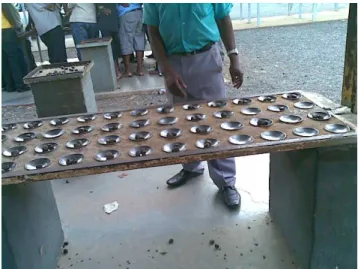
2.3.1 ‘Morabaraba’ (board game)
Figure 3 Schematic representation of ‘morabaraba’ (board game)
‘Morabaraba’ (board game) is a game of skill played by two participants. In the past this game was dominantly played by men. The game is mostly played by herd boys and men, miners, unemployed people and so forth. The aim of playing this game is to entertain, while time, and socialize and to defeat the opponent. ‘Morabaraba’ (board game) requires mental agility. It keeps people busy in such a way that those who do not work are kept occupied in the game. Those who work shifts are able to play until it is time for them to go to work. People play the game to get rid of boredom.
Nowadays ‘morabaraba’ (board game) is played by both boys and girls aged between ten and seventeen. This is clear when both boys and girls play ‘morabaraba’ (board game) on television program called ‘friends like this’. Boys and girls socialize and compete in this game, and sometimes the girls win against the boy which indicates that they were denied the chance to play this mentally embraced game.
‘Morabaraba’ (board game) is played any time of the day depending on the chance players get. Players use their time to play the game to the best of their ability. As indicated in the previous chapter the game is played at taxi ranks by taxi drivers and commuters who await their transport. The game is also played during the weekend at the sport field, at home and at the ‘shebeens’. Spectators enjoy looking on how competitors reason when playing the game. They become entertained to see somebody winning whilst the other one is looking on.
Material used
Two people
A board or a diagram can be drawn on the ground or on a piece of hard paper
Twenty four stones
Rules of the game
Step1.
The first player starts using twelve stones called ‘cows’ on a clear board. The players alternatively place one cow at a time on a junction. The aim is to create rows in a vertical, horizontal and diagonal way. Cows are only to be placed on unoccupied junctions three- in- a- row.
When ‘three in a row’ is achieved, the player can remove one of the opponent’s cows. A player cannot remove an opponent’s three-in-a-row cows if there are other cows on the board left to be removed.
Only one of the opponent’s cows may be removed at a time even if two or more lines of three-in-a-row are achieved with one move. Once a cow is removed, it may not be used to play again.
Step2.
After placing all twelve cows of each player on the board, cows may be moved from one junction to another. A cow is moved from a junction it occupied to an unoccupied adjacent junction. A player can break his own line, or reposition the cows. The cows can be moved back and forth to the same two junctions repeatedly. If a ‘three-in-a-row’ is remade, an opponent’s cow is removed.
Step3.
When a player has lost all the cows but left with three only, he or she can move any cow to any vacant junction on the board. The game is won when the opponent cannot move any cows or when the opponent has lost all the cows or remained with not more than two cows. The game will be a draw if a player is down to three cows, and both cannot move (shoot).
Variation
The player can use the stones but of different colours. They can, instead of stones or cows, use bottle caps. One player can play using them facing down and the second player use facing up.
Vocabulary
When the game is played, some players prefer to compete against an opponent of his age because sometimes they use words which are understood by people of the same age group. Besides, a player can enjoy having played a fair game if the game was played between people of his age. To add this up, Worthington (1980:118) says that competition, especially against someone of similar ability, motivates the player.
The players use some of the following words and sentences:
‘Ke go pshišitše’ (I have burnt you).
‘ke go jele’ (I have eaten you).
‘Pha (I beat you) (used when a winner removes the opponent’s stones or cows).
‘Ke a go betha’ (I beat you) or ‘Ke a go ja’ (I eat you).
‘Pha hmm’ (the opponent says these words holding his stomach as a sign of having caused pain to the opponents by winning his cows).
‘Ka mmetha a sa ile A ile bjaleng O rile ge a fihla
Ka mmetha, ka mmetha Maoto a ya godimo A tla a hwa lehu’
(I place the snare during his absence Having gone on a drinking spree When he arrived,
I struck him a cracking blow; I struck him a cracking blow
The winning player sings this song while his loosing opponent is stunt. The winner shows that he is nearing the end of his game and he has victory in his hand. He enjoys the game more. According to Masiea (1974:39) some players cannot stand defeat. So, when they realize that their ‘cattle’ are losing the fight, they collect them and start the game afresh.
Sometimes the winner uses words like ‘e re ke go hlabe’ (let me stab you). Such words are used when a player is about to win the game and may be for the second time. He shows that he is opening up a wound or he is about to cause a big hole on the body of his opponent for he is winning the game. He shows the pain he is about to cause to his opponent when he defeats him again. ‘E re ke mo thunye’ (let me shoot him) even here the winning opponent is about to win. He shows that he is pulling the gun to shoot. He also makes a sound of a firearm as he sings his win. The sound word ‘thu’ is used. ‘Sefofu sa ka se tlile’ (my blind man has come), a player is referring to a person whom he wins all the time. It means an opponent who does not win him has come and the player is certain that he is going to win the game.
2.3.2 ‘Moruba’ (board game)
Figure 4 Schematic representation of ‘moruba’ (board game)
Like ‘morabaraba’ (board game) this game is also played by men. ‘Moruba’ (board game) is one of the games that are widely played in Phalaborwa. As wealth is measured with cows in most African
This view is supported by Hammond-Tooke (1974:96) when he says:
‘Cattle therefore loom largely in a man’s thoughts. They are a principal form of wealth, his most treasured possession, and anything concerning them and their welfare focuses his attention’.
As cows are kept in kraals (paddocks), so are the elements of playing this game known as ‘dithuba’.
This is a game of mental agility too. The players socialize, entertain, while time, compete and win.
‘Moruba’ (board game) is predominantly men’s game but nowadays girls do play it too. Both males and females compete against each other.
To add further, Masiea (1973:37) points out that the cattle serve as bride- price (mahadi) of a player. To avoid defeat (thlolo), a player may thwart (thiba) the opponent’s blow or move by pushing his piece to the opposite direction. If a player is defeated, he looses his bride-price which is a disgrace because he no longer has money to pay ‘mahadi’ for his bride.
Material used
A minimum of two people and a maximum of four.
A board with a number of ‘kraals’ (holes) or dig holes on the ground.
‘Cows’ (stones) or bottle caps.
The rules of the game
The first player begins playing by removing any four stones from his holes and placing one stone in the next hole until all the four stones are in four holes. The player moves in an anti-clockwise direction, moving from the left to the right.
After placing the stones in the four holes, the same player takes all eight stones directly opposite the
If during the game, the player had one stone in row one, he or she must shift the stone until he or she reaches row two. If however, there are no stones belonging to the opponent in row three, but there are stones in row four, he cannot take them. When the player has completed his turn, his opponent begins the same way.
‘Moruba’ (board game) prepares a player to make correct decisions in life. Players take their time to think and avoid hasty move which can eventually bring disappointment. Competitors give themselves chance to think about the advantages and disadvantages of any new situation that may take place when they make a move. They first decide on the move they should make, support and to defend them, from the attack the opponent may impose.
2.4 Motivational games
According to Adair (1990:93) motivation covers all the reasons which underlie the way in which a person acts, including negative ones like fear along with the more positive motives, such as money, promotion and recognition. Further he maintains that a man, woman or child is motivated when he or she wants to do something. Motivation plays an important role in one’s life. It moulds a person positively.
Players in the motivational games are motivated by other members of the community and those within the team. Besides, a player should inspire himself or herself first. Adair (1990: 94) mentions that the first golden rule of motivation is that you will never inspire others unless you are inspired yourself.
Only a motivated leader motivates others. The games that fall under motivational games include
‘melamo’ (stick fighting) and ‘matswele’ (fist fighting).
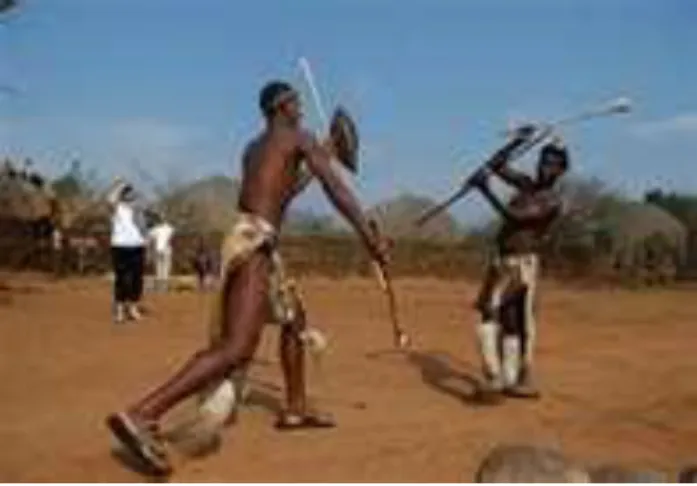
2.4.1 ‘Melamo’ (stick fighting)
Figure 5 Schematic representation of ‘melamo’ (stick fighting)
The Collins English Dictionary (2004) describes stick fighting as a Caribbean form of combat between two trained fighters, each of whom uses a stick with both hands at the midpoint to hit the opponent’s head and body. The description gives the impression that stick fighting owes its origin in the Caribbeans. This withstanding, stick fighting has become universal. It exists in places like Poland, Japan, Australia and Indonesia (www.news.za.msn 2011/07/20). Methods of fighting however, differ from country to country or nation to nation.
Contrary to the definition above, stick fighting has been a martial art traditionally practiced among the Zulu in South Africa, particularly by teenage herdboys. Each combatant is armed with two sticks.
These include a long stick for attacking, and shorter stick for defense. No armour or protective gear is used. The object of the game is to hit the opponent with a stick until pain is inflicted (www.wiki.ulwazi 2011/07/26).
Currently stick fighting among the Zulu has been developed into a regular sport, with rules and competitions. Playing areas, age categories, goal rules and scoring have all been well defined, with
I started stick fighting when I was a boy in 1976 in Utrecht. I have taken part in many competitions and I have worn them all. Now I have brought gold to my province and I am a hero
in Kwa-Zulu Natal and the champion stick fighter of ‘South Africa’ (Daily Sun 2010/10/22).
An almost similar situation exists in New Zealand where the sport has recently been introduced in 2007. Contrary to Zululand, competitors in New Zealand are required to wear a minimum amount of protective equipments which is thoroughly checked prior to the competition start and each individual bout. All these measures are taken to prevent injuries, thus ensuring safety of the sport (www.nznwingchun 2011/07/26).
Recently New Zealand played host to the first full contact sport stick fighting tournament with other countries like Indonesia, Australia and Poland where medals, plates and trophies were up for grabs (www.nzwingchun 11/07/26). Stick fighting has now become a legitimate sport in New Zealand and will probably go from strength to strength.
‘Melamo’ (stick fighting) among the Ba-Phalaborwa assumes three forms;
‘Thupa’(pliable rods with leaves)
‘Kgati’ (pliable rod without leaves)
‘Molamo’ (stick)
2.4.1.1 ‘Thupa’ (pliable rods without leaves)
The game is usually played by herdboys aged between eight and twelve when tending the livestock.
The fight is usually initiated by boys slightly older than them. The game extends to the initiation school level where initiates play this on daily basis. The next step is the playing of ‘kgati’ which starts from initiation age.
2.4.1.2 ‘Kgati’ (pliable rods with leaves)
‘Kgati’ (pliable rods with leaves) is a game played by old initiates during an initiation period. The game
and wide including females. However, only old initiates are eligible to participate. They all stand in a big circle the size of which is usually determined by the number of the old initiates present. Uninitiated males, young boys and girls and females stand a distance outside the circle as spectators. Participants fight topless with only pants on. It is believed that ‘muti’ is used by participants to ensure victory.
Participants sing motivating songs with some blowing whistles, flutes and shouting. Anyone feeling motivated enough goes to the centre of the circle with his ‘kgati’ and a shield. Such a player becomes the challenger and any of participants who feel to take on the challenge steps into the circle for the fight. Although there are no any formal rules, it is a transgression to hit the public section below the waist. The head and the topless part of the body are the point of the focus. There are no bouts or stoppage time. Participants play for one round, the length of which shall be determined by the first serious injury on one of the players or when he has fallen down and fails to rise to his feet again.
This day remarks the success of the initiates (badika) and also acts as harbinger to the coming out (end) of the initiation period. This occasion is known as “go fetolela”.
2.4.1.3 ‘Molamo (stick fighting)
Depending on the desire of the individual, either two sticks or one shield are used. Where two sticks are used, one is used for attacking and the other for defending. The game usually takes place at an open ground suitable to accommodate a fairly large crowd. Spectators and participants stand on side rather than in a circle. The loser has three options to take, either throwing his fighting equipments on the ground and raises his arms, waving his stick in the air or running away. The third option however, is rarely taken as it carries with it a public humiliation and cowardice.
Another form of stick fighting takes place between two rival groups during a competition dance commonly known as ‘sekopo’. This is an informal type of fighting where the fight might be sparked off by two individuals belonging to different camps, either during the dance or outside the dance. The
Fighting equipments include several sticks and a shield. Sticks are usually more than one to replace the one that breaks during the fight. One group attacks and the other one defend itself. Because the fight involves a large scale confrontation the group that loses always runs away to save their life. Anyone that will be trapped or caught is usually beaten to death. Of late however, fighting during the competition dance carries a penalty with it that might lead to a definite suspension or permanent expulsion from the competition.
2.4.2 ‘Matswele’ (fist fighting)
Figure 6 Schematic representation of ‘matswele’ (fist fighting)
The game of ‘matswele’ (fist fighting) is played by boys from the age of eight to eighteen as well as men. The boys play the game especially when they are in the field looking after the cattle and when they have taken the cattle for dipping. After the cattle had had a dip, those who herd the cattle arrange the fight between the young ones. The game is played to entertain, to while time and to win the opponent.
How the game is played
A bare hard ground
Two players
The rules of the game
A group of boys come together, make a circle. One boy enters the circle. The boys shout ‘o a mo tshaba na?’ (Are you afraid of him?). A boy who feels he can fight the challenger enters the center of the circle to take the challenge as he answers ‘aowa, a ke mo tshabe’ (no, I am not afraid of him). The two players begin to fight. They fight using their fists only. The spectators shout in order to encourage and to motivate the players. When a player is tired and about to loose the game, he runs backward, no longer fight back.
The player can insist on fighting until he falls down. He can rise up, fall again and his supporters throw a towel in the center as to stop the fight because they realize that their player is loosing the game. Those whose player won the game enter the center, carry their player and begin to celebrate. As such the player is declared a winner.
The game of ‘matswele’ (fist fighting) is also played by men especially at the end of initiation ceremony. Towards the end of initiation, initiates have a celebration where people come to see their children for the first time – more especially women and girls who were not allowed to see their relatives while in the initiation school. The initiates come to the ground in groups to dance for the crowd but before the initiates come out, a man enters the ground, shouting for a challenger to come out.
A man who feels challenged comes out of the crowd to face his opponent. The fight begins. The two players fight until the one who feels tired waves his hands in the air. The looser may also show that he is tired by falling onto the ground and fails to rise up again. The winner may not leave the ground if he feels he can fight another player. In that case, another man gets in and the fight continues until a winner wins the game.
In some instances the challenger can challenge anyone from the crowd. Here the challenger can challenge somebody he undermines and thinks that he can win him easily. The opponent finds himself
In most times when this type of a fight takes place, the challenger wins because he ensures that he chooses a player whom he will defeat. During this game, a person puts money on the ground and announces that whoever wins the game can have the money. In that case the player is not allowed to pick someone he knows he can easily defeat. The owner of the money can choose those known as
‘dinkgwete’ (heroes) within the community to fight. The game begins, players fight until the looser looses and the winner wins and takes the money.
As motivational games, the players of fist fighting feel motivated to play the game although in some areas, they do not get compensation, wages or salaries like in cricket or soccer. They play for fun.
Munyaradzi Vomo quotes fist fighter Foster Chauke as he says: ‘I am the Champion of Musangwe and I am proud because nothing else is talked about in Venda except for Musangwe. No soccer or cricket, just the Musangwe. So because I am the champion, people talk about me’ (Tonight Television 2010)
2.5 CONCLUSION
‘Matswele’ (fist fighting) and ‘melamo (stick fighting) games do not have rules that are prescribed as to when to start and to stop the game. The players are not restricted where to punch and when not to punch. They punch each other where they get chance to punch. Again, there is no referee to stop the game for the players to take a break. The players fight until the one who is tired gives in. During the fight, players play without hand gloves. This is an indigenous game for the indigenous people. People enjoy watching ‘matswele’ (fist fighting) and ‘melamo’ (stick fighting) to date.
CHAPTER THREE
VALUES AND USE OF THE GAMES
3.1 Introduction
The aim of the games in the lives of the people in Phalaborwa is to entertain. The entertainment phenomenon emphasizes element such as crime alienation and health promotion awareness. During the games, people have fun. They visit the sports field where they watch the game free of charge. The games have a great positive impact on society in which they are played. They have an entertainment effect, social and physical values, educational, health and motivational values.
3.2 Social Values
Socially, the indigenous games benefit the society in an immensely way. The communities around Phalaborwa are unified through the games. The people from diverse cultures compete. They make friendship, share ideas, work in groups and teams, socialize, support, sympathize, learn to make decisions and solve problems and above all, they learn discipline. The players learn to exercise patience, acceptance and tolerance towards one another.
Children come together, sing and dance when the games are played. The adults mingle with each other.
They become socially occupied which lead them to forgetting the elements which made them angry before they involved themselves in the company of other people. They put their concentration on the game. Players develop positive thinking towards themselves and the entire team as they work together.
They build each other's confidence to be able to handle defeat where necessary.
Most parents, whose children play the games, motivate and encourage those children to pursue with the games. Families and friends become united due to sport. In games such as street fighting, stick fighting
Youth’s engagement in the games delay them exposure to early alcohol drinking, doing drugs and teenage pregnancy. They become involved in the game and have less time for crime. The players grow as disciplined, responsible and accountable members of the community. Instead of going to the shebeens, they visit sports field where they play, go home being tired, eat, wash and sleep. Exposure to criminal activities is minimal.
In every game, communication takes place. Every good game is accompanied by good communication.
According to Smelser (1991:28) language is social. It cannot be learned without interaction – that is apart from other people. The people of Phalaborwa have diverse cultures. The games enable Bapedi, BaTsonga, BaVenda, amaZulu and maSwati to speak each other’s languages. Their involvement in different games results in language intermarriage. These games bring them together and assist them to work as a team.
The languages help coaches to co-ordinate their duties. Children use games as a tool to their da