An interrogation of
Consultant-Driven Curriculum Design in Lesotho:
A
Primary School Science Curriculum Design
Molise David Nhlapo PhD
2018
An interrogation of consultant-driven curriculum design in Lesotho:
Primary school science curriculum design
by
Molise David Nhlapo A
THESIS
Submitted in fulfillment of the degree DOCTOR OF PHILOSOPHY
Faculty of Education and Social Sciences Edgewood Campus
University of Kwa-Zulu Natal Supervisor: Dr. L.R. Maharajh
Pietermaritzburg
2018
DECLARATION
I, Molise David Nhlapo, declare that the contents of this thesis represent my own unaided work, and that the dissertation has not previously been submitted for academic examination towards any qualification. Furthermore, it represents my own opinions and not necessarily those of the University of Kwa-Zulu Natal.
……….. ……….
Signature Date
ABSTRACT
In 1978 National Dialogue in Lesotho, Basotho requested education that would build a Basotho nation with its own identity and specific destiny in life that would instill values and attitudes consistent with a Basotho way. One of the strategies to address these demands was to train more Basotho to spearhead Lesotho education system especially curriculum design and development.
Like any other underdeveloped African country, Lesotho lacked skills to achieve its objective and had to import expertise from other countries in the form of consultancy. But the involvement of foreign consultants in the Lesotho curriculum design and development has been in operation since the beginning of formal education in the country to-date. The expectation was that, with time, the country would produce enough quality curriculum specialists, and the engagement of foreign consultants would end.
This study assesses the issues of foreign consultants’ involvement in designing the Lesotho primary school Grade 4 science curriculum. Curriculum specialists mandated to design Lesotho curriculum and two foreign consultants engaged to assist curriculum specialists at time of study provided most of data for this research through one-on-one interviews. Another data was produced through document analysis of old school science Standard 4 syllabus (as it was called) and the new integrated curriculum for Grade 4. In order to interpret data, the researcher utilized the concept quality in which I interrogated the quality of curriculum specialists, foreign consultants and the quality of documents produced by both curriculum specialists and foreign consultants.
The results show that one of the main reasons for engaging foreign consultants is the collapse of training for newly employed curriculum specialists while on the other hand, the Ministry of Education and Training (MOET) employs less qualified and inexperienced curriculum specialists since the Centre (NCDC) is unable to retain or attract highly qualified curriculum specialists.
This resulted in the lack of knowledge of curriculum design and curriculum specialists are accused of taking too long to design a low quality curriculum.
ACKNOWLEDGEMENTS
I am grateful to my supervisor, Dr L.M. Maharajh for the guidance and support through the most and final journey of my study. I am also thankful to Prof Reshma Sookrajh for supervision, assistance and encouragements at the start of this journey. Their insightful and encouraging comments gave me a push to go forward to pursuit my goal.
I am also gratified to Prof Nyna Amin and Prof Labby Ramrathan for eye opening explanations and discussions in our contact sessions on research studies. The teachings and discussions really established a deep foundation for my academic journey.
I would like to appreciate contributions made by lecturers and students who participated in the Edgewood PhD Cohort between 2013 and 2015. The teachings and debates we went through also contributed a lot to my eagerness and possibility to finish my studies.
The University of KwaZulu-Natal had made it possible for me to achieve my dream by means of the support they provided through human, structural and financial resources.
Encouragements from colleagues and friends gave me strength to continue and not to slumber.
Dr L. Akpan aka Chief, Dr S. Makhasane, the late Sphindiwe Ndlela (May soul rest in peace), Dr Meda, Balugile Gumede and many others, you left a remarkable mark in my life through encouragements and support.
The Ministry of Education and Training through its department of The National Curriculum Development Centre (NCDC) which gave me permission to conduct this research in the Curriculum Centre. I am greatly appreciative to curriculum specialists, foreign consultants, directors, and authorities of the curriculum development Centre.
To my family, thank you so much for understanding and putting up with me when I was going through different emotions. To my daughters, Mamokoena Kwenzy Nhlapo and Mamashinini Nhlapo now known as Mrs ‘Mathabiso Matlapeng; my sons Leshoboro Shuby Nkunyana and Menzy Samuel Nhlapo, you have always known your father as “ngoana oa sekolo”; to my lovely wife, you have been a wonderful mother and acting father to our children.
Special thanks to Mandla Mncwabe, my brother-in-law and his wonderful family in C-section Kwa-Mashu, Durban. His wife, my sister Elizabeth Mncwabe and my niece Slie, Sya, Vumane, Zama, Sane, Zanele and also Mandisa, Andiswa, Nonfundo (Shabalala!!!) and Siyanqoba. Thank you for hosting and taking care of me while attending sessions in KZN.
Thank you all!! May Almighty God bless you richly!!!
Finally, I thank God in Jesus’ name because it is not by my power or might; I could not have made it on my own. Thank you God for Pastor Joseph; Prophet TB Joshua; Prophet Shepherd Bushiri, Bishop ND Nhlapo and my father, the General, Prophet Moorosi!!!!
DEDICATION
This work is dedicated to God Almighty!! Jesus Christ of Nazareth is my Lord and saviour.
My strong redeemer.
JESU KE MOLIMO I love you God
LISTOFACRONYMS
LIST OF TABLES
Table Description Page
Table 1.1 Curriculum decision-making structure in Lesotho 10 Table 2.1 Former foreign consultants assisted in Lesotho Education 34
Table 3.1 Eight-point Template Model 79
Table 3.2 Characteristics of a quality curriculum 84
Table 3.3 Characteristics of a quality curriculum 89
Table 4.1 Research design 95
Table 4.2 Method of data production – interviews 97
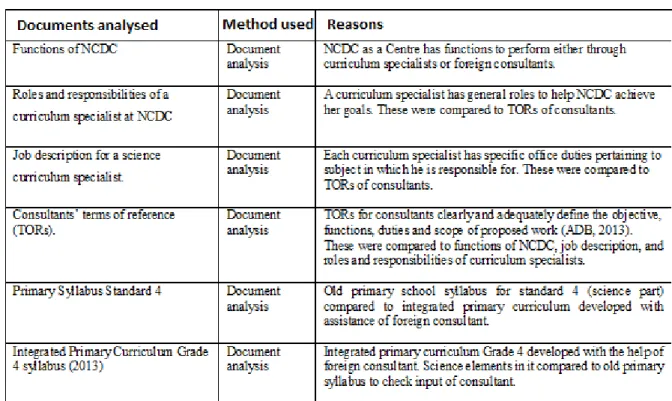
Table 4.3 Method of data production - document analyses 100
Table 5.1 Curriculum Specialists’ profile 113
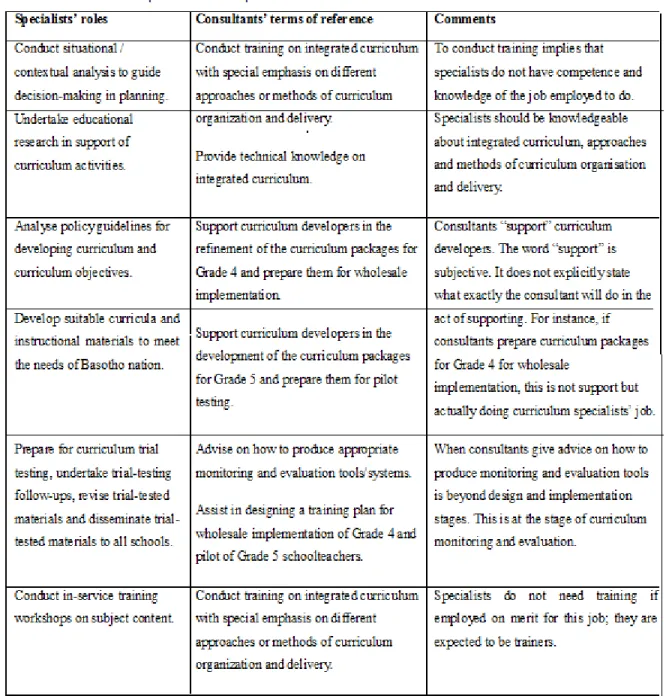
Table 5.2 Curriculum specialists’ roles and consultants’ terms of reference 136 Table 5.3 Comparison of old standard 4 school science syllabus with
integrated primary curriculum for Grade 4 138
Table 5.4 Learning outcomes related to science in integrated curriculum Grade 4 139
Table 6.1 Qualities of foreign consultants 152
Table 6.2 Expected deliverables of consultants 158
Table 6.3 Structural organisation of primary syllabus Standard 4 and
integrated primary curriculum Grade 4 160
Table 6.4 Comparison of learning outcomes of primary syllabus standard 4
with integrated primary curriculum Grade 4 161
LIST OF FIGURES
Figure Description Page
Figure 1.1 Structure of an old Lesotho’s education and training system 3
Figure 1.2 Lesotho Education System Option 1 4
Figure 1.3 Lesotho Education System Option 2 5
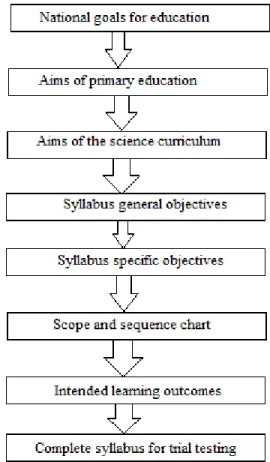
Figure 2.1 Steps in curriculum design and development in Lesotho 25 Figure 2.2 Model of curriculum specialists’ professional development 39
Figure 3.1 Quality Concept-web 72
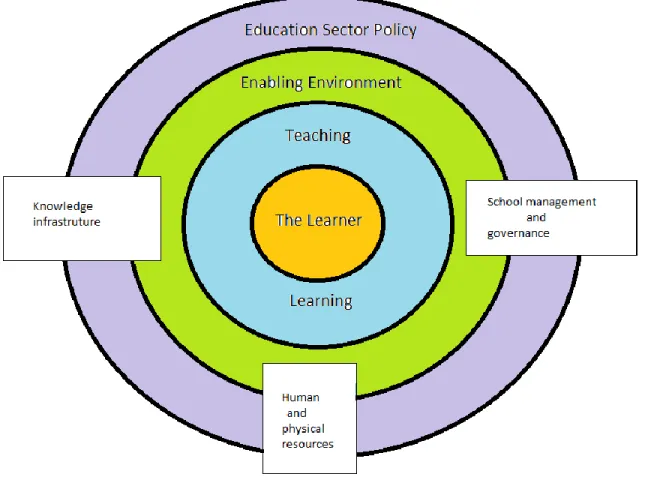
Figure 3.2 Policy framework for improving the quality of education 75 Figure 3.3 Quality Measurement Model adapted from Barnett 77
Figure 3.4 Quality curriculum policy flow chart 84
Figure 3.5 Quality concept-web 86
Figure 5.1 Model of curriculum developers’ professional development 123 Figure 6.1 Types of training curriculum specialists may need 149 Figure 6.2 Minimum requirements of physical resources for NCDC 150 Figure 6.3 Model of curriculum developers’ professional development 165 Figure 6.4 Framework of epistemological requirements for curriculum specialists’ 168
LIST OF APPENDICES
Appendix Description Page
Appendix A Letter to PS Education and Training 172
Appendix B Letter of informed consent for CEO 173
Appendix C Informed Consent letter (participants) 174
Appendix D Interview Schedules 175
Appendix E Job description of Curriculum Specialist (Advert) 177 Appendix F Roles and Responsibilities of Curriculum Specialists 179 Appendix G Request for Consultancy Grades 1, 2 and 3 180
Appendix H Terms of Reference for consultants 182
Appendix I Ethical clearance Molise Nhlapo 185
TABLE OF CONTENTS
DECLARATION……… ii
ABSTRACT……… iii
ACKNOWLEDGEMENTS……… iv
DEDICATION………. v
LIST OF ACRONYMS/ABBREVIATIONS………. vi
LIST OF TABLES……….. ix
LIST OF FIGURES………. x
LIST OF APPENDICES ……… xi
TABLE OF CONTENTS………. xii
Chapter 1: Introduction to the study………... 1
1.1 Introduction: Background to Lesotho……… 1
1.2 Rationale and motivation of the study……….. 6
1.3 Administrative issues of curriculum development in Lesotho………. 7
1.3.1 Decision-makers in curriculum……… 8
1.3.2 Stakeholders of curriculum design in Lesotho………. 12
1.3.3 The influence of stakeholders on curriculum development in Lesotho……… 14
1.4 Aims and objectives of the study……… 15
1.4.1 Broader issues considered through literature……… 15
1.4.2 Specific issues that provoked the investigation……… 16
1.4.3 Critical questions for the study……….. 17
1.5 Focus of the study ……… 17
1.6 Personal background to the study ……… 18
1.7 Arrangement of chapters of the dissertation………. 19
1.8 Conclusion………. 19
Chapter 2: Literature review……….. 21
2.1 Introduction……… 21
2.2 The concept: Curriculum, Curriculum design and development……… 21
2.2.1 Defining curriculum concepts………. 21
2.2.2 Curriculum development process……….. 23
2.2.2.1 Curriculum design and development……….….……….. 23
2.2.2.2 Curriculum dissemination ……….25
2.2.2.3 Curriculum implementation ………..26
2.2.2.4 Curriculum evaluation ……… 27
2.2.3 Curriculum borrowing………. 27
2.2.4 Curriculum integration……… 29
2.2.5 Value and quality of curriculum………. 31
2.2.6 Curriculum history ……….. 32
2.2.6.1 Curriculum design history ……….. 32
2.2.6.2 The design of consultant-driven curriculum in Lesotho ………. 33
2.3 Types of Knowledge for curriculum specialists………..……… 35
2.3.1 Indigenous knowledge………. 36
2.3.1.1 Informal traditional knowledge……… 36
2.3.1.2 Formal traditional education……… 37
2.3.2 Curriculum developers’ knowledge……… 38
2.4 Global influences on curriculum change ………. 43
2.4.1 International conferences………. 43
2.4.1.1 Different curriculum approaches ………. 44
2.4.1.1.1 Outcomes based education approach ……… 44
2.4.1.1.2 Competences as curriculum approach ……….. 45
2.4.1.1.3 Learner-centred approach ………. 46
2.4.1.2 “Education for all” influence on curriculum design……….. 48
2.4.1.3 Millennium development goals (MDGS) influence on curriculum design……….. 49
2.4.2 Financing curriculum innovations ……… 50
2.4.2.1 Financing curriculum through government levy ……….. 50
2.4.2.2 The role of the bank/donor in curriculum design.……….. 51
2.4.2.3 Donations and foreign aid in curriculum design ………. 51
2.4.2.3.1 Curriculum projects and emerging issues……… 52
a) Population and family life education (POP/FLE)………. 53
b) Environmental education (EE) ………. 53
c) Life skills education (LSE)………. 54
2.5 Consultants….……… 55
2.5.1 Who are curriculum consultants?... 55
2.5.2 Roles and responsibilities in consultancy……… 57
2.5.2.1 Consulting services……….. 57
2.5.2.2 Consultants’ roles………. 58
2.5.2.3 Responsibilities of consultants………. 60
2.5.2.4 The roles and responsibilities of the client……… 60
2.5.3 Selection of consultants for curriculum design ……… 61
2.5.3.1 Invitation of consultants ……….. 61
2.5.3.2 Who selects consultants? ………. 63
2.5.3.3 Methods of selecting consultants ………. 64
2.5.3.3.1 Quality and cost-based selection (QCBS) ……….. 65
2.5.3.3.2 Quality-based selection (QBS)……….. 66
2.5.3.3.3 Other minor selection methods ………..………. …… 66
2.6 Conclusion……….. 67
Chapter 3: Conceptual framework………..………. 68
3.1 Introduction……….. 68
3.2 The concept quality……….. 68
3.2.1 Conceptualizing of quality………. 68
3.2.2 Structural and process quality……… 69
3.2.3 Fitness for purpose………. 69
3.2.4 Empowering quality……… 70
3.2.5 Quality in schooling……… 71
3.2.6 Summary of quality concepts………. 72
3.3 Quality of curriculum programmes……….. 74
3.3.1 Framework for improving quality of education……… 75
3.3.2 Models for measurement of quality in curriculum………. 76
3.3.2.1 Barnett’s (1992) model for judging quality of an institution……….. 76
3.3.2.2 Eight-point template for judging quality………. 79
3.3.3 Other curriculum quality measurement tools………. 79
3.3.3.1 Categories of evaluating curriculum……… 79
3.3.3.2 Guidelines to determine quality curriculum……… 80
3.3.3.3 Quality of OBE in South Africa as seen by Jansen ……….... 81
3.3.3.4 Consolidation of curriculum quality measuring models………. 83
3.4 The achievement of quality………. 85
3.4.1 The quality concept-web……… 86
3.4.2 The characteristics of a quality curriculum programme……….. 87
3.5 Conclusion………. 88
Chapter 4: Methodology……… 89
4.1 Introduction……….. 89
4.2 The paradigm - critical paradigm ……… 89
4.3 Qualitative approach……….. 92
4.4 Case study………. 92
4.5 Methods of data production……… 95
4.5.1 Introduction………. 95
4.5.2 Interviews……… 96
4.5.3 Document analysis………. 99
4.6 Sampling and sampling procedures……… 101
4.6.1 Sampling of participants for interviews……… 101
4.6.2 Sampling of documents………. 103
4.7 Data analysis………. 103
4.7.1 Data analysis of interviews……….. 104
4.7.2 Data analysis of documentary data……… 105
4.7.3 Data analysis of primary school science syllabus documents……… 105
4.7.4 Using Bernstein’s principles of classification and framing scales……… 106
4.7.4.1 Introduction ………. 106
4.7.4.2 Bernstein’s principles of classification……… 107
4.8 validity and trustworthiness………. 107
4.9 Ethical considerations……… 108
4.10 Limitations of the research………. 109
4.11 Biasness in data production……… 110
4.12 Conclusion……… 110
Chapter 5: Data analysis, interpretation and discussions……… 111
5.1 Introduction……… 111
5.2 Participants’ profiles………. 112
5.2.1 Consultants’ profile………. 112
5.2.1.1 Foreign consultant 1 profile……… 112
5.2.1.2 Foreign consultant 2 profile……… 112
5.2.2 Curriculum specialists’ profiles……….. 113
5.2.3 Profile of documents……… 113
5.3 Selection procedure for curriculum consultants……… 114
5.3.1 Who selects consultants? ……….. 114
5.3.2 Consultants’ selection process……… 115
5.3.2.1 Non-procurement procedure……… 115
5.3.2.2 Procurement procedure……… 116
(a) Drawing terms of reference………. 116
(b) Development of advertisements for consultants……… 117
(c) Evaluation of tender documents………. 117
5.4 Quality in curriculum design………. 118
5.4.1 Qualifications of curriculum designers……… 119
5.4.1.1 Qualifications of foreign consultants………... 119
(a) General qualification……….. 119
(b) Adequacy for the assignment……… 119
5.4.1.2 Qualifications of curriculum specialists……….. 121
(a) General qualification………. 121
(b) Adequacy for the assignment……… 121
5.4.1.3 NCDC staff development………. 121
5.4.2 Experience in curriculum design and development………. 124
5.4.2.1 Experience of foreign consultants……… 124
(a) Professional activity……… 124
(b) Experience in the region and language……… 125
5.4.2.2 Experience of curriculum specialists……….. 126
5.4.3 Performance in curriculum design and development……….………… 128
5.4.3.1 Performance of foreign consultants……… 128
(a) Consultants assist curriculum specialists to develop curriculum……… 128
(b) Consultants enhance communication between stakeholders……… 129
(c) Consultants provide resources materials……… 130
(d) Consultants train curriculum specialists………. 132
5.4.3.2 Performance of curriculum specialists……… 133
5.5 Curriculum documents analysed……….. 135
5.5.1 Job descriptions of foreign consultants and curriculum specialists………. 135
5.5.2 Quality of grade 4 curriculum……….. 137
5.6 Theorizing curriculum consultancy in Lesotho ………..… 139
5.7 Conclusion……….. 142
Chapter 6: Concluding remarks……….. 144
6.1. Introduction……… 144
6.2. What was the research all about?... 144
6.2.1. How was the research done?... 145
6.3 Main findings……… 146
6.3.1 Reasons for engaging foreign consultants……….. 146
6.3.1.1 Specialists lack experience……… 146
6.3.1.2 Lack of training for curriculum specialists……….. 147
6.3.1.3 Lack of resources for specialists ………..……….…………. 150
6.3.2 Qualifications of foreign consultants……….. 151
6.3.3 Performance of foreign consultants………. 155
6.3.3.1 Training curriculum specialist……… 155
a) Formulation of learning outcomes and assessment criteria……… 155
b) Training on integrated curriculum……… 156
c) Presenting, organizing and structuring the integrated curriculum……….. 156
6.3.3.2 Providing resources for the country……… 156
a) Providing reading materials……… 156
b) Surfing internet……… 157
c) Providing vision for the country………. 157
6.3.3.3 Value added by consultants to Lesotho curriculum design……… 158
a) Consultants’ terms of reference against specialists’ job description………….. 158
b) Value added by consultants to the curriculum………. 159
(i) Structural organisation of curriculum……….. 159
(ii) Organisation of learning outcomes in both curricula……….………. 160
6.4 Possible areas for future research………..………. 162
6.5 Significance of my research……… 164
6.6 Recommendations……….. 164
6.6.1 Staff development……… 164
6.6.1.1 On the job training………..…. 164
6.6.1.2 Employing qualified candidates……… 165
6.6.2 Experience of specialists in curriculum………. 166
6.6.2.1 Involvement in curriculum activities………..… 166
6.6.2.2 Handling all phases of curriculum development……….. 166
6.6.2.3 Study tours……… 166
6.6.2.4 Provision of adequate physical resources……… 167
6.6.3 Framework of epistemological requirements for specialists ……… 167
6.7 Limitations of the study………. 169
6.8 Conclusion………... 171
LIST OF REFERENCES……….. 173
APPENDICES ………. 185
CHAPTER 1: INTRODUCTION TO THE STUDY
How and why the race began?
1.1 Introduction: Background to Lesotho
Lesotho is a small mountainous country completely surrounded by South Africa, covering about 30,000 sq. km with a population of about 2 million, of which about 75% reside in the rural areas, depending largely on subsistence agriculture (Jopo, Maema & Ramokoena, 2011). The country has a beautiful landscape characterized by high mountains and perennial rivers and it is popularly referred to as the “Mountain Kingdom” and is divided into 10 districts namely; Butha‐Buthe, Leribe, Berea, Maseru, Mafeteng, Mohale’s Hoek, Quthing, Qacha’s Nek, Mokhotlong, and Thaba‐Tseka.
Lesotho has a small mineral resource base and exports diamonds, wool and mohair to international markets. The country also receives royalties from the sale of water to South Africa under the Lesotho Highlands Water Project (LHWP). There is also revenue from the Southern African Customs Union (SACU), and sales of textile products. As one of the strategies for supporting the economy, the government of Lesotho aims to have enough skilled, innovative and technically trained manpower and a competitive science and technology infrastructure (Ministry of Natural Resources, 2002).
Lesotho is generally a peaceable country, the peacefulness of the country is reflected in the national motto, Khotso, Pula, Nala (peace, rain, and prosperity), and is reinforced by a shared indigenous language, history and culture where Sesotho and English are used as official languages (Government of Lesotho, 2004).
The government of Lesotho envisages the provision of basic education to all Basotho as central to enhancing social and economic development (Ntoi, 2007). The big challenge for this was that the educational system experienced great pressure in expanding education. The curriculum was overloaded with many academic subjects and learners developing minimum practical skills
during their schooling years. Under the old policy a primary school child had to learn 13 subjects and only seven were examinable. Science is among those subjects which are examinable in the primary education of Lesotho. To remedy the challenge of overload, the government of Lesotho has developed a new Curriculum and Assessment Policy in 2009 which significantly reduced the teaching load (Jopo, Maema & Ramokoena, 2011). The new policy is being piloted in 70 primary schools for Grades 1 to 3 and 4 to 5. At the moment, the curriculum has been implemented in standards 1 to 4 and covers the following five learning areas:
Linguistic and Literacy;
Numeracy and Mathematical;
Personal, Spiritual and Social;
Scientific and Technological;
Creativity and Entrepreneurial. (MOET, 2013).
The formal education system takes sixteen years in which the primary cycle takes seven years, at the end of which learners sit the Primary School Leaving Examination (PSLE). This is followed by the secondary education which takes five years. The secondary education is divided into two in which, junior secondary education takes three years and two for senior secondary education.
At the completion of junior secondary education learners sit for the Junior Certificate (JC/grade 9) and at the end of senior secondary education there is O-Level/Grade 12 examinations which prepare learners for selection and promotion into tertiary education. Tertiary education ranges from a three-year diploma in technical schools to a four-year degree at the University level.
Figure 1 below shows the education structure in Lesotho.
Source: Jopo, Maema & Ramokoena (2011, p.8)
The new curriculum which is being implemented (Grades 1, 2, 3 and 4) and piloted in 70 schools (Grade 5) at the time of this research, introduces a new structure of education in Lesotho. The new structure also suggests sixteen years of formal education system. The major difference is where the primary cycle has been merged with junior secondary. The merge produces ten (10) years of basic education at the end of which learners sit for external examinations. This is followed by secondary/General and Pre-technical training or Secondary/Vocational Training education which takes two years. At the completion of the secondary/General and Pre-technical training or Secondary/Vocational Training education there is AS/Grade 12 examinations which are used to promote learners into tertiary education which consists of academic/technical education and post-graduate/continuing education. Tertiary education ranges from a three-year diploma in technical schools to a four-year degree at an academic institution. This is followed by post-graduate and continuing education which consist of certificates, diplomas, masters and doctorate degrees.
The envisaged structure of education is presented in two diagrams as shown below:
Figure 1.2: Lesotho Education system (option 1)
Source: Curriculum and assessment policy framework (MOET, 2009, p.25)
Figure 1.3: Lesotho Education system (option 2)
Source: Curriculum and assessment policy framework (MOET, 2009, p.26)
In Lesotho, the National Curriculum Committee (NCC) is entrusted with the task of approving curriculum policy and syllabi, checking curriculum materials, and approving the curriculum programme and monitoring progress (Ntoi, 2007). The National Curriculum Committee’s main role is to advise the government on all curriculum matters and is composed of the Principal Secretary of Education, the Director of National Curriculum Centre (NCDC), the Directors of the National University of Lesotho (NUL) and Lesotho College of Education (LCE) and other directors of departments of education. The NCC committee members also include the senior education officers for primary and secondary, proprietors of schools and a member of the public and teachers’ organization representatives (Ministry of Education, 1980).
Curriculum development is based at the National Curriculum Development Centre (NCDC). The NCDC works through national subject panels comprising representatives of teachers, teacher‐training institutions, the inspectorate, and teachers’ associations (Jopo, Maema &
Ramokoena, 2011 p.19). Each subject in the school curriculum has its own panel. The panels also develop curriculum materials such as textbooks, teachers’ guides and other teaching aids.
All curriculum materials must be approved by the government on the advice of the National Curriculum Committee. The curriculum specialist is taken to be the curriculum expert who guides the panel through the curriculum development process. The Schools Supplies Unit is closely linked to the NCDC to assist in the procurement and distribution of curriculum materials.
1.2 RATIONALE AND MOTIVATION OF THE STUDY
The 1978-National Dialogue in Lesotho formed doctrine underpinning Lesotho’s educational system (Mosisidi, 1981). From this conference Basotho gave their views about the type of education they want. Reports from this conference reveal that Basotho requested education that would build a Basotho nation with its own identity and specific destiny in life (Ansell, 2002 p 106). They demanded education that would instill values and attitudes consistent with a Basotho in a way that it nurtures good citizens who can live and work in a civilized way, who are loyal, patriotic and respectful to elders, law-abiding and responsible, who can take care of their families; a good neighbour and a trustworthy friend; tolerant to different races and religions;
clean, neat, punctual, and well mannered (Ansell, 2002; Muzvidziwa & Seotsanyana, 2002;
Ministry of Education, 1982).
Past and current studies indicate that education requested and demanded by Basotho as per 1978 National Dialogue has not yet been achieved. Curriculum is regarded as a driving force for an educational system in any country but since 1967, not a great deal has happened in curriculum development in Lesotho; the education system has only expanded in scale but not changed in character from colonial education (Ansell, 2002, p.91; Muzvidziwa and Seotsanyana, 2002;
Raselimo, 2010). As a result, education in Lesotho is irrelevant to the needs of the society because it trains and imparts foreign values in youth (Ansell, 2002, p.94; Mosisidi, 1981, p.68;
Muzvidziwa & Seotsanyana, 2002). The type of education that Lesotho citizens receive is said to be largely ‘bookish’ not equipping learners for self-employment, but equips only a minority with
certification as it is geared towards public sector employment or white-collar jobs (Ansell, 2002, pp.95–96; Muzvidziwa & Seotsanyana, 2002). Due to its irrelevance to Basotho, Muzvidziwa and Seotsanyana (2002) recommend that it is essential to empty the European-oriented content of syllabus in schools, colleges and universities, and introduce a content that would instill a sense of pride in their own culture and identity as Basotho. But the question is, if Lesotho wants to eradicate the British-oriented education system and if Lesotho really wants to honour the request of the Basotho made in the 1978 conference, why does the government continue to engage foreign consultants to design the curriculum?
One reason that one can think of as a justification for continued use of foreign consultants, is lack of expertise from Lesotho. But from anecdotal experience as a primary science curriculum developer employed by Lesotho government at the National Curriculum Development Centre (NCDC), the researcher has observed that there are qualified Basotho nationals who can perform the task, both within NCDC and outside in other organisations and institutions. To confirm this idea, in 2009 when the researcher applied and requested to read for a Masters’ degree in curriculum design and development studies, the department responsible for bursaries, National Manpower Development Secretariat (NMDS) informed the researcher that he would not be sponsored for the study in that specialisation. The reason given was that the country has got enough curriculum experts. But the irony is that the curriculum design process has been spearheaded by foreign consultants ever since 1967 when the first curriculum was designed and still is. Therefore, the question is why curriculum experts from Lesotho are not used to design the Lesotho curriculum? Instead foreign consultants, mostly from Britain, are engaged.
1.3 ADMINISTRATIVE ISSUES OF CURRICULUM DEVELOPMENT IN LESOTHO
This section discusses the role of managers, CEOs, senior officials in the education system specifically in matters related to curriculum design and development. These are the people who make decisions whether to change or review a curriculum in a country. They sit in groups called committees, task teams or panels. The curriculum panels are structured in such a way that most of the knowledge providers are part of the curriculum design (Marsh, 2009). Contrary to this
argument, Ntoi (2007) observes that in Lesotho, the NCC is made up of members who do not necessarily have technical know-how of subject matter and as such their decisions are superficial. The administrative committees include senior government officials in the ministries of education, school principals, teachers, examination agencies, textbook writers and teacher unions (Marsh, 2009).
Marsh (2009, p.205) categorizes those who are collaboratively involved in curriculum development and design into three classes, thus: decision-makers, stakeholders and influence groups.
1.3.1 Curriculum Decision-makers in Lesotho
According to Marsh and Willis (2007, p.307), curriculum decision-makers in a formal education setting are “Those individuals or groups who, because of their professional status or positions of authority, would influence and have some degree of power to determine courses of action to be followed in schools.” Their professional status and position enable them to make specific decisions about what is to be taught, when, how and by whom (Marsh, 2009, p.205). These individuals operate within two systems of curriculum administrations namely; bottom up system and top down system (Chisholm, 2005). In the bottom up system, a community or society decides and shapes the education system of the country and the government act on what the people want the curriculum to be. On the other hand, in the top down system, decisions are imposed on people by rulers. Since curriculum is politically driven, each political party that is taking over the government implements its political ideologies to change the curriculum to suit their manifesto. For instant, in the Republic of South Africa, Cross, Mungadi & Rouhani (2002) argue that the ANC-led Government made changes in education in order to redress the legacy of apartheid education that provided unequal education for the various race groups. This is because the ANC inherited problems of an unequal, segregated education system that administered a politically defined curriculum that provided a racist model (Dean, 2005).
Decision-making is found in all levels but at the national level in the case of a centralised education system, there are discreet hierarchical levels. The top most decision-makers in curriculum reform are the political leaders. Ministers of education at the national level are the most influential decision-makers who have enormous political influence on curriculum change.
Once the political party is in power, its political ideas are implemented by senior government officials in the ministries of education in consultation with ministers of education. The ministers, with their political authority, have initiated major curriculum reforms as a result of their position and strong personalities. The education budget is so large in most countries that it is only politicians who can provide direct levels of accountability to the general public to justify the expenditure (Marsh, 2009, p.207). Following the ministers of education, the next level is the commissioners of education or senior education officers. In a centralised education system, the senior government officials include the Principal Secretary (PS) and chief education officers (CEOs). It is at this level where the commissioners of education or officers of educational agencies make policy decisions about establishing or terminating total programmes. The CEOs responsible for curriculum and assessment services also supervise curriculum development activities, which are undertaken by the National Curriculum Development Centre (Raselimo, 2010).
The next level that follows is the level of superintendents at district level, then principals at school level and lastly teachers at classroom level. Superintendents are mainly concerned with decisions about general programmes concerning their respective districts whereas, at school level, principals are more concerned with coordination within curricula or across grade levels.
Even though both teachers and principals are mainly concerned with decisions directly related to day-to-day teaching, teachers focus on the curricula of their own classroom within the school.
In the case of Lesotho in which the education system is highly centralised, curriculum decisions are made at the level of central government through the Ministry of Education and Training (MOET). The government of Lesotho had established an arm that is responsible for curriculum design. Curriculum design and development is the work of the National Curriculum Development Centre (NCDC). This unit has been in existence since 1974 in different names and focus. The primary curriculum panel and subjects’ panels were formed in 1974 to initiate the curriculum development process (Mosisidi, 1981, p.20). In 1975 subjects’ panels metamorphosed into the curriculum unit which specifically was tasked with the role of curriculum development. The curriculum unit evolved into the primary research and curriculum unit in 1976 to focus more on the research part. In 1980, the National Curriculum Development
Centre (NCDC) was established with the new scope of responsibility embracing all levels for both primary and secondary education and this is still the current situation as of 2016. More specifically, its functions (among others) are to:
design and develop syllabuses in different subjects areas at both primary education and secondary education levels;
prepare instructional materials of various types used in primary and secondary levels;
carry-out pilot testing of curriculum materials in selected schools;
undertake evaluation research in order to establish the effectiveness of the curriculum in schools (NCDC Handbook, 1993, unpaged).
To perform these functions, NCDC operates within the bureaucratic structure of the Ministry of Education and Training (MOET). Table 1.1 shows key players in the management and implementation of curriculum, from the senior level of the MOET to the level of classroom practice.
As Table 1.1 illustrates, the structure of curriculum decision-making in Lesotho is hierarchical, with the Principal Secretary (PS) for the MOET being the top government official responsible for the education policy for the Ministry of Education and Training. The Principal Secretary (PS) for
MOET is a top government official at the ministry but reports to the Education Minister who is the political authority deployed by the Prime Minister. The PS for MOET reports to the Education Minister but she is directly answerable to the Government Secretary (GS).
Under the PS, there is a Chief Education Officer (CEO) for Curriculum and Assessment services responsible for the three departments, thus School Supply Unit (SSU), Lesotho Distance Teaching Centre (LDTC) and NCDC. With the approval of the PS, the CEO-CA makes decisions on the formulation of new curricula, based on societal needs as expressed at level 2 of contextual intents. The CEO responsible for Curriculum and Assessment services supervises the activities of the three curriculum departments; one of these activities is the development of syllabi for various subjects at both primary and secondary levels. In order to perform the job of curriculum design and development, the curriculum and assessment task team was established in 1999 with the following terms of reference:
To present the state of the art in basic and secondary education in Lesotho;
To define basic and secondary education in the context of Lesotho in the formal sector and complementary forms of education;
To establish aims and objectives of basic and secondary education and an integrated curriculum and assessment framework;
To propose implementation strategies for basic and secondary education; and
To provide justification for the development of a comprehensive policy document for education and the establishment of a national commission for this purpose (MOET p. iii, 2009).
The Curriculum and Assessment Task team has membership that covers a range of stakeholders in education including teachers’ associations, unions, school principals, university lecturers, churches and other professionals.
The CEO-CAS and the task team are coordinating and facilitating the curriculum design and development, while the technical work in this field is done by NCDC which is staffed with subject specialists (curriculum specialists for different subjects) in different areas, who are usually recruited from classroom teachers with at least five years teaching experience (Appendix E; NCDC, 2010). Within NCDC, there are technical committees for different portfolios such as curriculum and assessment committee, book rental scheme committee, and training and staff
development committee. The curriculum and assessment technical committee is the only committee that comprises members outside NCDC specifically from ECOL. The NCDC curriculum specialists work with subject panels, which comprise representatives of key stakeholders including teachers’ associations and unions, teachers, teacher educators in relevant subjects from teacher training institutions and subject examination officers at the ECOL (Ministry of Education, 1980).
The syllabi and instructional materials developed by NCDC were approved by the National Curriculum Committee (NCC) prior to implementation in schools. The NCC had a broad membership of heads of key stakeholder institutions, including educational secretaries of the three major churches in Lesotho (Roman Catholic Church, Lesotho Evangelical Church and Anglican Church of Lesotho), and chairperson of the association of schools’ principals (Ministry of Education, 1980). The CEO for curriculum services is the chair of the committee, and the director of NCDC holds the position of secretary. In 2010, the NCC has evolved into a new curriculum development body called the Education Advisory Council (EAC) (Government of Lesotho, 2010). The terms of reference for this new council are different from NCC and the EAC has the PS for education and training and the registrar of ECOL as new members of the council.
1.3.2 Stakeholders of curriculum design in Lesotho
Curriculum development is a nation-wide activity that needs to take into account the aspirations of every citizen. Stakeholders are individuals or groups of persons who have a right to comment on, and have input into, school programmes (Arends as cited in Marsh, 2009, p.205). These are the head office education directors or regional directors. They may not have official powers on what to be taught but can influence the content and approach of curriculum and they usually rely on their modes of persuasion, such as parent groups or newspaper editors. Stakeholders to be considered when designing curriculum are: education authorities, assessment boards (ECOL in the case of Lesotho), teacher unions, parents and school councils/boards, school principals/heads, teachers, students, academics, professional associations and textbook writers (Marsh, 2009, p.207).
In the case of Lesotho, stakeholders form the broad representation in different committees such as the NCC, now known as EAC, curriculum panels, and task teams.
At the level of NCC/EAC, as mentioned earlier, the key stakeholder institutions include the three major churches in Lesotho, namely; the Roman Catholic Church (RCC), Lesotho Evangelical Church (LEC) and the Anglican Church of Lesotho (ACL). The chairperson of schools’
principals’ association is also a member of NCC/EAC representing the schools in which the curriculum will be implemented. The PS-MOET, CEO-curriculum and assessment services and the director-NCDC also form part of stakeholders in EAC representing as curriculum designers.
The main responsibility of NCC/EAC is to facilitate the task of developing curriculum policy, approving syllabi, checking curriculum materials, and approving the curriculum programme and monitoring progress of curriculum development and design. The EAC is composed of the Principal Secretary of Education, the CEO-CA, the Director of National Curriculum Development Centre (NCDC), the Directors of the National University of Lesotho (NUL) and Lesotho College of Education (LCE) and other directors of departments of education (Ntoi, 2007).
Other stakeholders in the EAC include the senior education officers for primary (SEO-Primary) and secondary (SEO-secondary), proprietors of schools, a member of the public and teachers’
organisation representatives and the Registrar of the Examinations Council of Lesotho (ECoL) (Ntoi, 2007). Since the EAC is made up of policy makers, the task of checking curriculum materials can be assumed to be superficial since most of the members do not necessarily need to have expertise in either curriculum development or subject content (Ntoi, 2007). As mentioned earlier, the technical task to develop the primary and junior secondary curriculum is mandated to the National Curriculum Development Centre (NCDC) using the system of subject panels. The panels also develop curriculum materials such as textbooks, teachers’ guides and other teaching aids.
1.3.3 The influence of stakeholders on curriculum development in Lesotho
Singh (2007) identifies that although culture can be regarded as a unifying force that binds social groups or classes together, it is also a divisive element that “reflects the complexity of societies generally constituted by various subgroups and subcultures in a struggle for legitimacy of their behaviour, values, ideals and life-styles against the dominant culture of the dominant society, that is, the hegemonic culture” (Cross as cited in Singh, 2007, p.62). One would have thought, that a country like Lesotho that has never experienced racial discrimination, would be a homogenous society. Bhabha (1994, p.148) argues that, “we are confronted with a nation split within itself, articulating the heterogeneity of its population…internally marked by the discourses of minorities, the heterogeneous histories of contending peoples, antagonistic authorities and tense locations of cultural differences”.
One of the groups that can be found in a society is ruling class. This is a group created by colonial education to do what the colonizers wanted (Raselimo, 2010; Ngubane, 2008; Ansell, 2002). This class does not simply change what they do but change who they are (Ngubane, 2008), which means that they have developed into and changed to a different nature with foreign ideologies. The problem is they are not Europeans or Africans because it is not possible to eliminate the African cultures “no matter how much is subtracted from the individual there is always a remainder that could embrace the task of constituting the self” (Kanu, 2011, p.220).
This is an elite class of civil servants and teachers, called the ruling class, brought up in a colonial environment of academic curriculum to serve the colonizers’ interests (Ansell, 2002;
Iutta, 2011). The class therefore supports an elitist education system driven by individualistic interest and the needs of a small but powerful minority (Muzvidziwa & Seotsanyana, 2002).
They support a colonial type of education because it provides white-collar employment for them and their own children, whatever ideology or academia might dictate (Ansell, 2002, p.104). As a result, it is difficult to make innovations acceptable to civil servants or teachers brought up in a colonial environment.
Most of these people are now curriculum decision makers in the form of ministers, CEOs, inspectors, examiners and curriculum designers and developers. Most in this group are concerned with individual betterment and few are concerned with social empowerment (Ansell, 2002,
p.107). These are the people who are in power, who make decisions about the type of educational reform which should be designed and by whom. Consequently, they frequently look up to their former colonial masters for assistance in the form of foreign consultants. Even though, Maharajh (2014, p.499) suggests that values education has the potential to remedy the rampant crime, violence and delinquency prevalent in schools, but the ruling class has the power to protect its particularistic interests, and it is naive to believe that they would bow to the voice of universal reason and agree to yield its power peacefully (Shalin, 1992). Therefore, there are two options (that lead to one outcome) in which the stakeholders can influence the curriculum development in Lesotho. Firstly, if the stakeholders are the ruling class, they might not see anything wrong with the engagement of foreign consultants to design curriculum of Lesotho for Basotho. It has already been mentioned that the curriculum decision makers in Lesotho include ministers, Chief Education Officers, inspectors, examiners and curriculum designers and developers. The same group can fit the definition of the ruling class.
Secondly, the lack of knowledge about curriculum, curriculum development and curriculum studies (Du Preez & Simmonds, 2014) by the stakeholders may not give them enough ammunition to contest the decision by curriculum specialists to engage foreign consultants to design Lesotho curriculum for Basotho (World Bank, 2011). Ntoi (2007) observes that the task of checking curriculum materials can be assumed to be superficial since most of the stakeholders do not have expertise in curriculum development. In essence, the stakeholders may not have any influence in the decision of engaging foreign consultants in Lesotho curriculum design.
1.4 AIMS AND OBJECTIVES OF THE STUDY 1.4.1 Broader issues considered through literature
The following are some of the issues that may have led to the engagement of foreign consultants in the curriculum design of Lesotho. They include values and beliefs of Basotho, capacity of Basotho to design curriculum, donors’ terms and conditions in funding educational projects, qualities in terms of qualification, experience, knowledge and ability to do work of people involved in curriculum design and development in Lesotho.
The study is interested in exploring the values of Basotho in order to determine whether “culture, language, traditions and right to self-determination” have or have not been replaced or mixed with the hegemony of the West (Parsons & Harding, 2011, p.2).
This information helps the researcher with knowledge and understanding of the broad issue which is whether Basotho have the ability to design their own curriculum. This is because a circular from National Manpower Development Secretariat (NMDS) claims that there are enough curriculum experts in Lesotho and hence there is no need to train more Basotho in curriculum studies (Ministry of Finance, 2009). Therefore, if the number of curriculum experts in the country is more than enough, then there should be another reason they are not utilized to design the curriculum of their country as they have an advantage of knowing the background and context of the country over the foreign curriculum experts. Therefore, issues including quality of their qualifications were investigated. The researcher also investigated the influence that funding has on people and their reasoning or decision making (Monaheng, 2007). The literature covered the results of poverty, factors and conditions that contribute to foreign aid acquisition or rejection (Raselimo, 2010).
Another broad issue investigated is the impact of initial knowledge to the society (Mosisidi, 1981; Ansell, 2002; Muzvidziwa & Seotsanyana, 2002). This is because most African countries were firstly introduced to colonial education (Khoboli, 2005). The issue is, how has this affected them? How easy or difficult is it to change from colonial knowledge to localization of education?
How easy is it to change values and attitudes imparted to them at a young age? The colonial paradigm and funding of educational reforms forms an unhealthy relationship between a dominant group and subordinate group (Iutta, 2011). The relationship between states where one state is more powerful than the other and between a state and the community can influence decision on curriculum reforms.
1.4.2 Specific issues that provoked the investigation
In 1967 when formal education was first introduced in a form of schooling, curriculum in Lesotho was designed, developed and implemented by consultants from the University of Durham in Britain (Mosisidi, 1981). This was understandable considering the situation that there
was no expertise in Lesotho to perform the task. But, the expectation would be that capacity should have been built for Basotho to take over the role of curriculum design and development.
However, it is astonishing to realize that in the latest curriculum review, in 2013, a consultant from Britain was engaged to develop syllabi and instructional materials, which should be within the capacity of Basotho curriculum experts and curriculum specialists employed for this specific purpose. Therefore, the study is assessing the issue of foreign consultants’ involvement in designing the Lesotho primary school Grade 4 science curriculum.
1.4.3 Critical questions for the study
1. Who are the foreign consultants engaged to design the primary school science curriculum in Lesotho?
2. How is the selection of consultants made to design the primary school science curriculum in Lesotho?
3. Why are foreign consultants used to design the primary school science curriculum in Lesotho?
1.5 FOCUS OF THE STUDY
The structure of Lesotho’s education and training system shows that primary school education covers seven years (Jopo, Maema & Ramokoena, 2011). The study focuses on the primary school science curriculum to answer the critical questions. As mentioned earlier, primary schooling in Lesotho takes seven years according to the old education structure which is still in operation as the new curriculum is currently being implemented up to Grade 4. The focus in this study is narrowed down from seven levels to two levels, standards/Grades 4 and 5 of primary schooling/basic education. I had planned to focus on Grades 4 and 5 but since the curriculum for Grade 5 had not been completed at the time of research, the study focused only on Grade 4.
Furthermore, the study focuses on assessment of foreign consultants’ involvement in designing the Lesotho primary school Grade 4 science curriculum. The primary education in Lesotho is organized such that learners learn all subjects and all of them are taught by one teacher per class.
As a result, the curriculum (old curriculum) is structured such that all subjects are compiled in one document. These subjects are not integrated, but discrete and separate but just put together in
one book. Therefore, it is possible to focus on one subject when analyzing the old school science curriculum, in this case, science subject. The challenge was to focus only on science subject when analyzing the new integrated school syllabus Grade 4 as all subjects have been infused.
There are three reasons for choosing science as a focus of this study. Firstly, science is regarded as one of the core subjects in the Lesotho curriculum. Consequently, most of the projects and innovations consider science as a career subject and as such it is usually used when integrating innovations into the existing curriculum. Secondly, the curriculum design in Lesotho started at primary level in 1967 and was extended to secondary level in 1980 (Mosisidi, 1981; Ansell, 2002, Khoboli, 2005). Therefore, primary science has been in existence since the inception of the Lesotho curriculum. Thirdly, the researcher is currently working as a primary science curriculum specialist in which case the access to relevant documents and resources is maximized as they comprise part of his roles and responsibilities.
1.6 PERSONAL BACKGROUND TO THE STUDY
I am working as a curriculum specialist for the primary science division at the Curriculum Development Centre (NCDC). As mentioned earlier, the work of NCDC, among others, is to develop suitable curricula and instructional materials to meet the needs of Basotho nation and as an employee of NCDC my job is to analyse policy guidelines for development of the curriculum and develop curriculum objectives. To perform my duties, I work with a committee known as a
“Primary science panel”. This is a committee that consists of curriculum experts in the country and stakeholders in the education system of Lesotho. They include the science subject specialist at the Examinations Council of Lesotho (ECoL), two practicing science teachers, a science curriculum lecturer at the National University of Lesotho and science subject specialists at Lesotho College of Education (LCE). As people mandated to design and develop curriculum of Lesotho, we (both curriculum specialists and panel) always feel insulted by involvement of external consultants to assist us in performing our work because we felt we were doing consultancy work for them.
1.7 ARRANGEMENT OF CHAPTERS OF THE DISSERTATION 1.7.1 Chapter 1: Introduction
This chapter introduces the study and outlines the backwardness of the Lesotho education system and involvement of foreign consultants. It is in this chapter where research questions are outlined with the main critical question being “Why are foreign consultants engaged in Lesotho to design the primary school science curriculum?”
1.7.2 Chapter 2: Literature review
In this chapter, studies done on areas related to the topic have been critically discussed. The focus was on why countries engage consultants especially in educational systems. The gap on investigating involvement of foreign consultants especially in Lesotho has also been discussed.
1.7.3 Chapter 3: Conceptual framework
A number of theories that explain educational relationship of countries, specifically where one country is an impoverished, third world, developing and former colony of the West was evaluated. These include neo-colonialism theory, and cultural theory. The main concept for this study is quality.
1.7.4 Chapter 4: Methodology
The methodology chapter discusses the nature of the study. This includes the paradigm as critical educational research, qualitative approach, methods of data production utilized in this study which are one-on-one interviews and document analysis. The sampling techniques are also explained as to how and why the sample was selected.
1.7.5 Chapter 5: Data analysis, interpretation and discussions
This chapter mainly reports the results from interviews of curriculum specialists, decision makers and foreign consultants. Documents that were analyzed include old primary syllabus standard 4 (science portion) and the new integrated primary curriculum Grade 4 syllabus.
Document analysis also included comparison between Terms of reference (TORs) for consultants with roles and responsibilities of curriculum specialists. In this chapter some conclusions were also drawn from the data, then explanation in regard to theories and literature review were incorporated.
1.7.6 Chapter 6: Concluding remarks
This chapter provides a summary of the whole dissertation and using the results obtained, a way forward in terms of solutions and further studies are recommended.
1.8 CONCLUSION
Chapter 1 provided outline of discussions and research about the involvement of foreign consultants in curriculum design and development in Lesotho. The challenges of Lesotho education are briefly discussed in the rationale and motivation of the study section.
Administrative issues provided discussions about how decisions are made in the curriculum design and development. Lastly, the layout of the whole dissertation is given.
CHAPTER 2: LITERATURE REVIEW
Going back to the future of curriculum design and development
2.1 INTRODUCTION
This study assesses the issue of foreign consultants’ involvement in designing Lesotho primary school science curriculum at Grade 4. The researcher aims to find out who the foreign consultants are, how they are selected and reasons for their engagement to design the primary school science curriculum in Lesotho. Countries like Lesotho have employed curriculum designers mandated to design and develop a curriculum for the country for a number of years, so the issue is why do countries engage consultants? And if consultants have to be engaged why do curriculum centers engage foreign consultants over local curriculum experts? Yet, Lesotho has obtained her independence and the local curriculum designers have undergone training on curriculum studies. Therefore, in this chapter, studies done on areas related to the involvement of consultants and curriculum reforms have been critically discussed.
The preliminary literature related to this study is summarised into the categories of the concept of curriculum, curriculum design and curriculum development; knowledge of curriculum specialists; administration of curriculum change; global influences on curriculum change and curriculum consultants.
2.2 THE CONCEPT: CURRICULUM, CURRICULUM DESIGN AND DEVELOPMENT 2.2.1 Defining curriculum concepts
Curriculum has numerous definitions that makes it difficult to come up with a single definition.
This is because “curriculum scholars produced new working definitions of curriculum, creating the field’s definitional largesse.” (Breault & Marshall, 2010, p.179). The way to understand curriculum is to atomize and explain the units of curriculum, curriculum design and curriculum development. There is a difference between curriculum and curriculum development.
Consequently, there is a thin line between curriculum design and curriculum development. Let me start with defining the difference between curriculum design and curriculum development.
Curriculum is a definition of what is to be taught (Ross, 2000, p.8) and curriculum design is a reasoning, debate and dialogue towards curriculum development. Two curriculum theorists who define curriculum design clearly are Freire (1970) and Tyler (1949). Tyler (1949, p.61) refers to curriculum design as technical questions that approach curriculum development as objective, scientific and “driven by rational decision-making”. In Lesotho, the decision-making process is deductive, it follows a top-down approach. The authorities such as Education ministers, CEOs, and school managers are making decisions regarding curriculum innovations. Similarly, Freire (1970) argues that curriculum design involves critical reflection, problem posing and dialogue about education matters in the country.
On the other hand, curriculum development is a process of putting ideas and decisions made in the curriculum design stage into a plan. This is ascertain by Tyler (1949), who define curriculum development as a technical production procedure and Elliot (2012) refers to curriculum development as a process and argues that curriculum development should be socially constructed. Mosisidi (1981, p. 66) distinguishes between curriculum design and curriculum development thus:
Design being conceived of here as a higher, wider planning level of curriculum while Development focuses on the actual operational stage, e.g. compiling syllabi for pre-selected subject areas and levels of study, writing up curriculum materials, etc.
Besides the difference between curriculum design and curriculum development, the two terms will be used interchangeably in this study. Even though, the involvement of foreign curriculum consultants were more on the curriculum development since decisions had already being made regarding the curriculum design.
For the definition of curriculum, this study will adopt the view of Du Preez and Simmonds (2014) who simply refer to curriculum as policy documents enacted by authorities such as the Ministry of Education and Training. As Ntoi (2007) highlights, these documents represent the official curriculum and illustrate a nation’s educational priorities. Official curriculum entails:
• School subjects and the knowledge included in them;
• Guidelines for how knowledge might be taught in the classroom;
• Providing the minimum knowledge, skills and values that learners must gain;
• Articulating what curriculum designers and policy-makers regard as important knowledge for learners and society. (Reed, Gultig and Adendorff, 2012, p.30).
This definition of curriculum is chosen as a result of the initial stage of curriculum process which the study is focusing on. The curriculum design results in curriculum development, the process, which produces a document, a policy, official curriculum, which is a blueprint to be used by teachers in schools (at meso level). The time teachers make use of official curriculum, it becomes enacted curriculum (Ntoi, 2007). Some of these concepts are explained further in the following sections.
2.2.2 Curriculum development process
There are a number of curriculum development models; however, I am not going to discuss all in this study. Curriculum is divided into three kinds, hidden, enacted and intended curriculum. The hidden curriculum is the learning gained by a learner which is not explicitly planned for in the formal curriculum while Kelly (1989) defines enacted curriculum as the actual experiences of the learner which are the result of teachers’ attempts to implement the planners’ intentions in the official or intended curriculum. On the other hand, intended curriculum defines the vision, values, specific outcomes and learning objectives in a standard form for the country as a whole (Ntoi, 2007). The intended curriculum is the initial stage of the curriculum and is usually done by government officials, curriculum designers, specialists and experts in curriculum studies. This is the kind of curriculum division this research is focusing on, with the engagement of foreign consultants to design the intended curriculum for primary schools in Lesotho. There are a number of models of curriculum development process from the literature. Kern et al. (2009) suggest six steps to curriculum design and development, while Gustafson & Branch (2004) propose the 5 steps curriculum development process model but the curriculum development process model that is used in Lesotho follows four stages as suggested by Stenhouse (1980).
Stenhouse (1980) argues that “in a broad sense, the curriculum development process includes the design, development, implementation and evaluation of curricula.
2.2.2.1 Curriculum design and development
Curriculum design is the phase in which a new curriculum is planned or an existing curriculum is revised. Varbelow (2012) says that curriculum design involves all the initial work that is carried out to ensure that the curriculum is relevant, appropriate and workable. McKernan (2008) writes as follows about curriculum design: