It is for this reason that there has been an increased interest in the field of school improvement. An interesting approach to whole school improvement is expressed by the way in which the foundation functions.
Chapter One: Introduction and background to this study
- Introduction
- Background to this study
- The rationale behind this study
- Key research questions
- The study sample
- The context in which this study took place
- Methodology
- Organisation and structure of this dissertation
What interventions has DRF implemented to create school improvements in the Isandlwana / Rorke's Drift area. As the main focus of this study was the DRF and its approach to bringing about school improvement in the Isandlwana/Rorke's Drift area, the CEO of the DRF was also interviewed.
Chapter Two: A review of literature
Introduction
Finally, the researcher will focus on school improvement within the South African context and assess what has been said and implemented in relation to bringing about improvements in South African schools. The researcher will then briefly introduce the David Rattray Foundation (DRF) and briefly discuss how this foundation initiated a project in rural KwaZulu-Natal, South Africa, with the aim of achieving school improvement.
Differentiating between school effectiveness and school improvement
It appears that school improvement and school effectiveness have much to learn from each other (Creemers & Reezigt, 1997). When conducting research on school effectiveness, school improvement programs can be looked at to identify what factors are needed to bring about improvement in schools (Creemers, 2002).
Critiques of school improvement and school effectiveness
And when designing school improvement programs, the research base on school effectiveness can be consulted to determine which factors require intervention (Creemers, 2002). Thus, there is a need for school effectiveness to focus on these contextual factors (Fielding, 1997) and also on the different levels that influence school improvement (Nobles et al., 2012).
The history of school improvement
In the 1980s, the International School Improvement Project (ISIP) was launched in response to the Coleman Report. The project was developed by experts from fourteen different countries around the world and was essentially aimed at school improvement (Reynolds, Bollen, Creemers, Hopkins, Stoll & Lagerweij, 1996).
The context and culture of schools
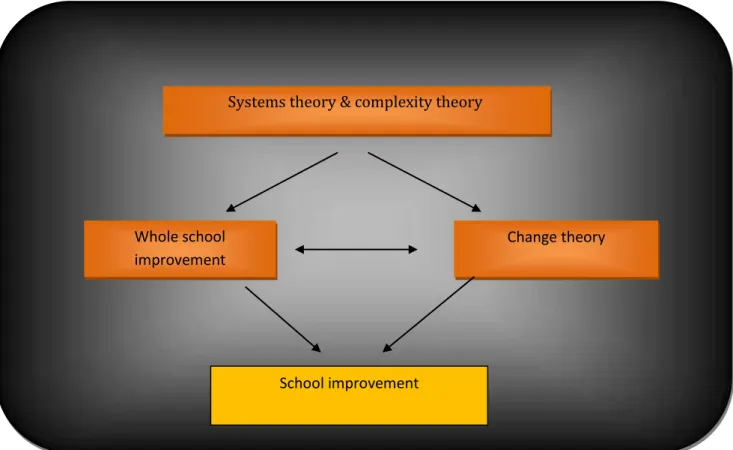
ISIP laid a foundation for knowledge about school improvement and made this knowledge available internationally (Reynolds et al., 1996). Thus, in order to achieve school improvement and change, the culture and system of the school and the individuals involved in the school must be changed (Nobles et al., 2012; Taylor, 2008).
Differentiating between MDCs and LDCs
The school is viewed as a system and change can only be achieved when the system changes (Nobles et al., 2012). Fullan (2011) states that school improvement interventions will only be able to achieve lasting change when there is a change in the culture of the school, with individuals in the school determined and motivated to change.
McKinsey’s model for school improvement
Mourshed et al (2010) note that each stage of performance is associated with a range of interventions that could be useful for schools to ensure success at that particular stage so that they can move on to the next stage (Mourshed et al, 2010). At schools that are in the 'fair to good' performance phase, the emphasis is on improving the school system as a whole.
The productive pedagogy model
Rather, the model of productive pedagogy is an indication of what teachers and schools can achieve by expanding the concept and recognizing the social aspects involved in teaching and learning (Lingard et al., 2003). They argue that it is precisely the social aspects involved in teaching and learning that need to be recognized (Mills & Goos, 2007), which would promote a social school community.
Visible teaching and learning
Using the model, Indigenous knowledge is explored and welcomed in the classroom (Christie, 2008). Hattie (2009) notes that most classroom teachers focus on promoting deeper understanding of the material.
A focus on school improvement within the South African context
Since teachers have direct contact with learners in the classroom, their approach to teaching and the teaching styles they adopt can have an effect on school improvement (Botha, 2010). Harris (2010) notes that there must be an integrated approach to school improvement, one that (a) acknowledges the uniqueness and the context in which the school is placed, (b) encourages networking between schools, whereby schools can learn from each other support and support each other, and (c) take a strategic school improvement approach to ensure that the resources required for a school are obtained.
School improvement projects that have been initiated within South Africa
As regards the medium of instruction, there was no language used in the schools of the province; rather there were variations (Simkins & Pereira, 2005). Overall results show that there is a correlation between teacher quality and school quality (Simkins & Pereira, 2005).
The David Rattray Foundation (DRF)
Conclusion
Finally, the researcher mentions the David Rattray Foundation and the school improvement projects it has implemented.
Chapter Three: Conceptual Framework
- Introduction
- Systems theory
- Complexity theory
- Whole school improvement
- Change theory
- Conclusion
For any change to occur in the school system, the culture in which individuals work must change (Fullan, Cuttress, & Kilcher, 2005). In order for the school to improve, there must be a change in the school system (Fullan, 2006; Taylor, 2008).
Chapter Four: Research design and methodology
- Introduction
- Research paradigm
- Research style
- Research approach
- The context of this study
- The research sample
- Data collection
- Data analysis
- Validity and reliability
- Limitations
- Ethical considerations
- Conclusion
There were three phases in the data collection phase of the study that the researcher followed. To do this, the researcher focused on the transferability, credibility, and reliability of the study. The researcher further emphasized that the purpose of the study was to understand the DRF and its activities.
In addition, the researcher engaged in email conversations with the CEO of DRF after data collection to ensure that the data was reliable (Rule & John, 2011).
Chapter Five: Findings and analysis
Introduction
Introducing the David Rattray Foundation (DRF)
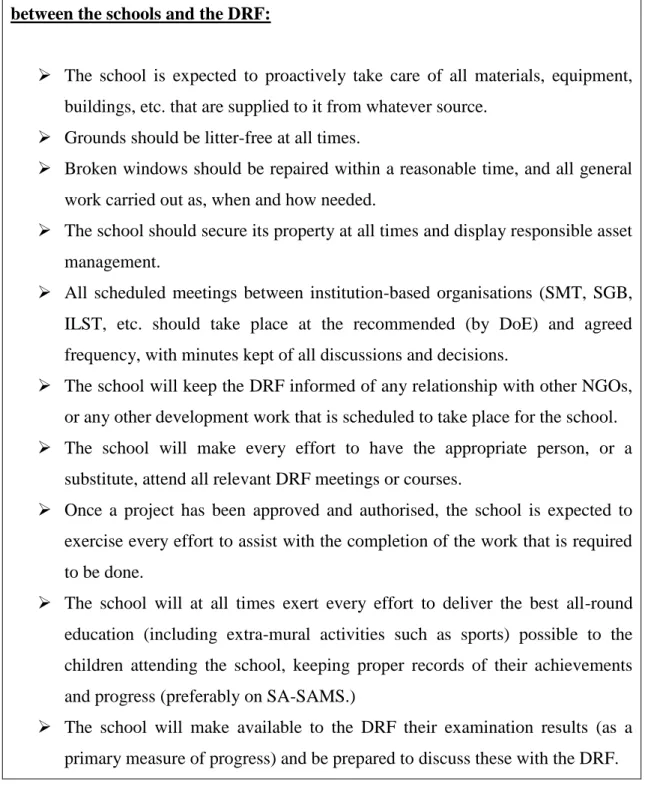
As part of the project, NGO FUEL (Feed Uplift Educate Love) came and conducted surveys among the schools to determine why some schools had failed to qualify for the National School Nutrition Program (NSNP). At the end of the program, all schools had qualified for the NSNP. The foundation expected that as part of the partnership, the schools would follow the criteria set out in the memorandum of understanding.
When this is done, the school leaders are obliged to make a written or oral request to the foundation's managing director.
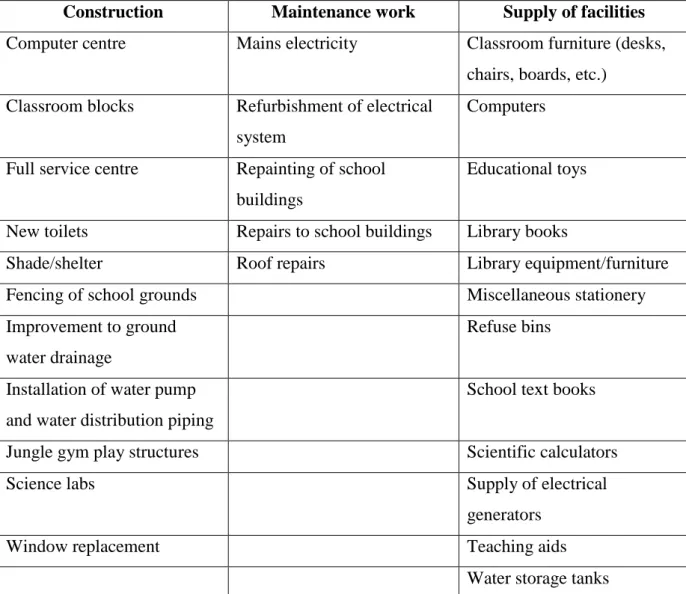
Theme one: School improvement
As one principal indicated, the role of the DRF is to provide support to the schools so that effective teaching and learning can take place. The above extract gives an indication of the extent to which the DRF has helped the schools in the area. Now that the partnerships are in place, it is a means to motivate the schools so that they perform optimally.
Initially, the DNS provided equal support to all the schools they were involved with.
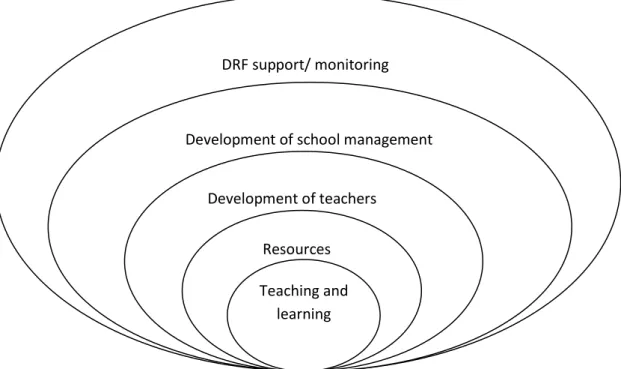
Theme two: Partnerships
The memorandum of understanding outlining the schools' responsibility makes clear the school's role in the partnership. From the extract above it is evident that the DRF CEO wanted some form of control over the situation. By formalizing the partnership, the CEO of FSDK has attempted to gain some form of control over the schools and the situation.
With the development of the foundation, he took over the new system of operation of the general director of the DRF.
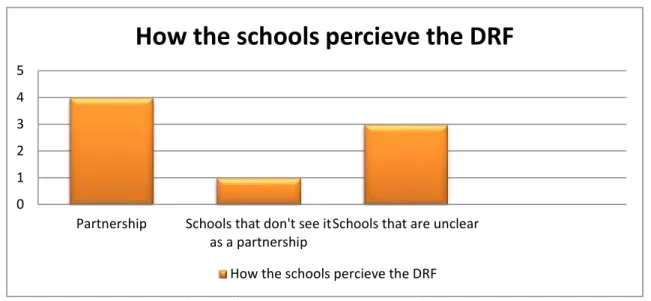
How the schools percieve the DRF
Theme Three: Wider system issues
The findings from this research study show that there has been a lack of concern on the part of the district towards some of the schools in the area. The above extract serves as evidence of the department's lack of interest in some of the schools within the area. The above extract is an indication of the need for a principal to be a good leader for the school and the teaching team.
But not to the extent that DRF is giving us support." (Fourth Principal) The above extract is an indication of the extent to which the area district provides support to schools.
Conclusion
You know that the purpose of the system is to provide children with an education that will make them good in the world. Another point made by the CEO of the DRF is that everyone involved in the Ministry of Education must share the same vision so that they have the same drive to change the education system in the country. What the CEO of the DRF says is consistent with what Fullan (2006) says about the need to change the culture of the school system.
This should be done at a whole school level, targeting the entire school system, so that each individual in the system is both capacitated and shares the same vision for education (Fullan, 2001).
Chapter Six: Discussion
- Introduction
- The complexity of schools
- Change within schools
- The context of schools
- Models of school improvement
- What was not predicted
- Conclusion
Within DRF we find that the CEO of DRF has a similar approach to school improvement. As described in chapter five, the researcher of this study found that the CEO of DRF uses a business approach when implementing various school improvement interventions. This is mainly due to the fact that the CEO of DRF comes from a business background.
Using this approach, the DRF CEO formulated partnerships with the schools, as outlined in chapter five.
Chapter Seven: Conclusion and recommendations
- Introduction
- Summary of the main findings
- Recommendations
- Conclusion
The findings of this research study also show that the way DRF works is unique compared to the approaches of other school improvement projects. DRF uses a business approach to school improvement by following business principles. The findings of this study show that DRF has provided various school improvement interventions to its partner schools.
With regard to the DRF, we note that the way the foundation has moved forward reflects the use of a business logic and business model for school improvement.
Retrieved from http://www.catalyst-chicago.org/sites/catalyst-chicago.org/files/michael_fullen_change_theory.pdf. Retrieved from http://eprints.lse.ac.uk/20656/1/Urbanization Patterns European vs Less Developed Countries.pdf. A comparison of. phenomenology, discourse analysis and grounded theory. http://www.tree4health.org/distancelearning/sites/www.tree4health.org.distancelearni ng/files/readings/Starks_Trinidad_choosing_qual_approach_article.pdf.
Extracted from http://www.jet.org.za/events/conferences/What%20works%20in%20school%20devel opment/Papers/Taylor%20Whats%20wrong%20with%20SA%20schools%20JET%20 Schools%20Conf% 20final.pdf.
Appendices
PURPOSE OF THE STUDY
The aim of the study is to determine the effectiveness of the DNA as an intervention for school improvement.
PROCEDURES
POTENTIAL RISKS AND DISCOMFORTS
POTENTIAL BENEFITS TO SUBJECTS AND/OR SOCIETY
PAYMENT FOR PARTICIPATION
CONFIDENTIALITY
PARTICIPATION AND WITHDRAWAL
IDENTIFICATION OF INVESTIGATORS
RIGHTS OF RESEARCH SUBJECTS