Suid-Afrika se demokratiese oorgang het gelei tot die aanvaarding van liberale wette en beleide wat daarop gemik was om historiese ongeregtighede reg te stel en vroue se deelname aan die mynbedryf te verhoog. Die teenwoordigheid van vroue kan dus bydra tot die verwesenliking van gelykheid in die bedryf. Hierdie afdeling dek ook die faktore wat die aantrekking, betrokkenheid en behoud van vroue in die mynbedryf beïnvloed.
Derdens het die literatuur 'n oorsig verskaf van die wetlike en regulatoriese raamwerk wat vroue se betrokkenheid by die Suid-Afrikaanse mynbedryf rig. Bevestigende faktoranalise het getoon dat die drie-faktorstruktuur (energie, toewyding en absorpsie) van die Utrecht Work Engagement Scale redelik goed by die steekproefdata pas. Alhoewel daar ruimte vir verbetering is, het respondente oor die algemeen hoë vlakke van betrokkenheid by hul werk aangedui.
Alle behoudfaktore het ʼn positiewe invloed gehad op die respondente se voorneme om in die organisasie te bly. Die navorsingsresultate van die navorser se saamgestelde vraelys het getoon dat die respondente in die algemeen ʼn bevorderlike werksomgewing en werksvoordele as belangrike faktore vir die aantrekking, betrokkenheid en behoud van vroue in tegniese mynbouposisies beskou.
INTRODUCTION, ORIENTATION AND BACKGROUND
One of the most significant challenges in the mining industry is to introduce and ensure the full incorporation and inclusion of women in the traditionally male-dominated industry (Zungu, 2011:4). The establishment of gender equality in the male-dominated mining industry is reported as one of the biggest gender equality challenges in South Africa (Botha & Cronjé. The perceived challenges regarding the integration of women in male-dominated professions in South Africa can be attributed to, among other things, the historical exclusion of women in the mining industry, structural changes in business and legislative restrictions (Bradley Heine Mashiane, 2009:2-3).
Calitz (2004:30) describes that the mining industry's association with male physical strength is due to the industry's hard labour, the location of mining companies, hot temperatures and handling of heavy machinery. This perception was exacerbated by the socialization of gender roles, which emphasized distinct roles for men and women, leading to gender occupational discrimination, which hindered women's participation in the industry and contributed to the mining industry's reputation as a relatively hostile one. environment for women (Heine, 2008) :13; Mashiane, 2009:24; Mxhakaza, 2010:1; Nndanduleni, 2016:28). For the mining industry to become a driver of inclusive economic growth, gender considerations and women's empowerment must be prioritized (BSR, 2017:3).
In addition, it is also imperative for the mining industry to implement relevant measures to ensure that current employees are retained, engaged and developed to their full potential (Hughes, 2012:39). It was inferred from the above background that it is imperative to include women in the mining industry as it challenges gender stereotypes that portray mining as a male-dominated industry.
PROBLEM STATEMENT
Therefore, the presence of women will contribute to the steps being taken to ensure gender equality in the industry (IOA, 2011). Attracting and retaining women is key to addressing skills shortages in the labor market. Attracting, retaining and engaging women in the mining industry is important to address skills shortages and contribute to gender diversity (AHRC, 2013:35).
There is a gap in the literature of studies that have examined how to attract, engage and retain women in tech mining jobs. Previous research (Lord & Eastham, 2011; MCA, 2005; MCSA, 2019) focused primarily on attracting and retaining women in the mining industry in general, but failed to consider the importance of involvement as a factor influencing the retention of women. could affect women. Shifting the focus to women working in technical mining positions is imperative given their under-representation in the sector.
Consequently, this research sought to fill the gap in existing knowledge in the area under investigation. This study aimed to contribute to the body of knowledge on factors that influence the attraction, involvement and retention of women in technical mining positions in order to promote women's successful participation in the South African mining industry.
RESEARCH QUESTIONS
General research question
Allen (2008:26) argues that if this is not used, we could lose valuable talent, which could have negative effects on the sustainability of the industry and will also affect transformation and diversity in the industry.
Specific research questions
RESEARCH OBJECTIVES
General research objective
Specific research objectives
CENTRAL THEORETICAL STATEMENTS
Research indicates that disengaged employees have contributed to the reduction of 28.5% in the mining industry's contribution to South Africa's gross domestic product (GDP) (Marais, 2017:11). Therefore, both concepts of retention and engagement are critical to ensuring a highly productive workforce, which can lead to the attraction of those not yet employed in the industry. Employee engagement and retention is the end result of consistent and positive employee experiences, which can be a positive attribute to attract potential employees (Meyer et al., 2002).
These reasons can essentially be related to the attraction of new entrants into the industry. The theory of employer attractiveness developed by Berthon et al. 2005) was used to understand the factors influencing attraction. 2005) assert that to understand attraction, we must first understand the factors that contribute to an employer's attractiveness. As a result, Schaufeli et al. 2002:74) see engagement as a positive, fulfilling, work-related state of mind characterized by energy, commitment and absorption.
Hygiene factors, on the other hand, are non-job-related factors that are external to the job and can lead to unsatisfactory experiences (Almaaitah et al., 2017:21). Likewise, Herzberg's two-factor theory has been extensively studied to understand the role of motivation in retention (Almaaitah et al., 2017; Berry & Morris, 2008; Owler & Morrison, 2015).
RESEARCH METHODOLOGY
- Literature review
- Research paradigm/worldview
- Empirical investigation
- Research setting
- Research design
- Sampling method
- Target population
- Sampling frame
- Sampling method/technique
- Sample size
- Data collection
- Quantitative phase (structured web-based questionnaires)
- Qualitative phase (semi-structured interviews)
- Instrumentation
- Quantitative phase
- Qualitative phase
- Pre-testing of the instruments
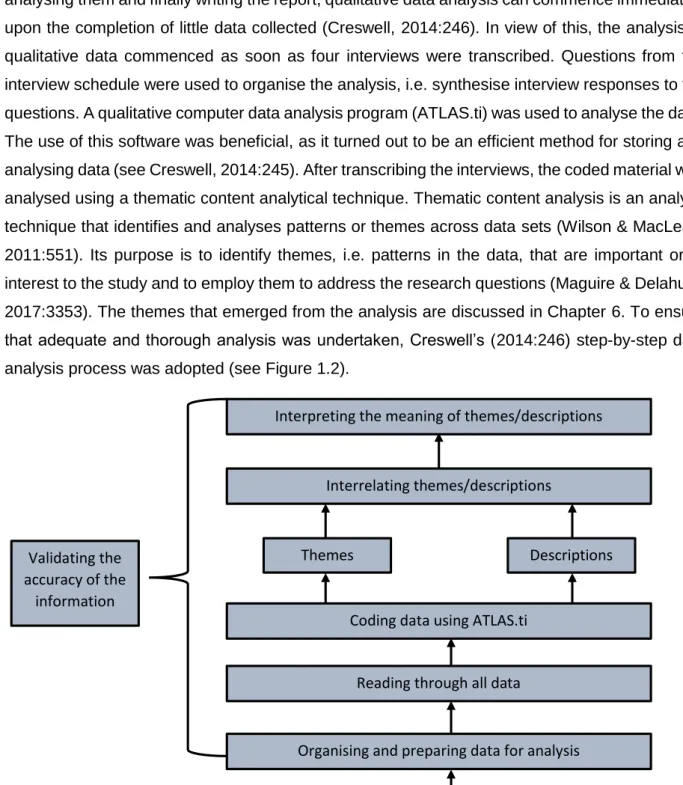
- Data analysis
- Quantitative phase
- Qualitative phase
- Approaches for ensuring reliability and validity
In light of the above, the study was conducted from the point of view of a relational epistemological position, i.e. women employed in technical mining positions at various mining companies in South Africa were the target group for the quantitative component of the study. In this study, convenience sampling (also known as availability sampling) was used to select the respondents for the quantitative phase of the study.
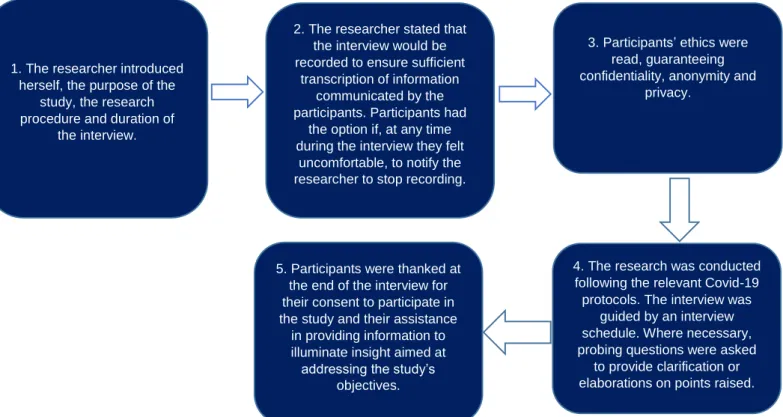
In addition, purposeful and convenience sampling was used to select participants for the qualitative phase of the study. At the end of the interview, the participants were thanked for their consent to participate in the study and for their assistance. For the quantitative component of the study, existing measurement scales were used to measure the attractiveness, engagement and retention of women in technical mining positions (see Appendix A).
The items added by the researcher belong to the statements related to the interest value ("the location of the workplace") and the social value ("an environment that allows me to easily balance my professional and home life"). Second, the questionnaire was tested among selected women in technical mining positions to assess their understanding and interpretation of the questions posed.
ETHICAL CONSIDERATIONS
LIMITATIONS AND DELIMITATION OF THE STUDY
THE SIGNIFICANCE OF THE STUDY
There is a need for women to be equally represented in social economic activities as their male counterparts as this leads to improved global economic growth and market efficiency, ensuring that all human resources society has to offer are well utilized and invested in (Ledwaba, 2017: 25). In addition, the attraction, engagement and retention of women in the mining industry challenges gender stereotypes that portray mining as an unsuitable work environment for women. Therefore, their presence contributes to the promotion of gender equality in the industry (Consultancy Africa Intelligence, 2011:2).
Although the theories used to examine the attraction, engagement and retention of women in technical mining positions help to contribute to the understanding of the research topic, there are gaps in addressing gender-related and industry-related factors. As previously mentioned, there is also a gap in the literature regarding similar studies conducted on this topic (Lord & Eastham, 2011; MCA, 2005; MCSA, 2011).
CHAPTER LAYOUT
The chapter presents the analysis of the empirical findings of the qualitative component of the study. In addition, it includes a discussion of the research results and findings against the theoretical framework, literature dealing with factors influencing the attraction, engagement and retention of women in mining and the policy/legislative framework. Based on the outcome of the study, findings and literature review, conclusions and recommendations are drawn in Chapter 7 with the aim of helping organizations to successfully attract, engage and retain women in mining technical positions.
CONCLUSIONS
ATTRACTION, ENGAGEMENT AND RETENTION: A THEORETICAL
INTRODUCTION
A CONCEPTUALISATION OF THE CONCEPTS OF EMPLOYEE
- Attraction
- Engagement
- Retention
THEORIES OF ATTRACTION
THEORIES OF ENGAGEMENT AND RETENTION
DESIGNATED THEORIES SUITABLE FOR THE INVESTIGATION OF
- Employer attractiveness theory
- Three-factor engagement model
- Herzberg’s two-factor theory
CONCLUSIONS
INTRODUCTION
AN OVERVIEW OF WOMEN EMPLOYED IN THE MINING INDUSTRY
- A global perspective
- Sweden
- India
- Chile
- China
- Mongolia
- Australia
- Canada
- An African perspective
- A national perspective
THE QUEST TO PROMOTE THE PARTICIPATION OF WOMEN IN THE
FACTORS AFFECTING THE ATTRACTION, ENGAGEMENT AND
- Compensation and benefits
- Career development opportunities
- Work-life balance
- Negative gender stereotypes and workplace culture
- Hazardous working conditions and safety risks
- Sexual harassment
CONCLUSIONS
STATUTORY AND REGULATORY FRAMEWORKS GOVERNING THE
INTRODUCTION
THE CONSTITUTION OF THE REPUBLIC OF SOUTH AFRICA
LABOUR LEGISLATION
- The Labour Relations Act (No. 66 of 1995)
- Employment Equity Act (No. 55 of 1998)
- The Basic Conditions of Employment Act (No. 75 of 1997)
- The Skills Development Act (No. 97 of 1998)
- Promotion of Equality and Prevention of Unfair Discrimination Act (No. 4 of
- Women Empowerment and Gender Equality Bill (2013)
- Overview of labour legislation
SECTOR-SPECIFIC REGULATORY FRAMEWORKS GOVERNING THE
- The Mine Health and Safety Act (No. 29 of 1996)
- The Mineral and Petroleum Resources Development Act (No. 28 of
- The Broad-based Socio-economic Empowerment Charter for the Mining and
- Overview of mining legislation
CONCLUSIONS
EMPIRICAL RESULTS AND ANALYSES OF QUANTITATIVE DATA
INTRODUCTION
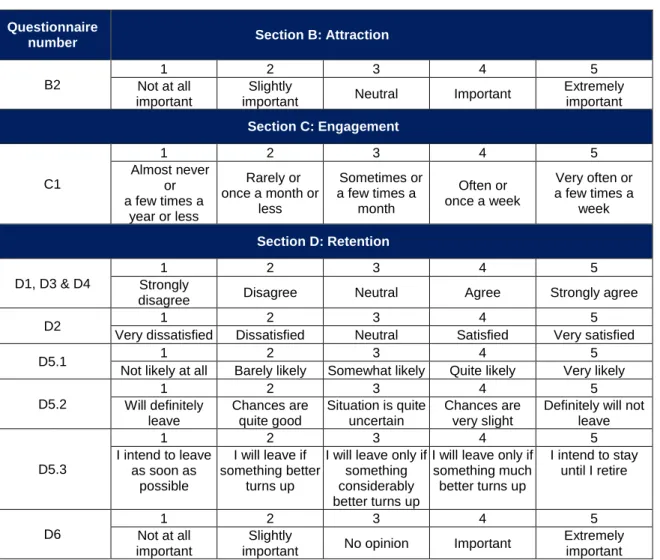
DEPLOYMENT OF THE RESEARCH METHODOLOGY: QUANTITATIVE
- Descriptive statistics
- Validity and reliability analysis
- Comparison tests
- Correlation
EMPIRICAL RESULTS AND ANALYSIS OF QUANTITATIVE DATA
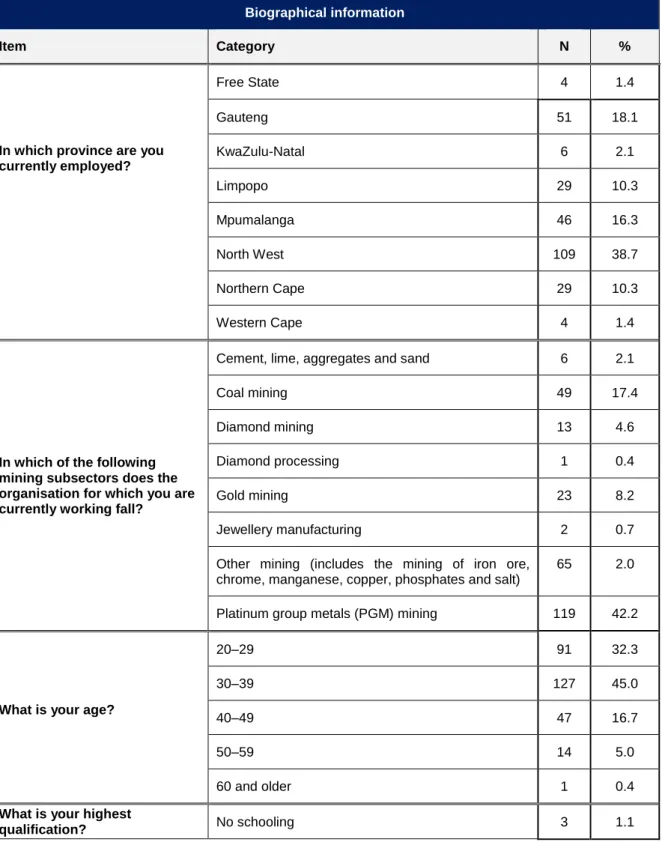
- Biographical information
- Province currently employed
- Organisation’s mining subsectors
- Age
- Highest qualification
- Marital status and existence of children
- Duration of employment in the present position, organisation and mining
- Place of work in the mine and work shifts
- Primary reasons for selecting a career in mining
- Descriptive statistics of attraction, engagement and retention
- Employee attraction
- Employee engagement
- Employee retention
- Organisational commitment
- Compensation and benefits
- Career development, training and job characteristics
- Work-life balance
- Intention to stay
- Factors influencing the attraction, engagement and retention of women in
- Effect of nominal biographical variables on attraction, engagement and
- Effect of night shift work on attraction, engagement and retention
- Effect of having children on attraction, engagement and retention
- Effect of work committee involvement on attraction, engagement and
- Effect of marital status on attraction, engagement and retention
- Correlations between age, highest qualification and length of employment in
- Age
- Highest qualification
- Duration of employment in current position
- Duration of employment in the organisation
- Duration of employment in the mining industry
- Correlations between factors of attraction, engagement and retention
- Correlations of factors of attraction with factors of engagement and retention,
- Correlations of factors of engagement with factors of retention, as well as
- Correlations of factors of retention with factors of attraction, engagement and
CONCLUSIONS
EMPIRICAL FINDINGS AND ANALYSES OF QUALITATIVE DATA AND
INTRODUCTION
DEPLOYMENT OF THE RESEARCH METHODOLOGY: QUALITATIVE
DEMOGRAPHIC INFORMATION OF RESEARCH PARTICIPANTS
THEMES AND SUB-THEMES
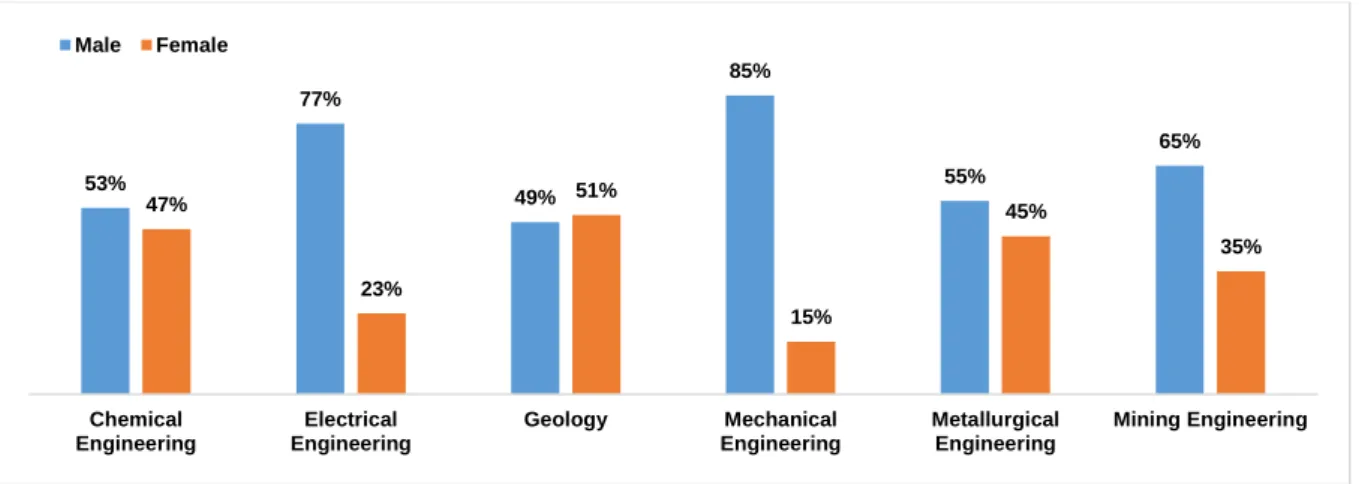
- Gender representation of employees in technical mining positions
- Reasons for the underrepresentation of women in technical mining
- The attraction of women to technical mining positions
- Barriers to attraction
- Measures implemented by mining organisations to ensure gender
- Recommendations to attract women to technical positions
- The engagement of women in technical mining positions
- Understanding of employee engagement
- Factors affecting employee engagement
- The retention of women in technical mining positions
- Average tenure of women in technical mining positions
- Factors influencing the retention of women in technical mining positions 233
- Recommendation for women to pursue careers in technical mining positions
CONCLUSIONS
DISCUSSION AND INTERPRETATION OF QUANTITATIVE RESULTS
- Biographical information
- Attraction
- Engagement
- Retention
- Attraction, engagement and retention of women in technical mining positions
CONCLUSIONS
CORE SUMMARY, CONCLUSIONS AND RECOMMENDATIONS
INTRODUCTION
RESEARCH PROBLEM AND OBJECTIVES
RESEARCH METHODOLOGY
RESEARCH OBJECTIVES OF THE STUDY
- Specific research objective 1
- Specific research objective 2
- Specific research objective 3
- Specific research objective 4
- Attraction
- Engagement
- Retention
- The attraction, engagement and retention of women in technical mining
- The relationship between attraction, engagement and retention
LIMITATIONS OF THE STUDY
AREAS FOR FUTURE RESEARCH
SUMMARY OF RESEARCH STUDY