Lenny Govender and sisters-in-law (Yagendree and Shalene Govender) thank you for the love, support and encouragement you have given me. The results show that the middle and lower reaches of the Umdloti River are the most affected.
Bird, mammal, reptile and other life 61
Research Techniques Employed in the Study 67
Nitrite (mg/L), Nitrate (mg/L) and Ammonia (mg/L) 83
Escherichia coli (E. Coli) (x10 6
Biological Oxygen Demand (BOD) (mg/L) and
Maps dated from 1959, 1978, 1989, and 2000
Sand mining taking place in the lower part of the Umdloti river
Contextualisation of the Problem
In South Africa, most river catchments suffer the consequences of at least some of the above pollution. Hazelmere Dam was constructed to regulate the flow of the Umdloti River in order to facilitate the reliable availability of water supply for regional and domestic water uses.
Aim of the Study
Water from the dam is supplied to the surrounding area by the North Coast Regional Water Services Corporation (NCRWSC) and they are the main users of urban and industrial water from Hazelmere Dam (White Paper Policy.
Objectives of the study
Relevance of the study
These developments, changes and impacts have visible manifestations in many parts of the country and are evident in the north coast of KwaZulu-Natal. It is the further aim of his research to provide information about the construction of positive and negative impacts encountered in the surrounding communities of the watershed.
Chapter Formation and Sequence
The nature of this study is academically useful in the sense that it will form the platform for future studies so that up-to-date scientific data is continuous as water quality changes over time. Changes in water quality occur all the time due to natural and human impacts on both dams and rivers.
Introduction
According to Harrison (2007), many developing countries use up to forty percent (40%) of their renewable freshwater for irrigation, and with population growth, pollution and climate change, the average water supply per person is likely to decrease by one-third over the next two decades, causing a global crisis that is expected to occur between the years 2025 and 2050. Therefore, a balance is needed between the use of water for human needs and the use of water for the survival of ecosystems on which humans depend (www. .awiru.co.za).
General Fluvial Characteristics and Importance
Oxygen levels can be lower even though rocks in the river bed can support a more extensive growth of microscopic algae. Increased sunlight and the slow flow in the river encourage the growth of phytoplankton and zooplankton.
Environmental Problems of Rivers
At the lower limit just above the estuary, the substrate becomes very muddy and rich in organic matter, thus providing an excellent shelter and food source and providing a habitat for many invertebrates, various avifauna and bottom-feeding fish, ( 4) the last stage of the river is the estuary and unlike the rest of the river, this is a place where the flow of water towards the sea can be completely stopped during periods of rising tides. Mclusky (1989), states that estuaries are vital feeding grounds for many species of birds, especially wild birds and wildfowl, coastal fishing sites or as. fascinating areas that pose challenges to our understanding of how animals and plants adapt to this environment, Day et al. 1986), cited in South African National Science Programs Report No.
Importance of Dams
- Dam Safety
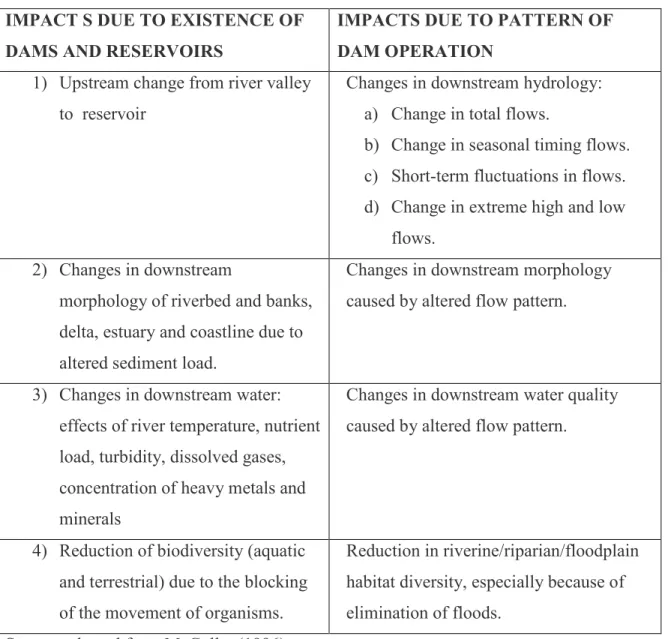
- Environmental Impacts of Dams
The first significant storage dams in South Africa were built in the second half of the nineteenth century. According to Rangeley (1990), cited in TheWorld Bank Technical Paper No.115, the need to preserve the quality of the human environment has long been on the minds of storage reservoir/dam planners.
The Hazelmere Dam
- Storage Capacity of the Hazelmere Dam
The capacity has been reduced by sedimentation to an estimated 16.8 million m3, which represents approximately 23% of the natural MAR. The capacity of the elevated dam is estimated at 36 million m3, which represents approximately 50% of the natural MAR.
Water Quality
- Human Impacts on Water Quality and Quantity
- Decline in Water Quality
- Water Pollution
- Water-Born Diseases
- Solid Waste
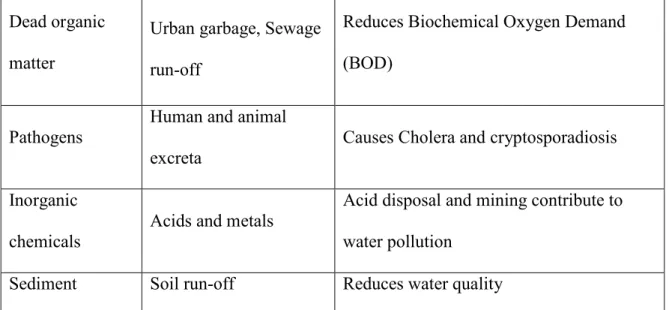
Non-point sources of pollution include: runoff from irrigated agricultural land and orchards; agricultural runoff and infiltration, forestry runoff and logging runoff, including logging roads and transportation; runoff from unrestricted rangeland and pasture; urban runoff, small communities with storm sewers and runoff from settlements with no sewerage facility; leaching of septic tanks; wet and dry deposition over a water source, runoff from abandoned mines, including inactive mine roads, runoff and snowmelt (with or without deicing chemicals) from roads and highways; wetland drainage; mass outdoor recreation and gathering; land development; Garbage refers to the perishable solid waste components that are left during the preparation or storage of meat, vegetables, fruit, etc.
Main Categories of Water Pollution
Ecosystems
- Ecosystems Services
- Estuaries
They are that part of a river system or a drainage system that has, or may have, interaction with the sea (Huizinga et al., 1997). During this closed phase direct interaction with seawater within the estuary flows from both the river and the sea (Huizinga et al., 1997) e.g.
The Physical, Chemical and Biological Characteristics of Water
- The Chemical and Physical Characteristics of Water
- Ammonia
- Nitrites and Nitrates
- Sulphate
- Phosphate
- Calcium
- Magnesium
- Chemical Oxygen Demand
- Biological Oxygen Demand
- Total Dissolved Solids
- The Biological Characteristics of Water
The measurement of calcium ions in surface water determines the 'hardness' of the water. Measuring biochemical oxygen demand (BOD) is not suitable for aquatic ecosystems, but is useful for determining the water quality requirements of wastewater discharged into aquatic systems to limit their impact (DWAF, 1996).
Environmental Legislation in South Africa
- Legislation in South Africa promoting safe waters
- The National Water Act
- The Water Services Act
- Compulsory National Standards for the Quality of Potable Water
- Municipal Structures Act
- The National Health Act
- The National Water Resources Strategy
The ministerial department that oversees water resources in South Africa is the Department of Water Affairs and Forestry (DWAF), now called the Department of Water Affairs (DWA). Mandatory National Standards for the Quality of Drinking Water (2001, Regulation 5 of Section 9 of the Water Services Act) – requires Water Service Authorities (WSAs) to implement drinking water quality monitoring programs to monitor, improve and report on the delivery of drinking water services (DWAF , 2005). The National Water Resources Strategy (2004) provides the framework within which water resources will be managed across the country.
The National Water Resources Strategy also provides the framework within which all catchment management strategies will be drawn up and implemented for water resource management in a catchment.
Conclusion
- Study Area
- Physiographic Characteristics of the Umdloti Catchment
- RESEARCH METHODOLOGY
- Measurement of Water Quality
- Water Quality Parameters
- Sampling Locations
- Questionnaire Survey Method
- Research Techniques Employed in the Study
- Collecting of Water Samples
- Laboratory Analysis of Water Samples
- Questionnaire Survey
- Statistical Analysis of the Data
- South Africa Water Quality Guidelines
- Conclusion
- INTRODUCTION
- Water quality analysis
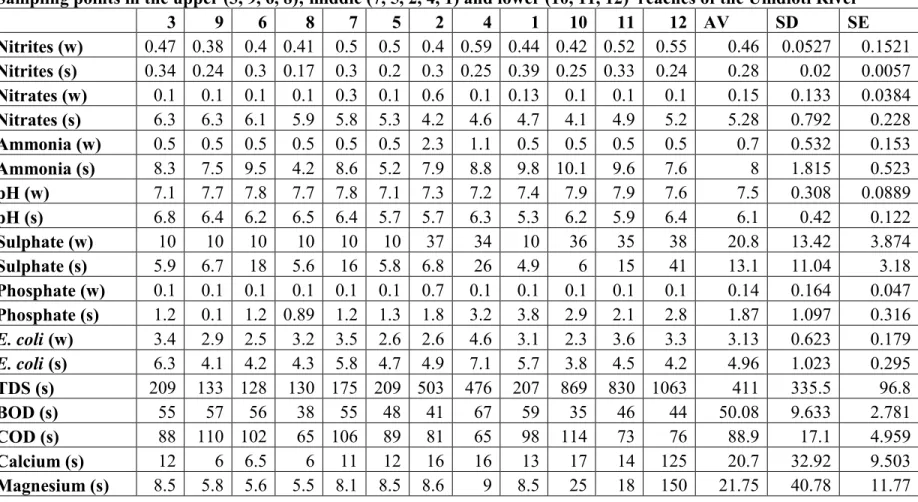
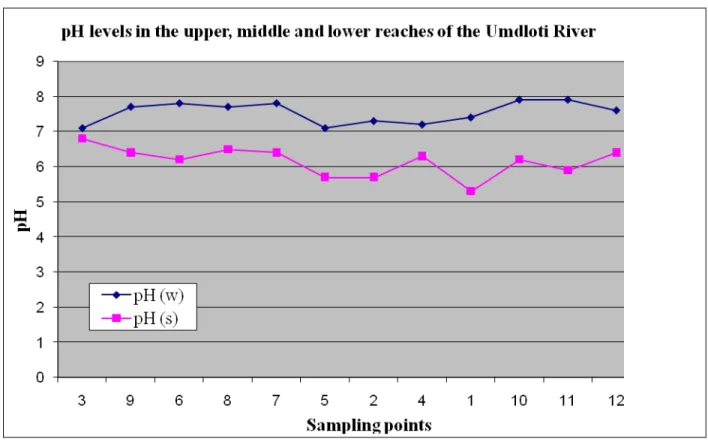
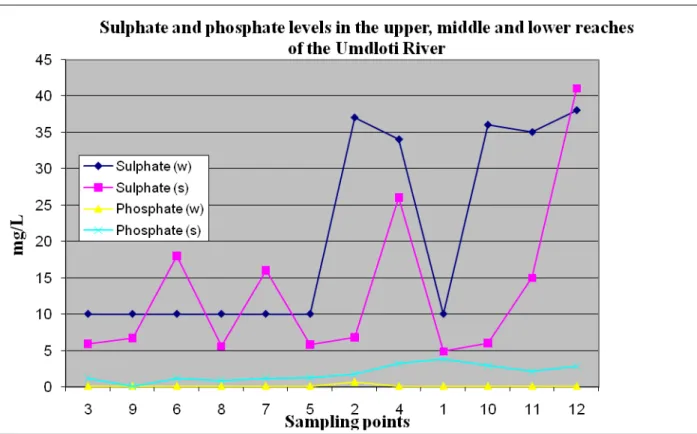
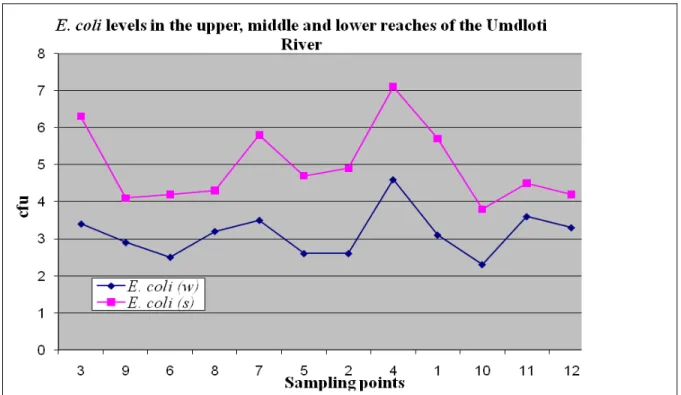
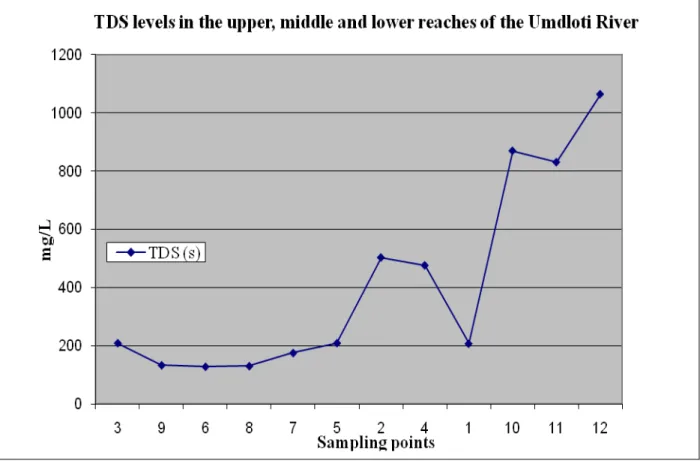
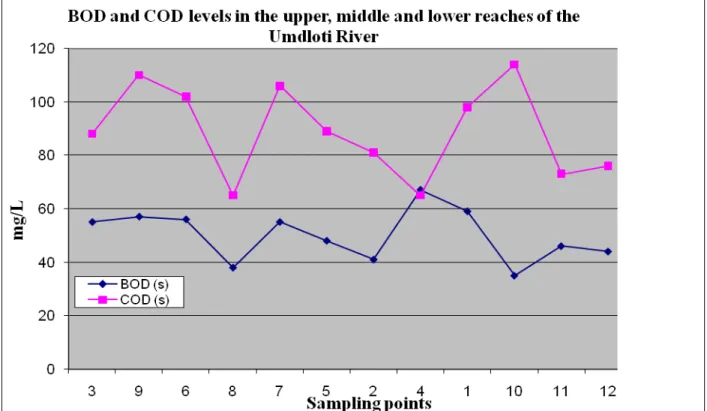
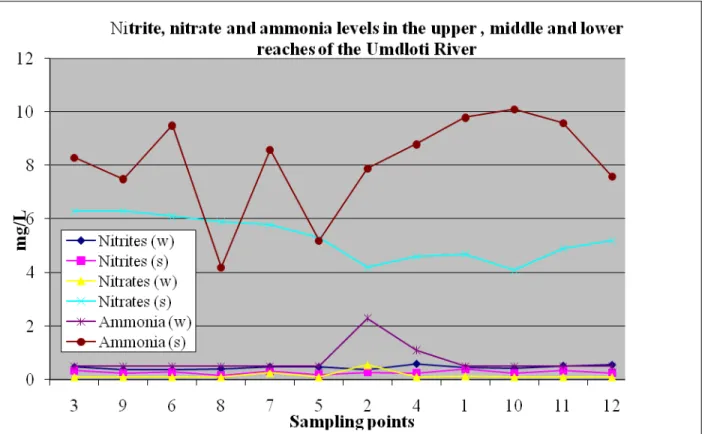
Water quality can be considered as a measure of the suitability of water for a particular purpose. The chronic effect value (CEV) is the level of a constituent at which there is expected to be a significant probability of measurable chronic effects to five percent (5%) of the species in the aquatic community. The graphs that follow are presented in accordance with the analyzed water quality data in the upper, middle and lower parts of the Umdloti River.
The sampling points of the upper, middle and lower reaches of the Umdloti River are presented as follows:
Summer AV-Average
- Nitrites, Nitrate and Ammonia (mg/L)
- Sulphate and phosphate (mg/L)
- Escherichia coli (E. coli) (x10 6 cfu)
- Statistical analysis of seasonal variations in water quality
- Total Dissolved Solids (TDS) (mg/L)
- Biochemical Oxygen Demand (COD) and Chemical Oxygen Demand (mg/L)
- Calcium and magnesium (mg/L)
- Conclusion
- Questionnaire survey analysis
- On site-observation analysis
The information collected shows that thirty percent (30%) of the total respondents surveyed have been compensated for the loss of property and four percent (04%) of the respondents surveyed. The results obtained showed that fifty-six (56%) of the respondents were unsure about the primary use of the land before construction, forty percent (40%) of the respondents. From the information collected, fifty-two percent (52%) of respondents reported being involved in agricultural activities and forty-eight percent (48%) of.
Currently, thirty-two percent (32%) of respondents indicate that their generated waste is transported by Durban Solid Waste (DSW) services, six percent (06%).
Sand mining taking place in the lower reaches of the Umdloti River Respondents from the questionnaire analysis have indicated that this is presently causing
Maps dated from 1959, 1978, 1989, and 2000 .1 Map dated 1959 (Figure .1.1)
The area is heavily vegetated and the town of La Mercy is practically non-existent, no development in the Umdloti beach area is visible. Residential developments at La Mercy had begun and the La Mercy airport was demarcated as early as 1978. The well-defined spit at La Mercy lagoon no longer exists and this can be attributed to the 1984 cyclone and 1987 storms.
It is clear from the maps that the La Mercy lagoon/estuary has increased in size over time.
Conclusion
Introduction
Water quality characteristics
While the statistical analyzes performed showed that there is no significant difference in the average measured concentration of E. Dissolved oxygen levels in the system are generally high when compared to the general limits for uptake by aquatic organisms. Dissolved oxygen levels in the system are generally high when compared to general limits for uptake by aquatic organisms.
Nevertheless, not all variables have an acute or chronic effect on water quality in the upper, middle and lower reaches of the river.
Questionnaire Survey
In summary, the construction of Hazelmere Dam was favorable to 64 percent (64%) of respondents. Thirty-six percent (36%) of respondents indicated that they had been adversely affected by the construction of the dam. For the majority of respondents, water from the river was available before and after the construction of the dam (94% of respondents).
The informal settlements in the Umdloti drainage (16% of respondents) using the alternative sanitation facilities near the river (more than 40 meters away) have contributed negatively to the water quality of the Umdloti River.
Conclusion
Integrated water resource management is a cornerstone of the new approach to water resource management adopted in South Africa and required by the National Water Act 36 of 1998. This principle applies as much to water resource management as it does to the management of any other human endeavour. . This principle is explicitly recognized in Chapter 14 of the National Water Act (NWA, Act No. 36 of 1998) (DWAF, 1998), which requires water resource quality monitoring to be an integral part of water resource management in South Africa (DWAF, 2004).
This crisis is not only presented in the sense that the shortage will be so pronounced as to cause serious economic, political and social consequences (Lee, 1999); therefore, there is an urgent need for integrated management of water resources.
Recommendations
Farmers in the area who withdraw water from the Umdloti River for irrigation purposes must register this water use or apply for a water use permit. Industrial wastewater from industries, especially in the Canelands area, should be recycled and reused in the industrial processing activities instead of being discharged into the Umdloti River. The permits for sand mining activities in the Umdloti River need to be reviewed by the Ministry of Minerals and Energy, the Ministry of Water Affairs and the Ministry of Environmental Affairs due to the uncontrolled mining that is taking place and has major impacts on water quality.
Rigorous development in the Umdloti River Basin and surrounding areas must be reconsidered as it will negatively contribute to the Umdloti River and threaten the availability and quality of water for future storage and supply.
Conclusion
Ahmed, F., 2005: Impacts of residential and tourism development on the north coast of KwaZulu Natal: Umhlanga Rocks to Salt Rock-Natal. Monitoring water quality in the United Nations environment: a practical guide to planning and implementation. Mangold, S., 2001: National Aquatic Ecosystem Biomonitoring Program: River Health Program Implementation Manual - A Hitchhiker's Guide to RHP Implementation.
Naidoo, K., 2005: The anthropogenic impacts of urbanization and industrialization on the water quality, ecology and health status of the Palmiet River catchment in Durban, KwaZulu Natal.