This is in contrast to the high levels of public concern about children and young people's choice and use of the media. It is undertaken with a sense of the significance of the media in everyday life and society.
SECTION ONE
Furthermore, there are different perspectives on the way people see the audience in the media. While some theorists believe that audiences are very powerful, some believe that audiences are only moderately powerful, and others believe that audiences are powerless.
The passive audience
He noted the ideological dimensions of the media that classified the audience as uncritical recipients of mass media. According to Goldsen (1975), Marxist critics of the media also viewed the audience as passive and unable to influence the content of the media.
The active audience
Readings will not only be the dominant, but related to the different meaning systems of the audience (Hall, ] 973). Each member of the audience is free to interpret and accept any text open to them (Hall, 1973).
The child audience
Some researchers were more interested in determining the impact of the media on children than the way texts were received. You could look at the Columbine massacre in the US, which was blamed on the media.
The relevance of audience study to critical literacy
In the same way we might ask: "How important is the audience in media education and in teaching critical literacy. Media educates need to have a sense of the kinds of texts they choose, the kinds of 'scripts' they are given are referred to.
SECTION TWO
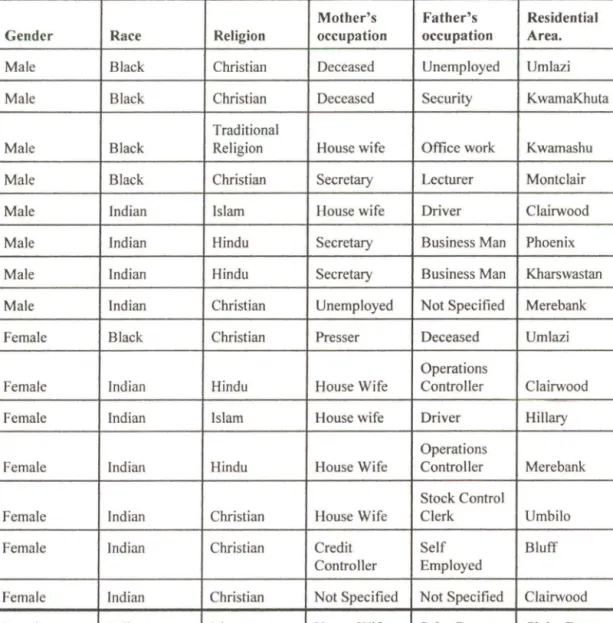
This investigation, which seeks to identify the type of media and the nature of genres chosen by young people, was conducted in three selected schools in the Durban area. In its findings, the research will take into account the racial, social, economic and cultural background of the learner. Race is a very prominent issue historically linked to social and economic status and remains one of the factors that can impact the type of media genres that learners access.
For example, dominant discourses suggest that blacks are successful mostly in the sports and entertainment industries, while whites are successful in professional occupations. Different races are therefore represented in different ways and the media has accepted and perpetuated this classification of race. This is also often the case for other forms of media such as newspapers and magazines. ( Drum for blacks and You for whites in the Magazine, Sowetan and Ilanga for blacks, post for Indians and Daily News and Die .. Burger for whites while Mail and Guidean is for all races in the professional, academic and business sectors).
The media genre selected by the students will indicate their viewing/reading preferences and thus the range of discourses that interest or captivate them and which therefore play a role in shaping their identity.
Research Method
Most questions offer respondents a range of possible answers from which to choose the correct answer. A media diary was also administered to record students' media engagement because it required students to record the media they engaged with over a period of time and this diary was regularly completed throughout the period. The diary is structured in this way: it consists of four columns and thirty-seven lines.
The columns consist of time, media type, program name, and program type. The diary is loosely structured, allowing respondents to fill in their details within the space of half an hour to indicate the type of media used and the name of the program at that specific time, over a three-day period. These days were chosen because it is believed that students spend more time with the media at these times and during the school holidays, when there is also a range of genres to choose from.
The analysis of the data also makes it possible to identify the media choices and thus make quantitative judgments about them.
Administering the questionnaire and the diary
Schools in study
The students at this school largely come from Umlazi, a black township created by apartheid and located south of Durban. The second school is Clairwood Secondary School in Clairwood, also a public school located on Durban's South Coast Road, an industrial area and a heavily polluted environment. During that time, the school operated in one block of classrooms until the 1970s, when it was merged with three other schools near Clairwood Secondary to form the vast complex it is today.
In the early 1970s, technical education was introduced into the school and a number of workshops were built to accommodate the range of technical subjects and it then became one of four schools offering both technical and academic subjects. The population is now not only Indians, but includes many Africans coming from Umgababa, south of Durban, and Phoenix, north of Durban. The last of the three schools is Crawford College in La Lucia on Durban's North Shore.
The target population of this school is mostly academically successful Caucasians who can afford to pay tuition fees of approximately R24000.00 per annum.
Process
Still at Rossburgh High, fourteen of the sixteen were eventually collected after waiting a long time for the remaining two students to return to school, which had not happened by the time of data analysis. Teachers in all schools complained about the bad weather which prevented students from coming to school for several days and delayed the receipt of these supplies. The whole process of administration and collection of primary and secondary data was time consuming and a strong learning for the researcher.
Ultimately, the data collection process was successful and a large number of students responded across all schools.
Findings and analysis of data
Out of the sixteen randomly selected learners, five of them are black learners while the remaining eleven are Indian learners. Female Indian Christian Not Specified Not Specified Clairwood Female Indian Islam Housewife Sales Representative Hindu:4 Work:5 Unemployed: I Apartheid Boy: 8 Black:5 Traditional Unemployed: I Not Specified: 1 City: 11 Girl: 8 Indian: II Religion : 1 Not specified: 1 Died: 2 Suburb:5.
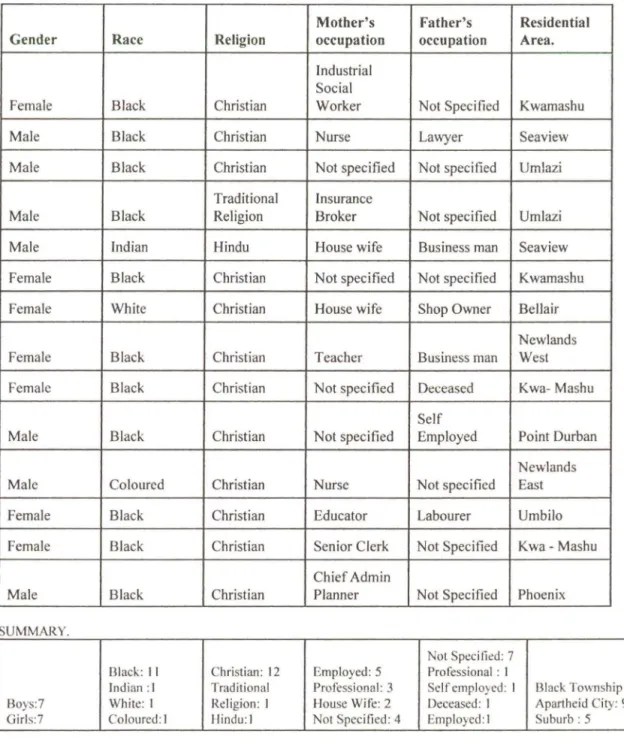
The third and last of the selected schools is Rossburgh High School, Rossburgh, Durban's South Coast. Six of the students live in the districts, while eight live in lower-middle-class suburbs such as Seaview, Bellair and Umbilo. In five out of fourteen, both parents are employed, and in three, both parents do not have specific jobs.
Indian: ] Traditional Professional: 3 Self Employed: I3 Missing City / Sons: 7 White: I Religion: I Spouse: 2 Deceased: I Apartheid City: 9 Daughters: 7 Colored: I Hindu:] Not Specified: 4 Employed: Periphery: 5.

Analysis of Media Diary Data
Crawford College Findings
Most of the genres chosen by the students of this school are from paid channels. The sports shown were Rugby, watched by 2 boys and a sports activity was watched by 2 girls on the Discovery channel (Pay TV). The only news program watched by these students on the free-to-air channel was Morning Live which is broadcast on SABC 2 every weekday morning, while other news and current affairs programs such as Carte Blanche were watched by 5 students (4 boys and 1 girl ) and CNN was followed by 2 boys and 3 girls.
Other types of movies, such as action, were watched by 4 students of both sexes (2 boys and 2 girls), and horror movies were watched by 2 boys, all on movie magic. But surprisingly few students used the computer in this school during this period, just 1 boy did word processing while 3 boys and 2 girls accessed the internet. The number of students from this school who use the computer is still higher than the students from the other two schools.
The other form of new media used by learners in this school includes compact discs of various types.
Clairwood Secondary School Findings
The Kwakhala local drama was no doubt watched only by black pupils because it was produced in the Zulu language. Woza Weekend is a program that talks about the sports activities that happened during the week on the free channel, especially football and boxing, and it was watched by only 2 black boys. When the students of this school watched the news, it was only on the free channel except for Carte Blanche, which was watched by 2 Indian students (1 boy and 1 girl).
CNN can be seen on the paid channel and can be seen simultaneously on SABC 3's free channel in the afternoon, was watched by only 3 students (2 Indian and I black boy). It is possible that these students were watching SABC 3. Most of the news watched by the black students is broadcast in the local language. Other television programs watched by these students include talk shows, variety shows, and documentaries.
Eastern Mosaic, which is a variety/cultural show reflecting on Indian culture, was attended by Indian students.
Rossburgh High School
None of the learners from this school watched any of the news programs on the paid channels and the news watched by these learners was that which was broadcast in the local languages. Morning live was watched by only 1 girl while 7 learners (3 boys and 4 girls) watched news on the other channels. Learners from this school only listen to the talk show that is broadcast on the free channels.
Television movies of various types were watched by the students of this school on the free channel, as were the students of Clairwood High School. Still on shows is the comedy showcase, The Steve Harvey Show was watched by 2 boys and 4 girls. All children's programs watched by students from this school are from the free channels and consisted of 9.4 boys and 5 girls.
It is very obvious that the students of this school are low consumers of radio programs. This confirms the previous claim that students at this school have access to fewer forms of media. It is very apparent that students at Clairwood High School and Rossburgh High School enjoy little radio programming.