University of Cape Town
ARCHIVAL STUDY
A portrait of a Housouana woman (Plate 63) by F. Le Vaillant 1772-1776
Supervisors: S. Chirikure T. Maggs
THESIS PRESENTED FOR THE DEGREE OF DOCTOR OF PHILOSOPHY IN THE DEPARTMENT OF ARCHAEOLOGY
ELLEN JEANNIE WALKER (WLKELL001)
University of Cape Town November 2015
The copyright of this thesis vests in the author. No quotation from it or information derived from it is to be published without full acknowledgement of the source.
The thesis is to be used for private study or non- commercial research purposes only.
Published by the University of Cape Town (UCT) in terms of the non-exclusive license granted to UCT by the author.
University of Cape Town
ABSTRACT
This thesis addresses continuity and change in the manufacture and use of decorative metalwork in the Iron Age (200-1900 AD) of southern Africa, within a framework of archival studies and artefact studies theory. The thesis adopted a direct historical approach which exploited the huge database of existing information to create typologies of objects and processing techniques that are prominent in ethno-historical sources of the 19th and 20th centuries. This process enabled for the first time, a comprehensive mapping of object typologies and techniques of manufacture by ethnic groups thereby allowing cross cultural comparisons. Subsequently, the study explored the typology of objects utilized further back in the time of the Early Iron Age using archaeological evidence. It demonstrated that most of the objects used in the Iron Age were similar to those that were used in the 19th century.
However, new innovations were made along the way with metals and alloys being constantly added to the range of materials worked. A dedicated visual study of fabrication techniques employed in the manufacture of ethnographic materials housed at Iziko Museum of Cape Town was carried out. The techniques gleaned from the macroscopic study were compared with those metallographically documented in the literature for the manufacture of Iron Age objects, further exposing continuity and change in metal fabrication. The social, economic and political role of decorative metalwork was hardly static, and varied from context to context and group to group.
DECLARATION
I, Ellen Jeannie Walker hereby:
(a) Grant the University of Cape Town free license to reproduce the above thesis in whole or in part, for the purpose of research;
(b) Declare that:
(i) The above thesis is my own unaided work, both in concept and execution, that apart from the normal guidance from my supervisor, I have received no assistance except as stated below. I did not receive assistance
(ii) Neither the substance nor any part of the above thesis has been submitted for a degree at this University or at any other university, except as stated below
This thesis has not been presented elsewhere
I am now presenting the thesis for examination for the degree of PhD
Candidate’s Signature:
Date: 12 November 2015
ACKNOWLEDGEMENTS
I would like to thank Dr. S. Chirikure and Dr. T. Maggs for their support in producing this thesis. I would also like to thank Dr. G. Klinghardt and the staff at Iziko South African Museum, Cape Town for their assistance in assembling and analysing metal objects from their collections. Grateful thanks is extended to the library staff of African Studies, The Oppenheim Library, the Interlibrary Loans desk, the document and the information technology centre for their continuous unstinting help. Family and friends are thanked for their affection and support.
TABLE OF CONTENTS
ABSTRACT ... ii
DECLARATION ... iii
ACKNOWLEDGEMENTS ... iv
TABLE OF CONTENTS ... v
LIST OF FIGURES ... ix
LIST OF TABLES ... xv
1. CHAPTER ONE: PREAMBLE, RESEARCH AIMS AND METHODS, AND OUTLINE OF THE THESIS ... 1
1.1: PREAMBLE ... 1
1.2: THESIS AIMS ... 4
1.3: THEORY AND METHODS ... 5
1.4: LIMITATIONS ... 7
1.5: OUTLINE OF THE THESIS ... 8
2. CHAPTER TWO: METAL PRODUCTION AND SMITHING ... 10
2.1: INTRODUCTION ... 10
2.2 METAL PRODUCTION ... 10
2.2.1: IRON SMELTING ... 10
2.2.2: IRON SMITHING ... 12
2.2.3: COPPER SMELTING ... 13
2.2.4: COPPER SMITHING ... 14
2.2.5: TIN SMELTING ... 15
2.2.6: GOLD MELTING ... 16
2.2.7: GOLD SMITHING ... 16
2.3: THE ANTHROPOLOGY OF METAL WORKING ... 17
2.3.1: WHAT SOCIO-CULTURAL BELIEFS ARE ASSOCIATED WITH METAL WORKING? ... 17
2.4: WHAT IS THE ROLE OF SMELTERS AND SMITHS IN SOCIETIES? ... 20
2.5: CONCLUSION ... 21
3. CHAPTER THREE: ISSUES IN THE STUDY OF OBJECTS ... 23
3.1: INTRODUCTION ... 23
3.2: OBJECTS AS PRODUCTS OF MANUFACTURE ... 25
3.3: OBJECTS AND FUNCTION ... 25
3.4: OBJECTS, THE SELF AND SOCIETY ... 27
3.5: OBJECTS AND SPACE ... 28
3.6: OBJECTS AND STYLE ... 30
3.7: TECHNICAL PROPERTIES ... 32
3.8: CULTURAL INFLUENCES ... 32
3.9: ECONOMIC CONSTRAINTS ... 34
3.10: RECYCLED MATERIALS ... 36
3.11: NEW MATERIALS ... 37
3.12: CONCLUSIONS ... 39
4. CHAPTER FOUR: THE VALUE OF NINETEENTH CENTURY ETHNO-HISTORY IN STUDYING DECORATIVE METALWORK IN SOUTHERN AFRICA ... 41
4.1: INTRODUCTION ... 41
4.2: THE VALUE OF ETHNO-HISTORY ... 41
4.3: LIMITATIONS OF THE ETHNO-HISTORICAL DATABASE ... 45
4.4: THE ETHNO-HISTORICAL LITERARY CONTRIBUTION TO FURNACE BUILDING, AND SMELTING ACTIVITIES ... 46
4.5: ETHNO-HISTORICAL REPORTS ON FORGING AND SMITHING IN THE 19TH CENTURY ... 58
4.6: ETHNO-HISTORICAL CONTRIBUTIONS TO THE OBJECTS MADE IN THE 19th AND 20th CENTURY ... 62
4.7.1: THE MANUFACTURE OF CELEBRATORY OBJECTS FOR COMMEMORATIVE EVENTS ... 62
4.7.2: THE MANUFACTURE OF KNIVES FOR GENERAL USE ... 65
4.7.3: THE MANUFACTURE OF SPEARS FOR GENERAL USE ... 68
4.7.4: THE MANUFACTURE OF AXES FOR GENERAL USE ... 72
4.7.5: THE MANUFACTURE OF ORNAMENTATION... 76
4.7.5.1: THE MANUFACTURE OF ORNAMENTATION: BEADS ... 77
4.7.5.2: THE MANUFACTURE OF ORNAMENTATION: SOLID BANGLES ... 80
4.7.5.3: THE MANUFACTURE OF ORNAMENTATION: WIRE-WOUND FLEXIBLE
BRACELETS ... 83
4.7.5.4: THE MANUFACTURE OF ORNAMENTATION: NECK-RINGS ... 84
4.7.5.5: THE MANUFACTURE OF ORNAMENTATION: EAR-RINGS ... 85
4.8: CONCLUSIONS ... 89
5. CHAPTER FIVE: FROM THE ARCHAEOLOGICAL RECORD: DECORATIVE AND EXPRESSIVE METAL OBJECTS ... 91
5.1: INTRODUCTION ... 91
5.2: THE LATER IRON AGE ... 92
5.2.1: DECORATIVE METALWORK FROM LATER IRON AGE SITES ON THE ZIMBABWE PLATEAU AND ADJACENT LOWLANDS. ... 93
5.3.4: EVIDENCE OF DECORATIVE METAL WORK FROM ARCHAEOLOGICALLY INVESTIGATED SITES IN SOUTH AFRICA IN THE LATER IRON AGE ... 111
5.4: THE MIDDLE IRON AGE: 1300-1000 ... 117
5.5: THE EARLY IRON AGE: 1000-200 ... 120
5.6: CONCLUSIONS ... 128
6. CHAPTER SIX: A VISUAL STUDY OF DECORATIVE METALWORK AS A WAY OF UNDERSTANDING MANUFACTURING TECHNIQUES ... 130
6.1: INTRODUCTION ... 130
6.2: THE ASSEMBLAGE ... 130
6.3: LIMITATIONS ... 133
6.4: VISUAL STUDY METHODOLOGY ... 133
6.4.1: ORNAMENTS MADE OF IRON AND WITH IRON ... 134
6.4.2: ORNAMENTS MADE OF COPPER AND WITH COPPER ... 137
6.4.3: ORNAMENTS MADE OF BRASS AND WITH BRASS ... 144
6.5.1: INTRODUCTION ... 153
6.5.2: ARCHAEOMETALLURGICAL RECONSTRUCTIONS OF FABRICATION TECHNIQUES USED TO MANUFACTURE DECORATIVE METALWORK IN SOUTHERN AFRICA ... 154
6.5.3: ARCHAEOMETALLURGICAL RECONSTRUCTIONS OF TECHNIQUES USED TO FABRICATE DECORATIVE COPPER, BRONZE AND BRASS WORK ... 158
6.5.4: ARCHAEOMETALLURGICAL RECONSTRUCTIONS OF TECHNIQUES USING MIXED METALS FOR DECORATIVE METALWORK. ... 165
6.6.5: ARCHAEOMETALLURGICAL RECONSTRUCTIONS OF TECHNIQUES USED TO MANUFACTURE GOLD FOR DECORATIVE METALWORK. ... 168
6.6: CONCLUSION ... 170
7. CHAPTER SEVEN: DISCUSSION AND CONCLUSION ... 172
7.1: INTRODUCTION ... 172
7.2: CONTINUITY AND CHANGE IN THE TYPOLOGY, MANUFACTURE AND USE OF DECORATIVE METALWORK ... 174
7.3: DECORATIVE METALWORK AND STATUS IN SOUTHERN AFRICAN IRON AGE COMMUNITIES ... 181
7.4: TRADE, EXCHANGE, INTERACTION AND ORGANISATION OF PRODUCTION IN RELATION TO DECORATIVE METALWORK ... 185
7.5: CONCLUSION AND OUTLOOK FOR FUTURE RESEARCH ... 191
REFERENCES ... 194
APPENDICES ... 215
Appendix 1 Glossary of terms (after Miller, D.1996) ... 215
Appendix 2: Ceremonial, ritual and utilitarian axes from the Iziko Museum, Cape Town .. 216
Appendix 3:Ceremonial, ritual and utilitarian knives from the Iziko Museum, Cape Town 217 Appendix 4: Ceremonial, ritual and utilitarian spears from the Iziko Museum, Cape Town218 Appendix 5: Table of metal beads in the Iziko Museum, Cape Town ... 219
Appendix 6: Table of metal bangles, bracelets and arm bands in the Iziko Museum, Cape Town ... 220
Appendix 7: Table of metal ankle and leg rings in the Iziko Museum, Cape Town ... 222
Appendix 8: Table of metal collars and necklaces in the Iziko Museum, Cape Town ... 223
Appendix 9: Table of metal ear-rings in the Iziko Museum, Cape Town ... 224
Appendix 10: Distribution of metal biconical beads in northern southern Africa ... 225
Appendix 10a: Distribution of metal biconical in northern southern Africa ... 226
LIST OF FIGURES
Frontispiece: A portrait of a woman (Plate 63) by F. Le Vaillant 1772-1776
Figure 1.1 Shows the position of southern Africa within Africa and some of the archaeological sites mentioned in the text. ... 2 Figure 2.1 This figure shows 1, (on the left), an iron-smelting furnace from Mashishimali hills on the farm “Square” and 2 (on the right), a copper-smelting furnace from Masêkê hill on the farm “Wegsteek”, Limpopo Province. (Photograph from More, C.E. 1974: 231). ... 12 Figure 2.2 “Kaffirs smelting and forging”. (The past and future of the kaffir races in three parts. Holden, W.C. 1866: 222) ... 13
Figure 2.3 Lemba iron wire drawing tools. Examples in the IZIKO Museum (tongs (SAMAE 9898), and draw-plate (SAMAE 9896). (Davison, 1984: 136). ... 15 Figure 2.4 Some tin ingots from South African collections (Friede, 1976: 465). ... 16 Figure 2.5 A furnace in Chibi Nature Reserve, Zimbabwe, decorated with female sexual features (Robinson, K. 1961, Plate 2). ... 19 Figure 2.6 Forging and smithing taking place in a metalworker’s workshop in KwaZulu-Natal.
(Wood, J.G. 1873: 97) ... 20 Figure 4.1 The locations of some of the cultural groups who practised smelting and smithing in southern Africa mentioned in the text. ... 48 Figure 4.2 Map of smelting sites investigated north of the Zambezi River and south of the Sahara. ... 52 Figure 4.3 The line drawing shows a cross-section of the furnace in Mafa showing details of construction to achieve a down draught for smelting purposes (Killick, 1991: 53, citing Nicholas David, 1989). ... 55 Figure 4.4 The illustration shows the Ng’anjo, or induced draught furnace at Kasungo, Malawi, 1983 (Killick, 1991: 50). ... 58 Figure 4.5 Smithing taking place at a small scale metal smith’s workshop aided by the metal smith’s assistant operating leather bellows near Lake Shirwa, southern Malawi.
(Livingstone’s African Journal, Livingstone, D. & C. 1963:103) ... 59 Figure 4.6 The illustration shows the short copper knife in its wide copper wire decorated sheath, known as the “king’s signet”. The significance of the knife is that the holder was a representative of the king and whatever request were made the holder could expect full cooperation amongst the various cultural groups amongst the Ovambo. Its full length is 19.0 cm. (Shaw, 1938: Plate LXXVI: 1) ... 63
Figure 4.7 A map showing the distribution of knives made by various cultural groups in southern Africa. Information gathered from literary data. ... 67 Figure 4.8 The illustration shows a range of axe-blade shapes made for combat, utilitarian and ceremonial purposes by cultural groups in southern Africa; sourced from literature. .... 76 Figure 4.9 Distribution of iron and copper beads in southern Africa, information assembled from literary records. ... 78 Figure 4.10 A grooved and ribbed izingxotha showing the characteristics of metal fatigue from KwaZulu-Natal (Conner & Pelrine, 1983: 25). ... 81 Figure 4.11 A water colour of an elite member amongst the Sotho/Tswana displaying the large copper pendant ear-plate (Daniell, 1802, Plate 92 Vol. II) (Bradlow, 1976). ... 86 Figure 4.12 Distribution of ear-rings sourced from literature amongst the Sotho/Tswana and Khoisan. ... 88 Figure 4.13 A chart showing the different types of ear-rings retrieved from archaeological sites and literary sources ... 89 Figure 5.1 Position of Later Iron Age archaeological sites mentioned in the text. ... 93 Figure 5.2 A photograph showing the gold neck-piece beneath the bones of a juvenile, at Musimbira, Zimbabwe (Munro and Spies, 1975:9). ... 96 Figure 5.3 A diagram showing the arrangement of gold beads, bangles and bracelets surrounding the skeleton at Castle Kopje. (Walker, 1991: 143) ... 98 Figure 5.4 The drawing shows the (3, 4, 5) triple gold wire intertwined bangle around the (1
& 2) ulnar and radius exposed at Thulamela, north-eastern South Africa. (Steyn et al., 1998:77). ... 100 Figure 5.5 A collection of blade shapes and decorated shafts of ceremonial implements found at Khami (after Garlake, 1983; No page numbers (5 specimens on the right) (Museum codes from Robinson, 1959) and on the left from Great Zimbabwe (Caton-Thompson, 1931:
196). ... 102 Figure 5.6 The photograph shows copper crosses, fine bangle wire and a pair of tongs shown at the neck of burial II/1 at Ingombe Ilede, Zambia (Fagan et al., 1969, Plate 5(a) no page numbers). ... 108 Figure 5.7 Illustrations of a draw plate and tongs recovered from Ingombe Ilede Zambia (Fagan et al. 1969: 97, 99). ... 109 Figure 5.8 A complete bronze composite ear-ring from Goergap, North West Province.
(Miller et al. 1993, 54) (Measurement in mm). ... 114
Figure 5.9 The illustration shows a selection of copper body ornaments excavated at Marothodi, North West Province South Africa (Hall et al., 2006: 23). ... 115 Figure 5.10 Fragments of iron wire-wound bracelets from Bosutswe, Botswana (Denbow &
Miller, 2006: 282). ... 116 Figure 5.11 Distribution of archaeological sites investigated for the Middle Iron Age 1300- 1000 ... 117 Figure 5.12 The distribution of Early Iron Age sites referred to in the text 1000-200 ... 120 Figure 5.13 5th to 7th century copper beads and iron beads from Lydenburg (Inskeep &
Maggs 1975: 134). ... 122 Figure 5.14 An assembled chain of copper links from Broederstroom, South Africa (Friede, 1977: 231). ... 124 Figure 6.1 Map showing the position of selected cultural groups and the metals used in the manufacture of ornaments. ... 131 Figure 6.2 The photograph shows an uneven iron bangle made by a Xhosa metal-smith. 135 Figure 6.3 A narrow decorated iron bangle from Zimbabwe including detail (SAMAE 6712).
... 135 Figure 6.4 Four iron wire ear-rings (SAMAE 5671) made by the Mpukushu, Northern Botswana. ... 136 Figure 6.5 A European inspired brooch (SAMAE 562) made from iron, copper, brass and aluminium wire of varying thickness from Lesotho. ... 137 Figure 6.6 (left) (SAMAE 9910) a set of two copper cylindrical beads ... 139 Figure 6.7 (right) (SAMAE 9911) a set of two barrel shaped beads, showing manufacturing marks ... 139 Figure 6.8 Copper beads made from D-shaped cross-section rod demonstrate polished surfaces and chisel cut butt-joins ... 140 Figure 6.9 Cylindrical copper beads of Bushman manufacture from the central Kalahari Desert. ... 141 Figure 6.10 A bracelet made of uneven copper beads from Northern Botswana showing manufacturing irregularities. ... 141 Figure 6.11 Thirty-three flexible bracelets of copper and brass, most of which are patinated including a detail showing fabrication methods. ... 142
Figure 6.12 A double stranded copper flexible bracelet held together by iron brackets made by a South Sotho metal-smith. ... 143 Figure 6.13 Lobedu brass beads strung on leather thonging indicating manufacturing details.
... 145 Figure 6.14 A brass bangle showing manufacture and decoration on the outer surface including details of chisel marks. The two images on the right show closer details of decoration. ... 146 Figure 6.15 A photograph of heavy brass (SAMAE 7839) arm decoration from the South Tsonga, Mozambique. ... 147 Figure 6.16 a/b Bracelets made of fine wire copper core and commercially acquired triangular manufactured brass wire made by a Mpondomise metal-smith. ... 148 Figure 6.17 A Northern Nguni neck-ring manufactured with available rough casting methods.
... 149 Figure 6.18 A Swazi neck-ring indicating cast and manufacturing details ... 150 Figure 6.19 A South Sotho cast brass neck-ring showing imperfections in manufacture ... 151 Figure 6.20 a / b: A copper (a) and brass (b) (SAMAE 10151) (lower) neck-ring made by Ndzundza in Limpopo Province. ... 152 Figure 6.21 A brass ear-ring (SAMAE 5390) of square cross-sectioned wire from Groot Marico showing fabrication details. ... 153 Figure 6.22, Figure 6.23, Figure 6.24 showing different grades steel, while the last one shows slag stringers inside the objects (Stanley, 1929: Plate 3 facing page 132) (Magnification 100x). ... 154 Figure 6.25 A polished section of an iron bangle from Divuyu, Botswana (Miller, 1996: 110) (Magnification 562x). ... 155 Figure 6.26 A micrograph shows an etched transverse section through an iron ring from Divuyu (D 63) (Miller, 1996: 107) (Magnification, 18x). ... 156 Figure 6.27 A micrograph shows the distorted cut end of an iron clip (N 926) from Nqoma (Miller, 1996: 105) (Magnification 56x). ... 156 Figure 6.28 A micrograph showing a fold in an iron plate from Mapungubwe (Miller, 2001:
29) (Magnification 10x). ... 157 Figure 6.29 Photograph showing four corroded cylindrical iron beads from Goergap, (Miller et al, 1995: 54). Scale in mm. ... 157
Figure 6.30 The photograph shows an example of poor welding between two strips of iron with different carbon content (Miller et al, 1995: 54) (Magnification 45x). ... 158 Figure 6.31 A micrograph showing a polished section through an iron bead (WAT 4) indicating its laminated structure (Miller et al., 1995: 54) (Magnification 7.2x). ... 158 Figure 6.32 A micrograph showing layered copper strands detaching from the main form from corrosion (Childs, 1991c: 39). ... 159 Figure 6.33 A photograph (left) showing the thick copper rod formed into a bangle and a micrograph (right) showing the inserted strand of copper hammered into its periphery (Childs, 1991: 39) (Magnification 12.5x) ... 159 Figure 6.34 The micrograph shows how a network of cuprite/copper eutectic had been drawn out longitudinally (Miller, 2001: 92). (Magnification 240x). ... 160 Figure 6.35 The micrograph shows a polished longitudinal section through a copper wire- wound bracelet (Miller, 2001: 92) (Magnification 7.5x). ... 160 Figure 6.36 A micrograph of a polished longitudinal section through a copper wire-wound bracelet (M 400-1) showing corrosion rinds around residual cores of metal (Miller, 2001: 92) (Magnification 10x). ... 161 Figure 6.37 A micrograph showing a longitudinal section of an annealed copper bead from Bosutswe (Denbow & Miller, 2007: 286) (Magnification 11x). ... 161 Figure 6.38 The micrograph shows an etched section through a wrapped copper bead (B 159) from Bosutswe (Miller, 2002: 1124) (Magnification 10x). ... 162 Figure 6.39 The micrograph shows an etched section through a bronze nodule (B 3) from Bosutswe (Miller, 2002: 1124) (Magnification 257x). ... 163 Figure 6.40 The micrograph shows etched longitudinal section of a bronze bead showing open join with preferential corrosion attack in cold-worked areas (Denbow & Miller, 2007:
286) (Magnification 7.2x). ... 163 Figure 6.41 A micrograph of a polished longitudinal section through a bronze wire-wound bracelet (M 1175) showing trapezoidal cross-section of the strips wound with the pinched edges on the inside (Miller, 2001: 91) (Magnification 15x). ... 164 Figure 6.42 A micrograph of a cross-section of brass showing recrystallized and heavy worked grain structures (Scott, 1991: 97). ... 165 Figure 6.43 The illustration shows the polished longitudinal section of a compound wire- wound bracelet (D 136) from the Early Iron Age site Divuyu, Botswana, (Miller, 1996:103) (Magnification 14x). ... 166
Figure 6.44 The micrograph shows a polished longitudinal section through a compound wire- wound bracelet fragment from Bosutswe comprising two thicknesses of bronze wire and twice times a single thickness of iron wire (Miller, 2002: 1125) (Magnification 26x). ... 166 Figure 6.45 A micrograph showing a polished section through a multimetal wire-wound fragment (Z 216) from Great Zimbabwe. The metals represented are iron and bronze (Miller, 2002:1125) (Magnification 8x). ... 167 Figure 6.46 The micrograph shows a portion of a polished longitudinal section through a compound wire-wound iron and copper bracelet fragment from Thulamela (TM 106) (Miller, 2002: 1125) (Magnification 10x). ... 167 Figure 6.47 The detailed micrograph shows the coiled gold wire ribbon wound around a core forming wire-wound bracelets (Oddy, 1984: 74) (Magnification not included). ... 168 Figure 6.48 A micrograph showing a gold cut trapezoidal shape with burrs at the end of the long edge and the rough inner surface designed to be placed against the fibre core. The burrs were burnished together to form a smooth outer surface (Miller 2002: 1126) (Magnification 51x). ... 169 Figure 6.49 A micrograph showing a wrapped gold bead with indentations placed around the perimeter (Miller, 2002: 1126) (Magnification 26x). ... 169 Figure 6.50 A micrograph through gold fragment, showing the angularity of the recrystallized grains. Note the deformation of the top and lower surface (Desai 2001: 112) (Magnification 84 x). ... 170 Figure 7.1 The map shows patterns of distribution of decorative metal work. ... 179
LIST OF TABLES
Table 4.1 The production inventory and tool-kits of the cultural groups investigated in southern Africa supported by ethnographical literature. ... 43 Table 4.2 The distribution of copper musuku found in north eastern South Africa sourced from literary records. ... 64 Table 4.3 The distribution of copper marale found in north eastern South Africa sourced from literary records. ... 64 Table 4.4 Information on knives from a variety of cultural groups who made them for utilitarian and ceremonial use sourced from literature (Period19th century). ... 67 Table 4.5 Information on spears from a variety of cultural groups who made them for utilitarian use and ceremony sourced from literature (Period 19th century). ... 70 Table 4.6 Distribution of ceremonial, ritual and utilitarian axes sourced from literature. (For further information see Appendix 2). ... 74 Table 4.7 Distribution of beads as noted by ethnologists and anthropologists in the 18th– 20th centuries, sourced from relevant literature. ... 79 Table 4.8 Distribution of solid bangles and armbands from the 18th to 19th centuries sourced from literary data. ... 82 Table 4.9 Distribution of solid neck-rings from the 18th to 19th centuries sourced from literary data. ... 85 Table 4.10 Distribution of ear-rings as noted by ethnologists and anthropologists in the 18th - 20th centuries, sourced from literature. ... 88 Table 5.1 Dimensions of ceremonial spears from Great Zimbabwe and Khami Ruins (1300- 1445 AD). ... 103 Table 5.2 Distribution of wire with dimensions from sites in Zimbabwe in the Later Iron Age (1840-1300 AD) sourced from literature. ... 104 Table 5.3 Distribution of beads with dimensions from sites in Zimbabwe in the Later Iron Age (1840-1300), sourced from literature. ... 105 Table 5.4 Distribution of wire with dimensions from sites in South Africa in the Later Iron Age (1840-1300), sourced from literature. ... 112 Table 5.5 Dimensions of beads from sites in South Africa from the Later Iron Age (1840- 1300) sourced from literature. ... 112 Table 5.6 Dimensions of wire and plate on three distinctive ear-rings, ear-hooks with suspended metal cones from North West Province and Free State. ... 114
Table 5.7 Distribution of wire with dimensions from sites in Zimbabwe, South Africa and Botswana in the Middle Iron Age (1000-1300), sourced from literature ... 114 Table 5.8 Distribution of beads with dimensions from sites in Zimbabwe and South Africa in the Middle Iron Age (1300-900), sourced from literature. ... 119 Table 5.9 Distribution of beads with dimensions from sites in Zimbabwe and South Africa in the Early Iron Age (1000-200), sourced from literature. ... 127 Table 6.1 Survey of body ornamental forms chosen for analysis from the Iziko South African Museum ... 131 Table 7.1 Major iron decorative and ceremonial objects from selected sites dating to the Iron Age. ... 175 Table 7.2 Major copper decorative and ceremonial objects from selected sites dating to the Iron Age. ... 176 Table 7.3 Major bronze decorative and ceremonial objects from selected sites dating to the Iron Age. ... 177 Table 7.4 Major brass decorative and ceremonial objects from selected sites dating to the Iron Age. ... 177 Table 7.5 Major gold decorative and ceremonial objects from selected sites dating to the Iron Age. ... 177
1. CHAPTER ONE: PREAMBLE, RESEARCH AIMS AND METHODS, AND OUTLINE OF THE THESIS
1.1: PREAMBLE
In broad terms, the region of southern Africa is defined by lands that lie approximately 15º degrees south of the equator, and below the Zambezi and Kunene Rivers (see Figure 1.1). In this region, the arrival in the first millennium AD of Black agro-pastoralists travelling south- wards brought their agricultural, potting and metallurgical skills. These communities were both pastoral and sedentary and built their villages along permanent water courses. During this initial period metal smiths worked only with iron and copper with the former metal being reserved for more utilitarian tasks while the latter was largely restricted to ornamental domains. In time, their activities expanded and at the turn of the millennium, when gold was extracted, the communities in the region became associated with the acquisitive desire and commercial activities of the Swahili and Arabs from the Indian Ocean coast, who penetrated the interior seeking tradable items such as ivory and animal skins and later precious metals (Freeman-Grenville, 1962; Pwiti, 2005; Killick, 2009; Wood, 2012). The incorporation of southern Africa into the Indian Ocean based long distance trade, interacted with local factors such as cattle husbandry, and agriculture among others to produce far- reaching social, economic, religious and political changes (Summers, 1969; Maggs, 1982; Maylam, 1989; Pwiti, 1991; Miller, 2002; Killick, 2009). These transformations took place at the pivot between first and second millennia AD (Maggs, 1982).
From 1500 AD Portuguese merchants arrived on the east coast of Africa seeking to displace the Arab traders in order to benefit from the gold trade (Summers, 1969). In the course of two centuries, they together with merchants from other European nations increased the importation of brass in a variety of forms to the populations of southern Africa by the 18th century. By the 19th century, in some areas in the region there was a greater focus on brass, for body ornamentation alongside bronze, copper and iron, the traditional alloy and metals for this purpose (Roodt, 1993, 1996; Pikirayi, 1993).
Archaeologists have recovered ubiquitous evidence of mining, smelting and smithing dating from the onset of metallurgy until colonialism gathered impetus, in the 19th century (Summers, 1969; Muller, 2002; Chirikure, 2010). The wide range of decorative items generated from metallurgy in southern Africa over the period of the past 1500 (ca.
400 to 1900) years was created initially from locally mined and smelted iron and copper, with a later addition of gold, bronze (an alloy of tin with copper) imported brass (an alloy of copper and zinc) and some lead (Miller, 1996). The nearly two millennia span of time in which this activity took place is divided into Early (ca. 400 to 1000), Middle (ca. 1000 to
1400) and Later Iron Ages (ca. 1500 to 1900) (Mason, 1974; Huffman, 2007). The Middle Iron Age is however restricted to the Middle Limpopo valley in other areas of southern Africa there is only an earlier and later Iron Age.
Figure 1.1 Shows the position of southern Africa within Africa and some of the archaeological sites mentioned in the text.
Over a century of research at Iron Age sites of varying periods exposed different categories of decorative metalwork such as bracelets, bangles, beads, neck-rings, pendants and ear- rings. Within a diachronic and synchronic framework, that draws from material culture theory, this thesis attempts to describe the wide distribution of decorative metalwork that was both worn and utilized by a variety of cultural groups in southern
Africa. According to Caple (2006), writing about archaeological research, as material culture, objects are reluctant witnesses to the past – they illuminate a wide variety of information about their producers and users. Amongst other aspects, such information covers the technological, social, political, economic and religious aspects of a group or society (Jones, 2001; Martinón-Torres & Rehren, 2008). Therefore, it is anticipated that a study of decorative metalwork from southern Africa will throw light on these specific issues as well as on the broader topics linked to within group and between group interaction, technological cross borrowing, innovation and the ways of life of Iron Age people (Miller 2002, Thondhlana & Martinón- Torres, 2009). According to Childs & Dewey (1996), a study of decorative metalwork found at archaeological locations permits the distinction between functional and expressive objects. Furthermore, by studying decorative metalwork and associated contexts, we can explore differences in rank and status across sites and periods thereby passing comment on consumption pattern differences between elites and non-elites in society (Kristiansen, 2007).
A dedicated literature search reveals that the earliest decorative metalwork to appear in southern Africa were the iron and copper beads recorded at places such as Broederstroom near Hartebeespoort Dam (Mason 1986), and Mabveni in south central Zimbabwe (Robinson, 1961; Friede & Steel 1975; Miller & van der Merwe 1994; Miller, 1995). However, recent work on glass beads by Wood (2012) suggests that the Mabveni objects may have come later than initially thought. The earliest objects date to the mid first millennium AD and are mostly small items such as beads. By the later first millennium, there was an increase in the range of decorative metalwork encompassing bangles, bracelets, pendants, beads and ear-rings.
Miller (1996), in a study of an inventory of decorative work from Nqoma and Divuyu in Botswana found that, by the early second millennium, gold and bronze appeared in southern Africa where these metals were used for creating ornamentation in the form of beads, bracelets and necklaces (Miller, 2002). Additionally, at places such as Mapungubwe and Great Zimbabwe, gold and bronze were used to make emblems of power. Good examples are the iconic Mapungubwe golden rhino and the barbed bronze spearheads from Great Zimbabwe (Caton-Thompson, 1931; Fouché, 1937; Oddy, 1984;
Duffy, 2012). Similar objects were also recovered from Khami and other sites (Robinson, 1959). Some of the evidence of metalwork from elite sites was however destroyed by treasure hunters in the late 19th and early 20th centuries (Caton-Thompson, 1931;
Fouché 1937, Hall & Neal 1972; Garlake, 1973; Meyer, 1998). From 1500 AD onwards decorative metalwork continued to be manufactured and used by these groups until colonization. Various European observers including Portuguese travelers recorded the objects used by the cultural groups with which they interacted. Indeed, a survey of this
ethno-historical literature shows some common objects used by certain groups, for example the ear-rings worn by the Tswana and South Sotho (Campbell, 1822;
Backhouse, 1844; Ellenberger, 1912; Ashton, 1938; Burchell, 1952; Casalis, 1965;
Maggs, 1976; Morris, 1981; Miller et al., 1995; Hall et al., 2006). The survey also found some axes, metal sheet and wires which were used by these populations (Campbell, 1822; Moffat, 1842; Stayt 1931; Burchell, 1953; Shaw & Van Warmelo, 1974). Within southern Africa, from the Early Iron Age up to the 19th century, an extensive variety of ornaments was worn mainly by various sections of the populations for status endorsement and enhancement (Campbell, 1822; Ellenberger, 1912; Fouché 1937;
Burchell, 1953; Oddy.1984; Herbert 1984; Kennedy 1991; Roodt, 1993). Implements for war, hunting, ceremony and ritual, in the form of spears, axes, adzes and knives were made generally of iron, while some of those were made of copper and bronze for ceremonial and ritual purposes (Caton- Thompson 1931; Snowden 1940; Robinson, 1959; Ellert 1984; Maggs, 1991; Herbert 1993; 1996).
Although researchers of various time periods have from a comprehensive perspective noted the presence of decorative metalwork objects, to date limited studies have been carried out of this important material culture category (with the exception of that done by Miller in 1996). And yet, this area of study is a repository of nuggets of information about the societies that made and used these objects (Miller, 2006). Moreover, a long term perspective on decorative metalwork illuminates changes and continuities across space and time as well as the ways in which metals contributed to the functioning and sustaining of the communities that made and used them.
1.2: THESIS AIMS
Against a background of a general neglect of decorative metalwork in the literature this thesis seeks to examine the decorative metalwork objects revealed throughout the Early and Later Iron Age periods.
The following sub-aims apply:
• To develop a diachronic perspective on the use of decorative metalwork in southern Africa from the Early Iron Age to the early 1900s
• To document and develop a synthesis of decorative metalwork used in southern Africa in the last two thousand years
• To map and develop a typology of decorative metalwork used during the Iron Age
• To identify the metal types and reconstruct the technology of fabrication invested in making the various objects using a range of published and unpublished sources and laboratory techniques
• To explore the socio-economic significance of the decorative metalwork in the Iron Age.
These aims are interrelated and the last sub-aim develops out of the others, showing that technological and sociological factors influenced each other.
1.3: THEORY AND METHODS
As a result of notable improvements in global archaeology, archaeological objects now feature prominently in the exploration and understanding of past societies, see for example Gosden, (2005) and Caple (2006). This development has also witnessed a rise in new theories dedicated to an improved understanding of various societies’ use of the objects which they have left behind. This has in turn shifted attention back to existing collections, which when interrogated using the right questions, have the potential to create new or additional answers. Material culture theory is widely used by archaeologists and historians to understand objects because it illuminates information on their production and use (Miller, 1997).
Material culture theory is a term that appears to be relevant only in archaeology and anthropological studies as it is widely used by archaeologists and historians to understand objects as they illuminate information on their production and use including the people that benefit by their presence (Miller: 1997, Buchli, 2002). This why Caple (2006) has labelled objects reluctant witnesses to the past. Some researchers have even developed their research methods further to stress both the materials and the materialities fundamental to objects. It is this focus on the physical evidence of a culture in objects that were made by past societies that has promoted more intense investigation. Preston (2000: 22) has suggested that in studying material cultures it is that crafted objects are considered under two main aspects; firstly the form of the object : the materials from which they are made, and the shape that has been achieved through skill. The second factor is the uses to which the object is exposed. Other characteristics suggested by Preston (2000) are qualitative measurements, and relation to other objects under function. It is this decipherment of functions of durable objects that informs present day researches in the production capabilities of past populations. This means that when studying objects one can obtain information about materials making objects as well as the socio-cultural and symbolic meanings of these objects Jones (Jones, 2004). This is possible because objects are embedded in a cultural context.
One of the material cultural inspired theories that unifies material and cultural properties of objects and the processes from which they were produced is known as the chaîne opératoire. A broader understanding of the chaîne opératoire is appreciated in the
dedicated studies of Schlanger (2005: 25) who stated that the concept of chaîne opératoire was the analysis of the ‘operational chain’ or the incremental progressions that an object is subjected to in its passage of construction, using natural materials, to the fully formed material objects for utilitarian and non-utilitarian uses. The incremental progressions or processes can be found in some archaeological records, although not all, especially when analysing metalwork from the use of raw materials to completed objects. An example of these activities is noted at the site of Bosutswe, Botswana, where metalwork was practiced over several centuries in the Later Iron Age revealing beads, bangle and wire-wound bracelets made of iron, copper, and bronze including metal tools (Denbow and Miller, 2007). From this site and others it is possible to assess the division between production and consumption and value of inter connecting life-histories of these objects as simultaneously social, technical and symbolic achievements (Schlanger: 28).
This methodology refers to the sequence of operations invested in producing objects from raw material selection, in a pattern of manufacture, use, reuse and discard (Dobres, 2000). The holistic focus of chaîne opératoire places emphasis on the cultural choices and decision making process invested in the production and use of objects. This thesis uses the lens and framework provided by these theories in order to understand both the technical and social aspects of decorative metalwork made and used in southern Africa from the Early Iron Age to the early 1900s.
Within this theoretical framework, a stepped methodology starting with desktop studies and existing archival research is utilized. Primary and secondary sources are critically examined to understand both the types of objects used in the historical past, and the techniques of manufacture and associated social contexts.
In terms of primary sources there exists a significant number of reports, records and diaries from early adventurers, historians, travelers, missionaries, prospectors, traders, hunters and early ethnographers in the region in the 18th, 19th and early 20th centuries. Examples of these include: A. Sparrman writing in 1778 (Forbes, 1975); F. Le Vaillant 1781-1784 (1973); S. Daniell 1804 (Bradlow, 1976); W. Burchell in 1822 (1953);
Gardener in 1836; G. Angas 1849 and T. Baines (1846) including Methuen (1846), Fleming, (1856), Shooter (1857) and Holden (1866). I have made use of early photography which records blacksmiths at work, the tools that they used, and their products especially spears and axes such as those seen in Bent (1982), Posselt (1926);
Bryant (1949); Elliot (1978); McLaughlin (1982) and Maggs (1986). This information when carefully deconstructed and considered alongside archaeological evidence yields new information with the potential to deepen our understanding of decorative metalwork and its historical-cultural and social context. Due to the fact this work is also collection based, macroscopic studies of objects archived at Iziko South African Museum in Cape
Town are performed. The resulting usual information on object manufacture will be combined with cultural information to develop a holistic understanding of the context and significance of decorative metalwork and its role in southern Africa in the period under study.
1.4: LIMITATIONS
A comprehensive study of ornament and ceremonial artefacts is hampered by such limitations as a lack of extensive collections for analysis in terms of metals used, tools utilized and means and methods of fabrication. The foundation for this study is the archival literature dating from the earliest visitors to southern Africa as well as current contributions from a range of scholars and disciplines, including archaeologists, anthropologists, ethnographers, ethno-historians, and metallurgists. Some of their scholarly documents are illustrated with artist’s impressions in pen and ink and water colours (Le Vaillant, 1781- 1784(1976); Daniell, 1804 (1976); Gardener, 1835; Angas, 1849). Many literary contributions have used photographs, a recording and art form with antecedents in the mid-19th century, and one that has been manipulated to direct incorrect or distorted information affecting local communities, their habits and customs, including the photographer’s personal expressions or representations of the exotic and erotic for readers in their countries of origin (Webb 1974; Monti, 1987; Rippe, 2012).
A failure in current and archival literature is the lack of adequate descriptions of metallic small finds in archaeological sites, a passing comment on “copper wire fragments and copper-chain links or beads” were amongst the remains of a site in Botswana (Kiyaga- Mulindwa, 1991: 164). These sketchy records can be assessed against the comprehensive description of an archaeological site in Zimbabwe by Garlake (1970), where care was taken to list all the measurements of each metallic item found.
A further difficulty has been the nomenclature of ornamental finds in the form of solid bangles in terms of clearly differentiating these from flexible wire-wound bracelets. Thus it has been possible to read ‘bangles’ for ‘bracelets’ and vice versa (see Glossary). A similar confusion is the documented use of copper or iron ‘rings’ which in terms of their measurements, could be understood as beads. At times differentiation between metal beads and glass beads is not clearly articulated leading to misunderstanding of the composition of the cultural material of the community (Elphick, 1977).
With regard to actual ethno-historical literature, the question arises as to how much of it is trust-worthy? Thornton (1983) alerts readers to the misconceptions, myths and legends that have influenced visitor’s backgrounds and knowledge prior to arrival at their destinations in southern Africa thereby inadequately observing their environments and
delivering unfactual and incorrect information to their publishers. Publishers were known to
‘cleanse’ / sanitise or romanticise the literary contribution for public readership in order to sell their books (Dritsas, 2010: 117). Harkin (2010: 119) queries oral testimonies as reliable evidence arguing that “we cannot know them to be true”, and asking questions “is this a form of denying a historical consciousness to” people? The positive aspects gained from the 19th century visitors to southern Africa in terms of research in this area is that records indicate that smithing was broadly practiced linked to cultural requirements and that significant information on material cultures were observed including the use of metallic decoration.
1.5: OUTLINE OF THE THESIS
The first chapter has provided a brief introductory historical background to the research in terms of the reliability and extent of archaeological evidence of the manufacture and the use of metal objects in southern Africa during the period under study, together with the research aims, the theory and the methods informing the research and the limitations.
Chapter two focuses on the background to the production and smithing of body ornament and expressive tools and the anthropology of metal working amongst indigenous African metal workers.
Chapter three considers the theory of artefacts and their significance within various cultural groups, and their material cultures linking this with the role these objects played in the lives of these populations. This information is derived from archaeological, anthropological and ethnographic accounts emerging from the 16th century.
Chapter four considers the combination of ethnographical and historical observations from published data. The data will be presented in a series of distribution maps and tables detailing sites where expressive ornamentation and tools have been recovered. The data will be sourced from literature dating from the late 18th century AD to the 20th century AD Chapter five focuses on the archaeological information derived from archival and current literature dealing with 1500 years of metallurgical development in southern Africa.
Chapter six will combine macroscopic studies of a selection of objects from the Iziko Museum’s collection and those published with micro-analyses of objects with a view to establishing which metals were exploited and the technologies used in their manufacture.
Chapter seven discusses the implications of these findings within the broader historical, anthropological and archaeological context linked with the social, economic and political
situations that took place within a number of social groups in southern Africa.
Suggestions for further research are noted.
Having given a preview of the outline of the thesis, I now endeavour to indicate that manner in which decorative metalwork in the Iron Age in southern Africa was influenced by a variety of factors, the decisive ones being its manufacture and its socio-economic significance.
2. CHAPTER TWO: METAL PRODUCTION AND SMITHING 2.1: INTRODUCTION
The range of metals found to be worked by various cultural groups in pre-colonial times in sub-Saharan Africa involves and includes at least four metals, iron, gold, tin, and copper and its alloys (Wagner & Gordon, 1929; Stanley, 1929, 1931; Fouché, 1937; Van der Merwe, 1980; Herbert, 1984, 1993; Miller & Van der Merwe, 1994, Miller, 1997, 2001). In sub- Saharan Africa (with the exception of the Sudan and the Horn of Africa) iron and copper technology appeared concurrently and reached southern Africa about 200 AD (Miller, 2002; Phillipson, 2005; Killick, 2014). Accompanying metal working technologies into southern Africa was a variety of other activities such as crop and animal farming in settled communities (Maggs, 1984; Miller & Van der Merwe, 1994).
Iron was used for utilitarian purposes and also fulfilled a role in expressive forms for ornamentation and ceremonial artefacts (Childs, 1991a/c; Childs & Dewey 1996).
Copper was considered by metal smiths to be a softer, more ductile metal than iron and was used for ceremonial tools and making ornamental objects (Herbert, 1984; Childs 1991; Bisson 2000). The smelting of copper, iron and tin followed the bloomery process in which high grade ores were reduced by carbon monoxide in charcoal fuelled furnaces of various sizes (Stanley 1929; Miller & Van der Merwe, 1994; Miller & Killick, 2004). For example, iron and copper were smelted in bowl, low shaft and tall natural draught furnaces (Bellamy, 1909; Küsel, 1974; Pole, 1985; Van der Merwe, 1980; Van der Merwe
& Avery, 1987; Schmidt, 1996, 1997; Chirikure et al., 2009). Given its restricted occurrence in nature, it is possible that tin was smelted in bowl and low shaft furnaces as at Rooiberg (Miller & Hall, 2008; Heimann et al, 2010). The metal from the furnaces was further refined to remove occluded impurities. Once refined, the metal was then fabricated to produce a wide array of objects which were used in a number of settings.
The production, distribution and consumption of metals fulfilled various socio-cultural functions which within different contexts, accorded different social statuses to both the producers and the users throughout the first and second millennia.
2.2 METAL PRODUCTION 2.2.1: IRON SMELTING
On current evidence the literature of the 20th and 21st centuries describing the ethnography, history and archaeology of indigenous iron smelting in Africa is extensive (see for example Cline, 1937; Herbert, 1994; Miller & Van der Merwe; 1994; Schmidt, 1997; de Barros, 1997; Chirikure, 2006; Bandama, 2013). According to these sources the smelting of iron was achieved through the smelting of ores such as magnetite, haematite and even laterite in charcoal fuelled furnaces. Iron smelting required a number
of essential raw materials for it to be successful. These included suitable ore (Killick &
Miller, 2014), charcoal (Horne, 1982) air (van der Merwe, 1980) and clay for making tuyères and furnaces (Chirikure & Rehren, 2006).
The air was supplied either by pumping bellows (bag and pot varieties) (Chirikure, et al., 2009) or was drawn in naturally through the principle of convection (Bellamy, 1909;
Goucher & Herbert, 1996; Robion-Brunner et al., 2013). Hardwoods that burnt without producing too much ash were preferred for smelting (Horne, 1982). The different furnace types used to smelt iron include the bowl, shaft and tall natural draught furnaces (see Chirikure, 2015 for distribution). Low shaft and bowl furnaces were widely used in southern Africa but natural draught ones were only restricted to Malawi, Zambia and adjacent regions of Zimbabwe (Prendergast, 1975; Van der Merwe & Avery, 1985;
Ndoro, 1994). In the seventies Prendergast (1975) excavated a natural draught furnace near Harare in Zimbabwe while 20 years later Ndoro (1994) documented a natural draught furnace also within Zimbabwe which represents the southernmost extent of natural draught furnaces. It is possible that tuyères fused in multiples at the Tswapong Hills in Botswana (Kiyaga-Mulindwa, 1993) were remnants from natural draught furnaces.
Although difficult to do, it is possible to infer and reconstruct furnace types used since the inception of iron smelting in the Early Iron Age. It appears that in the Early Iron Age furnaces were demolished after use and the remains discarded along with the waste smelting slag (Miller & Killick, 2004). These furnaces seem to have conformed to both bowl and low shaft types. The material signature for natural draught furnaces, particularly in the regions south of the Limpopo is poorly reported. The photographs below (Figure 2.1) show two types of furnaces, on the (left) the triangular form which was constructed for iron smelting and the circular shaped form (right) built for copper smelting. Both show ports for the use of tuyères at ground level and on the right, the furnace has a wide chimney in order to pour the charge through it.
Figure 2.1 This figure shows 1, (on the left), an iron-smelting furnace from Mashishimali hills on the farm “Square” and 2 (on the right), a copper-smelting furnace from Masêkê hill on the farm “Wegsteek”, Limpopo Province. (Photograph from More, C.E. 1974: 231).
The spades in the photographs give an idea of the furnace’s dimensions.
Once all the raw materials were gathered, the process of smelting began and was complete when the charge reached the bottom of the furnace. The ore underwent several chemical reactions from the top where conditions were oxidising to the bottom where conditions were reducing. The iron oxide was reduced to solid metal by carbon monoxide to produce metallic iron. Part of the iron oxide in the ore combined with impurities (gangue) to form slag (Miller, 2002; Miller & Killick, 2004). The bloom from the furnaces contained impurities that had to be expelled through refining or primary smithing. Repeated hammering of the bloom at red hot temperatures removed most of the impurities in the consolidation of the metal into a billet or ingot which was fabricated into different objects and was even traded in some areas. Smelting produced waste such as slag, collapsed furnaces and broken tuyères. The remnants from smithing also comprised slag, smith’s hearths and the objects themselves.
2.2.2: IRON SMITHING
Many scholars have acknowledged that iron smithing, particularly the fabrication of iron objects has not received the same attention as smelting (Cline, 1937; Herbert, 1984, 1993; Miller, 1997, 2002; Childs & Dewey, 1996; Brown, 2005; de Barros, 1997, 2000, Thondhlana & Martinón-Torres, 2009). There has been sparse investigation into the smithing techniques and processes from which billets of iron were formed into recognisable artefacts. The process of secondary smithing or fabrication required a number of tools such as an anvil, hammers, tongs and a pair of bellows (Miller & Van der
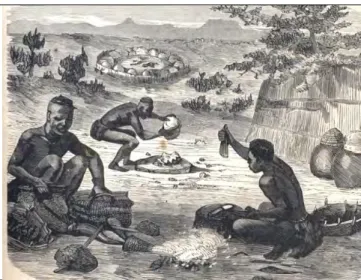
Merwe, 1994; Miller, 2002). A red hot billet was repeatedly hammered until it was cold and placed on the fire again, the process being repeated until the desired object was made. Items such as hoes, spears, knives, axes, small tools and body ornaments were made this way (Miller & Van der Merwe, 1994; Miller 1997). Often different pieces of metal were forged together (Childs, a/b; Childs & Dewey, 1996). Inadequate expulsion of slag in the metal led to the formation of stringers which can be metallographically identified (Stanley, 1931; Childs, 1991a; Maggs, 1986; Miller, 2002). The illustration (Figure 2.2) produced in the 19th century shows the public nature of smithing in the confines of a village environment. The relaxation of prohibitions against women at the smithing site is noted in the presence of a woman near the forge, and the dwelling hut nearby shows the village’s proximity to the smithing activity. Archaeological research has exposed hoes, awls, axes, spears, arrows, beads, bangles and bracelets that were made throughout the Iron Age (Friede, 1975; Miller, 1996; Walker, 1991; Childs & Dewey, 1996; Miller 2002).
Figure 2.2 “Kaffirs smelting and forging”. (The past and future of the kaffir races in three parts. Holden, W.C. 1866: 222)
2.2.3: COPPER SMELTING
Unlike iron smelting which has been found to be very widespread, copper reduction was with a few exceptions restricted to regions which hosted abundant ores such as Phalaborwa, Marothodi, Musina in (South Africa; Van der Merwe and Scully, 1971, Hall et al., 2006, Van Warmelo, 1940), Hurungwe in (Zimbabwe, Garlake, 1970, Swan, 2002, 2007), Eastern Botswana (Kiygaga-Mulindwa, 1993) and Katanga (DRC;
Rickard, 1927). In some cases, small ore bodies were exploited while ore was also traded over large distances (Inskeep & Maggs, 1975; Maggs, 1976; Herbert, 1984;
Miller & Whitelaw, 1994; Bisson 2000, Swan, 2007). The similarities between iron and copper smelting within relevant sites in southern Africa have been the focus of several South African investigators (Stayt, 1931; Van Warmelo, 1940; Van der Merwe & Scully, 1971; Hanisch, 1974; Friede, 1975; Miller & Sandelowsky, 1999; Miller 2002; Swan,
1998; Miller, 2002). The raw materials included suitable ores, clay, air and charcoal.
Pot or bag bellows were used to generate the air (Chirikure et al, 2009). Copper was smelted in bowl, and low shaft furnaces (Schwellnus, 1936; Küsel, 1974). However, Bisson (2002) recorded an instance where copper was smelted in natural draught furnaces in Zambia during the early second millennium AD. In the environment of Phalaborwa, Van der Merwe & Scully (1971) encountered beehive shaped copper furnaces about a meter in height and in diameter at the base, while at the apex there was an aperture of about 30 to 45 cm in diameter. As far as ores are concerned malachite and azurite were some of the most commonly smelted types (Hammel et al.
2000). Ore was gathered and hammered into small nodules for easier decanting through the furnace’s top chimney. When all the raw materials were gathered, the furnace was charged with alternating layers of charcoal and ore. The molten metal settled at the bottom of the furnace where it formed a puddle. This was processed in crucibles to remove occluded slag and other impurities (Stayt, 1931; Van der Merwe &
Scully, 1971; Garlake, 1970, 1983; Herbert, 1984; Bisson, 1997, 2000). The refined metal was hammered into billets to produce a variety of objects. The refined copper metal was either cast or hammered to produce a variety of objects,
2.2.4: COPPER SMITHING
Limited information on copper smithing is available as most of the copper was cast into ingots at the end of the smelting process (Bisson 1975, 1997, 2000; Herbert, 1984). It appears that early copper smiths chose to manufacture copper items from cast ingots (Childs, 1991c). The processes of fabricating copper objects were the same as those invested in iron smithing. Ingots were hammered through cycles of hot and cold working until the desired shape was achieved. In contrast to iron copper is regarded as a highly malleable metal and can be cold-worked into desirable forms in workshop settings without leaving evidence of the activity taking place as heat was not required (Mapunda, personal communication, 2016). Often copper was also drawn or hammered to produce ornamental objects such as plate, wire, beads, chains ear-rings, flexible wire-wound bracelets, solid bangles and neck-rings (Stayt, 1931; Maggs, 1976; Davison, 1984;
Herbert 1984; Calabrese, 2000; Swan, 2007). The copper wire drawing technique, dating from the Early Iron Age in southern Africa, was associated with the use of an iron wire draw- plate and vice (see Figure 2.4) (Fagan et al, 1969; Miller, 2002). This long narrow implement with its successively diminishing holes assisted in the preparation of fine wire for decorative purposes. The illustration shows the draw plate and tongs retrieved by the Krige’s and placed in the collection of the Iziko Museum (van Schalkwyk, 1982; Davison, 1984). The fine wire was mainly used for wire-wound bracelets and the decorative wire work on handles of ritual items for ceremonial
purposes (Junod, 1927; Childs & Dewey, 1996; Dewey, 1994). Hammered sheets of copper were cut into strips or thin rods with a chisel and bent around with the smooth surface exposed (Miller, 2002). Stayt (1931) noted that the Lemba made use of a small iron staple with two lines engraved across the face, called a muvangwa, used for cutting copper into short lengths for making large copper studs to be attached to bracelets.
Figure 2.3 Lemba iron wire drawing tools. Examples in the IZIKO Museum (tongs (SAMAE 9898), and draw-plate (SAMAE 9896). (Davison, 1984: 136).
2.2.5: TIN SMELTING
Our understanding of indigenous tin smelting is largely conditioned by work done at Rooiberg since the 1900s. Rooiberg is the only unequivocal source of tin in pre-colonial southern Africa (Miller, 2002; Miller & Hall, 2008). Like copper and iron, tin smelting required smelters to assemble all the essential raw materials. Cassiterite is the most common ore type smelted at Rooiberg. It is possible that tin was smelted in bowl and low shaft furnaces (Trevor, 1930; Killick, 1991; Chirikure et al., 2010). Recent work has hinted at the possibility that tin was smelted in and around Rooiberg from the early second millennium AD (Bandama, 2013) and extended into the late 19th century (Hall, 1981; Chirikure et al., 2010). When all the raw materials were assembled, the process of smelting was initiated to reduce the ore.
Temperatures sufficient for tin smelting ranged between 1000 and 1200 degrees like those for copper and iron. Often, these high temperatures promoted the reduction of iron creating portions of iron tin alloy called hard head. The excess iron was removed in a secondary process (Killick, 1991). The refined metal was cast to produce a variety of ingots which were traded over large areas (see Figure 2.4). Tin was rarely used on its own for body decorative forms, but was mixed with copper to produce bronze, a highly valuable alloy during this period (Herbert, 1984).
Figure 2.4 Some tin ingots from South African collections (Friede, 1976: 465).
2.2.6: GOLD MELTING
There is sparse information in the archival records on pre-colonial activities surrounding gold melting. Pre-colonial gold production from alluvial and hard rock sources has been broadly described by various scholars (Summers, 1969; Küsel, 1974; Phimister, 1974;
1976; Mudenge 1988; Swan, 1994, 1997; Hammel, 2000; Miller et al., 2001; Miller, 2002). Information is meagre on the earliest gold extraction, and may well have been in the form of alluvial panning (Swan, 1997). Once extracted from the above sources it was refined with methods of crushing and milling, the latter achieved with the use of dolly holes, otherwise mortars and pestles (Phimister 1976). Gold for melting purposes was gathered as dust or nugget form and stored in quills until delivered to the gold craftsmen (Swan, 1997). The dust was then molten in crucibles to consolidate it into usable metal.
Crucibles with gold prills in the slag were recovered at places such as Great Zimbabwe (Bent, 1892, Caton-Thompson, 1931; Hall & Neal, 1972; Garlake, 1974), and at Thulamela, where a few crucible fragments bearing gold residue have been found in stratified contexts (Küsel, 1992; Miller et al., 2001).
The molten gold was either cast into thin bars or rendered as prills for further use, or traded as “very small beads and trinkets” as reported by the Factor at Sofala writing in 1513 AD (Fagan et al., 1969: 136, Ellert, 1993). Gold was also hammered to produce a wide variety of objects (Oddy, 1983, 1984; Mayer, 1998; Desai, 2001, Miller, 2002).
2.2.7: GOLD SMITHING
The study of collections of gold artefacts from sites in northern South Africa and Zimbabwe confirms that the gold working technology was similar to that used in copper working (Oddy, 1983, 1984; Desai, 2001; Miller, 2002). The main output observed from a
number of sites was bead fabrication from gold hammer flattened and centrally punched prills, including those made from cut strips of gold plate wound around a former with ends butted (Desai, 2001). At Mapungubwe it was noted that wire was hammered into shape and used to make beads similar to those described above (Miller, 2002). At the same site hammered gold foil was put to several uses by gold craftsmen, mainly to cover pre-formed wooden shapes such as the rhinoceros and the gilded sceptre (Fouché 1937;
Oddy, 1984; Meyer, 2000; Steyn, 2007; Duffy, 2012). Small square nails or tacks were made to attach overlapping pieces of foil to carved wooden forms which have since decayed (Caton-Thompson, 1931; Hall & Neal, 1972; Fouché, 1937; Oddy, 1983, 1984;
Desai, 2001; Miller et al., 2001; Tiley, 2004; Duffey, 2013).
At two archaeological sites, Ingombe Ilede and Macardon, specialist gold craftsmen had mastered the casting of gold beads in a variety of shapes and sizes, from small to large, including some heavy specimens weighing as much as 70 g (2 oz. 5 dwts) and equally large beads from Mundi, Danangombe and Umnukwana Ruins (Hall & Neal, 1972:
94,145, 147). Spherical beads were noted from Macardon Claims (Jones, 1939) while irregular shapes were achieved with the combined use of the lost wax process at Ingombe Ilede (Frey, 1969).
2.3: THE ANTHROPOLOGY OF METAL WORKING
2.3.1: WHAT SOCIO-CULTURAL BELIEFS ARE ASSOCIATED WITH METAL WORKING?
A number of scholars with an interest in ethno-archaeology, ethnology, ethno-history, archaeology, metallurgy, and history over the past century have scrutinised the “chaîne opératoire” of iron and copper production not only from a chemical and physical point of view but also from a non-technical perspective; the ritualism and symbolism that accompanied the process (McCosh, 1979; Childs & Killick, 1993; Herbert, 1993; Childs &
Dewey, 1996; de Barros, 1997; Miller, 1997, Mapunda, 2013). In terms of the gendered and seasonal nature of iron and copper production, most observations concerning the activity of iron work in southern Africa stress that the entire metal working profession was controlled by men, especially the smelting process which was in charge of a professional master iron worker, generally an elderly man with senior assistants (Thompson, 1949; Shaw, 1974).
While copper smelting was controlled by men, Bisson (2000) argues that women could control the mining operations. A great deal of variation has been found amongst groups in the region regarding the participation of women in smelting. In some cases, they were not allowed near the smelting camp because it was feared that their fertility, if
unconstrained, might result in failed smelts (McCosh, 1979; Childs & Killick, 1993;
Herbert, 1993, De Barros, 1997, Huffman 2007; Mapunda, 2013). However, there are some Karanga women who helped their husbands with the pumping of bellows (Hatton, 1967). While metal working in most African communities was practiced in the dry winter months at the end of the harvest season. There were a few iron working enterprises such as those of the Njanja and the Zulu, that grew so large that they became year round activities (Mackenzie, 1975; Maggs, 1992).
As a transformative process, metal smelting was associated with beliefs in and dependence on magic, rituals and the integration of taboos which for the smelters and their communities, were essential for a positive transformation of raw earths and rocks into bloom (Herbert, 1993). The strong belief of the smelters and their societies, in the intervention of ancestors and diviners was also considered vital to the success of the smelt. Smelters used medicines to neutralize the power of the malevolent forces (Thompson, 1949; Van der Merwe & Avery, 1987). Such medicines were often planted in holes strategically dug at the bottom of furnaces (Van der Merwe & Scully, 1971; Childs
& Killick, 1993).
One of the most powerful metaphors in African metallurgy is the symbolic association between smelting and human copulation and reproduction (Childs and Killick, 1993, Miller, 2001; Mapunda, 2013). Smelting furnaces were symbolically viewed as female bodies that were impregnated during smelting to produce a child – iron. Not surprisingly furnaces for smelting, in a number of African societies such as the Shona, and the Barongo, were built and decorated with female sexual features such as breasts, stomach scarification marks, splayed legs and a lower hollow, the ‘womb’, to receive the bloom which represented the neonate. These female features can be seen on the photograph below in Figure 2.5 (Bent, 1892; Posselt, 1926; Herbert, 1984, 1993; Robinson, 1961; Bernard, 1962; Ndoro, 1991;
Childs & Dewey, 1996, Mapunda, 2013). This association, required that smelters had to withdraw from sexual relations with their wives, in order to be fully affiliated with the furnace, the temporary wife for the duration of the smelt to ensure a successful smelting operation (Herbert, 1993).
Figure 2.5 A furnace in Chibi Nature Reserve, Zimbabwe, decorated with female sexual features (Robinson, K. 1961, Plate 2).
Once the smelting operation was complete some rituals and taboos were relaxed (Herbert, 1993). When formed, the iron bloom was withdrawn and when cool it was subjected to smithing as discussed above but in a less ritualised condition.
Several scholars have argued that the presence of rituals and metaphors of reproduction often necessitated the location of smelting activities in secluded areas. This is archaeologically demonstrated by the discoveries of furnaces away from residential areas. (Herbert, 1993; de Barros, 1997, 2000; Maggs, 1992, Huffman, 2007) to retain sexual wholesomeness for the sake of producing pure smelt (Raum, 1973; Anderson, 2009). Smelters also believed that isolation was essential to preserve knowledge and power over the craft and ultimately their own wealth (Childs, 1991a). However the archaeological and anthropological records are full of variations as there are some cases where smelting was done in areas adjacent to settlements (Schmidt, 1997) with the participation of women (Hatton, 1967; Mackenzie, 1975). This illustration (Figure 2.6) is an adaption of Angas’s (1849) of “Zulu blacksmiths at work” (Plate XXIII). The image shows that heating, forging and smithing took place detached from the immediate family activities in KwaZulu-Natal.
Figure 2.6 Forging and smithing taking place in a metalworker’s workshop in KwaZulu- Natal. (Wood, J.G. 1873: 97)
2.4: WHAT IS THE ROLE OF SMELTERS AND SMITHS IN SOCIETIES?
During the Iron Age, the social position of iron smelters and smiths varied depending on context. In most of southern Africa, they commanded as much respect from citizens as chiefs and kings (Herbert, 1993; de Barros, 2000). Their knowledge of heat-generated metal technologies placed them on a superior social level above the rank and file in their communities, although some exceptions have been found in Saharan Africa amongst the metal smiths of Darfur, including those amongst the Tuareg, Masai and Somali (Herbert, 1984: 33: 1993, Haaland, 1985: 57). Iron smelting was sometimes an all-male occupation but in cases necessitating improvisation women, could participate in the process.
The smelters position in society was enhanced by considerable economic power. The affluence of a smith at Ingombe Ilede was exposed in several graves of chiefs, smiths or traders in the form of considerable material wealth consisting of local and exotic items and tool kits (Fagan et al., 1969). The production of hoes, spears and axes, all necessary for heavy duty, attracted payment which was settled with produce, wives or slaves (de Barros, 1997). In some African societies, this power was observed to be equal to that of the chief and kings, as the master smelter was involved in the initiation rites of the incumbent as he was prepared for office. The master smith demonstrated his social and political position with the chief’s or king’s court by providing expressive artefacts for this event, whether in the form of body ornaments or short hand-held artefacts of uncommon designs (Childs, 1991a; Childs & Herbert, 2005).
The social position of smiths in southern Africa was often as high as that of the smelters.
As with smelting, the spatial location of forges varied from context to context. It has been reported that forgers were placed within and outside residential areas. A few illustrations