JUVENILE OFFENDERS:
DIVERSION FOR THOSE IN CUSTODY
BY: MELANe JOHANNA DE JAGER
SUBMITTED IN PART FULFILLMENT OF THE REQUIREMENTS FOR THE DEGREE OF MASTERS IN CHILD CARE AND PROTECTION (SOCIAL WORK AND LAW).
SUPERVISOR: PROF. Managay Reddi STUDENT NO: 200301602
Date submitted September 2008
ACKNOWLEDGEMENTS
I would like to acknowledge and thank all the people who encouraged me and had faith in me in finalising this work.
A special thank you to Prof. M. Reddi, my supervisor for all the hard work and effort in assisting me to finalise this work and her continuous guidance without giving up.
To Andre de Jager for all the support and for taking care of our children during the time I attended lectures and needed to do research.
My friends Antionette Vermooten, Ashika Pramlall, Henriette Schutte, my sister Helena Aitken, my mother, Steve Terblanche and Ferial Seedat who kept on encouraging me to finalise this work and believed in me. A special thanks to Richi and Sharma Ramseram for all their assistance. Thank you to Razia Amod for all her assistance and phone calls she made in getting the dissertation finalised.
Caren van der Wait who assisted in editing the first chapter before she immigrated to New Zealand and Mots Motala for assisting in editing at the last moment.
Finally yet importantly thanks to my Heavenly Father who gave me the strength to continue during trying times.
DECLARATION
I Melane Johanna de Jager declare that:
(i) The research report in this dissertation, except where otherwise indicated, is my original work.
(ii) This dissertation has not been submitted for any other degree or examination at any other university.
(iii) This dissertation does not contain other persons' data, pictures, graphs or other information, unless specifically acknowledged as being sourced from other persons.
(iv) This dissertation does not contain other persons' writing, unless specifically acknowledged as being sourced from other researchers. Where other sources have been quoted, then;
(a) Where their exact words have been used, their writing has been placed inside quotation marks, and referenced.
(b) Their words have been re-written but the general information attributed to them has been referenced.
(v) Where I have reproduced a publication of which I am an author, co-author or editor, I have indicated in detail which part of the publication was actually written by myself alone and have fully referenced such publications.
(vi) This dissertation does not contain text, graphics or tables copied and pasted from the Internet, unless specifically acknowledged, and the source being detailed in the dissertation and in the References sections.
11
TABLE OF CONTENTS
Acknowledgements Declaration
Table of contents
CHAPTER 1
JUVENILE OFFENDERS: DIVERSION FOR THOSE IN CUSTODY
1.1. Introduction
1.1.1. Benefits of Diversion
1.1.2. Aims and Purposes of Diversion 1.1.3. Objectives of Diversion
1.2. Aims of this Study
1.3. Key Questions to be Answered in this Study
1.4. Layout of this Study
1.5. Methodology
1.5.1. Data: Collection Method 1.5.2. Limitations
CHAPTER 2
THE CHILD JUSTICE BILL AND OTHER RELEVANT NATIONAL AND INTERNATIONAL INSTRUMENTS
2.1. Introduction
ii iii
1
1
5 5 8
9
10
10
11 12 12
14
14
2.2. International Framework for Diversion 14 2.2.1. The United Nations Convention on the Rights of the Child (1989) 14 2.2.2. United Nations Standard Minimum Rulesfor the Administration
of Juvenile Justice (Beijing Rules)(1995) 15
2.2.3. The United Nations Guidelines for the Prevention of Juvenile
Delinquency (1990)(Riyadh Guidelines) 18
2.2.4. The African Charter on the Rights and Welfare of Children
(1990) 19
2.3. Diversion in South Africa 19
2.3.1. Programmes being offered at present 19
2.3.1.1. Pre-trial Community Programmes 22
2.3.1.2. Youth empowerment Programme 22
2.3.1.3. Victim-offender Mediation 23
2.3.1.4. Family-group Conference 24
2.2 1.5. Anger Management Programme 24
2.3.1.6. Adolescent Drug Abuse, Prevention and Treatment
Programme 25
2.3.1.7. The Journey 26
2.4. Case Law and the South African Law Commission's
Issue Paper on Juvenile Justice 28
2.5. The Child Justice Bill 31
2.5.1. The Diversion Process in terms of The Child Justice Bill 35
2.5.1.1. The Preliminary Inquiry 38
2.5.1.2. Aims and Objectives of Diversion 39
2.5.1.3. Diversion Levels 40
2.5.1.4. Level One 42
2.5.1.5. Level Two 42
2.5.1.6. Level Three 42
IV
2.6. Proceedings where there is a Failure to Comply with a Diversion Order
2.7. Conclusion
CHAPTER 3
43
44
47
THE ROLE OF THE SOCIAL WORKER AND THE PROBATION OFFICER
3.1. Introduction 47
3.2. The Role of the Social worker at the Excelsior Place of Safety
and the Westville Youth Centre 48
3.3. Activities at the Excelsior Place of Safety and the Westville
Youth Centre 49
3.3.1. The Youth Empowerment Scheme 49
3.3.2. Sport, Recreation and Indoor Games 50
3.3.3. Court Readiness 50
3.3.4. Involvement of Parents 50
3.4.1. The Process of Diversion at the Excelsior Place of Safety and
the Westville Youth Centre 51
3.4.2. The Follow up after the Withdrawal of a Matter 51
3.5 The Differences and Similarities in the Programmes Offered by NICRO and the Westville Youth Centre and the Excelsior Place
of Safety 52
v
3.6. The Role of the Social Worker and the Probation Officer in terms of the proposed Bill
3.7. Conclusion
CHAPTER 4
53
56
DISCUSSIONS AND RECOMMENDATIONS REGARDING THE BILL 58
4.1. Introduction 58
4.2. The differences between the International instruments and the Bill 58
4.2.1. Orders 58
4.2.2. Treatment Orders 59
4.2.3. Consent to Diversion 60
4.3. Human Rights 61
4.4. The Juvenile Offender in Custody 61
4.5. The After Care 63
4.6. The Proposed Changes to the Bill by the Justice and Constitutional
Development Portfolio Committee 64
4.6.1. Diversion by the Prosecutor in respect of Minor Offences 66
4.6.2. The Preliminary Inquiry 67
4.6.3. The Child Justice Court 67
4.7. Conclusion 68
BIBLIOGRAPHY 74
VI
CHAPTER 1
JUVENILE OFFENDERS
DIVERSION OPTIONS FOR THOSE IN CUSTODY
1.1 INTRODUCTION
"Children should not be in prison at all save in exceptional circumstances."
These are the words of Justice J.J. Fagan.1According to Justice Erasmus, in 2006/2007 there were 2 077 juvenile offenders under the age of 18 years in prison of which 1 165 were awaiting trial.2 The latest 2006/2007 report does not give statistics of the types of offences and the number of juvenile offenders who are in custody. However, in the 2003/2004 report the offences were categorised according to awaiting trial juvenile offenders and the nature of the offences committed.3
Table 1
Juvenile Offenders Awaiting Trial in South African Prisons October 2004
AGE OF ECONOMIC AGGRESSIVE SEXUAL NARCOTIC
CHILD OFFENCES OFFENCES OFFENCES OFFENCES
7 - 13 3 4 1 0
14 40 40 7 2
7 - 16 358 363 124 13
15 101 84 30 4
16 214 235 86 6
17 - 18 1 374 2 171 640 39
17 264 423 130 8
18 1 110 1 748 510 31
From table 1 it is clear that extremely young children are in prison awaiting trial. The table does not define what is meant under economic offences.
Fagan J 'Annual Report of the Office of the Inspecting Judge 2004-2005' (2005) at 12.
2 Erasmus N 'Annual Report of the Office of the Inspecting Judge 2006-2007' (2006).
3 Fagan J 'Annual Report of the Inspecting Judge 2003-2004' (2004).
Economic offences can include fraud, theft by shoplifting, theft of or out of motor vehicle, theft and being found in possession of an item suspected to be stolen.4 Aggressive offences can include armed robbery, robbery; assault and assault with the intent do grievous bodily harm. Narcotic offences can be dealing in or possession of prohibited substances. It is difficult to establish from the abovementioned information how many juvenile offenders are in custody awaiting trial for minor offences.
For many years the issue of juvenile offenders in custody has been of great concern to human rights activists. Due to their concerns, international bodies such as the United Nations drew up guidelines to promote the protection of children's rights.5 The United Nations Standard Minimum Rules on Juvenile Justice, also known as the "Beijing Rules", sets out the rights of the juvenile offender. The ANC Woman's League raised their concerns in 1996 about juvenile offenders in custody especially for minor offences.6 In 1996 there were 398 awaiting trial juvenile offenders in custody and an estimated 62%
were suspected of minor offences. Woman's League Executive Member M.
Malumise stated that: 'The League speaks for millions of South African mothers, in fiercely opposing the imprisonment of children who are accused of minor transgressions.,7
During 1998 former President Nelson Mandela made the following statement regarding juvenile offenders in detention and prisons: '... the government will, as a matter of urgency, attend to the tragic and complex question of children and juveniles in detention and prison. The basic principle from which we will proceed from now onwards is that we must rescue the children of the nation
4 Deysel, A. Kids Behind Bars: Talking to Young Inmates.www.csvr.org.za/papers/papdis9.html.
5 N Jacobs-du Preez 'The application of the United Nations Standard Minimum Rules on Juvenile Justice in an African Context' Second World Conference 2001 on the Investigation of Crime, Modern Criminal Investigation, Organised Crime and Human Rights. ' Durban, South-Africa, 3-7 December2001. www.tsa.ac.za/corp/research/papers/duPreez2001/unrules
6 Quoted in a statement issued by African National Congress on 4 September 1996 'Kids in prison an outragesays Woman's League' www.anc.org.za/ancdocs/pr/1996/pr0904.html.
7 Supra.
and ensure that the system of criminal justice must be the last resort in the case ofjuvenile offenders. '8
From the above it is clear that the main issue is juvenile offenders being kept in custody for minor offences. Mrs. Maureen Malumise MP commented as follows on juvenile offenders who are in custody and who have allegedly committed serious offences: IThe detention of children who are alleged to have committed serious offences has the full support of the Women's League ...' 9 Juvenile offenders are only to be detained in custody as the last resort'.10
This is in accordance with s 28( 1)(g) of the Constitution of the Republic of South Africa Act 108 of 1996 and other international instruments, which state that the imprisonment of juvenile offenders will be permissible in certain defined circumstances.11
In an attempt to minimise the imprisonment of juvenile offenders and to steer them away from the criminal justice system, the concept of diversion has been introduced in South Africa.
Diversion in the juvenile justice system is a fairly new concept in South Africa and started in 1990 with the introduction of the Youth Empowerment Scheme ('YES' programme). This was followed in 1992 with the life skills diversion programme by the National Institute for Crime Prevention and Reintegration of
8 Quoted in South African Law Commission documentI What do you think about ... young people in trouble with the law' (1998) 1-7.
9 Quoted in a statement issued by African National Congress on 4 September 1996 'Kids in prison an outrage says Woman's League' www.anc.org.za/ancdocs/pr/1996/pr0904.html.
10 Quoted in a statement issued by African National Congress on 4 September 1996 'Kids in prison an outrage says Woman's League' www.anc.org.za/ancdocs/pr/1996/pr0904.html.
11 The United Nations Convention on the Rights of the Child (1989);the 1995 United Nations Standard Minimum Rules for the Administration of Juvenile Justice; the 1990 United Nations Rules for the Prosecution of Juveniles Deprived of their Liberty; the 1990 United Nations Guidelines for the Prevention of Juvenile Delinquency and the African Charter on the Rights and Welfare of Children.
Offenders (NICRO).12 To date there is no legislation that regulates diversion.
Currently the discretion to offer diversion to a juvenile offender depends on the prosecutor. 13 If a prosecutor or the legal representative of a juvenile offender is unaware of the diversion option, the juvenile offender will not be afforded this option.
Diversion attempts to divert the juvenile offender away from the criminal justice system and into reintegrated programmes.14
This is in keeping with standards set for juvenile justice in Art 3(1) of the United Nations Convention on the Rights of the Child (1989) (herein after referred to as "the Convention").
Article 40(3)(b) states that wherever appropriate and desirable; States are encouraged to take measures to deal with juvenile offenders without resorting to criminal proceedings with the proviso that the human rights of the community and the juvenile offender are safeguarded.15 Other relevant international instruments are the 1995 United Nations Standard Minimum Rules for the Administration of Juvenile Justice (Beijing Rules), the 1990 United Nations Rules for the Prosecution of Juveniles Deprived of their Liberty, the 1990 United Nations Guidelines for the Prevention of Juvenile Delinquency and the African Charter on the Rights and Welfare of Children (1999).
Diversion is aimed at balancing the interests of justice and the rights of the juvenile offender. Various rights of the juvenile offender may be infringed if the juvenile offender agrees to diversion. The right to be presumed innocent until
12 J Sloth-Nielson and J Callinetti Child Justice in Africa. A Guide to Good Practice (2004) 'Policy Development: Change and Reform within Existing Justice Systems'
at 42 and also J Gallinetti 'Diversion' 66 at 66. See also T Maepa(ed) Diversion: A Central Feature of the New Child Justice System in Beyond Retribution Prospects For Restorative Justice in South Africa (2005) 76 at 76.
13 This is based on a directive issued by the National Director of Public Prosecutors (NDPP) (Part7 of NDPP Policy and Directive on Diversion (herein after referred to as the NDPP)
Policy).
14 C. Bezuidenhout and S Joubert Child and Youth Misbehavior in South Africa aHolistic View on 191.
15 CJ Davel Introduction to Child Law in South Africa at 418-419.
the State proves the commission of the offence beyond reasonable doubt is infringed when the juvenile offender agrees to diversion. The privilege against self-incrimination may also be violated as the juvenile offender has the right to have a court of law decide on his or her innocence.16 It is submitted that the benefits derived from diversion, as discussed below out- weigh the possible infringement of the abovementioned rights of the juvenile offender.
1.1.1 BENEFITS OF DIVERSION
The benefit of diversion to the juvenile offender is the removal of the stigmatism of being arrested and also the decriminalisation of the offence.17The other advantages are:
• not being incarcerated whilst awaiting trial;
• not being exposed to other juvenile offenders who are in custody for more serious offences; and
• the juvenile offender does not acquire a criminal record.18
1.1.2 AIMS AND PURPOSES OF DIVERSION
In terms of a directive issued by the National Director of Public Prosecutors (herein after referred to as the NDPP) the aims and purposes of diversion are:19
16 17
18 19
•
to encourage the child to be accountable for the harm caused by his or her acts;Part 7 of NDPP Policy and Directive on Diversion.
J Sloth-Nielson Juvenile Justice. Regspleging ten opsigte van minderjariges SACJ (1998) 11 at 98.
CJ Davel at 418.
The United Nations Convention on the Rights of the Child (1989);the 1995 United Nations Standard Minimum Rules for the Administration of Juvenile Justice; the 1990 United Nations Rules for the Prosecution of Juveniles Deprived of their Liberty; the 1990 United Nations Guidelines for the Prevention of Juvenile Delinquency and the African Charter on the Rights and Welfare of Children.
• to promote the re-integration of the child into the family and the community;
• to provide an opportunity for reparation;
• to provide an opportunity to the person or persons or community affected by the harm caused to express their views regarding the impact of such crime;
• to identify underlying problems motivating offending behaviour;
• to provide educational and rehabilitative programmes to the benefit of all parties concerned; and
• to lessen the case-load of the formal justice system.
At present, the procedure is that a juvenile offender, who has admitted to committing an offence, is assessed by a probation officer to establish the suitability of the juvenile offender to be considered for diversion and then released into the custody of a guardian, care-giver or parent. Some of the factors that will be taken into account in assessing the juvenile offender's suitability for diversion are the following:20
• biographical information ( name, age address and gender);
• education, schooling and school attendance;
• household structure;
• household income;
• level of parental or guardian supervision;
• relationship with parent or guardian;
• criminal history of the juvenile offender;
• the parent or guardian's of the case and the juvenile offender;
• opinions of any significant persons of the case and also the juvenile offender;
• any previous diversions offered to the juvenile offender and what programmes where offered; and
• any history of substance and or alcohol abuse.
20Child Law manual for judicial officers at 0 -17.
The person concerned will have to take responsibility for ensuring the juvenile offender's attendance at all the required programmes and also in certain circumstances as part of the retribution or community service. The juvenile offender and the guardian, care-giver or parent is sent to NIGRO with a letter of reference as NIGRO offers the diversion programmes. NIGRO then assesses the juvenile offender to determine if he or she is a suitable candidate to attend the programmes. If the juvenile offender is found to be suitable, a contract is given to the juvenile offender to return to the prosecutor.
The contract normally sets out the programmes that have to be followed, the number of applicable hours of community service and the venue of such service. On receipt of the said contract, the prosecutor, the juvenile offender and his or her guardian, care-giver or parent signs the contract. Once the document is signed, it is returned to NIGRO.
Once the juvenile offender has completed the programmes and/or community service, the criminal charges are withdrawn against him or her, thus enabling the juvenile offender to walk out of court, without a criminal record.
NIGRO will not accept a juvenile offender into any programme if the juvenile offender does not admit guilt to committing the offence or if he or she had previously attended any programme at NIGRO. In these instances, NIGRO notifies the prosecutor in writing of the reasons for not accepting the juvenile offender. If the juvenile offender is not accepted as a candidate to the diversion programme, the matter will then go through the normal criminal procedures stipulated under the Griminal Procedure Act 51 of 1977.21
Diversion has not been practiced consistently across South Africa. Only 25%
of all magistrates' courts offer this option.22 The Ghild Justice Bill (hereafter
21 The procedures stipulated in these paragraphs are not contained in any official documentation but has been the practice followed in court. This has been from the researcher's experience both as Prosecutor and Magistrate in the Juvenile Court in Durban.
20 What ia Restorative Justice?www.capeway.gov.za/pubs/public infolW/47588.
referred to as the Bill) that is still to be promulgated will for the first time give formal legislative enforcement to diversion. The diversion requirements and processes are covered in chapter 6 of the Bill.
1.1.3 OBJECTIVES OF DIVERSION
Diversion in South Africa has two different objectives:
• Diversion for the juvenile offender in conflict with the law; and
• Diversion for the juvenile who is living in the street and not yet in conflict with the law.23
Juvenile offenders who are in conflict with the law can fall into one of two categories:
• Those who have committed minor offences, and
• Those who have committed serious offences.
Juvenile offenders who have committed minor offences are more likely to be offered diversion options than those juvenile offenders who have committed serious offences.
This dissertation will focus on juvenile offenders who are in custody due to minor offences at the Westville Youth Centre and the Excelsior Place of Safety. Juvenile offenders who are kept in custody for minor offences normally do not have care-givers, guardians or parents in whose custody they can be released.
Where a juvenile offender is in the disadvantaged position of not having a guardian, care-giver or parent to take responsibility for him or her, he or she does not qualify for diversion. The unfortunate result is that the juvenile offender is not given the opportunity to be steered away from the criminal
23 J Callinetti Child Justice in Africa A guide to Good Practice 'Diversion' 66 at 68.
justice system. This leads to an unfair situation as the juvenile offender will be convicted even after admitting guilt and accordingly will acquire a criminal record.
The other option to convicting such a juvenile offender would be to withdraw the case against him or her. This option, however, will not be in the interests of justice or in the interest of the community. If minor offences are withdrawn due to the fact that the juvenile offender has no care-giver, guardian or parent, wrong messages will be sent out to the community and like-minded juvenile offenders.
In light of the aims and purposes of diversion, it is likely that juvenile offenders without care-givers, guardians or parents will benefit even more from attending or undergoing the programmes that are currently being offered to juvenile offenders who are diverted from the criminal justice system, as they do not have adult supervision or proper role models to guide them. 24
1.2 AIMS OF THIS STUDY
This study aims to investigate the diversion programmes presently offered at the Westville Youth Centre and the Excelsior Place of Safety for the juvenile offender who is in custody. The study also seeks to identify the benefits of diversion to the juvenile offender. Recommendations will be made for diversion to be made available to all juvenile offenders who are in custody in the Republic of South Africa.
This study will investigate the role of the social worker and the probation officer in the diversion process.
Finally recommendations will be made to improve the existing diversion system and the provisions regarding diversion in the proposed Juvenile Justice Bill for juvenile offenders in custody.
24 See Chapter 2 at 11-12.
1.3 KEY QUESTIONS TO BE ANSWERED IN THIS STUDY
The following issues will be discussed in this study:
• Does diversion benefit juvenile offenders?
• What are the shortcomings in the current diversion system?
• What are the differences and/or similarities between programmes offered at NICRO and those offered by the Westville Youth Centre and the Excelsior Place of Safety?
• What happens to the juvenile offender who undergoes diversion while in custody after the diversion programme has been completed?
• What are the roles of the social worker and the probation officer in the diversion process?
• What if any are the short comings of the Child Justice Bill?
1.4 LAYOUT OF THE DISSERTATION
Chapter 1 discusses the concept of diversion and the problems relating to diversion options for juvenile offenders who are in custody.
In Chapter 2 the provisions relating to diversion in the proposed Child Justice Bill will be discussed as well as other relevant legislation.
In Chapter 3 the information received from the social workers at the Westville Youth Centre and the Excelsior Place of Safety will be discussed and analysed and the role of the social worker and the probation officer in the diversion process will be investigated.
Chapter 4, the concluding chapter, will include evaluations of the current position regarding diversion, comparisons with international instruments and comparisons will be made with the proposed Child Justice Bill. Further proposals will be made regarding the current position and the Bill.
1.5 METHODOLOGY
The methods of approach in this research are as follows:
Scheduled interviews will be held with the social workers who are involved with the diversion programmes at the Westville Youth Centre and at the Excelsior Place of Safety. The social workers concerned will be those who offer diversion programmes.
Library and internet research will be conducted for secondary sources of information.
The provisions of the proposed Bill, relating to diversion, will be studied to determine the proposed diversion options and the diversion options available at present for juvenile offenders in custody.
The researcher's interest in this subject emanated from her personal experience in presiding over cases where children were in conflict with the law. There are diversion programmes for juvenile offenders in custody but this study is limited to two institutions in KwaZulu-Natal. The two institutions are the Youth Centre at Westville prison and the Excelsior Place of Safety in Pinetown. These two institutions deal with the disadvantaged juvenile offender in the sense that he or she does not have a parent, care-giver or guardian.
The Westville Youth Centre and the Excelsior Place of Safety are detention centres for juvenile offenders for the following areas Durban, Pinetown which includes Bothas Hill, Dassenhoek, St Windowlenes and Kwandengezi ,Kwa Mashu, Chatswoth, Inanda and the Excelsior Place of Safety also accept juvenile offenders from Verulam and as far as Umbumbulu.25
25 Interview with Mrs. R.Veerasamy, Principal social worker of Excelsior place of safety and Westville Youth Centre, at Pinetown on 17 October 2006.
The fact that there are o~ly two institutions in Kwa Zulu Natal offering diversion programmes gave rise to this research. This is a problem that arose from "a concrete problem observed in reality" and "the researcher's sense of professional responsibility to contribute to the enhancement of the underlying knowledge base underlying the delivery of certain services".26
Newman27 defines research as the studious inquiry on examination, especially critical and exhaustive investigation, or experimentation having as its aim the discovery of new facts and their correct interpretation, the revision of acceptable conclusions, theories or laws in the light of newly discovered facts, or the practical applications of such new or revised conclusions, theories or laws. This study will inquire into the effectiveness and shortcomings of the diversion programmes and will make recommendations to improve these programmes.
1.5.1 DATA: COLLECTION METHOD
The research project will be carried out at the Westville Youth Centre and at Excelsior Place of Safety as the two places where children without guardians, caregivers or parents are detained. At both of these institutions the Department of Social Welfare and Development offers diversion programmes.
The number of cases referred for diversion will be taken for the period between January 2006 to December 2006. The number of children successfully completing the programmes and the number of re-offenders will be examined to establish the success rate of the diversion programmes offered.
1.5.2 LIMITATIONS
• The findings will be based on only two institutions as diversion
26 AS de Vos (edit) Research at Grass Roots For the Social Sciences and Human Service Professions (2002) at 96.
27 WL Newman Social Research Methods: Qualitative and Quantitative Approaches (2000) at 6.
programmes for children in detention are done only at these institutions.
• The success rate will only cover a period of one year. Thus it does not take into account the long-term success or failure rate.
CHAPTER 2
THE CHILD JUSTICE BILL AND OTHER RELEVANT NATIONAL AND INTERNATIONAL INSTUMENTS.
2.1 INTRODUCTION
Diversion is the referral of prima facie cases away from the criminal justice system, with or without conditions.1The process of diversion is in keeping with international instruments that have been ratified by South Africa. 2 In this chapter diversion will be looked at from the perspective of the international instruments, the current position regarding diversion and diversion in terms of the proposed Child Justice Bill, 2003.
2.2 INTERNATIONAL FRAMEWORK FOR DIVERSION
2.2.1 THE UNITED NATIONS CONVENTION ON THE RIGHTS OF THE CHILD (1989)
Article 40(3)(b) of the Convention deals with juvenile offenders and provides that IWhenever appropriate and desirable, measures for dealing with such children without resorting to judicial proceedings, providing that human rights and legal safeguards are fully respected'.
Article 40(4) makes provision for various dispositions, such as '... care, guidance and supervision orders; counselling; probation; foster care;
1 Wood, C. Diversion in South Africa. A review of policy and practice, 1990-2003 www.iss.co.za/pubs/papers/79/Paper79.html.
2 See p 3-4 chap 1.
educational and vocational training programmes and other alternatives to institutional care shall be available to ensure that children are dealt with in a manner appropriate to their well-being and proportionate both to their circumstances and the offence'. 3
From the above it is clear that in appropriate cases, and also if it is desirable, the juvenile offender should be diverted away from judicial proceedings. In Article 40(4) various options are mentioned in the diverting process for example guidance and supervision orders, vocational training programmes and probation. The article further states that '... and other alternatives to institutional care shall be available to ensure that children are dealt with in a manner appropriate to their well-being and proportionate both to their circumstances and the offence. '
In terms of this article it is clear that each country that has ratified the Convention must make provision for programmes as a means of diverting juvenile offenders away from criminal proceedings. Due to the different circumstances in each country, each country should tailor-make programmes that the juvenile offender can follow.4
2.2.2 UNITED NATIONS STANDARD MINIMUM RULES FOR THE ADMINISTRATION OF JUVENILE JUSTICE (BEIJING RULES) (1985)
In terms of the general principles of the United Nations Standard Minimum Rules of Juvenile Justice, (hereinafter referred to as the 'Beijing Rules') 'sufficient attention shall be given to positive measures that involve the full mobilization of all possible resources, including the family, volunteers and other community institutions, for the purpose of promoting the well-being of the juvenile, with a view to reducing the need for intervention under the
3 United Nations Convention on the Rights of the Child.
www.rehydrate.org/facts/convention_full.htm.
4 South Africa ratified the United Nations Convention on the Rights of the Child (1989) on the 10thof June 1995.
law, and of, effectively, fairly and humanly dealing with the juvenile in conflict with the law. '
Rule 11 of the Beijing Rules make provision for diversion. The appropriate rules state as follows:5
Rule 11.1
Consideration shall be given, wherever appropriate, to deal with juvenile offenders without resorting to formal trial by the competent authority.
Rule 11.3
Any diversion involving referral to appropriate community or other services shall require the consent of the juvenile, or her or his parents or guardian, provided that such decision to refer a case shall be subject to review by a competent authority, upon application.
It is submitted that in the South African context 'the competent authority' is the public prosecutor who has the discretion to offer a juvenile offender the opportunity to attend diversion programmes.
Rule 11.4
In order to facilitate the discretionary disposition of juvenile cases, efforts shall be made to provide for community programmes, such as temporary supervision and guidance, restitution and compensation of victims.
Rule 18 provides for various disposition measures which includes the following:
• Care, guidance and supervision orders;
• Probation;
• Community service orders;
• Financial penalties, compensation and restitution;
5 United Nations Standard Minimum Rules for the Adminisration of Juvenile Justice ("The Beijing Rules') www.unhchr.ch./english/law/paf/crc.pdf.
•
•
•
Intermediate treatment and other treatment orders;
Orders to participate in group counselling and similar activities;
educational settings.
Orders concerning foster care, living in communities or other relevant.
Rule 24 provides for assistance to the juvenile offender in the rehabilitative process. The rule states that all efforts are to be made to assist the juvenile offender at all stages of the proceedings. Assistance includes lodging, education or vocational training or any assistance that is helpful and practical during the rehabilitative process.
Rule 25 makes provision for volunteers, voluntary organisations, local institutions and other community resources to contribute to the rehabilitation of a juvenile offender in a community setting.
It should be noted that the Beijing Rules were not ratified by South Africa but may nevertheless serve as guidelines in developing the diversion process. The Beijing Rules set out more comprehensively proposed programmes that can be used in the diversion process. The issue of community service is dealt with in Rule 11.3 that requires the permission from the juvenile offender or his/her parents. The Beijing Rules are the only international instrument that requires the consent of the juvenile offender before community service can be done. Consent can be given by the juvenile offender with or without the assistance of his or her parents but it also allows for the parents to give consent without requiring the juvenile offender to consent. This can lead to a situation where the juvenile offender does not want to do community service but is forced by his or her parents. The upside of the rule is that even if the parents do not want to consent to the juvenile offender doing community service, the juvenile offender can do so on his or her own.
It is submitted that the aims and objectives of the Beijing Rules are consistent with the aims and objectives for diversion in South Africa and should be utilised to develop the diversion process in South Africa.
2.2.3 THE UNITED NATIONS GUIDELINES FOR THE PREVENTION OF JUVENILE DELINQUENCY (1990) (RIYADH GUIDELINES)
The United Nations Guidelines for the Prevention of Juvenile Delinquency (1990) (Riyadh Guidelines) (herein after referred to as the Riyadh Guidelines) refer to diversion.6 The Riyadh Guidelines are guidelines to prevent juvenile delinquency. These guidelines also make provision for legislation to be passed to enforce diversion options.7
Articles 5(a) and (b) state as follows:8
(a) The provisions of opportunities, in particular educational opportunities, to meet the varying needs of young persons and to serve as a supportive framework for safeguarding the personal development of all young persons, particularly those who are demonstrably endangered or at social risk and in need of special care and protection;
(b) Specialized philosophies and approaches for delinquency prevention, on the basis of laws, processes, institutions, facilities and service delivery network aimed at reducing the motivation, need and opportunity for, or conditions giving rise to, the commission of infractions. '
Article 58 states that:
'Law enforcement and other relevant personnel, of both sexes, should be trained to respond to the special needs of young persons and should be
6 United Nations Guidelines for the Prevention of Juvenile Delinquency (The Riyadh
Guidelines) Adopted and proclaimed by General Assembly Resolution 45/112of 14 December 1990. www.unhchr.ch./html/menu3/b/h_comp47.htm._And also
Article 58 of the Riyadh Guide.
7 Supra. Also Article 52.'Goverments should enact and enforce specific laws and procedures to promote and protect the rights and well-being of all young persons.'
8 Supra.
familiar with and use, to the maximum extent possible, programmes and referral possibilities for the diversion of young persons from the justice system.'
This instrument has not been ratified by South Africa but it is a useful instrument to follow in the diversion process in South Africa as diversion programmes aim to teach juvenile offenders to avoid criminal activities.9
2.2.4 THE AFRICAN CHARTER ON THE RIGHTS AND WELFARE OF CHILDREN (1990)10
In terms of Article 17 of the African Charter 'Every child accused or found guiltyof having infringed penal law shall have the right to special treatment in a manner consistent with the child's sense of dignity and worth and which reinforces the child's respect for human rights and fundamental freedoms of others'.11
The African Charter on the Rights and Welfare of Children (hereafter referred to as the Charter) states in general the right of a juvenile offender to special treatment. Diversion can be regarded as special treatment that would reinforce the juvenile offender's 'respect for human rights and fundamental freedoms of others'.
2.3 DIVERSION IN SOUTH AFRICA
2.3.1 PROGRAMMES CURRENTLY OFFERED
South Africa attempted to comply with the abovementioned provisions by in introducing diversion into the criminal justice system. There are presently two statutes that contain sections that steer juvenile offenders
9 Supra.
10 South Africa ratified the Charter on thei hof January 2000 and it is therefore binding on South Africa.
11 African Charter on the Rights and Welfare ofthe Child, OA U Doe. CAB/LEG/24. 9/49 (1990), entered into force Nov. 29, 1999._www.umn.edu/humantrs/africa/afchild.html.
away from the criminal justice system, s 254 of the Criminal Procedure Act 51 of 1977 (hereafter referred to as the CPA) and s 11 of the Child Care Act 74 of 1983 (hereafter referred to as the Child Care Act).
Section 254 of the CPA states:
(1) Ifit appears to a court at the trial upon anycharge of an accused under the age of eighteen years that he is a child as referred to in section 14(4) of the Child Care Act,1983(Act 74 of1983), and it is desirable to deal with him in terms of sections 13, 14and 15of that Act, it may stop the trial and order that the accused be brought before a children's court mentioned in terms of section 5 of that Act and that he be dealt with under the said sections 13, 14 and 15.
(2) If the order under subsection (1) is made after conviction, the verdict shall be of no force in relation to the person in respect of whom the order is made and shall be deemed not to have been returned. '
This is the only section in the Criminal Procedure Act that permits a Magistrate to steer a juvenile offender away from criminal proceedings.
This section, however does not make provision for diversion as intended in the Child Justice Bill. The juvenile offender is referred to the Children's Court to be dealt with in terms of the Child Care Act.12
Section 11 the Child Care Act states:
'If it appears to any court in the course of any proceedings before that court that a child has no parent or that it is in the interest of the safety and welfare of any child that he be taken to a place of safety, that court may order that the child be taken to a place of safety and be brought as soon as may be thereafter before a children's court'.
The effect of s 11 is that the words 'any court' would include criminal courts and 'any proceedings' would include criminal proceedings. The effect of this section is that the criminal court can apply the Child Care Act
12 Section 11 of the Child Care Act 74 of 1983.
to divert a child in conflict with the law away from criminal proceedings.13
Section 11 of the Child Care Act and s 254 of the CPA have limitations that would make them inadequate for the diversion process. Section 254 only applies to juvenile offenders at the trial stage. In terms of time spent in custody, if it is assumed that the juvenile offender has no parents, this can be from a few days up to a few months. In practice the courts do not refer a juvenile offender to the Children's Court without the recommendation of a probation officer. The courts normally require reports by probation officers, indicating that the juvenile offender is a child in need of care defined in s 14(4) of the Child Care Act, before making a finding that a juvenile offender should be dealt with in terms of s 254 of the CPA.
Section 11 of the Child Care Act can be implemented by any court at any stage of the proceedings. This section can be applied as soon as a juvenile offender appears in court for the first time or at any stage up to sentencing. Section 11 does not mention the option of diversion as contained in the Child Justice Bill.
In terms of s 11 of the Child Care Act, no distinction is made between a juvenile offender pleading guilty or one who pleads not guilty. Applying the abovementioned section and diverting a juvenile offender away from criminal proceedings and placing him/her at a place of safety would achieve very little, as the juvenile offender would in terms of the Child Care Act, only be placed in a place of safety or in foster care without any further "Life Skills" training.14This is because there are no programmes in place to educate a juvenile offender on life skills. Life skills training includes the following: personal awareness, communication skills, conflict resolution and effective mediation, sexuality, crime awareness and crime prevention, gender sensitivity, leadership development and family Iife.15 It
13 A Louw andF van Oosten Diverting Children From the Criminal Courts: Some Proposals' (2000) 61 THRH at 123.
14 Section 15 of the Child Care Act.
15 T Maepa(ed) Diversion: A Central Feature of the New Child Justice System in Beyond Retribution Prospects For Restorative Justice in South Africa (2005) 76 at 76.
is submitted that if the juvenile offender would have been exposed to such a programme before being placed in a place of safety or in foster care, he or she would have insight into the wrongfulness of being involved in crime.
For criminal proceedings in terms of s 11 of the Child Care Act to take effect there is no need for a juvenile offender to take responsibility for his or her actions. This enables the juvenile offender to walk away from the whole process without any insight as to what he or she has done wrong.
Thus the interests of the juvenile offender and the interests of the community have not been taken care of. Practical experience has shown that most of the juvenile offenders who have been referred to the Children's Court in terms of s 254 of the CPA abscond before the proceedings are held in terms of the Child Care Act.
At present diversion is not being implemented by way of legislation but only in an informal manner by virtue of a directive of the National Director of Public Prosecutors.16 NICRO is currently providing most of the diversion programmes. Various programmes are offered. The programmes are as follows:17
2.3.1.1 PRE-TRIAL COMMUNITY PROGRAMME
Charges against the juvenile offender are withdrawn on the condition that he/she performs free community service, to benefit the community, at a non-profit organisation. The number of hours of community service ranges from 10 to 120. Failure to comply with the conditions would result in the charges being reinstated.
2.3.1.2 YOUTH EMPOWERMENT PROGRAMME
This programme is a six-week course where a group of about 20 juvenile offenders attend the course one afternoon per week. The material covered in this course includes conflict management, responsible decision-making,
16 Supra.
17 The Development of Diversion Options for Youth Offenders-Policing the Transformation.
www.iss.co.za/Pubs/Monographs/No12/Muntingh.html.
parent-child relationships and street law. The parents of the juvenile offender are required to attend the first and the last sessions with the juvenile offender.
This programme focuses on the following sets of skills-18
• RESILENCE AND RESISTANCE:
These skills enable juvenile offenders to recognise and challenge common misconceptions about crime and other high risk behaviour. They also enable the juvenile offender to deal with peer and media pressures that may portray crime as a quick fix solution to financial problems.
• PERSONAL SELF-MANAGEMENT:
These skills help juvenile offenders to examine their values and self- esteem and its effects on their behaviour. These skills also assist in setting goals and keeping track of personal progress, identify everyday decisions and how they may be influenced by others. They also assist in analysing problem situations and consider the consequences before making decisions.
• GENERAL SOCIAL
These skills provide the juvenile offender with the necessary skills to adapt to attitudes, to communicate effectively and to avoid misunderstandings.
2.3.1.3 VICTIM-OFFENDER MEDIATION
This programme is facilitated by a facilitator who mediates between the juvenile offender and the victim. The two parties meet face-to-face. The aim is to mediate an agreement between the parties that will satisfy their respective needs. The agreement can include a restitution payment,
18NICRO Programmes for Alternate/Non Custodial Sentencing Options and Adult Diversion at 7.
community service, attendance of another diversion programme, or a combination of these. The main aim of this programme is to hold the juvenile offender directly accountable and to provide assistance and support to the victim.19
2.3.1.4 FAMILYGROUP CONFERENCE
This option is suitable for young juvenile offenders who present patterns of problematic behaviour. The family group conference (hereinafter called the FGC) is attended by the juvenile offender, the family of the juvenile offender, any other person/s who has a direct interest in the case or is significant to the juvenile offender and the youth worker as a facilitator.
The aim of the FGC is to work out a plan of action that would prevent further behaviour problems and to provide a support structure for the juvenile offender and also to rebuild disruptive relationships where the focus is on correcting things and not on punishment. 20
Some of the benefits of this programme are:
• Providing a safe environment for all participants to talk about their mistakes and how to set things right;
• Giving the victim the opportunity to participate in the justice process;
• Lowering the possibility of repeating offensive behaviour; and
• Restoring the trust and safety in the community.21
2.3.1.5 ANGER MANAGMENT PROGRAMME
This programme aims to bring about cognitive, attitudinal and behavioural change. It targets juvenile offenders that were charged with assault and malicious damage to property. This programme is not suitable for juvenile
19 NICRO Programmes for Alternate/Non Custodial Sentencing Options and Adult Diversion at 2.
20 NICRO Programmes for Alternate/Non Custodial Sentencing Options and Adult Diversion at3.
21 NICRO Programmes for Alternate/Non Custodial Sentencing Options and Adult Diversion at 3.
offenders charged with sexual offences, murder, rape, offences against children, violent offences(armed robbery), housebreaking where the owners were present during the break-in and arson. The programme is
k 22 presented once a week for fourteen wee s.
The programme includes the following topics:
• General Orientation;
• Anger and Aggression;
• Triggers, Control and Power;
• Childhood Anger;
• Anger Management Techniques;
• De-escalation skills; and
• Relapse and Motivation for Changes.
2.3.1.6 ADOLESCENT DRUG ABUSE, PREVENTION AND TREATMENT PROGRAMME
This programme is aimed at juvenile offenders that present with drug related behavioural problems. The objectives of the programme include-
• To provide the juvenile offender with skills to prevent the use of drug;
• To prevent the juvenile offender from getting involved with drugs or to get further involved with drugs;
• To provide the juvenile offender with facts about the use of drugs, the effects of drugs on mental and physical health; and
• The improvement of communication between the juvenile offender, their friends, parents and the community.23
22NICRO Programmes for Alternate/Non Custodial Sentencing Options and Adult Diversion at 1.
23 NICRO Programmes for Alternate/Non Custodial Sentencing Options and Adult Diversion at 10.
2.3.1.7 THE JOURNEY
This is a high-impact programme for juvenile offenders who require intensive and long-term intervention. This programme includes support by the community and mentors. The time frame for this programme is from between 6-12 months. The Journey includes wilderness and/or outdoor education and at least one residential workshop.
Topics normally covered during the diversion programmes are personal awareness and development, crime awareness, responsible decision- making, communication skills, conflict resolution, self-esteem, sexuality, gender sensitivity and leadership development.24
A Project Committee commissioned by NICRO held interactive workshops with children to ascertain their opinion on the benefit diversion.
There were seven groups of children who fell into the following categories:
• Children who had had no contact with the justice system,
• Juvenile offenders in prison serving sentences,
• Juvenile offenders in prison awaiting trial,
• Juvenile offenders in reformatories,
• Juvenile offenders awaiting trial at places of safety,
• Juvenile offenders who had been placed in diversion programmes, and
• Juvenile offenders who were serving residential sentences.
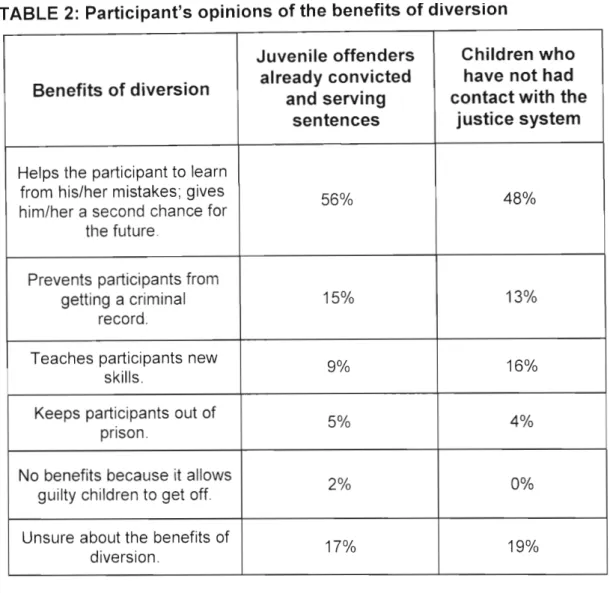
Table 2 outlines the responses of the participants to the question {What would be the benefits of diversion for a child arrested for committing an offence?,25
24 Diversion in South Africa, A review of policy and practice, 1990-2003.
www.iss.co.za/pubs/papers/79/Paper79.html.
25Diversion in South Africa, Areview of policy and practice, 1990 2003. www.iss.co.za/pubs/papers/79/Paper79.htm
TABLE 2: Participant's opinions of the benefits of diversion
Juvenile offenders Children who Benefits of diversion already convicted have not had and serving contact with the
sentences justice system Helps the participant to learn
from his/her mistakes; gives 56% 48%
him/her a second chance for the future.
Prevents participants from
getting a criminal 15% 13%
record.
Teaches participants new g% 16%>
skills.
Keeps participants out of 5% 4%
prison.
No benefits because it allows 2% 00/0
guilty children to get off.
Unsure about the benefits of 17% 19%
diversion.
Eighty-three percent of the juvenile offenders who attended the workshop were offered diversion. They were of the opinion that had they received one of the diversion options outlined in the Bill, it would have assisted them to change their lives. The juvenile offenders that were not offered diversion felt that if they had been given the opportunity of diversion when they first committed an offence, they:26
• Would have changed their behaviour as they would have realised what was wrong with their behaviour;
• Could have learnt skills in making decisions and the consequences of the crime committed;
• Could have completed school and could have achieved some other ambition;
26 Diversion in South Africa, A review of policy and practice, 1990-2003.www.iss.co.za pu bs/papers/79/Paper79. htm
•
•
Could have spent their time better than spending time in prison;
and
Would have had a more meaningful life.
From the above responses of the participants at the workshops by NICRO it is clear that diversion programmes may have a positive effect on various aspects of the juvenile offenders' lives. 27
Very little criticism can be levelled against the diversion process except for the fact that it results in 'net-widening'" in that more people are being involved in the remedial process and the scope of it is more invasive.28 Diversion can in no way be regarded as being "soft on crime" as the diversion process makes provision for the juvenile offender not only to understand the impact of crime on others but also provides for retribution.29
2.4 CASE LAW AND THE SOUTH AFRICAN LAW COMMISSION'S ISSUE PAPER ON JUVENILE JUSTICE 30
Due to the fact that the issue of diversion is an option that can only be considered by the prosecutor, very few cases are reported on this issue in the law reports. The power to institute and conduct criminal proceedings is vested in the prosecuting authority. The function of the prosecuting authority is to institute and conduct criminal proceedings and to discontinue criminal proceedings.31 In terms of s 32(1)(b) of the National Prosecuting Act 32 of 1998 'no organ of State and no member or employee of an organ of State or any other person shall improperly
27 Supra. Diversion in South Africa, A review of policy and practice, 1990-2003.
www.iss.co.zapubs/papers/79/Paper79.htm
28 SCohen Visions of Social Control at 25.
29 What is Diversion?www.capegateway.gov.za/eng/pubs/publicjnfo/W/47586 on 1 and Frequently Asked Questions www.childjustice.gov.za/faq.htm._on 5
30 No. 9, Project 106, 1997.
31 Section 20 of the National Prosecuting Act, Act 32 of 1998 and also E du Toit (ed) Commentary on the Criminal Procedure Act(2006) at 1-4A.
interfere with, hinder or obstruct the prosecuting authority in the exercise, carrying out or performance of its, his or her powers, duties and functions.,32 The High Court will only interfere with a prosecutor's decision
d rt · · t 33
un er ce am clrcums ances.
In the unreported case of M v The Senior Public Prosecutor, Randburg and Another4 an application for review was brought by the mother of a juvenile offender (a girl) who had been charged with shoplifting. The juvenile offender had been convicted of theft after she had pleaded guilty. The review was not brought because of the conviction but on the grounds that the prosecutor had not applied his mind to the possibility of diversion as an alternative option to criminal proceedings. The juvenile offender's co-accused was offered diversion as an alternative option to criminal proceedings which was accepted by her co-accused. The prosecutor was given the opportunity to file papers as to the question on whether or not he had applied his mind in considering diversion in the case before the review court. Unfortunately no papers were submitted by the prosecutor.
The High Court will only interfere with a decision made by a prosecutor if it can be shown that the decision was made mala fide or that it was grossly unreasonable.35
Based on the fact that the prosecutor had not submitted any papers to the review court, the court accepted that the prosecutor had not considered diversion and accordingly found that the prosecutor had not applied his mind to diversion as an option. The conviction was set aside and referred back to the prosecutor to consider diversion as an alternative option to criminal proceedings.36
32 Supra.
33 Supra and also Gillingham v Attorney General 1909 TS 572.
34 Case 3284/00 WLD.
35 The DevelopmentofDiversion Options for Youth Offenders-Policing the
Transformation.www.iss.co.za/Pubs/Monographs/No12/Muntingh.html. See also S vD 1997(2) SACR 673(C).
The case of S v037 was the first reported case that mentioned diversion.
The facts of the case were that four juvenile offenders had been arrested for possession of dagga at 8hOO. The matter was taken to court on the same day and the juvenile offenders were convicted on the same day by 11 hOO. On application for special review it was averred that some weeks earlier a similar matter had been converted which meant that the juvenile offenders concerned did not acquire a criminal record. It was also brought to the court's attention that similar drug related matters had been referred for diversion. The court had no problem with the conviction of the juvenile offenders. The judge found that it was possible the juvenile offenders' rights were not properly explained to them. The judge expressed sympathy for the idea of diversion but the court said that the prosecutor as dominus litis had the discretion to divert the matter or to proceed with criminal charges.
In the case of S v Z en Vier Ander Sake38 an interesting development occurred on the issue of dominus litis. As a rule, magistrates do not interfere with a prosecutor's decision in criminal matters.39 In this case the court suggested that the court should play an active role in the diversion process. The Judge suggested that a court should, before proceeding with a trial against a juvenile offender, advance the referral of a juvenile offender for diversion. Obviously not all cases would be appropriate for diversion but if a magistrate is of the opinion that the matter might qualify for diversion, it should be posed to the prosecutor for consideration.
The above decision is clearly in accordance with s 28 of the Constitution of the Republic South Africa which states that 'the best interest of a child should be paramount'.
36 Sloth-Nielson. J "M v Senior Public Prosecutor, Randburg case no 3284/00(W).
Reviewing the prosecutorial decision not to divert" (2001) 34(3)De Jure 194 at 195.
37 1997(2) SACR 673(C).
38 1999(1) SACR 427 (EC).
39 For example the decision to withdraw charges against an accused person.
It should be pointed out that there are no reported cases where the diversion process was utilised in respect of juvenile offenders that were in custody. The abovementioned cases are discussed to illustrate the development in the diversion process in South Africa.4o
The general rule has always been that magistrates are not to descend into the arena but to remain impartial.41 From the abovementioned case law and the South African Law Commission's Issue Paper on Juvenile Justice it is clear that the role of the magistrate in respect of juvenile offenders is changing. The magistrate may now descent into the arena and may suggest diversion to the prosecutor in cases where juvenile offenders are appearing on criminal charges. This change is for the better as in cases where you have an inexperienced prosecutor, such person may now be guided by the Magistrate to consider the option of diverting the juvenile offender away from the criminal justice system.
2.5 THE CHILD JUSTICE BILL
One of the main objectives in the Child Justice Bill, 49-2002 (here after referred to as the Bill) is to promote and expand the use of diversion in a just and consistent manner.42 It should be pointed out that once the Bill is promulgated as law, for the first time in South Africa all aspects of diversion and the process of diversion will then been legislated. In terms of s 45(1) of the Bill no juvenile offender is to be excluded from a diversion programme due to an inability to pay any fee required for diversion.
The Bill covers diversion in great length in chapter 6. This chapter covers the following issues:
40 It was suggested in the South African Law Commission's Issue Paper on Juvenile Justice, that 'In deciding the outcome of any matter involving a young offender, the
presiding officer should be guided by the principles of proportionality, the best interest of the child, the least possible restriction on the child's liberty and the right of the community to live in safety'.
41 S vMsithing2006(1) SACR 266(N) and also Sv Jaipa/2005(1) SACR 215 (CC).
42 Wood, CDiversion in South Africa. A reviewofpo/icy and practice, 1990 2003www.iss.co.za/pubs/papers/79/Paper79/html.
•
•
•
The purpose of diversion, 43
when diversion can be considered,44
the minimum standards applicable to diversion and the diversion options,45
• the development of diversion options and record keeping of juvenile offenders who have been involved with diversion,46
• the diversion options,47
• the referral of a child in conflict with the law to a family group Conference,48 and
• the referral of a child in conflict with the law to victim-offender mediation.
Section 40 is applicable in the event that a juvenile offender fails to comply with a diversion order and s 39 gives guidelines to prosecutors in considering diversion.
Section 44 covers the circumstances under which a juvenile offender has to be considered for diversion. The circumstances are the following:
• the juvenile offender voluntarily acknowledges responsibility for the offence;
• he or she understands his or her right to remain silent;
• he or she has not been unduly influenced to acknowledge responsibility;
• there is sufficient evidence to prosecute; and
• the juvenile offender and his or her parent or appropriate adult consent to diversion and the diversion option. 49
43 Section 43.
44 Section 44.
45 Section 45.
46 Section 46.
47 Section 47.
48 Section 48.
49 Appropriate adult according to the Bill"means any member of a child's family or a custodian or guardian of a child but excludes a parent or a primary care- giver as
This implies that diversion can only be considered if there is a parent or appropriate adult to consent to diversion. In the programmes that are offered by the Department of Social Welfare the requirement of a parent or appropriate adult does not play a role. It is submitted that this is the correct approach as the fact that the child has no parent or appropriate adult should not be held against him or. her and should not be a factor to exclude him or her from the possibility of being diverted away from criminal proceedings.
The Bill makes provision for the following diversion orders:
• A supervision and guidance order
This involves placing a child under the supervision and guidance of a schoolteacher, a probation officer, a social worker, or a community member etc also referred to as a mentor or a peer role model.
• A reporting order
This order requires a child to report to a specified person (e.g. police officer, school principal, probation officer etc.) When and how often the child has to report depends on the magistrate.
• A compulsory school attendance order
This order requires a child to attend school every day for a specified period of time. Their attendance must be monitored by a specified person.
• A family time order
This order requires a child to attend a specified number of hours with his/her family. Activities such as attending church, spending time at home or assisting with household chores may be specified as part of this order.
defined in section 1 of the Social Assistance Act, Act 59 of 1992".