
This study examined the lives of ten school leavers who were in the special class at the school in Durban, KwaZulu-Natal. Where other people's work has been used, it has been duly acknowledged in the text. That is why the special classes were referred to as adjustment classes in the former House of Representatives Department of Education (Colored Education Department).
A psychologist had to evaluate the students and approve special class placement after the school made referrals. These students were labeled Educable Mentally Retarded (EMR) in the US, Educationally Subnormal (ESN) in the UK and mildly mentally retarded in South Africa. At the school, some students from the special class stay in the facility until the age of 13.
The study explored the life histories of high school dropouts who were in a special education class at the school where I teach. I believe that the findings of my study could contribute to the implementation of the inclusive education policy that is now being implemented in the provinces.
LITERATURE REVIEW 2.1 Introduction
- Theoretical Framework for the Study
- Conclusion
- Developing an interview guide
- Interviews
- Data analysis
- Conclusion
The other theory that I also feel informs my study of the life stories of special grade students is critical theory. In studying the life stories of dropouts from particular classes, these are the issues I wish to investigate. The results of the interviews were then analyzed in terms of school history, employment standards, and post-secondary education and training experiences.
The purpose of the study was to investigate why special education learners leave school. This study is located within the interpretive paradigm - the aim is to understand the lives of the ten participants. The use of the interpretive paradigm therefore enabled me to investigate the subjective experiences of the participants, and it enabled me to understand those experiences through interaction with the participants in the interviews.
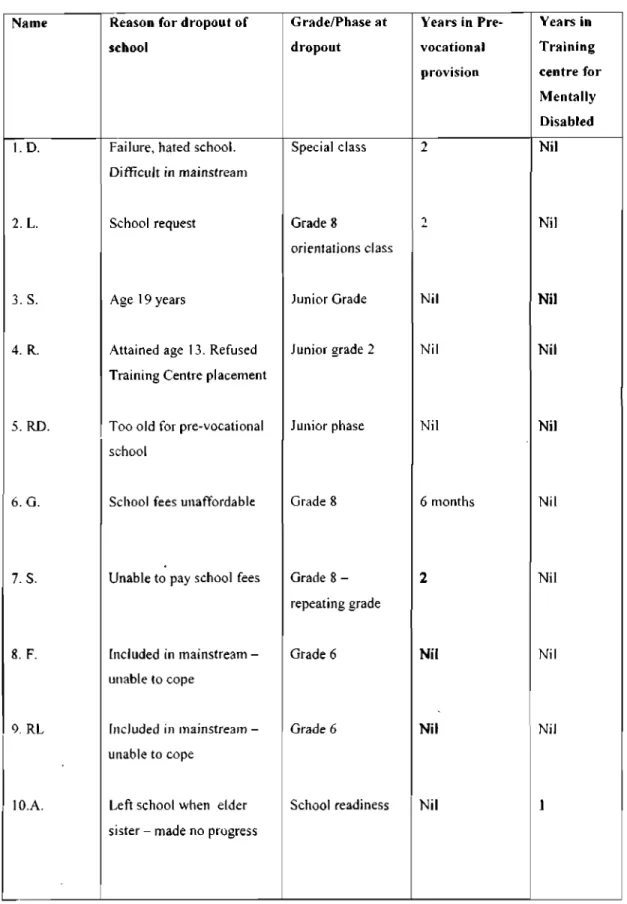
For example, I could not trace some of the students at all; some fell outside the age group and those who were from the orphanage in the area. She had been placed in the gym and left the school never to return when her older sister dropped out. The aim of the study was to explore the life history of ten school pupils from the special class.
His mother objected to some of the information he gave, and this made it necessary for me to include his mother in the interview.
ANALYSIS AND DISCUSSION OF FINDINGS 4.1 Introduction
Analysis of the Ten Life Storie
The white kids were clearly privileged The white kids bullied us, when we retaliated, the male teacher only listened to the white side of the story."). Experience of support ("Most teachers were helpful and nice - just the one in the special class made me play with blocks."). Teacher's positive attitude ("The teachers were nice in elementary school. They encouraged me to work well, and they motivated me to make something of myself. I missed my friends and kindness from teachers.") .
Parental concerns ("Larry is so bored at home. The school should have trained them to do something."). Negative attitude towards school ("He went to school late and didn't want to go because he hated it."). She alone refused admission to the training center because she perceived the students there as "crazy". has poor social skills, she has no friends and is unable to go out alone.
Negative attitude toward placement ("I was tired of the special class, doing the same things over and over."). Stigmatization ("The kids always teased me because I was too big for the class and I couldn't cope."). She answered our questions and listened to us.”) Frustration at school (“I had to wear shorts when I was that big. My friends left me and went to high school.”).
Teacher responsive to the child's needs ("My special class teacher helped me a lot and gave me bread to take home."). School fees a barrier ("The school gave us letters for school fees, they wanted too much. I couldn't afford it, so I left school."). Stigmatization and stereotyping ("When we travel on the bus, students from other schools tease you and say you're from the wrong school.").
Dissatisfaction with school ("We pulled her out of school because she couldn't cope and because of the teasing."). Challenges of inclusion in the mainstream ("The work was too hard. The teachers yell at you if you are slow."). Stigmatization and stereotyping ("She was old for 6th grade. She was teased because she was shy and withdrawn.").
The challenges of schooling ("She could not cope in the mainstream or special class, even though an individual plan was devised for her." She did well at the training center, and learned to write and recognize some letters. Impact of emotional trauma in the home ("She refused to go to school when there was violence in the home. She clung to me.").
Discussion of Findings
- Parents/caregivers and emotional concerns
- Accessing help and support
- The complexities of life after school
Nine of the ten parents or carers reported emotional difficulties they experienced in getting involved, both at the school stage and in the post-school years of the participants. Difficulties included the shock and strong emotions evoked upon discovering that their children were 'not normal'; the unresponsiveness of the school to the child's needs, poor job opportunities, low income at sheltered workshops, exclusion from school; frustration about school failure and repetition; lack of support from the school to meet the child's needs, dependence on social welfare allowance from the government. Eight of the carers and parents tried to access help and support for their children during the school years, and after their children left school.
A parent complained about the unsatisfactory nature of teaching and learning at the school in the hope that help might result. Unfortunately, this led to further marginalization of the child by the teacher. The child struggles in school, is quickly labeled because he or she cannot cope in the classroom, and this.
As mentioned earlier, the term 'curriculum' is used broadly in this study to include the ethos and culture of the learning environment; the learning programs; teaching practice; how learning outcomes are assessed; learning materials, facilities and equipment available; the medium of teaching and learning; the capacity of educators; I wanted to do things." Two of the participants left school because of the pressure the school put on paying school fees. Of the ten participants, five suggested that there were a few teachers who supported them at school.
The report of the National Commission for Special Needs in Education and Training and the report of the National Commission for Education Support Services (Department of Education, 1997), which emphasize the need for a social rights model for disability and learning difficulties, suggests that one of the The biggest barriers to learning and participation in school, community and society are negative attitudes and stereotypes. In the case of the participants in this study, experiences with negative attitudes come from peers, teachers and caregivers. For some participants, the policy of establishing special classes in primary schools was the cause of the problem.
Nine participants are dependent on social assistance of R700.00 for their survival. The vulnerability of the high school graduates to social risks is reflected in the fact that one of the women was a victim of rape in the community. The study showed that only one in ten participants is engaged in a form of self-employment: "I have many clients.
Conclusion
All participants have goals and aspirations for a better life ranging from gaining job skills, going back to school, going to university, getting a job, wanting friends, gaining work experience. Perhaps there is a need for a more large-scale study to investigate the extent of the problem raised in this study so that it can be addressed in the context of the implementation of Education White Paper 6 which is currently underway.
CONCLUSION AND IMPLICATIONS
Report of the National Commission for Special Needs in Education and Training (NCSNET) and the National Commission for Education Support Services (NCESS). Transition from school to adulthood: case studies of adults with learning disabilities who have left school, exceptional children.
