The overall aim of this study was to examine the relationship between media independence and the legal, economic and political environment in contemporary Ghana. Legally, it examined the impact of media laws and the fourth republican constitutional provisions on the independence of the media, and finally, it assessed the independence of the Ghanaian print media from the perspective of standards and professionalism.
SUMMARY, CONCLUSION(S) & RECOMMENDATIONS 199-208
Some Successes of the Fourth Republican Constitution
Despite Ghana's checkered past with regard to press freedom (Temin and Smith Media Monitor, 2004:5), the 1992 constitution that removed controls on the press (Prompted and devoted an entire chapter to media freedom and independence (Alhassan as described above in Table 1, meant that the media landscape was liberalized (African Media Barometer [AMB], 2011:5). Ghana's informal environment began to expand due to the liberalization of the press in ways that were previously unimaginable considering its media history (Amoakohene, 2004:26).
Some Drawbacks
Control over media tightens in the event that Ghana's Registrar Generals Department is given a mandate to register all businesses, including media bodies, to pay taxes without recognition of the public watchdog role of the media. For example, the First National Democratic Congress (NDC) government refused the media's request to be provided with copies of the opposition New Patriotic Party's (NPP) budget proposals until a court order instructed otherwise after the NPP sued and the matter (Morrison, 2004:437).
Media funding: Relations with media independence
The above scenario does not erase the fact that the state-owned media is free from funding problems in the history of its establishment in Ghana. Overall, it can be said that the state of Ghana's media and its audience has changed with the variations in the political landscape.
Objectives of the thesis
Research Questions
Delimitation
Significance
Space is given to the role of media owners as strategic partners in financing issues. This chapter reviews the literature related to the issues of media independence, with a focus on Ghana's Fourth Republic.
Concept of Freedom
In the absence of the press, "society would remain in the darkness of ignorance" (Mohd Sani, 2004:343). Consequently, any form of control of the press means direct control of citizens' freedom of speech (Mohd Sani.
Media Independence: Defining the Concept
McQuail refutes this claim by arguing that notions of media independence should be an ongoing and practical activity. In general, it can be concluded that media independence is related to the interaction of both direct (internal) and remote (external) stakeholders of a given society.
Previous Studies
In order to scrutinize the Southern African Development Community's (SADC) developing democracy, Balule (2008) examined the impact that libel laws have on media freedom. Professionalism has been cited by several scholars as one of the factors hindering the development of media worldwide.
- Media Accountability and Responsibility: An Obligation of Freedom
- Media Ethics, Standards and Professionalism
Mohd Hamdan Adnan (2003) observed that there are six roles of the media at the level of society. The concept of media responsibility has its roots in the theory of social responsibility based on the 1947 Report.
- Socialist governance and the press
Kwame Nkrumah, the first President of the Republic of Ghana, considered himself a thinker and doer. The commercialization of the private press was opposed as politically irresponsible, and so the private newspapers were harassed.
Media Ownership and Control
- Media Ownership in Africa
Basically, the independence of the media was completely compromised under this system, because the space to act freely was completely closed. This seems to "counter the much vaunted claim that the media are neutral institutions that have severed ties to sectoral interests" (Curran, 2002:130). Regarding the important position of the media, governors may wish to either control or influence the spread of information from the media reaching their citizens.
Governments in poorer countries tend to own the media and their regimes are autocratic and, above all, own the state economy.
Advertising Defined
- Advertising as a Funding Source
- Media Commodification, Profitability and Consumption
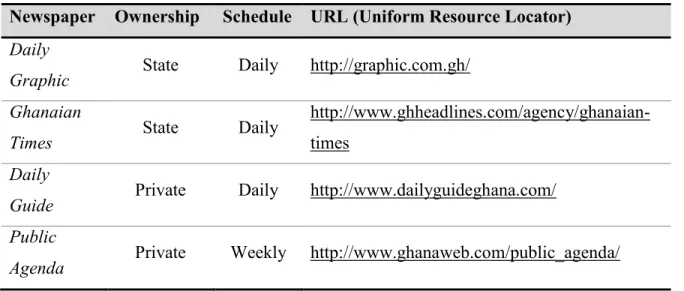
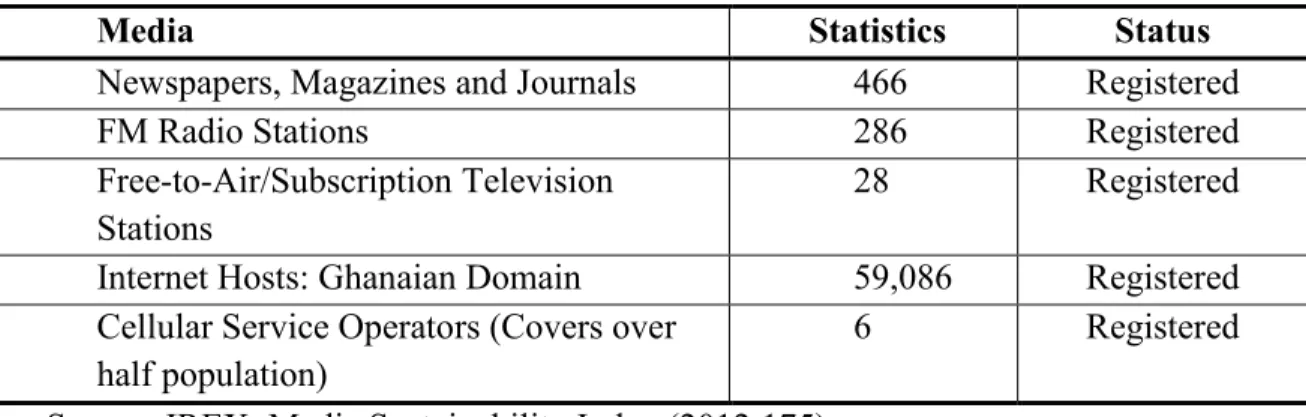
How these priorities are arranged depends on the media owners and their employees. It started in Sierra Leone in 1801 with the publication of the Royal Gazette.” (Wilcox, 1975:1; Jones-Quartey, 1974:1) A handwritten article, the Gold Coast Gazette, was published in Ghana (then the Gold Coast) twenty-one years later. At the beginning of the Fourth Republic (1992), Ghana witnessed a rapid increase in the number of privately owned media, leading to a rapidly developed number of tabloids amid the existing two state-owned newspapers (Morrison, 2004: 437).
Due to unaffordability of print media by ordinary members of Ghanaian society (AMB a newspaper bought by one person will, however, be read by several people (Temin and Smith thus form a network of tens to hundreds of readers (Hasty, 2005:1).
Media Regulatory Institution(s) and Advocacy / Professional Groups
- NMC Composition and Formation
- Ghana Journalists Association (GJA) and Private Newspaper Publishers Association of Ghana (PRINPAG)
Historically, the idea of establishing a press council was conceived and implemented in the Scandinavian region of Norway and Sweden in 1912 and 1916 respectively (Morgan and by 1985 there were 22 non-local press councils in eighteen countries, which quickly expanded to include Canada (Balk, 1989: 66). The mandate (function) of the NMC is to establish and maintain the highest standard of journalistic practice in the mass media and to investigate, mediate and resolve cases brought against the press or others. The National Council of the GJA formally adopted its Code of Ethics in Sunyani (27 .July 1994).
The GJA Code of Ethics is mandatory for state and private media as well as for independent professionals.
International Media Bodies/Protocols
- Windhoek Declaration (1991)
GJA is now affiliated with several international media organizations such as the Association of West African Journalists in Dakar, the Federation of African Journalists (FAJ) and the International Federation of Journalists in Brussels, (IFJ) (GJA, 2012:35). The declaration states that “the worldwide trend towards democracy and freedom of information and expression is a fundamental contribution to the fulfillment of human aspirations. At the 32nd Ordinary Session of the African Commission on Human and Peoples' Rights (ACHPR) convened in the Gambian capital Banjul on 17 October 2002, the Commission adopted the Declaration of Principles on Freedom of Expression in Africa (Mendel, 2011 : 50).
Diversity and pluralism increased from 1991, but the flaws in the declaration have outweighed the benefits.
Regulatory Environment of Media: Survey of Media Law
It is claimed that a "pluralistic press" means "the end of monopolies of all kinds and the existence of the greatest possible number of newspapers, magazines and periodicals reflecting the widest possible range of opinions within the community." The requirements of the Press Acts at the time were that the editor should send to the Colonial Secretary the total circulation and title of the paper, its offices, printers and publishers; and that the printer must print the name and address on the first and last pages of the newspaper. Bond (1997) deduced that the essence of imposing the above-mentioned press laws was to enable the colonial administration to easily identify publishers and locate their publication locations, and to determine the circulation range of those newspapers in order to monitor critical newspapers .
This may be due to Hachten's observation that Ghanaian journalists, lawyers and generally educated elites believe in the notion of critical and independent journalism, hence the importance attached to freedom of the press is seen as an extension of the cultural heritage from Britain that informed Ghana. common law system and influenced his educational approach.
Post-Independent Ghana and Press Laws
Busia repealed the Newspaper Licensing Act in 1970, but at the same time ousted the editor of the Daily Graphic (Faringer, 1991:47). However, in subsequent years, Ghana's transition to democracy required some fairness in media regulation. This ushered in the establishment of the NMC and NCA through the Constitution as explained above.
The NMC remains the highest media regulatory body in Ghana and it is a product of the Fourth Republican Constitution.
Theoretical Framework
- Globalisation
In their propaganda model based on the political economy of the United States mass media, Herman and Chomsky theorized using the following news. The notion of "political economy of news", for example, seeks to link the publication of news with the economic position of the media entity itself (Zelizer, 2004:77). Globalization has been defined as "the compaction of the world and the intensification of the consciousness of the world as a whole" (Robertson, 1992:8).
Moreover, it assumes that issues of ethics form an inseparable component of the forces on the media within a defined political economy of the media.
Data Collection Sources
This was to draw conclusions on the subject of media independence in Ghana under the Fourth Republic from the perspective of funding, ownership, legality/regulation and professionalism/standards. The term is therefore used to represent information that has been collected primarily for a specific purpose (Churchill Jr. and Iacobucci, 2010:171). In contrast, secondary data is that which is mainly collected for another purpose, usually by someone other than the researcher (Montello and Sutton, 2006:36).
While the primary source is credited as the source from which said data originated, the secondary source is a repository of the data from the original source (Churchill Jr. and Iacobucci, 2010:171).
Qualitative / Quantitative Research
- Qualitative and Quantitative: Merger or Dichotomous Debate
In contrast, [q]quantitative research involves experiences (such as randomized control trials (RCTs)) and studies where data are collected using standardized methods such as questionnaires and structured interviews. The data is in the form of numbers from which statistical generalizations can be made” (Meadows, 2003:520). Quantitative data is thus defined as empirical information that comes in the form of numbers, generated by measurement.
By justifying the value of its use, quantitative research allows the researcher to become familiar with the problem or issue to be studied and further creates the opportunity for generating hypotheses to be tested (Golafshani, 2003: 597) .
Content Analysis: What Is It?
- Media Content Analysis: The Roots
- Applicability of Qualitative and Quantitative: Revisited in line with Content Analysis
- Content Analysis: Procedural Measures
The popularity of media content analysis grew rapidly in the 1920s and 1930s as a method to study the communication content of film. No wonder, for many decades, content analysis has been considered one of the most cited. As indicated above, content analysis can come in various forms such as visual, verbal, graphical, or oral.
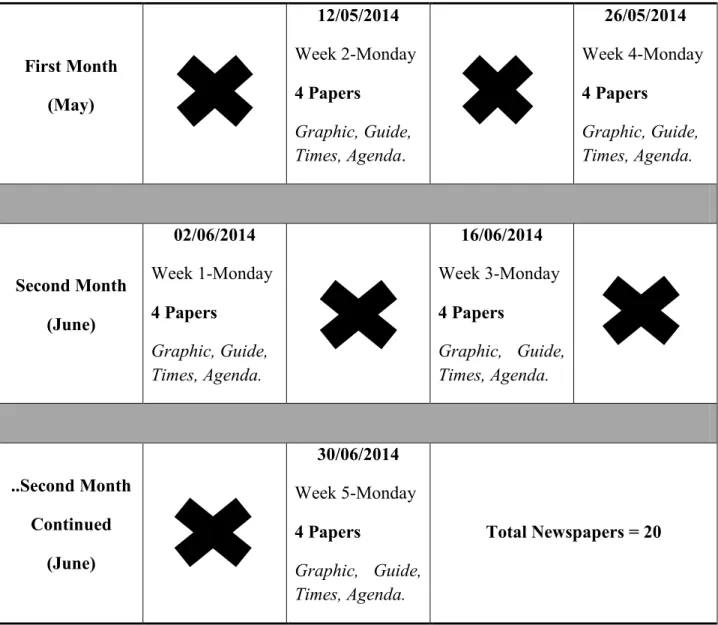
A typical flowchart depicting the process of content analysis research by Neuendorf (2002) was adopted for this exercise (cited in Mcnamara.

Theory &
Sampling
Training &
- Sample Size for Newspapers
- Sections of Content Selection for Newspapers
- Framing and Agenda-setting: Determinant of Media Independence .1 Framing
- Agenda Setting
- Reliability and Validity Differentiated
- Reliability
- Inter-coder Reliability
- Validity
- Thematic Analysis: What Is It?
- Interviews
- Sample Size for Interviews
- Thematic Analysis: Procedural Measures
- Interpreting Data and Presentation
- Ethical Considerations
- Limitations
- Results
- Newspaper Funding through Advertising
- Justification: Advertising Allocation Gap
- Media Funding Versus Agenda-setting / Framing
- Newspaper Categorisation and Agenda-setting
- Conclusion
- Introduction
- Results
- Discussion
- Conclusion
- Introduction
- Results
- Discussion
- Conclusion
- Introduction
- Discussion
- Conclusion
- Results
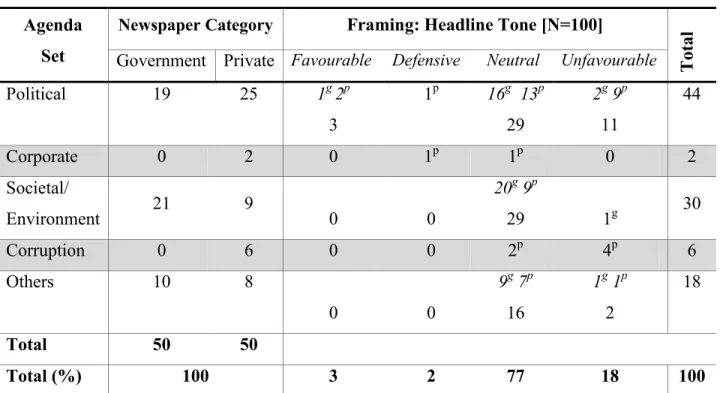
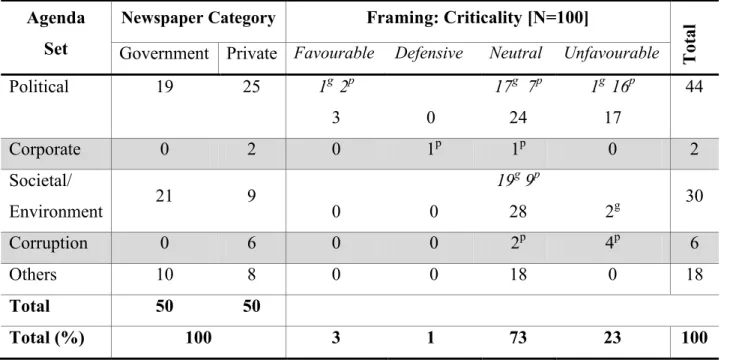
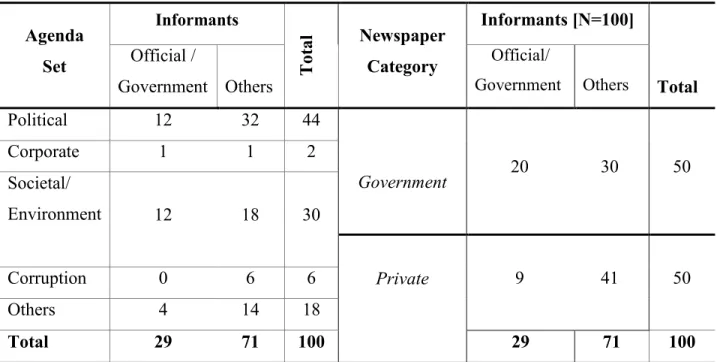
In addition, an external manipulative role in the functioning of the media by the government and business entities cannot be ruled out in the allocation of advertisements. Of the nineteen (19) political stories headlined in government newspapers, one (1) was framed as favorable, two (2) unfavorable and sixteen (16) were framed as neutral. In terms of categorization, the study found that out of the twenty-nine (29) official sources of government information, government newspapers recorded twenty (20) while private newspapers recorded only nine (9).
Content published in the media landscape tends to fulfill the personal agenda of the owner. These are some of the legal deterrents to freedom of speech and freedom of the media. Now there is a diversity of media, but media freedom comes with responsibility.