· Trto7-
'=>5"
::ti;. b . I'J'lct'104-'1 .
The Politics of Planning in Eastern Cape Local
Government:
A Case Study of Ngqushwa and
Buffalo City 1998 - 2004
This thesis is submitted in fulfilment of the requirements for the degree of Master of Arts of Rhodes University by
Glenn Delroy Hollands
January 2007
ABSTRACT
This thesis examines the political implications of the integrated development planning process embarked upon by South African municipalities in the period 1998-2004. Through the use of case study methodology that focuses on the Eastern Cape municipalities of Buffalo City and Ngqushwa, the conventions of municipal planning are examined. This inquiry into municipal planning draws upon official government documents and reports and publications from the non- government sector. The thesis is particularly focused on the claims made in policy documents and related secondary sources and compares these to more critical reports and publication as well as the author's personal experience of the integrated development planning process. Of key interest is the possibility that planning serves political interests and the material needs of an emerging municipal elite and that this is seldom acknowledged in official planning documentation or government sanctioned publications on the topic. The primary findings of the thesis are as follows:
• That the 'reason' of expert policy formulations that accompanied integrated development planning has weakened political economy as a prism of understanding and separated itself from the institutional reality of municipal government
• That the dominant critique of planning and other post-apartheid municipal policy is concerned with the triumph of neoliberalism but this critique, while valid, does not fully explain successive policy failures especially in the setting of Eastern Cape local government
• That function of policy and its relationship to both the state and civil society is usually understood only in the most obvious sense and not as an instrument for wielding political power
• That planning still derives much of its influence from its claim to technical rationality and that this underpinned the 'authority' of the integrated
development planning project in South Africa and reinforced its power to make communities governable
Acknowledgements
lowe thanks to Josef Pampalk and Leslie Bank who first urged me to undertake this paper. Rosie Smith became enthused by the idea and linked me up with Dr Peter Vale who provided both encouragement and a much needed theoretical foundation to the paper. Dr Greg Ruiters had the unenviable task of supervising a scholar who had not seen the inside of a lecture room for more than seventeen years and provided an unusual combination of academic experience and contextual knowledge on local government. Afesis-corplan made a generous contribution towards the costs of my studies and my partners at Mbumba Development Services showed patience when my input into the company was very limited. My wife
Barbara was constantly positive about my efforts and did the school run when I was battling with a chapter. My daughter Anya forfeited surfing lessons and time on the computer. Lastly Rentia Ellis proved endlessly patient in helping with the format of the paper.
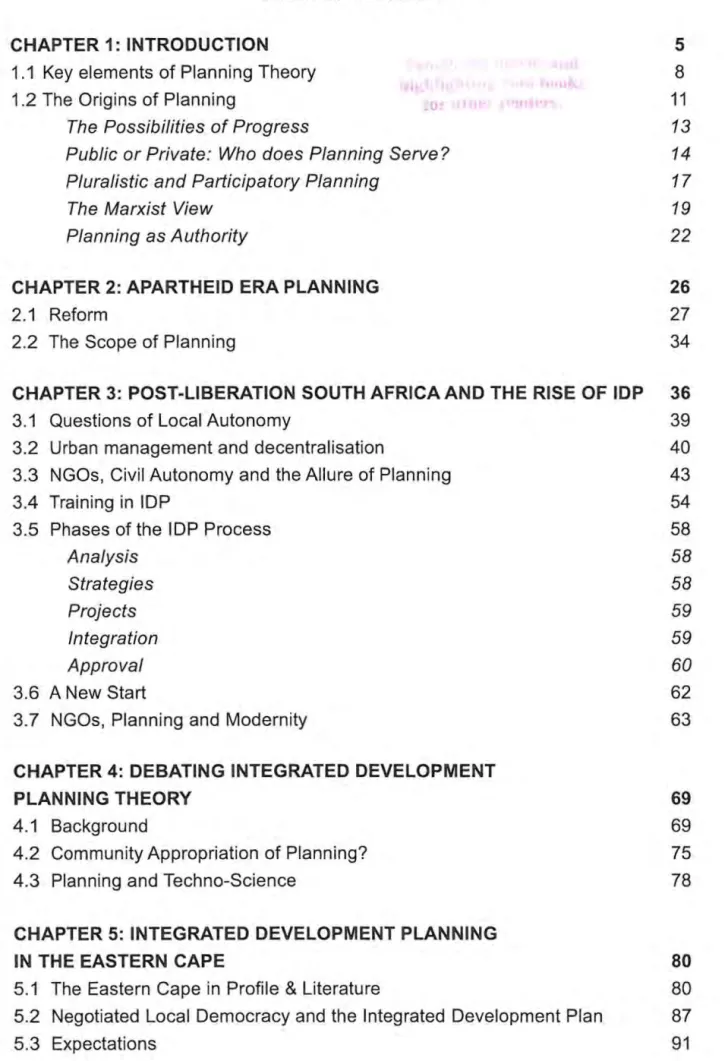
TABLE OF CONTENTS
CHAPTER 1: INTRODUCTION 1.1 Key elements of Planning Theory
1.2 The Origins of Planning
"
'a r , • I;5 8 11
The Possibilities of Progress 13
Public or Private: Who does Planning Serve? 14
Pluralistic and Participatory Planning 17
The Marxist View 19
Planning as Authority 22
CHAPTER 2: APARTHEID ERA PLANNING 26
2.1 Reform 27
2.2 The Scope of Planning 34
CHAPTER 3: POST-LIBERATION SOUTH AFRICA AND THE RISE OF lOP 36
3.1 Questions of Local Autonomy 39
3.2 Urban management and decentralisation 40
3.3 NGOs, Civil Autonomy and the Allure of Planning 43
3.4 Training in lOP 54
3.5 Phases of the lOP Process 58
Analysis 58
Strategies 58
Projects 59
Integration 59
Approval 60
3.6 A New Start 62
3.7 NGOs, Planning and Modernity 63
CHAPTER 4: DEBATING INTEGRATED DEVELOPMENT PLANNING THEORY
4.1 Background
4.2 Community Appropriation of Planning?
4.3 Planning and Techno-Science
CHAPTER 5: INTEGRATED DEVELOPMENT PLANNING
69 69 75 78
IN THE EASTERN CAPE 80
5.1 The Eastern Cape in Profile & Literature 80
5.2 Negotiated Local Democracy and the Integrated Development Plan 87
5.3 Expectations 91
CHAPTER 6: BUFFALO CITY MUNICIPALITY INTEGRATED DEVELOPMENT
PLANNING FROM 2002 - 2006 94
6.1 Institutional Approach 95
6.2 Process 96
6.3 Priority Issues 98
6.4 Managing Performance 106
CHAPTER 7: lOP PLANNING IN NGQUSHWA 117
7.1 Municipal Demarcation 1998-2000 119
7.2 lOP in action: Ngqushwa 137
7.3 Planning and Municipal Finances 147
7.4 Affordable Staffing 152
7.5 Public Scrutiny of Municipal Finance 157
7.6 Borrowing the Jargon of Space and System 158
7.7 Local Perceptions and Understanding versus Scientific Information 160
7.8 Corruption 166
7.9 Conclusion 170
CHAPTER 8: CONCLUSIONS 173
LIST OF TABLES
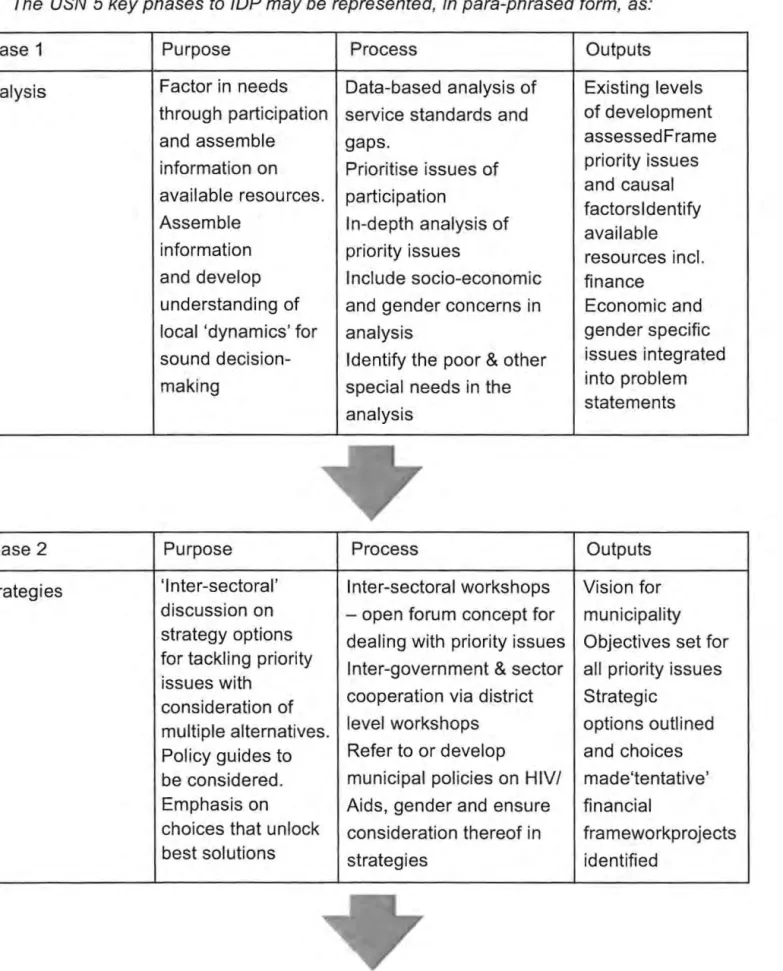
Table 1: Phases of lOP - Urban Sector Network 58
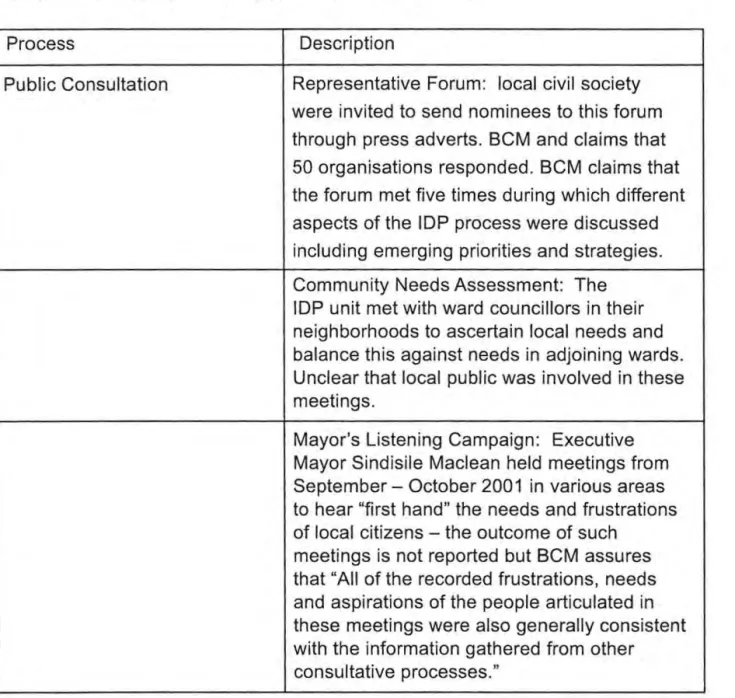
Table 2: The Planning Process in Buffalo City 96
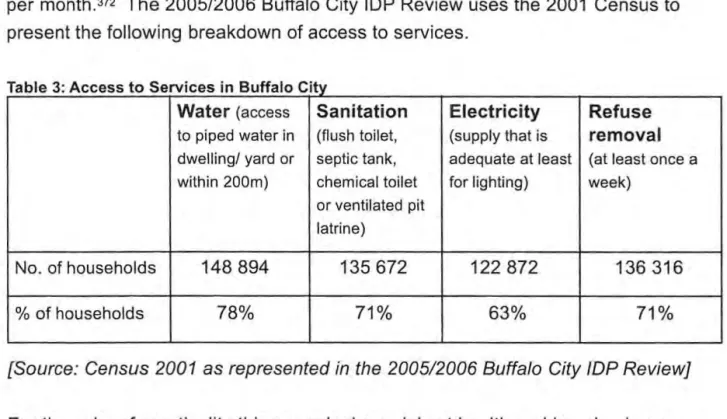
Table 3: Access to Services in Buffalo City 98
Table 4: Settlement Types in Buffalo City 101
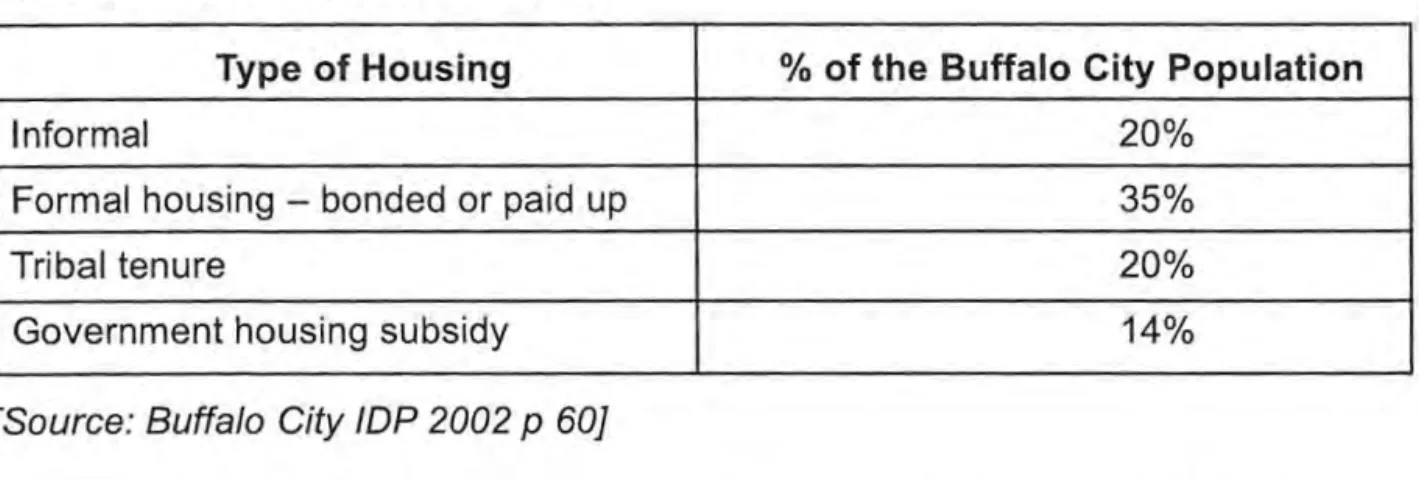
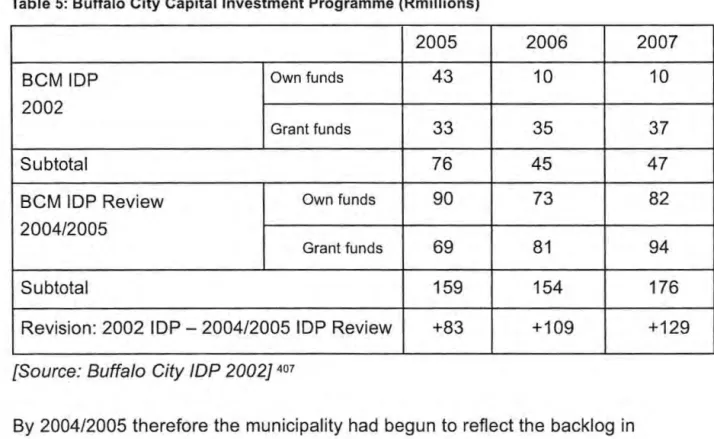
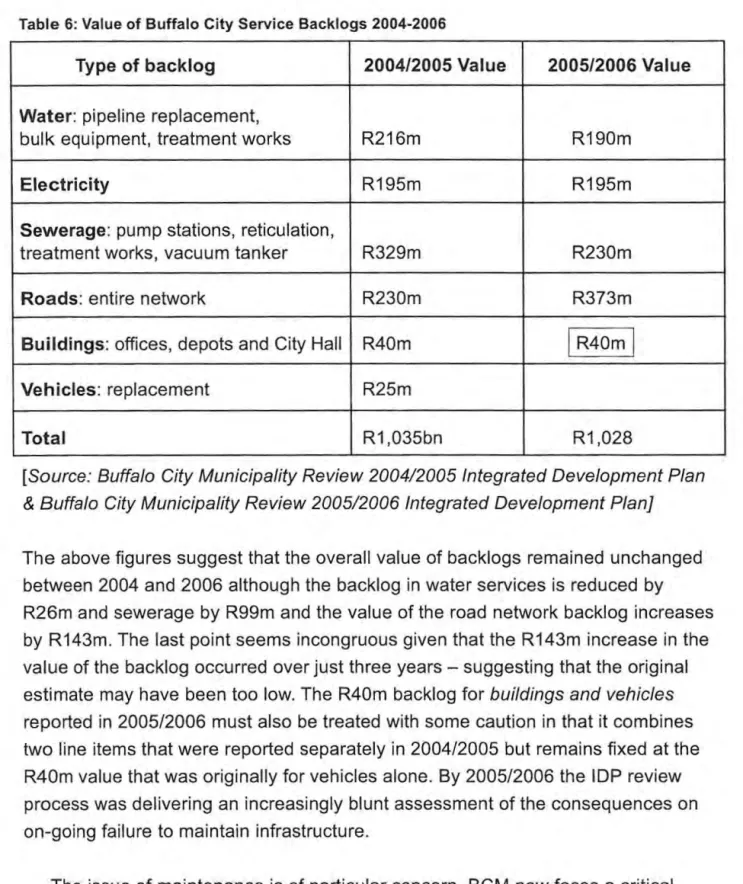
Table 5: Buffalo City Capital Investment Programme (Rmillions) 104 Table 6: Value of Buffalo City Service Backlogs 2004 - 2006 105
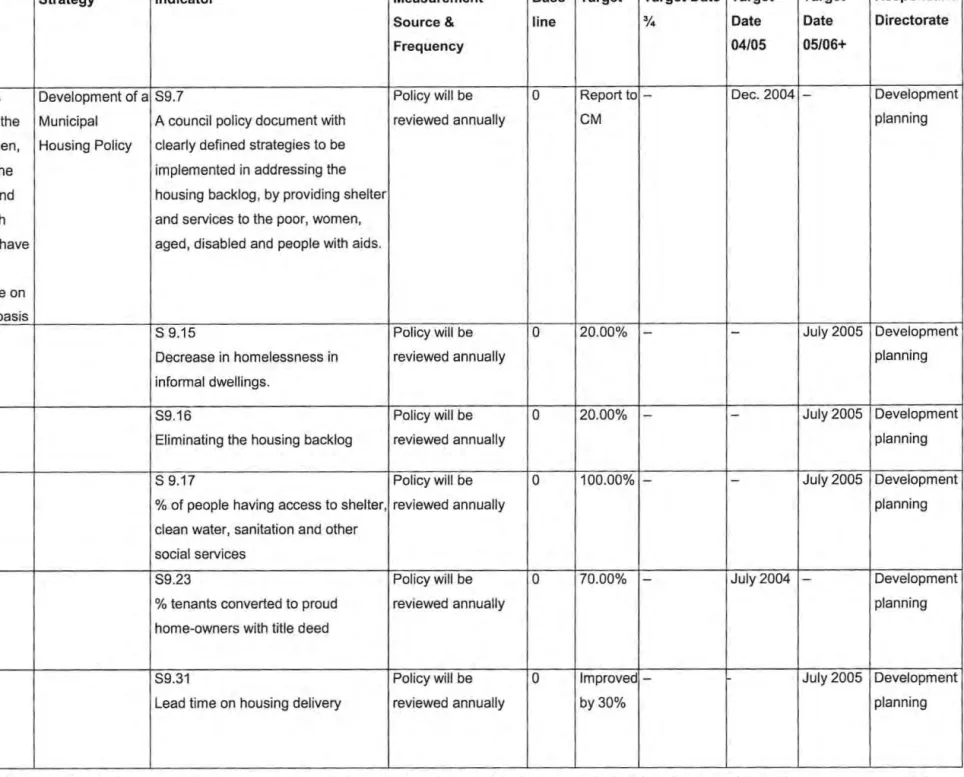
Table 7: Buffalo City Housing Scorecard 2002 108
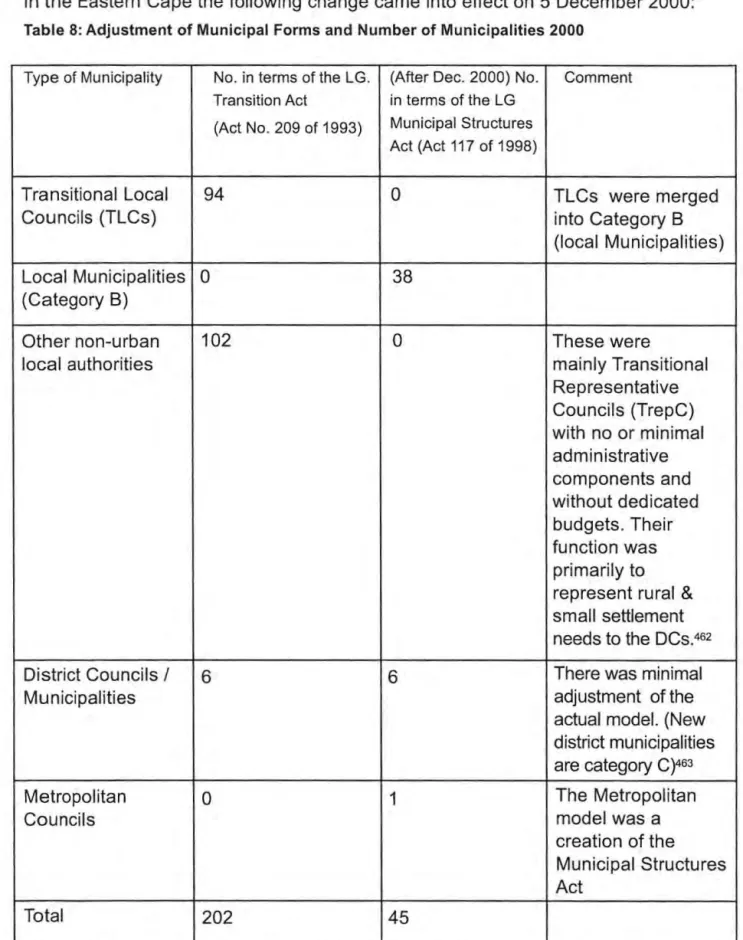
Table 8: Adjustment of Municipal Forms and Number of Municipalities 2000 118 Table 9: Example of the representation of a 'Development Need' - Electricity 140 Table 10: Intergovernmental Transfers as a Percentage of Total Income:
Hamburg Transitional Local Council 1994 - 1997 148
Table 11: Comparison of Increases: Bulk Services and Salaries 1999 - 2003 149 Table 12: Sources of Funding Ngqushwa Municipality 2002 150 Table 13: Services Subsidies: Hamburg Transitional Local Council 1999 151 Table 14: Ngqushwa Municipality 5-year Institutional Action Plan 154 Table 15: Respondents to Afesis-corplan Governance Survey 1999 165
CHAPTER 1: INTRODUCTION
This paper will analyse change in the procedures for planning in South African local government from 1998 to 2004 and the manner in which this change is represented in the dominant literature and policy instruments. The research will draw upon both political and social theory to explore how local government practice, particularly in the Eastern Cape and especially that practice that relates to Integrated
Development Planning, falls short of the standards and practice prescribed in national policy developed by the state between 1995 and 2002. It will investigate gaps between the "ideal" i.e. the predominant policy framework of the time and the
"reality" experienced by local municipalities and various sectors of civil society. It will also explore at a theoretical level, the manner in which planning is represented by the state and non-government organisations (NGOs) and specific instruments and models that fall within an approach known as Integrated Development
Planning.
The term 'a local government policy framework' embraces a huge range of legal and administrative instruments and less formal 'guidelines'. Policy for local government is contained in the Constitution, the White Paper on Local
Government, two national laws relating to institutional matters and operations (the Municipal Systems Act and the Municipal Structures Act), and the Demarcation Act (which has not just shaped municipal space but patterns of institutional power and responsibility within that space.) There are laws governing municipal finance and draft legislation on the imposition of property tax. Then there is national level legislation by other line departments on the environment, transport, energy and its usage, bulk water supply and a host of other matters. In addition there is a different sphere of policy framed by provincial ordinances that give more substance to national frameworks and bring a regional specificity to policy design (although the import of these ordinances has been greatly reduced by overarching national legislation.) Lastly there are the internal policies, by-laws and regulations of particular municipalities that give a final form and character to policy before it is enacted and experienced by the public.
The new political and civic leadership were responsible for shaping these laws after 1994 had been confronted with the very palpable challenge of turning around a set of largely discredited and certainly unpopular societal values and norms that shaped apartheid South Africa. For the post 1994 South African leadership, the dominant value system, at least overtly, were the norms and principles of
democracy, non-racialism and social equality that for several decades prior to 1994
bound them together in their mission to overthrow the apartheid state.1 The status quo they confronted was a society shaped by state violence, government enforced segregation, gross economic inequality and racial suspicion and hostility. What made this status quo even more complex were the various political and economic reforms invoked by the apartheid government from about the mid 1970s in an effort to prolong its grip on political power2
For, at the level of administration, policing, and individual consciousness, the legacy of apartheid is likely to persist stubbornly in endless petty and profound ways for many years to come. Breaking it down will require not only educating and empowering the victims of apartheid, but also re-educating its former practitioners, and promoting dialogue between these two groupS.3
Some would argue that in the post-RDP phase, the value system of the elected leadership had been fatally contaminated through a clandestine marriage with neoliberalism incorporating values like 'new realism' in public administration, cost reduction and performance management. Portrayed as a stealthy triumph of the 'New Right', GEAR finds few defenders amongst even centrist analysts and becomes a ready explanation for successive policy failures.4 While undoubtedly bringing a problem of coherence into the policy framework, it is an all too easy to blame GEAR for all forms of weak policy implementation.
It is certainly more politically acceptable to discuss 'impossible' attempts to reconcile irreconcilable social and economic values within policy than to confront the awkward reality that many politically correct policies are nonetheless hopelessly out of kilter with the institutions that are supposed to implement them. An emotive addition to this turbulent mixture of policy, is the suggestion that a return to
sustained consultation, deeper participation, social justice and more enthusiastic partnerships with civil society5 would somehow ameliorate the more objectionable aspects of GEAR. This is to be achieved whilst retaining GEAR's limited but much valued benefits like fiscal savings directed to infrastructure spending, tax cuts for individuals and businesses and a sharply reduced percentage of the budget spent on servicing debt. 6
Research Aims
The research will attempt to describe an unfolding planning framework for local government and its interpretation within the mainstream South African local government policy debate. It will also look at the enactment of policy amongst
smaller non-metropolitan municipalities and in a very limited way draw upon some of the theoretical constructs framed in chapter one, to explain the gap between the ideal and the reality.
In empirical terms, the main point of the dissertation will ultimately be to explore the adequacy and suitability of legislation and policy provisions for local government and the impact of high order technical/scientific interventions that flow from that policy. My main thesis is that these provisions are often ill suited to the operational challenges faced by most non -metropolitan municipalities. As municipal practice falls increasingly behind the objectives outlined in policy, either through neglect,
incompetence or willful abuse, symptoms of a weak state begin to emerge. On the other hand it will also be shown that policy and planning frequently serve, by design or accident, other less disclosed interests. The discourse that has elevated issues of local governance including planning into a realm of techno-science? and scientific management has little bearing on the day-to-day challenges of local governance but may well help to maintain the authority and the credibility of the state and the (local) ruling class. Even when the interests of the latter become antithetical to the broad principles of the local government project, they may be able to manipulate planning and technical interventions to maintain their ascendancy through a new and distorted form of rationality.
The research will also be based on the following methods:
• Highly detailed documentation analysis: The research makes extensive use of the unpublished documentation held by the Local Government Transformation Project at Afesis-corplan, an NGO based in the Eastern Cape, other NGOs around the country and the government agencies with which these NGOs interacted. These documents include NGO and government resource and training materials, official planning guides, policy directives, planning documents including municipal integrated development plans and budgets, media statements, working papers, journal articles and official reports by government & non-government agencies.
• In depth participant observation: The candidate has been deeply involved in the subject under discussion and thus carries an insider awareness of the issues.
This creates the basis for unique insight but also imposes an obligation to be self-aware i.e. to recognise the difficulty of achieving objectivity and the need to constantly clarify the observer's own assumptions and proclivities on the issues.
• Case studies: A case study approach involving Buffalo City municipality and Ngqushwa municipality is used. The term case study is used in the loose sense
that most (but not all) of the illustrative material comes from these two
municipalities. The paper draws out particular issues from each case study on a selective basis and does not purport to offer a full overview of all municipal functions or even the planning exercise as a whole.
Synopsis of the Study Areas
Buffalo City municipality is a category B municipality and constitutes the second largest urban area in the province. It is centrally located within the province and stretches from the port city of East London in the East to Dimbaza in the West. s Buffalo City Municipality (BCM) estimates its population at 888 0009 with 80%
residing in the urban areas of East London and King William's Town and 20%
residing within interlinking rural areas. Although it constitutes the economic core of the sub-region, BCM is relatively poor with 71 % of the population earning less than the household subsistence level of R1,500 per month.1o BCM nevertheless represents the second most well resourced municipality in the province with a significant revenue base and a reasonably well-established municipal administration.
Ngqushwa municipality is predominantly rural and comprises the small towns of Hamburg in the East and Peddie in the West. Most (95%)of the 93 997 population reside within 20 757 households mainly located in rural villages.11
About 72% of the employed population earn less than R800 per month. Ngqushwa municipality is has a very weak revenue base and relies on financial transfers from national government. Although its administration has grown over recent years and is reasonably well resourced, it lacks key competencies and like many other rural municipalities in the province, seems incapable of delivering effective administration and municipal services.
1.1 Key elements of Planning Theory
Before considering aspects of planning and urban development that appear to have special significance in the South African context, it is worth overviewing a selection of writings that form a useful theoretical backdrop to the examination of Integrated Development Planning. In this regard the paper will look at the work of Robert Fishman, John Friedman, Richard E. Klosterman, Richard E. Foglesong, Robert A. Beauregard, James C. Scott, Charles Lindblom, Paul Davidoff and Bent Flyvbjerg. I have found the writing of Beauregard to be particularly interesting in exploring planning as a force of modernity. Lindblom's frank observations on policy- making as a science of "muddling through" brings some sense of reality to the often lofty world of policy-making and Scott's warnings about the operation of "high
modernism" seem particularly apt in describing authoritarian trends in planning such as the work of the Municipal Demarcation Board 1999-2001. Throughout the paper there is at least implicit reference to the insights of Arturo Escobar's and his critique of planning which seems particularly relevant to the lOP programme in South Africa:
But development experts have been blind to these insidious aspects of planning .... One cannot look on the bright side of planning, its modern
achievements (if one were to accept them), without looking at the same time on its dark side of domination. The management of the social has produced modern subjects who are not only dependent on professionals for their needs, but also ordered into realities (cities, health and educational systems, economies etc.) that can be governed by the state through planning. Planning inevitably requires the normalisation and standardisation of reality, which in turn entails injustice and the erasure of difference and diversity.'>
The theoretical part of the dissertation will also explore the characterisation of planning and related legal and policy instruments as 'techno-science' and the realm of what Timothy Mitchell calls "calculability"13 as a reinforcing rationale for a new political order at the local level. Mitchell comes from a post-structuralist school of writers who draw upon Foucault in examining the idea of the political economy and the manner in which this has shaped thinking about management as a function of government and politics. Where Mitchell presents the map as epitomizing the power of the coloniser or the modern state, this dissertation suggests that planning has been used in a similar manner by the South African state in extending its hegemony and rendering populations governable in the Foucaudian sense.14 The thesis will try to show how the 'reason' of these expert policy formulations has weakened municipal institutions and produced a rationale for democracy and development that is in many respects deeply irrational.
The research has been motivated firstly by the concerns I have felt when working as an NGO consultant in the field of local government and its transition to
democracy over the last twelve years. I have had an increasing sense that the project for democratic and developmental local government is beginning to derail.
Other attempts to understand this have either been deeply instrumentalist i.e. the perspective of consulting engineers, accountants and planners or else have come from social analysts steeped in a critique of neoliberalism and its impact on the state. I have no quarrel with the contention that this is the most meaningful analysis and goes to the core of local government's woes however as an NGO worker
who is also obliged to frame interventions to address the problem, I have found the dominant neo-Marxist approach to have many gaps in its epistemology and to readily embrace a form of technical modernism that easily becomes authoritarian.
The left discourse also fails to take proper responsibility for its prior influence over the local government project and in some respects seeks to reinterpret historical features of the process to suit the thesis of neoliberal capture. The left critique of the state is limited since it portrays development in South Africa as a stealthy triumph of the New Right. The critique, while valid at many levels, becomes a powerful but blunt instrument for explaining successive policy failures.15 Planning Theory and South African Integrated Development Planning
To the extent that there has been any theoretical analysis of the lOP programme, it has been mainly in terms of its holism, its integrationist capabilities and the extent to which it has involved public participation.'6 This section of the paper draws upon fairly mainstream planning theory to highlight apparent gaps in the theoretical critique of recent lOP programmes in South Africa Five main threads of the discourse are considered, namely:
• whether planning serves the public or private realm.
• how and why planning is often able to achieve a virtual omnipotence and how its utopian nature can serve to channel key social forces.
• the conceptual issue of modernism and postmodemism and how planning seems especially tied to modernism and its promise of order and progress.
• policy choices, how these are made, and critical differences between ideal and real decision-making in public policy matters.
• finally the section turns to planning as an instrument of authority, espousing developmental objectives whilst often serving more political agendas
A limitation regarding the relevance of mainstream planning theory to the South African Integrated Development Planning (lOP) experience is that most of the theory has been developed around planning activity that has the city as its primary focus. After 2000 however the re-demarcation process shifted municipal boundaries to a scale that incorporated both urban and rural, thus planning had to embrace entire 'districts' or 'sub-regions.' Planning theory has in general paid less attention to planning at this scale. Robert A. Beauregard suggests that this is a global dilemma for planning because modernist planning was dependent on the "economic dynamics of the industrial city and the rise of the middle class" for
its holism,17 Thus the legitimacy of planning remained bound up with notion of progress in an urban environment. For the working class this meant the promise of
"embourgeoisement" - a rise to affluence through the taming of capital, a properly organised city and the consequent spread of prosperity.
1.2 The Origins of Planning
There is broad agreement that planning emerged in response to social problems located within19th century discontent about the industrial city, the functioning of market forces and the political outcomes from what many regarded as a poisonous mix (squalor, exploitation and corruption.)18 A significant body of opinion now asks whether planning can address the social problems in a world of post-modernity.19 Planning theorists like Scott Campbell and Susan S. Fainstein stress the holism and eclecticism of planning i.e. a mix of fields that include design, civil engineering, local politics, community organisation and social justice.20 With roots in architecture and landscape architecture and a concern to improve the performance of public utilities21, planning has come to be regarded as a "quasi-profession" and has increasingly been associated with public sector bureaucracies 22 Campbell and Fainstein note that while planners tackled substantive issues like the need for public health reform, their response, for example the Garden City or the City Beautiful were visions of something more.23 This capacity to conjure a vision of something new and emblematic is an important element of the lOP process in South Africa and will be discussed in more depth later.
Richard E. Klosterman suggests, that the essence of planning lies in the belief that the public interest cannot be adequately served by the groups and individuals that comprise ordinary society - planning is the independent "4th power" to do
this.24 This notion of planning as embodying the power of expertise is particularly
useful when understanding the role of the Municipal Demarcation Board (MOB) in the mid to late 1990s and draws upon the traditional or classic case for planning.
Furthermore the model is based on the centrality of space and a concern to coordinate public and private use of land with the realisation that individual uses of space have consequences for adjoining private and public space.25 The guiding hand of the expert with its sense of removal is critical to understanding how
planning derives its professional authority. It is based on the belief that:
" ... the conscious application of professional expertise, instrumental rationality, and scientific methods could more effectively promote economic growth
and political stability than the unplanned forces of the market and political competition. "26
The planner must therefore work comprehensively and look at the external effects of individual and group action and the projection of the consequences of these into the future. Robert A Beauregard terms this the "modernist project of planning."27 Modernist because " ... it engaged the city of industrial capitalism and became institutionalised as a form of state intervention." Whereas this school of planning is widely regarded to have faltered because the " ... response to the turmoil of
modernization" was "shrouded in modernism", many of the core assumptions of this thinking still prevail in the planning process, namely28:
• Reality can be controlled and perfected
• Planning works in a malleable world where an inherent logic exists that can be uncovered and manipulated
• Alienation can be reduced by addressing social problems
• Experts can drive society forward along a uni-linear path of progress - the planner liberates through enlightenment
• Planning achieves objectivity by maintaining a critical distance from social problems
• The logic of planning is able to transcend the interests of capital, labour and the state
• A coherent urban form that overcomes the contradictions and conflicts of capitalism is possible - the planner's task is to capture this in a 'master plan' For Beauregard the manifestation of this thinking was in the various master forms of city plans that begun to emerge at the turn of the century. Housing began to be regulated with a move towards the provision of public housing.29 By the 1920s transport planning saw the emergence of highways and later, after World War 2, the advent of zoning that restricted land use to certain functions in particular areas.
Urban renewal became a concern and by the 1960s planning specialisations like environmental, manpower, social, health, transport, energy and regional planning began to emerge.3D Increasing concern for the social aspects of planning led to a questioning of the dominance of the spatial, especially the fixation with the city
as "the common object of interest".31 Beauregard describes this reformist shift
in planning as a mix of common sense, emerging middle-class values of social responsibility and organisation with elements of sociology and economics. It was
however "all flavoured with" a sense of classical order related to architecture and the city.32
In his paper Toward a Non-Euclidian Mode of Planning33 John Friedman argues that to break with its historical ties to a past dominated by science and engineering (now in a state of collapse), planning has to be defined in relation to real action in the public domain.34 This call for more 'applied' planning however begins to chip away at one of the key tenets of planning i.e. the notion that its unique value lies
in being principle-driven and independent in a world fixated by the expedient and
the short-term. The expertise-authority of the Municipal Demarcation Board and its failure to come to terms with some of the mundane realities of local government is discussed later and is probably a good example of an imperfect achievement of this balance.
The Possibilities of Progress
Large scale planning projects, like the Integrated Development Planning
programme in South Africa and the municipal demarcation process (1998-2001) are invariably infused with some sort of vision of urbanism. This serves to galvanise the necessary social and political support for the planning project. Robert Fishman has compared the approach of three key figures in planning, namely Ebenezer Howard, Frank Lloyd Wright and Le Corbusier and has analysed the roots of their radical and all-embracing response to industrial society.35 According to Fishman these three "icons of planning" shared little in the manner of political outlook - all three had very different interpretations of what the ultimate industrial society would look like; Howard's garden cities" were significantly different to Wright's strongly individualistic planned city of 'Broadacres'37 which was a far cry from Le Corbusier's hierarchically organised "radiant City38".
Fishman reminds us however that these three planners were driven by at least three common motivations when embarking upon their projects. One, they feared and were repulsed by the 19th century metropolis, secondly they shared a sense that improvements in technology would allow new urban forms to emerge which had hitherto been considered impossible and thirdly they anticipated a significant
realignment of human society or in Fishman's words: "a revolutionary age of
brotherhood and freedom was at hand."39 Thus whether the problem manifested itself as the 19th century city expanding out of control due to the "blind force of chance and profit"40 or the irrational urban patterns left by apartheid, the pre- conditions for the ascendancy of planning are notably similar.
Fishman also suggests that the three iconic planners built upon the optimism of 19th century utopian socialists like Charles Fourier, Robert Owen and Henri de Saint-Simon.41 Whereas the latter had tried to build utopian communal societies free of class struggle and irrational separation of urban and rural, Howard, Wright and Le Corbusier brought technology to the hope and optimism of the utopians.
Fishman however readily accepts that the 19th century philanthropists and their colleagues in planning "almost always assumed the continued poverty of the poor and the privileges of the rich."42 Thus planning was dismissed by Marxists and consigned, in Engel's view to, "part of the superstructure of capitalist society."43 The Marxist critique of planning is expanded later in this section but it is worth noting that Marxists were impressed by the exercise of technocratic authority and expertise that implied a notable concentration of power. This tendency to reliance on collective organisation of the economy and society on a scale that that rarely proves workable, is described by Fishman as, "the concept that the entire productive capacity of a nation could be managed as if it were one huge trust."44 Public or Private: Who does Planning Serve?
The dominant hypothesis in planning theory, is that planning is caught up in the duality of public sector regulator and the demands of the market. Campbell and Fainstein offer two interpretations of this relationship. In the first, planning acts as a check upon the worst outcomes of the market ("chaos and uncertainty")45.
In the second, planning is caste as the problem itself i.e. the irrational force that created, and finally led to the collapse of socialist societies in Eastern Europe46 In this instance it is market forces that in fact 'rescue' society from the irrationality imposed by planning. A third idea, explored later by examining Marxist thought on the issue, is that planning acts as an important 'prop' to the market and that the apparent 'checks' it exerts are simply to preserve the necessary harmony between otherwise competitive capitalist interests. These Beuaregard refers to as "fractions of capital"47, and although their immediate interests may differ in relation to built environments, they remain bound by the logic of 'the economy.'
Campbell and Fainstein offset these foundation principles with the more complex reality of overlap between the public and the private sector and the increasing privatisation of what were traditionally public sector functions.48 As the democratic rights and obligations of citizens are increasingly reduced to issues of consumerism and 'who can pay for what', so planners are confronted with more complex
questions of who they are serving and what values underpin the process of planning. However this 'dilemma' also lends the planner a form of power. This
power derives from professional or expert discretion and is attributable to the freedom to choose which imperative to serve and to what degree. This latitude gives rise to the possibility that in many instances, planning serves those who plan.
Intersections between Market and State
Richard E. Klosterman sets out the rationale for the first and most common
planning paradigm viz. the familiar notion of planning as a periodic and pragmatic response to the shortcomings of the free-marke!.49 The second model described by Klosterman, (the pluralist view) proposes planning as an improved form of representing the public interest, in a context of imperfect political systems. The third model returns to some of the foundation ideas of the iconic planners i.e. the search for rationality set apart from ideology and material interest or the planner as 'expert'. Here knowledge and instrumental rationality allow the planner to function autonomously from the dictates of interest groups or societal pressures.50
As Klosterman notes, the cause of planning is enhanced by weaknesses in the classical and neo-classical economists faith in market forces, rule of law and individual rights as the systems and values for effectively allocating society's resourcesS1 The classical liberal tradition has long argued that planning and other forms of state regulation serve only to stifle entrepreneurial energy and stand in the way of innovation. This argument focuses on the financial costs and administrative burdens that government bureaucracy inevitably imposes upon entrepreneurial initiative. The classical argument is that only the economy can allocate society's resources effectively.52
In a now well-established line of critique, Klosterman points towards the
simplifications in this representation of the "ideal marke!." Examining concepts like public goods, externalities and spill over effects that are linked to public and private investment in built environments, Klosterman argues that the ideal market is in fact impossible. Its validation requires it to be "perfectly competitive", and it relies on large numbers of traders with identical goods and services, rational choices by buyers and sellers. It further assumes that labour, production and consumption is mobile.53 Both classical and neo-classical economists now recognise that this ideal world does not exist and thus arises the rationale for state intervention to correct the failures of the marke!.54
The need therefore arises for instruments like building codes and the mandatory maintenance of buildings. It is self-evident that some degree of government intervention is required to reduce incompatible land use, to coordinate private
development and public infrastructure and to preserve public open spaces and historic buildings. Klosterman concedes that the rationale for planning cannot be based on the deficiencies of the market alone, which is in many respects more effective than centralised coordination by government.Ss
Klosterman also sets out the pluralist argument where the economic argument for planning prevails but the scale and reach of planning is curtailed by the system of representative politics. s6 Long-range planning and large-scale coordination i.e.
the sense of an engineered society are avoided and instead the "existing political bargaining process" guides government.57 That formal political process suggests Klosterman, is seldom played out on 'playing fields' that are level in terms of citizen's power.
By thus tying individual's political voice to underlying disparities in political power and resources, current political processes exacerbate existing inequalities in income and wealth and fail to provide adequate information for fully informed policy-making.s8
This also raises the fundamental question of whether any planning can occur from
"a position of value neutrality."s9 Paul Davidoff's asserts, "values are inescapable elements of any rational decision-making process".60
The recommendation that city planners represent and plead the plans of many interest groups is founded upon the need to establish an effective urban democracy, one in which citizens may be able to play an active role in the process of deciding public policy. Appropriate policy in a democracy is determined through a process of political debate. The right course of action is always a matter of choice, never of fact.61
This last point is critical in recognising deficiencies in the lOP programme in South Africa which invariably limited rather than expanded public policy solutions to complex social problems. Planning therefore becomes a conduit to a limited set of state-sanctioned remedies. Charles Lindblom suggests that the relationship between citizens' values and technocratic decision-making is in fact quite complex.
Administrators who retreat to the position of "majority preference" ignore the fact that preference has not been registered on most issues. Even when the importance of values is recognised, different values come into play in different decisions
(especially matters of social policy) and may be judged to be of greater or lesser importance.62
Lindblom concludes that choices between values and policy options are made at one and the same time and not in sequence (as ideal planning scenarios suggest).
This inter-twinning of marginal analysis and empirical analysis is both inevitable and relevant since the hard distinction between ends and means is a myth. The only way for administrators to truly assess policy is to ask whether the objective could have been better served through an alternative policy. In democracies the issue at hand is more about how to achieve the policy than the policy itself.63 Lindblom also suggests that the problem of comprehensiveness in planning may be resolved by simply allowing certain values to be safeguarded by watchdog institutions. These institutions, provided they are strong and articulate, will ensure that key values are not lost in the policy-making process. In a somewhat idealised notion of the United States system, Lindblom suggests:
A policy nevertheless evolves and one responding to a whole variety of interests. A process of mutual adjustment among farm groups, labour unions, municipalities and school boards, tax authorities, and government agencies with responsibilities in the field of housing, health, highways, national parks, fire and police, accomplishes a distribution of income, in which particular income problems neglected at one point become central at another point.64
Thus a convincing case is made for a rough process of trial and error where social scientists, politicians and administrators "".do not know enough about the social world to avoid repeated error in predicting the consequences of policy moves."65 This form of incrementalism stands in stark contrast to the bold high modernist systems described with much trepidation by James Scott. In the former there is at least the opportunity as Lindblom notes to avoid the "big disasters" and remedy error before it becomes fatal.
Pluralistic and Participatory Planning
Davidoff makes the case for citizen's participation in planning as a counterweight to bureaucratic dominance and other forms of centralisation that occur when a 'unitary' or comprehensive plan is espoused.66 Davidoff suggests that public agency planners have no place seeking loyalty from independent planners or interest
groups because "Lively political dispute aided by plural plans could do much to improve the level of rationality in the process of preparing the public plan."67 Public awareness of alternative choices, competition within the planning process itself and devolved responsibility to outside interests (non-establishment) to produce better plans (rather than simply criticize) are some of the envisaged benefits of pluralistic
planning. Davidoff goes on to propose a strong role for advocacy planners
- planners who align themselves with a particular set of values or interests. At the same time Davidoff also laments the circumstances, namely expanded roles for government bureaucracies and weakened party politics at the municipal level, that made it necessary to invoke highly organised forms of citizen's participation.
There is something very shameful to our society in the necessity to have organised "citizen participation." Such participation should be the norm in an enlightened democracy. The formalisation of citizen participation as a required practice in localities is similar in many respects to totalitarian shows of loyalty to the state by citizen parades.B8
These misgivings could well be applied to the many orchestrated forms of
participation, currently regarded as 'cutting edge local democracy' in South Africa, notably representative forums for planning, public hearings around proposed
developments and for environmental scoping and ward committees for ensuring on- going contact between elected municipal representatives and their constituencies.
Pure pluralist formulations thus neglect the reality of small powerful groups
pursuing strongly vested interests on a playing field that is strongly biased towards their success. The fact that the influence of such groups is disproportionate to their numerical significance is less important than the fact that the policy they influence spills over to groups whose interests are very poorly represented.69
Advocacy Planning
This dilemma provides much of the rationale for Davidoff and Klosterman's focus on advocacy planners i.e. planners who do not adopt the mantle of 'value neutral' planning but explicitly set out to serve a set of interests considered to be underrepresented - frequently society's poor. For Davidoff the social advocacy planner is one who is 'engaged' both in the sense of acting as an agent for a particular interest group but also because the planner is 'hands-on' and probably identifies with the values being served. Thus the planner is able to abandon the myth of neutrality and become a proponent of "specific substantive solutions."7o The advocacy planner also has the function of the cross-examiner i.e. providing a fresh and usually critical perspective on mainstream planning and revealing existing bias. Thinking mostly in terms of organisations and well-defined interest groups (for example down-town neighborhoods threatened with relocation), Davidoff suggests that the advocacy planner should also assume responsibility for the education of such groups, supporting them to better formulate and articulate their ideas.71
Klosterman however makes the obvious point that advocacy planners are also prone to problems of representivity. It is easier to represent narrow interests and preserve the status quo than to advocate on behalf of "diffuse and widely shared interests."72 This is one of the main critiques that has shaped the development of planning theory - planning's pretension to serve a collective public interest whereas the track record indicates its service to the "needs of civic and business elites".73 However it is possible that Klosterman counter poses the "shared interests of the community" versus the "private interests of individuals and groups"74 too simplistically. Clearly these are interwoven and untangling the former from the latter is difficult.
The Marxist View
In South Africa, the lOP process did not attract a strong Marxist critique despite the relatively strong left discourse that was generated around local government transformation. Perhaps this was because the lOP sufficiently resembled the state- led planning historically favored by socialist states. Marxist writers on planning insist that any understanding of planning can only emerge from recognising how modern capitalism relates to space and the physical environmenP5 Questions of what constitutes the public interest are irrelevant because the social and
political institutions of capitalist society promote the interests of those who control productive capital over the interests of society in general.76 Planning is little more than a system for managing class conflict, and providing for the needs of the working class in a manner that ensures that the capitalist order holds together and
is maintained.77 Planner's use of scientific techniques is simply an attempt to mask this reality and legitimate the state's actions in the service of capitalJB Similarly the reformist tendencies in planning, like advocacy planning or planning with a particular social mission are dismissed as a co-optative strategy invoked to pre- empt more fundamental reform.79
For Marxist analysts like Francois LamarcheBo, the existence of "fractions of capital"
is key to understanding the significance of planning. Sometimes termed 'property capital', and comprised of real estate developers, construction firms, mortgage lenders etc, this group is threatened by the need for social control of space and would be in constant conflict with other elements of the capitalist order (who seek an expanded role for government in planning and using space) were it not for the mediating role of planning. The "central contradiction of capitalist urbanisation"
according to Foglesong is the "social character of land and its private ownership and control."B1 Foglesong cites manufacturing capital's need for state intervention
in the arena of worker housing and public infrastructure whereas urban developers will seek as little state intervention as possible to maximise land as simply a
commodity (albeit a commodity that is not moveable) and thus the generation of profit.82 These constitute some of the competing imperatives that capitalism imposes on the urban environment.
The fact that the market cannot produce an urban built environment capable of maintaining capitalism obliges the capitalist order to create the legal space for state intervention. This however brings with it a reliance on formally democratic institutions and the danger of passing control on to a non-landowner majority.83 The capitalist order is thus constantly searching for a legitimating political system.
The system must deliver that which the market cannot, namely the reproduction of labour and public infrastructure.
Marxists therefore see some vindication in the post-modern failure of planning. The grand strategies and vision of the reformists and the utopians, which served only to ameliorate the worst effects of the market and defuse the potential for class conflict, have now been exposed in their inadequacy. Thus in Foglesong's view, the political agenda of planning i.e. urban renewal, education, health, transport, crime etc have largely failed to meet expectations. In the post-Fordist era, planning has returned to its true function, namely a managerial I administrative vehicle for tactical decisions dedicated to preserving the capitalist order.84
Beyond Modernist Planning?
For David Perry social or advocacy planning has been succeeded by a focus on economic development as a response to de-industrialisation and the growth of the service sector. Local government tries to attract new industries by offering incentives like land and financing. Development planning now focuses on growth rather than redistribution. Questions of equity and the contradictions of capitalism no longer concern planners. According to Perry, this thrusts the planner into the role of the developer or the "entrepreneurial deal-maker."85 Generating economic growth is the new legitimating factor for planning and the basis for measuring its success.86 The contradiction between planning and capital is eliminated through a
"new abstract code in which private advantage is equated with public benefit."
There is no longer a tension between accumulation and redistribution: it is assumed that accumUlation will ultimately generate redistribution. 87
Perry warns that even as planning becomes more ubiquitous, the "wild city" is
beginning to re-emerge with conditions of hopelessness, new forms of under- employment and unemployment, spaces of decline and 'zones of fear.' These
"disfigured" spaces exist in contrast to the 'regulated space' of the concentrated central business district, the city-edge malls and the mixed use industrial/office parks. Thus urban space becomes "splintered."BB
Beauregard shares this view, noting the abandonment of the emancipatory
potential of planning and a reluctance to embrace social theory89 The emphasis on production of high technology products, the mobility of capital matched by flexible workplace procedures and the reality of defensive and weak labour, have redefined the task of planningBO As the state has become weaker and more ideologically conservative, it has deepened its pact with capital and the balance between welfare and economic growth has shifted entirely towards the latter. In this view, one of planning's key principles, that of critical distance, is lost. Complex partnerships between public entities and the private sector emerge to "isolate development politics from democratic politics".91 Urban development initiatives are thus removed from public scrutiny.
At the same time the increased mobility of capital removes property and industrial development from the local sphere and makes it a matter of regional, national and even global significance. 92 Decisions on location and local quality of life are more ephemeral and public authorities compete to 'sell place' or attract investment in ways that commodify local social conditions and amenities. Local consumption patterns and lifestyle are therefore shaped by the global dictates of capital and middle-class values. This occurs against the failure of the modernist planning project - evinced by the lack of any consensual notion of urban development and persistent inequalities of class, race and gender. In Beauregard's view, the post- modern city is layered with historical forms, i.e. industrial, post industrial, formal
and informal, thus making the identification of the unitary public interest more
difficult.S3
Reduced state controls and the enhanced power of capital consequently drive cities along a "seesaw" path of uneven development comprised of cycles of growth and decline where the costs and benefits are unevenly distributed and where the main, albeit contested purpose is consumption.94 Evidence of the failure of modernist planning lies in the abandoned hopes for "orderliness, functional integration and social homogeneity". Planners therefore find themselves in a state of "post-modern helplessness" according to Beauregard.95
Post-modernism and the Return to Pedagogy
Robert Beauregard suggests that in the face of a failed modernist planning project, modernist planners turned back to pedagogy rather than confront the social reality of planning.96 The succeeding school of thought, postmodernism, reflects on the "demise of the master narrative, the bankruptcy of positivism, and the political deficiencies of technical expertise" but presents little in the way of a new and clear political agenda. It may well be that the modernist planning agenda has "disintegrated but not disappeared" and in fact re-emerges in various forms to impose 'expertise' on democracy and a new grand vision built mainly around pragmatism.2
This nascent principle - the idea of technical rationality, remains a key element of planning despite the subsequent development of transactive and communicative planning models. John Friedman writes of the Euclidian order with its predominance of engineering and planning sciences and its emphasis on the
"time-space continuum".97 It is the world of "stable entities and common sense
assumptions that have governed our understanding of the world for the past two hundred years."96 It is in this world that planning is able to operate as a 'vanguard profession' using its own inherent logic and knowledge of science to shape society and seek new intellectual boundaries.99 The demise of this approach to planning may be clearly evident in the discussion of planning theory and the crisis that has befallen modernist planning but the actual functions of planning in particular circumstances, for example lOP in South Africa, reveals much reliance on the techno-modernist approach.
Planning as Authority
Why then do municipal and other government authorities rely on a demonstrably failed modernist planning paradigm? James C. Scott proposes that historically the state or dominant elites experience social and economic circumstances that set the scene for the preponderance of high modernism.'oo High modernism is the confidence in scientific and technical knowledge associated with Western European and North American industrialisation. True to modernist principle, it embodies a faith in continued uni-linear progress, the expansion of production and the possibility of rational social order in all aspects of human activity, through state regulation'o, Scott observes that 19th century optimism around improved human conditions possible through science and industry created expectation for a
"continuing stream of new marvels."
2 J am para-phrasing Beauregard here
Simplification and rationalisation previously applied to forests, weights and measures, taxation and factories were now applied to the design of society as a whole. Industrial strength social engineering was borne.102
From this emerged scientific ways of describing population (demographics) and scientific readings of society that mimicked long-standing scientific conventions for understanding nature. This faith in progress based on science and technology seems to be a 'super-charged' version of the inspiration that drove the early iconic planners and the utopian reformists. In Scott's view it was greatly boosted by German mobilisation during World War II when it became evident what could be achieved through planned and well-serviced mass production.'03 It has one critical difference however in that it is not content to flourish on its own merits and seeks instead to use the authority of science and knowledge to silence other 'authorities' like received tradition.104 Thus emerges the defining trait of high modernism
- its authoritarian nature, manifest in Lenin and Ie Corbusier, which creates the propensity to sweep aside those who cling to tradition or remain 'untransformed." 0s
At its most radical, high modernism imagined wiping the slate utterly clean and beginning from zero.106
In this view, nature has no inherent merit in its untransformed state and exists merely as a drawing board on which to sketch out the grand designs of the planners, engineers and architects.107 Thus socialist intellectuals were fascinated with capitalism's grand projects, like the Suez and Panama canals, regarding these projects as evidence that it was man's destiny to "tame nature."
In fact, this promise, made plausible by capitalist development, was for Marx the point of departure for socialism, which would place the fruits of capitalism at the service of the working class ... 10B
But high modernism is not in Scott's view the exclusive preserve of socialist
regimes. Scott offers the examples of Nazism, social engineering under apartheid, modernisation plans of the Shah of Iran, villagisation schemes in Vietnam and other great colonial ventures to show that the only ideology attached to high modernism is that of modernity and the unquestioned authority of the expert. High modernism flourishes in colonial and revolutionary settings for different reasons. The common thread however is the concentration of authoritarian power .
. .. the great state-sponsored calamities of the 20th century have been the work of
rulers with grandiose and utopian plans for their society.''109
In Scott's formulation it is the combination of 3 key social conditions that gives rise to episodes of high modernist planning:
1. The desire for an improved and radical re-configuration of society to be
achieved through administrative ordering and re-engineered social life in all its
aspects. Thus the importance of change as an end in itself - the promise of a break with the past.
2. The existence of the modern state with its power for administration and coercion are key.
3. Civil society must be weakened or "prostrate" and therefore incapable of resisting these plans."O
Modernist planning in this vein is thus frequently the domain of progressive or revolutionary elites whose power lies in their comprehensive critique of existing society and a popular mandate to transform that society. The conditions for such a planning approach to emerge are crises of the state i.e. war, economic depression, revolution or significant shifts in power. According to Scott, such planning is
only dangerous when it is in the hands of elites that cannot be held in check by democracy or civil rights."1
The past is an impediment, a history that must be transcended; the present is the platform for launching plans for a better future. A key characteristic of discourses of high modernism and of the public pronouncements of those states that have embraced it is a heavy reliance on visual images of heroic progress towards a totally transformed future."2
But there is invariably a gap between the planned ideal and the reality - a contradiction commonly present in societies undergoing transformation. This is particularly evident in the lOP wish list approach in South Africa and the grinding bureaucratic indifference of municipal government on the ground. For Scott this is very much the formula of high modernism i.e. the promise of a better future justifies short-term sacrifices required to achieve that future.
This vision of a great future is often in sharp contrast to the disorder, misery and unseeming scramble for petty advantage that the elites may very likely see in their daily foreground.113
High modernism does not concern itself with competing values in the planning process but by its own reliance on technical rationality, is by definition obliged to
deliver something more than "muddling through." This ability to re-invent challenges and goals is an essential component of modernist planning exercises, along with the ability to badger a "technically backward and unschooled"114 population into accepting the role of the governing elite as technical and cultural educator. This was arguably one of the crowning achievements of the Municipal Demarcation Board and the official exponents of lOP in South Africa. However tendencies towards high modernism are invariably constrained where distinctions between state and society remain strong - the liberal democratic emphasis on pluralistic models of government and civil liberties, freedom of expression and sensitivity to trends in polling, all stand in the way of unmitigated high modernism"5
Some concluding thoughts on planning theory
Planning is in a significant crisis with the advent of post-modern scepticism and the rise of neo-liberal values and neo-conservative economic policy. Part of the response entails a return to modernist traditions with some indication the Euclidian3 impulse is not forever buried. Trends towards pluralism and the acceptance of advocacy planning are bound to weaken in a general shift back to technical
rationality. The prescription that planners cannot be agents of change in a capitalist order is difficult to contest, however the alternative notion of serving the working class in bringing about real transformation seems equally improbable. The problem however is not the intellectual binds that confront planning theory but the fact that in the world of realpolitik and formal government, planning still exerts huge authority based on its foundations in techno-science and its manipulation of rationality.
There is little reason to believe that authoritarian manipulation of planning will not inflict further calamities on societies desperately seeking remedies to untenable human settlements and unworkable political / economic regimes. In the following descriptive sections of this paper this understanding of why planning is undertaken, who it serves and its potential as an instrument of state power, are critical if we are to move beyond the idea that planning is simply a technically informed response to a particular set of local circumstances.
3 John Friedman's term
CHAPTER 2: APARTHEID ERA PLANNING
Urban policy under apartheid was not simply a technocratic process for protecting white interests and the middle-class lifestyle, it was also a powerful mechanism for framing a vision of society based on segregation and a version of modernity that was racially exclusive and protected by space. Apartheid offered an alternative to the problems that typically beset modernisation in developing countries:
... the Verwoerdian paradigm (which) postulated that unrestrained black
urbanisation would inevitably lead to overcrowding, the proliferation of squatter settlements, urban and industrial strife and decay, regional inequalities and a rise in the levels of social pathology in urban areas"6
Urban policy under apartheid had elements of integration that often go
unrecognised by critics who focus upon its more obvious shortfalls. The urban policy of segregation and restricted movement of black citizens, known as influx control, was matched by supportive policies for labour and its mobility, housing, and industrialization. Verwoerdian policy indeed amounted to a comprehensive exercise in social engineering which fundamentally restructured the urban
environment: influx controls were systematized and refined, an elaborate system of labour bureaux were established with the purpose of channelling African labour more effectively between the agricultural and industrial sectors, huge modern townships were constructed, and black people living in inner-city areas and squatter camps were relocated to these tightly regulated townships designed to accommodate only the legitimate labour requirements of urban employers.117 In the 1960s and 1970s industrialists were induced to relocate to decentralised growth points by the imposition of limitations on labour and industrial land supplies and by the offer of attractive financial incentives in the new areas.118
Industrial decentralisation policy was linked to the political policy of establishing self-governing homelands - a doomed from the start strategy for deflecting black political aspirations. Patrick Bond describes the underlying motives for this policy and its implications:
There was, additionally, apartheid's own supposed geographic antidote to the glut of domestic manufacturing capital: the homelands-inspired 'regional decentralisation' policies and subsidies which picked up steam during the 1970s, and which turned during the 1980s to three dozen specific 'deconcentration points.' Aside from the policies political purpose, namely propping up the
Bantustans, decentralisation also played a (temporary) role as a form of spatial fix, by promoting a qualitative new degree of 'competition in laxity' (dramatically lower wages, tax holidays and other incentives) which fuelled capital mobility.119 These policies undoubtedly established a link in the minds of many black South Africans between the politics of racial dominance and state intervention in favour of capital. Business would no doubt claim that most of its members did not benefit from this policy and opposed both its political and economic dimensions. However it is also true that there were those who were not opposed to apartheid per se but sought a more liberalised economic environment in which to do business.
The liberal opposition argued that the policy meant restricted labour supply in the context of growing black unemployment and that not all industrialists were able to follow the route of increased mechanisation. There were also limited options for industrial expansion due to non-market regulation of industrial land. A liberal business perspective suggested that less regulation of black urbanisation might not only ease the supply of labour but "promote industrialisation, economic growth and modernisation ... "12o Nevertheless as Stack notes, untrammelled urbanisation risked bringing increased poverty, joblessness and decayed infrastructure and facilities from the rural into the urban.121 Clearly inevitable, urbanisation needed to managed if the predominantly white middle-class were to be protected.
2.1 Reform
By the mid 1980s the apartheid state had begun to reform its urbanisation policy with the assistance of bodies like the Urban Foundation. Stack described the broad principles of this policy as follows:
The proposals advocate an urbanisation strategy aimed at accelerating economic growth and achieving a comprehensive and systematic approach to both urban and rural development. Effective urban management is emphasised, with greater local political autonomy, increased financial support for cities and reconstituted local govemment boundaries defined according to functional criteria. The acceptance of informal settlement, the promotion of large-scale job creation, a non-racial rural land market, inter-city competition for public and private investment, state assistance to bring the poor into the urban system, and community participation in urban and rural development programmes ... 122
In the late eighties, the rapid crystallisation of these policies, amid massive
pressure on the organs of the state charged with urban planning and development,