
Pre-Breeding of Bottle Gourd [Lagenaria siceraria (Molina) Standl.]
By
Jacob Mashilo
BSc. Agric (Horticultural Science); MSc. Agric (Crop Science) University of KwaZulu-Natal
A thesis submitted in partial fulfillment of the requirements for the Degree of Doctor of Philosophy (PhD) in Crop Science
Crop Science
School of Agricultural, Earth and Environmental Sciences College of Agriculture, Engineering and Science
University of KwaZulu-Natal Pietermaritzburg
South Africa
December, 2016
Thesis Abstract
Bottle gourd [Lagenaria siceraria (Molina.) Standl.] is potentially a useful food crop that could contribute to crop diversification among smallholder farmers and the alleviation of malnutrition in South Africa. However, the crop can be considered as being among one of the most neglected, underutilized and under-researched. The crop is widely grown by smallholder farmers in the drier regions of South Africa who use predominantly landrace varieties. There is no genetic improvement programme in the country which impacts on breeding and strategic conservation of the crop. Therefore, the genetic diversity of this crop needs to be studied and documented to enhance its production and productivity. This knowledge will be essential for effective bottle gourd pre-breeding and breeding programs in South Africa. Evaluation of the available genetic resources of the crop using agro-morphological and horticultural attributes and molecular markers will be useful in the selection of promising genotypes for the development of unique varieties with improved yield, yield components and quality and for resistance breeding against abiotic and biotic stresses. Therefore, the objectives of this study were: 1) to determine genetic diversity present among bottle gourd landraces widely grown in South Africa using qualitative and quantitative morphological traits, 2) to determine genetic diversity among bottle gourd landraces using single sequence repeat (SSR) markers; 3) to apply correlation and path coefficient analyses to determine level of association among qualitative and quantitative traits and subsequently to select unique genotypes with suitable traits for breeding and strategic conservation; 4) to determine drought tolerance of a diverse set of bottle gourd landraces using drought tolerance indices and to identify promising genotypes for direct production or breeding and 5) to determine the relationship between cucurbitacin accumulation with leaf gas exchange and chlorophyll fluorescence in bottle gourd under water stress conditions.
In the first study, the genetic diversity present among 36 diverse landrace selections of bottle gourd was investigated using morphological qualitative and quantitative traits. Phenotypic differences were observed among bottle gourd landraces. Principal component analysis (PCA) of qualitative
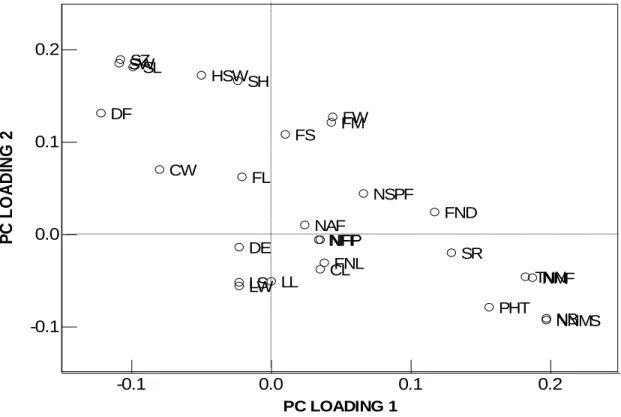
fruit neck, fruit shape, degree of neck bending and fruit neck length positively correlated with PC1, which accounted for 31.9% of the total variation. Presence or absence of seed lines and seed texture was highly correlated with PC2 which accounted for 14.9% of the total variation. For quantitative traits, plant height, number of nodes on the main stem, total number of nodes, number of male flowers, number of branches, fruit neck diameter positively correlated with PC1, which accounted for 39.6% of the total variation. Fruit mass, fruit width, fruit size, shell thickness, seed length, seed width, seed size and hundred seed weight highly correlated with PC2 which accounted for 13.7%
of the total variation. Unique genotypes such as BG-16, BG-25, BG-09, BG-37 and BG-10 showing suitable qualitative traits and BG-07, BG-13, BG-67, BG-12, BG-09 and BG-06 showing suitable quantitative traits were identified for genetic improvement.
In the second study, the genetic diversity of 67 bottle gourd landraces was determined using 14 selected polymorphic simple sequence repeat (SSR) markers. The markers amplified a total of 86 alleles with allele sizes ranging from 145 to 330 base pairs (bp). Number of effective alleles (Ne) ranged from 1.58 to 6.14 with a mean of 3.10. Allelic richness varied from 3.00 to 8.90 with a mean of 5.23. Expected heterozygosity (He) values ranged from 0.37 to 0.84 with a mean of 0.65.
The mean polymorphic information content (PIC) was 0.57. Jaccard’s coefficient of similarity values ranged from 0.00 to 1.00, with a mean of 0.63. Analysis of molecular variance revealed that 79%, 17% and 4% of the variation was attributable to among landraces, within landraces and between populations, respectively. Cluster analysis classified the bottle gourd landraces into three major clusters namely: cluster I, cluster II and cluster III. Overall, landraces such as BG-04, BG- 06, BG-08, BG-09, BG-15, BG-55, BG-42, BG-57, BG-58, BG-28, BG-23, BG-29 and BG-34 selected for breeding and systematic conservation.
In the third study, simple correlation and path coefficient analysis were used to determine the level of association between qualitative and quantitative traits among 36 bottle gourd landraces. Simple correlation analysis showed that fruit width, number of seeds per fruit, seed width, seed size and hundred seed weight significantly and positively correlated with fruit yield and seed yield, respectively. Highly significant and negative correlations (P < 0.001) were observed between primary fruit colour, secondary fruit colour, fruit texture, fruit shape, degree of corrugation, neck
revealed high direct positive path coefficient values between number of female flowers, seed size, and number of seeds per fruit and fruit width with fruit yield, respectively. High direct negative path coefficient values were observed between primary fruit colour and fruit shape with seed yield and presence or absence of fruit neck, fruit texture and neck bending degree with fruit yield, respectively. The identified quantitative and qualitative traits are useful for improving the yield potential of bottle gourd.
The focus in the fourth study was to evaluate selected bottle gourd landraces for drought tolerance and select genotypes for breeding using yield-based selection indices. Significant differences (P <
0.05) were observed amongst bottle gourd landraces with respect to edible fruit number and fruit yield under drought stress (DS) and non-stress (NS) conditions. The mean fruit number under DS and NS conditions were 15 457 and 31 088 ha-1, respectively. The mean fruit yield under DS and NS were 8.75 t ha-1 and 22.4 t ha-1, respectively. Drought stress reduced fruit number and yield by 49% and 62%, respectively. Landraces such as BG-79, BG 31, BG-48, BG-67, BG-52, BG-78 and GC were promising for large scale production or as parents for drought tolerance breeding.
Correlation and principal component analyses revealed the significance of drought tolerant indices such as geometric mean productivity, stress tolerance, mean productivity, yield index and harmonic mean which allowed discrimination of drought tolerant bottle gourd landraces.
Lastly, twelve selected bottle gourd landraces were grown under non-stressed and water-stressed conditions under glasshouse conditions to determine whether the accumulation of cucurbitacins could be indicative of drought tolerance in bottle gourd. Leaf gaseous exchange and chlorophyll fluorescence parameters were measured and correlated to cucurbitacin content. Stomatal conductance, transpiration rate, net CO2 assimilation rate, CO2 assimilation rate/intercellular CO2, intrinsic water-use efficiency and instantaneous water-use efficiency declined under water stress conditions. Intercellular CO2 concentrations, ratio of atmospheric and intercellular CO2 were significantly increased by water stress. The maximum photosystem II activity, quantum yield of photosystem II, photochemical quenching and non-photochemical quenching were not affected by water stress; whereas, electron transport rate, electron transport to oxygen molecules and
cucurbitacin I content with electron transportation to O2 molecules and alternative electron sinks suggesting their possible role in the regulation of photorespiration and photoprotection against oxidative stress. Accumulation of cucurbitacin I could be considered as a tool for selection of bottle gourd genotypes for drought tolerance.
Overall, the present study identified valuable bottle gourd genetic resources useful in the development of improved cultivars for large-scale production in South Africa or related environments.
Declaration
I, Jacob Mashilo, declare that:
1. The research reported in this thesis, except where otherwise indicated, is my original research.
2. This thesis has not been submitted for any degree or examination at any other university.
3. This thesis does not contain any other persons’ data, pictures graphs, or other information, unless specifically acknowledged as being sourced from other persons.
4. This thesis does not contain any other persons’ writing, unless specifically acknowledged as being sourced from other researchers. Where other written sources have been quoted, then:
a) Their words have been re-written but the general information attributed to them has been referenced;
b) Where their exact words have been used, their writing has been placed inside quotation marks, and referenced.
5. This thesis does not contain text, graphics and tables copied and pasted from the internet unless specifically acknowledged, and the source being detailed in the dissertation and in the reference sections.
Signed
………..
Jacob Mashilo
As the candidate’s supervisors, we agree to the submission of this thesis:
………
Dr. Alfred Odindo (Supervisor)
Acknowledgements
My supervisor Dr. Alfred Odindo for his guidance, encouragement and support during the development of the research idea, drafting of the research proposal, the conduct of the study and final thesis write-up. I sincerely appreciate your permanent availability, support, scientific guidance and for the critical questions which challenged and motivated me to think critically during my PhD study.
Professor Hussein Shimelis, my co-supervisor for his immense knowledge, support, motivation, patience and valuable guidance from the beginning to the end of this study, which greatly improved and increased my research skills. Thank you very much for your quick review of draft papers and your guidance during preparation and proofreading of manuscripts which greatly improved my writing skills.
Dr Amelework Beyene for assistance with analysis of molecular data and providing valuable inputs and suggestions to improve chapters and manuscripts. It was a pleasure working with you and I have learned so much from you and will recommend you as a supervisor to any student.
Dr. Samson Zeray Tesfay for assistance with the extraction of cucurbitacins and preparation of standard curves. Thank you very much for sharing your office space with me, your friendship, encouragement, your interest in my research and the wonderful coffee cups you made for me during my visits to Pietermaritzburg.
Mrs Caryl Janse van Rensburg (School of Chemistry and Physics, University of KwaZulu- Natal) for Mass Spectroscopy analysis.
Dr. Lembe Magwaza for allowing us to use the LI-6400 XT portable photosynthesis system.
My grandmother, Mmapitsi Kobe, great grandmother Maphuti Mabitsela, my mother, Pitsi Mashilo, Rirhandzu Chauke, Ntuwiseni Mmbi, Alinah Mpe, Mrs Raisibe Mahlong and Mr George Mabasa for providing bottle gourd seed used in the study.
Matthew Erasmus for all the technical support during the conduct of glasshouse experiments.
Pearl Amanda Musenge for assistance with setting up and monitoring the drought stress experiment. Without you taking care of the plants while I was away, I would not have made it.
Thank you very much.
National Research Foundation (NRF) and the University of KwaZulu-Natal for funding the study.
My employer, Limpopo Department of Agriculture and Rural Development (LDARD) for allowing me to pursue my PhD study.
The Agronomy research team at Towoomba Research Station: Peter Malemela, Kamogelo Huma, Patricia Modiba, Richard Ngwepe, Gehard Breedt and Mapaseka Malebana for the help provided during the conduct of field studies and during data collection.
My friends Mamoloka Manamela and Thapelo Mpyana for their support and encouragement at all times. Thanks for believing in me
My family and extended family for the love, encouragement and support at all times.
The Lord God Almighty for making a way and providing people and resources that helped me complete my studies. To Him goes all the Glory.
Dedication
This work is dedicated to my son, Onalenna.
Table of Contents
Thesis Abstract ... i
Declaration ...v
Acknowledgements ... vi
Dedication ... viii
Table of Contents ... ix
Publications Pertaining to This Thesis ... xiii
Thesis Introduction ...xiv
Background ...xiv
Research objectives ... xviii
Chapter 1: Review of literature...1
Abstract ...1
1.1 Introduction ...2
1.2 Bottle gourd: origin, genetic diversity and distribution ...2
1.3 Description of bottle gourd ...3
1.3.1 Crop biology ...3
1.3.2 Sex phenotypes ...5
1.3.3 Flowering and fruit set ...6
1.3.4 Fruit and seed characteristics ...7
1.4 Economic importance of bottle gourd ... 10
1.5 Genetic diversity and crop improvement ... 11
1.6 Germplasm characterization ... 13
1.7 Molecular marker based characterization ... 17
1.8 Intra-and-inter population structure among Lagenaria species ... 18
1.9 Pre-breeding ... 19
1.10 Landraces as source of genetic diversity for breeding ... 20
1.11 Breeding neglected and underutilized crops for drought tolerance ... 22
1.11.1 Physiological response to drought stress ... 23
1.11.2 Cucurbitacins and drought adaptation ... 24
1.11.3 Biosynthesis of cucurbitacins ... 25
1.12 Conclusions ... 29
References... 29
Chapter 2: Assessment of Genetic Diversity among Bottle Gourd [Lagenaria siceraria (Molina) Standl.] Landraces Using Qualitative and Quantitative Traits ... 42
Abstract ... 42
2.1 Introduction ... 43
2.2.3 Experimental design and field establishment ... 45
2.3 Data collection... 46
2.4 Data analysis ... 48
2.5 Results ... 48
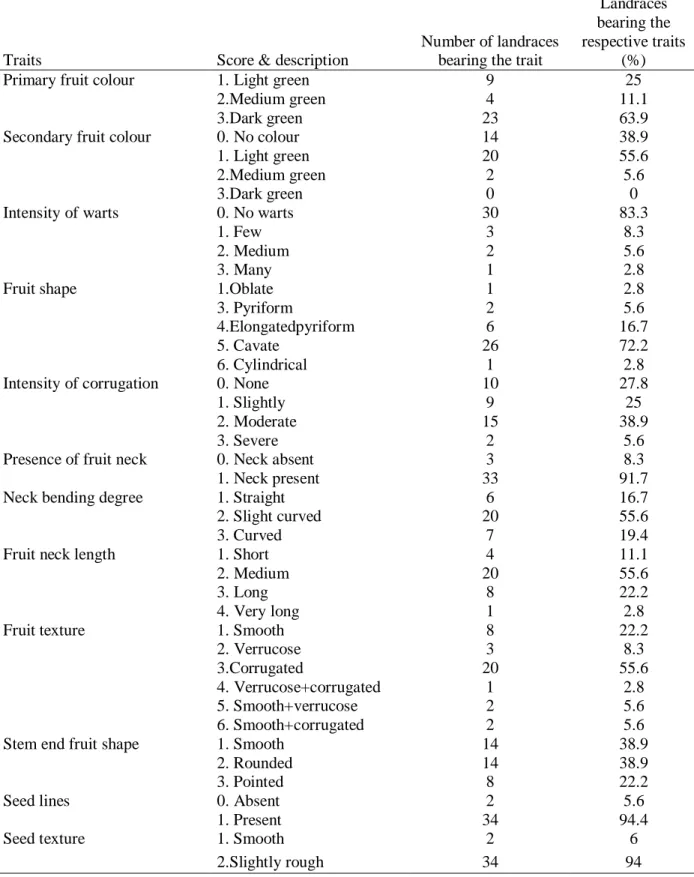
2.5.1 Qualitative traits ... 48
2.5.2 Quantitative traits... 53
2.6 Principal component analysis ... 55
2.6.1 Quantitative traits... 55
2.6.2 Qualitative traits ... 58
2.7 Discussion ... 61
2.8 Conclusions ... 63
References... 63
Chapter 3: Genetic Diversity of Bottle Gourd [Lagenaria siceraria (Molina) Standl.] Landraces Revealed By Simple Sequence Repeat Markers ... 66
Abstract ... 66
3.1 Introduction ... 67
3.2 Materials and methods ... 69
3.2.1 Plant materials ... 69
3.2.2 DNA extraction, purification and quantification ... 71
3.2.3 PCR and SSR analyses ... 71
3.3 Data analysis ... 72
3.3.1 Genetic parameters ... 72
3.3.2 Analysis of molecular variance ... 73
3.3.3 Cluster analysis ... 73
3.4 Results ... 73
3.4.1 Polymorphism and allelic diversity of SSR markers ... 73
3.4.2 Genetic variability within and among populations based on district of collection ... 75
3.4.3 Cluster analysis ... 75
3.4.4 Analysis of molecular variance ... 78
3.5 Discussion ... 79
3.6 Conclusion ... 82
References... 82
Chapter 4: Correlation and Path Coefficient Analyses of Qualitative and Quantitative Traits in Selected Bottle Gourd Landraces ... 87
Abstract ... 87
4.1 Introduction ... 88
4.2 Materials and methods ... 90
4.2.1 Plant materials ... 90
4.2.2 Study site ... 91
4.2.3 Experimental design and field establishment ... 91
4.2.4 Data collection ... 91
4.3 Data analysis ... 94
4.3.1 Correlation analysis ... 94
4.3.2 Path coefficient analysis ... 94
4.4.1 Characterization of bottle gourd landraces using qualitative traits ... 95
4.4.2 Characterization of bottle gourd landraces using quantitative phenotypic traits ... 97
4.4.3 Correlation analysis ... 100
4.4.4 Path coefficient analysis of qualitative traits in bottle gourd ... 103
4.4.5 Path coefficient analysis of quantitative traits in bottle gourd ... 104
4.5 Discussion ... 106
4.6 Conclusions ... 109
References... 109
Chapter 5: Yield-Based Selection Indices for Drought Tolerance Evaluation in Selected Bottle Gourd [Lagenaria siceraria (Molina) Standl.] Landraces ... 115
Abstract ... 115
5.1 Introduction ... 116
5.2 Materials and methods ... 117
5.2.1 Plant materials ... 117
5.2.2 Study site ... 118
5.2.3 Weather conditions ... 118
5.2.4 Experimental design and field establishment ... 119
5.3 Data collection... 120
5.4 Ranking of bottle gourd landraces for drought tolerance ... 122
5.5 Data analysis ... 122
5.6 Results ... 123
5.6.1 Effect of drought stress on genotypic performance ... 123
5.6.2 Effect of drought stress on phenology of bottle gourd ... 124
5.6.3 Effect of drought stress on fruit number and fruit yield of bottle gourd landraces . 125 5.6.4 Yield-based indices of drought tolerance ... 127
5.6.5 Correlation analysis ... 128
5.6.6 Principal component analysis ... 130
5.6.7 Ranking of bottle gourd landraces ... 132
5.7 Discussion ... 133
5.8 Conclusions ... 136
References... 136
Chapter 6: Bottle Gourd [Lagenaria siceraria (Molina) Standl.] Response to Water Stress: Relationship between Cucurbitacin Accumulation with Leaf Gas Exchange and Chlorophyll Fluorescence ... 140
Abstract ... 140
6.1 Introduction ... 141
6.2 Materials and Methods ... 142
6.2.1 Plant materials ... 142
6.2.2 Experimental design and crop establishment ... 143
6.3 Data collection... 144
6.3.1 Soil moisture content monitoring ... 144
6.5 Results ... 147
6.5.1 Soil water content ... 147
6.5.2 Changes in leaf gas exchange and chlorophyll fluorescence parameters among genotypes under water-stressed and non-stressed conditions ... 148
6.5.3 Changes in leaf gas exchange in response to water stress ... 149
6.5.4 Changes in photosynthetic efficiency (chlorophyll fluorescence) among bottle gourd landraces in response to water stress ... 153
6.5.5 Cucurbitacin E and I accumulation in bottle gourd landraces under non-stressed and water-stressed conditions ... 155
6.5.6 Correlation analysis between cucurbitacin content with leaf gas exchange and chlorophyll fluorescence parameters ... 158
6.5.7 Principal component analysis ... 158
6.5.8 Principal component bi-plot analysis ... 160
6.6 Discussion ... 162
6.7 Conclusions ... 165
References... 166
An overview of the research findings ... 173
Introduction and objectives of the study ... 173
Research findings in brief ... 174
Implications of the research findings for breeding bottle gourd ... 177
Publications Pertaining to This Thesis
Chapter two and three
Jacob Mashilo., Hussein Shimelis & Alfred Odindo. 2015. Genetic diversity of bottle gourd [Lagenaria siceraria (Molina) Standl.] landraces of South Africa assessed by morphological traits and simple sequence repeat markers. South African Journal of Plant and Soil. 33: 113- 124.
Chapter three
Jacob Mashilo., Hussein Shimelis., Alfred Odindo., & Beyene Amelework. 2016. Genetic diversity of South African bottle gourd [Lagenaria siceraria (Molina) Standl.] landraces revealed simple sequence repeat markers. HortScience 51: 120-126.
Chapter four
Jacob Mashilo., Hussein Shimelis & Alfred Odindo. 2016. Correlation and path coefficient analysis of qualitative and quantitative traits in selected bottle gourd landraces. Acta Agriculturae Scandinavica, Section B – Soil & Plant Science. 66: 558-569.
Chapter five
Jacob Mashilo., Hussein Shimelis & Alfred Odindo. 2017. Yield based selection indices for drought tolerance evaluation in selected bottle gourd [Lagenaria siceraria (Molina) Standl.]
landraces. Acta Agriculturae Scandinavica, Section B – Soil & Plant Science. 67: 43-50.
Thesis Introduction Background
Bottle gourd [Lagenaria siceraria (Molina.) Standl.] is an important underutilized crop (van Rensburg et al., 2007; van Wyk, 2011). The crop is grown for its fresh or dry fruits, seed and succulent leaf vegetable (Hart, 2011). It is mainly cultivated by smallholder farmers using unimproved landraces. There is no formal bottle gourd breeding program in South Africa impacting on breeding and strategic conservation of the crop and its commercial value. The commercial potential of this crop is currently known in South Africa being widely marketed in some supermarkets and informal open market systems. Landrace varieties of bottle gourd are widely grown in Limpopo Province of South Africa. However, limited studies are conducted that determine the presence and magnitude of bottle gourd genetic diversity in South Africa. Landraces of crop species are considered to be storehouses of valuable genetic diversity (Bashir et al., 2015).
Therefore, a better understanding of the extent of genetic diversity within and amongst the landraces of South African bottle gourd is essential for conservation and strategic breeding. For plant genetic resources to remain a foundation for future sustainable agricultural development, complementary conservation and breeding strategies are needed (Hawtin et al., 1996).
Systematic study of landrace genotypes including bottle gourd is important to identify genetically unrelated genetic stocks for conservation and as possible source of novel genes for breeding programmes (Lai et al., 2015). According to Afuape et al. (2011), proper management and effective utilization of plant genetic resources depends on detailed understanding of their genetic variability. The failure to identify suitable and potential parents affects the success and genetic gains of the breeding programme, which is dependent on the extent of genetic variability present in the source genetic pool (Tseng et al., 2002). Therefore, there is need to initiate a dedicated pre- breeding of bottle gourd to fully exploit the genetic diversity and to identify candidate genotypes for breeding or direct production in South Africa.
Drought is currently the major production constraint affecting global crop production especially under dry-land farming systems. The frequency and intensity of droughts have increased over the last 30 years in many parts of the world due to climate change (Hall et al., 2003). In southern
Therefore, there is a continuous need to increase crop production and productivity by developing drought resilient varieties that are more adapted to grow under the changing environmental conditions and water-limited conditions.
There is a growing interest to introduce neglected and underutilised crops as possible drought tolerant crops (Mabhaudhi, 2012). Neglected underutilized crop species like bottle gourd are believed to be drought tolerant (Zeven, 1998). This is probably through many years of selection by famers living in marginal and drought prone areas. This might have led in the development of drought resilient landrace varieties that are unique and adapted to their local conditions. According to Blum and Sullivan (1986), farmers’ local varieties or landraces may possess some unique genetic and physiological attributes that may not be present in modern varieties. Landraces are believed to be tolerant to abiotic stress (e.g. heat and drought stresses) making these materials a potential key genetic resource for crop improvement. There is no detailed record on the genetic basis of drought tolerance in the South African bottle gourd landraces despite the importance of the crop and occurrence of frequent droughts in the country.
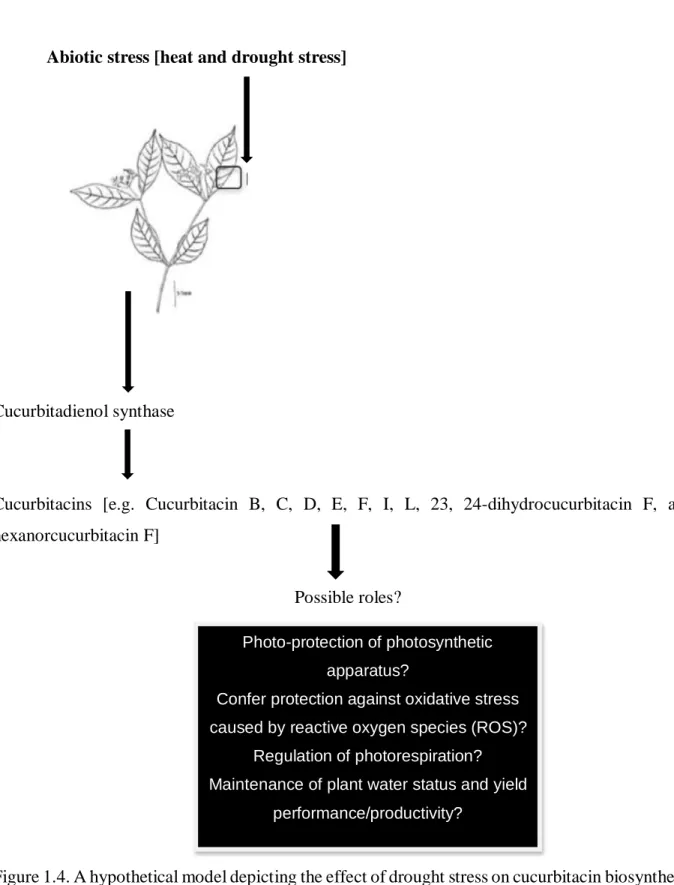
Breeding for drought tolerance requires knowledge of genetic and physiological mechanisms associated with adaptation under drought stress conditions. Therefore, it is important to identify agronomic attributes and specific physiological mechanisms that improve adaptation to water- limited environments to develop drought tolerant cultivars (Subbarao et al., 1995). Cucurbits accumulate more bitter-tasting secondary metabolites referred to as cucurbitacins in response to drought and heat stress (Haynes and Jones, 1975; Balkema- Boomstra et al., 2003; Shang et al., 2014). The role of this compounds and whether they could be linked to drought adaptation or tolerance has not been well-established. The literature indicated that secondary metabolites play essential roles in mediating interactions between the plant and its environment (e.g. UV-radiation, nutrient deficiencies, temperature and drought stress). Secondary metabolites have been regarded as metabolic waste or substances with no role in plant functions. However, evidence of their role in many plant process including plant growth and development, protection from UV-radiation and their role as antioxidants has been reported (Munne-Bosch and Alegre, 2000; Hura et al., 2007;
cucurbitacins may be associated with drought adaptation. However, very limited information is available linking cucurbitacins accumulation and drought tolerance. Understanding the physiological role of cucurbitacins may underpin the underlying regulatory processes at genotypic level and the identification of genes associated with their biosynthesis. This information could be applicable for drought tolerance breeding.
Rationale for pre-breeding and genetic improvement of bottle gourd
Bottle gourd is an important crop in the drier regions of sub-Saharan Africa including South Africa.
The crop is mostly cultivated using unimproved landrace varieties mainly by smallholder farmers.
Bottle gourd landraces are phenotypically and genetically diverse attributed to long-term selection by growers (Zeven, 1998), the diverse farming systems, variable environmental conditions and the predominant cross-fertilisation mating system of the crop (Morimoto et al., 2005; Koffi et al., 2009). Nass and Parterniani (2000) defined a landrace as ‘a local variety of a plant species that evolved largely through selection by farmers in an unstructured way and which has becomes adapted to ecologies where it grows and survives’. Assessing the extent of genetic variation among landraces is useful for strategic conservation for effective breeding. Bottle gourd landraces can be systematically exploited in breeding programs through identification of promising genotypes via a dedicated pre-breeding program.
Pre-breeding is defined as the ‘the art of identifying desired traits, and subsequent incorporation of these into modern breeding materials’ (Nass and Parterniani, 2000). It is routinely applied in commercial breeding programs where desired traits are constantly sought and identified from source genotypes for use in cultivar development. Pre-breeding includes all activities directed at identification of desirable crop traits and/or genes, and their subsequent transfer into a suitable set of parents for cultivar development. Understanding the genetic variability and genetic interrelationship present among germplasm collections is valuable to avoid redundancy and to select potential parents with desirable traits to be used in development of new cultivars (Chaudhary and Singh, 1982; Yoshida, 2004).
Genetically diverse landrace varieties of bottle gourd are widely grown in the Limpopo Province of South Africa. The landraces show significant variations in fruit shape, neck shape, fruit colour and texture. However, this germplasm has not been adequately characterized and conserved.
Detailed phenotypic and genotypic characterization of the bottle gourd germplasm is an important step to identify suitable genotypes as starting point for long term improvement of the crop. Farmers mostly use fruit traits for identification of bottle gourd genotypes making these traits important for strategic breeding according to the farmer’s needs or for commercial purposes.
Bottle gourd landraces have been shown to be potential sources of disease resistance. Some landrace collections from Africa were reportedly used in disease resistance breeding programs in the USA (Ling and Levi, 2007; Kousik et al., 2008; Ling et al., 2013). Kousik et al. (2008) tested various bottle gourd landraces collected from Israel, Syria, South Africa, Ethiopia, Israel Zimbabwe and Zambia and reported resistance to powdery mildew. Resistance to zucchini yellow mosaic virus was described in bottle gourd landrace collections from Africa (i.e. Zimbabwe and South Africa) (Ling and Levi, 2007). Bottle gourd also shows a wide adaptability, growing from arid to humid environments and from temperate to tropical conditions with annual rainfall ranging between 400-1500 mm (Haque et al., 2009). The capacity to grow under diverse climates could perhaps be explained by a broad genetic diversity which could be inherent in the species. This genetic variability may to a large extent account for the wide adaptation of the species to distinct environments and specifically to water limited conditions. In South Africa, bottle gourd landraces are normally planted under rain fed conditions in the marginal dry areas such as the Limpopo Province often characterized by prolonged dry spells. Farmers in these regions do not have access to irrigation facilities and bottle gourd grows under dry-land farming systems with low production inputs. Farmers reported that their landraces are tolerant to harsh conditions and produce reasonable fruit yield. The potential value of bottle gourd for biotic and abiotic stresses has not been well-documented.
Bottle gourd is under-utilized and under-researched crop and cultivated mostly using landraces in South Africa. There has been no strategic breeding of the crop and consequently there are no
program to develop new cultivars with improved yield, enhanced horticultural attributes with tolerance to biotic and abiotic stresses integrating farmers and consumers preferences.
Research objectives
The main aim of this study is to initiate a pre-breeding programme of bottle gourd in South Africa for subsequent development and deployment of improved cultivars with high yield, enhanced horticultural quality and tolerance to abiotic and biotic stresses.
The specific objectives of the study were:
1. To determine the genetic diversity of bottle gourd landrace collections from the Limpopo Province, South Africa using qualitative and quantitative morphological traits.
2. To determine genetic diversity of bottle gourd landraces from the Limpopo Province, South Africa, using single sequence repeats (SSR) markers.
3. To use correlation and path coefficient analysis to determine level of association between qualitative and quantitative traits and subsequently to select suitable parents for breeding.
4. To determine drought tolerance of a diverse set of bottle gourd landraces using drought tolerance indices and to identify promising genotypes for direct production or breeding.
5. To determine the relationship between accumulation of cucurbitacins with leaf gas exchange and chlorophyll fluorescence in bottle gourd under water stress conditions.
Thesis outline
This thesis consisted of six chapters, which are outlined below. The referencing system used in this thesis is based on the referencing style of the Journal of Crop Science. The thesis is in the form of discrete research chapters, each following the format of a stand-alone research paper (whether or not the chapter has already been published). This is the dominant thesis format adopted by the University of KwaZulu-Natal. As such, there is some unavoidable repetition of references and some introductory information between chapters. The research outcomes covered in Chapter Two
Journal of Plant and Soil (Volume 33, No. 2, 2015). Chapter Four has been published in Acta Agriculturae Scandinavica, Section B - Soil & Plant Science (Volume 66. No. 7, 2016). Chapter Five has been published in Acta Agriculturae Scandinavica, Section B - Soil & Plant Science (Volume 67. No. 1, 2017).
The structure of the thesis is outlined below:
Chapter Title
- Thesis Introduction
1. Review of Literature
2. Assessment of genetic diversity among bottle gourd [Lagenaria siceraria (Molina) standl.] landraces using qualitative and quantitative traits
3. Genetic diversity of bottle gourd [Lagenaria siceraria (Molina) standl.]
landraces revealed by simple sequence repeat markers
4. Correlation and path coefficient analyses of qualitative and quantitative traits in selected bottle gourd landraces
5. Yield-based selection indices for drought tolerance evaluation in selected bottle gourd [Lagenaria siceraria (Molina) standl.] landraces
6. Bottle gourd [Lagenaria siceraria (Molina) standl.] response to water stress: relationship between cucurbitacin accumulation with leaf gas exchange and chlorophyll fluorescence
- An overview of the research findings
References
Afuape S.O., Okocha P.I., Njoku D. (2011) Multivariate assessment of the agromorphological variability and yield components among sweetpotato (Ipomoea batatas (L.) Lam) landraces. African Journal of Plant Science 5:123-132.
Balkema- Boomstra A.G., Zijlstra S., Verstappen F.W.A., Inggamer H., Mercke P.E., Jongsma M.A., Bouwmeester H.J. (2003) Role of cucurbitacin C in resistance to spider mite (Tetranychus urticae) in cucumber (Cucumis sativus L.). Journal of Chemical Ecology 29:225-235.
Bashir E.A., Ali A.M., Ali A.M., Mohamed E., Melchinger A.E., Parzies H.K., Haussmann B.G.
(2015) Genetic diversity of Sudanese pearl millet (Pennisetum glaucum (L.) R. Br.) landraces as revealed by SSR markers, and relationship between genetic and agro- morphological diversity. Genetic Resources and Crop Evolution 62:579-591.
Blum A., Sullivan C.Y. (1986) The comparative drought resistance of landraces of sorghum and millet from dry and humid regions. Annals of Botany 57:846-853.
Chaudhary V.S., Singh B.B. (1982) Heterosis and genetic variability in relation to genetic diversity in soybean. Indian Jounal of Genetics 42:324-328.
Fauchereau N., Trzaska S., Rouault M., Richard Y. (2003) Rainfall variability and changes in Southern Africa during the 20th century in the global warming context. Natural Hazards 29:139-154.
Hall A.E., Cisse N., Thiaw S., Elawad H.O.A., Ehlers J.D., Ismail A.M., Fery R.L., Roberts P.A., Phillips R.D., McWatters K.H. (2003) Development of cowpea cultivars and germplasm by the Bean/Cowpea CRSP. Field Crops Research 82:103-134.
Haque M.M., Hasanuzzaman M., Rahman M.L. (2009) Effect of light intensity on the morphophysiology and yield of bottle gourd (Lagenaria vulgaris). Academic Journal of Plant Sciences 2:158-161.
Hart T.G.B. (2011) The significance of African vegetables in ensuring food security for South Africa’s rural poor. Agriculture and Human Values 28:321-333.
Hawtin G., Iwanaga M., Hodgkin T. (1996) Genetic resources in breeding for adaptation.
Euphytica 92:255-266.
Haynes R.L., Jones C.M. (1975) Wilting and damage to cucumber by spotted and stripes cucumber beetles. HortScience 10:266-276.
Hura T., Hura K., Grzesiak S. (2008) Contents of total phenolics and ferulic acid, and PAL activity during water potential changes in leaves of Maize Single-Cross Hybrids of different drought tolerance. Journal of Agronomy and Crop Science 194:104-112.
Hura T., Hura K., Grzesiak S. (2009) Possible conttibution of cell-wall-bound ferulic acid in drought resistance and recovery in triticale seedlings. Journal of Plant Physiology 166:1720-1733.
Hura T., Grzesiak S., Hura K., Thiemt E., Tokarz K., Wedzony M. (2007) Physiological and biochemical tools useful in drought-tolerance detection in genotypes of winter triticale:
accumulation of ferulic acid correlates with drought tolerance. Annals of Botany 100:767- 775.
Koffi K.K., Anzera G.K., Malice M., Dje Y., Bertin P., Baudoin J.P., Zoro Bi I.A. (2009) Morphological and allozyme variation in a collection of Lagenaria siceraria (Molina) Standl. from Cote D'Ivoire. Biotechnology, Agronomy, Society and Environment 13:257- 270.
Kousik C.S., Levi A., Ling K.S., Wechter P. (2008) Potential sources of resistance to cucurbit powdery mildew in U.S. plant introductions of bottle gourd. HortScience 43:1359-1364.
Lai J.J., Li Z.Z., Man Y.P., Lei R., Wang Y.C. (2015) Genetic diversity of five wild Actinidia arguta populations native to China as revealed by SSR markers. Scientia Horticulturae 191:101–107.
Ling K.S., Levi A. (2007) Sources of resistance to Zucchini Yellow Mosaic virus in Lagenaria siceraria Germplasm. HortScience 42:1124-1126.
Ling K.S., Levi A., Adkins S., Kousik C.S., Miller G., Hassell R., Keinath A.P. (2013) Development and field evaluation of multiple virus resistant bottle gourd (Lagenaria siceraria). Plant Disease 97:1057-1062.
Mabhaudhi T. (2012) Drought tolerance and water-use of selected South African landraces of Taro (Colocasia esculenta L. Schott) and Bambara groundnut (Vigna subterranea L. Verdc).
PhD thesis, Crop Science, University of KwaZulu-Natal, Pietermaritzburg.
Morimoto Y., Maundu P., Fujimaki H., Morishima H. (2005) Diversity of landraces of the white- flowered gourd (Lagenaria siceraria) and its wild relatives in Kenya: fruit and seed morphology. Genetic Resources and Crop Evolution 52:737-747.
Munne-Bosch S., Alegre L. (2000) Changes in carotenoids, tocopherols and diterpenes during
Nass L.L., Parterniani E. (2000) Pre-breeding: A link between genetic resources and maize breeding. Scientia Agricola 57:581-587.
Shang Y., Ma Y., Zhou Y., Zhang H., Duan L., Chen H., Zeng J., Zhou Q., Wang S., Gu W., Liu M., Ren J., Gu X., Zhang S., Wang Y., Yasukawa K., Bouwmeester H.J., Qi X., Zhang Z., Lucas W.J., Huang S. (2014) Biosynthesis, regulation, and domestication of bitterness in cucumber. Science 346:1084-1088.
Subbarao G.V., Johansen C., Slinkard A.E., Nageswara Rao R.C., Saxena N.P., Chauhan Y.S.
(1995) Strategies for improving drought resistance in grain legumes. Critical Reviews in Plant Science 14:469-523.
Tseng Y.T., Lo H.F., Hwang S.Y. (2002) Genotyping and assessment of genetic relationships in elite polycross breeding cultivars of sweetpotato in Taiwan based on SAMPL polymorphisms. Botanical Bulletin of Academia Sinica 43:99-105.
van Rensburg W.S.J., van Averbeke W., Slabbert R., Faber M., van Jaarsveld P., van Heerden I., Wenhold F., Oelofse A. (2007) African leafy vegetables in South Africa. Water SA 33:317- 326.
van Wyk B.E. (2011) The potential of South African plants in the development of new food and beverage products. South African Journal of Botany 77:857-868.
Yoshida T. (2004) Sorghum diversity evaluated by simple sequence repeat (SSR) markers and phenotypic performance. Plant Production Science 7:301-308.
Zeven A.C. (1998) Landraces: a review of definitions and classifications. Euphytica 104:127-139.
Chapter 1: Review of literature Abstract
Bottle gourd is under-utilized and under-researched crop widely grown for its fruits, seeds and succulent leaves. It is commonly grown by smallholder farmers in Limpopo Province of South Africa predominantly using unimproved landrace varieties. Thus far little effort has been directed towards genetic improvement of the crop in South Africa or sub-Saharan Africa. Landraces possess valuable genetic variability and are often well adapted to harsh environments characterized by poor soils, prolonged dry spells, low and erratic rainfall and high temperatures. Assessing the extent of genetic variation present among landraces is useful for strategic conservation and efficient use in bottle gourd improvement programmes. This review discusses flowering and fruit biology, economic importance, characterization, genetic diversity and population structure in bottle gourd germplasm and implications for breeding and conservation.
Keywords: Bottle gourd, breeding, conservation, crop improvement, hybrids, genetic, landrace
1.1 Introduction
Bottle gourd (Lagenaria siceraria (Molina) Standl.) also known as white-flowered gourd or calabash, is a diploid species (2n = 2x = 22) belonging to the genus Lagenaria of the Cucurbitaceae family (Beevy and Kuriachan, 1996; Morimoto et al., 2005). The Cucurbitaceae family contains many other economically important species including, watermelon (Citrullus lanatus), cucumber (Cucumis sativus), melon (Cucumis melo) and pumpkin (Cucurbita pepo) (Xu et al., 2011). The genus Lagenaria contains five other wild species, namely: L. breviflora (Benth.) Roberty, L.
abyssinica (Hook f.) Jeffrey, L. rufa (Gilg.) Jeffrey, L. sphaerica (Sonder) Naudin and L.
guineensis (G. Don) Jeffrey. All the six species are found in Africa, which is believed to be the centre of genetic diversity for L. siceraria (Whitaker, 1971). Lagenaria siceraria (Molina) Standley, is the only cultivated species. Within the species L. siceraria, two morphologically distinct sub-species of bottle gourd have been recognized, namely: L. siceraria ssp. siceraria and L. siceraria ssp. asiatica. The northern half of the African continent is the centre of diversity of five Lagenaria species, with the distribution of Lagenaria sphaerica (Sond.) Naud. extending to South Africa (Jeffrey, 1976).
1.2 Bottle gourd: origin, genetic diversity and distribution
Bottle gourd is one of the most ancient crops cultivated by humans in the tropics (Erickson et al., 2005; Clarke et al., 2006). Archaeological evidence suggested human utilization of bottle gourd at least 15,000 years ago in the New World and 12,000 years in the Old World (Richardson, 1972).
The same evidence suggested that the independent use and possible cultivation of the crop started from around 9 000 to 10 000 BP (before present) in the Americas (New World), 6 000 to 10 000 BP in East Asia and 4 000 to 5 000 BP in Africa. Whitaker (1971) suggested that bottle gourd was indigenous to tropical Africa (south of Equator) and diffused to the New World by trans-oceanic drift or human transport. Heiser (1980) supporting the view of Whitaker concluded Africa as place of origin of bottle gourd. This author further conceded that there lacks a decisive evidence to distinguish between Africa and America as the original home of this species. However, recently, based on seed morphology and analysis of DNA, Erickson et al. (2005) reported that American
bottle gourd germplasm showed genetic variation and lineage aligned to bottle gourds derived from Eastern Asia. This suggested that domesticated bottle gourd was introduced to Americas from Asia by Paleoindians (Erickson et al., 2005). Kistler et al. (2014) suggested that bottle gourds of America are most closely related to African gourds. The discovery of a wild indigenous bottle gourd species in Zimbabwe by Decker-Walters et al. (2004) reinforced Africa as the centre of origin. However, the evolutionary history of bottle remains unresolved.
1.3 Description of bottle gourd 1.3.1 Crop biology
The cultivated bottle gourd is an annual, viny, strong-growing climber or trailer (Figure 1.1 A &
B) (Morimoto et al., 2004). The stem has many branches. Prostrate or climbing branches of a single plant can cover varying space depending on weather conditions, soil fertility, moisture availability, and plant spacing. The plants have well developed branched root system. The nodes also develop out roots when they come in contact with moist soil. The leaves are commonly simple, reniform and wavy with entire margin. The leaves may have 3-5 shallow to deep lobes called segments. Segmented leaf shape has been reported to be dominant over the normal type. A single dominant gene 'S' is thought to be responsible for segmented leaf shape character in bottle gourd (Tiwari and Ram, 2009). The apex of the leaves may be pointed or blunt. Tendrils are borne in the axils of leaves (Singh, 2008).
Figure 1.1. Bottle gourd plant growing in the field showing open male flowers, tendrils (A) and developed fruits (B) (photo by author).
A
B
1.3.2 Sex phenotypes
Bottle gourd is a monoecious species with male and female flowers found separately on the leaf axils of the same plant (Morimoto et al., 2004; Achigan-Dako et al., 2008; Singh, 2008). Though monoecious, bottle gourd is a highly cross pollinating crop (Tiwari and Ram, 2009). Dioecious (e.g. male and female flowers found on different plants) and andromonoecious sex forms (e.g. sex forms bearing male and perfect flowers) also exist in wild, non-cultivated species (Singh et al., 1996). An andromonoecious sex form bearing hermaphrodite flower and male flower in the same plant have been isolated and named Andromon-6 by Singh et al. (1996). The male flowers of Andromon-6 are similar to normal monoecious, however; the hermaphrodite flowers exhibit a few distinguishing characteristics compared to normal female flowers. The distinguishing characteristics are: long corolla, 3.5 to 4.5 cm compared to 2.5 to 3.5 cm present in normal flowers;
well-developed anthers encircling the fully developed stigma and oval/round ovary that develops into a drum-shaped fruit with 12 light grooves. Furthermore, the fruit bears scars and contain about 400 to 700 white/brown small empty non-viable seeds with under-developed seed coats. Only a few fruits bears about 1 to 25 normal viable seeds and fruit length and diameter can be about 25 and 45 cm, respectively (Singh et al., 1996). The expression of monoecious and andromonoecious sex form in bottle gourd is genetically controlled (Singh et al., 1996). The expression of sex form, flower, fruit morphology and seed characteristics in the F1 generation demonstrated that monoecious sex form is completely dominant over andromonoecious sex form, normal size corolla dominant over large size corolla, long fruit shape dominant over drum-shaped oval fruit, small blossom scar dominant over large blossom scar and normal seed development dominant over abnormal seed development. Even though more than one sex form has been reported in bottle gourd, there is generally little sex phenotypes reported in this crop compared to other cucurbits.
For example, in cucumber sex phenotypes includes monoecious or gynoecious (female flowers only), androecious (male flowers only), hermaphroditic (perfect flowers), andromonoecious (male and perfect flowers), and trimonoecious (male, perfect, and female flowers) (Behera et al., 2009).
Male flowers in bottle gourd are borne on longer pedicels than female and hermaphrodite flowers.
two are 2–celled and one is 1–celled (Singh, 2008). Female flowers have small prominent ovary, which may be round, ovate, long or cylindrical. Female flowers also have three stigmatic lobes with many ovules, generally between 400 to 700 (Morimoto et al., 2004; Singh, 2008). Petals and sepals are fused. The spiny, sticky pollen is not windborne and the plants therefore require pollinators to move pollen from male to female flowers (Morimoto et al., 2004).
1.3.3 Flowering and fruit set
Bottle gourd flowers are produced at leaf nodes and are solitary. Flowers open late during the day and only last for a day (Delesalle and Mooreside, 1995). Flowering starts from about 40 days after planting during summer, however; this may be influenced by cultivar differences (Morimoto et al., 2004). Female flowers are normally formed on the 1st to 3rd leaf axils of the auxiliary vines surrounded by male flowers. They may also occur towards the tip of the main and auxiliary vines (Delesalle and Mooreside, 1995; Morimoto et al., 2004). Generally male flowers appear before female flowers (Hossain et al., 1990; Delesalle and Mooreside, 1995; Morimoto et al., 2004).
Thereafter, a flush of male and female flowers occurs continuesly. Male flowers remain open only for a few hours and eventually wither and die off; thus, the flowers have a short life span (Shah et al., 2010; Sugiyama et al., 2014). Therefore, the flowering period is normally shorter in male flowers than in female flowers (Morimoto et al., 2004). Flower opening occurs late in the afternoon and sometimes during the night (Sugiyama et al., 2014). Hossain et al. (1990) reported that both male and female flowers opened between 16h30 and 18h00 and closed 14 hours later. Morimoto et al. (2005) also reported that flowering began between 17h30 and 23h00 taking almost 60 to 90 minutes to open fully and closed between 07h00 and 13h00 the following day. Pollen of male flowers is only viable for two days (Sugiyama et al. 2014). The sex ratio in bottle gourd is a male- biased floral sex ratio (Delesalle and Mooreside, 1995). Floral sex ratio in bottle gourd is reported to be much more male-biased than is typical for monoecious species (Sutherland, 1986). The ratio of male: female flowers may vary from 5:1 to 15:1 in the common types. Higher male: female sex ratio of 20: 1 and 26:1 have also been reported (Delesalle and Mooreside, 1995; Morimoto et al., 2004). Even though sex determination genes controls sex expression, several authors have indicated that environmental conditions (e.g. precipitation, temperature and light intensity) and plant growth regulators (e.g. auxins, ethylene, gibberellic acid) can alter sex ratio (Arora et al.,
1982; Quan Yu, 1999; Ingle et al., 2000; Desai et al., 2011; Mishra et al., 2013). Higher temperature, long day length, and high light intensity and high nitrogen levels are reported to result in more male flowers (Singh, 2008; Tan et al., 2009) while the opposite results in more female flowers.
Fruit formation can occur only after 24 hours following pollination (Singh, 2008). Fruit shape differences has been reported to have an effect on flowering in bottle gourd. Morimoto et al. (2004) reported that small round edible, often warted types produced more female flowers compared to the dipper, bilobal and club–shaped types. In general higher proportions of female flowers are borne in a plant even during summer but only a few turns into fruits. Morimoto et al. (2004) observed that female flowers appearing on the early leaf axils (early nodes) have a higher chance of developing into fruits than those appearing later. Female flowers developing towards the end of the creeping branches usually develop into smaller fruits which often die (Delesalle and Mooreside, 1995). The mechanisms responsible for premature death of fruits in bottle gourd are not well-understood. First edible fruits can be available between 55 to 65 days after sowing in early varieties (Singh, 2008).
1.3.4 Fruit and seed characteristics
Bottle gourd exhibits great diversity with respect to fruit shapes (Morimoto et al., 2005; Singh, 2008; Yetişir et al., 2008; Xu et al., 2013). Figure 1.2 shows some common fruit shapes found from bottle gourd collections of South Africa (Figure 1.2A) and Turkey (Figure 1.2B) (Yetişir et al., 2008). The specific shape of the fruits depends on the variety while the size of the fruits depends on amount of rainfall, and its position along the vine (Morimoto et al., 2004). The fruit is often globular, bottle-or club-shaped, cylindrical, necked, oblate, flat, flat-round, conical, pear- shaped, white-yellow to dark green when young, with a hard and durable rind (Achigan-Dako et al., 2008).
Fruit size varies considerably from 5 to 40 cm in diameter, and 20 to 90 cm in length. There also
0.5 kg to 2.0 kg because at this stage the fruit size is smaller. At edible stage the fruits are pale green, green or dark green. At maturity the fruit turn into cream or creamish-brown in colour (Singh, 2008). Fruit characters in bottle gourd are not generally indicative of subspecies; however, plants producing large round fruits are typically native to tropical West Africa, whereas the long, thin, snake-like fruits are considered to be of Asian origin. Warted gourds occur only in Africa and the New World, and the ‘maranka-type’ gourds, which have 10 lengthwise, knobby, contorted ridges along the spherical region of the dipper-shaped fruit, occur in Africa (Heiser Jr, 1973).
Figure 1.2. Common fruit shapes of bottle gourd genotypes grown in South Africa (A, Photo by author) and Turkey (B, Yetişir et al., 2008).
A
B
Edibility of bottle gourd fruit varies with size and shape. Edible fruits are relatively small and either oblate, spherical ovoid or pyriform in shape while non-edible types are characterized by relatively thin shells and had dipper, club or elongated cylindrical shapes, with handles (Morimoto et al., 2005). The fruits may be sweet or bitter (Milind and Satbir, 2011). Bitter types are not edible, although they have medicinal importance. Bitter fruit taste has been reported to be dominant over the sweet taste and they are differentiated by single gene difference (Tyagi, 1976). The number of seeds per fruit varies from 400 to 700 with seed weight varying from 10 to 15g per 100 seeds (Singh, 2008). Furrows and ridges are also present on seeds. The seeds are oblong, generally up to 2 cm long, emarginated at the base, with two facial ridges, mostly smooth, whitish to brownish (Achigan-Dako et al., 2008). Brown seed colour has been reported to be dominant over light brown and the mode of segregation is controlled by a pair of genes (Tyagi, 1976).
1.4 Economic importance of bottle gourd
Bottle gourd is mostly grown for its fruit either being harvested young and used as a vegetable or harvested mature and used as a bottle, utensil, or pipe (Hart, 2011). The fresh fruit, which usually has a light green smooth skin and a white flesh, is frequently used in many regions of Asia and Africa as either a stir-fry or vegetable soup (Morimoto and Mvere, 2004). The tender edible fruits may also be used to prepare sweets, pickles and other delicious dishes (Singh, 2008). It is a preferred vegetable for treating ailments because of its cooling effect to the stomach and easy digestibility (Singh, 2008). The young edible fruits are rich in dietary fibre, essential minerals (e.g.
iron, phosphorus, potassium, zinc, magnesium etc.), amino acids and vitamins (e.g. vitamins B and E) (Milind and Satbir, 2011). The juice from the fruit helps control blood pressure due to its high potassium content. It also help in weight loss due to its high dietary fibre and low fat and cholesterol levels (Milind and Satbir, 2011; Sukhlecha, 2012). Fresh bottle gourd juice is used as medicine to cure diseases like flatulence, diabetes mellitus, hypertension, liver diseases and as a diuretic (Ghule et al., 2007). The crop is regarded as a useful vegetable for the management of many diseases like cardiac disorders, hepatic diseases and ulcer. The seeds are rich in essential amino acids and are also used for oil extraction. The seeds are rich in protein, minerals, lipids and fatty acids (Achu et al., 2005; Fokou et al., 2009; Essien et al., 2013) ideal for human food or for incorporation into livestock feed (Achu et al., 2005; Ojiako and Igwe, 2007; Ogunbusola et al.,
2010). The fatty acid profile shows linoleic acid as the most abundant (62%) as compared to oleic (16.2%), palmitic (14.4%) and stearic (5.8%) acids. High linoleic and low linolenic acid levels of these oils suggest that they could be sources of good edible oils for cooking. The abundance of linoleic followed by oleic acid in bottle gourd seed makes them good oils for reducing serum cholesterol and low density lipoprotein (LDL) and increasing high density lipoprotein (HDL) levels, hence, they could be good oils to fight against cardiovascular illnesses (Fokou et al., 2009).
Furthermore, bottle gourd seed are also a good source of amino acids. A study by Ogunbusola et al. (2010) showed that glutamic acid (139–168 mg/g protein) was the most abundant amino acid followed by aspartic acid (89.0 to 116 mg/g protein). These authors further reported that the total essential amino acid ranged from 45.8 to 51.5%.
Further, bottle gourd is used as rootstocks for watermelon (Citrullus lanatus var. lanatus) owing to its tolerance to various biotic and abiotic stress factors. It is reported to be highly tolerant to fusarium wilt disease (Yetisir and Sari, 2003) and tolerant to salt (Colla et al., 2005; Yetisir and Uygur, 2010). Production of seedless watermelon by pollinating with bottle gourd pollen has recently been demonstrated (Sugiyama et al., 2014). As a result, plant breeders are increasingly interested in exploring the bottle gourd germplasm for use in watermelon breeding. However, to preserve the genetic richness of this crop for such purposes, efforts must be directed towards the achievement of reliable collection and conservation strategies (Bhawna et al., 2015). Conservation of genetic resources is critical to plant breeding because economically important traits are constantly sought after to increase yield and quality and improve human health (Gaikward et al., 2008).
1.5 Genetic diversity and crop improvement
Neglected and underutilized crops such as bottle gourd play a prominent role in sustaining the livelihood of poor rural people by increasing food availability (Padulosi et al., 2002). The significance of ‘underutilized’ and ‘neglected’ crops such as bottle gourd for global food security has received attention by the researchers and food security policy organizations (Massawe et al.,
crop species has been realized and research has been re-directed towards these crops because of the important role they play in house-hold food security.
Genetic diversity within a crop gene pool is important for breeding and germplasm conservation (Smith et al., 1991; Pagnotta et al., 2009; Bhawna et al., 2015). Genetic variation for crop improvement exists in modern varieties, exotic germplasm, genetically modified plants or mutants.
The success of a breeding programme depends on careful selection of individuals that have superior or specific attributes needed by growers and consumers (Zamir, 2001). Knowledge of the genetic diversity among breeding materials is important to avoid the risk of increasing uniformity in elite germplasm, and in order to ensure long term selection gain. This is because crossing of a limited number of elite lines creates the danger of losing their genetic diversity.
Genetic diversity should be maintained at two different stages: (i) during formation of core collections where genetic diversity is maximized with minimum repetition (Pessoa-Filho et al., 2010) and (ii) in the intermediate generations of a breeding programme to conserve genetic variability for selection in later generations (El-Basyoni et al., 2013). Genetic diversity can be determined using different methods such as pedigree analysis, morphological, biochemical or DNA based markers. The first step towards identifying genetic diversity patterns in a given population is to estimate the similarities or differences among genotypes.
Despite its economic and nutritional values, bottle gourd is relatively under studied and under- utilized genetic resource in Africa. Further, there has been no targeted breeding of the crop and consequently there are no improved varieties of bottle gourd in South Africa where it is mostly grown using unimproved landraces maintained by farmers. Therefore, detailed genetic diversity analyses of the crop need to be undertaken to understand population structure and to maximize the genetic potential of the crop. Characterization of genetic diversity among cultivated bottle gourd varieties may be important for the selection of traits for breeding.
1.6 Germplasm characterization
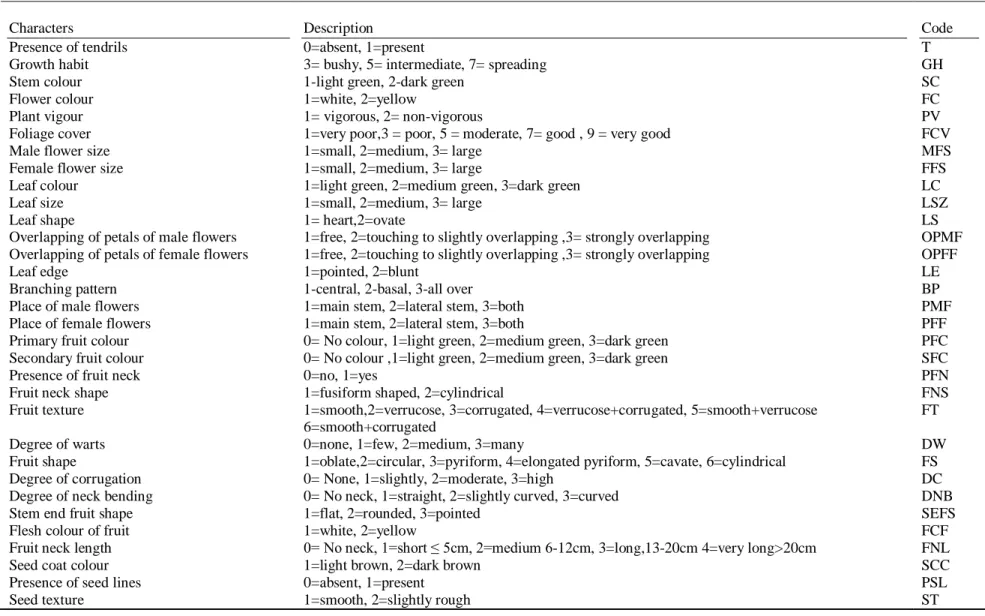
Characterization of genotypes is fundamental for breeding and strategic conservation. To serve the diverse human needs the genetic diversity of ‘underutilized’ and ‘neglected’ crops like bottle gourd needs to be harnessed through an effective pre-breeding program. The standard descriptors for bottle gourd have been used as guidelines in phenotypic characterization (Morimoto et al., 2005;
Yetişir et al., 2008). Table 1.1 summarizes some qualitative traits that have been used for bottle gourd phenotyping. The diversity represented especially by fruit qualitative provides an important basis for the breeding of new bottle gourd cultivars. Qualitative traits form discrete phenotypic classes that can be assessed visually and are therefore useful for breeding and genetic analysis of the crop (Manivannan et al., 2016). Several genes controlling different qualitative traits have been described in bottle gourd (Table 1.2). Inheritance studies of several qualitative traits are yet to be studied in bottle gourd including blossom and stem-end fruit shape, presence or absence of fruit neck, fruit neck length and other fruit shapes (e.g. necked vs non-necked, pyriform vs elongated and snake-like vs. curvilinear etc.).
Table 1.1. Summary of qualitative traits used in genetic diversity analysis in bottle gourd.
Trait Class Reference
Seed size Small Yetisir et al. (2008)
Medium Large
Seed margin Absent Yetisir et al. (2008)
Thin and uniform Thin and irregular Thick uniform Thick irregular
Seed margin color Absent Yetisir et al. (2008) White
Tan Yellow Orange Brown Grey Black Light brown Dark brown
Cotyledon size Small Yetisir et al. (2008)
Intermediate Large
Cotyledon color Light green Yetisir et al. (2008) Intermediate
Dark green
Leaf shape Ovate Yetisir et al. (2008)
Orbicular Reniform Retuse Heart
Leaf size Small Yetisir et al. (2008)
Intermediate Large
Leaf edge Smooth Yetisir et al. (2008)
Toothed
Leaf pubescence Small Yetisir et al. (2008)
Intermediate Large
Pubescence of upper Small Yetisir et al. (2008) surface of leaf Intermediate
Large
Branching pattern Central Mashilo et al. (2015) Basal
Table 1.1. (Continued)
Trait Class Reference
Peduncle transactional Round Yetisir et al. (2008)
Shape Slightly angled
Angled
Peduncle attachment Easy Yetisir et al. (2008) Intermediate
Difficult Stem end fruit shape Depressed
Yetisir et al. (2008) and Sivaraj and Pandravada (2005)
Flattened Rounded Pointed Blossom end shape Depressed
Yetisir et al. (2008) and Sivaraj and Pandravada (2005)
Flattened Rounded Pointed
Fruit shape Oblate Sivaraj and Pandravada (2005)
Circular Pyriform
Elongated pyriform Cavate
Cylindrical
Variation in fruit shape Low Yetisir et al. (2008) Intermediate
High
Table 1.2. Genes controlling some qualitative traits in bottle gourd.
Gene Description Reference
Bb Bottle-shaped fruit Tyagi (1976)
BB Disk-shaped fruit Tyagi (1976)
Rr Produces round-shaped fruit Tyagi (1976)
GG Dark green fruit colour Tyagi (1976)
Gg Light green fruit colour Tyagi (1976)
Lblb Light brown seed coat colour Tyagi (1976)
LbLb Brown seed coat colour Tyagi (1976)
WtWt Warty fruit texture Mladenovic et al. (2013)
Wtwt Smooth fruit texture Mladenovic et al. (2013)
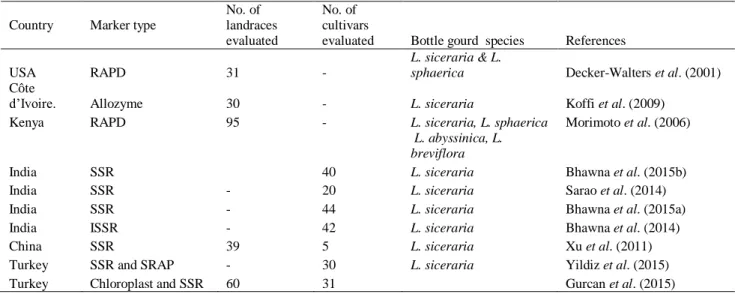
Genetic diversity in bottle gourd has also been described based on quantitative phenotypic traits (Morimoto et al., 2005; Yetişir et al., 2008; Koffi et al., 2009; Mladenovic et al., 2012; Xu et al., 2014). Quantitative traits widely reported in genetic diversity studies are summarized in Table 1.3.
Coefficient of variation (CV’s) in these studies tended to be larger for fruit traits than other quantitative traits indicating that bottle gourd is more diversified in fruit size and fruit shape (Morimoto et al., 2005; Sivaraj and Pandravada, 2005).
Table 1.3. Quantitative phenotypic traits and corresponding mean values reported in bottle gourd.
Quantitative trait Mean Reference
Days to 50% female flowering 54.2 (7.38) Harika et al. (2012) Number of nodes on main-stem 5.21 (5.9) Harika et al. (2012)
Sex ratio 17.4 (9.2) Harika et al. (2012)
Number of branches 8.89 (5.1) Harika et al. (2012)
Number of fruits per plant 7.62 (7.5) Harika et al. (2012)
Fruit mass (kg) 1.1 (8.3) Harika et al. (2012)
Fruit length (cm) 35.6 (7.2) Harika et al. (2012)
17.8 (60) Morimoto et al. (2005) 38.7 (51.7) Sivaraj and Pandravad (2005)
Fruit width (cm) 8.77 (17.7) Harika et al. (2012)
10.8 (33) Morimoto et al. (2005) 19.3(38.3) Sivaraj and Pandravad (2005) Fruit circumference (cm) 42.2(39.1) Morimoto et al. (2005)
Volume of fruit (cm3) 1016 (93) Morimoto et al. (2005)
Length between apical point and wide fruit part
(cm) 5.6 (40)
Morimoto et al. (2005) Relative length of fruit width 0.76 (45) Morimoto et al. (2005) Relative length of the apical point 0.36 (32) Morimoto et al. (2005)
Shell thickness (cm) 2.87 (10.6) Harika et al. (2012)
0.42 (39) Morimoto et al. (2005) 0.31 (9.7) Sivaraj and Pandravad (2005) Number of seeds per fruit 304 (50) Morimoto et al. (2005)
Seed length (cm) 1.32 (16) Morimoto et al. (2005)
1.67(10.7) Sivaraj and Pandravad (2005)
Seed width (cm) 0.68 (16) Morimoto et al. (2005)
0.74 (9.6) Sivaraj and Pandravad (2005)
Seed size (cm²) 0.92 (32) Morimoto et al. (2005)
Hundred seed weight (g) 14.05 (8.1) Harika et al. (2012)
17.9 (26.8) Sivaraj and Pandravad (2005)
Days to maturity 63.61 (6.9) Harika et al. (2012)
Values in parenthesis are coefficient of variation (CV) in percentages.
Germplasm characterization using morphological markers is an important first step in the




![Food security potential of bottle gourd [Lagenaria siceraria (Molina Standly)] landraces : an agronomic perspective.](data:image/gif;base64,R0lGODlhAQABAIAAAP///wAAACH5BAEAAAAALAAAAAABAAEAAAICRAEAOw==)