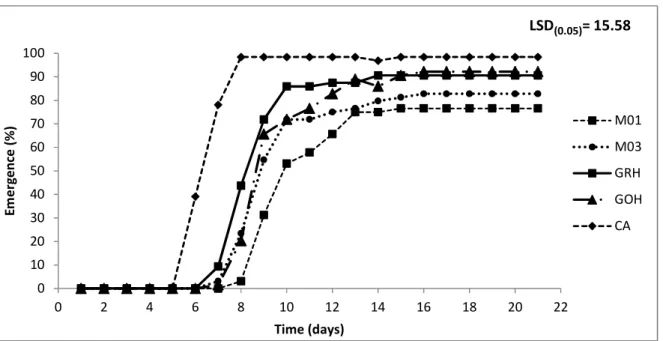
48 Figure 5.6: Proline accumulation in leaves of bottle gourd landraces (M01 & M02) and hybrid varieties of pumpkins (Ca & GRH). 79 Figure 7.7: Daily germination of bottle gourd landraces (M01, M02 & M03) compared to selected hybrid pumpkins (GRH, GOH & CA) during the standard germination test.
Specific objectives of the study
To determine the seed quality of bottle gourd landraces compared to two conventional cucumbers (Cucurbita maxima and Cucurbita pepo). To determine the effect of water stress on growth, development, physiology and yield of bottle gourd landraces compared to two conventional cucumbers (Cucurbita maxima and Cucurbita pepo) under controlled environmental conditions.
- Crop History and Classification
- Botany
- Bottle gourd ecology
- Uses of the crop and its Potential as a Food Security Crop
- Economic and medical uses
- Bottle gourd as a possible food security crop
- Agronomy of bottle gourd
- Seed germination and establishment
- Planting date
- Plant nutrient requirements
- Production
- Pest and diseases
- Yield potential
- Genotype by environment interaction
- Crop responses to water stress
- Proline accumulation
- Conclusions
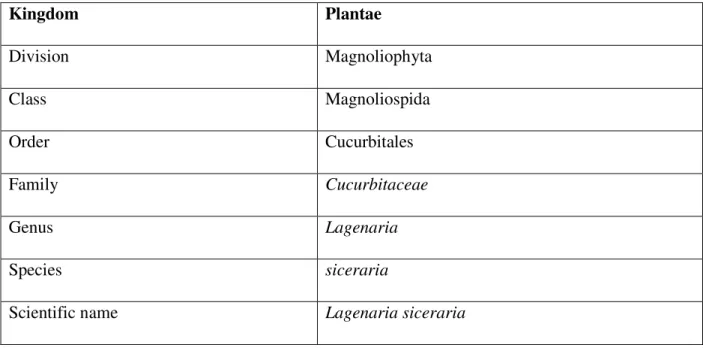
Bottle gourd is found throughout the tropical regions of the African continent (Decker-Walters et al., 2004). Bottle gourd is one of South Africa's traditional underutilized crops that has been ignored by researchers.
- Plant Materials
- Seed Quality
- Standard germination test
- Seed electrical conductivity (EC)
- Tetrazolium (TZ) test
- Seedling emergence
- Controlled Environmental Experiment: Crop Responses to Water Stress
- Experimental design and trial management
- Data collection
- Controlled Environmental Experiment: Nutritional Value
- Experimental design
- Data collection
- Field Trials
- Experimental design
- Agronomic practices
- Data collection
- Statistical Analyses
It was laid out as a randomized complete block design with two treatment factors, varieties and harvest replicated three times (however, plants harvested every two weeks to termination were replicated 18 times to make enough material for analysis). The crop treatments included; 1) harvest once, two weeks after crop establishment, 2) harvest every two weeks until termination of the experiment and, 3) no harvest (control). Measurements of leaf number, vine length, chlorophyll content index, stomatal conductance and soil water content were taken weekly until the experiment was terminated.
Introduction
While holding all other traits constant and different seed coat colors, Odindo (2007) and Rolston (1978) observed differences in seed quality in pea and Trifolium alexandrinum, respectively. According to Mabhaudhi and Modi (2010), determining the seed quality of landraces from a single test is often misleading due to large variation. For the purpose of this study it was necessary to evaluate the seed quality of land races of bottle gourd for establishing field and pot trials as they were collected from different locations.
Information on seed quality is also important for the implementation of effective breeding programs, where more efficient seeds are the starting point of selection. Therefore, the objective of this study was to evaluate the seed quality of native varieties of local pumpkins compared to exotic pumpkins.
Results
- Standard germination test
- Electrical conductivity (EC)
- Tetrazolium (TZ) test
- Correlation of germination traits
- Emergence
- Correlation of emergence traits
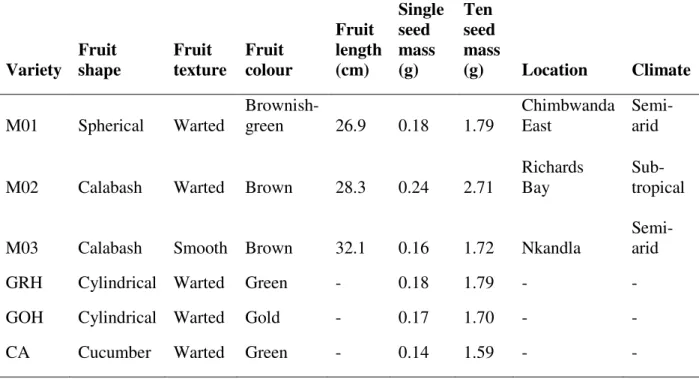
36 Table 4.1: Seed performance of bottle gourd landraces (M01, M02 and M03) compared to selected hybrid gourds (GRH, GOH and CA) during the standard germination test. Highly significant differences (P < 0.001) were observed between the varieties in terms of their emergence time (Fig. 4.4). There were no significant differences (P . > 0.05) observed between the varieties in terms of their final yield (Table 4.3).
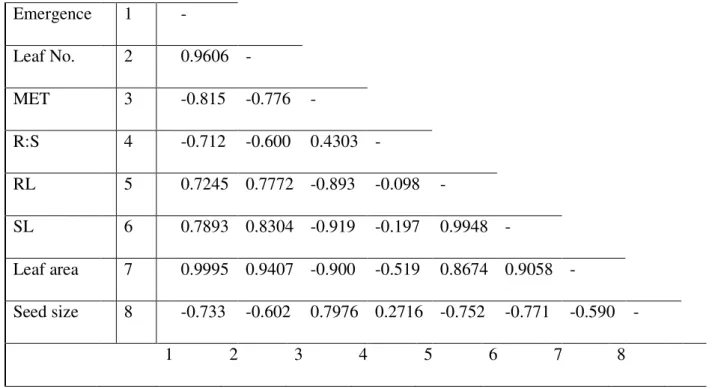
However, significant differences (P < 0.05) were observed for MET, number of leaves, leaf area, root and shoot length (Table 4.3). Hybrid CA had the shortest emergence time of about 7 days followed by GRH at 9 days.

Discussion
42 The obtained results for the viability test showed that the majority of seeds for all varieties were alive. This indicates that the viability test was a poor indicator of seed quality in this case and suggests that this test should be used in conjunction with other tests to determine overall seed quality. Yield establishment depends on the interaction between seed quality and the seed bed environment (Khajeh-Hosseini et al., 2003).
In this study the results obtained for seedling emergence were consistent with those found in the germination and seed vigor tests, with a few exceptions. The results of the study showed that the seed quality of landraces of gourd with different fruit morphologies collected from different localities differed in terms of various seed measures, including viability, germination, germination rate and seedling establishment.
Introduction
44 Plant responses to water stress are complex (Blum, 2009) and cause a reduction or even a total failure of plant production. Cell division and expansion are severely affected by drought stress ( Prasal et al., 2008 ); consequently, leaf expansion will also be inhibited (Seyed et al., 2012). Water stress affects plants at all stages of development (Liu et al., 2003) and its effects vary depending on the stage of crop development (Abo-El-Kheir and Mekki, 2007).
Severe water stress at early emergence, vegetative growth, flowering and yield formation significantly reduces yields (Dhillon et al., 1995) with the early stage of crop establishment being particularly sensitive (Liu et al., 2003). ). 45 Therefore, the aim of the study was to evaluate the responses of bottle gourd cultivars to water stress in comparison to two commercially produced squash cultivars.
Results
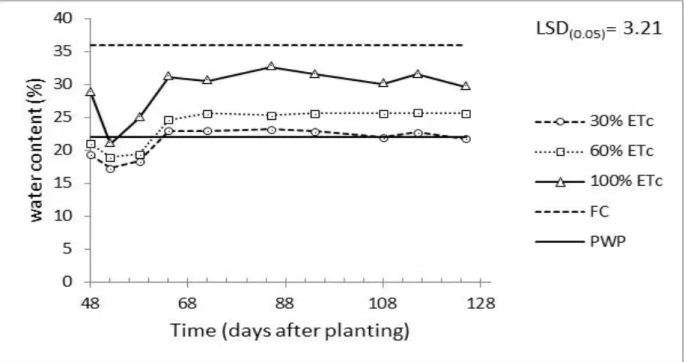
- Soil water content
- Crop physiology
- Stomatal Conductance (SC) and Chlorophyll Content Index (CCI)
- Crop growth
- Proline and protein content
- Yield and yield component
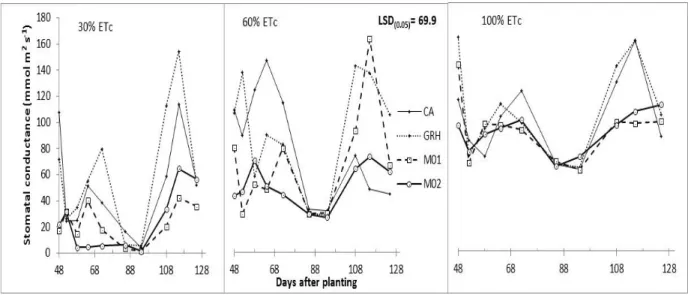
Varieties in 30% ETc were observed to close their stomata with increase in water stress, while in 100% ETc varieties were shown to have higher values of stomatal conductance. Hybrid CA was observed to have the shortest vine length than all cultivars, while landrace M01 had the longest vine length compared to all other cultivars. Vine lengths were observed to be longer under 100% ETc followed by 60% and 30% ETc respectively for all cultivars except CA where vine length was observed to be high at 60% ETc.
Although not statistically significant, water stressed plants were observed to take longer to flower compared to unstressed plants. A significant interaction (P < 0.05) between cultivars and water regimes was observed with respect to leaf fresh mass.
Discussion
Similar results have been reported in maize showing height reduction due to water deficit (Porro and Cassel, 1986). In cucumber plants, Doss et al. 1977) and Elkner (1985) also showed a significant reduction in vine length and number of leaves, which in turn greatly reduced fruit yield and quality. A decrease in vine plant length is due to a physiological decrease in cell proliferation by Hsiao (1973), and a decrease in leaf number, on the other hand, is associated with a decrease in the rate of leaf emergence (Sharp et al., 1979).
Proline was shown to accumulate more in hybrid cultivars than in landraces and its accumulation was observed to be higher in stressed plants than in non-stressed plants. According to ETc, protein was observed to increase with decreasing water stress.
Introduction
The edible part of pumpkin contains carbohydrates, proteins, fats and minerals including phosphorus and calcium (Ahmad et al., 2011). This information is obtained in other countries; South African indigenous squash varieties remain underutilized in favor of introduced species whose nutritional values are well defined. It was hypothesized that local domestic squash varieties have similar nutritional value to popular commercial squash varieties.
The primary goal of the research was to determine the nutritional value in the leaves of domestic pumpkins at different stages of crop growth and to determine the optimal harvesting time. In addition, the study assessed the nutritional potential of pumpkin leaves by assessing their potential contribution to nutritional requirements.
Results
- Stomatal conductance and chlorophyll content
- Crop growth
- Mineral levels
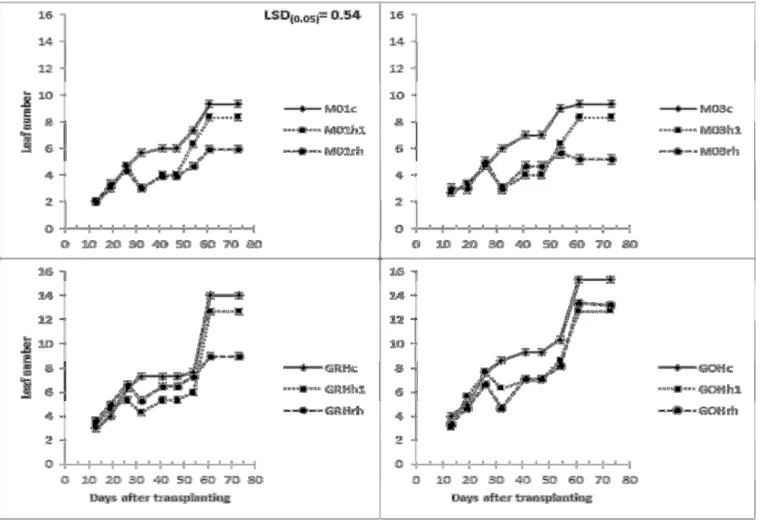
Highly significant differences (P < 0.001) were also observed among varieties in terms of leaf number, with hybrid varieties having more leaf number than landraces (Fig. 6.4). Regarding sequential harvesting, Ca levels were also observed to be high; Ca levels were even higher in hybrid cultivars, averaging about 5 000 mg 100 g-1 per harvest. High nitrogen content (> 1 000 mg 100 g-1) was observed in all cultivars, with hybrid cultivars having higher N content than landraces (Table 6.1).
With regard to sequential harvesting, N concentration was found to increase in landraces, while in hybrid varieties it fluctuated within narrow limits. A huge range of 739 mg 100 g-1 was observed between the landraces and hybrids, with hybrid varieties having a higher K concentration (Table 6.1).
Discussion
This was also contrary to the findings by Kruger et al. 1991) where they observed higher amounts of protein in locally grown leafy vegetables compared to their commercially produced counterparts. Variation of nutrients observed in different studies may also be associated with postharvest handling and processing and different methods used in nutrient quantification (Gupta et al., 2004). As such, van Jaarsveld et al. 2014) advised that nutrient comparison should be interpreted with great caution.
In contrast to this study, van Jaarsvel et al. 2014) reported a significantly lower amount of RDA of iron in both age groups 4–8 years old children and 19–30 years old women in pumpkin leaves. Great variety and high iron content in low-lying leaves such as pumpkin may be due to soil contamination and van Jaarsveld et al. 2014) advised that it should be interpreted with great caution.
Introduction
- Meteorological data
- Crop establishment
- Physiological and growth associated parameters
- Yield
- Seed quality test
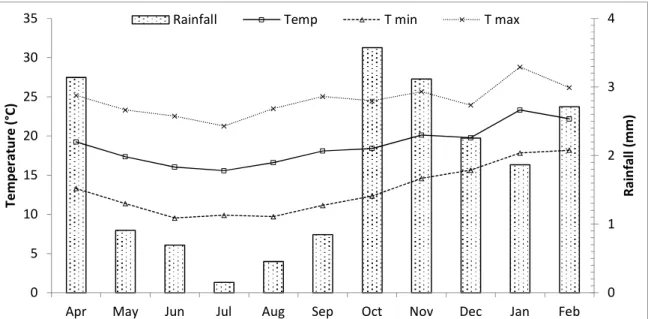
The aim of the study was to compare winter and summer plantings of bottle gourd landraces, using commercial varieties of other cucurbits as control varieties. 76 Figure 7.3: Stomatal conductance and CCI of landraces (M01 & M02) and hybrid varieties of cucurbits (GRH & CA) recorded over time. 79 Figure 7.6: Estimated fruit yield of bottle gourd landraces (M01 & M02) and cucurbit hybrid varieties (GRH, GOH & CA) obtained when planted in early summer.
80 Figure 7.7: Daily germination of bottle gourd landraces (M01, M02 & M03) compared to selected hybrid cucurbits (GRH, GOH & CA) during the standard germination test. 81 Table 7.2: Seed performance of bottle gourd landraces (M01, M02 & M03) compared to selected hybrid cucurbits (GRH, GOH & CA) during standard germination test.
Discussion
Occurrence of frost during the winter season damaged the plants significantly and led to stunted growth and the death of the plants. Seed quality characteristics in terms of viability and vigor for cultivars of the same age were not very different from those obtained in seed quality tests in Chapter 2, except for a few changes. Landrace M01 which performed well and hybrid GRH which had poor germination under standard germination test had conflicting results compared to the present study.
It was observed that the seeds of this landrace were not fully ripe at the time of harvest compared to other varieties. While hybrid GRH on the other hand could have gained vigor due to age effect.
- Introduction
- Aims and Objectives
- Challenges
- Future Teaching, Learning and Research Possibilities
- Final Comments and Summary Conclusions
Closing of stomata in response to decreasing soil water content is an initial response of plants to water stress. In this study, it was used as an index for assessing the severity of water stress. Growth phenological and yield responses of bambara groundnut (Vigna subterranea L. Verdc) landraces to imposed water stress: 11.
Effect of water stress during flower initiation, flowering and pods on the growth and yield of broad bean (Vicia faba L.). A simple instrument for measuring leaf growth in grasses and its application in the study of water stress on maize and sorghum.
Analysis of variance tables for chapter 4
Analysis of variance tables for chapter 5
Analysis of variance tables for chapter 6
Analysis of variance tables for chapter 7