The Namibia Water Corporations Act, 1997 requires that a performance contract be concluded between the owners of the company (the State) and the Corporation. It further requires that the Namibia Water Corporation (NamWater) must formulate and maintain service standards in respect of the provision of water, services or facilities. The Support Process should be the second priority with improving the asset management organization high on the.
It will form part of the implementation phase of a quality management system for Nam Water. To monitor Nam Water's performance over time in meeting the requirements of the quality policy, various performance indicators have been identified.
INTRODUCTION
A Board of Directors, appointed by the government, ensures that Nam Water uses the country's scarce water resources in the best interests of Namibia and its people. It further requires Nam Water to formulate and enforce service standards regarding the provision of water, services or facilities. The objectives of the study, as set out in this document, are to develop a quality management system for Nam Water that addresses all these aspects, identify deficiencies within Nam Water and continuously monitor progress towards meeting standards.
Part of the study was to formulate a set of service standards relating to the provision of water, services and/or facilities as required by the Namibia Water Corporation Act of 1997. The details of the methodology used in this study are presented in Chapter 4 , while Chapter 5 discusses the findings and conclusions of the study.
QUALITY AND QUALITY MANAGEMENT
Benchmarking
- Definition of Benchmarking
- Metric Benchmarking
- Process Benchmarking
According to Alegre et al (2000), benchmarking is the comparison of the processes and systems of a particular business function between companies. The first step is to identify key areas of concern where performance gaps exist, using the results of the metric benchmarking. The use of performance indicators is the first stage in the process of identifying key focus areas.
Information is necessary for a company to ensure a greater degree of understanding of the identified central focus areas. Adopt, adapt or modify selected best practices from the superior performers to meet the specific conditions of your business and integrate these into the organization's core focus areas.
TOTAL QUALITY MANAGEMENT .1 What is Total Quality Management?
- Participants in the Total Quality Management Process .1 The Company and its Organisation
- Top Management
- All Employees
- Customers and Suppliers
TQM is a company-wide commitment to continuous quality improvement of all aspects of the company's customer-relevant processes, products and services. An indicator of the successful implementation of TQM in a company is when all employees at every level participate in decisions that affect their work. A consistent policy, identifiable to everyone and linked to the structure and culture of the company.
Tailored instruction, training and design to align with company goals. The public sector has a large number of employees and represents a significant part of the workforce in a country.
QUALITY MANAGEMENT IN A WATER UTILITY .1 Quality Contracts
- Performance Indicators and Benchmarking
- IWA Programme
- WUP Programme
- Process Benchmarking in the Water Sector
- The role of quality management in the water sector .1 Introduction
- The Various Fields in the Water Sector where Quality Management Plays a Major Roll
- Total Quality Management in the Water Industry
- Quality standards
- Quality system
- Quality assurance
The maintenance policy in a water company is closely related to the company's asset management policy. During the tertiary phase in the water industry, the emphasis regarding quality goes to the consumer and the quality of the services provided. Bill presentation should not be confusing and complicated as it can easily result in the water industry.
The public image of a water supply is directly related to the quality image of the company. The implementation of a TQM system will have a short-term financial effect on the profit of the water utilities.
INTRODUCTION
QUALITY MANAGEMENT IN NAMWATER .1 Vision
- Quality policy (Annexure 4)
- Quality standards (Annexures 5 & 6)
The following aspects of quality are a summary of all the quality requirements of the Nam Water Act 1997. In formulating its policies and carrying out its duties, Nam Water will take into account the need to preserve public rights of access to mountains, forests, deserts, cliffs, riverbanks or other open spaces and other places of natural beauty and take appropriate measures to preserve such access rights. Nam voda prepares and keeps prescribed records, which are available for public inspection.
Nam Water will send each customer at least once a year the address and telephone number of one of the offices of Nam Water where information regarding any matter included in the record maintained by Nam Water can be obtained. The Government may enter into a written agreement with Nam Water for the supply of water, services or facilities by Nam Water at a cost subsidized or paid in full by the Government. A detailed quality policy document for Nam Water was developed as part of this study (Appendix 4).
It also contains quality issues from the IWA and WUP programs that apply to the current Nam Water situation. As soon as the new strategic plan for Nam Water is adopted, this quality policy should be updated to reflect any new requirements from this plan. A standard or target has been identified for each quality aspect in the proposed quality policy document for Nam Water (Appendix 5).
A set of proposed service standards as prescribed by the Namibia Water Corporation Act 1997 has been drawn up for Nam Water (Annex 6). Various performance indicators have been established to continuously monitor Nam Water's performance in meeting the requirements of the quality policy and quality standards to ensure that work is carried out in accordance with the quality management system and that the quality management system is effectively applied. The following performance indicators have been identified (from the IWA and WUP programs) due to the fact that it will serve the purpose mentioned above and is compatible with the current situation in Nam Water.
IDENTIFICATION OF PERFORMANCE GAPS WITHIN THE NAMIBIA WATER CORPORATION
- Key Performance Areas (KPA)
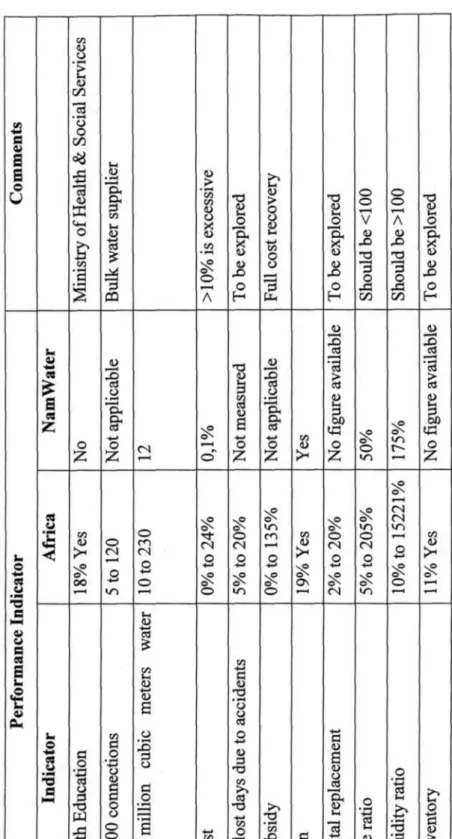
Nam Water participates in two programs for the development of performance indicators for the water supply industry: the International Water Association project on performance indicators for water supply services, and the Water Utility Partnership for Capacity Building in Africa (WUP) program on performance indicators and Benchmarking (chapter 3, sections 3.2.2.1 and 3.2.2.2). Overall, Nam Water's performance is better than many water companies in other African countries. However, by evaluating the information in Table 1, the following performance differences within Nam Water could be identified.
This assessment identifies the sales process as an area to focus on as a first priority, with a focus on improving revenue collection, improving customer relationships and reducing total cost. The Support Process should be the second priority with improving the asset management organization high on the list. Identifying the industry's top performers in various areas where performance gaps exist is beyond the scope of this study.
A QUALITY MANAGEMENT SYSTEM FOR NAMWATER As can be seen from the performance gap analysis done on Nam Water
This policy can be the starting point for the development of a TQM system for Nam Water. Targets or standards have been identified for the selected performance indicators to monitor Nam Water's performance continuously over time in relation to meeting the requirements of the quality policy, whether the work is carried out in accordance with the quality management system, and about the quality management system. used effectively. By introducing TQM in a company, quality assurance is automatically included, as TQM is a customer-oriented approach that fully satisfies the needs and expectations of customers and suppliers.
A quality culture in an organization will ensure a company-wide commitment to continuous improvement of the quality of all aspects of the company.
CONCLUSIONS
To monitor Nam Water's performance on a continuous basis over time in meeting the requirements of the Quality Policy, several performance indicators have been identified, as set out in Appendix 5. These indicators will also identify future performance gaps, various determine performance trends in the business and measure and monitor the benefits of implementing best practices. As shown in the performance gap analysis, all three processes in the Nam Water organization have shortcomings that need to be addressed through a quality management system.
The quality policy developed during this research (Appendix 4 & 5) is an ideal instrument for a TQM system. It describes all aspects of Nam Water that require quality attention, defines performance indicators to measure progress on quality aspects and sets objectives to ensure a commitment to further quality improvement. This proposed quality policy can be the starting point for the development of a TQM system for Nam Water.
RECOMMENDATIONS
- Developing of strategic planning and policies
- SALES PROCESS
- Meter reading and processing meter reading data
- Invoicing, debt management and collection
- Marketing
- PRODUCTION PROCESS
- Operating of bulk water supply facilities
- Water resource management
- Water quality monitoring, sampling and analysis
- ORGANISATION FUNCTIONS IN A WATER UTILITY
- Global Management
- Percentage population served The indicator is calculated as
- Percentage samples failing to meet quality standards
- Public health education
- Percentage planned and unplanned maintenance
- Recording of customer complaints
- Customer surveys
- Staff per 1000 connections This indicator is calculate as
- Average debtors days
- Percentage of customers metered
- Percentage of meters checked, recalibrated or replaced
- Lifeline tariffs
- Strategic inventory
- PERSONNEL INDICATORS
- Personnel per main function of the utility (Management and Support, Financial and Commercial, Customer Services, Technical)
- Personnel qualification
- Personnel health and safety Absenteeism
- OPERATIONAL INDICATORS 1 Reservoir cleaning
- Valve inspections
- Electrical equipment inspection
- Vehicle availability
- Pump rehabilitation
- Pipe failures
- QUALITY OF SERVICE INDICATORS
- Interruptions per million cubic meters of water distributed
- Service complaints
- Billing complaints
- FINANCIAL INDICATORS 1 Unit total cost
- Internal manpower cost
- Energy cost
- Annual running cost per main function of the utility (Management and Support, Financial and Commercial, Customer Services,
- Depreciation costs
- QUALITY ASPECTS
- Support Process
- Sales Process .1 Population served
- Production Process
- Cost
- Income
- PRODUCTION PROCESS
- Water demand and sustainability of resources .1 Per capita consumption
- Water quality standards
- Protection of water sources
- Environmental protection
- Records
Developing plans for the expansion of the company and the replacement of water supply infrastructure that has reached the end of its life (including preliminary budget figures). Because Nam Water is a bulk water supplier, the number of household connections is not a realistic indicator to measure the extent of expansion of the Nam Water supply system. Because Nam Water is a bulk water supplier, the number of standpipes is not a realistic indicator to measure the expansion rate of the Nam Water supply system.
Much of the community served by Nam Water is poor and cannot afford connection fees. It could be part of Nam Water's social responsibility and expanding existing service coverage. The availability and cost of water should depend on the economic value of the water where it is used in industry.
This indicator is a measure of the extent to which the utilities' assets are proactively managed. This indicator is a measure of the relative level of maintenance costs in relation to total operating costs. The costs for a utility company have a major impact on the company's financial viability.
The national average tariff for water is an indicator of the effectiveness of society. Securing the budget to reach a level of 0.1% of Nam Water's annual budget in five years. The costs incurred by an enterprise have a major impact on the economic viability of the company.
This is a measure of the extent to which the company's assets are being proactively managed. This is a measure of the relative level of maintenance costs compared to total operating costs. Customers will be informed of the extent of the water supply interruption as well as the expected repair time.
To protect against excessive use of water, Nam Water will support any initiative regarding the efficient use of water.