
Violent behavior is one of the most critical problems facing the world in general and South Africa in particular. In the face of such increasing violence, it is crucial for peace educators to focus on and teach people non-violent ways to resolve conflicts in order to contribute to a better awareness of the root causes of conflict from the global to the interpersonal level and encourage the individual to develop non-violent behavior. The immediate result of the program was satisfactory and the results show that this program affects the lives of individuals.
Violent behavior is one of the most important problems facing the world today, and South Africa in particular. It is crucial for peace educators to focus on and teach people nonviolent ways of resolving conflicts, to help contribute to a better awareness of the root causes of conflict from the global to the interpersonal level, and to encourage the individual to develop nonviolent behavior (Castro, 1999). . The module material helped me to answer most of the questions related to peace, violence and non-violence.
Research objectives
These goals of the Youth Offender Diversion Program motivated me to design a non-violence program that can be used in training sessions to help reduce the level of violent behavior in the lives of young offenders.
Research Question
Study Rationale
Research Design
Qualitative approaches were suitable because they enabled the participants to raise topics and issues that were critical. It also allowed participants to express their feelings and offer their perspectives in their own words (Neuman. It is important to note that details provided helped to gather information about people's opinions and attitudes towards conflict and violence in to collect and therefore appropriate non-violence training for juvenile offenders was designed.(Elmendorf.
Structure of dissertation
Literature review and Theoretical framework 2.1 Literature review
- Defining peace education
- Peace education as a mean to prevent/decrease violence
- Nature vs. Nurture
- THEORETICAL FRAMEWORK
Violent behavior is a learned phenomenon: if something is learned, it can also be unlearned. She emphasized the importance of peace education in preventing violence and focused on social skills programs, supporting the motion that these can be effective in transforming unpleasant behavior. Social learning theory denies that human aggression is not natural, but can be learned by observing the aggression model or by receiving and expecting rewards after aggression.
The statement concluded that violence is a learned behavior and that it can be unlearned, the same species that invented violence is capable of inviting peace (Adams. Bornman et al (1998) requires that working together, the cycle of violence Most importantly, they must be taught that conflict can be resolved without hurting someone with fists or guns, or with hateful, destructive words (Bornman et al 1998: 377).
METHODOLOGY 3.1. Introduction
- Action research design
- Methods of data collection
- Preliminary identification of participants
- Questionnaires (See Appendix 1)
- Short stories (See Appendix 2 and 4)
- Series of questions (See Appendix 3 and 5)
- Evaluation (See Appendix 6)
- Sample of research participants
- Ethical considerations
- Limitation of the study
As Costello argues, action research is most valuable when practitioners must respond to the changing demands of a situation or for evaluation of an ongoing program or curriculum change. In line with action research guiding principles, my research was presented in a way that allowed qualitative data to lead to action in the complexity of the situation by being more about language than numbers. It is noted that researchers have used action research methods in a variety of research arenas for dealing with issues presented in people's daily activities.
It is essential to note that time constraints cannot allow me to proceed to the second stage of action research which involves revised planning, followed by the second stage of action which involves reflection on the project, development of action strategies and analysis ( O'Brien, 2001). . I analyzed the four mini-assessments leading to an overall assessment at the end of the training. In my opinion, action research methods for dealing with issues presented in people's everyday activities such as conflict and violence will provide an appropriate methodology for researching the issue of reducing male violence (Dick, 1993).
I have developed more interest in action research as a result of attending AVP workshops, from the basic level to the facilitator level. As an action-oriented person, I was motivated by two main reasons to apply action research to this project. In the planning phase of action research as mentioned above, I started by collecting data on all the participants' offenses or criminal records from NICRO social workers.
The comparative study of the pre-test and post-test questionnaire helped to evaluate the immediate outcome of the training. During the training process, participants were given two short stories related to the specific aims of the study. Another limitation also imposed by time constraints is that I could not proceed to the next stage of action research, which could have led me to develop action strategies after reflecting on the immediate outcome of the training.
This means that this study has allowed me to use only one cycle of action research instead of its full cyclical process.
FINDINGS & DISCUSSION
Introduction
- Major themes of the program
- Affirmation of ourselves and others (Theme 1)
- Communication (Theme 2)
- Conflict resolution (Theme 3)
- What is peace? (Theme 4)
- Conflict, Violence and Nonviolence (Theme 5)
- End of workshop evaluation
- Peaceful resolution of conflict
- Change in approach to conflict and more choices for solving conflict
- Trusting others
- Self-respect and responsibility for behavior
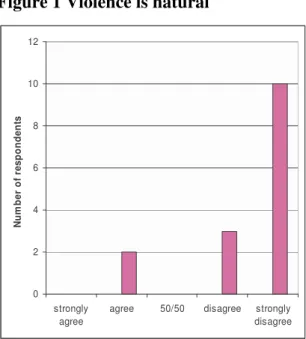
It is important to note that the main theme for the pre-test questionnaire was the "nature of violence". I believe that it is very important for a person to recognize his/her positive qualities and goodness. It is clear that there is some goodness within each individual; all we need is to develop self-esteem and self-confidence in us.
Conflict in itself is not a problem; however, how it is handled can bring people together or tear them apart. A more demanding question was: Is it possible to live non-violently in a violent environment. In other words, the majority tried to say that violence is innate and that it is not an individual's choice to be violent, contrary to the Seville statement on the nature of violence, which states that "it is scientifically wrong to say that violence is natural" (Paige, 1997:99).
It is argued that people try nonviolence and even if it works they turn to violence. It is true that the environment has a great impact on the lives of the people who live in it. It is emphasized that social and economic inequality has generated and fueled more violence.
The responses reflected that the workshop was useful as diverse as the individual lives of the respondents. To this question, the majority (93.3%) of participants state that the workshop helped them to develop a peaceful solution to conflict. Question nine shows that the workshop was successful in helping participants to have a new approach to conflict.
The answer to question 4: “Did the workshop help you realize that you have choices when a conflict arises?” it shows that the issue of more choices for conflict resolution has been addressed. In concluding this section, it is important to note that many respondents commented on a variety of resources that demonstrated that the workshop helped them see violence and conflict from a new angle and enabled them to approach conflict with nonviolent alternatives. However, if we reflect the general trend of the responses, we can rightly say that the reflective phase of the action research was successful.
CONCLUSIONS and RECOMMENDATIONS 5.1 Conclusion
- Recommendations
- NICRO should promote nonviolence culture in their different activities
- NICRO and Offenders’ parents
- NICRO and former inmates
- The community should provide supports and programming for young people
- Formal Learning institutions (schools, colleges and university) should promote the culture of peace
- The family should promote the culture of nonviolence
- Media
Many respondents also found their experience to be one in which they encountered respect: "the respect and friendship I received from other people." Comparison of the answers to the pre-test questionnaire and the answers of the workshop evaluation together with all the comments of the participants; it is obvious that the workshop contributed greatly to the change in the lives of the participants. The participants, who before the beginning of the workshop valued violence and undermined the effectiveness of nonviolence, ended up with a new perception and new approaches to conflict and violence.
It is essential to confirm that the overall goal of the research has been achieved, which is to build capacity for non-violent conflict response among a group of juvenile delinquents. Another tool I used to infer the effectiveness of the program was to compare the answers to the pre-test questionnaire that the participants submitted before the start of the workshop with the answers at the end of the workshop evaluation (workshop survey). The open-ended responses clearly show that people are empowered to take advantage of the choices opened up through the experiential learning process used in the workshops.
The study focused on developing a nonviolence education program to teach nonviolent problem solving to a group of young male offenders and to test the immediate outcome of the program. As a result of the assessment, the following recommendations are not limited to minors or prisoners, but to the whole society, locally and nationally. The main role of the peace center will be to organize an awareness campaign, seminars related to peace education and focus on the social and economic effects of violence in their prospective community.
Through the peace center's efforts, the community should also be part of the program in supporting cultural and social relations that promote nonviolence. Young people must be trained to stop the spread of violence and be part of the solution by standing up against inequality, racism, discrimination, poverty, genocide, torture and other problems related to human rights violations. Parents and families play an important role in the lives of children and adolescents.
What did you find to be the most useful aspect of the workshop for your life?
Castro, L.N., 1999, Peace and Education for Peace: A Holistic View. Eds) World Encyclopedia of Peace (2nd Edition) Vol. Catholic Education office & New South Department of Education., 1986, Education for peace: Research and proposals. Paths to Peace Program /www.impactpublications.com/. amp; Toh, S-H., 1989, Peace Education in a Land of Suffering and Hope: Insights from the Philippines.
King, Mary., 1999, Mahatma Gandhi og Martin Luther King Jr: The power of nonviolent action, Paris, UNESCO/India Council for Cultural Relations, New Delhi, Mehta Publishers, ch1. McCawley, S., 2001, The Nature of Aggression (eller er det Nurture?) http://serendip.brynmawr.edu/bb/neuro//web2/Mccawley.html. Mishra Y., 2006, Negotiating Culture: Intersections of Culture and Violence Against Women in Asia Pacific.Asia Pacific Forum on Women, Law and Development.
Paige, G.D., 1997, To jump further as even closer, bring: from war after peace to non-violence to non-murder, International Journal of Peace Studies. Swan, B., 1995, Peace search: from the secular to the Christian, in M.Salla et al (eds.) Essay on peace, Rockhampton, Central Queensland University Press, 34-48.
Internet sources
