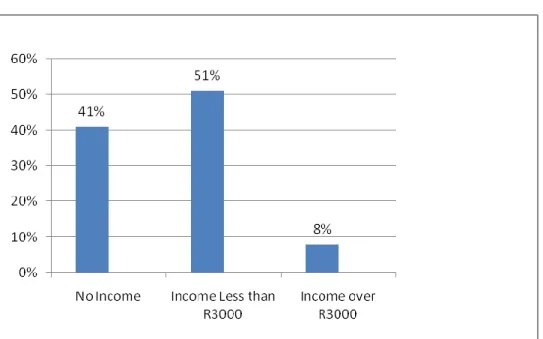
It was noted that the land reform projects did not provide sufficient income to the beneficiaries. These are notably the Department of Rural Development and Land Reform; Ministry of Agriculture; non-governmental organizations (NGOs) and rural-based municipalities.
Introduction
There were arguments that the land reform program in general and the redistribution program in particular failed to solve the situation in rural areas. 3 The National Land Summit was held in 2005 to assess the state of the land reform program in South Africa.
Public Administration and Management: Theoretical Perspective
The classical approach
According to Roux et al, the classical approach was characterized by an emphasis on formal aspects of the organization together with closed organizational systems to deal with the inefficiencies that characterize organizations. In terms of the classical approach, an appropriate structure with clear roles and levels of authority.
Neo-classical organisation theories and perspectives
The contemporary approach
This research seeks to establish whether proper institutional mechanisms were in place to enable the Department to fulfill its mandate. One of the elements of the assessment is to determine the effectiveness of the Department of Rural Development and Land Reform, as this will have an effect on the success of the programme.
Rationale for the Study
The purpose of the law was to regulate access to land by black people by monitoring land transactions between blacks and non-blacks. As a result of the provisions of this law, blacks were denied access to this important economic resource (land).
Significance of the Study
This statement is supported by the African National Congress (RDP), which claims that apartheid policies pushed millions of black South Africans into overcrowded and impoverished homelands and reserves. It is therefore not surprising that the majority of blacks live in extreme poverty, which is largely related to a lack of access to land.
Objectives of the Study
On this basis, the democratic government prioritized land reform as a means of community development as well as addressing the challenges of poverty and inequality. The land reform program and especially the land redistribution program give hope for improving the quality of life of the previously disadvantaged.
Research Approach
Literature Survey
Empirical Research
Questionnaires
Interviews
Observation Method (Izimbizo)
Key Terms in the Study
ADMINISTRATION: The management of public affairs, the execution or carrying out of the details of government. CHIEF: The chief is the head of the division within the geographical area of the traditional authority.
Organisation of Chapters
Chapter five focuses on the state of land reform in Limpopo Province, particularly in the Greater Letaba Local Municipality area. It examines the role played by NGOs and their interaction with the provincial Department of Rural Development and Land Reform.
Delimitations and Limitations of the Research
It discusses various efforts undertaken by the state to advance the land reform process and explores various partnership options. The primary objective of the study is to assess the impact of land reform on beneficiaries.
Conclusion
To determine impact, sensitive information such as the income of beneficiaries is critical.
Introduction
The Constitutional Mandate
Section 25(4) states that the public interest includes the nation's commitment to land reform to ensure equal access to all of South Africa's natural resources. Section 25(6) obliges the State to improve the security of real estate for persons or communities who were deprived or never enjoyed security of real estate due to past injustices (Constitution of the Republic of South Africa, 1996: 11).
A Conceptual Model
These provisions clearly indicate the state's will to ensure successful land reforms. The next section focuses on the legislative framework in relation to land reform and ownership.
The Land Legislative Framework
- The Restitution of Land Rights Act, 22 of 1994
- The Restitution of Land Rights Amendment Act, 22 of 2003
- The Communal Land Rights Act, 11 of 2004
- Extension of Security of Tenure Act, 1997
Section 35(5) of the Restitution Act only allowed the Minister for Lands to expropriate land. The new section 42 (e) provided that "the Minister may purchase, acquire or in any way expropriate land for which a claim has been made under the Restitution Act." The intention was to restore or assign the land or part of it to the plaintiff (Farmers' Weekly.
Public Administration and Public Management
In the public administration, the senior officials take responsibility for both technical and political advice to the minister or the government in question. Fredrickson and Smith argued that management theories in public administration describe management behaviors or prescribed guidelines to improve management while institutions work.
The Evolution of Public Administration
- The classical approach
- The scientific management approach
- Administrative theories
- Administrative bureacracy
- New Public Management
These questions, aimed at identifying the obstacles to the success of the land reform program, are linked to Taylor's formulation. Key to the research is the extent to which the land reform program embraced these principles.
Public Policy and Development
This research examined whether the concept of public administration is useful in land reform programs. For example, it assesses whether the land reform program has contributed to community development and poverty reduction.
Public Accountability of Public Administration and Management
Public service efficiency emphasizes the public interest where the expenditure of funds is in the interest of the community. The study attempted to determine whether the public administration principle of consistency in decision-making is applicable in the land redistribution projects in the research area.
The Role of a Public Manager
Their decisions must in every case be based on the full available facts and information (Botes et al. Finally, management needs evolution of performance to ensure the correct way of doing things (Botes et al.
Municipality and Land Reform
- Delivering land services at a local level
- Institutional arrangements
- Municipal commonage
- Building capacity for sustainable local government in land reform
- Human capital training for municipal land reform
- Strengthening municipal financial resources
- Non-governmental organisations (NGOs)
- Municipal-community partnerships
Efforts have been made to ensure that local offices of the Department of Rural Development and Land Reform are accessible to local authorities. In Limpopo Province, a satellite office linked to the district municipality provided accommodation for staff from the provincial office of the Department of Rural Development and Land Reform.
Policy for Land and Agriculture
Taking these issues into account, this study sought to determine whether poverty had been reduced in CPAs that acquired properties through the land redistribution program. This relates to the question of the extent of the legislative framework that the government has put together to address the issue of land reforms.
Conclusion
These will ensure that the implementation of the land reform program results in improved service delivery and functional responsiveness. To achieve these objectives, the public manager must guide the actions and behavior of public officials in the implementation phases of land reform policies.
Introduction
Background: Spatial and Temporal Aspects of Land Reform
As Cousins shows (undated: 1), the objective of the land reform program was both to correct past imbalances and contribute to poverty reduction. The adoption of the three components of the Land Reform Program – namely redistribution, restitution and restitution reform – was aimed at addressing such challenges.
South African Land Policy Framework
Redistribution of land is seen as one of the decisive means of changing the pattern of land tenure in South Africa (Lahiff, 2002: 44). The land reform, on the other hand, focuses on the protection of the rights of people (mainly farm workers) living on privately owned farms as well as on state land.
Land Acquisition Models Governing Land Reform
- Expropriation with some compensation (non-market-related)
- Expropriation paying market-related prices
- Expropriation without compensation
- Market-based land reform (MBLR) model
Section 25(2) of the Constitution and the land reform legislation explicitly grant the government the power to expropriate land for land reform purposes. The discussion now focuses on the progress made in implementing the land reform program from 1994 to 2011.
Progress on Land Reform
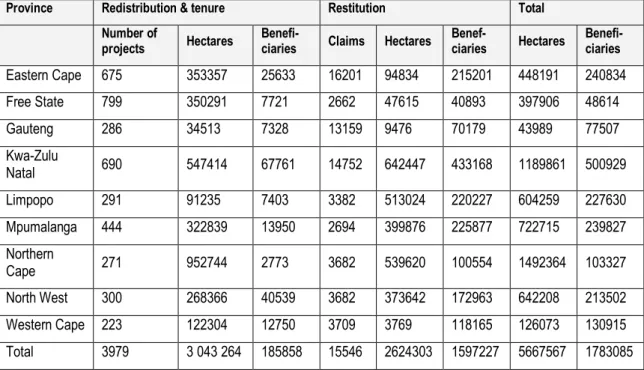
The Department of Rural Development and Land Reform has however come up with a plan that would see Executive Council members in the provinces share resources to settle claims. Mayende did not downplay the challenges facing the Department of Rural Development and Land Reform.
Challenges Facing Land Reform in South Africa
- Legislation and policies
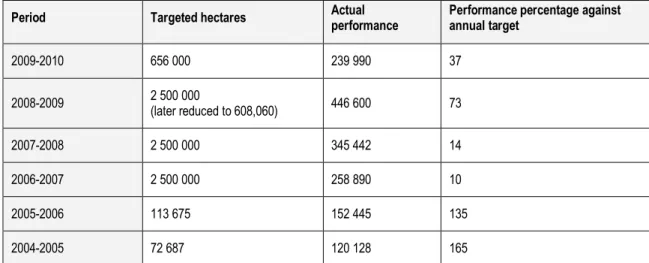
- Slow pace of the Land Reform Programme
- Capacity of the public service
- Capacity of the new farmers
Analysis of the above table shows that the department struggled to achieve its annual targets. The market-based approach to land reform also contributes to the slow pace of the reform process.
Lack of Access to Credit and Other Support Systems
This is cause for concern, as the transformation of ACB and Deželna Banka was intended to benefit the beneficiaries of the land reform, not to make them worse off. This prospect has encouraged the establishment of several institutions offering nationally accredited Agricultural Education and Training (AET) courses in support of various land reform programmes.
Civil Society Organisations’ Views on Land Reform
These seem to be lacking in relation to land reform projects in South Africa. SACC asserts that the land reform strategy should include maximum participation by beneficiaries (Department of Land Affairs, Land News, 2004: 7) and suggests that its success should be measured in terms of how widely and sustainably it advances the cause of justice and the restoration of human dignity by enabling people to secure livelihoods and regain control of their lives (Department of Land Affairs, Land News, 2004: 7).
Land Reform and Post-settlement Implementation Support
She understood that the responsibility for the success of the land reform program cannot be borne by the state alone. As a private sector institution in the cane industry, it provides training and other support services to new farmers.
The Impact of the Land Redistribution Programme
In addressing these questions, this inquiry takes the position that the success of the land reform program should be measured not so much in quantitative terms (ie, the amount of land redistributed and returned), but in terms of its impact on the quality of the lives of the beneficiaries. According to the "Quality of Life Survey" conducted by the Department of Rural Development and Land Reform in 1999, only 16% of the land reform projects surveyed provided their beneficiaries with a sustainable income (May and Roberts, 2000:14 , cited in Lahiff, undated: 35).
The Role of the State in Land and Agrarian Reform
The following example highlights the importance of the government's role in the land reform scene. The development of the much talked about green paper on land reform is a benchmark for the major.
Conclusion
The argument made in this chapter lends strong support to the conclusion that the market-led land reform policy needs to be urgently reviewed as it appears to be failing the people of South Africa. This is a policy area that cannot be left to market excesses alone.
Introduction
Land Reform in China
- Historical perspectives and land-related challenges
- Land reform model
- Merits
- Demerits
These are some of the questions that are critical in evaluating the success of a land reform program. An important lesson to be learned is that China has adopted an integrated approach and "revamped" the entire economic system to support the land reform program.
Land Reform in Zimbabwe
Historical perspectives and land-related challenges
The land crisis in Zimbabwe has been described as "broken hopes and expectations of liberation" (Edigheji, 2000 in Tsheola, undated: 8). The land that was redistributed did not benefit the poor and landless, but rather African large-scale commercial farmers and the politically connected (Bush & Szeftel, 2000 in Obioha & . Molapo, 2007: 97).
Policy framework
Insofar as land was allocated to the poor and marginalized, the land reform can be seen as a positive and appropriate response on the part of the Zimbabwean government. The farms that were taken back by the Fast Track Land Reform were not allocated to the farm workers per se, but to people connected to politicians.
Land Reform in Namibia
- Historical perspectives and land-related challenges
- Policy framework for land reform
- Merits
- Demerits
In addition, 40% of the Namibian population lives in the northern part of the country, which makes up about 7% of the total land area. The implementation of the Namibian land reform policy by the national government was led by the Ministry of Land, Resettlement and Rehabilitation.
Ethiopia’s Land Reform
- Historical perspectives and land-related challenges
- Policy framework
- Merits
- Demerits
There is no encouragement of commercial practices that could stimulate the economy, nor does the state provide any support to farmers (Haileselassie & Panos Features Staff, 2004). All property is owned by the state and is distributed to farmers who can sell it or leave it unused.
Thailand’s Land Programme
- Historical perspective and land-related challenges
- Policy framework
- Merits
- Demerits
The acceptance of land sharing depends on the recognition of its legitimacy by the land owner and the slum authority (Payne. The disadvantage of the land sharing policy is that it is applied only in specific cases.
Land Reform in India
- Historical perspective and land-related challenges
- Policy framework
- Merits
- Demerits
This situation shows that land reforms in Punjab have not contributed to community development and poverty reduction. These loans and credits started with the MBLR, which was based on the land reform policy for structural adjustment.
Land Reform in Brazil
- Historical perspectives and land-related challenges
- Policy framework
- Merits
- Demerits
Land reform has not had much impact on the peasantry in the Indian states of Punjab and Haryana (two Indian states (Thapliyal. Rural laborers began occupying unused land when they realized the government's inability to implement land reform under the provisions of the 1988 Brazil Constitution (Teofilo & Garcia, 2003 cited in Cullen, Alger & Rambaldi.
Conclusion
South Africa's Department of Rural Development and Land Reform can learn from this Brazilian approach. The application and implementation of the land reform program should not be to the detriment of other residents.
Introduction
The Mandate of the Provincial Department of Rural Development and Land Reform
Providing this information is an important responsibility of the provincial rural development and land reform office. The provincial office receives a budget allocation from the national office of the Ministry of Rural Development and Land Reform.
Implementing Land Reform Processes
As an implementation component of the Department of Rural Development and Land Reform, the provincial office should help determine whether the land reform policy has substance and whether it has been successful. Public officials must account for the expenditure of financial resources, and more specifically officials in the provincial office of the Department of Rural Development and Land Reform must account for the services they provide in the public administration process.
The Case of the Bophelo ke Semphekgo Project
The case study outlined in the next section shows how the Department of Rural Development and Land Reform applied its processes and procedures in a particular case. In order to have a positive effect on land reform, the ministry should share its responsibilities with other (non-state) actors.
Community Support in Understanding Land Reform in Limpopo
The lesson for policy makers is that there is a gap in civil society adaptation to improve the land reform agenda. The generous but haphazard provision of training by the Tompi Seleka College of Agriculture is another example of the involvement of an outside entity that could be more proactively recommended by the Legislature.
Capacity Building for Land Reform Beneficiaries in Limpopo Province
The strategic partnership initiative requires in-depth planning to deliver benefits to land reform claimants. Sufficient support for land reform beneficiaries is thus a continuing challenge for land redistribution projects to succeed.
The Pace of Land Reform in Limpopo
Landowners contesting the land claims also influence the pace of land reform in the Limpopo province. These disputes negatively affect the rate of land reform, diverting the attention of the state from further delivery of more land reform properties.
Dept of Rural Development and Land Reform and NGO Initiatives in Limpopo Province 139
The Nkuzi Development Association can be seen as a pacesetter in the proactive coordination of land-related issues, in contrast to the inactive role of government as represented by the Limpopo Provincial Office in the Department of Rural Development and Land Reform. Dissemination of information: Poor dissemination of information is a stumbling block in the way of land reform goals.
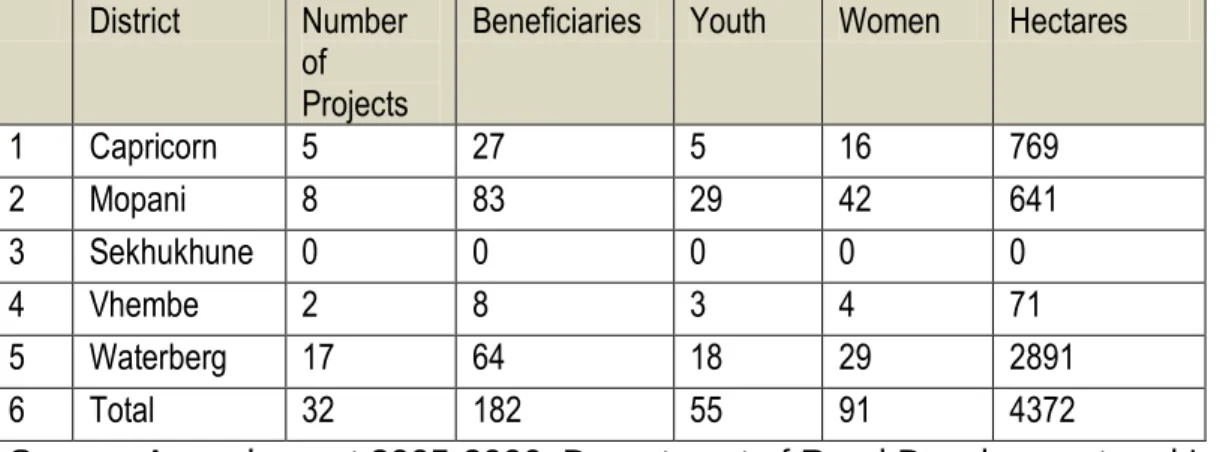
Approved Projects on Land Redistribution for Agricultural Development (Lrad) (1 April
Of the 152,445 ha that the LRAD sub-program delivered nationwide, the Limpopo Provincial Office for Rural Development and Land Reform contributed around 4,575 ha of agricultural land, which amounts to 3% of all land transferred in the country. From a public administration perspective, the provincial offices of Rural Development and Land Reform need to review their strategic plans and improve their current decisions (Denhardt & Denhardt.
Conclusion
Introduction
Geographical Background of the Research Area
Description of the area
Availability of land
Income and employment
The dominant economic sector is agriculture, with the town of Mooketsi in the municipality producing as much as 90% of South Africa's tomatoes.
The Research Problem
The research further aimed to determine whether land reform programs have contributed to community development and poverty reduction. The 2006 White Paper on South African Land Policy states that "the aim of land redistribution is to provide the poor with land for residential and productive purposes in order to improve their livelihoods" (White Paper on South African Land Policy, 2006: xii ), further specifying that priority should be given to the poor, as the poor require land in order to earn income and achieve food security (White Paper on South African Land Policy, 2006 : 9).
Research Questions
It is the capacity of the government to support the beneficiaries and the rate at which the land reform program is being implemented. The written consent was prepared and it accompanied each questionnaire that was distributed to the research participants.
Research Instruments
- Theoretical search
- Data collection
- Structured questionnaires
- Research interviews
In this study, structured questionnaires were used to obtain information from land reform beneficiaries. This helped the researcher to determine the impact of land reform on livelihoods.
Population, Sampling and Data Analysis
Population
In this study, the research population was the beneficiaries of the land reform projects in Greater Letaba municipality, municipal councilors, civil servants and traditional leaders. This subset of the entire population that was selected and studied as representative of the entire population is referred to as the sample.
Sampling frame
The sample for traditional authorities was drawn from all 10 traditional authorities that fall within the geographical area of the survey. The sample for Ministry of Agriculture extension service officers was drawn from those working in GLM.
Sampling technique and sample size
The sample for the Ministry of Rural Development and Land Reform focused primarily on officials working in the wider Mopani District, which encompasses the study area. The Department of Rural Development and Land Reform recommended one official working in Mopani District which covered the study area.
Conclusion
First, data can be presented in the form of pie charts, tables, or graphs to describe a situation. During the analysis, descriptive statistical method was mainly used and the data was presented in the form of tables, graphs and charts.
Introduction
Data Categories
Category 1: Data From Beneficiary Questionnaires
Beneficiary Demographics
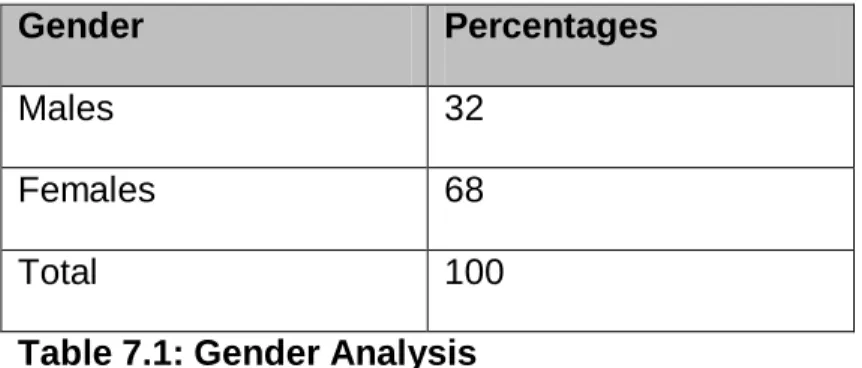
- Gender
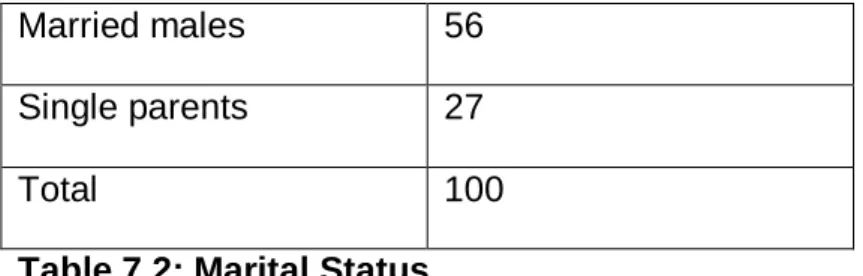
- Marital status of respondents
- Number of household heads among respondents
- Respondents’ level of education
- Income analysis
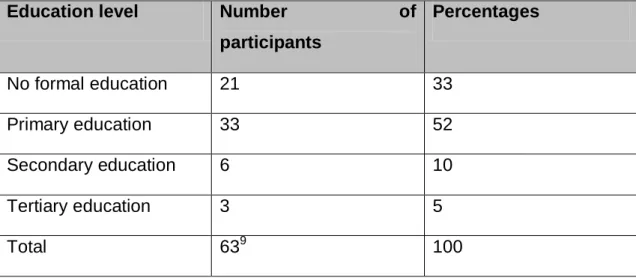
The research showed that 33% of respondents had no formal education; while 52% had only primary education. 9 The number represents only the beneficiaries of land reform projects and excludes government officials, traditional leaders and municipal councilors who participated in the research.

Beneficiary Responses on Land Reform Issues
- Income received from land reform projects
- Motivation to encourage others to participate in land reform projects
- Support by agricultural extension officers
- Suggestions by land reform beneficiaries to the Department of Rural Development and
Funds were also allocated to recruit new staff to assist land reform beneficiaries (African Renaissance, 2006: 51). The department should ensure that land reform projects are properly equipped with the necessary machinery, plows and tractors.
Policy and Conceptual Issues on Land Reform
- Application of the land reform legislation
- Reviewed policy on land acquisition
- Legislative review
- Information about Land Reform programme
- Proposals for information sharing
It indicates that if South Africa can fast track the land reform programme, many people can be helped (African Renaissance, 2006: 51). In fact, they stand to benefit more from the land reform program than the municipalities.
Impact of Land Reform on Key Community Determinants
- Acquisition of new skills
- Reduced unemployment
- Access to financial assistance
- Consequences of inadequate financial assistance
The financial support received by the land reform beneficiaries in this study came from the Land Bank. For most participants, the land reform programs created employment in the form of employment on the newly acquired farms.
Extent of Satisfaction with the Pace of Change
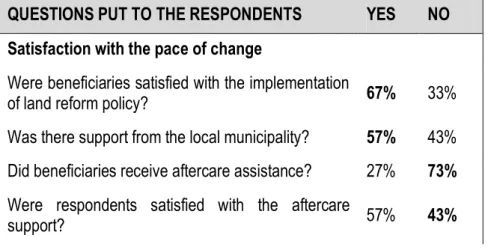
Satisfaction with the implementation of land reform policy
The fact that only 57% agreed that the Municipality had given this priority is a somewhat dubious confirmation of the municipality's commitment to the land reform process. The beneficiaries in the GLM tried to avoid the collapse of the land reform projects by working as hard as they could.
Category 2: Interviews
Beneficiary demand for both agricultural infrastructure and inputs is an indicator of the beneficiaries' commitment to the given projects. In addition to the contribution of agricultural activity, the beneficiaries also requested the relevant infrastructure, as mentioned in the previous discussion.
Interviews with Government Officials
All interviewees agreed that beneficiaries of land reforms in the GLM had not received any training in agricultural production. Most agreed that the inadequate financing was a serious shortcoming in the implementation of the land reform programme.
Interviews with Municipal Council Members in the Land and Infrastructure Portfolio
The interviewees mentioned that the program did not significantly contribute to the reduction of unemployment, and they see the neglect of strengthening the capacities of the beneficiaries of the land reform as a serious drawback of the program. According to the second review agreement, the minister, if the state deemed it necessary, would expropriate the property for allocation to the beneficiaries of the land reform.
Interviews with Traditional Authorities in the Greater Letaba Local Municipality
The council members highlighted the following as challenges in the implementation of the Land Reform Program in the study area: poor financial management by beneficiaries; insufficient support by the agricultural extension service officers; beneficiaries with no background farming knowledge; and lack of coordination of roles and responsibilities between the department and the municipality. There was disagreement among councilors whether poverty had decreased since the inception of land reform in the study area, as there were people who worked on the land reform projects who still relied on government pension grants.
Conclusion
They said key stakeholders such as established commercial farmers were reluctant to support the program and convincing them to contribute remains a challenge for the Department of Rural Development and Land Reform.
Introduction
Summary and Conclusions
The extent to which the South African legislative and policy framework addressed the
Monitoring and evaluation is crucial to the success of any public project, and the research showed that land redistribution projects are not sufficiently monitored by the Department to make sure that production on the redistributed farms remains uninterrupted. Project beneficiaries in particular often did not have access to the necessary farming machinery, and they called for better supervision by the Department to ensure that projects were properly equipped.
Gaps discovered in the implementation of the land redistribution programme
What lessons could the main stakeholders in land reform learn to improve the
Recommendations
Incorporate land reform in Municipal Integrated Development Plans
Financial Support
The Role of political leadership
Aftercare needed for land reform
Agricultural infrastructure required
Extension officers accounting to politicians
Increasing the Department of Agriculture staff complement
Sufficient training in agricultural production
Need for financial resources
Need for strict control measures
Disregard of business plans by land reform beneficiaries
Increase extension services
Problems with the willing-seller willing-buyer principle
Communication
Need for community support
Capacity building for beneficiaries
Partnerships
Strong coordination between Municipality and department
Strategic support from traditional authorities
Conclusion