A large earnings gap exists between self-employed blacks and whites, and the study examines how much of this earnings gap is attributable to differences in observed characteristics of the self-employed and how much is due to differences in the returns to these observed characteristics. . I estimate earnings equations using data from the September 2004 Labor Force Survey and find that variables representing the individual, family, and employment characteristics of the self-employed are determining part of their earnings. Using the Oaxaca-Blinder decomposition technique, I nevertheless find that only 55 percent of the earnings gap between blacks and whites in self-employment is attributable to differences in observed characteristics.
The remainder of the earnings differential may reflect the effects of omitted (unobserved) characteristics, or it may reflect differences in returns to observed characteristics.
Chapter One: Introduction
Context: The South African labour market
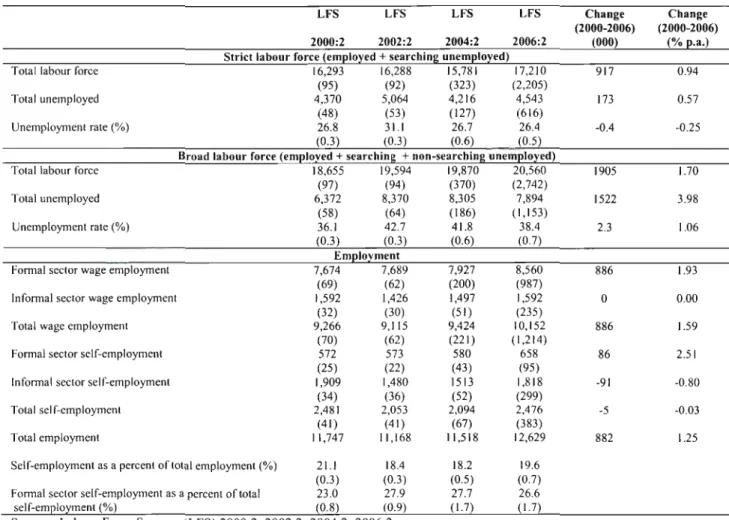
Growth in the number of self-employed has therefore been low in relation to South Africa's persistently high unemployment rate. In the US, for example, self-employment is a major source of employment among East Asian minorities (e.g., the Chinese). Furthermore, the promotion and promotion of self-employment and small businesses is seen as a source of economic growth and employment growth in the economy. .
This thesis does not explicitly investigate why the number of self-employed people in South Africa remains so low despite very high unemployment rates.
Overview
Discrimination can also take the form of consumer discrimination, where customers may be unwilling to rent the services or buy goods from someone of color unless they can offset the costs by paying less (Borjas & Bronars, 1989; Meyer, 1990 ; Boyd, 1991).
Chapter Two: Literature review
Self-employment in South Africa .1 Self-employment
- Standard explanatory variables used in earnings equations
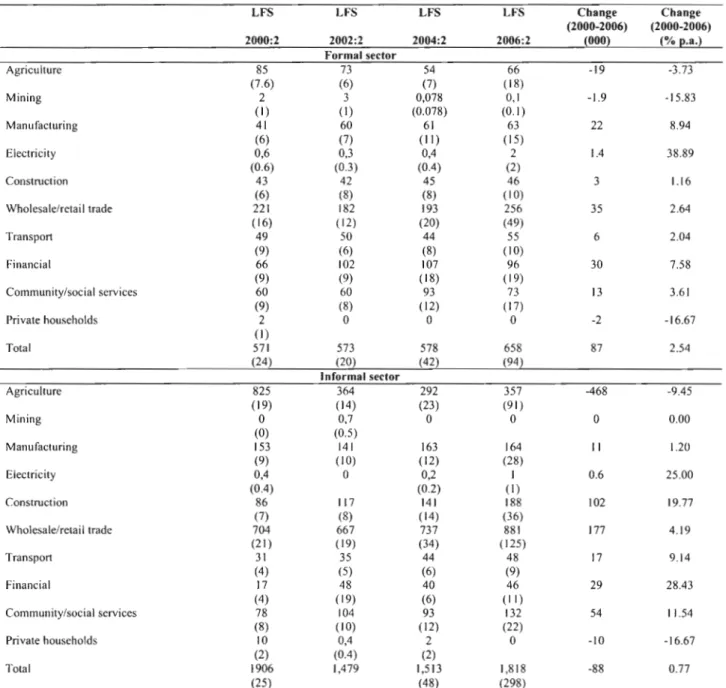
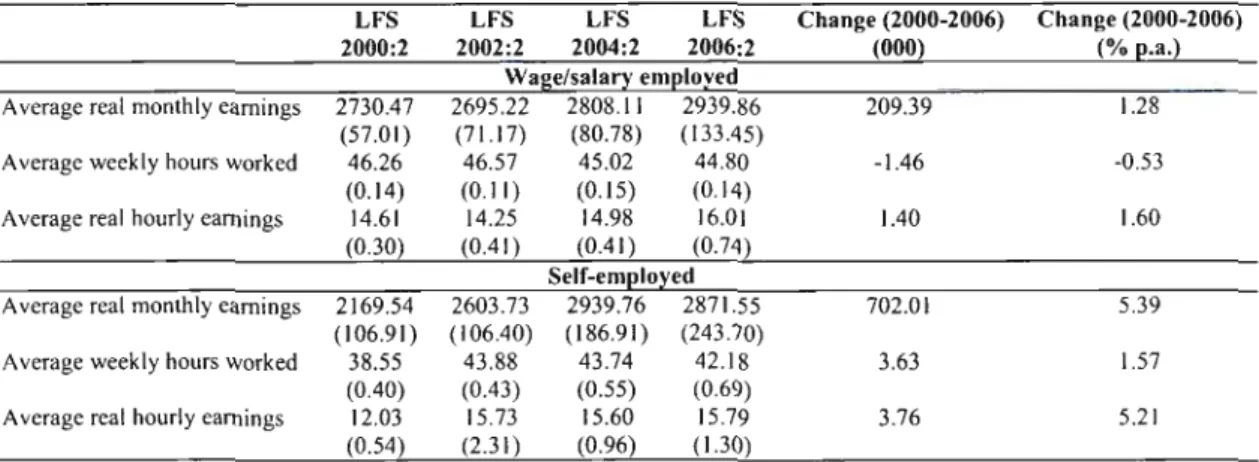
Therefore, when I look at self-employment in South Africa in this dissertation, I refer to the self-employed in the broadest sense. In this section I examine these trends in self-employment and earnings of the self-employed in South Africa for the period 1995-2003. How has the increase in self-employment affected the income of the self-employed.
I have not found any econometric studies in the South African literature that specifically estimate the earnings of self-employed people. For example, the presence of children in the household affects the income of employees in the household. None of the studies on self-employment in the international literature specifically focus on self-employment earnings by sector.
Conclusion
I have not come across any studies in the South African literature that specifically address the decomposition of the racial earnings gap among the self-employed. However, Rospabe (2002) estimated the racial breakdown of earnings among a pooled sample of black and white self-employed and employed people. She broke down the earnings gap between black and white employees and the self-employed for 1993 and 1999.
She finds that the earnings differential has decreased over the period and that the most important component of the earnings gap is the declared productivity component. However, the contribution of this component to the wage differential decreased over the period. The undeclared component or discriminatory component accounts for 23 percent of the wage gap in 1993 and 29 percent in 1999.
Thus, what is evident from the above studies is that the black-white wage gap persists in South Africa and that it may be partly caused by discrimination in the labor market. These include unmeasured attributes that may be related to income (such as motivation and risk attitudes among the self-employed) and discrimination (such as consumer discrimination among the self-employed). Income decompositions can be used to decompose the racial earnings gap between Black and White self-employed in South Africa into an explained component (explained by differences in measured characteristics) and an unexplained component (reflecting, in part , the effects of discrimination).
Chapter Three: Research design and methodology
Cross-sectional descriptive analysis of the self-employed in South Africa, 2004
- Characteristics of the self-employed
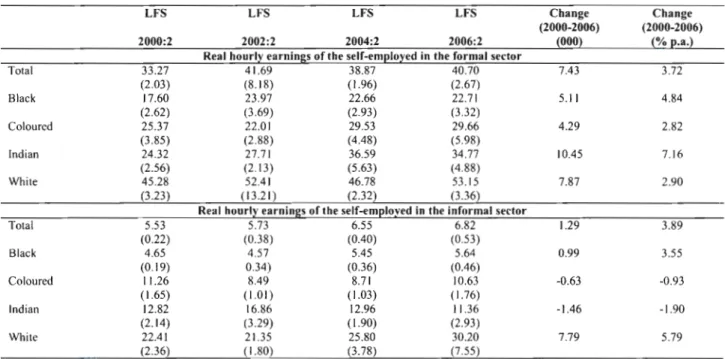
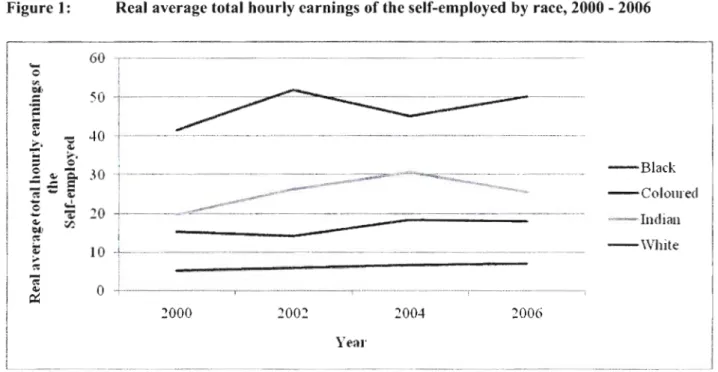
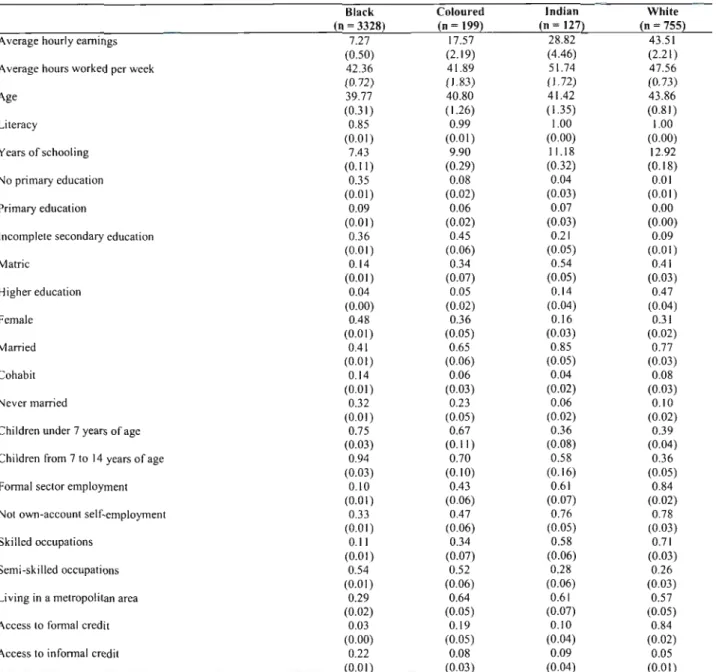
The average real hourly wage for self-employed whites (R43.51 per hour) is greater than. However, Table 6 also describes clear differences in the average observable characteristics of these self-employed people. Thus, this section suggests that the average observable characteristics of the self-employed differ by race and that these differences may affect the return to self-employment.
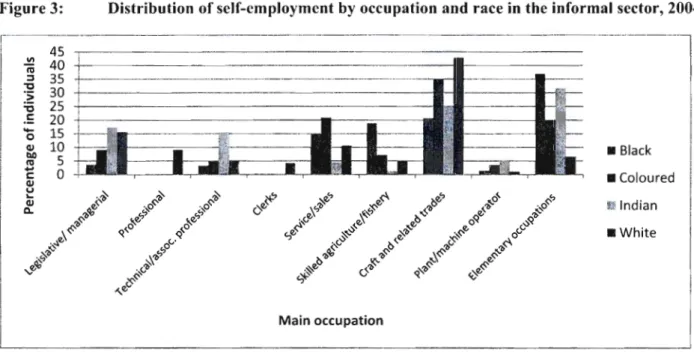
Returning to self-employment is also influenced by the type of employment and the type of profession that the self-employed person performs. The results reveal that three-quarters of self-employed whites in the business sector are in skilled occupations (52, 11, and 13 percent in managerial, professional, and technical occupations, respectively). Similarly, 70 percent of self-employed Indians in the business sector are placed in skilled occupations such as managerial and professional occupations (65 and 5 percent respectively), and another 20 percent are in semi-skilled occupations such as sales and artisans (8 and 12 percent respectively).
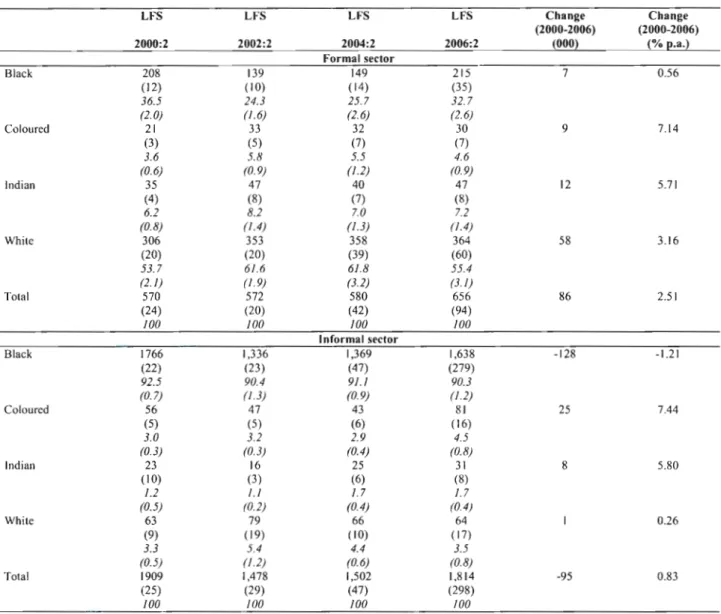
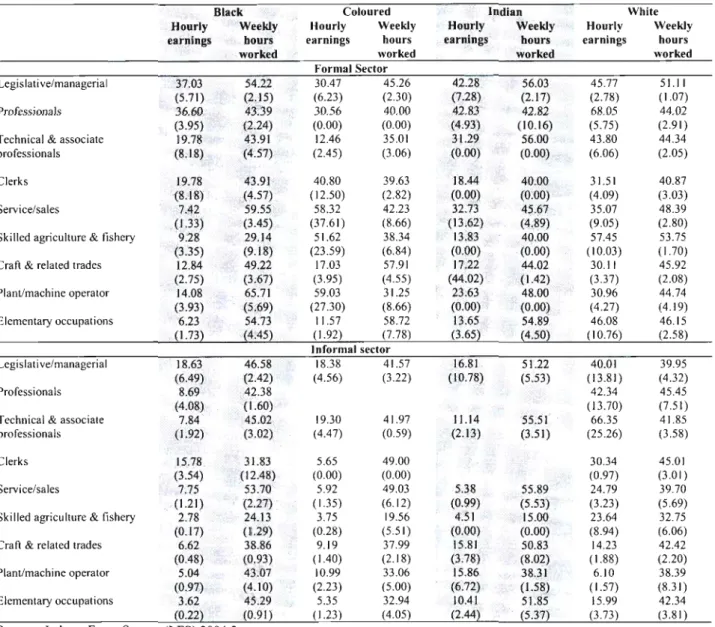
Almost half of the self-employed Blacks are spread over semi-skilled and unskilled occupations such as sales, crafts and elementary occupations (18, 10 and 10 percent respectively). Conversely, with approximately 90 percent of self-employed Blacks located in the information sector of the economy and the results of Figure 2 and Figure 3, self-employed Blacks are predominantly found in semi- and unskilled occupations in the information sector. This racial earnings gap is particularly evident in skilled occupations in the main sector of the economy where self-employed Whites earn more than self-employed Indians, Coloreds and Blacks (in order of earnings).
By comparison, self-employed whites are mostly in the formal sector of the economy (84 percent, representing about 350 000 individuals) and about three-quarters of these individuals are in skilled occupations, generating an average hourly earnings of about R52. The descriptions above describe the distribution of the self-employed and how the differences in the observed characteristics related to differences in the average returns of the self-employed.
Chapter Five: Estimating earnings of the self-employed
The determinants of earnings in self-employment
- Econometric framework
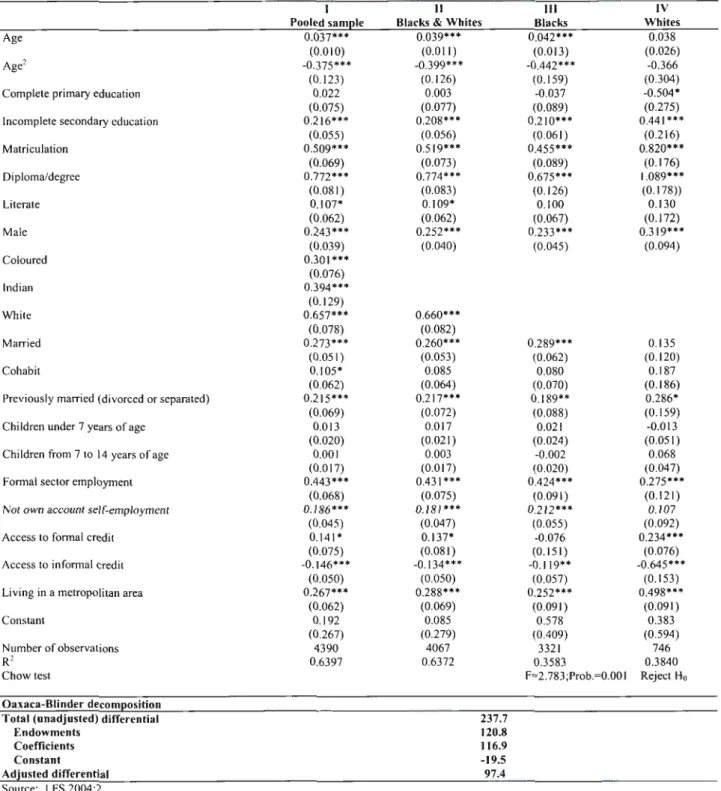
The unrestricted regressions fit equations to independent blacks and independent whites separately, thus allowing the coefficients to differ. The results of the OLS estimations of the self-employed earnings equations are reported in Table 10. However, this male earnings premium is higher for self-employed whites than for self-employed blacks.
However, Regression I suggests an earnings premium for cohabitation of 11 percent for the national sample of the self-employed. This earnings gap is significantly greater for self-employed whites (65 percent) than for self-employed blacks (29 percent). However, the earnings premium for the self-employed in the formal sector is greater for self-employed blacks (53 per cent) than for self-employed whites (32 per cent).
Note that in the decomposition analysis the negative sign indicates an advantage for self-employed blacks. White self-employed people who have access to financial credits generate, ceteris paribus, a 26 percent higher return. The estimated coefficient for the variable access to informal credit shows a negative relationship with the income of self-employed people.
This negative relationship may be the result of access to non-financial credit being endogenous to self-employment income: the self-employed who are not. Self-employed blacks have higher returns to age, marriage, good sector work, and access to informal credit.
Chapter Six: Conclusions and recommendations
Main findings
Average hourly earnings of the self-employed increased over this period and this is consistent across both sectors of the economy, with most of the growth in earnings occurring among the self-employed in the formal sector. In contrast, self-employed blacks are, on average, younger and have significantly lower levels of education than other self-employed people. In addition, self-employed blacks are distributed across activities associated with lower returns to self-employment.
The estimated coefficients in this earnings regression show that level of education IS a significant part of earnings among the self-employed: higher levels of education are associated with significantly higher returns to self-employment. Self-employed whites generate higher returns to self-employment than blacks for similar levels of education. I then examined the earnings gap between blacks and whites in the self-employed using the Oaxaca-Blinder decomposition technique.
Whites have significantly greater returns on educational attainment, good credit, and residence in a metropolitan area than self-employed blacks. Results from the study point to the importance of educational attainment in determining earnings among the self-employed: higher levels of educational attainment are closely related to higher returns to self-employment. For example, researchers could examine more closely the role of technical training and skills development in increasing self-employment and the success of the self-employed.
Self-employment is an important source of gainful employment in the economy, so policies aimed at encouraging and helping the self-employed are central to the well-being of those affected. This study shows that there is a large gap in earnings between black and white self-employed people in South Africa.
34;The male spousal earnings premium in the context of dowry payments: Evidence from South Africa". Paper presented at the DPRU and FES Conference on Labor Markets and Poverty in South Africa, 15 and 16 November. Athens University of Economics and Business, Athens Institute for Economic Policy Studies (IMOP) and Institute for the Study of Labor (IZA).
34; Perceived Barriers to Entry into Self-Employment in Khayelitsha, South Africa: Crime, Risk and Venture Capital Override Profit Concerns". 34; The Earnings and Employment Dynamics of Africans in Post-Apartheid South Africa: A KwaZulu -Natal Panel Study". Paper presented at the 2003 TIPS AND DPRU FORUM, The Challenge of Growth and Poverty: The South African Economy since Democracy, 8-10 September 2003, Indaba Hotel, Johannesburg.
34;Gender Differences in Self-Employed Earnings: The Effects of Marriage, Children, and the Division of Household Labor". 34;Why Are There So Few Black Entrepreneurs?" NBER Working Papers 3537, National Bureau of Economic Research, Inc. 34; Concerns in measuring employment in the informal sector: An analysis of national household surveys in South Africa.
34;Is there evidence of a wage penalty for part-time work for women in South Africa?" ERSA Working Paper, no.
UNIVERSITY OF
KWAZULU-NATAL