
Beyond Schooling: Primary School Girls Experiences of Gender and Sexual violence.
BY: Dhanasagrie Jewnarain 203520677
Supervisor: Professor Deevia Bhana Specialization: Gender and Education
Submitted to the School of Education, College of Humanities, University of KwaZulu-Natal
in fulfillment of the requirements for the degree of Doctor of Philosophy
November 2019
i Supervisor's Declaration
‘As the candidate’s supervisor I agree / do not agree to the submission of this thesis’.
Signed:
Name: Professor Deevia Bhana
Date: 15 November 2019
ii
Declaration:
I, Dhanasagrie Jewnarain, declare that:
(i) The research reported in this thesis, except where otherwise indicated, is my original work.
(ii) This thesis has not been submitted for any degree or examination at any other university.
(iii) This thesis does not contain other person’s data, pictures, graphs or other information, unless specifically acknowledged as being sourced from other persons.
(iv) This thesis does not contain other person’s writing, unless specifically acknowledged as being sourced from other researchers. Where other written sources have been quoted; then:
a) Their words have been re-written but the general information attributed to them has been referenced;
b) Where their exact words have been used, their writing has been placed inside quotation marks and referenced.
(v) Where I have reproduced a publication of which I am an author or co-author, I have fully referenced such publications.
(vi) This thesis does not contain text, graphics or tables copied and pasted from the internet, unless specifically acknowledged, and unless the source is detailed in the thesis and in the references section.
Signed:
Date: 15 November 2019
iii
Dedication
To the girls in this study
iv
NRF Acknowledgement
This study was supported by the South African Research Chairs Initiative
of the Department of Science and Technology and the National Research
Foundation of South Africa [Grant number 98407].
v
Acknowledgements
My mentor, my supervisor and my inspiration, Professor Deevia Bhana. Thank you for teaching me what ‘excellence’ means. Your unwavering focus in your goal, which I strongly believe, is to ensure that your students’ succeed in their pursuit of academic success is one of the most admirable qualities that you possess. Your belief in me and your unwavering support throughout my long journey has made this achievement real. My journey has been long, but it was worthwhile, because I have become a critical thinker, which I believe is one of the goals of a PhD study. Your commitment to research as a means to
addressing the gender inequalities that seek to erode our South African society, and stymy our quest for gender and sexual equality is truly a gift that you have been blessed with and one so generously shared with me [and the rest of your students]. I am eternally grateful. Thank you for completing this journey with me.
To the girls in this study, I do hope that one day, you read this study and understand our precious contribution to addressing gender and sexual inequalities in primary schools. I pray that your life ahead is successful and blessed. Thank you for consenting to be a part of this study.
My mother, Mrs Chilka Reddy, You have always been so proud of me and I do hope that I continue to make you proud. Your perseverance in ensuring that we, your children, are educated and successful is something that I am forever
grateful and has been the stepping stone to my success in life. Your investment
in your children continues to draw dividends, and this study is evidence. Thank
you.
vi
My daughter Nadika Jewnarain, we are mother and daughter but more than that, we are friends. I love you so much! Thank you for being part of my journey. I admire so much the woman that you have become and I pray that your courage, honesty and perseverance never dissipates. I am so proud of you. You are a beautiful daughter and an integral part of me.
My son, Ruen Jewnarain, in this journey of mine, you have grown up, changed from boy to man! Your strength is my strength and I thank you for educating me throughout my journey. I am very proud of you too and I love you so much.
My husband, Naveen Jewnarain, words cannot express my deep gratitude to you for tolerating me throughout this journey. Thank you for the consideration that you gave to me and for the concern you showed when I became overwhelmed with my work.
My thanks and appreciation to my brothers, sister, sister-in laws, niece and nephews. Thank for understanding that time away from you was immersed in my purpose to complete my study.
My best friend, Monie Naidoo. You believed in me. Thank you. You always understood me and so often, we would think and do as one. It is the bond that we share!
My PhD cohort! What a wonderful group to have been a part of. I have made friends for life. I wish you all every success as you move towards your
completing your study too.
The Principal of Westhills, you have shared a big part of this journey with me.
Thank you for understanding and supporting my study. I am eternally grateful.
vii
To the rest of the teachers who celebrated my pursuit for a PhD, thank you for all your help.
Finally, to my Editor, Sarah Anne Bologna. You have been such an inspiration as I crawled to the finishing line. Your brilliant editing combined with
Malachy’s support and your warm messages always made me happy. I am so
thankful to have worked with you.
viii Preface
My reflections on writing this thesis
This ethnography is not about me, but I am an inescapable part of it; the ‘me’ in it troubles and disturbs the neat process through which qualitative research is constructed. I am an Indian Tamil woman, born in South Africa. Tamils orginated in the southern parts of Indian and Sri Lanka and speak the language which is also called Tamil (more than 2 000 years old).
My religion is Hinduism. Hinduism proscribes my beliefs and actions as a woman. As an Indian Hindu woman, I am expected to adhere to specific cultural beliefs and gender norms that should dictate my existence. These include beliefs that I am supposed to imbibe so that they infuse my whole being, operating like a network, that should flood my body and mind so that I undertand my position in Indian society and within an Indian family. Being an Indian woman meant that I adhere to the socialisation process that was already carved for me. These included my mannerisms, my attire, my devotion to my husband, children and elders, my role as nurturer and caregiver, and my commitment to Hinduism. In my greetings, I am supposed to put my palms together and say ‘Namaste’ or ‘Vanakkam’, which is also a sign of respect.
Apartheid also infused my life, classifying me as person of colour who was also subjected to restrictions. My freedom was curtailed. However, where there is oppression, there is
resistance and my resistance to cultural and gender norms marks my power. Throughout the study, I found that the concept of being an ‘insider’ take on more meaning than I had initially imagined. To me, the predication of what an insider is, was more than being a teacher at the research site for ten years. In fact, and to be true to myself, the concept of ‘insider’ and the intimacy with the subject it entails became real as the study progressed, and with my growing familiarity with the participants. It forced me empathise, to relive my youth, and my school days, unearthing memories and emotions that I had buried years ago. To date, I would offer people only a glimpse into my past, preferring to keep my history to myself. However, this study demanded more than just writing up my ethnography. It required honesty from myself first, in order to be more perceptive of the nuances in character and emotions I had shared with the girls in this study. This required that I unravelled my own psyche, and trace my roots to my working class upbringing and understanding my experiences of school violence, along with gender and sexual harassment I dealt with when I was a learner.
ix
I grew up in an extended family; my parents lived with my grandmother who rented a council home for R35 a month in Springfield, an all Indian working classdistrict constructed under apartheid. As I write now, I am able to reflect on how the poorer residential areas were
named districts and the wealthy residential areas called suburbs. Along with my three siblings and parents I shared this home with my grandmother. We were a family of six, and an
extended family of seven.
We were not rich, but we were not poor either. My father worked as a waiter and my mother supplemented this income by working as a service hand in a clothing factory. My mother was thirty eight years old when my father died. I was fifteen. I was sad that he had died, but I was not devastated. My biggest fear revolved around what would happen to us as a family. I had realised long ago that my grandmother knew of my father’s extra-marital affair,
witnessed my mother’s suffering and despair and now with my father dead, wished us to leave as she held no extended loyalty or feeling toward us without the shadow of a man, her son, to shade us. I recognise now the power of patriarchy. My mother lacked a voice and a position in her union with a man she named her husband; a connection that was tenuous after his death, all dependent on those surrounding us.
My mother left work, and collected child support grants to support and pay for our schooling.
We attended Araya Samaj, a state aided primary school, where the school fees was R2 [0.13USD] a year. There were huge power differentials between the teachers and the learners here, which was typical at the time, given the intrinsic veneration awarded to teachers
retained through first and second generational Indians. A teacher was also given the title
‘Guru’ [translated, means a spiritual teacher] thus teachers were seen as ‘Godlike’ and therefore unquestionable and incontestable both in their knowledge and teaching practices.
Parents respected this authority, hence when we were beaten, we never complained to our parents since they [parents] they beat us even further.
Teachers did take advantage of their exalted positions and my parents, amongst many, sought to gain favour with my teachers. They would often send fruit, appetizing curries and
‘presents’ for our teachers. When my father returned from Lorenzo Marques (now, Maputo) in Mozambique, my parents maintained a steady supply of ‘cashew nuts’ for a teacher who requested them regularly. At the end of the year, it was customary to send small gifts to thank our teachers for teaching us.
x
Ideas of teaching and disciplinary practices have changed drastically from then. We were often subjected to ridicule and corporal punishment for not knowing our work. I used to receive ‘strikes’ on my knuckles for not knowing my tables and for not emphasising the ‘r’ in Afrikaans1 words. I remember an English exercise that required we write an imaginary story about the sea. When our work was returned, mine was held back. I had written about
encountering a grouper [a giant fish] in the ocean. The teacher then proceeded to tell the class about my story and they all laughed, including the teacher, who tried to convince me that there was no such fish as a ‘grouper’. I know it was an imaginary story, but the grouper is a real fish!
In August, 1976, I misbalanced and fell whilst doing a cartwheel during a physical education (P.E) lesson. I suffered a major fracture on my hip. I had pins inserted into my hips and hard plaster wrapped around my entire body and my left leg for six weeks. I had to walk with crutches for three months. I stayed at home for the remainder of the year and I did not want to be seen walking and balancing with crutches. I hated my P.E. Teacher.
It was during this period that I became very conscious of my body and my gait [I walked with a limp following the injury]. I became ashamed of my physical appearance, which is not unique, however during that period to every teenager seems to be, heightening the feelings of isolation and awkwardness that comes with developing sexuality. This shame followed me into high school the following year.
In 1978, I started standard 7 in Abelia Secondary School. It was a year of turmoil and violence. Abelia Secondary School became one of the many schools that joined in the
rejection of apartheid schooling. Learners boycotted classes, argued with teachers who urged them to return to class and even resorted to violence, like stoning the school and teachers cars. The police would be called to disperse students and we would try to run into nearby houses but many of us would run or walk quickly into the nearby ground and head towards our district. It was both a frightening and exciting experience, formative in a way. We prided
Afrikaans1 One of the compulsory languages that prevailed in the Apartheid era. Leaners refused to be taught in this language, arguing that Afrikaans (and English) were foreign languages, associated with oppression and racism. Furthermore, the language was regarded as foreign as it led to the suppression and oppression of indigenous language that most people in South Africa spoke (Napier & Napier, 2002).
xi
ourselves with the knowledge that we were fighting against structural inequalities and we would become part of history. 2
I remembered the day when I was accosted by a boy on my way home from school. I was 14 years old. I usually walked home through the municipal grounds, as this was a shortcut. Many other learners also walked this route as my school was the closest high school to the district in which I lived.3 At the moment the boy grabbed me, I had no friends nearby. I fell to the ground. He fell on top of me and attempted to kiss me, hurting me in my struggles to free myself. His friends laughed and I remember kicking and fighting and crying. He let me go. I was so ashamed and I felt that I was responsible. I remember thinking that this only happened to girls. Why did this person want to hurt or embarass me? This is not what boys do to girls that they like. So why did he do it? It is this question that becomes fundamental to the victim in many cases of assault. Why did they do this to me, which often turns to self-reflection and blame towards themselves. I did not tell my mother. But now, 42 years later, I shared this experience with the girls in this study.
I remember my typing teacher at school. I recall how he used to pause behind me and other girls. And then I would wait, knowing that he would be reaching for my bra strap any second.
And then the sting would come. He would pull on the bra strap and release it to sting as a reprimand for a mistake or error in our work. We never complained to the other teachers or to our parents. Silence was the order of the day. I now recognise fear as an all-encompassing emotion–and that dictated my decisions to remain silent. This is what I too recognised in the girls in this PhD study.
I recall another incident: I was going to the local shop and I was stopped by an older man who asked me for directions to the same ground, even though the ground was a mere 20 meters from the shop. I remember turning tail and walking as fast as I could back to my granny’s house. When I realised that he was following, I broke into a run and reached her house.
2
3 As I write now, I reflect on how the poorer residential areas were labelled ‘districts’ and the wealthier residential areas were called suburbs.
xii
Sometimes I felt uneasy listening to a girl as she talked about an experience that reminded me of an experience of my own. For example, when girls spoke about their boyfriends with such animation, I was often transported to my childhood days in primary school. I remember being aware and conscious of thoughts, my feelings and my body from an early age. I always wanted to look neat and clean and prided myself on having the pleats in my uniform pressed with a hot iron over a damp cloth [I did not know about steam irons and even if they existed at that time, we never owned one]. When I was in the lower grades, my mother used to plait my long hair tightly, but I countered this severe look by asking her to weave shiny, long silky white ribbons into my plaits. When I was in standard 5 (grade 7), she cut my hair to a
shoulder length and I would then wear an ‘Alice band’. My hair used to curl around my face and I felt pretty. I know understand how self-objectification was key to the way I presented myself to my peers. However, boyfriends did not feature at this stage in my life. Boys were not attracted to me. Even in high school, I recall being teased and looked down upon because of my physical appearance and my social location. What was wrong with my physical
appearance? Many who know me now would ask this question. Now, in my adult life, I am considered pretty. But I remember what it was like to feel less ‘with it’ than the other girls, and this, I am sure, impacted on my fieldwork (See p. 18).
I started menstruating in when I was 13 years old and a few months before I fractured my hip.
When I first got my period, I was asked to stay in room where only females had access to me.
I had to swallow a raw egg for breakfast every morning as it was believed that the egg would strengthen my uterus. My mother also noted the time and date when my period first started and this information was taken to a Hindu Brahmin (male priest) who would then consult with his religious ‘books’ and inform her as to whether my period has started in a ‘good’
time or a ‘bad’ time. If it was a ‘bad’ time, then my mother has to perform a special prayer to ward off the evil. Then a ceremony would be performed. This ritual required that I dress in a sari, decorate my hair with flowers and wear gold jewelry. I had to resemble an Indian bride.
These rituals celebrated my coming of age, meaning that I was now of a marriageable age since I had reached reproductive status. Subsequently, girls who achieved menstrual status were referred to as ‘aged up’! I hated these words, I felt that they somehow made me appear
‘old’, no longer a child. Yet my so-called maturity did not earn me suitors. I remember the word ‘dark’ was often used to describe me and my skin colour by relatives and people I knew and by my peers. I remember clearly an experience at school when I was walking with a friend and I heard the boys behind us comment on the differences in our legs. I still remember
xiii
the boy’s scornful laughter as he said “check the colour and shape!” pointing out my legs to his friends. My legs were dark brown and thin as compared to my friend’s, whom I thought was more attractive and who had a lighter complexion. I remember clearly the humiliation and hurt I felt. I wanted to be admired and I wanted boys to find me attractive too. Thus, as Lamb and Peterson (2011) suggest, perhaps subjective empowerment is suspect when considering a 13 year old who may not be in the best position to evaluate the context and background behind her own sense of empowerment–or her own subordination. Light skin colour was, and I think still is, most attractive to Indian people. Even now, when my mother- in-law introduces me to people she usually says something in Hindi that ends with “Naveen’s wife. She is Tamil”. Tamil people emerging from the South of Indian, are generally noted for their dark skin.
My menstruation time was truly a most unhappy and stressful time for me. I experienced both shame and pain. I used to be so embarrassed to purchase sanitary pads at the local shop because I was scared that the boys would see it and then tease me. I was even ashamed to ask the shopkeeper for sanitary pads. However, I soon moved past this: I would write the word
‘Kotex’ [a brand name] on a piece of paper and hand it to the shopkeeper. He would wrap the
‘offending’ item in newspaper and then place it into a packet. I would accept the packet with my head bent and walk as fast as I could out of the shop, avoiding the groups of boys that used to congregate around the shops, holding my ‘secret’ tightly. I often wondered if this transaction was embarrassing for him as it was for me. Campus days were most traumatic. I had to dose myself with painkillers a day before my menstruation started and continue until it ceased. I used to suffer acute pain and I sometimes used to faint. I would then be brought home by one of my lecturers.
From the time I started my menstruation I was viewed in a different light. I was not allowed to wear jeans because it drew attention to my body, my mother expected me home at a certain time, she estimated the time it will take me to reach home after school and she would wait for me. If I was late, I had to have a plausible explanation or risk being accused having a
boyfriend and then punished physically and verbally. I did manage to get a boyfriend though, although the relationship fizzled out after a few months. He was my brother’s peer and I was scared of my brother.
xiv
I am now a married women with two children, a boy and a girl. The world has not changed even though I am now on the other side in terms of my status. I find myself constantly
contesting the essentialist constructs of gender and normative gender roles bestowed upon me by society and culture.
xv Abstract
This ethnography explored primary school girls’ experiences of gender and sexual violence at Westhills Primary School. My key objectives were to understand the underlying factors that shaped my respondents’ experiences of such violence, to develop an understanding of how teachers’ attitudes contributed to these experiences, and to explore how the girls constructed their sexual identities. Throughout the study I highlight the importance of understanding the context in which gender and sexual violence occurs.
Gender and sexual violence and harassment is not easily explained but through girls’ own experiences this study seeks to provide a contextual understanding of such violence. Often feminist researchers suggest that such violence is always an exercise of power that boys and men engage in to subordinate girls. Sexualised verbal abuse, taunts and teasing are conduits through which boys assert themselves to display dominance.
In this study I ask questions about how humiliating acts—such as the ‘sexualised touching’
of girls’ private parts—can be interpreted both as an indication of heterosexual teasing linked to heterosexual attraction and as a humiliating act that seeks to erode girls’ sexuality by drawing attention to their sexual development. Such confusion suggests that girls are complicit in their own subordination, just as they are subordinated by the performance of dominant heterosexual masculinities. The study shows that heterosexual femininity is shaped by broader structural, cultural and social processes in which girls are subordinated through rampant sexual harassment, abuse and violence. Girls’ experiences of persecution and oppression are located in socio-cultural factors that manifest in gender asymmetries that benefit the construct of hegemonic masculinities and subordinated femininities. Such
misogyny is part of the enactment and pursuit of hegemonic ideals since it works to destroy a girl’s concept of herself, eroding her sexuality and dignity and causing her humiliation. To claim that the girls were passive victims nullifies their sexualities, just as to claim that boys performed sexually harassing behaviours towards girls because of their age and stage of development is too simplistic: it nullifies the legitimacy of the girls’ experiences of unwanted touching, fondling and groping. While the school thus became a platform or training ground for boys to display culturally exalted forms of masculinity, such as boldness, sexual
entitlement, heterosexuality and the privilege of male power, it was also a training ground for the girls.
xvi
However, embedded in the girls’ experiences of persecution and oppression was their negotiation of their own gender and sexual identities in heterosexuality. Girls, too, are invested in heterosexuality, and a central aim of this thesis is to show the agency that young girls’ exercise through their experiences of gender and sexual violence.
The girls’ increased sexual assertiveness debunks the myth of the sexual innocence and sexual passivity in young school girls, resisting the construction of them as little people who have little or no agency. The girls’ resistance and challenge to the hierarchal positioning that the boys occupy constitutes a challenge to hegemonic displays of masculinity such as male supremacy and male domination.. Girls have a sophisticated sense of what constitutes sexual harassment and violence. They have the ability to name and make visible their complex gendered and sexual entanglement with and among boys.
Listening carefully to what girls themselves raised as problematic, unwanted and oppressive, has enabled me to illuminate the nuanced dimensions of sexual harassment and violence – physical, verbal and emotional assault – and its dynamic association with heterosexual masculinity and the broader social and cultural environment through which girls are
subordinated. The girls’ experiences of sexual harassment, and the teachers’ lack of interest in addressing it, suggest that whilst the education system has evolved over time, the violence that the girls experience is situated within a larger sociocultural construction of gender that has its roots in patriarchy which, whilst being malleable, remains steadfastly robust and resilient.
I conclude by arguing that what is required is a rigorous and concerted effort on the part of all teaching staff to examine our teaching practices, our accountability and our integrity in relation to our jobs as teachers and our ethics of care towards the learners. More importantly, it requires an analysis of our own gendered behaviours and beliefs, and a critical reflection of how these contribute to the regulatory capture of young girls’ sexuality and agency. Once we have a better understanding of young girls’ sexuality and agency, we will be able to reject practices that condone gender inequalities in our school and beyond and offer alternatives whereby the school can become a core site of change, and where teachers are prepared and supported to challenge the widespread practice and tolerance of unequal gender norms.
xvii
Abbreviations and Acronyms
AAUW – American Association of University Women AIDS - Acquired Immune Deficiency Syndrome
ATM – Automatic Teller Machine
CAPS – Curriculum and Assessment Policy Statement CP – Corporal Punishment
DoE – Department of Education ECD – Early Childhood Development
FCS – Family Violence, Child Protection and Sexual Offences FP – Foundation Phase
HIV – Human Immunodeficiency Virus HOD – Head of Department
HRW – Human Rights Watch IP – Intermediate Phase L/S- Life Skills
MMC – Medical Male Circumcision NCS – National Curriculum Statement NS – Natural Science
RNCS – Revised National Curriculum Statement SAHRC – South African Human Rights Council SAPS – South African Police Services
SASA- South African School Act No. 84 of 1996 SNES – Special Needs Education Services SOA – Sexual Offences Act
SP - Senior Primary
UNAIDS – Joint United Nations Programme on HIV and AIDS
UNESCO – United Nations Educational, Scientific and Cultural Organisation WHO – World Health Organisation
xviii
Glossary of terms
Asidlale amagenda – girls explained that this was a slang word boys used to indicate a desire to have sex with them
Blocks – the school building is built in separate long buildings that is referred to as ‘Blocks’.
Foundation Phase – Grades R - 3 Imijondolo/jondol - shacks Intermediate Phase – Grades 4 - 5 intombiyana - girl
ischoolbus – taxis that are used by the learners to commute to school and home Lento mnyama le asikhungce okukhala – you are like burnt meat
Malume/uMalume - uncle
Msunu kanyoko - (slang and derogatory word) your mother’s private part Msunu kayihlo – (slang and derogatory word) your father’s private part ingquza (ingquza) - vagina
Ntombazane yesikhashana - girl of the moment
Nkosi Sikelel` iAfrika – South African Naional Anthem Quantum – minibus that serves as a taxi by taxi operators Senior Phase – grades 7-9
Siyanda – name of the taxi driver and the taxi.
uAunti - aunty
Uyabanda (kubanda) – cold or frigid Ukubatshwa – to be struck
Ukuhlonipha - respect Umfana – boy
xix List of Figures
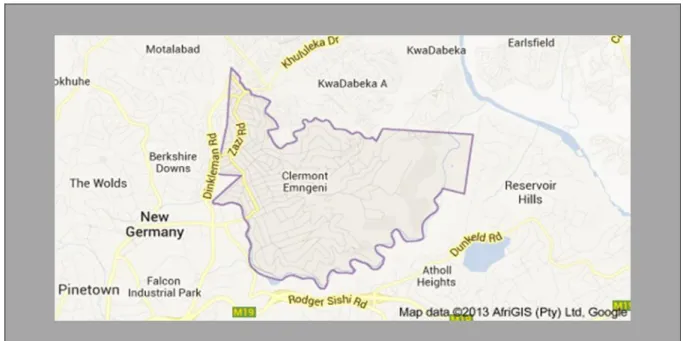
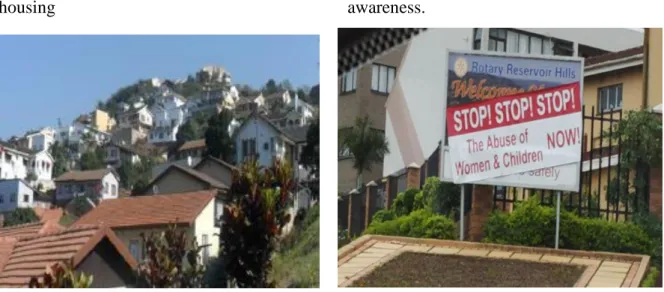
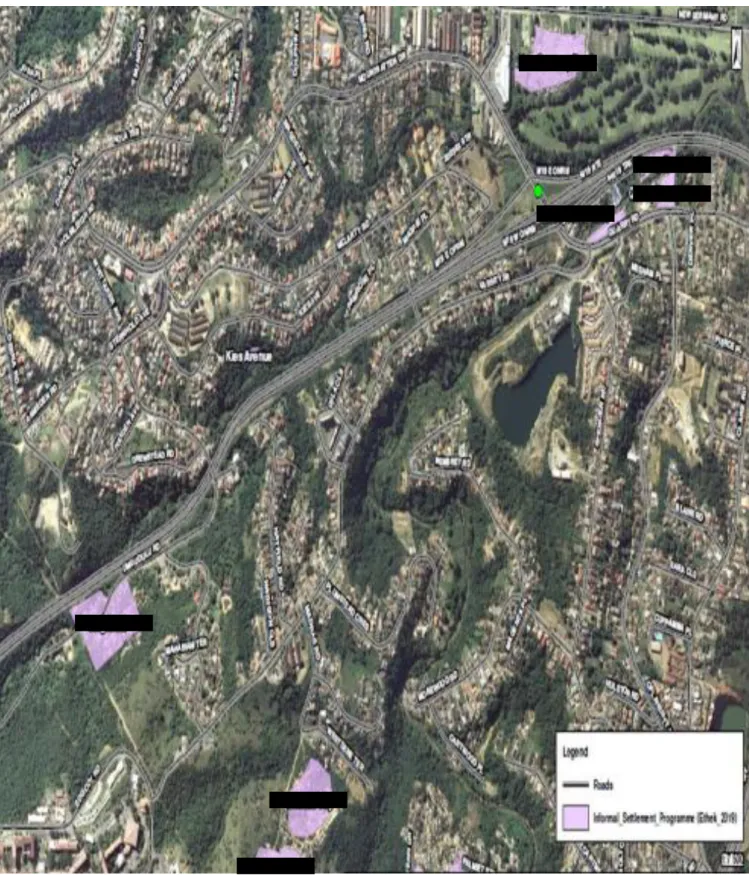
Figure 1: Map showing Reservoir Hils, Clermont and Kwadabeka Figure 2: Reservoir Hills: Middle class housing
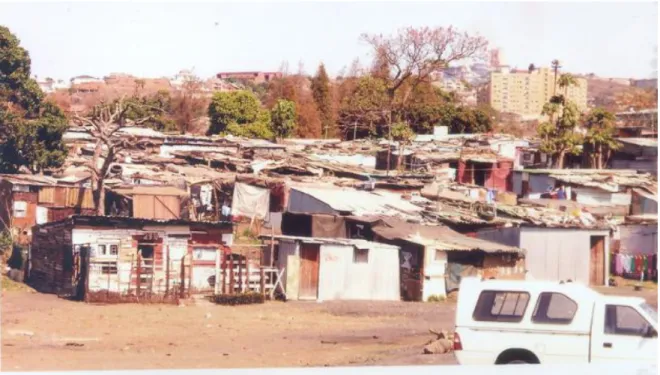
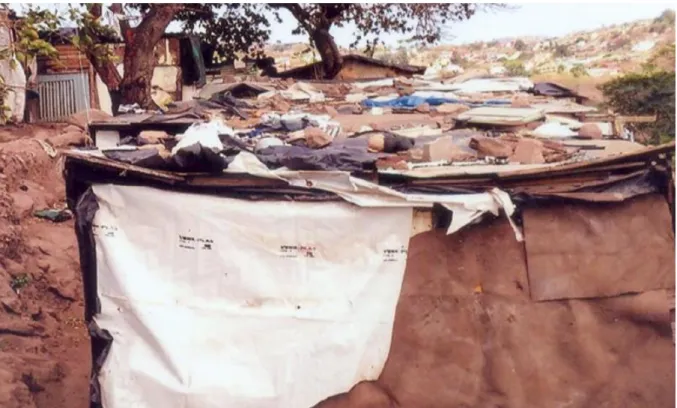
Figure 3: Creating gender violence awareness Figure 4: Macaranga Informal Settlement Figure 5: Mopane Informal Settlement Figure 6: Canaan Informal Settlement
Figure 7: Imijondolos at Canaan Informal Settlement Figure 8: Imijondolos at Mopane Informal Settlement Figure 9: Imijondolos at Macaranga Informal Settlement Figure 10: An aerial view of the research context
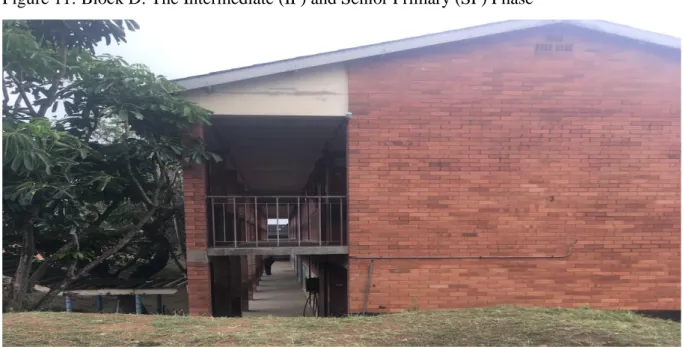
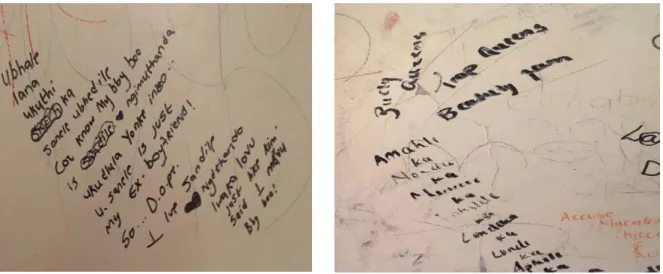
Figure 11: Block D: The Intermediate (IP) and the Senior Primary (SP) Phase Figure 12: Declarations of love on the walls outside the grade seven classes Figure 13: Declarations of love on the walls outside the grade seven classes Figure 14: Inside the grade seven class
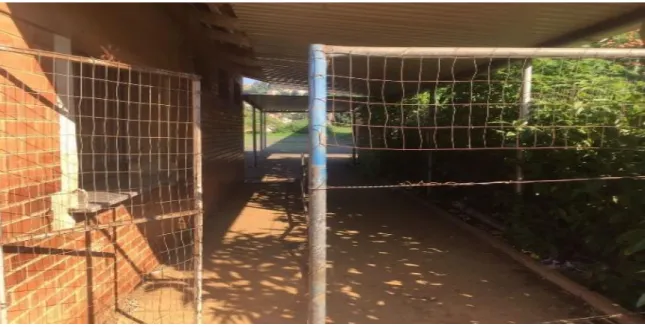
Figure 15: The Senior Primary girls and boys Toilets Figure 16: Behind the SP toilets
Figure 17: Writings on the toilet walls Figure 18: Declaring a group
Figure 19: Someone writes ‘Fuck Banele’ after seeing that he has a girlfriend Figure 20: The tuckshop area where the older learners congregate
Figure 21: The Learner Profile
Figure 22: Documentation taken from the learner profile
Figure 23: Azande’s drawing her meeting her boyfriend amid the concealing trees
List of tables
Table 1: Respondents’ Background Information. Page 91
xx Publications from this thesis
Jewnarain, D. (2013). The ethical dilemmas of doing research with 12-14 year-old school girls in KwaZulu-Natal. Agenda, 27(3), 118-126.
xxi Contents
Chapter 1 ... 1 Gender and sexual violence in primary schools ... 1 1.2. Defining the problem of gender and sexual violence in schools ... 3 1.3. Gender and sexual violence in South African schools ... 4 1.3.1. Corporal punishment in schools ... 6 1.3.2. Gendering the schooling curriculum ... 7 1.3.3. Gendered production tasks in school ... 8 1.4. Gender and sexual violence perpetration by boys ... 8 1.5. Warrior girls ... 10 1.6. Me – a teacher and a researcher ... 12 1.7. The research context and background ... 13 1.8. Aims and Objectives of the study ... 19 1. 9. Outline of the study ... 20 Chapter 2 ... 22 Theorising girls’ experiences of gender and sexual violence ... 22 2.1. Introduction ... 22 2.2. Essentialism: sex and gender as a biological construct ... 23 2.3. The socialisation theory ... 24 2.3.1. The socialization of sex and gender ... 24 2.3.2. A critique of the socialization theory ... 26 2.4. The social constructionist theory ... 28 2.5. Poststructuralist theory ... 31 2.6. Foucault’s thoughts about sexuality ... 31 2.6.1. Power, gender and sexuality: a Foucauldian perspective ... 32 2.6.2. Foucault’s perspectives on discipline and power ... 33 2.6.3. A critique of the Foucauldian notion of power ... 34 2.7. Using a poststructuralist framework to explore young girls’ experiences of ... 36 gender and sexual violence ... 36 2.8. Subjectivity and discourse: voice, experience and language... 37 2.9. Butler’s Theory on gender and gender performativity ... 38 2.10. Schooling as a gendered experience ... 41 2.11. Masculinity and gender violence ... 43 2.12. Young girls’ sexuality and sexual agency ... 46 2.13. Femininities, sexuality and heterosexuality ... 47 2.14. Femininities, violence and heterosexuality ... 50 2.15. Conclusion ... 51
xxii
Chapter 3 ... 54 Literature Review ... 54 3.1. Introduction ... 54 3.2. Girls’ Experiences of Sexual Violence in South African Schools ... 56 3.3. Sexual violence in schools: a global phenomenon ... 65 3.4. Sexual Harassment: mis-identified, mis-labeled, minimised or ignored by ... 66 school personnel ... 66 3.5. Girls’ experiences of sexualised verbal violence perpetrated by boys ... 68 3.6. Girls as perpetrators of sexualised verbal violence ... 70 3.7. Girls’ Experiences of Physical Sexualised Violence Perpetrated by Boys ... 70 3.8. Girls’ experiences of sexual harassment and sexual violence by boys ... 72 3.9. Girls experiences of physical violence in heterosexual relationships ... 74 3.10. Sexual harassment of pubescent and menstruating girls ... 76 3.11. Sexual coercion by teachers ... 77 3.12. Conclusion ... 78 Chapter 4 ... 80 Conducting research with young girls: The research process and methods ... 80 4.1. Introduction ... 80 4.2. Ethnography: a qualitative research methodology ... 80 4.3. Engaging in qualitative research methods ... 84 4.3.1. The learner profile ... 84 4.3.2. Observation ... 85 4.4. Observing the girls ... 87 4.5. Ethical considerations... 92 4.6. Confidentiality and anonymity in ethnography ... 93 4.7. Recording the interviews ... 94 4.8. Focus group discussions and individual interviews ... 95 4.9. Validity trustworthiness, rigour and reliability ... 99 4.10. Writing up my field notes ... 100 4.11. Reflecting on the study ... 100 4.12. Ontological framework and data analysis ... 102 4.13. Researcher reflexivity ... 105 Chapter 5 ... 107 The School Context ... 107 5.1. Introduction ... 107 5.2. Taxis, Malumes’ [uncles], uaunti [aunties] and the ‘KK’ bus ... 107 5.3. Westhills Primary School ... 109
xxiii
5.4. The School Toilets ... 111 5.5. The School Tuck Shop ... 113 5.6. Ground Duty and Duty points ... 114 5.7. The Quintile Ranking of Westhills Primary School ... 115 5.8. Discipline and Punishment ... 116 5.9. A Typical Day in Westhills Primary School ... 116 5.9.1. Reporting for Duty ... 117 5.9.2. Arrival of the Learners ... 117 5.9.3. The School Assembly ... 118 5.9.4. The School Curriculum ... 119 5.9.5. Break [lunch] Time and Friendship Bonds ... 119 5.9.6. Dismissal Time (1h45pm) ... 120 5.10. Conclusion ... 120 Chapter 6 ... 122 Gender and sexual violence: A concealed phenomenon within a heterosexual ... 122 discourse ... 122 6.1. Introduction ... 122 6.2. Sexualised verbal abuse is about sex ... 124 6.3. Harassment and ridicule in the toilets ... 128 6.4. Periods, ridicule and sexual humiliation... 131 6.5. Sexual Taunts: ‘bodies that don’t fit in’ ... 137 6.6. Sexualised verbal abuse is about sex ... 141 6.7. Blurring the lines between sexual harassment, sexuality and desire ... 146 6.7.1. Heterosexual bodies: a conflicting site for desire and sexual violence ... 148 6.7.2. Sexual harassment and violence by girls ... 151 6.7.3. Blurring the lines between sexual harassment and boyfriends ... 154 6.7.4. Heterosexual violence in heterosexual games ... 155 6.8. Fear of re-victimisation ... 156 6.9. Conclusion ... 158 Chapter 7 ... 161 Sexual Coercion, Power Relations and Agency ... 161 7.1. Introduction. ... 161 7.2. Revisiting ethical concerns ... 162 7.3. Azande: A Biography ... 164 7.4. Azande’s Achievements at School ... 164 7.5. Azande experience of an attempted rape ... 169 7.6. Azande enters into a coerced sexual relationship ... 171
xxiv
7.7. Azande’s relationship is discovered ... 175 7.8. Azande is sent away to Valleyview ... 179 7.9. Conclusion ... 181 Chapter 8 ... 183 Challenging age, authority and power in the classroom ... 183 8.1. Introduction ... 183 8.2. Silenced in the classroom ... 184 8.3. Girls’ experiences of discrimination during teaching time ... 188 8.4. Blaming girls for boys sexually harassing behaviour ... 193 8.5. Girls experiences of corporal punishment ... 199 8.6. Conclusion ... 204 Chapter 9 ... 208 Conclusion ... 208 9.1. Introduction ... 208 9.3. Main findings ... 210 9.3.1. Boys are driven by masculine norms to demonstrate power over the girls .. 211 9.3.2. Sexual objectification of girls’ bodies... 211 9.3.3. Sexual harassment is perceived in contradictory and complex ways ... 212 9.3.4. Girls as perpetrators of sexual harassment ... 213 9.3.5. School playground games are gendered and highly sexualized ... 213 9.3.6. Girls challenge gender inequality, gender violence and sexual harassment through ... 214 their individual empowerment and self-advocacy ... 214 9.3.7. Negotiating heterosexuality ... 214 9.3.8. Sexual coerción ... 214 9.3.9. Girls’ mobility exposed them to sexual violence ... 215 9.3.10. Hostile classrooms: Challenging age, authority and power in the classroom ... 215 9.3.11. Corporal punishment ... 216 9.3.12. Ineffective response mechanisms at school level ... 217 9.3.13. Shortfalls in the delivery of life skills/life orientation lesson ... 218 9.4. Recommendations ... 218 9.5. Recommendations for further research ... 221 9.6. Concluding thoughts ... 221 References ... 224 Appendix 1: Ethical Clearance Certificate ... 243 Appendix 2: Ammended Ethical Clearance certificate ... 244
xxv
Appendix 3: Change in title ... 245 Appendix 4: Permission to conduct research - School Principal ... 246 Appendix 5: Permission to conduct research with learners - Parent ... 249 Appendix 6: Permission to conduct research – girls ... 252 Appendix 7: Information sheet and assent for participants ... 253 Appendix 8: Letter informing the Principal about a disclosure ... 255
Appendix 9: Informing Azande of my obligation to report a case of sexual coercion ... 256 Appendix 10: Request for a meeting with Parent ... 257 Appendix 11: Request for a meeting with Parent (2nd) ... 258 Appendix 12: Renegotiating participant consent - Parent ... 259 Appendix 13: Renegotiating participant consent - participant ... 260 Appendix 14: Information and Consent Letter for Parent ... 261 Appendix 15: Affidavit ... 264 Appendix 16: Reporting to Child Welfare ... 265 Appendix 17: Letter from Child Welfare ... 266 Appendix 18: Proof of editing ... 268 Appendix 19: Turn it in Report ... 269
1 Chapter 1
Gender and sexual violence in primary schools
Field notes: Date: 31/08/2012 Time: 11:45 Place: Senior Primary Block
The lunch break that normally ends at 11h15 has been extended to 11h45 because an
emergency staff meeting has been called concerning the merger of Westhills Primary School with its neighbouring school. Cleaners and prefects and some members of management are asked to assist with ground duty whilst the meeting is in progress. I am dispatched to block duty. I walk around the Foundation Phase (FP) blocks and then make my way towards the Senior Primary (SP) block. At 11h45, the buzzer goes. The wail of the siren combines with the noisy learners as they start running towards their classrooms. I stand aside, wanting to ensure that no one gets hurt as the learners push their way up the stairs, heading towards their classrooms. It is hot, the children are hot and sweating. I notice a small group of Senior Primary girls lingering just behind the block. I move towards them to ask that they make their way to their classrooms. When I get closer, I notice that one of the girls is visibly upset. She is crying so I enquire what the matter is. The girls hesitate, then one of them says that she got hurt when a boy pushed her, but that she is okay now. I ask the girl to confirm that this is what happened and she nods to indicate that she is okay. She also avoids looking at me. I ask her to take a few minutes to regain her composure and suggest that she washes her face to remove traces of her crying. I ask the other girls to return to class. I ask again if she is okay and she says ‘Yes’. I leave her and head towards my class where I am due to teach
Mathematics.
Field notes: Date: 31/08/2012 Time: 14h00 Place: My office
The Senior Primary Head of Department (HOD) comes into my office and asks me if I am aware of a game called ‘Spin the bottle’. I say I am not, and she proceeds to explain it to me.
She tells me that the game involves kissing and violence. She also tells me that the girl who had been upset earlier was crying because a boy had grabbed her breast. She says she has spoken to both the learners and that the girl said they had been playing a game of ‘slapping’
each other and that the game had gone wrong.
1.1.Introduction
The focus of this thesis is to explore gender and sexual violence within a primary school.
These two extracts reflect the core my argument, which is that primary school girls’
experiences of gender and sexual violence are driven by unequal gender norms which are situated within a heterosexual discourse. The purpose of this chapter is to provide background to the study, in particular how the school works as an intermediary to regulate, capture and stymy young girls’ sexuality. I then locate sexual violence within the discourse of
2
heterosexuality and discuss how sociocultural norms and values attached to gender, sexuality and age underpin girls’ experiences of sexual violence.
My fieldwork examined the experiences of gender and sexual violence amongst twelve primary school girls, aged twelve to fourteen, in Westhills Primary, a co-educational school located in the KwaZulu-Natal province of South Africa. These excerpts from my field notes capture the essence of my study. To begin with, they immediately locate the girl’s
experiences of gender and sexual violence within the context of heterosexuality. Although there is an extensive and growing amount of research on sexuality and sexual violence in South Africa, the focus has largely been on high schools (Bhana, 2012; Bhana & Pattman, 2011; Jewkes & Morrell, 2012) and on children aged seven to nine (Bhana, 2013, Jewnarain, 2013, and Mayeza, 2017). Girls between the ages of 12–14 have been largely overlooked (see Bhana 2018 as an exception). Part of the purpose of my thesis is to address this gap. I believe that working with girls of the 12–14 age group is critical if we are to reduce the scourge of gender and sexual violence in schools, and in society more broadly.
The experiences of primary school girls such as those in my study seldom come to light, and even less seldom are they heard from the girls’ own perspectives, and in their own words. In the chapters that follow I present their graphic and vivid descriptions of the experiences they have lived through, and show how they navigate a heterosexual and masculine domain that significantly reduces their opportunity to exercise agency. Throughout the study, I emphasise girls’ interpretations of what constitutes gendered and sexualised harassment, interpretations that are driven by their own social and cultural realities. Throughout my thesis, sexual violence is thus defined by the girls: through the scenarios and examples they themselves highlight as unwanted sexualised behaviours. The girls’ ambivalence towards sexual violence or unwanted behaviour problematizes such top down definitions. The lines between sexual harassment, sexual violence and consent are blurred. In the same vein, scholars caution about romanticising girls’ agency because sexual harassment is, undeniably, an issue of power that is located mainly within a masculinity discourse (Bhana, 2017). For this reason I am cautious about romanticising my respondents’ agency. Rather, I adopt the concept ‘lite’ agency (Bhana, 2017) which is not to indicate the absence of power or girls’ ability to act. Rather
‘lite’ agency as Bhana explains, points to girls’ restrictions, their inability to comprehensively act, choose and contest within a broader environment which reduces their action. Her
conception of ‘lite’ agency is incredibly important as it sends such a clear signal, telling us
3
that whilst it is important to recognise young girls’ agency, it is also important to recognise how incredibly complex and nuanced violence plays out within the domain of
heterosexuality.
1.2. Defining the problem of gender and sexual violence in schools
In 2001, Human Rights Watch (HRW) released a report entitled Scared at School that communicated the horror of sexual violence in and around a sample of South African
schools. It spoke of widespread sexual violence, sexual abuse and sexual harassment in which teachers and boys were named as perpetrators. According to the report, one of the greatest threats to a South African girl’s safety at school is likely to be seated next to her in the class.
Larger, quantitative studies that followed in the wake of this report validated that sexual violence and abuse of schoolgirls was, indeed, prevalent in many schools throughout South Africa (see, for example, Burton and Leoschut, 2012; Mncube & Harber, 2013; Ncontsa &
Shumba, 2013). These studies are important because they provide evidence of an extensive landscape of sexual violence in South African schools. However, a notable gap in these studies has been attention to the context in which sexual violence occurs.
Recent reports of gender and sexual violence conducted by the Human Sciences Research Council (Lynch, Essop, Tolla & Morison, 2018) and published in the media (Daniels, 2018) show that South African schools continue to be dangerous and violent spaces. Qualitative research that puts sexual violence at the forefront of investigation is scarce (see Bhana, 2018 as an exception). Bhana, who has located the primary school as a key site for the production of sexual identities, argues that there is a need to explore sexual violence in the primary school, and that young children’s sexuality needs to be recognised. She argues that interventions to ameliorate girls’ negative schooling experiences must take account of contextual realities, and emphasises that girls’ sexuality must not be seen as a biological construct but as a part of their identity construction—which is underpinned by their social relations with others. Scholars have also recognised that a key feature of South African girls’
experiences of sexual violence is that they are situated within a heterosexual discourse (Bhana, 2018; Gevers et al., 2012; Lynch et al., 2018). Such studies have shown that
dominant constructions of gender and sexuality inform boys’ interactions with girls, and that there is no other place, except the school, where such displays of power become most
evident: Girls’ experiences of gender and sexual violence are linked to dominant
4
constructions of hegemonic masculinity that define maleness as powerful, strong, and displaying both sexual interest and misogyny towards females.
Throughout this thesis I thus highlight the importance of understanding the context in which gender and sexual violence occurs. I argue, drawing on studies (Bhana, 2017; 2018, Cobbett
& Warrington, 2013; Renold, 2005) that girls’ experiences of gender and sexual violence are not so easily explained because there is no general consensus over what constitutes sexual harassment. I ask questions about how humiliating acts—such as the ‘sexualised touching’ of girls’ private parts—can be interpreted both as an indication of heterosexual teasing linked to heterosexual attraction and as a humiliating act that seeks to erode girls’ sexuality by drawing attention to their sexual development. In many of my respondents’ experiences, confusion created uncertainty about sexualised touching and blurred the line between wanted and unwanted sexualised behaviour. Such confusion suggests that girls are complicit in their own subordination, just as they are subordinated by the performance of dominant heterosexual masculinities. Thus it is important that due consideration is given to what the girls themselves say and do, and their interpretation of their experiences. For me this was important as it prevented me from allowing my own bias to prevail in the interpretation of sexual
harassment. It also allowed me to recognise my respondents’ sexual agency as they contested gender power relations. Thus, whilst I recognise that sexual harassment causes huge
anxieties, I also recognise that my respondents’ active engagement in their sexualities was, for most, a pleasurable experience.
In the following part of this chapter, I draw on literature to discuss the prevalence of gender and sexual violence in schools. I also highlight recent reports of gender and sexual violence in South African schools.
1.3. Gender and sexual violence in South African schools
South African studies, such as those by Harber and Mncube (2017), Moletsane & Mitchell (2018) and Morrell, Bhana & Hamlall (2012), assert that structures within schools are heavily influenced by patriarchal notions of control and discipline that endow teachers with
institutional powers which determine and reinforces the authoritarian relationship between the teacher and the learner. Connell (2002) explains that such authority is embedded in the patriarchal notion of power that exists in individuals, structures and institutions. Schools thus
5
serve as institutions where teachers’ responsibility is exercised through authority and power, even within the classroom, where the teacher is outnumbered (Morrell, 2001). Morrell further argues that such binary positioning of teachers and learners sustains power relationships by allowing teachers to inflict verbal and even physical and violent disciplinary measures on their learners despite its prohibition. Studies (Dunne, Humphreys & Leach, 2003;
Humphreys, 2008) support that such positioning places girls as objects to be manipulated within the school, explaining that when teachers instill discipline, it is located within the same asymmetrical power relations that underpin the sometimes excessive and draconian measures of punishment that some teachers employ. According to Humphreys, corporal punishment also serves as a socialization process that reinforces obedience, passivity and tolerance of violence in girls. Dunne et al. (2003) further identify additional practices of gender violence like unsolicited touching and grabbing of girls (and boys private parts), coercive sex and rape as manifestations of heterosexual violence in our schools.
Academic studies, and even reports such as Scared at School, do not reach the masses in South Africa. Rather, it is the media—newspapers, television news and social media—that has brought the phenomena of sexual violence and sexual abuse in both primary and high schools into the public arena:
In February, 2019, sexual assault claims lodged at Valhalla Primary School in Pretoria surfaced in media reports (Mahlokwane, 2019) and television news (eNCS, February 2019).
The reports stated that a 55-year-old male teacher was suspended from school after girls between 10 and 13 years old, in Grades 5, 6, and 7 reported that he had touched them inappropriately and indecently. According to the report, the alleged violations took place in 2018 but only came to light after Metro Police (South African Police Services) visited Valhalla Primary School to teach learners how to recognise sexual violence.
In 2017, a scholar patrol (believed to be in his late fifties and whom the children referred to as Malume (uncle in isiZulu), was charged with sexually molesting 54 school girls from Grade R to Grade 7 in AB Zuma Primary School, in Soweto, Johannesburg, South Africa (Mabuza, 2017). It was alleged that the guard violated the girls in his security guardhouse near the school’s gate, that he hit them on the buttocks and told them that he wanted to have sex with them. It was reported that the Principal learned of the abuse much earlier but asked the children to remain silent while the matter was investigated. The principal and her
6
management team were subsequently suspended for failing to report the abuse. However, in 2018, the guard walked free because of errors, discrepancies, insufficient evidence and contradictions regarding the case. The presiding judge described the case as “a comedy of errors” saying that the ‘errors’ contaminated the girls’ testimonies.
These two reports resonate with Lynch et al. (2018) and the HRW report that emerged almost twenty years ago, highlighting the prevalence of sexual violence in our schools. However, whilst such explicit forms of sexual violence make headlines, other implicit forms of gender and sexual harassment go unnoticed.
1.3.1. Corporal punishment in schools
Notwithstanding South African laws which state that “everyone has the right not to be treated or punished in a cruel, inhuman or degrading way”, (The South African Constitution and the National Education Policy Act of 1996), statistics suggest that little headway has been made in reducing corporal punishment in schools (Burton and Leoschut, 2013, School violence in South Africa). The study showed that primary school learners (70%) were more likely to experience corporal punishment than high school learners (47%) in South African schools.
Furthermore, (73.7%) was observed in KwaZulu-Natal, the province in which my study is located (Geldenhuys & Doubell, 2011). In July 2013, the South African Human Rights Commission (SAHRC) raised concerns after receiving complaints about corporal punishment in schools across the country. They noted instances where learners were shamed, seriously injured, and that some even succumbed to their injuries.
Corporal punishment has been recognised as a form of gender violence in its use and in the meanings it holds for boys and girls. For example, boys are supposed to endure corporal punishment as a means of toughening them up in preparation for manhood, which entails being able to endure pain and violence, and girls are hit in order to suppress ‘unruly’
behaviour in them (Morrell, 2001). Boys also learn that violence is a tool for ensuring compliance and dominance, and girls learn that violence is necessary for passivity, submissiveness and compliance.
Incidents of corporal punishment in the primary school are usually silenced mainly because of the fear wielded by authoritarian figures. Learners, like the girls in this study, are often scared of the repercussions of challenging their teachers, hence they are silent about the
7
punishments they receive. However recent media reports and social media have drawn attention to teachers’ use of corporal punishment. In 2017, a cell phone recording showing a girl being brutally beaten, caned and thrown about the classroom by her male teacher in Mdlamfe Secondary School in Esikhawini, KwaZulu Natal, received widespread attention (Hayden, 2017). The teacher was served with suspension papers. There was no explanation for the teacher’s behaviour. In 2018, seven teachers from Zamokuhle Primary School in KwaMashu, Durban, KwaZulu-Natal were accused of inflicting corporal punishment on learners (Vilakazi, 2018). According to the report, one of the teachers also hit a learner on his head with a coat hanger that resulted in an injury that required stitches. The teachers accused of corporal punishment were suspended pending further investigation.
1.3.2. Gendering the schooling curriculum
The curriculum has undergone major changes over time and now we are implementing the Curriculum Assessment Policy Statement (CAPS). Educators grapple to keep abreast of the changes. A good example is the Life Orientation Learning area, which is aimed at developing the learner holistically. The aim is to empower the learner with skills, knowledge and values to make informed decisions regarding personal, health and social matters. However, studies have found that there is reluctance to implement the health aspect of Life Orientation because of a reluctance to discuss sexuality and matters related to sexuality with school children (Buthelezi et al., 2007). Buthelezi contends that the non-implementation of the Life
Orientation can be seen as a nuanced form of violence as it deprives leaners of knowledge, values and skills regarding sex and sexuality and thus leaves huge gaps in their knowledge, social skills, values and beliefs regarding matters such as safe sex and reproductive health.
This non-implementation is underscored by teachers’ power to determine the content of the Life Orientation programme they teach to the learners.
According to Dunne, Humphreys and Leach (2003) the failure to deliver sexual health and reproductive rights education to learners compromises their decision-making skills, especially concerning their sexuality and their ability to understand and implement safe sex related behaviour.
8 1.3.3. Gendered production tasks in school
Connell (2002) situates gender and power relations in what she refers to as productive relations that emerge out of differentiated tasks or a gendered segregation of labour. In my school, I have seen girls assigned to kitchen duties, especially when the cleaner is absent, whilst boys are asked to help work in the gardens or clean the school hall. In most cases boys are offered tasks that require strength and stamina, for example, moving chairs and tables, whilst girls stand quietly washing and drying dishes in the staffroom. Being prefects shows learners’ potential to be leaders, but when girls are made prefects boys tend to reject girls exerting power over them for their misdemeanours. I draw on the field notes below to illustrate this assertion.
Field notes: Date: 15 August 2012 Time: 11:15 Place: School corridor
Paleesa was red in the face. She was angry. I stopped her and enquired if everything was okay.
P.J.: She explained that when the siren was sounded, she noticed that some boys were still lingering at the taps. When she asked them to make their way to their classroom. A boy retaliated by saying that she should go and her duty behind the tuck-shop because girls and boys were having sex there. Paleesa explained that when she sought help from the Principal, she was told that she must report the incident to the Prefect mistress since she (the Principal) was not in charge of the prefects.
Whilst such as ‘they are having sex there were intended to embarrass Paleesa, they also reinforce the male prerogative to speak unabashedly about sex, highlighting the heterosexual domain in which sexual harassment is perpetrated. In the following sections I focus on sexual harassment within a heterosexual discourse.
1.4. Gender and sexual violence perpetration by boys
In the school where I teach girls navigate a heterosexual domain where boys have already accrued sociocultural status, and have learnt that heterosexual prowess and masculinity are deeply connected to the validation of male privilege (Bhana, 2018). South African studies report that boys engage in gender and sexual violence to show domination, power and
9
privilege, whilst simultaneously claiming their heterosexuality, which offers them pathways to demonstrating hegemonic forms of masculinity (Gevers et al., 2012; Lynch, et al., 2018).
Whilst touching, grabbing, groping and fondling is misogynistic behaviour that boys deploy to unsettle and humiliate girls, girls who are found to be sexually attractive also bear the brunt of sexually violent acts that entail unwanted touching, pawing, grabbing and, in some instances, even rape or attempted rape.
Both Bhana (2018) and Lynch et al. (2018) argue that boys’ collective engagement in sexually harassing behaviour suggests a collusion intended to demonstrate power and reinforce unequal gender relations by coercing girls to occupy traditional roles of femininity which position them as weak and subordinate, sex objects who are fearful, compliant and accepting. However, in the field notes above, it is worthwhile to consider Paleesa’s response as one that attempts to defy this construction of femininity. However, the shame that she experiences combine with the dismissal of her complaint to her subordination, demonstrating how male privilege and power reinforce the dominant constructions of masculinity (Connell, 1985)
Mirembe and Davies (2001) also asserted that the disinclination of school staff to address gender and sexual violence encouraged misogyny and legitimized male power, thereby widening the power disparities between boys and girls. Such behaviour, both authors concluded exploited the teacher’s position of authority and betrayed their duty of care.
Wilson (2012) also explained the mismatch between female teachers’ action and words, explaining that whilst female teachers condemned gender and sexual violence, their own responses often are generally consistent with inequality since they too intimidated girls to ensure their subordination. These authors suggest that teachers need to first understand the meanings given to harassment and sexual harassment in order to be able to recognise such behaviours. Furthermore they state that teachers must be prepared to recognise and
acknowledge harassment of learners. Similarly, inadequate school responses has been documented by other researchers in sub-Saharan Africa (Jones and Norton, 2007; Kajawu, 2001; Leach and Humphreys, 2007; Mirembe and Davies, 2001; Pattman and Chege, 2003).
However, Renold (2005) and Cobbett and Warrington (2013) argue that girls’ experiences of gender and sexual violence is not so easily explained: The binary positioning of boys as perpetrators and girls as victims misses how girls navigate a heterosexual and masculine
10
domain which significantly reduces their opportunity to exercise agency. This understanding is shared by Bhana (2018), who argues for more rigorous research into gender violence in order to investigate and explore the nuances surrounding young girls’ experiences of sexual violence. Bhana maintains that this requires readjusting the research gaze on young girls’
sexuality. Whilst dominant discourses position girls as being at the mercy of boys’ violent and harassing behaviour, emerging studies show that girls are not simply victims (Bhana, 2018; Cobbett and Warrington, 2013; Gadin, 2012). Rather they are active social beings who are able to make decisions to shift their positioning as victims by contesting and challenging gender inequality, gender violence, and sexual harassment in ways that reflect their individual empowerment and self-advocacy.
1.5. Warrior girls
I use the heading ‘warrior girls’ because it immediately displaces the image of girls as victims. A major thread that runs throughout my thesis is that girls resist and reject gender inequalities in relation to the school, and to boys and other girls. This indicates the presence of a changing discourse around femininities and young girls’ sexuality (Jewkes & Morrell, 2012). The assertion of the ‘self’ by girls is an indication of how the cultural capital afforded to institutions (school, society and gender) become contested and unstable. As I show, for the girls in this study, their agency is in verbal and physical opposition to structures that seek to erode their sexuality. In the context of heterosexuality, girls, like boys, are motivated by jealousy, control, self-defence and anger. Whilst boys’ aggression correlates with a desire to achieve hegemonic forms of masculinity, girls’ aggression can be seen as located within shifting femininities that seek to repudiate and challenge the boys who wish to subordinate them. However, when girls engage in violent behaviour they are often described as ‘raw’,
‘wild’ and ‘acting like a boy’, the latter simultaneously endorsing violence as a form of masculinity whilst rejecting girls who show aggression as deviants of proscribed gender norms (Eliasson, Isaksson & Laflamme, 2007). Silence about the violence they experience can also be seen as action-orientated as it shows innate strength in rejecting potential
provocation and sexual harassment from boys: It shows their ability to ignore situations that have the potential to erupt or result in further victimisation and violence against them.
Changing expectations in relationships suggests that girls are rethinking and repudiating unequal gender practices to contest their subordination. It also suggest that girls are
11
developing clearer and different expectations in relationships that allude to their agency in wanting to establish themselves within the gender order and within heterosexual
relationships.
The violence perpetrated towards boys who harass or try to control girls marks a distinction between traditional and modern femininity. Bhana (2008) argues that whilst girls’
engagement in fights works to challenge or subvert dominant constructions of gender, their engagement in verbal abuse is not advantageous for their femininity. This is because toughness does not equate to femininity and desirability, and bossy and aggressive girls are generally avoided in schools (Eliasson et al, 2007). However, Bhana challenges the
dichotomous placing of girls on one end of a continuum of gender and sexual violence, pointing out that the recognition of girls’ agency is critical as it displaces notions of girls as passive victims of sexual violence.
While school girls’ aggression and their transgressions are often regarded as non-compliance, it is worth considering such behaviour as a resource that allows them to self-advocate and to assert their rights. Flouting school rules, in other words, can be seen as the exercise of agency, and this lends itself to the construction of young girls as active sexual beings rather than blank slates onto which only authorised knowledge can or should be inscribed.
Considering self-advocacy as a way of rejecting inequitable treatment thus offers a new lens through which to view primary school girls’ aggression. In another shift, Ranganathan et al (2016) and Mojola (2015) studies demonstrate how girls challenge the construction of femininities as monogamous and acquiescent, electing to engage in multi-partnering heterosexual relationships often linked to the ‘benefits’ that such relationships generate.
Given the link between unsafe sexual practices, violence and sexually transmitted diseases, such as HIV, it is essential to consider the particularities of young girls’ sexuality and the role
of the school in its contribution to the subordination of primary school girls.
In the following section I provide an overview of my research context, Reservoir Hills and Westhills Primary School. I then discuss the research aims and objectives and conclude with an outline of each chapter of this thesis. But first, I begin by situating myself within the research context.
12 1.6. Me – a teacher and a researcher
I have been a school teacher for 27 years, and have taught at Westhills Primary School since June 2003. In 2009 I was appointed Head of Department of the Foundation Phase (FP). Prior to taking up my appointment at Westhills Primary School, I taught at two well-resourced and well maintained schools for fifteen years. I believe I was privileged to have had such an opportunity. Westhills Primary lacked almost everything my old schools had: there was a small playground, no functional library, no computer centre, poorly maintained buildings and toilets, no shady areas for the children during breaks, few teaching resources and
overcrowded classrooms.
I was told that this had not always been the case. Dwindling financial resources (especially owing to unpaid school fees) had contributed to the weakening of the school. One of the first things I noticed at the school was the age and relative wealth of the educators, which was in sharp contrast to the children. Most of the educators were very senior (over 45 years old), and almost all drove expensive cars and, as I later found out, owned expensive homes in desirable suburbs such as Westville, which was formerly Whites’ only suburb.4
The first class I taught comprised 44 learners in grade two. I experienced many teaching challenges that year, but one of the biggest was being seen as an outsider. I later learnt that the general perception of the teachers in the school was that the vacancy should have been filled by a different teacher. Furthermore, the previous teacher had often been absent due to poor health, and this meant that there were huge gaps in the students’ learning. Discipline was also a problem.
In 2005 I was given a grade one class to teach. This was much better as the children and I started on new ground. I was much happier and became very close to the children. However, my happiness was short-lived. In March of that year, four of the children’s mothers died. One child was removed from school and sent to live on a farm. These years of teaching
experiences inspired me to focus my postgraduate studies on young children.
4 Under the apartheid system, the Group Areas Act No. 41 passed in 1950 by the South African apartheid government, divided most of the country into racially segregated zones, whereby “Group Areas” were created exclusively for separate racial groups. This meant that only Whites were allowed to own or occupy land in these designated areas.

![Global and Regional Estimates of Violence Againts Women : prevalence and health effects of intimate partner violence and non-partner sexual violence - [ BUKU ]](data:image/gif;base64,R0lGODlhAQABAIAAAP///wAAACH5BAEAAAAALAAAAAABAAEAAAICRAEAOw==)