The South African Antarctic and Southern Ocean Research Plan
2014 – 2024
Prepared for
The National Research Foundation By P.H. Skelton
March 2014
Writers and Contributors
This report is compiled from the inputs of a number of individuals who either wrote sections, or contributed in a practical way. These individuals are listed here.
Name Affiliation email address
Ansorge I UCT [email protected]
Benadé G NWU [email protected]
Boshoff J IZIKO [email protected]
Chang N CSIR [email protected]
Cooper J US [email protected]
Crawford R DEA [email protected] Dorrington R RU [email protected]
Engelbrecht F CSIR [email protected]
Fietz S US [email protected]
Findlay K UP [email protected]
Frost L [email protected]
Grantham GH CGS [email protected] Glazewski J UCT [email protected]
Gulekana M DEA [email protected]
Jacobs C DEA [email protected]
Kosch M SANSA [email protected]
Lamprecht G SANSA [email protected]
Lucas M UCT [email protected]
Makhado A DEA [email protected]
McKinnell L SANSA [email protected] Meiklejohn I RU [email protected] Monteiro P CSIR [email protected]
Moraal H NWU [email protected]
Mtshali T CSIR [email protected]
Olivier R US [email protected]
Rash J UKZN [email protected]
Roberts M DEA [email protected]
Roychoudhury A US [email protected]
Ryan P UCT [email protected]
Swart S CSIR [email protected] Thomalla S CSIR [email protected] van Aswegen P US [email protected]
List of Acronyms
ACAP Agreement on the Conservation of Albatross and Petrels ARESSA Antarctic Research Strategy for South Africa
ATS Antarctic Treaty System
CCAMLR Convention on the Conservation of Antarctica Marine Living Resources
CGS Council for Geosciences
CO2 Carbon Dioxide
CSIR Council for Scientific and Industrial Research DEA Department of Environmental Affairs DPW Department of Public Works
DST Department of Science and Technology EEZ Exclusive Economic Zone
HF High Frequency
ICSU International Council of Scientific Unions IZIKO Iziko Museums of South Africa
Ma Million years ago NWU North West University R&D Research and Development
RU Rhodes University
SAEON South African Environmental Observatory Network SALT Southern African Large Telescope
SANAE South African National Antarctic Expedition SANAP South African National Antarctic Programme SANSA South African National Space Agency
SARChI South African Research Chairs Initiative SCAR Scientific Committee for Antarctic Research SKA Square Kilometre Array
SOCCO Southern Ocean Carbon and Climate Observatory SOOS Southern Ocean Observing System
UCT University of Cape Town UKZN University of KwaZulu-Natal UP University of Pretoria US University of Stellenbosch
Executive Summary
Background
South Africa, a founding member of the Antarctic Treaty System (ATS), has a long-term track record of, and commitment to undertaking oceanic, terrestrial and atmospheric research in Antarctica and the Southern Ocean. This includes work at its sub-Antarctic Prince Edward Islands, in collaboration with the United Kingdom at Gough Island, where it has a weather station, and at the Tristan islands. South Africa is also a party to several treaties that relate to the conservation of biodiversity in the Southern Ocean, including the conservation of species that occur at the PEIs. Among these treaties is the Agreement on the Conservation of Albatrosses and Petrels (ACAP) and the Convention for the Conservation of Antarctic Marine Living Resources (CCAMLR). In response to its obligations to treaties, South Africa has established permanent bases in Antarctica, currently the South African National Antarctic Expedition (SANAE) IV in Dronning Maud Land and at Marion Island, one of the Prince Edward Islands.
South Africa has a comparative geographic advantage for conducting research in Antarctica and the Southern Ocean. It is the closest African nation to the Austral Polar region, separated from the continent of Antarctica by approximately 4000km of Open Ocean that contains a regionally unique configuration of ocean circulation, making the region key to understanding past, present and future evolution of global climate. South Africa is also the only African nation with a foothold in Antarctica and the Southern Ocean.
Within a reconstructed Gondwana Supercontinent, southern Africa shares a common geological history and continental boundary with Dronning Maud Land, Antarctica. Consequently an understanding of the geological evolution of that sector of Antarctica provides insights into the evolution of southern Africa and vice versa. South Africa therefore bears a regional responsibility and serves as a springboard for broader African scientific research interests in the Antarctic region.
The South African Government has indicated its commitment to continued research in Antarctica and the Southern Ocean through major financial investments in new state-of-the-art platforms including new bases on Marion Island and in Antarctica, and an advanced research and supply vessel, the SA Agulhas II. Various academic instruments have facilitated outstanding academic research, often interdisciplinary, focused on Antarctica and the Southern Ocean. These endeavours have helped to keep South African
scientific research at the forefront of international research in Antarctica and the Southern Ocean. Most importantly, the research is a platform for the development of vital high-quality human capital. This plan integrates of all these investments to capitalize on the emerging global prominence of Antarctica and the Southern Ocean, and on South Africa’s comparative geographic advantage, which extends into the historic and current use of Cape Town as a home port for foreign research endeavours.
The current research plan remains within the scope of the Antarctic Research Strategy for South Africa (ARESSA) vision, and is focused on an integrative systems approach to understanding the evolution of the Earth systems and ecosystems in the 21st Century.
Constraints
Several major constraints to South African research in the Antarctic and Southern Ocean have been identified:
Logistic arrangements
Access to the Antarctic and Southern Ocean region is limited by insufficient access to available facilities. Although the S.A. Agulhas II was purpose-built to boost South African scientific research, it currently operates only 42% of the 12-month period. This compares poorly with other countries, and represents an under utilisation of a costly State asset. In addition to this, the lack of dedicated research time on this research vessel significantly compromises South Africa’s credibility and standing within the international arena. There remains a misalignment between the strategies of capital investment, their maintenance, and research funding. Opportunities are provided by joint programmes from the International sphere, but these are provided via individual research collaborations. While formal logistical co-operation between South Africa and international partners exists, similar formal government to government scientific co-operation is lacking.
Major instrumentation
A well-funded, carefully planned strategy for updating and extending existing research infrastructure is required. Such a instrumentation strategy would need to include the acquisition, training and retention of adequately qualified technical support.
Technical support
Due to the complex nature of much of the instrumentation, and especially of that housed at SANAE IV, the importance of adequately trained home-based
engineering support cannot be overemphasized. Financial support on timescales of longer than one year is essential.
Communication systems
Broad-band communication between the bases, the ship and the South African research centres is currently limited. 24 hour real-time data transfer is essential, as is reliable, quick access to emails and the internet. As part of an overall infrastructure strategy, a dedicated staff member should run the required servers to ensure availability and functionality. The South African National Antarctic Programme (SANAP) website, as the first point of entry for web-based searchers on South African Antarctic and Southern Ocean research, should be managed by a dedicated staff member, and should be kept topical and up to date.
Co-ordination
National scientific activities in the far south are complex, and require high- levels of co-ordination. The development of a central planning and management hub for Antarctic research is seen to be critical for success.
Personnel
Recruitment of appropriately qualified expedition personnel requires streamlined processes, clearly defined roles and responsibilities and timeous appointment procedures to facilitate adequate science planning and training.
Research Themes
The strategic approach in this research plan follows the progression from Earth Systems to Ecosystems to Human Systems in the selected research themes, and focuses on the study of concordant atmospheric, oceanic and terrestrial ecosystems. Human activities and socio-political complexities in this international arena are of equal importance. The focus of each research theme is determined by current scientific strengths as well as the perceived future strengths and national requirements in South Africa. The research plan serves to link South Africa’s comparative geographic and research advantage, regional stewardship and national interest considerations to the three research themes so as to stimulate systems scale integration of knowledge and understanding. This will not only strengthen South Africa’s profile and develop advanced skills, but in so doing will also support the Country’s geo- political and citizenship goals in both regional and global dialogues.
Research Theme 1: Earth Systems
Earth System dynamics embrace a tier of layered dynamics, each requiring its own set of investigative instrumentation and skills set. The emphasis in this research plan is across the boundaries of such domains, in order to advance the understanding and consequences of interactions across the layers of the Earth System. The strategic approach within the Earth Systems Research Theme is to focus on the major sub-themes independently, starting with space science: upper and lower atmosphere dynamics, proceeding to atmospheric- ocean interactions, and then to atmosphere-landscape interactions.
(i) Space Science in Antarctica: A Window into Geospace
The research thrust in what was previously known as the “physical sciences” in Antarctica has largely focused on studies of the heliosphere, the magnetosphere, and the ionosphere, with some attention being given to the neutral atmosphere. The space environment, the region of space surrounding Earth that lies between Earth and the Sun, is of particular importance due to the impact that weather in this hostile region (space weather) can have on technological systems. This region is termed “Geospace”. In particular, this is the region where satellites orbit. Satellites need to be protected from severe radiation, and ground-based infrastructure needs protection from geomagnetically induced currents. The prediction of adverse space weather is thus a major research goal. The suite of instrumentation at SANAE IV, including the HF radar, can make significant contributions towards our understanding of space weather. They are uniquely positioned to measure space from the ground at the point where the impact is felt the most (the high latitude region). The importance of the role of a station such as SANAE IV in coordinating multiple observations, including those made on satellites when they pass over the region or across the connecting magnetic field lines, cannot be overstated
(ii) The Southern Ocean in the Coupled Ocean – Atmosphere, Climate and Earth System
The Southern Ocean is an important component in the global carbon cycle, and contributes approximately 50% of the ocean-anthropogenic CO2 uptake, and between 30% and 40% of the much larger natural component. The transition of the Southern Ocean to a non-steady state carbon cycle poses one of the most important challenges understanding the evolution of global warming in the second half of the 21st Century. Understanding the links between ocean-atmospheric physics, ocean iron availability, trace element biogeochemistry and ocean productivity are key to reliable modeling of the ocean contribution to the carbon–climate feedbacks that will improve the reliability of climate forecasting. By investigating the carbon-climate linkages
in the Southern Ocean and Southern Hemisphere, South African scientists can begin to understand (a) the sensitivity of large-scale trends in Southern Ocean–atmospheric carbon cycle to climate driven changes; (b) the links between regional and global ocean–atmosphere systems; and (c) the empirical constraints to CO2 fluxes. By combining observation and empirical models, South African scientists are well placed to derive low uncertainty CO2
exchange fluxes in the Southern Ocean, and to help assess the risk of the changing ocean CO2 cycle to global CO2 mitigation.
(iii) Large Scale Ocean Circulation and Global Climate
The Meridional Overturning Circulation (MOC) is a global-reaching system of surface and deep ocean currents, and is the primary mechanism for the ventilation, transport and storage of heat, freshwater and carbon among ocean basins. While it is known that the MOC provides a vehicle connecting surface and deep ocean currents around the world’s oceans, there is insufficient understanding of the response and degree to which heat and CO2
are taken up or transported. The Southern Ocean is the only ocean where the deep ocean connects to the surface water, and as such is central to the MOC, providing a core link between these upper and lower layers. Together, these strongly influence climate variability and the supply of carbon and nutrients across all ocean basins. An improved understanding of the interplay between the Southern Ocean and the Greater Agulhas Current systems will contribute to identifying the sensitivities of climate change south of Africa, and through that provide a better understanding of climate evolution in both the southern and northern hemispheres.
Trace elements and their isotopes play an important role in the ocean as nutrients, as tracers of circulation now and in the past, and as contaminants.
The study of geotracers is a relatively new field, and as such there is limited geotracer data available for the global oceans, and specifically for the Southern Ocean. “GEOTRACES” is an international effort to map the global oceans for trace elements in this decade. Through this initiative, South Africa can take a lead role in the scientific contributions for the Southern Ocean distribution.
(iv) Solid Earth Antarctica: Views on Earth Evolution
The sector of Antarctica between ∼25° W and ∼35°E, comprising a major component of Dronning Maud Land, was adjacent to the southern African coastline prior to the breakup of Gondwana. Aerial geophysical surveys over parts of both continents in the last decade have facilitated a re-interpretation of the geological evolution of both continents, particularly in the broader
areas inland and adjacent to the contact along which the two continents separated. In addition, improved onshore and offshore geophysical and geochemical techniques are being deployed in the studies of paleo- and modern climate change in other sectors of Antarctica. Currently no such studies are being conducted in the vicinity of SANAE IV, with the consequence that a holistic view of paleo-climate change in Antarctica is geographically restricted to other areas.
Research Theme 2: Living Systems
The physical environment explored in Research Theme 1 greatly influences biotic components of ecosystems, especially at high latitudes, where strong seasonality and extreme conditions tend to dominate biotic interactions.
Within this context, the disentanglement of the role of past exploitation and current recovery from current impacts of global change remains a challenge.
Fixed and renewable natural resources in the region are poorly explored.
Although currently restricted by the ATS, exploitation of such natural resources is of international interest. It this remains necessary to ensure that biodiversity is conserved and that any development in the region is sustainable.
(i) Ecosystem functioning and the response to Global Change
Understanding the impacts of physical forcing, ocean acidification and biogeochemical cycles on Southern Ocean ecosystems is vitally important.
About 85% of all ocean productivity is supported by nutrients derived from the Southern Ocean. Emerging environmental changes that impact virus, bacterioplankton, phytoplankton and macro-algal community composition, biomass and productivity in the Southern Ocean will have major future consequences for ocean-atmosphere CO2 fluxes, global biogeochemical cycles in addition to impacts on higher trophic levels, including krill, fish, birds and mammals. Warming in the Southern Ocean is shifting community structure and ocean acidification will further complicate understanding of ecosystem functioning, as all carbonate-forming plankton are likely to be adversely affected by a lower ocean pH.
(ii) Biodiversity conservation and sustainable development
Ecosystems, and the biodiversity and services they support, are intrinsically dependent on climate. It is clearly important to understand how resilient Antarctic and Southern Ocean ecosystems are to global change. In better understanding the vulnerabilities of ecosystems, South African researchers can begin to investigate strategies of mitigation, contributing to the achievement
of sustainable development of various ecosystems in the region. Such an understanding demands an integrated, interdisciplinary investigation of the structure and functioning of living systems in the region. Such understanding remains essential in enabling South Africa to fulfill its legal, and international, obligations for the monitoring, management and conservation of birds and mammals in the region.
(iii) Biodiscovery and biotechnology
Biodiscovery or bioprospecting is the process of discovery and commercialization of products from biomaterials, for the economic benefit of society. While the sub-Antarctic and Antarctic regions are thought to be regions of relatively low species diversity, high levels of endemism reflect adaptation to extreme environments. Such adaption could signal the potential discovery and possible use of psychrophilic enzymes in industrial processed.
Research Theme 3: Human Enterprise
The “Human Enterprise” research theme explores international relations, law, and the humanities, including historical, sociological and political dimensions of South African past, present and possible future activities in the Southern Ocean, its sub-Antarctic islands, and within Antarctica. Four broad, inter- related sub-themes for inter-disciplinary study of human enterprise in the Southern Ocean and Antarctica have been identified
(i) Geopolitics, international and national law and policy
South Africa is one of the twelve founding members of the 1959 Antarctic Treaty. This was later to become the Antarctic Treaty System (ATS), a set of
‘living’ treaties where parties, including South African Government delegations, are active participants in regularly attending international scientific and governance meetings. The lack of a formal structure to enable academic support to the South African delegations attending these meetings remains an essential gap.
South Africa has enacted a number of statutes that are directly or indirectly relevant to the region. It remains important to monitor the South African domestic legislative and regulatory framework so as to ensure that this keeps up with international law developments.
(ii) Human history and archaeology
There is a rich history of South African human enterprise in the Southern Ocean and Antarctica. Whilst some of this history is available in the literature there is a wealth of interest that remains to be archived, researched and
published. There is relatively little information on architectural artifacts which reflect the human endeavours of the region, whose oceans and adjacent landmasses have both ancient and modern human histories. The SANAP Antarctic Legacy database is an online open-access tool for historical, archaeological and sociological research as well as for other disciplines. This sub-theme supports research into such fields as history, archaeology and sociology.
(iii) Arts, architecture and literature
South African art, architecture and literature of the region remain largely unexplored from a research perspective. There is a rich store of visual record to be drawn from the Antarctic Legacy database as well as other archival and private material on which such research can be based. Unlike the reasonably well developed body of literature on aesthetics and Antarctica by British, Australian and New Zealand writers, there is little information on artistic and literary works which reflect the human endeavours of the Southern African Antarctic region. The challenge for this sub-theme is to open up research into such fields as the production of art, literature and architecture in the region.
iv) Social adaptation
The Southern Ocean and Antarctica is a harsh, inhospitable region where human activity can be extremely dangerous, stressful and unforgiving. As such, the region provides a natural laboratory for studying the human condition under stress.
2.4 Research Theme 4: Innovation: Southern Ocean and Antarctic technology and engineering
Because of the extreme environment in Antarctica and the Southern Ocean (including the islands), there is a constant need for the maintenance, improvement and re-design of equipment, infrastructure the supporting management systems that underpin research.
(i) Construction
The harsh conditions in the Southern Ocean, her Islands and in Antarctica give researchers the opportunity to investigate and evaluate new construction methods, materials and techniques. These conditions require innovative solutions. Such issues as energy efficiency, skill requirements for implementation and maintenance, and ease of transportation are especially important in the region.
(ii) Communications
Much of the research in the region generates large volumes of data that need to be communicated, often in real time, from relatively remote locations.
Such communication is required from the transport vessels, from the permanent bases, and from various temporary research points. The central management of such research data, as well as access to the same, is an important consideration.
(iii) Energy management and generation
The smooth and efficient running of research operations in the region requires a significant energy input. Clean energy alternatives should be developed and tested under the region’s extreme conditions. Such alternatives would substantially reduce the costs and environmental impacts of current non- renewable energy usage.
(iv) Infrastructure design, research and evaluation
South African researchers have access to significant research infrastructure, both on the SA Agulhas II, and at the permanent research bases. This sets the stage for continued research and development through equipment and infrastructure testing and evaluation. As an example, ongoing condition monitoring of research vessels, research bases and equipment will ensure a better understanding of equipment performance in extreme conditions.
(v) Robotic platforms
The remoteness, as well as the extreme environmental conditions experienced in the Southern Ocean and Antarctica, limits human access for extended periods of time. Robotic platforms not only save considerable resources and make the working environment safer for scientists; but also spur advanced skills development and job creation in South Africa.
(vi) Supplies management and materials handling
Material handling and supply management forms an important area of operations at the various research bases in the region. Research on, and evaluation of existing systems can be used to improve general operations, both at the bases and back in South Africa.
(vii) Waste management
Waste generated as the bases in the Southern Ocean and on Antarctica is kept isolated from the general environment for extended periods of time. The development of systems that reduce waste, or provide for alternative uses for waste, thus saving energy and resources, is important for the region.
(viii) Security of infrastructure and natural resources
The remoteness of the sub-Antarctic islands put these at risk, both in terms of the infrastructure and in terms of the surrounding natural resources. By developing effective remote monitoring programmes for the sensitive marine resources as well as regional infrastructure, potential threats to human life or marine resources can be evaluated and protected appropriately.
(ix) Research platform design:
There is clear potential for research platform innovation and design technology. High foreign exchange costs would promote local development.
Human Capital Development
Ongoing and improved government support of peer-reviewed research programmes will provide future opportunities for all young, early career and established researchers working in the Southern Ocean and Antarctica. Such support would extend beyond research to logistics as well. By creating a sustainable programme, such support will enable the creation and strengthening of international and national networks, which will play a crucial role in revitalizing science and developing skills, knowledge and expertise in this important research area. This is critical if South Africa is to take full advantage of her comparative geographic advantage, retain her top-class scientists, attract international partnerships, and continue to produce top quality research outputs.
Platforms and Infrastructure
A rich suite of platforms and infrastructure is available for research in Antarctica and the Southern Ocean. Despite this, the state of observations and modelling south of Africa is not as developed as it is in other regions of the world’s oceans. This is largely due to limited logistic support, the lack of available technical support and the lack of sufficient funds to establish a long- term mooring array and improved local research and development of buoy and sensor prototypes suitable for these energetic conditions. As a consequence, South Africa's participation in, and contribution to, international programmes is limited. Appropriate funding and the effective management of training, logistics support and technical support should be considered for attention and development
Data Dynamics
Data transfer, access and reliability remain a challenge when working in the region. Proper, centralized management of data emanating from Southern Ocean and Antarctic research is required, to meet both national and international data requirements. Systems that make the data available to national and global users are required. The integrity of the data, as well as guaranteed access to this is critical.
Data curation and archiving of South African activity in the Southern Ocean and Antarctica is addressed in a proposed SANAP Data Management System (Annexure I). This system should be considered as part of the overall plan for data management in the region.
Public Awareness of Science
The harsh, often striking environment of the Southern Ocean and Antarctica, combined with modern technological research done in the region, offer exciting opportunities for raising public awareness of the South African research endeavor. Channels to enhance the national and international visibility of South African Southern Ocean and Antarctic science must be explored and exploited.
A National Southern Ocean and Antarctic Research Plan for South Africa 2014 – 2024 +
Contents
Writers and Contributors List of Acronyms
Executive Summary 1. Introduction
Background
The Geographical Advantage Research Focus
Constraints 2. Themes
Theme 1: Earth Systems Theme 2: Living Systems Theme 3: Human Enterprise Theme 4: Innovation
3. Human Capital Development 4. Platforms and Infrastructure 5. Data Dynamics
6. Public Awareness of Science 7. References
8. Appendix 1: Proposed Antarctic and Southern Ocean Data Management System
1. Introduction
1.1 Background
Antarctica and the surrounding Southern Ocean are remote and endure a particularly harsh environment, being the coldest, windiest and driest place on Earth. The position the region is also globally unique because of an uninterrupted circumpolar circulation, which not only regulates global and regional climate through heat, moisture and CO2 exchange, but also ocean productivity through its supply of nutrients. The long-term accumulation of ice on Antarctica provides a record that retains a signal of past global changes and through them, clues to future dynamics. The Antarctic and Southern Ocean are critical laboratories where international scientific investigation is inextricably linked to our understanding of the fundamental drivers of the entire Earth system.
South Africa was a founding member of the Antarctic Treaty System (ATS) and as such, has a long-term track record and commitment to undertaking research in Antarctica and the Southern Ocean (Glazewski, 2010). The ATS is the overarching international legal framework by which nations conduct their presence and interests in the region, which is defined as the area south of 60°
S. Signatories undertake to ensure that the Antarctic region will be used for peaceful and scientific purposes only and to protect and preserve the environment. The three core principles enshrined in the ATS are that:
(1) the region may be used only for peaceful activities, all military activities are prohibited;
(2) scientific research is encouraged; and (3) territorial claims are suspended.
During the International Geophysical Year, 1957-58, the Bureau of the International Council of Science (ICSU) invited the twelve nations actively engaged in Antarctic research to nominate a delegate each to a Special Committee on Antarctic Research (SCAR). South African has actively participated in SCAR since its first overwintering expedition to Antarctica in 1960. Several South Africans have played, and continue to play, leadings roles in the Scientific Research Programmes of SCAR as well as in several SCAR standing committees, including the Standing Committee on Antarctic Data Management.
In response to its Treaty obligations, South Africa has established a permanent base in Antarctica, currently SANAE IV, on mainland Antarctica in Dronning
Maud Land within the Norwegian claimed territory. Farther north, in the sub- Antarctic environment the Prince Edward Islands (i.e. Marion Island and Prince Edward Island at approximately 46°S, 37°E in the south-west Indian Ocean) are South African territory. Marion Island hosts an over-wintering base intended for research and meteorological observations. South Africa also leases and manages a weather station on the British-governed Gough Island (40°19S, 9°55W) in the central South Atlantic Ocean. During the Fourth International Polar Year (2007-2008), South Africa participated in a SCAR initiative to expand the infrastructure for Physical Sciences in Antarctica and on Marion and Gough Islands, and established new instruments for monitoring at all three these locations. Data from these instruments continues to be used in SCAR studies.
Over the years, South Africa has been a party member to various international initiatives and activities pertaining to the Antarctic and the sub-Antarctic regions, and these continue to guide its research mandate and interests. The South African National Antarctic Programme (SANAP), funded by, and integrated into the DST and managed by the NRF since 2003, submits an annual report to ICSU via SCAR. Several South African scientists participate in international SCAR working groups that focus on capacity building programmes to promote the involvement of young scientists. Also, South Africa ratified the Convention on the Conservation of Antarctic Marine Living Resources (CCAMLR) in 1982 and the Agreement on the Conservation of Albatrosses and Petrels (ACAP) in 2003. South Africa acceded to the Convention on Biological Diversity in 1991, and is represented in the recently formed Southern Ocean Observing System (SOOS) in 2011.
1.2 The Geographic Comparative Advantage
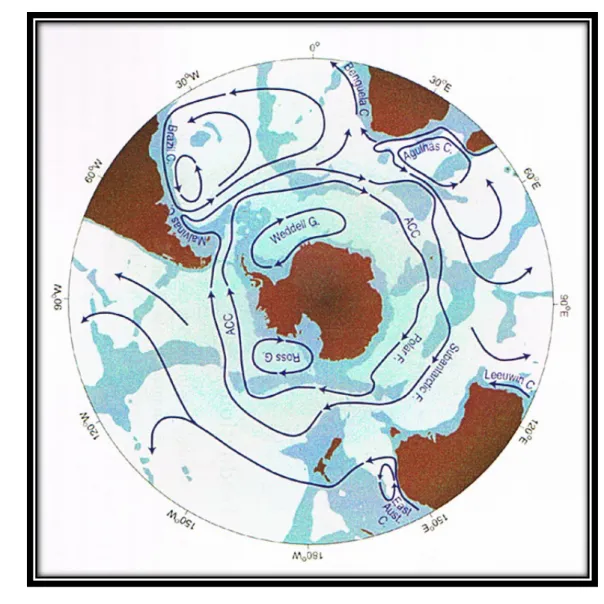
Viewed from the south, the Southern Hemisphere 85% ocean, and the Southern Ocean is its largest component (Figure 1). South Africa is the closest African nation to the Austral Polar region, separated from the continent of Antarctica by approximately 4000km of Southern Ocean. This distance is the greatest of all southern continents to the Antarctic continent, but most significantly it allows for a regionally unique configuration of ocean circulation to occur.
• A line from Cape Town to the Prince Edward Islands and beyond transects this dynamic region where ecosystem shifts are commuted from the tropics to the temperate gyres of the South Atlantic via the Agulhas current and its leakage. It is also the region
Figure 1: The Southern Hemisphere showing major land-masses and ocean currents (Rintoul et al, 2001).
where nutrient-rich polar waters of Antarctic Circumpolar Current converge;
• The Atlantic–South West Indian Ocean sector of the Southern Ocean encompasses some of the strongest pathways for CO2 exchange and storage. South Africa already partially capitalizes on its geographical advantage through established long-term observations programmes, including the atmospheric green-house gas observations at Cape Point;
• The Southern Ocean is globally significant as it represents a region where polar marine living resources surpass that of all other oceans;
• The Southern Ocean marks the intersection of the most important sources of deep and bottom water, which modulate both the heat and CO2 exchange with the atmosphere, and their storage in the ocean;
• South Africa’s geographic position relative to Antarctica has historically
lent itself to Antarctic exploration and exploitation. This could, and should, extend to future international collaborations. South Africa currently capitalises this advantage with the use of Cape Town as a home port for foreign cruises and as a flight springboard to Queen Maud Land, but this should be expanded to include research collaborations.
The Austral Polar region is also significant when considering the interaction of the planet with solar and other cosmic bombardment. The importance of Antarctica in space investigations thus arises from the nature of the Earth’s magnetic field. The geomagnetic field lines that intersect the Polar Regions near the magnetic poles stretch far out into space. Particle and wave phenomena in space map down the field lines onto the upper atmosphere.
Study of the effects in the ionosphere and upper atmosphere above Antarctica is analogous to observing a television screen image of activity in deep space.
The Polar Regions are uniquely important for ground-based space observations: Antarctica in effect, provides a window into geospace.
The geomagnetic field has a profound influence on the intensity of cosmic rays observed on Earth. The cosmic ray spectrum can be measured by using chains of detectors over a wide range of latitudes, and stations in the Polar Regions form an important part of such chains. Events on the sun modulate the intensity of cosmic rays, and this modulation is important for the study of effects on climate. Useful data require observations over several solar cycles, and such observations continue to be made at SANAE IV.
Within a reconstructed Gondwana Supercontinent, southern Africa shares a common geological history and boundary with Dronning Maud Land in Antarctica (Figure 2). Consequently, an understanding of the geological evolution of that sector of Antarctica provides insights into the evolution of southern Africa and vice versa. Such insights will contribute, inter alia, to the understanding of the genesis and distribution of mineral resources in southern Africa and Antarctica
Figure 2. Reconstruction of Gondwana showing the juxtaposition of part of Antarctica against southern Africa (Grantham et al, 2013)
1.3 Research Relevance
How, then, is the Antarctic and the Southern Ocean region relevant to South Africa? South Africa is the only African nation with a foothold in Antarctica and the Southern Ocean. It therefore bears a regional responsibility, and serves as a channel for broader African scientific research interests in the Antarctic region. This would, for instance, be of particular importance to African marine researchers working on species making annual migrations from summer feeding in Polar Regions to winder breeding in coastal national waters like Mozambique, Madagascar, Gabon, Angola, Seychelles, etc. Since the inception of the ATS, South Africa has been at the forefront of a number of major international oceanographic, astro- and bio-physical projects in which
African partnerships have been well embedded. These projects have strived not only to develop the required infrastructure for research, but also to train and develop African human resources in these most advanced physical science realms.
South Africa’s research focus now extends to space research, and amongst others, South Africa’s recently established National Space Agency (SANSA) is rapidly developing the physical and human resources required for Space Research. South Africa’s longstanding presence in Antarctica (since 1960) is a critical component of this long-term international research thrust. Similar internationally recognized long-term data sets are available for marine mammals and marine birds in the region. As an example, the University of Pretoria’s Mammal Research Institute hosts a unique 32-year long uninterrupted record of Southern Elephant Seal demographic data (Bester et al, 2011)
In future, Antarctica and the Southern Ocean will offer other vital opportunities relating to predicting and managing global change, food security, and the fueling of the bio-economy through bio-discovery and biotechnology. The region will also likely be a possible future source of fossil fuels and other strategic minerals.
The Prince Edward Islands are of relatively recent volcanic origin, and have limited economic value. However, within the context of a rapidly growing international need for innovative and workable marine conservation systems, these islands are of considerable importance for ecosystem and biodiversity conservation (Chown and Froneman, 2008, Terauds et al., 2010). For example, the extended Exclusive Economic Zone (EEZ) (200 nautical miles from shelf waters) around these islands exceeds that of mainland South Africa in area, and supports important marine resources. In addition, the islands have been declared a Marine Protected Area under the National Environmental Management Protected Areas Act, and there are obligatory research, monitoring and protecting responsibilities that come with this declaration.
The Prince Edward Islands also fall within the CCAMLR area, and as such, South Africa has international obligations to conserve the globally important breeding sites for several marine top predators. As it happens, the location of the Prince Edward Islands is strategically critical to the island’s ecosystem, and this provides a valuable opportunity to monitor the impacts of global change on the surrounding dynamic marine current systems (Ansorge, et al., 2014).
The South African Government has indicated its commitment to continued research in the Antarctic and Southern Oceans through major financial investments in new state-of-the-art platforms including new bases on Marion Island and SANAE IV, a state of the art research and supply vessel, the SA Agulhas II, ocean robotics, and other investments that provide a sound platform for scientific endeavor. The establishment of instruments such as SAEON, the Centres of Excellence, and the Council for Scientific and Industrial Research (CSIR’s) Southern Ocean Carbon and Climate Observatory (SOCCO) Programme, have facilitated outstanding academic research at several South African institutions, some of which has been focused on the Antarctic and the Southern Oceans. Additionally, the national Department of Environmental Affairs conducts research to guide resource management and biodiversity conservation. This research also contributes to international agreements and to understanding global change in the region. This research excellence has helped to keep South African scientific research at the forefront of international research in Antarctica and the Southern Ocean, and South African scientists play leading roles within several international bodies. Most importantly, this scientific excellence is linked to the development of high- quality human capital. This plan integrates all these investments to capitalize on the emerging global prominence of the Southern Ocean and South Africa’s comparative geographic advantage, which extends into the historic and current use of Cape Town as a homeport for foreign research endeavours.
Clearly, Southern Ocean and Antarctic research is in an ‘Age of Change’, where new opportunities to reach beyond what was possible in the past are being created through rapid technological transformation and innovation. An important example of this can be seen in research using cost-effective remote sensing and autonomous recording instrumentation. In addition, such technology-led opportunities are themselves a focus for innovation in the demanding environments of the far south. The global information technology revolution has been boosted in South Africa by the major investments required to operate such instruments as the South African Large Telescope (SALT) and the Square Kilometer Array (SKA). The advantages created by these investments themselves have released unimagined new potential for the generation of rich data, and for data storage and analysis, through instruments that are increasingly becoming remotely controlled, reaching new physical and logistical boundaries. Of course, the challenge of servicing and replacing such instrumentation in the harsh environments of Antarctica and the Southern Ocean remains.
This research plan provides a framework for the South African Southern Ocean
and Antarctic research enterprise over at least the next 10 years. It represents a bridge between the past and the future, and is critical in ensuring that the future becomes a proud and sustainable record for the Nation.
1.4 Research Focus
The development of a comprehensive research plan for South African Southern Ocean and Antarctic research has been the concern of the research community for several years. In 2005, the DST released the Antarctic Research Strategy for South Africa (ARESSA). This document has guided Southern Ocean and Antarctic research since that time.
The ARESSA Vision was to:
• “Create a demographically balanced Antarctic research programme that strives for high quality international research links to other African countries and interdisciplinary research.”
The ARESSA Mission was to:
• Establish a national research programme that will produce maximum human capital, innovation and economic growth;
• Increase South Africa’s international profile and influence; and
• Create a coordinated interactive effort towards public visibility.
The ARESSA Research Themes, designed to address environmental variability and sustainability within the context of human quality of life, were:
• Antarctica a window into Geospace;
• Climate variability, Past, Present and Future;
• Biodiversity responses to Earth System variability;
• Engineering and a sustainable presence in Antarctica; and
• History, Sociology and Politics of Antarctic Expeditions and Research.
The current research plan remains within the scope of the ARESSA Vision and is focused on an integrative systems approach to understanding the evolution of the earth systems and ecosystems in the 21st Century. The understanding of Earth Systems, reaching from space to the seabed, of the physical world provides the overarching framework of operations.
1.5 Constraints
It is necessary to recognize the major constraints that currently apply to South African research in the Southern Ocean and Antarctica so as to limit expectations of what can be achieved, and to ensure that appropriate attention be given to addressing such constraints. The following major constraints were highlighted:
1.5.1 Logistics:
Access to island and Antarctic bases and transport to and from these bases and the region is currently limited by insufficient access. These difficulties are occasionally offset by the occasional opportunities provided by joint programmes from the International sphere. The logistics and infrastructure platforms are costly and difficult to manage effectively and efficiently in the face of complex economic and administrative circumstances. South Africa has recently invested considerable capital in acquiring new infrastructure for ongoing support of this Southern Ocean and Antarctic research. This infrastructure includes a new base at Marion Island and a purpose-built, ice capable research vessel, the S.A. Agulhas II. This infrastructure greatly expands research potential and opportunities, and South Africa is therefore well positioned to play a leading role in Southern Ocean and Antarctic science.
However, this future needs to be consolidated and strengthened within the current governmental management structures. Although the S.A. Agulhas II was built to boost scientific research, it currently operates below its optimal operating schedule (currently 42% of the 12-month period). This compares poorly with other countries such as Australia, the UK and Germany (Treasure et al., 2013). Limited access to land-based research sites represents a major constraint. The current lack of dedicated research-driven ship’s time and access to the Agulhas II not only under utilises valuable and expensive research platforms, but compromises South Africa’s standing within the international arena. More frequent, appropriately timed visits to Marion Island would enhance the research productivity of the new base there; longer or more adaptable field seasons in Queen Maud Land could significantly increase the amount of time available for data collection. This could be achieved in various ways, including access to the field by air could increase a field season from the current 3-4 weeks to up to 14weeks.
1.5.2 Major Instrumentation:
In addition to maintaining existing momentum with regards to the acquisition and placement of new, modern instrumentation, it is clear that a well-funded, carefully planned strategy for updating and extending existing research infrastructure is required. It is essential to acknowledge that such new, modern instrumentation often takes time and collaborative effort to acquire
and install, and the installation and maintenance of such in harsh environments is often challenging. An instrumentation strategy would thus need to include the acquisition, training and retention of adequately qualified technical support.
1.5.3 Technical support:
The importance of home-based technical support cannot be over-emphasised.
Extensive (minimum 6-month) pre-expedition training is required to equip especially SANAE IV engineers to deal with the complex instrumentation on the base. 3 months post-expedition it then required to hand over new developments, and to introduce these to the next generation of expedition members.
1.5.4 Communication systems:
Continuous broad-band communications between the bases, the ship and the South African research centres is currently limited. 24 hour real-time data transfer is essential, as is reliable, quick access to emails and the internet. The current shipboard communication systems incapable of handling modern data transfer requirements. This is unacceptable within the context of the ship being the national research platform for oceanographic and other research activities. A dedicated staff member would be required to run the required servers to ensure availability and functionality. The SANAP website, as the first point of entry for web-based searches should also be managed by a dedicated staff member, and should be kept topical and up to date. This should form part of an overall infrastructure strategy.
1.5.5 Co-ordination:
National scientific activities in the far south require National Government inter-departmental cooperation as well as academic inter-institutional cooperation. In addition to this, it is important to acknowledge that modern research questions require inter- and an intra-disciplinary effort, and inevitably involve international participation. To be successful, operations with often competing logistic and research interests must be brought together. This critical requirement was recently highlighted in the 2009 report on the “Investigation into an Optimal Model for the Establishment of a South African Polar Research Entity” (Von Gruenewaldt, 2009). Possible solutions were highlighted in more recent articles by Treasure et al (2013) and Ansorge et al (2014), and include the development of a central management hub for Southern Ocean and Antarctic research
1.5.6 Personnel:
Recruitment of appropriately qualified expedition personnel requires streamlined processes. Equally important is the timeous appointment and training of such personnel. Clearly defined roles and responsibilities, and well managed timelines will facilitate adequate science planning and training.
2. Research Themes
In 2005, the Department of Science and Technology (DST) released the ARESSA, which has guided all Antarctic and Southern Ocean research to date.
The ARESSA addressed environmental variability within the context of human quality of life and sustainability. The Southern Ocean and Antarctic regions continue to offer unique opportunities in a continuum from the far reaches of outer space to the ocean bed. The strategic approach in this research plan thus follows the progression from Earth Systems to Ecosystems to Human Systems in the selected research themes, and focuses on the study of concordant atmospheric, oceanic and terrestrial ecosystems. Human activities and socio-political complexities in this international arena are of equal importance. The focus of each research theme is determined by current scientific strengths as well as the perceived future strengths and national requirements in South Africa. The research plan serves to link South Africa’s comparative geographic and research advantage, regional stewardship and national interest considerations to these three research themes so as to stimulate systems scale integration of knowledge and understanding. This will not only strengthen South Africa’s profile and develop advanced skills, but in so doing will also support the Country’s geo-political and citizenship goals in both regional and global dialogues.
2.1 Research Theme 1: Earth Systems
Earth System dynamics embrace a tier of layered dynamics, each requiring its own set of investigative instrumentation and skills set. While in the past much research effort has gone into the study of components of these domains, the emphasis in this research plan is across the boundaries of such domains, in order to advance the understanding and consequences of interactions across the layers of the Earth System. The whole cannot be studied by a single entity and collaboration and interaction between component teams is essential. The strategic approach within the Earth Systems Research Theme is to focus on the major sub-themes independently, starting with space science: upper and lower atmosphere dynamics, proceeding to atmospheric-ocean interactions,
and then to atmosphere-landscape interactions. The living systems that function within the earth-system dynamics of the Antarctic and Southern Ocean are then further addressed in the second major research theme.
2.1.1 Sub-Theme 1:
Space Science in Antarctica: A window into Geospace
South Africa has operated an atmospheric and space science programme (previously known as the "physical sciences") in Antarctica since the first SANAE expedition in 1960. The thrust has mainly been on studies of the heliosphere, the magnetosphere, and the ionosphere, with some attention being given to the neutral atmosphere.
The Antarctic neutral atmosphere is of global importance for several reasons including the following:
• The discovery of the stratospheric ozone hole in Antarctica was an alarming indicator of human impact on the planet;
• Most of the energy transported from the solar wind to the earth is deposited in the atmosphere in the polar regions; and
• The Polar Regions play a crucial role in the relationship between space weather and Earth's climate.
The space environment, the region of space surrounding Earth that lies between Earth and the Sun, is of particular importance due to the impact that weather in this hostile region (space weather) can have on technological systems. This region is termed “Geospace”, meaning near Earth-space environment. In particular, this is the region where satellites orbit, and satellites are used in a number of varied applications, including communication, navigation, and remote sensing. Geospace is a hostile environment, and therefore the study of space weather for application purposes is extremely important. The impact that space weather has on satellites and technological systems is of significant interest to the commercial sector as well as to scientists who aim to achieve a greater understanding of space weather in order to be able to provide better mitigation for our technological systems in the future. Satellites need to be protected from severe radiation, and ground-based infrastructure needs protection from geomagnetically induced currents. The prediction of adverse space weather is thus a major research goal. With South Africa developing its own satellites, knowledge of the hazards of the geospace environment is also becoming increasingly important from a domestic point of view.
The suite of instrumentation at SANAE IV, including the High Frequency (HF) radar, can make significant contributions towards our understanding of space weather. They are uniquely positioned to measure space from the ground at the point where the impact is felt the most (the high latitude region). These instruments give South African researchers access to unique datasets. The polar region data gives South African researchers “the edge” in such fields as the accurate modeling of space weather events and the development of related applications.
In many of the space weather investigations, no single instrument or individual can necessarily address these research questions. Rather, a combination of instruments and techniques supporting multi-disciplinary investigations highlight different aspects or effects of a specific phenomenon. The importance of the role of a station such as SANAE IV in coordinating such observations, including those made on satellites when they pass over the region or across the connecting magnetic field lines, cannot be overstated.
One of the crucial fundamental questions for space physics relates to vertical coupling in the upper atmosphere - the mechanisms of energy transfer between the different layers. Some work has been done on the first step of energy transfer from the solar wind to the magnetosphere, but there is much that needs to be done to understand transfer all the way down to the lower atmosphere. South African scientists are well placed to play an important role in such investigations.
Energetic particle precipitation into the polar upper-atmosphere has important consequences for atmospheric chemistry elsewhere on Earth.
Particle precipitation into the mesosphere creates long-lived chemical species, and these can be transported long distances both horizontally and vertically by winds. These substances are efficient catalysts for destroying ozone. By observing ozone at SANAE IV, the creation, transport, and consequences of these catalysts can be studied.
The Earth's magnetic field has been steadily decreasing for 2000 years and the rate at which this occurs is increasing, most rapidly over southern Africa and the adjacent Southern Ocean. This appears to be leading up to a field reversal, which statistically is long overdue. Investigation of the nature of this reversal, and its consequences for a range of geospace phenomena, and for the Earth’s atmosphere, is very well placed for South African science, and is of global significance.
2.1.2 Sub-Theme 2:
Southern Ocean in the Coupled Ocean – Atmosphere Climate and Earth System
The Global Carbon Cycle is a complex exchange of carbon dioxide (CO2)
between the atmospheric, ocean and terrestrial reservoirs as well as short to long-term storage within them. Natural or pre-industrial CO2 is a major greenhouse gas and past large scale CO2 adjustments between the ocean and the atmosphere were associated with glacial and warm climate phases. Post- industrial human derived CO2 emissions have made an additional load on the very large natural carbon cycle, which is shifting it away from its long-term steady state. Modern oceanic CO2 exchange with the atmosphere comprises a natural flux of approximately 90 giga-tonnes of carbon per year, and an anthropogenic uptake of about 2 giga-tonnes, generated by human agency.
Climate change, associated with CO2 driven global warming, influences change in upper-ocean physics, which alters the rate of ocean uptake and release of both natural and anthropogenic CO2 to the atmosphere.
The Southern Ocean is an important component in the global carbon cycle and contributes approximately 50% of the anthropogenic CO2 uptake, and 30-40%
of the much larger natural component. Clearly, even small changes in the Southern Ocean’s carbon cycle could meaningfully impact on the Earth’s carbon-climate feedback processes. Understanding the links between ocean- atmospheric physics, ocean iron availability, trace element biogeochemistry and ocean productivity are key to reliable modeling of the ocean contribution of these processes, which will in turn improve the reliability of global climate forecasting. This is why there is such a strong international focus on the Southern Ocean. The effectiveness of global and regional carbon mitigation measures during the 21st Century may depend on its as yet uncertain sensitivity to climate change. This risk is a key rationale for this theme, addressing the uncertainties of the regional and global carbon-climate links.
Model data as well as in situ observations over the past 30 years suggest that the Southern Ocean CO2 sink is weakening (LeQueré et al., 2007; Lenton et al., 2013). That is, the Southern Ocean CO2 sink is weakening. However, the impact of these changes on the carbon cycle and fluxes is likely to be highly non-linear and not predictable on traditional averaging of regional and intra- annual variability. A focus on the dynamical considerations is a key step towards understanding the sensitivities of the system to change and its feedback to the planet’s warming.
Recent work also indicates that in very large areas of the Southern Ocean, productivity and carbon cycle is modulated by sub-seasonal variability, and not only by the seasonal cycle in atmospheric and solar forcing. Such sensitivity to seasonal and sub-seasonal forcing (at meso- and sub-mesoscale) is an important consideration in the understanding of the vulnerability of the Southern Hemisphere carbon cycle to climate change and reducing the uncertainty in predicting long-term trends.
The Southern Ocean Carbon and Climate Observatory (SOCCO) is a South African born science programme that provides data about the physics–
biogeochemistry interface of the Southern Ocean, with a special focus on sub- seasonal (1–4 weeks) and sub-mesocale (1–100km) dynamics. SOCCO is an integrated interdisciplinary and multi-platform (observations and modeling) programme addressing the role of the Southern Ocean in global climate primarily through the physical and biological processes and mechanisms that influence the emission and uptake of CO2.
2.1.3 Sub-Theme 3:
Large Scale Ocean Circulation and Global Climate
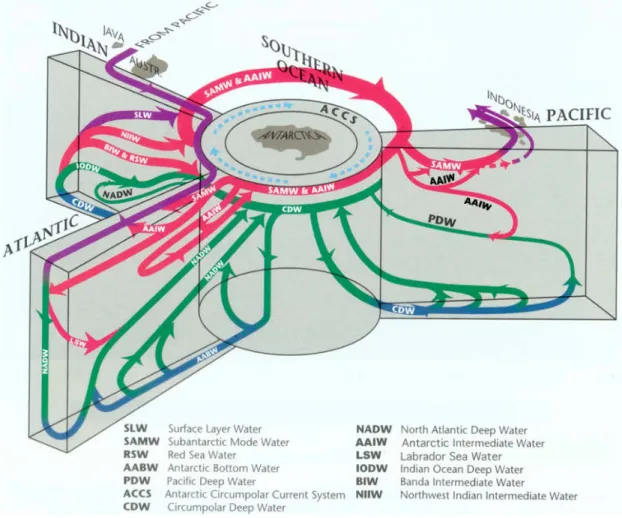
The Southern Ocean is arguably the core of the Earth’s oceans. Not only is it the ocean with the largest continuous current on the planet, namely the Antarctic Circumpolar Current, some 21,000 km in length, but it also connects the Atlantic, Pacific and Indian Oceans. There is little doubt that the Southern Ocean plays a pivotal role in the Meridional Overturning Circulation (MOC), global reaching system of surface and deep ocean currents (Figure 3) that is the primary mechanism for the ventilation, transport and storage of heat, freshwater and carbon among ocean basins (Sarmiento et al., 2004). It connects the ocean surface and atmosphere with the huge reservoir of the deep ocean. Observations and models consistently indicate that variations in the MOC are strongly correlated to variations in precipitation and surface air temperatures on earth.
While the MOC provides a vehicle connecting surface and deep ocean currents around the world’s oceans, little is known of the response and degree in which heat is absorbed or transported zonally or meridionally, and throughout the water column. The Southern Ocean is central to the MOC and provides a core link between the upper and lower layers. Hence, the circulation within the Southern Ocean strongly influences climate patterns and the cycling of carbon and nutrients across all ocean basins and any changes in the Southern Ocean will thus have global ramifications.
And changes in the Southern Ocean are evident. Limited observations suggest that the region is warming more rapidly than the global ocean average, wind systems are moving southwards, salinity change driven by shifts in precipitation and ice melt have been observed in both the upper and deep ocean, and the uptake of carbon has decreased (Rintoul et al., 2012). In response to these changes, Southern Ocean ecosystems are being forced to adapt or are diminishing in diversity and numbers (Allison et al., 2011). The severe lack of historical observations in the region makes it difficult to quantify this change and, in particular, to quantify the rate of change.
Figure 3 The global MOC overturn from the Southern Ocean perspective.
The most dynamic region of the Southern Ocean-MOC circuit is in the vicinity south of Africa. The present warming trends of the Agulhas system, and the variability associated with such phenomena as the Agulhas Leakage, can be linked to the position of the westerly wind belt (Beal, et al., 2011). Should the westerly belt shift southwards, as recent findings now suggest, the oceanic
‘gateway’ between the African continent and the northern boundary of the Southern Ocean widens. This will result in an increase in Agulhas Leakage and a strengthening of the MOC. These instabilities produce eddies, which carry heat, salt, chemical tracers and biota into the respective oceans, and cause turbulent mixing across the Subtropical Convergence.
An improved understanding of the interplay between the Southern Ocean and the Greater Agulhas Current systems is required to identify the potential drivers of climate change south of Africa. Currently, and incomplete picture of the mean state and variability of the African sector of the Southern Ocean and surrounds exists. The coupling of the Southern Ocean with the atmosphere, and cryosphere; and the exchange between the zonal and meridional fluxes across neighbouring basins are important gaps that South African scientists are well placed to address.. Current investigations should not only be continued, but should be extended to include the Greater Agulhas Current in the north.
A recent international effort (over 35 countries) to map the global oceans for trace element is underway (Geotraces, 2006). Trace elements and their isotopes play important roles in the ocean as nutrients, as tracers of processes now and in the past, and as contaminants. The study of geotracers is a relatively new field, and currently, little geotracer data is available for the Southern Ocean. South Africa is thus well-placed to contribute to this international initiative by investigating the Southern Ocean distribution of selected trace elements and isotopes, including their concentration, chemical speciation and physical form. Such work would characterize more completely the physical, chemical and biological processes regulating the distributions of selected trace elements and isotopes, their flux, sources, sinks, and internal cycling. This will have direct implication for research in such diverse areas as the carbon cycle, climate change, ocean ecosystems and environmental contamination.
2.1.4 Sub-Theme 4:
Solid Earth Antarctica: Views on Earth Evolution
The sector of Antarctica between ~25oW and ~35oE, comprising a major component of Dronning Maud Land, was adjacent to the southern African coastline prior to the breakup of Gondwana approximately 180Ma years ago.
As a result, southern Africa and Dronning Maud Land shared a similar geological evolution.
A recent project aimed at geologically mapping Mozambique on a scale of 1:250 000 was supported by available and new aero-geophysical data as well
as lithological sampling and structural field data. This led to the acquisition of extensive new aero-geophysical data over Dronning Maud Land, which will contribute to an improved understanding of the geology of that area. This leads directly to an improved understanding of supercontinent evolution.
In recognition of the value of these data to contributing to our understanding of the geology of Dronning Maud Land, a new Action Group was proposed and accepted at the SCAR Business meeting in Portland, Oregon 2012. A four-year map compilation and research project over Dronning Maud Land was initiated in 2014. Currently, the least understood area of Dronning Maud Land lies between 2oE to 15oE, and this will be the focus of collaborative research initiatives in the area. South African scientists are well placed to contribute meaningfully to this initiative.
The study of climate evolution is typically concerned with the analysis of glacial moraine systems, the distribution of clearly identifiable glacial erratics located above current ice levels, as well as glacial striation on bed rock at elevations significantly above current ice levels. Sampling of such localities provides material for the application of cosmogenic dating techniques, which provide insights into when a rock surface was first exposed to sunlight. The technique uses the interactions between cosmic rays and nuclides in glacially transported boulders or glacially eroded bedrock to provide age estimates for rock at the Earth’s surface. It is an excellent way of directly dating glaciated regions, and is effective over short to long timescales (1,000-10,000,000 years).
New developments in the sensitivity of gravity geophysical applications and instrumentations coupled with improvements in long life batteries permit continuous monitoring of the effect and rates of seasonal snow ablation and accumulation. Sustained monitoring of selected sites can provide insights into the possible effects of climate change.
Lastly, the pristine exposures of rock, typical of most nunataks in Antarctica, lend themselves to detailed studies of geological processes, including mineral- fluid interaction, partial melt genesis and melt migration, deformation mechanisms involving folding and fracturing of rocks, and of combinations of interactions between these aspects.