..
\TITILE
Stress Amongst Critical Care Nurses in Abu-Dhabi Hospitals
A DISSERTATION SUBMITTED TO:
FACULTY OF COMMUNITY AND DEVELOPMENT DESCIPLINES SCHOOL OF NURSING
UNIVERSITY OF NATAL
AS A PARTIAL REQUIREMENT FOR THE DEGREE:
MASTERS IN NURSING
Critical Care and Trauma Nursing
BY:
Eyad Mahmoud Melhem
Supervisor: Prof. L R Uys February 2003
DEDICATION:
I dedicate this dissertation to my parents and my wife Ruba for their support, patience, and understanding.
i i
ACKNOWLEDGEMENTS
I highly appreciate the great effort, support, and guidance of my advisor in achieving this dissertation.
I would like to thank Mrs. Najah Mustafa, the
director of the institutes of Nursing in the UAE for her continuous support and encouragement.
Many thanks to Mrs. Helen Michael who helped me by editing this dissertation.
A particular thanks to the director of nursing of Al-Jazeera and Central hospitals, Critical Care Units Manager in Al-Mafraq hospital, and the critical care nurses who participated by filling the questionnaire.
i i i
DECLARATION
Except for referenced citation in text, this is the researcher's original work.
Signature --- Date: February, 2003
iv
STRESS AMONGST CRITICAL CARE NURSES IN ABU-DHABI HOSPITALS
Purpose: The purpose of this study was to identify the stressors that affecting the critical care nurses in Abu Dhabi hospitals in order for the managers to take action to decrease or control these stressors where possible, or to take other appropriate action. Design: A cross
sectional survey design was adopted in this study, as the phenomena of stress in CCNs was surveyed at one point of
time. Sample: A convenient sample of 50 CCNs was included in the study. The participants were working as a CCNs in Abu Dhabi hospitals for a minimum one-year.
Instruments: Two questionnaires were utilized to collect the data for this study; The Critical Care Stressors Scale and The Hamilton Anxiety Scale. Results: Results showed that The CCNs did not show a high level of anxiety according to the adopted scale. The most frequent
stressors perceived by the CCNs were the stressors related to the critical care unit environment and the nursing responsibilities. On the other hand, the most severe stressors perceived by the CCNs were also under the categories of the critical care unit environment and Nurse- Health care workers conflicts.
v
Conclusion: The hospital/nursing administrations were asked to revise the policies of vi s i t i n g , dealing with infectious hazards, and portable X- r a y s . Also, the
results showed that hiring more rton-nurses staff to deal with non-nursing jobs, and more male staff to carry out the heavy jobs such as changing position wi l l aid in decreasing the stress perceived by the CCNs.
vi
TABLE OF CONTENT
DEDICATION--- 11
ACKWLEDGENTS--- 111
DECLRATION---iv
ABSTRACT--- V CHAPTER 1 INTRODUCTION Work related stress---l Stress in nursing---2
Stress in critical care nursing---~---2
Research problem---3
Research objectives---3
Research questions---4
Purpose of the research---4
Significance of the studY---4
Definitions of terms---5
CHAPTER TWO: LITERATURE SURVEY Views on stress--- 6
Stress at work---10
Stressors--- ll Coping mechanisms--- 15
Results--- 16
Conclusion--- 17 vii
•
CHAPTER THREE: RESEARCH METHODOLOGY
Resear ch design---19 Sample--- --- 20 Data collection---2 1
Data analysis~---~23
Ethical issues---23
CHAPTER FOUR: RESULTS Introduction---24
Sample Description--- --- ---24
Gender--- ---24
Age---24
Marital Status--- --- --- 23
Presence of participants' families in UAE---24
Nursing experience of the participants---26
Level of Anxiety--- 27
Correlation between Hamilton anxiety scale and the participants' experience---28
Frequency Of Stressors ---29
Identifying the most frequent stressors---30
Severity Of Stressors ---32
Identifying the most severe stressors---33
Conclusion---34
viii
•
CHAPTER FIVE: DISCUSSION
Introduction---35 What are the most frequent stressors in the critical
care units of Abu Dhabi, as identified by
the CCNs?---35 What are the most severe stressors in the critical care units of Abu Dhabi, as identified by
the CCNs?---35 Do these stressors lead to anxiety in the CCNs?---38 Recommendations---39 Conclusion---41
REFERENCES---43
ANNEXURES
Annexure I (The Questionnaires)---48 Annexure 11 (Letter to Nursing Directors)---58 Annexure III (Letter to respondents)---60
lX
LIST OF TABLES
Table 4.1 : Ages of participants- - --- - --- -- -- - - --- ----2 5 Table 4.2: Presence of participants' families in UAE---2 5 Table 4.3: Ex p e ri e n c e of partic ipa nts- - - - --- - - -- - -2 6 Table 4.4 : Critical care Nursing Exper ience of
Part icipants - - - --- - -- - - --- -- - - --- - - -- - - -- - - -27 Table 4.5: Ha mil t o n anxiety Scale scores- - - -- ----28 Tabl e 4.6: Frequency of categor ies of stresso rs
experienced by t h e CCNs- - - -- - - -- - - -- - - 29 Ta b l e 4. 7 : Frequency of str e s s o r s in the most two
fr e qu en t catego r ies (c rit i c a l care uni t environment and nurse responsib i lities) - - - -- - - -31 Ta b l e 4.8 : Severity of Stressors experienced by CCNs- - -32 Table 4.9 : severity of stressors in t he most t wo
stressful categories (Nurse -healt h car e worker conf lict and critical care uni t environment) - - - -- -- - -- - - -- - - -3 3
x
STRESS AMONGST CRITICAL CARE NURSES IN ABU-DHABI HOSPITALS
CHAPTER ONE
INTRODUCTION
Work related stress:
Determining the extent of stress-related health problems at work is not an easy issue. Researchers have
investigated the phenomena of work stress and the
existence of a correlation between job stress, physical and mental health, job satisfaction, and burnout (Vinas, 1999) .
Packard and Motowildow's (1987) research findings revealed that stress has been linked to physical and mental health, absenteeism, job satisfaction, and burnout.
Cox, Graffith & Cox (1996) commended that the experience of stress at work has undesirable effects, both on the health and safety of workers and on the effectiveness of
their organizations. Norbeck (1985) supported the
hypothesis that the higher the perceived job stress lS related to decreased job satisfaction and increased psychological sYmptoms.
. .
Stress in nursing:
Stress experienced by nursing staff has received considerable attention and focus from researchers.
Packard and Motowildow (1987) noted, "When patients require bodily care, understanding, empathy and full, unconditional acceptance, or when many complex tasks are required unexpectedly, hospital nurses find practical, tangible evidence of the worth of their talents, skills, and commitment to people. But when nurses recognize that their work is underappreciated, disparaged, taken for granted and when in addition they are treated
discourteously or even pitted against one another for the meagre rewards of their job, the nurses properly regard
such stressors undesirable." (P. 253-254.)
Boey et al. (1997) provided the information that most occupations are susceptible to stress but the nursing profession seems to be particularly vulnerable due to its psychological demanding nature. The researchers added that work stressors are believed to affect the mental health of the nurses, which may lead to high levels of anxiety and depression.
Stress in critical care nursing:
Most researchers supported the idea that a high level of stress is a characteristic of the work life of critical care nurses. Caring for critically i l l and dying patients
and their families is often a source of moral conflict and personal suffering for nurses (Rushton, 1992) .Vinas
(1999) concluded that professionals involved with
patien~
,
interaction, critically i l l and dying patients tend to 8e exposed to strong psychological, philosophical and/or emotional feelings. Stehle's (1981) research findings / revealed that ICD nurses showed significantly more depression, irritability, resentment, and verbal aggression rather than did non-ICD nurses.
Research Problem
Working in the critical care units is a stressful
)
experience for the critical care nurses (CCNs), and thus might influence the quality of care delivered to the critically i l l patients. CCNs use different coping
mechanisms to deal with the stress. If the stressors, the CCNs perception to these stressors, and coping mechanism are not known, i t will be difficult to identify and plan effective interventions.
Research Objectives
1. To identify the stressors that affect the Critical Care Nurses (CCNs) in Abu Dhabi hospitals, as
perceived by themselves.
2. To list and measure the anxiety / stress sYmptoms of CCNs in Abu-Dhabi hospitals.
Research Questions
1. What are the most prevalent stressors in the critical care units of Abu Dhabi, as identified by the CCNs?
2. Which of these stressor do nurses find the most stressful?
3. Do these stressors lead to anxiety in the nurses?
Purpose of the Research
To identify the stressors that are affecting the critical care nurses in Abu Dhabi hospitals in order for the
managers to take action to decrease or control these stressors where possible, or to take other appropriate action.
Significance of The Study
All recent researches suggest that job stress
among health care workers may be a major factor in the poor delivery of health services and the development of negative attitude toward the patient.
Nurses working in the critical care areas assuming an ever - increasing responsibilities for the management of patient care. In this expanding role, the CCNs are
confronted not only by the impending crisis of patients and families, but also by the demand for technologic
excellence. Moreover, nursing job stress caries costs for
the employing organization through absenteeism, staff conflict and rapid staff turnover.
Thus, the negative impact of job stress on the CCNs and organizations may directly or indirectly affect the quality of nursing care provided to patients and patients' families.
Since job stress is purported to be costly on the nurse, organization, patients and patients' families, i t is very important to identify and control the stressors that
affect the CCNs in order to improve the working condition and the standard of nursing profession, and to control the burnout among CCNs.
Definition of Ter.ms
(I) Stressor:
Theoretically: The change or stimuli that evokes the state of stress (Smeltzer & Bare, 1996) .
Operationally: Any item in the subscales of the Critical Care stressors checklist.
(11) Critical Care Nurse:
Theoretically: A licensed professional who is
responsible for ensuring that all critically i l l patients receive optimal care (Holloway, 1993).
Operationally: A nurse who works in the leD in any of Abu Dhabi hospitals.
CHAPTER TWO LITERATURE SURVEY
Views on stress
Selye (1978) defined stress as the non-specific response of the body to any demand, regardless of its nature.
Selye (1978) developed a theory of adaptation to stress.
This theory postulates that a person's body responds to the non-specific demands of stress by means of the
General Adaptation Syndrome (GAS), which continues until adaptation occurs or death ensues. Stress, in this model, may be internal or external to the individual and is manifested by the syndrome, which consists of non-
specifically induced changes occurring within the person's body. The GAS consists of three phases - the alarm phase, the phase of adaptation or resistance, and the phase of exhaustion - all of which are reversible if adjustment to stress occurs. A greatly simplified
construction of Selye's (1978) theory might consist of the following propositions:
1. Humans seek to attain a desired state (e.g. the reduction of stress) by mobilizing the body's general defence mechanisms to overact to maintain life.
2. When the specific defence mechanism is identified by the body for dealing with the source of stress (such
as increased muscular activity), the over activity of the general mechanism subsides, and the specific mechanism overacts (such as increasing the oxygen
supply in muscular activity) .
3. If the specific defence mechanisms are unable to cope with the stress, then the general defence mechanisms reactivate to help the body adjust, or death ensues .
4. During the alarm and exhaustion phases, there is an increase in the production of adrenocortical
hormone (ACTH), which subsides during the
resistance phase when specific defence mechanisms come into play.
The concepts that form the basis of Selye's theory include stress, the GAS, the body's general defence mechanisms, and the body's specific defence mechanisms.
His theory postulates that relationships occur between stress and the body's defence mechanisms, which are activated to cope with the stress. For example, the theory claims that the level of ACTH varies with the stage of GAS. (Polit & Hungler, 1999).
In Smith's engineering stress model, stress is
essentially an external force acting against a resisting body. One could say that stress also becomes a stressor when the level of force exceeds limits defining
structural integrity. More precisely, stress is defined in the engineering model as the load exerted by a force divided by the capacity of the material to resist
(Horwitz & Schied, 1999).
The conceptual framework for this study is the primary appraisal in Lazarus and Folkman's (1984) cognitive theory of stress, coping, and appraisal. This model has been chosen because it suits the purpose of the study more than other theories. It discusses the perception of
the human being toward his/her well-being. Also, the primary appraisal differentiates the situation into
irrelative, positive, and stressful. This studY ,explores the CCN's perceptions toward the stressors in the
critical care areas, and the CCNs are asked to classify those stressors from "not stressful" to "severely
stressful".
Lazarus and Folkman (1984:21) defined stress as "a
relationship between the person and the environment that is appraised by the person as taxing or exceeding his/her resources and endangering his/her well-being". This
relationship is dynamic and bi-directional, that is, ,t h e person and the environment constantly act on each other.
Cognitive appraisal is an evaluative process that focuses on the meaning or the significance of an encounter for the individual well-being. This process reveals what
is at stake for the individual in relation to a given encounter. The authors identified two basic appraisals:
primary and secondary. They propose that when an
individual encounters a new situation, he/she engages in these two types of appraisals.
Primary appraisal is the process by which individuals determine the significance of the situation for the personal well-being. The primary appraisal is
differentiated into three kinds: irrelevant, benign- positive, and stressful. Irrelevant means that the
transaction, an interaction between the person and the environment, is of no significance for well-being.
Benign-positive appraisal indicates that the appraisal is not exceeding the person's internal resources and has positive outcomes. Stressful appraisals include
harm/loss, threat, or challenge. Harm/loss and threat appraisals are characterized by negative emotional
reactions, whereas challenge appraisals are characterized by pleasurable emotions. The authors propose that the primary appraisal of a threat is a major component of stress. A threat according to this model is defined as an imbalance between the demands and the resources within a specific situation. Through the transaction, the primary appraisal is affected by personal factors including
beliefs, commitments, and situational factors. Secondary
appraisals are the evaluation of coping resources and alternatives either to overcome the harm and threat or to
improve the benefits and the positive outcomes. The two appraisals determine the extent to which the coping process is effective.
Because stress is an individual's cognitive appraisal of any given situation, i t will develop when the
individual perceives the demands of the situation
(primary appraisal) as exceeding his/her capabilities and resources (secondary appraisal) and anticipates harm or loss. In other words, appraisals refer to the evaluation of the situation by answering two questions; what is happening? And, what can I do about it? If the situation
is appraised as harmful or threatening and the imbalance between the demands and the capabilities to do something about the situation occur, then stress will develop.
Stress at work
It is generally believed that the nursing profession is stressful, creating unpleasant emotions to those who practice it. In a study conducted by Foxall et al. (1990) who compared the frequency and sources of nursing job stress perceived by intensive care unit (ICD) , hospice, and medical-surgical nurses, found that ICD, hospice, and medical surgical nurses were similar with respect to
overall frequency of job stress. However, the ICD and
hospice nurses had significantly higher stress levels with respect to death and dying subscale. On the
floating subscale,
reu
nurses and medical-surgical nurses had 'significantly higher mean scores than hospice nurses.With respect to work overload/staffing, medical-surgical nurses had significantly higher mean scores than
reu
nurses or hospice nurses.
Similarly, Goodfellow et al. (1997) investigated the
occupational stress in staff working in an intensive care unit. The result showed that nursing staff were found to experience greater stress than medical staff, relating to career and achievement and organizational design
and structure. Also, staff in the
reu
were more stressed than a normal working population by their career and by the organization.(a) Stressors
Many attempts have been made to draw up a definite list of stressors in the working area. Such an attempt has been made by Fontana (1990) who identified a considerable 11 stressors that can induce stress at work:
1. Unclear role specification, when we are not given a clear brief on what we are supposed to do.
2. Role-induced stress, which can occur when two
aspects of our job are incompatible with each other.
3 . .Unrealistically high self-expectations, which are linked to the unclear role specification and the role conflicts.
4. Powerlessness, which can produce high levels of frustration.
5. Frequent clashes with superiors.
6. Isolation from colleagues support.
7.0verwork and time pressures.
8. Poor channels of communication.
9. Inadequate leadership.
10. Conflict with colleagues.
11. Inability to finish a job due to time pressures, poor general organization at higher levels, or poor communication.
From a nursing perspective, Swartzky (1996) studied the perceived and actual stressors in 96 intensive care unit
female nurses in two Canadian hospitals. The result revealed that patient related stressors ranked the highest overall. Also, there was a significant relationship between perceived life stress and the perceived severity of work stressors.
Similarly, Rushton (1992) identified the sources of profound moral conflict and personal suffering for critical care nurses. The author states that
professionals in a patient care environment are
susceptible to stressors that are several times more prevalent than their non-patient care counterparts.
Professionals involved with patient interaction,
critically i l l and dying patients tend to be exposed to strong psychological, philosophical and/or emotional feelings.
It was stated that many critical care nurses experience a variety of conflicts as they carry out their care-giving roles. Conflicts may occur between various moral
positions and competing obligations (to patients,
families, colleagues, institutions, or themselves) or in institutions that can place their moral integrity in
jeopardy. Moreover, because of sustained interaction with the patient and the intimate nature of his or her care, nurses may suffer as a result of conflicts that arise when their responsibility to promote the patients well- being clash with the interests of the family. Also,
nurses may experience deep conflicts when they are placed In situations where the safety and quality of their care is jeopardized as a result of institutional policies, lack of administrative support, inter professional
conflicts, or legal constraints. Often, i t is the nurses sense of powerlessness that contributes to his/her
suffering.
In another study, Hibbert (1995) aimed to identify the stressors experienced by critical care nurses who care for organ donors. The researcher concluded that the threat of patients dying, the inconsistent commitment of physicians to organ donation, and returning to an empty
space were frequently mentioned stressors. However, all nurses felt positive about being involved in the organ donation process.
In a recent study, Collaghan, Tak-Ying, & Wyatt (2000) investigated the factors related to stress and coping among Chinese nurses in Hong Kong. The researchers showed that pediatric nurses, low-graded nurses, single, and female nurses reported the highest stress levels. The respondent's major sources of stress were related to nursing issues like too much work, interpersonal
relationships, and dealing with hospital administration.
Baily (1980) aimed to identify the stressors of ICD
nurses and to develop procedures to assist them to manage stress in their work environment. The researcher found that the categories of patient care and interpersonal relationships were perceived by ICD nurses as categories that produce the most stress. Paradoxically, the same categories were identified as categories from which ICD nurses receive the greatest source of satisfaction. This
finding is a significant one as i t points out the
perception of the individual as the key in the identification of stressors.
McAbee (1991) studied the occupational stress in the nursing profession. The researcher identified some
factors that contribute to psychological disorders. These factors are work overload, lack of control over one's work, non-supportive work environment, limited job opportunity, role ambiguity, rotating shift work, and machine paced work.
(b) Coping mechanisms
Healy and McKay (2000) studied the effects of coping strategies and job satisfaction in a sample of nurses.
The results revealed a positive relationship between nursing stress and mood disturbance, and a significant negative relationship between nursing stress and job satisfaction. The researcher concluded that the use of avoidance coping and the perception of work overload were found to be significant predictors of mood disturbance.
In addition, a study conducted by Hibbert (1995) displayed a major recommendation by nurses for more education in the area of grief, crisis interventions, stress, and coping theories. More importantly, they suggested the need to address their feelings through stress debriefing sessions.
A Collaghan, Tak-Ying, & Wyatt's (2000) study showed that the respondents coped with thei r stressors by seeking support from friends and colleagues, using different cognitive skills and leisure activities. Also, there was a significant link between the respondents' stress and sickness levels.
(c) Results
Many studies have attempted to find a link between perceived job stress and job satisfaction. Specific
studies in the area of the nursing profession such as the one done by Cox et al. (1996) concluded that nursing is acknowledged to be stressful work, and that stress can influence job satisfaction, psychological well being and physical health. The researchers added that by
identifying the stress factors that influence nurses, stress in nursing could be reduced by application of control cycle and risk management technique.
Likewise, Packard and Motowildo (1987) studied the relationship of stress, job satisfaction, and job performance in 366 hospital nurses. The findings were
that stress and job satisfaction are not directly
related, and that stress is associated with lower levels of job performance. Job satisfaction is unrelated to job performance, and is based on depression and hostility,
which are affected, by stress and personal characteristics.
In three current investigations done by Badger (2001), Collaghan et al . (2000), and Vinas (1999) which studied
the stresses of nursing profession. It was concluded that stress could affect the nurse's health that may result ln an increase in the number of sick days, indecision,
difficulty in problem solving, isolation or withdrawal, and behavioural outbursts. According to the researchers, these eventually compromise team cohesion and the quality of patient care.
Conclusion
Many studies have attempted to identify the stressors in the critical care nursing profession, and the results showed a variety of stressors that affect the CCNs in the working environment. However, most researchers concluded that patient- related stressors were perceived by
the CCNs as categories that produce the most stress.
Although several coping mechanisms have been addressed in order to explore how CCNs deal with their stress, no
definite coping mechanism was identified to be the
appropriate way to deal with the stress. Moreover, each study has identified different coping mechanisms carried by the nurses.
An important fact, which is strongly believed among the researchers, that stress can affect job satisfaction, performance, and burnout.
CHAPTER THREE RESEARCH METHODOLOGY
Research Design:
A cross sectional survey design was adopted in this
study, as the phenomena of stress in CCNs was surveyed at one point of time.
Polit and Hungler (1999) defined the survey research as non-experimental research that focuses on obtaining information regarding activities, beliefs, preferences, and attitudes of people through direct questioning of a sample of respondents. The authors have stated "survey is designed to obtain information from populations regarding the prevalence, distribution, and interrelations of
variables within those populations. The greatest advantage of survey research is its flexibility and broadness of scope. It can be applied to many
populations, focus on a wide range of topics, and its information can be used for many purposes. However, the information obtained in most surveys tends to
be relatively superficial since they rarely probe deeply into such complexities as contradictions of human
behaviour and feelings. Survey research is better suited to extensive rather than intensive analysis. Although surveys can be conducted within the context of large-
scale experiments, they are usually done as part of non- experimental study. 11 (p. 200-201).
In this study a survey was chosen because i t seemed best suited to describe the stressors as perceived by the
population of CCNs in the hospitals of Abu Dhabi. It will give an extensive rather than an intensive view of the problem.
Sample
A total of 140 questionnaires were distributed in the three hospitals, aimed at including all CCNs working in the critical care areas. Only 50 CCNs responded and were included in the study. This represents a 36% sample, and was considered to be sufficient for this study.
Those people who met the inclusion criteria were invited to be a part of the study. The inclusion criteria were nurses who:
1.Are working as CCNs in the ICD in Abu Dhabi hospitals (see definition of terms) .
2.Have been employed in the critical care area for a minimum one-year period.
A population sampling strategy was used to invite
~ potential participants, since an effort was made to include all eligible nurses in the research. Once
permission had been obtained, all units were visited and the research was explained to the nurses.
The questionnaires were handed out, and the participants asked to complete them and put them in a specific safe place for collection the next week. This continued until all nurses had been contacted and all questionnaires collected.
Data Collection:
Objectives one and two: Two questionnaires were utilized to collect the data for this study: The Critical Care Stressors Scale and The Hamilton Anxiety Scale.
The Critical Care Stressors Scale is a modification of the stressors scale developed by Antonelli (1985) .It consists of 64 items (stressors) and 6 sub scales:
a. 6 items measure the stressors related to philosophical-emotional conflicts.
b. 10 items measure the stressors related to nurse-health care workers conflicts.
c. 16 items measure the stressors related to nurse responsibilities.
d. 12 items measure the stressors related to knowledge and skills.
e. 9 items measure the stressors related to interpersonal conflicts.
f. 11 items measure the stressors related to the critical care unit environment.
This scale is a double rating scale, indicating first the frequency of stressor, and then the seriousness of the stressor. Frequency is rated on a five-point scale from every day to never, and seriousness is rated on a four- point rating scale from not stressful at all to severe stress.
Objective three: The Hamilton Anxiety Scale was one of the first rating scales developed to quantify the
severity of anxiety symptomatology. It consists of 14 items, each focusing on a group of symptoms. Each item is rated onS-point scale, ranging from 0 (not present) "to 4
(severely present). The idea is that not all people express what they feel as anxiety, but have other
symptoms indicating anxiety. The instrument, therefore, covers a wide range of typical anxiety symptoms.
The reliability of the instruments was assessed by test- retest reliability procedure. In this, the instruments were administered to a group of CCNs on two occasions;
then computing the reliability coefficient would enable the scores to be compared.
Polit & Hungler (1999) pointed out that the test-retest method is a relatively easy and straightforward approach to estimate reliability. The authors added that i t is a
method that can be used with self-report, observational, and physiological measures.
The content validity of the instruments was evaluated by consulting experts in the critical care nursing field, and others in the psychology field. This was done before the instruments were used.
A pilot study was conducted for both instruments on a few nurses to find out wh e t h e r i t gave the data required or not, and whether the respondents had any problems
understanding the items.
Data Analysis
Frequencies were utilized to identify the most common stressors, as well as the most serious stressors.
Also, a frequency table of the levels of the stress in Hamilton Anxiety scale were formulated.
Ethical issues
A formal letters were sent to the Directors of Nursing in each hospital to get permission for conducting the study.
After that, the units were visited so that the CCNs could be fully informed about the objectives and the benefits of the study to enable them to decide thoughtfully
regarding the participation in the study.
Questionnaires were kept anonymous, to ensure the confidentiality and privacy of respondents.
CHAPTER FOUR RESULTS
INTRODUCTION
This chapter deals with the analysis of data gathered by the questionnaires. The categories and subcategories that emerged from the data are presented.
Coding was done for the questionnaires and data were analysed by using the SPSS program.
SAMPLE DESCRIPTION:
Gender:
A total of 50 CCNs participated in the study. The sample was composed of 48 females (96%) and 2 males (4%).
Age:
Table 4.1 shows the distribution of ages of the
participants. It can be seen that a large number of the participants were between 31 and 35 years of age.
Marital Status:
The results revealed that 86% (n=43) of the participants reported to be married.
Presence of participants' families in UAE:
Table 4.2 shows the presence of participants' families in the UAE. The results showed that eighty percent (n=40) of participants are living with their families in the UAE.
Tab1e 4.1- Ages of participants:
Age Male Female Total %
25-30 - 8 8 16
31-35 - 17 17 34
36-40 1 9 10 10
41-45 - 7 7 14
46-50 1 5 6 14
51-55 - 4 4 8
Total 2 48 50 100%
Table 4.2-Presence of participants' families in UAE
Family in UAE Male Female Total %
Yes 2 38 40 80
No - 10 10 20
Total 2 48 50
Nursing experience of the participants:
The CCNs who participated In the sample covered a wide range of nursing experience with the minimum of one year.
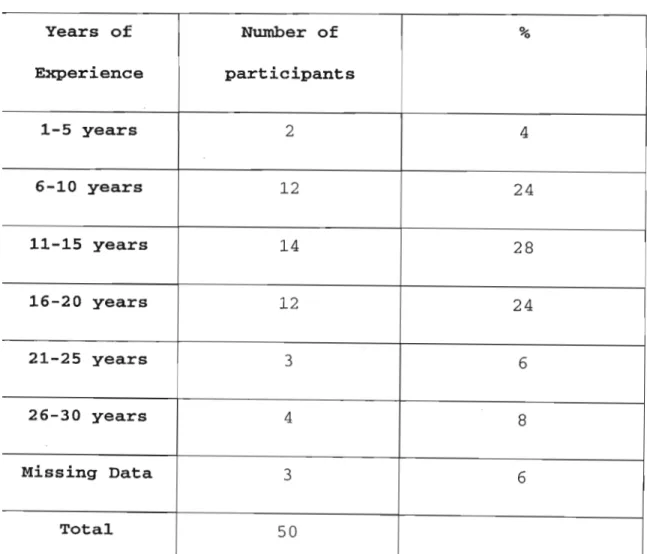
The majority of the participants (48%) have between 6-20 years of nursing experience. Moreover, the majority of
the participants (88%) have between 1-15 years leD nursing experience (see table 4.3).
Table 4.3-Nursing Experience of participants.
Years of Number of %
Experience participants
1-5 years 2 4
6-10 years 12 24
11-15 years 14 28
16-20 years 12 24
21-25 years 3 6
26-30 years 4 8
Missing Data 3 6
Total 50
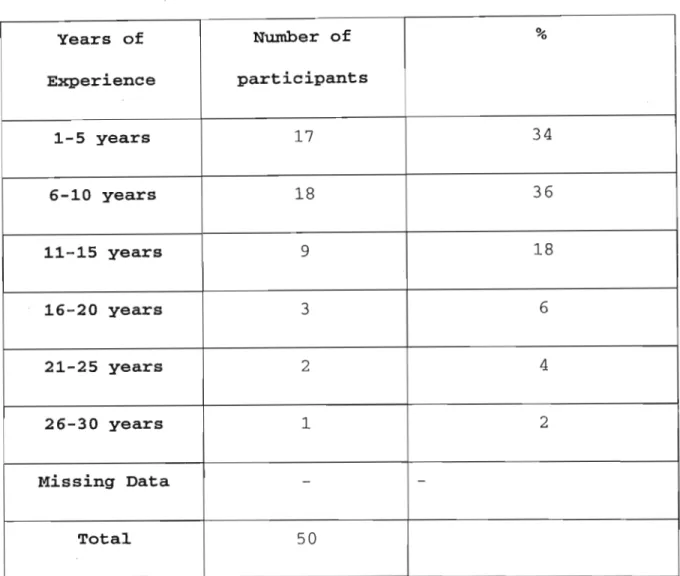
Table 4.4 describes the experience of participants In the critical care field. It is clear that the majority of the
participants have an experience between 1-10 years. A small percentage of the participants (5%) has an
experience more than 15 ye a r s .
Table 4.4-critical Care Nursing Experience of participants.
Years of Number of %
Experience participants
1-5 years 17 34
6-10 years 18 36
11-15 years 9 18
16-20 years 3 6
21-25 years 2 4
26-30 years 1 2
Missing Data - -
Total 50
LEVEL OF ANXIETY:
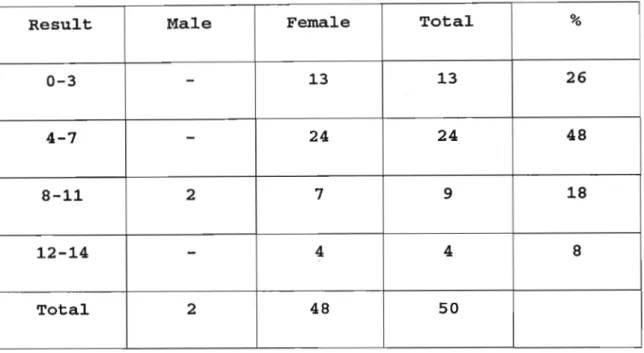
Table 4.5 represents distribution of scores of the Hamilton anxiety scale amongst the participants .
Almost half of the participants (n=24) scored between 4 and 7. Also, around a quarter of the participants (n=13)
scored between 0 and 3. Only 8% (n=4) of the sample scored between 12 and 14.
The table reveals that no participant has symptoms of stresst since results above 18 are considered as mild anxiety (www.fpnotebook.com!PSY73 .html).
Table 4.5- Hamilton Anxiety Scale scores of the participants.
Result Male Female Total %
0-3
-
13 13 264-7
-
24 24 488-11 2 7 9 18
12-14
-
4 4 8Total 2 48 50
Correlation between the Hamilton anxiety scale and ICU nursing experience.
When the correlation between the ye a r s of experience as a nurse and the anxiety level was calculatedt a Pearson Correlation of 0.07 was foundt which means that no correlation could be identified between these two variables.
FREQUENCY OF STRESSORS:
In table 4.6, the frequency of stressors is shown. Taking into consideration that the maximum frequency of a
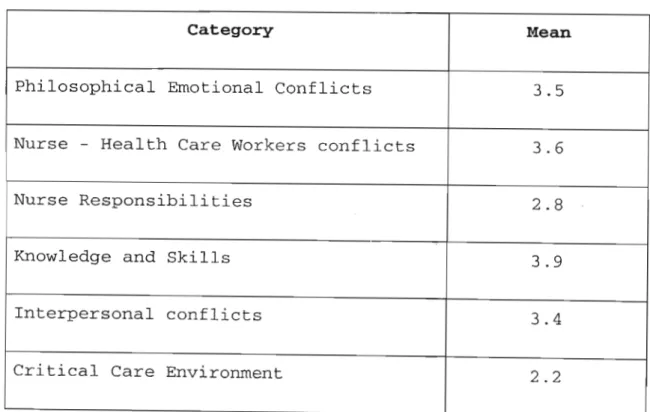
stressor (every day) has the number I, and the minimum frequency of a stressor (every month) has the number 3, i t is clear from the table that the category of critical care environment is considered as the stressor of highest frequency (mean= 2.2), followed by the stressors related to nurse responsibilities (mean= 2.8).
The stressors related to knowledge and skills are perceived as the stressors of least frequency (mean=
3.9) .
Table 4.6-Frequency of categories of stressors experienced by the CCNs.
Category Mean
Philosophical Emotional Conflicts 3.5
Nurse - Health Care Workers conflicts 3.6
Nurse Responsibilities 2.8
Knowledge and Skills 3.9
Interpersonal conflicts 3.4
Critical Care Environment 2.2
Identifying the most frequent stressors:
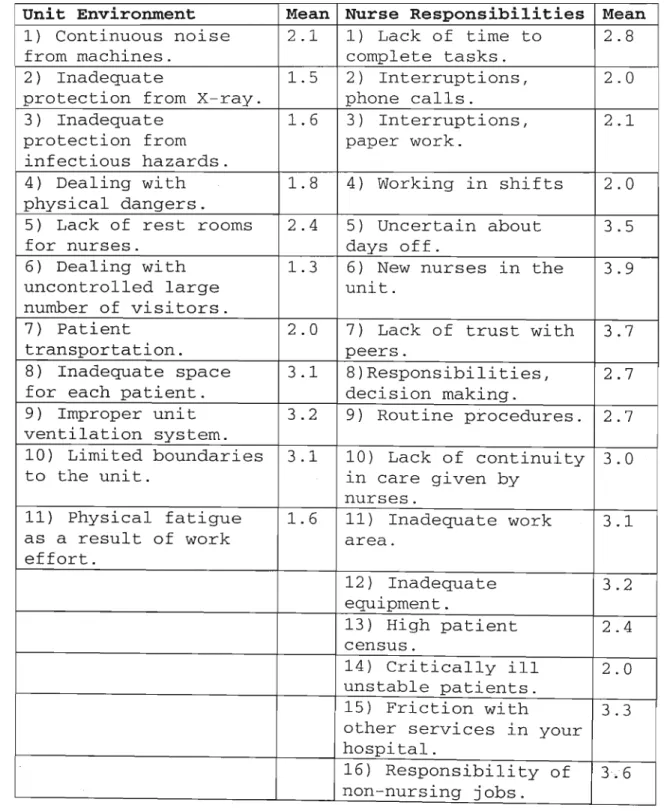
Table 4.7 presents the frequency of stressors in the categories that were perceived as the most frequent
stressful categories (critical care unit environment and nurse-responsibility) .
The results presented in table 4.6 reveals that dealing with large numbers of visitors, inadequate protection
from the X-ray and infectious hazards, dealing with physical dangers are the most frequent stressors
perceived by the CCNs under the category of the critical care unit environment. Also, i t can be seen that working in shifts, dealing with critically i l l patients, and interrupting phone calls and paperwork are considered as the most frequent stressors under the category of nurse responsibilities.
Table 4.7 shows also that the stressors under the
category of the critical care unit environment is either daily or weekly (mean between 1.3 and 1.8) whereas the frequency of stressors under the category of nurse
responsibility is almost weekly (mean between 2 and 2.1).
Table 4.7- Frequency of stressors in the most two
frequent categories (critical care unit environment and nurse responsibilities).
Unit Environment Mean Nurse Responsibilities Mean 1) Continuous noise 2.1 1) Lack of time to 2.8 from machines. complete tasks.
2 ) Inadequate 1.5 2 ) Interruptions, 2.0 protection from X-ray. phone calls.
3) Inadequate 1.6 3 ) Interruptions, 2.1 protection from paper work.
infectious hazards.
4) Dealing with 1.8 4) Working in shifts 2.0 physical dangers.
5) Lack of rest rooms 2.4 5 ) Uncertain about 3.5
for nurses. days off.
6) Dealing with 1.3 6) New nurses in the 3.9 uncontrolled large unit.
number of visitors.
7) Patient 2.0 7) Lack of trust with 3.7
transportation. peers.
8) Inadequate space 3.1 8) Responsibilities, 2.7 for each patient. decision making.
9) Improper unit 3.2 9) Routine procedures. 2.7 ventilation system.
10) Limited boundaries 3.1 10) Lack of continuity 3.0
to the unit. ln care given by
nurses.
11) Physical fatigue 1.6 11) Inadequate work 3.1 as a result of work area.
effort.
12) Inadequate 3.2 equipment.
13) High patient 2.4 census.
14) Critically ill 2.0 unstable patients.
15) Friction with 3.3 other services in your hospital.
16 ) Responsibility of 3.6 non-nursing jobs.
SEVERITY OF STRESSORS EXERIENCED BY THE CCNs:
Table 4.8 describes the perceived severity of the stressors by CCNs. Taking into consideration that the severity of stress is rated from 1 (not stressful at all) to 4 (severe stress), it can be concluded that the most stressful stressors are those under the category of the critical care environment (mean 2.5), followed by the stressors under the category of health care workers conflicts (mean 2.4).
Also, i t should be taken into consideration that in all categories, the stress is rated by CCNs as between mildly stressful and moderately stressful.
Table 4.8-Severity of Stressors experienced by CCNs.
Category Mean
Philosophical Emotional Conflicts 2.0 Nurse - Health Care Workers conflicts 2.4
Nurse Responsibilities 2.2
Knowledge and Skills 2.1
Interpersonal conflicts 2.3
Critical Care Unit Environment 2.5
Identifying the most severe stressors.
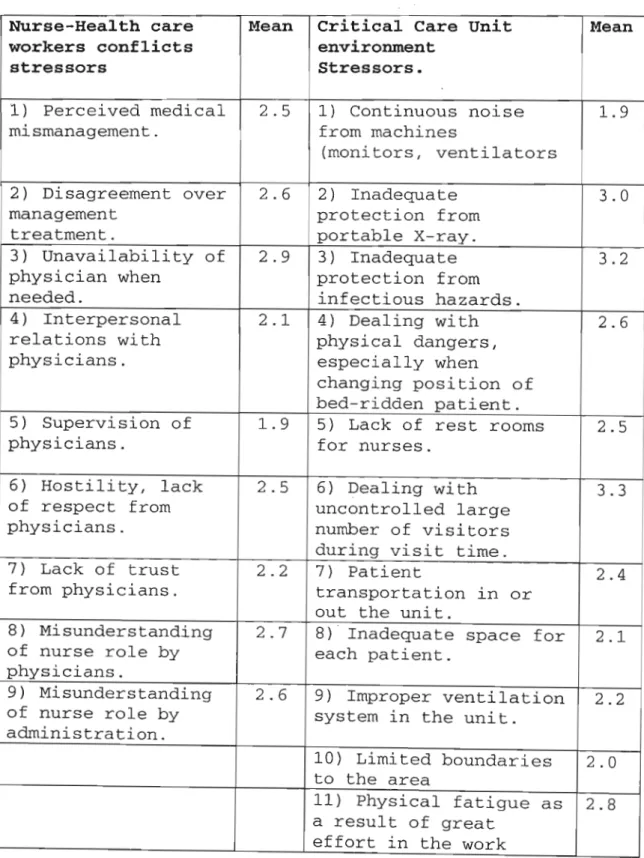
Table 4.9-Severity of stressors in the most two stressful categories (Nurse-health care worker conflict and
critical care unit environment).
Nurse-Health care Mean Critical Care Unit Mean workers conflicts environment
stressors Stressors.
1) Perceived medical 2. 5 1) Continuous noise 1.9 mismanagement. fr om machines
(moni to rs , ventilators
2) Disagreement over 2. 6 2) Inadequate 3.0
management protection from
treatment. portable X- r a y .
3) Unavailabi l ity of 2.9 3) Inadequate 3. 2 physician when protection from
needed. infectious hazards.
4) Interpersonal 2.1 4) Dealing with 2.6 relations wit h physical da n g e r s ,
physicians. especially when
changing position of bed-ridden patient.
5) Supervision of 1.9 5) Lack of rest rooms 2. 5
physicians. for nurses .
6) Hostility , lack 2.5 6) Dealing with 3.3 of respect from uncontrolled large
physicians. number of visitors during visit time.
7) Lack of t rust 2.2 7) Patient 2. 4 from physicians. transportation in or
out the unit.
8) Misunderstanding 2. 7 8) Inadequate space for 2.1 of nurse role by each patient.
physicians.
9) Misunderstanding 2. 6 9) Improper ventilation 2.2 of nurse role by system in the unit.
administration.
10) Limited boundaries 2.0 to the area
11) Physical fatigue as 2. 8 a result of great
effort in the work
By examining the data presented in table 4.9, i t becomes clear that the most severe stressors perceived by the CCNs in the Nurse-Health care workers conflicts stressors category are related to the physicians such as the
unavailability of the physician when needed,
misunderstanding of nurse role by the physician, and disagreement over management treatment. In the category of the critical care unit environment stressors, the dealing with visitors, inadequate protection from
infectious hazards and inadequate protection from the
x-
ray were perceived as the most severe stressors.
CONCLUSION:
This study attempted to measure the level of anxiety in CCNs, and to identify the most frequent and the most severe stressors perceived by CCNs in Abu-Dhabi
hospitals.
Overall, the CCNs did not show a high level of anxiety according to the adopted scale. The most frequent
stressors perceived by the CCNs were the stressors related to the critical care uni t environment and the nursing responsibilities. Additionally, the most severe stressors perceived by the CCNs were also under the categories of the critical care unit environment and Nurse-Health care workers conflicts.
CHAPTER FIVE DISCUSSION
INTRODUCTION
In this chapter the results will be discussed with reference to the research questions.
What are the most frequent stressors in the critical care units of Abu Dhabi as identified by the CCNs?
The most frequent stressors perceived by the CCNs in Abu- Dhabi hospitals were related to the category of the
critical care unit environment. According to this result, we can conclude that the critical care environment
usually evokes a frequent flow of stressors for nurses who work there, like the presence of noisy and complex machines, inadequate protection from X-rays, inadequate protection from hazards, and dealing with visitors; and
this leaves no doubt that the work environment of the critical care units is a source of stress and conflicts.
No studies were found that examined the frequency of stressors in the CCNs. Most of the studies investigated the occurrence and severity of the stressors.
What are the most severe stressors in the critical care units of Abu Dhabi as identified by the CCNs?
The results showed that the stressors under the
categories of health care workers conflicts and critical
care unit environment are perceived as the most severe stressors by the CCNs.
Regarding the category of health care workers conflicts, i t would seem that physicians play an important part in CCNs stress because they are the people who have the most direct work relationship with the CCNs. Nurses are also usually supervised by the physicians. Unavailability of the physician who is the decision maker in the unit, especially in serious situations, causes the most severe stress for the CCNs. Also, hostility and lack of respect from physicians increase the CCNs' level of stress
because the physicians are the people who should support and collaborate with the CCNs.
The critical care unit environment is the category that causes the most severe and frequent stress. The results showed the large number of visitors as a major stressor, which indicates that the visiting policy to the critical care units in Abu-Dhabi hospital needs some adjustments and modifications.
Inadequate protection from infectious hazards and X-ray appear as another important source of stress. CCNs have many severely i l l ventilated patients, who are in need for frequent X-rays. Taking into consideration that most of the CCNs are female; the scattering of the X-ray in
the environment is perceived by the CCNs as a source of concern.
Inadequate protection from infectious hazards is perceived as a source of stress to the CCNs. Here i t
should be emphasized that delivering direct care to
critically i l l patients, and the performance of a variety of invasive procedures in the critical care units will result in various infectious hazards that may cause a transmission of infectious diseases from the patients to the CCNs.
Several investigations support the findings of this research. For example, Gardner et. al. (1980), Bailey
(1980), and Rushton (1992) concluded also that the
critical care unit environment produces an intense stress for the nurses working there.
Also, Callaghan et. al. (2000) concluded that
interpersonal relationship and aggression from colleagues including physicians are some of the major sources of stress for nurses.
Leatt and Schneck (1980) identified situations involving patient care, conflicts and demands, and doctors'
behaviour as potential stressors for CCNs.
Harris (1984) and Robinson & Lewis (1990) concluded that workload, failure of physicians to recognize nurses' skill and expertise, unnecessary prolongation of
stressful for CCNs.
Most of the stressors which are perceived as the most severe and frequent can be controlled or modified by the hospital and nursing administration, and this will be discussed in the recommendations part.
Do these stressors lead to anxiety in the CCNs?
The results revealed by the Hamilton anxiety scale showed that no CCN demonstrated a high level of anxiety. One reason might be that the high frequency of the stressors could make the nurses used to the stressors, thus
habituating them and reducing the impact of stressors.
Also, some nurses may have not responded frankly to the anxiety scale because they feel shy about expressing their anxiety/stress, or worried about negative
evaluation, although no studies were found to support this idea.
The results also revealed that there are highly frequent stressors affecting the CCNs rating from daily to weekly occurring stressorsi therefore, the accumulation of
effects of these low level stressors across the time ma y affect the CCNs performance and may lead to aggravation of the stress symptoms.
One must also take into account the demographics of the participants. They are a group with a solid support
system, ln that 86% are married and 80% are living with their families ln the UAE. The family members will
provide the support to cope with work-related stress.
This also can affect the level of anxiety.
Callaghan et. al. (2000) concluded that single nurses had marginally higher stress scores than married nurses.
The results showed no relation between the years of experience and the level of anxiety. This result is
supported by the finding of Spoth and Kenewko (1987) who concluded that there is no significant relationship
between the age or the experience of th CCNs and their level of anxiety/stress. However, Norbeck (1985)found that less experienced nurses showed a higher level of stress than more experienced nurses.
RECOMMENDATIONS:
For further research:
• Further studies on stress of CCNs using a larger sample covering other emirates in the UAE should be carried out to generalize the findings.
• The effect of job stress on additional outcome measures, such as other health outcomes,
absenteeism, job turnover, and job performance, need to be studied.
For Hospitals:
• The nursing administrators need to address the stressors perceived by the CCNs. Actions should be taken if the psychological needs of the CCNs are to be met, and if the CCNs wh o play a vital role in the delivery of health care are to be retained.
• The stressors tool is found to be useful in the
identification of the most frequent/severe stressors of the CCNs; Nursing administrators are encouraged to review the results to identify these stressors.
• Employ a full-time physician as a permanent ICU/CCU director. He or she would be available, especially during emergencies, and could supervise and teach the new CCNs. This may help to deal with the stress caused by the nurse-physician relationship problem.
• Schedule a senior staff nurse on each shift with a light patient assignment; he or she can teach the less experienced CCNs.
• Give extra time for the orientation period for the new CCNs.
• Initiate strict visiting policies regarding the visiting hours and the number of visitors to the critical care units.
•
Review the guidelines followed by the X-ray department in obtaining a portable X- r a y s forcritically i l l patients in order to maintain staff safety and to provide the maximum protection against the X-ray.
• The results showed that interrupting phone calls and paperwork are perceived as major sources of stress;
Hiring non-nursing staff to carry out these kinds of jobs will minimize the stress perceived by the CCNs.
• The sample demographics showed that most of the CCNs are females, and this will increase the level of stress due to physical dangers resulting from patients' position changing. Employing more male CCNs who are physically more qualified to perform these jobs.
• Infection control department is required to review the process of dealing with infectious hazards in terms of policy and equipment.
Conclusion:
The categories of the critical care unit environment and nurse responsibilities are considered as the most
frequent stressors for the CCNs. Under the category of the unit environment, the study showed that dealing with visitors, inadequate protection from infectious hazards and portable x-rays are the most frequent stressors, whereas working in shifts, dealing with critically ill
patients, interruptin g phon e ca l ls and pap e r wo r k ar e the most fre q u e nt stress ors un d e r t h e category of nurs e
respon s ib i l i t i e s . No previ ou s studies hav e been conducted t o st u d y the frequen cy of stressors in the CCNs .
The categories of the critical care unit environment an d nurse-health care workers conflicts were perceived as the categories of the most severe stress, although the
stress ors perceived are rated by t h e CCNs as bet ween mildly stressf ul and moderat el y str e ssful. Under the category of nurse-health care wo r ke r s confli cts, the study showed that physicians play a major role in producing stress for the CCNs. On the ot h e r hand, the category of the unit environment, again dealing wi t h vi s i t o r s , infectious hazards, and por t a b l e X- r a y s wer e perceived as the categories of most severe stressors.
The majority of research supports these findings.
The hospital administrations shoul d be asked to revise the poli ci es of visiting, dealing wit h infecti ous
haz a r d s , and porta b l e X- r ay s . Also, the resu l ts sh owed t ha t hiring more non- nurs es staff to dea l wi t h non-
nursing jobs,and more male staff t o ca r r y ou t the heavy jobs such as ch a n gi ng positi on will aid in decr e a s i n g the stress perc eived by the CCNs.
References
Antonelli, K .. (1985). Stress and Neonatal Nurse
Practitioner/Clinician. NEONATAL NETWORK, 13(2) :15-18.
Badger, J. M. . (2001). Understanding secondary traumatic stress. AMERICAN JOURNAL OF NURSING, 101(7) :26-32.
Baily, J. T .. (1980). The stress audit: identifying the stressors of ICU nursing. JOURNAL OF NURSING EDUCATION,19
(6) :14-25 .
Baily, J. T .. (1980). Stress and stress management: an overview. JOURNAL OF NURSING EDUCATION,19 (6) :3-13.
Boey, K.M., Chan, K.B., Ko, Y.C., Goh, L.G., & Lim, G.C .. (199)) . Work stress and psychological well-being among the nursing profession in Singapore. SINGAPORE MEDICAL JOURNAL. Htt://www.sma.org.sg/smj/3806a5.htm Callaghan , P. , Tak-Ying, S. A. , Wyatt, P. A .. (2000).
Factors related to stress and coping among Chinese nurses in Hong-Kong. JOURNAL OF ADVANCED NURSING,31 (6) :1518- 1527.
Cox, T., Griffith, A., & Cox, S .. (1996). Work related stress in nursing: controlling the risk to health.
International labour office. Geneva.
Erlen, J. A., & Sereika, S. M.. (1997). Critical care nurses, ethical decision making and stress. JOURNAL OF ADVANCED NURSING, 26:953-961.
Fontana, D .. (1990). Problems in practice: managing
stress. The British psychology society and Routledge Ltd.
London.UK.
Foxall, M. J., Zimmerman, L., Standly, R., & Captain, B.
B.. (1990) A comparison of frequency and sources of nursing job stress perceived by intensive care, hospice and medical - surgical nurse. JOURNAL OF ADVANCED
NURSING, 15:577-584.
Gardner D., Parzen, Z.D., & Stewart; N .. (1980). The nurses dilemma: mediating stress in critical care units.
HEART & LUNG, 9:103-106.
Goodfellow, A., Varnam, R., Rees, D., & Shelly,
M.P .. (1997). Staff stress on the intensive care unit: a comparison of doctors and nurses. ANAESTHESIA, 52:1037- 1041.
Harris, J. S .. (1984). Stressors and stress In critical care. CRITICAL CARE NURSE, 1: 84-97.
Healy, C.M., & McKay, M.F .. (2000). Nursing stress: the effect of coping strategies and job satisfaction in a sample of Australian nurses. JOURNAL OF ADVANCED
NURSING, 31 (3) :681-688.
Hibbert, M.. (1995). Stressors experienced by nurses while they are caring for organ donors and their families. HEART & LUNG,24(5) :399-407.
Hollowa y, N. M.. (1993). Nursing the cr i t i ca l l y i l l adult. Redwood City: Benjamin/Cummings publishing company.
Horwitz, A. V., & Scheid, T. L .. (1999). A handbook for the study of mental health: social contexts, theories, and systems. Ca mb r i d g e : Cambridge Universit y press.
Lazarus, R. S., & Folkman, S. . (1984). Stress appraisal and coping. Springer publication company. New York.
Leatt, P. & Schneck, R.. (1980). Differences in stress perceived by head nurses across nurses specialties I hospitals. JOURNAL OF ADVANCED NURSING, (5) :31-46.
McAbee, R .. (1991). Occupational stress and burnout in the nursing profession. A model for prevention. AMERI CAN ASSOCIATION OF OCCUPATIONAL HEALTH NURSES
JOURNAL, (39) 12:568-575.
Norbeck, J.S .. (1985). Types and sources of social support for manag ing job stress in critical ca r e nursing. NURSING RESEARCH, 34 (4) :225- 230.
Packard, J. S., & Motowildo, J. S.. (198 7 ) . Subjec t ive stress, job satisfaction, and job performance of hospital nurses. RESEARCH IN NURSING AND HEALTH, 10:253-261.
Perkin, R.M., Yo u n g , T., Freier, C., Allen, J., & Orr, R.
D. . (19 97). Stress and distress in pediatric nurses: a
lessons from baby K. AMERICAN JOURNAL OF CRITICAL CARE, 6(3): 225-232.
Polit, F.D., & Hungler, B.P .. (1999) .6th Ed .. Nursing research. Philadelphia: J.P. Lippincott.
Robinson, J.A., & Lewis, D.J .. (1990). Coping with ICU work related stress. CRITICAL CARE NURSE, 10:80-86.
Rushton, C. H .. (1992). Care-giver suffering in critical care nursing. HEART & LUNG 21(3) :303-306.
Selye, H. (1978). Stress without distress. J.P.
Lippincott. New York.
Smeltzer, S. C., & Bare, B. G.. (2000). Brunner and suddarth textbook of medical- surgical nursing.
Philadelphia: J .P. Lippincott.
Spoth, R. & Kenewko, P. . (1987). Intensive care staff stressors and life event changes across multiple settings and work units. HEART & LUNG, 16(3}: 278-284.
Stehle, J.L .. (1981). Critical care nursing stress: the findings revisited. NURSING RESEARCH, 30(3) :182-187 . Swartzky, J . A .. (1996) . Stress in critical care nurses:
actual and perceived. HEART & LUNG, 25(5) :409-417.
Talbot, L.A . . (1995). PRINCIPLES AND PRACTICE OF NURSING RESEARCH. Mosby. St. Luis, Missouri.
Vinas, M.A .. (1999). Occupational stress, burnout, and the medical professional.
http://tridenthealthcare.com/perfweb/burnout.html www.fpnotebook.com/PSY73.htm
ANNEXURES
ANNEXURE (I) THE QUESTIONNAIRE.
STRESS QUESITONNAIRE: ABU DRABI
A: DEMOGRAPHICS:
PLEASE COMPLETE SECTION A BY FILLING IN ALL THE MISSING DATA
Age:
Gender:
Marital status:
Family ln UAE: Yes No __
Experience in nursing:
Year in ICU/CCU:
Have you got a qualification ln Critical Care: Yes _ No _
Country of training:
B: Hamilton Anxiety Rating Scale.
Please indicate with an X which column best describes your experience of the items listed in column one.
Anxiety:
Worries, anticipation of worst, fearful
anticipation, irritability.
Tension:
Feeling of tension, fatigue, moved to tears easily, trembling
feelings of
restlessness, startle response, inability to relax.
Fears:
Of dark, of strangers, of being left alone, of animals, of traffic, of crowds.
Insomnia:
Difficulty in falling asleep, night terrors, unsatisfying sleep, fatigue on waking,
dreams, and nightmares.
Intellectual (Cognition) : Difficulty in
concentration, poor memory.
Depression:
Loss of interest, lack of pleasure in hobbies, depression, early
waking, diurnal swing.
Not Present
Mild Modera -te
Seve -re
Very Seve -re
Somatic (muscular):
Pains and aches,
twitching, stiffness, myoclonic jerks,
grinding of teeth, unsteady voice,
increased muscular tone.
Somatic:
Tinnitus, blurring of vision, hot and cold
flushes, feeling of weakness, prickling sensation.
Cardiovascular symptoms:
Tachycardia,
palpitations, pain in chest, throbbing of vessels, feeling faint, missed beats.
Respiratory symptoms:
Pressure or constriction in chest, choking
feelings, sighing, dyspnea .
Gastrointestinal symptoms:
Difficulty in swallowing, wind, burning sensations, abdominal pain, nausea, vomiting, looseness of bowels, loss of weight, constipation.
Genitourinary:
Frequency and urgency of urination, amenorrhea, menorrhagea, frigidity,
loss of libido,
impotence, premature ejaculation.
Not Present
Mild Modera -te
Seve -re
Very Seve -re
Not Mild Modera Seve Very
Present te re Seve
re Autonomic symptoms:
Dry mouth, flushing, pallor, sweating,
giddiness, tension, and headache.
c:
Stressors Scale. Antonelli (1985) INSTRUCTIONS:1.In column 2 (frequency) please indicate how often you have encountered the stressor identified in column one over the pa s t six months, using th e following key :
Every day: 1 Every week : 2 Ever y mon t h: 3 Seldom: 4
Never: 5
2. In columns 3 to 6, pl e a s e indicat e how stressful you find this kind of stressor, by tick ing the appropriat e column.
1 2 3 4 5 6
Stressors Freq- Not Mild Moderate Severe stressful stress stress stress uency at all
I.
Phil.osophical.
Emotional.
confl.icts 1) Conflict ing feeling towards abusive or
irresponsible families.
2) Coping with grief over the death of a client.
3 ) Unnecessary prolongation of life.
4) Long-ter m chronically i l l clients.
5 ) Shock and impact of sights and smell.
6) Withholding of treatment in severely
impaired cl ients.
1 2 3 4 5 6
Stressors Freq- Not Mild Modera Severe
uency stressful stress te stress
at all stress
II. Nurse- Health care workers conflicts.
1) Perceived medical mismanagement.
2) Disagreement over management treatment.
3 ) Unavailability of physician when needed.
4) Interpersonal relations with physicians.
5) Supervision of physicians.
6) Hostility, lack of respect from
physicians.
7) Lack of trust from physicians.
8) Misunderstanding of nurse role by
physicians.
9) Misunderstanding of nurse role by
administration.
10) Mistrust of other physician services,
(surgical, diagnostic) .
2 3 4 5 6
1 Freq- Not Mild Modera
uency stressful stress te Severe
Stressors at all Stress Stress
III. Nurse-
Responsibilities.
1) Lack of time to complete tasks.
2) Interruptions, phone calls.
3) Interruptions, paper work.
4) Working in shifts.
5) Uncertain about days off.
6) New nurses in the unit.
7) Lack of trust with peers.
8)Responsibilities, decision making.
9) Routine procedures.
10) Lack of
continuity in care given by nurses.
11) Inadequate work area.
12) Inadequate equipment.
13) High patient census.
14) Critically ill, unstable patients.
15) Friction with other services in your hospital.
16) Responsibility of non-nursing jobs.
2 3 5 6
1 Freq- Not Mild Moderate Severe
Stressors uency stressful stress
at all stress Stress IV. Knowledge and
skills.
1) Insecurity about knowledge and competence.
2) Mistakes made, perceived or real.
3) Lack of in- service and continuing education.
4) Lack of experience and skills required. 5) Number of rapid decisions that must be made.
6) Unfamiliar situations.
7) Unfamiliarity with special
equipment or procedures.
8) Lack of orientation program for job
requirements.
9) Lack of confidence in mastering skills. 10 ) Lack of
resources personnel.
11) Over
qualification for the work you do.
12) Under
qualification for the work you do.
1 2 3 4 5 6 Frequ Not Mild Moderate Severe Stressors -ency stressful stress stress stress
at all v. Interpersonal
conflicts
1. Nurse leader-
Nursing staff personal conflicts.
2. Incomplete staff and/or irresponsible personnel.
3. Inadequate staffing.
4. Lack of teamwork or incorporation.
5 . Disrespect from staff under your leadership.
6. Unresponsive nursing
administration.
7. Family
responsibility versus work you do.
8. Hospital policy and regulations conflict. 9. Competition among your peers.
1 2 3 4 5 6
Stressors Freq- Not Mild Moderate Severe
uency Stressful stress Stress stress at all
VI. Critical Care Unit environment
1) Continuous noise from machines
(monitors, ventilators 2) Inadequate
protection from portable X-ray.
3) Inadequate protection from infectious hazards.
4) Dealing with physical dangers, especially when
changing position of bed-ridden patient.
5) Lack of rest rooms for nurses.
6) Dealing with uncontrolled large number of visitors during visit time.
7) Patient
transportation in or out the unit.
8) Inadequate space for each patient.
9) Improper
ventilation system In the unit.
10) Limited boundaries to the area.
11 ) Physical fatigue as a result of great
effort in the work.
ANNEXURE (II): letter to the directors of nursing
Dear Madam,
I'm Eyad Mahmoud Melhem, working as a nursing tutor ln the Institute of Nursing in Abu Dhabi. I'm doing my masters education in critical care nursing at the University of Natal-South Africa.
I'm conducting a study about "Stress amongst critical care nurses in Abu Dhabi hospitals" as a partial
fulfilment of my degree. The purpose of the study is to identify the stressors that affect the critical care nurses. Since high levels of stress might influence the quality of patient care, i t is important for health
service managers to know what causes stress and how high stress levels are in order to plan appropriate
interventions.
I would like to ask for your permission to access the critical care units in your hospital in order to
distribute a questionnaire. The results of the study will be communicated to you after completion.
The staff will be free to participate in the study and the questionnaire will be anonymous in order to ensure the privacy and dignity of the staff.
I'm attaching a copy of my questionnaire for your review.
Your cooperation will be highly appreciated.
Yours faithfully,
Eyad Melhem.