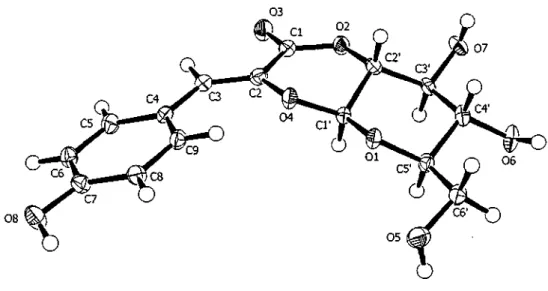
From the methanol extracts of the rhizomes we isolated the compounds Z-venusol, methyllespedesate, 4-6>-/?-D-glucopyranosyl-3,3',4'-tri-0-methylellagic acid and punicallagin. It is clear from the HPLC study that the rhizomes contain large concentrations of the hydrolysable tannin punicalagin and the second most abundant metabolite was Z-venusol. One of the most important considerations regarding the synthesis was the manipulation of hydroxyl groups of gallic acid through selective protection reactions that provide access to the aforementioned preparation of unsymmetrical ellagic acid derivatives.
CHAPTER ONE
INTRODUCTION
BIOACTIVE NATURAL PRODUCTS
Vinblastine (1.7) and vincristine (1.8), both isolated from Catharanthus roseus, are used to treat Hodgkin's disease, lymphosarcoma, and leukemia.10'11 Irenotecan (1.9), first isolated from a Chinese tree. Taxol (1.10) was isolated from the Pacific yew Taxus brevifolia and is used to treat cancer. Recently, a compound with appetite suppressant activity was isolated from the South African plants Hoodia pilifera and H. P59 (1.11).
South African natives also used it to treat other ailments such as rheumatic fever, swelling, menstrual pain and stomach bleeding. A preliminary screening of the crude extract of this plant for uterotonic effects has been reported.16 However, no information on the phytochemistry of this plant was available prior to this investigation.
PLANTS WITH UTEROACTIVITY (OXYTOCIC PLANTS)
- INTRODUCTION
- SOUTH AFRICAN OXYTOCIC PLANTS
- NON-SOUTH AFRICAN OXYTOCIC PLANTS
- CONCLUSION
- REFERENCES
Agapanthus was also found to be one of five plants used to treat complications related to child labor. In Tanzania, chimpanzees consume the leaves of the plant in an unusual way for self-medication. There have been recent reports of the plant being used in connection with child labour.
CHAPTER THREE
PHYTOCHEMICAL STUDY OF GUNNERA PERPENSA L
REVIEW OF GUNNERACEAE
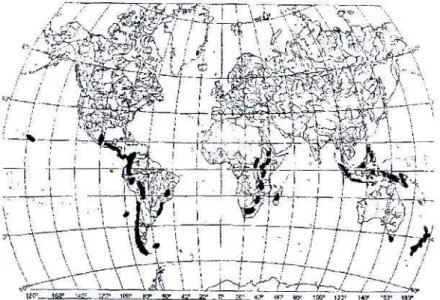
This was the first species of the genus to be described and occurs in the mountains of southern Africa and along the Great Rift to Ethiopia and also in Madagascar. Motivated by the striking red color of the stems and skin irritation on contact with the leaves of the plant, Drewes et al. The leaves of the plant are used in wound dressing by the rural people of the Eastern Cape.24.
RESULTS AND DISCUSSION
- Introduction
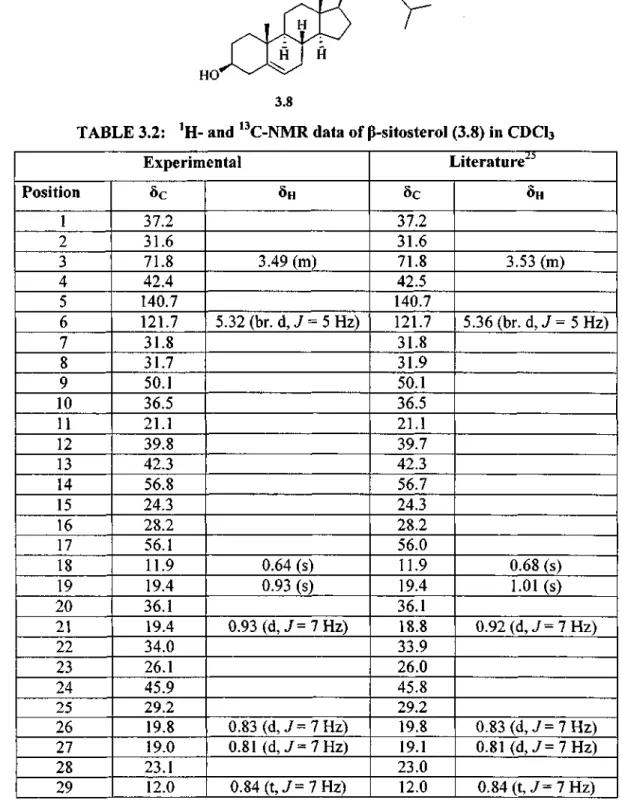
- Structural elucidation of p-sitosterol (3.8)
- Structural elucidation of Z-methyl lespedezate (3.18)
- Biosynthesis of venusol (3.17)
- Discussion on ellagic acid derivatives
- Structural elucidation of punicalagin (3.20)
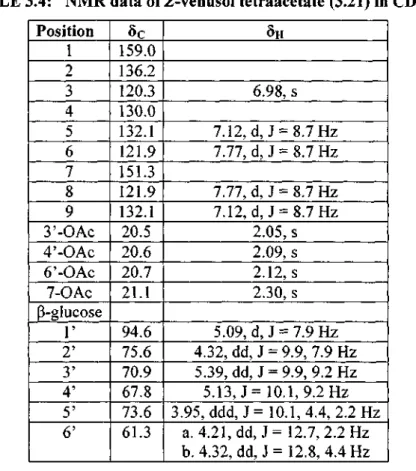
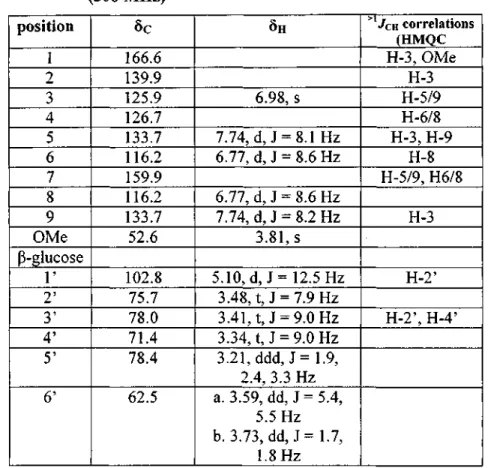
Unequivocal evidence for the structure of Z-venusol (3.17) was provided by acetylation of the compound to yield venusol tetraacetate (3.21). From the chemical shift of H-l it was clear that C-1 of the carbohydrate was not derivatized. In the 13C-NMR spectrum (Plate 31) 23 signals are observed at 8c corresponding to 23 carbonyl carbons (seventeen acetate carbonyl carbons and six other ester carbonyl carbons), six sugar carbons 8c 63.9-90.0 and the rest of the carbons were assigned to the aryl carbons.
GIucose
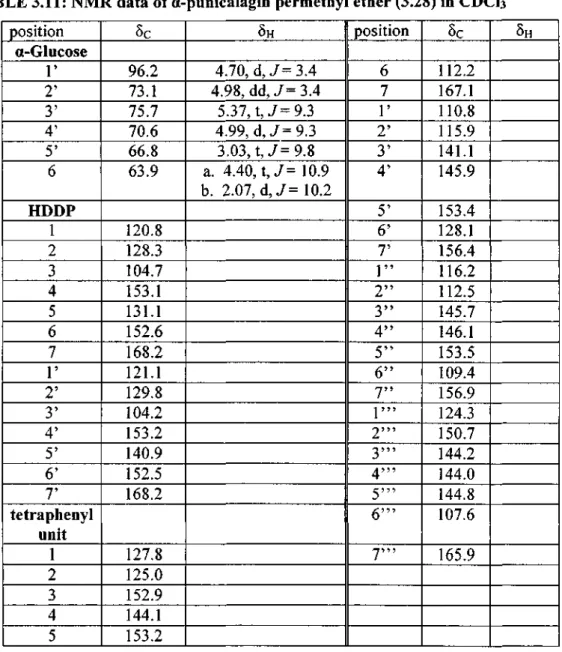
- Structural elucidation of a- and p-punicalagin permethyl ether (3.28 and 3.29)
The sharp aromatic singlets corresponding to four protons are clearly observed in the spectra of the two compounds indicating the presence of four tetra-substituted aromatic rings. In the 13C NMR spectra of the two compounds, it was clearly observed that 3.28 differs from 3.29 in anomeric carbon chemical shifts with a-anomeric carbon at 8c 96.27 and the B-anomeric carbon resonated at 8c 100.14. Although the structure of this hydrolyzable tannin initially seemed very complex, we have shown here that analysis of high-field NMR spectra of punicalagin and its derivatives allowed us to assign a precise structure to this very complex compound.
Glucose
- Discussion on punicalagin (3.20)
- Uterotonic activity of crude extract and Z-venusol (3.17)
- HIV-RT inhibitory activity of the crude extract and punicalagin (3.20)
- CONCLUSION
- EXPERIMENTAL
- General
- Acetylation Procedure
- Methylation Procedure
- Isolation of P-sitosterol (3.8)
- Isolation of methyl lespedezate (3.18)
- Isolation of punicalagin (3.20)
- Isolation of p-punicalagin acetate (3.27)
- Isolation of a- and p-punicalagin permethyl ester (3.28 and 3.29)
- REFERENCES
7 Punicalagin is present in the leaves of this plant as one of the hydrolyzable tannins. Punicalagin is one of the hydrolyzable tannins and can be hydrolyzed to form ellagic acid by spontaneous lactonization of hexahydrodiphenic acid (Scheme 3.6). Although secondary metabolites are usually associated with specific plant species, chemical variations in the compounds present in a particular species are sometimes observed in plants collected from different geographical areas.
When working with medicinal plants that grow in the wild, it is important to investigate the chemical variations of plants collected in different areas before making general statements about plant composition and function. However, the presence of methyl lespedezate (3.18) was not observed in any of the crude extracts. Bioassay-guided fractionation of the crude extracts led to the isolation of punicalagin (3.20) as the active compound.
Prior to this study, nothing was known about the phytochemistry of this plant and very little had been reported about the chemistry of the other Gunnera species. Optical rotations of the isolated compounds were determined with the appropriate spectroscopic solvent with a Perkin-Elmer 241 polarimeter. Thin layer chromatography (TLC) of the crude extracts was performed using aluminium-backed, 0.2 mm silica gel plates (Merck 0.20 mm or Machery-Nagel 0.20 mm).
Three fractions were collected and one of the fractions was a single compound identified as p-sitosterol (3.8) (6 mg).
CHAPTER FOUR
SYNTHESIS OF ELLAGIC ACID AND UROLITHIN DERIVATIVES
INTRODUCTION
It has been shown that punicalagin (3.20) from various sources is not absorbed by humans but is hydrolyzed to yield ellagic acid (4.1), which is further metabolized by the human intestinal microflora to form the bioavailable urolithins A (4.2) and B (4.3 ) deliver. ) (Scheme 4.1).7 These metabolites reach concentrations of micromolar levels in the blood and are excreted in the urine of humans. It has been reported that urolithins exhibit very poor antioxidant activity and nothing is yet known about other (if any) potential biological activities in the human body.8 It was recently proposed that urolithins A (4.2) and B (4.3) could be used as biomarkers used. of human exposure to dietary ellagic acid derivatives.8. The biological activities of punicalagin (3.20), ellagic acid (4.1) and its derivatives and the ellagic acid metabolites have not been extensively investigated.
The need for larger amounts of ellagic acid and its derivatives for biological studies prompted us to do so.
NATURALLY OCCURING ELLAGIC ACID DERIVATIVES
The plant genus is well known for containing a large amount of polyphenols such as tannins. A phytochemical study of Rhabdodendron macrophyllum (Rhabdodendraceae) showed that the roots contain 3,3',4-tri-O-methylflavellagic acid (4.15) and 3,3',4-tri-O-methyl-. Qing-Mei and Xiu-Wei16 reported the isolation of a new ellagic acid derivative, 3-0-methylellagic acid 4'-O-a-L-2"-0-acetylrhamnopyranoside (4.17) and other known ellagic acid derivatives from the fruits of Eucalyptus balls (Myrtaceae).
Bioassay-guided fractionation led to the isolation of two antioxidant and antimicrobial ellagic acid derivatives, 3'-0-methyl-3,4-methylenedioxyellagic acid 4'-0-glucoside-(4.18) and pteleolelagic acid derivative 4.19 together with two others know the derivatives of ellagic acid from the bark of the stem of Pteleopsis hylodendron (Combretaceae). Extraction and fractionation of the bark of Eschweilera coriacea (Lecythidaceae) by Young et al.18 led to the isolation of three ellagic acid derivatives, eschweilenol A (4.20), eschweilenol B (4.21) and eschweilenol C (4.22). While screening new bioactive products from Chinese plants distributed in Yunnan, Yukihiro et al19 found that a 60% ethanolic extract of Combretum yunnanensis (Combretaceae) branches inhibited the growth of adriamycin-resistant murine leukemia cells.
Motivated by these findings, they isolated the active ellagic acid derivative, ellagic acid acetyl-α-rhamnopyranoside (4.23). It is clear that ellagic acid derivatives are widespread in nature and that some of them have pronounced biological activity.
BIOSYNTHESIS OF ELLAGIC ACID
SYNTHESIS OF ELLAGIC ACID DERIVATIVES AND UROLITHIN A: A LITERATURE REVIEW
- Synthesis of ellagic acid derivatives
Yukihiro et al.19 reported on the semi-synthesis of a bioactive ellagic acid derivative isolated from C . Selective benzylation of the more reactive 3,3'-hydroxy groups of 4.1 afforded 3,3'-di-O-benzylellagic acid (4.27). ) and subsequent glycosylation with an L-rhamnose derivative 4.29 and debenzylation led to the target compound 4.23 in good yield (Scheme 4.4).
- Synthesis of urolithins
- METHODS FOR THE REDUCTIVE COUPLING OF ARYL HALIDES
- Ullmann coupling methodology
- Heck coupling methodology
- TBAF, THF
- RESULTS AND DISCUSSION
Treatment of the ester with Pd(PPh3)2Cl2 and sodium acetate in DMA at 125 °C to effect an intramolecular biaryl coupling followed by hydrogenolysis resulted in the formation of 4.55. In conclusion, a review of the literature shows that both Ullmann coupling and Heck coupling reactions can be used in the formation of key biaryl bonds of ellagic acid derivatives. However, with free gallic acid derivatives as a substrate, the exclusive formation of the monobrominated product was possible.
Acid chloride 4.67 was obtained by refluxing 4.73 in SOCI2 and after removal of excess thionyl chloride, this acid chloride was used immediately in the next step without purification. Hydrolysis of the methyl ester followed by acetylation of the 3-hydroxy group and selective bromination at the 2-position gave 4.78 in 67% yield (Scheme 4.19). The acid chloride 4.68 was obtained by refluxing 4.78 in SOCI2 and after evaporation of the excess thionyl chloride, the acid chloride was used immediately in the next step without further purification.
To obtain a monoacylated tartrate, a tin-mediated acylation reaction was used.4 ' ' Several steps are involved in the preparation of the above starting materials 4.67 and 4.68. Tin-mediated acylation of diethyl tartrate allowed the formation of the monoacylated alcohol 4.80 in 54% (Scheme 4.21). Subsequent acylation of the free hydroxy group of 4.80 using the same benzoyl chloride in the presence of a catalytic amount of DMAP gave 4.81.
In another attempt to test the performance of the disposable rope under Ullmann conditions, it was decided to use the synthesized aryl halides 4.67 and 4.68 in an unsymmetrical biaryl arrangement (Scheme 4.22).
- Heck coupling reactions
- CDMT
- DMTMM RCOOH
- CONCLUSION
- EXPERIMENTAL
- General
- Synthetic procedures
- OCH(CH3) 2 ]
- REFERENCES
In the 13C NMR spectrum, a total of 12 carbon atoms were observed in the aromatic regions, suggesting the presence of two non-identical aromatic rings. Addition of acid chloride 4.68 to monoester 4.87 in the presence of a catalytic amount of DMAP afforded diester 4.88 in 62% yield. An attempt was made to synthesize the punicalagin metabolite urolithin A using the Heck coupling reaction employed in the preparation of biaryl compound 4.104.
In the synthesis of an ellagic acid derivative, we faced the challenge of realizing the biaryl formation of two unsymmetrical electron-rich rings. The Heck coupling methodology also proved to be a promising method in the coupling of biaryls towards the synthesis of the punicalagin metabolite urolithin A (4.2). We propose that ellagic acid derivatives may play a role in the biological activity of this plant.
After the reaction, SOCI2 was distilled off in vacuo to give 2-bromo-3,4,5-trimethoxybenzoyl chloride, which was used in the next step without purification. After the reaction, SOCb was distilled off in vacuo to give benzoyl chloride 4.67, which was used in the next step without purification. After the reaction, SOCI2 was distilled off in vacuo to give benzoyl chloride 4.67, which was used in the next step without purification.
The mixture was heated at reflux for 5 h and concentrated hydrochloric acid (Ph = 2) was added to give a white precipitate, which was filtered to give the diacid and used in the next step without purification.
Plate 23
COSY spektrum af p-punicalagin acetat (3,27) i CDCI3 HSQC spektrum af p-punicalagin acetat (3,27) i CDCI3 HMQC spektrum af p-punicalagin acetat (3,27) i CDCI3. 13C NMR spektrum af P-punicalagin permethylether (3,29) i CDCI3 COZY spektrum af P-punicalagin permethylether (3,29) i CDCI3 HSQC spektrum af P-punicalagin permethylether (3,29) i CDCI3 HMQC spektrum af p-9 methylether (3in methyl ether). ) i CDCI3. 13C NMR spektrum af a-punicalagin permethylether (3.28) i CDCI3 COSY spektrum af a-punicalagin permethylether (3.28) i CDCI3 HSQC spektrum af a-punicalagin permethylether (3.28) i CDCI3 HMQC spektrum af a-8 punicalagin. ) i CDCI3.
0 J& ft