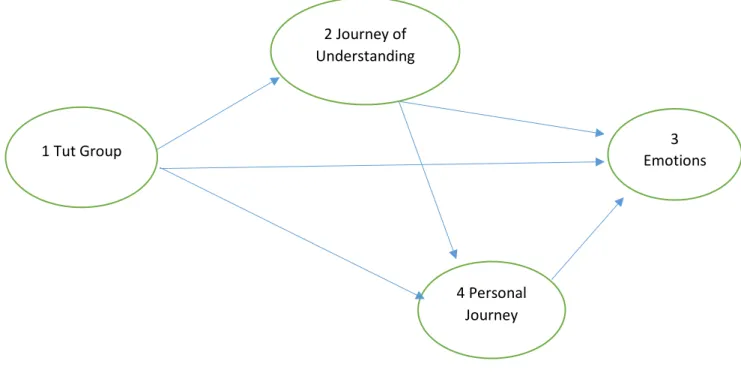
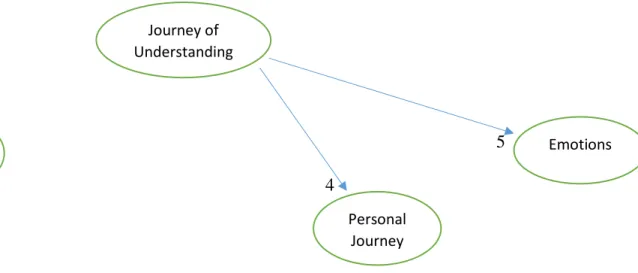
Taken together, the data provided rich descriptions of learning in the student participants' voices. The thesis offers a visually rich and in-depth conceptual representation of experiences and processes of disciplinary learning in the threshold concept-enriched tutorial program.
Introduction
There has been little or no qualitative or conceptual investigation and understanding of how students learn statistics in higher education in South Africa is sketchy. I then sketch the context of South African higher education and consider existing research on higher education statistics in that country.
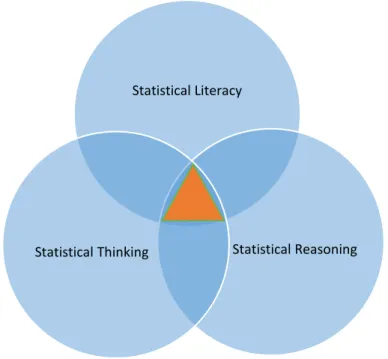
Statistical literacy, thinking and reasoning
The defining principles, conceptual skills, and ways of thinking just described must be mastered if students are to become proficient participants in the discipline. The idea that disciplinary learning requires the mastery of particular transformative and troublesome ideas is formalized and elaborated in the theory of threshold concepts (Meyer & Land, 2003), which (as mentioned above) frames this study, and is discussed more fully in Chapter 3 . .
Features and challenges of the South African higher education context
Most of the things I didn't understand in class I could understand in the tut group. Fear of the unknown (not sure what to expect in the module) and fear of the known (unpleasant encounter with statistics in high school).
Research on learning introductory statistics in South Africa
Research design and statement of research problem
Volunteers from the mainstream classroom participated in the curriculum and related data generation processes. In addition, the main thread of students' posted messages in the WhatsApp™6 group chat created for the participants in the tutorial program were noted and used to augment the findings of this study.
Significance of the study
The pedagogical approach in the tutorials reflected constructivist principles in its active, collaborative emphasis, and was enriched with a threshold concepts orientation inherent in the activities that structured students' interactions in the tutorials (Bulmer, O'Brien, & Price, 2007; Thompson, 2008). The study findings provide insights into the experiences and processes of students' learning in statistics, drawn from a rich, contextualized, qualitative description based on participants' own constructions of their learning in the threshold concepts-enriched tutorial program.
Organisation of the study
These insights may be relevant to statistics educators and researchers using threshold concepts or related orientations, and may ultimately benefit statistics students through pedagogical and curricular responses.
LITERATURE REVIEW: RESEARCH IN STATISTICS HIGHER
Introduction
The second part addresses concerns regarding the identification and impact of affective constructions on student learning in the discipline. This part examines the process of how students learn in the discipline and draws on research in educational psychology.
Research around teaching and learning in statistics
- Non-cognitive aspirations: students beliefs and attitudes
- Potentially troublesome disciplinary knowledge
The following sections will provide an overview of the statistics education literature that focuses on the affective aspects of student learning in the discipline. The next section will review the literature related to the affective constructs of statistics anxiety and attitudes toward statistics as they relate to student learning in the discipline.
Concluding comments
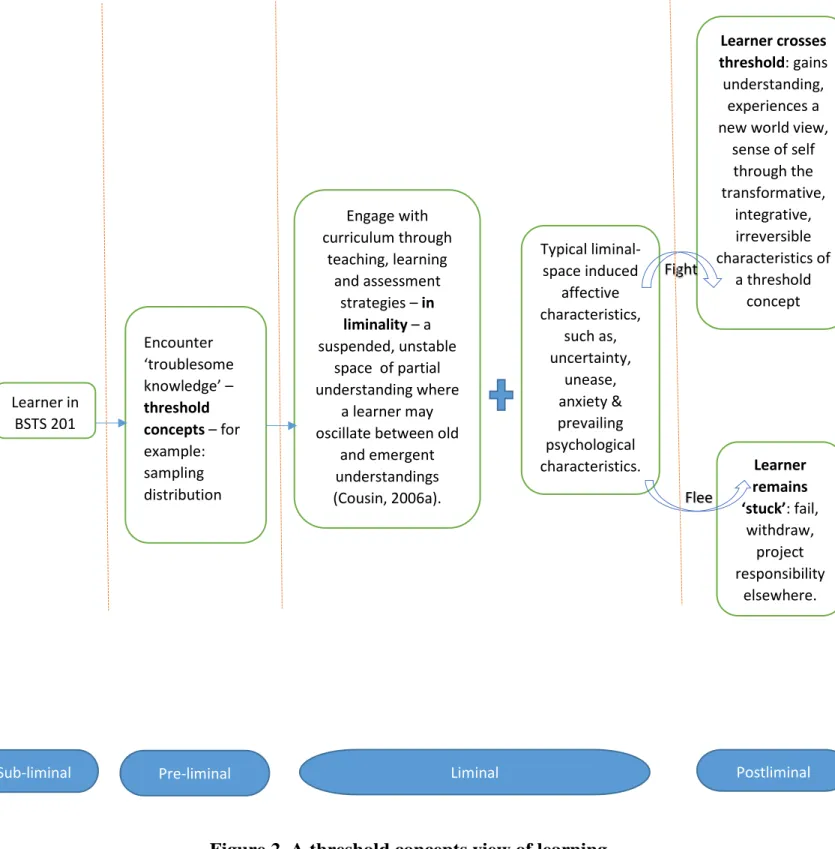
Consideration of the literature related to student success and progression in the discipline suggests that a good understanding of disciplinary concepts requires a transformation in student thinking if they are to master the underlying concepts. This understanding of learning in the discipline resonates with the Threshold Concepts Framework (TCF) (Meyer & Land, 2003) for learning; which breaks down the idea of core disciplinary concepts as being.
APPLYING A THRESHOLD CONCEPTS FRAMEWORK
Introduction
The threshold concepts framework therefore accommodates the questions around learning in which I have developed an interest. Finally, section 3.5 positions this study in relation to existing scholarship in statistics education and the threshold concepts framework, outlining key areas where it is hoped that this study can contribute to the understanding of students' learning in statistics.
A threshold concepts enquiry into learning
- Identifying and characterizing threshold concepts
- Essential features of learning in the Threshold Concepts Framework
Based on descriptions of learning in the Threshold Concepts Framework by Schwartzman (2010), Land, Meyer and Baillie (2010)). There is much discussion in the literature regarding the integration of threshold concepts with student learning and the curriculum (Barradell & Kennedy-Jones, 2013; Cousin, 2007; Land, Cousin, & Meyer, 2005; Meyer & Land, 2006).
Theoretical lineage and applications of the Threshold Concepts Framework
- Theoretical lineage and leanings
- Scope and recent trends
In statistical education research studies, the application of the threshold conceptual framework as an analytical tool for understanding student learning resulted in the promotion and adoption of various pedagogical and curriculum reforms. In South Africa, the threshold concepts approach to learning remains largely unexplored in higher education statistical research and I was only able to find one research article based on the identification of statistical threshold.
Critique of the Threshold Concepts Framework
- Definitions, agent-relative properties and methodological concerns
- Theoretical standing of Threshold Concepts Framework
It has been argued that the threshold concepts hypothesis does not account for the fact that the extent to which students experience the transformative/disturbing aspects of a threshold concept is an idiosyncratic experience. Questions have been raised relating to the nature, originality and usefulness of the threshold conceptual framework - questioning whether the framework is a theory or a concept (Walker, 2013), whether it is simply a reformulation of older ideas (Cousin, 2008 ). , and possible connections to complementary theories (Schwartzman, 2010), and whether a single framework is able to accommodate such a variety of disciplinary constructs (Tight, 2014).
Synthesis
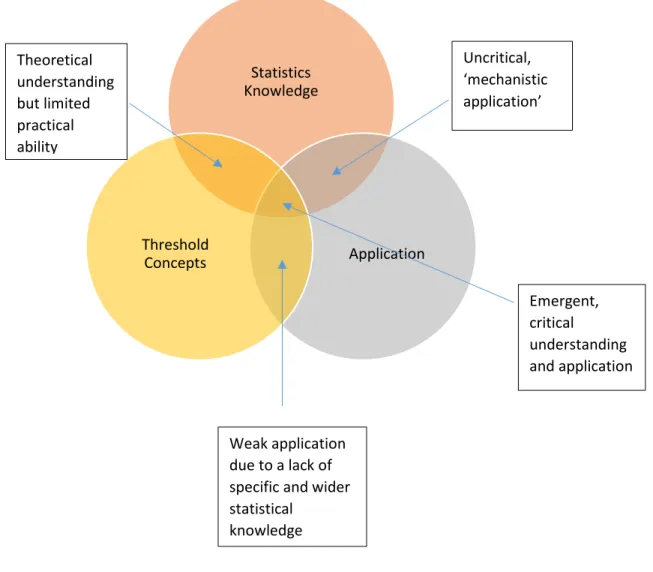
Attempts to supplement the threshold conceptual framework include a proposed framework for designing university curricula in the form of the Threshold Capability Integrated Theoretical Framework (TCITF) (Baillie et al., 2012). If disciplinary knowledge and threshold concepts are involved alone, there is a deficit in the applied/practical use of the emerging learning.
RESEARCH METHODOLOGY: THE THRESHOLD CONCEPTS-ENRICHED
Introduction
Qualitative research
This research approach therefore makes sense of the phenomenon from the point of view of the individuals who are active participants in it (Cohen et al., 2011; Denzin & Lincoln, 2011). This study places itself within the interpretivist paradigm, as the study seeks to understand how (and why) students learn in statistics, by gaining insight into their backgrounds, beliefs and experiences (Schwartz-Shea & Yanow, 2012), and penetrate the next. defining characteristics of a qualitative, interpretivist approach (Thanh & Thanh, 2015):. i) studies are conducted in a natural environment, where this research on students' learning in statistics took place in the students' natural environment of a tutorial classroom;. ii) research questions are designed to explore, interpret or understand the social context and participants are non-randomly selected based on their knowledge of the phenomenon, where the student participants in this study were selected in a non-random method . using purposive sampling methods to sample the students who I thought had essential answers to the research questions;. iii) the researcher must be in close contact with the participants, where as a researcher I played an active role in familiarizing myself with the participants and the social context in which they live through the threshold concepts enriched tutorial programs, my facilitation of the focus groups and conducting the individual interviews; iv) research hypotheses are made after data collection and modified as new data is collected, where hypotheses for this study were formed after the data were collected and analyzed and verified by means of data triangulation; and. v) research results should be reported in narrative style, where the results of this research were reported using rich, detailed narratives.
A qualitative case study research design
- Site and context of research
- Study participants and the selection process
The study was based on the Business Statistics II (BSTS 201) module at DUT's ML Sultan Campus. During the semester (which consisted of seven lessons), this number of 19 participants remained more or less constant, of which 17 participated in the focus group sessions and interviews.
The threshold concepts-enriched tutorial programme
- Tutorial format and activities
- Writings in reflective learning journals
- WhatsApp Group in Lieu of the online discussion board
On average, the tutorials were consistently attended by a core group of 15 to 20 students, who stayed on task and participated in the focus group sessions and individual interviews at the end of the semester. MacDougall (2010) states that using a discussion board can provide several benefits when teaching statistics.
Data generation and analysis
- Interactive Qualitative Analysis (IQA)
- IQA ideology
- IQA methodology in action
In the following paragraphs I provide an overview of the IQA focus group procedure related to this study. My use of these steps, culminating in a mind map of participants' experiences of learning statistics in a curriculum enriched with threshold concepts, is detailed in Chapter 5.
Rigour
In my study, the two phases of the IQA (focus groups and interviews) were supplemented by the analysis of reflective writing and the participants'. Descriptions of data collection, condensation and analysis and a discussion and presentation of the research findings all help maintain an audit trail.
Strategies to address ethical and methodological issues
The representations that emerged can thus be considered as capturing the legitimate voice of the participants (Northcutt & McCoy, 2004). I received no complaints from regular students or have any reason to believe that there was a sense of preferential treatment of the participants.
Methodological reflections
However, participants from the other half of the class taught by a different instructor were sometimes behind in the sections covered by the tutorial program. Again, this emphasizes the critical importance of focus group conduct and function.
Concluding comments
I was conscious of my own investment in the tutorial program and in the students' learning. Given that 'objectivity', in the sense that I was detached and disinterested in the participants and the course of their learning, was not possible, a supportive attitude seemed appropriate.
AFFINITIES, RELATIONSHIPS OF INFLUENCE AND SYSTEM
Introduction
The IQA process
- System elements: Focus groups and affinity generation
- Theoretical coding: System relationships of influence
- Focus group: System Influence Diagram (SID)
- Feedback loops, zooming and naming
I scheduled the focus group sessions for the last few weeks of the semester, five days apart. The information presented in IRD is graphically represented in the form of SID.

Concluding comments
This description and presentation of individual realities will be the subject of the next two chapters. The second sentence interprets the sub-affinity in the researcher's voice and contains a noun or key phrase that is italicized.
INDIVIDUAL REALITIES WOVEN IN THE WORDS OF THE
Introduction
Tut Group
- Fundamentals of Tut Group
The application of statistical concepts to real-world problems impacted students' understanding of the field. Fear of the underlying mathematical concepts in the field was also a driving force for students wanting to be part of the tutorial sessions.
Journey of Understanding
- Fundamentals of Journey of Understanding
Several factors influenced students' comprehension journey: personal characteristics, participation in the tutorial program, and teacher characteristics. Participation in the tutorial program was a crucial element in helping students progress on their journey to understanding.
Personal Journey
- Fundamentals of Personal Journey
Students' experience of learning statistics in a tutoring program influenced their metacognition and perception of learning about metals in sense. Studying statistics and participating in an exercise program throughout the semester resulted in an ontological shift in students in terms of their metacognitive and metalearning perceptions.
Emotions
- Fundamentals of Emotions
The fear of interacting with mathematical concepts and formulas in the field affected students' emotions. Overall, participation in the tutorial program fueled students' positive emotions toward learning in the field.
Concluding comments
The extent of the affinity that Tut Group has on the rest of the components in the system cannot be emphasized enough. I see Tut Group as an energizing life force to the rest of the system, bringing about and strengthening learning and understanding in the discipline.
INDIVIDUAL REALITIES WOVEN IN THE WORDS OF THE
- Introduction
- Tut Group: Relationships of Influence
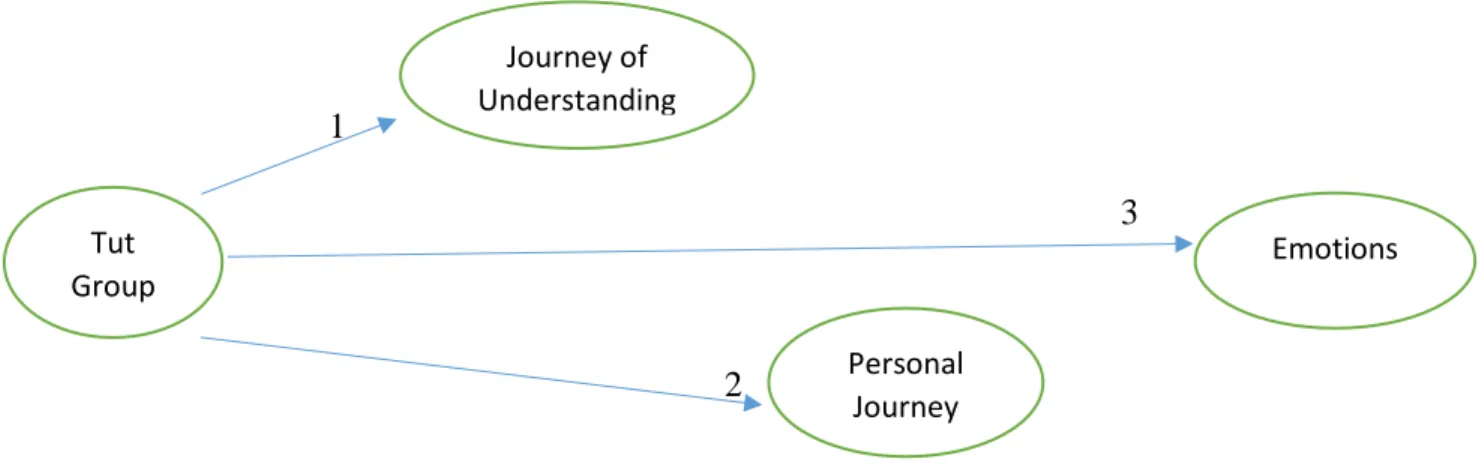
- Tut Group influences Journey of Understanding
- Tut Group influences Personal Journey
- Tut Group influences Emotions
- Synopsis: Influences of Tut Group
- Journey of Understanding: Relationships of Influence
- Journey of Understanding influences Personal Journey
- Journey of Understanding influences Emotions
- Synopsis: Influences of the Journey Of Understanding
- Personal Journey: Relationships of Influence
- Personal Journey influences Emotions
- Students’ final reflections
- Concluding comments
The tut group influences your understanding because more work is explained in the tut group. I overcame this by bringing this issue into the tut group and finding more practice and practice.
FINDINGS AND DISCUSSION: EXPERIENCES OF LEARNING
Introduction
Threshold concepts theory-science features in the discussion of the findings as the link between the intertwined cognitive and affective strands of learning. This integrated approach to the presentation of the study's findings and discussion provides a comprehensive assessment of the system and reflects the SID mind map of the phenomenon under study.
A holistic approach to learning in statistics
- Barriers to learning in statistics
- Scaling Barriers: Evoking the might of the cognitive-affective strand on a
The mathematized aspects of the statistical learning were predominant in the participants' reflections on sources of difficulty and sense of impasse in the discipline. The students' reflections revealed that the source of their mathematics anxiety can be attributed to environmental factors, where there may be a dissonance between the value of the subject and control over it (Buckley, 2013) and experiences of school-based mathematics.
Concluding comments
STATISTICS STUDENTS’ LEARNING IN A THRESHOLD CONCEPTS-
Introduction
Overview of the study
- Background, rationale and research questions
- Literature review: Teaching and learning in statistics
- Theoretical framing: Threshold concepts
- Methodology
- Findings
Limitations
Implications
Towards a model of students’ experiences of learning statistics in a
Concluding reflections
REQUEST TO CONDUCT RESEARCH
PERMISSION TO CONDUCT RESEARCH
ETHICAL APPROVAL
INFORMED CONSENT
TUTORIAL TOPIC LIST
REFLECTIVE WRITING PROMPTS
FINAL ISSUE STATEMENTS
FOCUS GROUP AFFINITY GENERATION
SUPPLEMENTARY GRAPH
INDIVIDUAL INTERVIEW PROTOCOL
TURNITIN ORIGINALITY REPORT