with the n smooth" variant had died. In view of the large doses given the results were probably significant. As far as could be judged from the small number of animals used, the rough strain appeared fairly stable at the reduced level
of virulence. Neither a passage through a guinea pig nor a period of rapid subculturing affected the relative virulence of the two strains to any extent. Although the rough variant produced capsules in vivo these were not detectable in the cultures grovm either in carbon dioxide or in air.
Summary.
(1) A rough virulent strain grown in carbon dioxide became smooth mucoid.
(2) A rough variant was isolated :f:rom the smooth mucoid grovm in carbon dioxide.
(3) When grotm in air, subcultures from both the smooth mucoid and from the rough growth in carbon dioxide were rough and morphologically indistinguishable from one another.
(4) The rough variant obtained from the smooth mucoid in carbon dioxide took a significantly longer time
to kill guinea pigs than the subculture from the mucoid growth in carbon dioxide.
(3) Dissociation of virulent anthrax strain 568 in carbon dioxide.
After two days incubation in cm~bon dioxide the growth generally was rough, but the centre portion was opaque and the opacity extended to the edge of tl1e culture in a number of radiating lines. These projected as opaque rough outgrO\\rths from the edge of the colony. Small smooth mucoid patches commenced to grow in the opaque areas.
Between the opaque areas were rough a..reas which were more translucent and showed a more marked cuneiform structure than did the opaque parts of the culture. The denser and the less dense parts were sharply demarcated from each other.
The smooth mucoid patches gradually extended, but were restricted to the opaque areas and did not tend to overlap the more translucent parts of the culture. After strain 568 had been grovm in carbon dioxide for seven days, sub- cultures VlTere made (a) from the mixture o:f mucoid and opaque portion of the growth and (b) from the more translucent rough part of the culture. (a) was termed the smooth variant and
(b) the rough variant. Both variants were rough when grovm in air and the colonies were then morphologically indis-
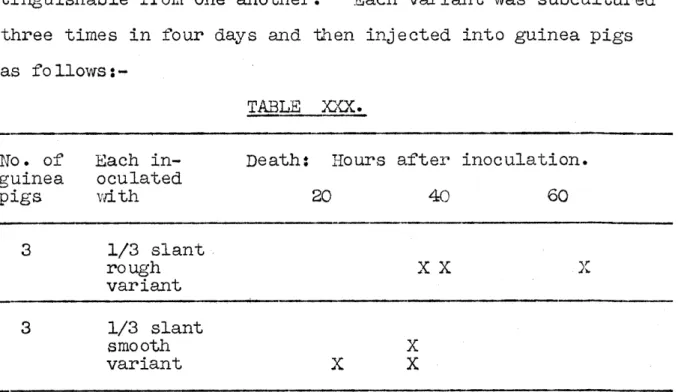
tinguishable from one another. Each variant was subcultured three times in four days and then injected into guinea pigs as fo llows :-
No. of guinea pigs
3
3
Each in- oculated Vlith
1/3 slant.
rough variant 1/3 slant smooth variant
TABLE XX.~"'{.
Death: Hours after inoculation.
20
X
40
XX
X X
60
X
The difference in virulence between the variants was slight and it was impossible to say whether it was
significent. Because of the large doses given, and because the original stock rough was very virulent and al,Nays killed guinea pigs in from 30 - 40 hours, it is possible that the rough va:eiant v1as slightly less virulent than the smooth.
After 14 days the ttsmooth" variant and the ttrough"
variant used in the experiment noted in table ~{X were again subcultured onto agar in air and guinea pigs were again
injected. The results were as follows:-
No. of guinea pigs
3
3
Each in- oculated with
1/3 slant rough variant 1/3 slant smooth variant
TABLE XXXI.
Death: Hours after inoculation.
20 40 60
X X X
... c·--
X X X
The difference in virulence was very slight; but again the rough variant seemed a little less virulent. The
slight differences noted in tables XXX and XXXI did not
real~ warrant any conclusion as to the relative pathogeni- city of the variants.
Swnr.oary.
(1) A virulent strain of anthrax developed a patchy smooth mucoid growth in carbon dioxide.
(2) It was not possib.le to demonstrate a signifi- cant difference in virulence between the smooth mucoid and the non-mucoid portions of the culture.
D.
DISSOCIATION OF VIRlJT.wENT STRAINS OF ANTHRAX ON SEHUM AGAEl IN CAr"l.BON DIOXIDE.
In the previous series of experiments (C) a certain amow1t of success was obtained in an attempt to pick attenuated variants from virulent strains grovm in carbon dioxide. Ho\tv·ever, this technique did not yield completely non-pathogenic strains and it was realized that the inability to produce a detectable nunmer of capsules in carbon dioxide was not an index of complete lack of ability to produce capsules in vivo because the less virulent strains, although rough and uncapsuled in carbon dioxide, were able to produce capsules in vivo.
Thus the carbon dioxide \-fas not as good an environn1ent
for the production of capsules as at first thought, and
certainly did not approach in vivo conditions in this respect.
For although fully virulent rough strains became fairly mucoid and formed large numbers of capsules in the carbon dioxide, some strains were not able to produce capsules although still virulent.
It was previously established that the complete avirulence of some rough strains was associated with the loss of ability to develop capsules and that these rough strains were derived from smooth mucoid strains; therefore a medium was sought in which the fUlly virulent strain would grow in a completely smooth mucoid form, and in which rough variants, if present, could be picked with a fair degree of certainty that their roughness indicated inability to become capsuled, and possibly avirulence.
According to Bail (1915) the virulent anthrax bacillus regularly produced capsules in liquid serum.
A liquid medium was however of little use in the study of colony variation, and it was also found that capsule
production by different virulent strains in serum varied considerably. A number of experiments were carried out in vvhich virulent strains were grown on inspissated serum.
It was found that about 20 - 30 per cent of the organisms developed capsules, but that the strains were not ~egularly
smooth mucoid. Moreover, the liquefaction of the serum by the bacilli was a factor vvhich complicated the observation of the growth to a considerable extent. The opacity of the inspissated serum also made the medium unsatisfactory.
Further eX'_periments were carried out in which the strains were grown on 50 per cent serum agar. All the virulent strains ·were rough, but most of the cultures had rather a shiny surface, and by the fourth day about 20 per cent of the virulent bacilli showed capsules. Laboratory strains with any tendency at all to the production of mucoid grovrth on ordinary agar, developed a richly mucoid structure on the
50 per cent serum agar and all the bacilli or such strains developed capsules. Strains like the rough avirulent Bos·ho:ff remained rough and uncapsuled on this medium. The 50 per cent serum agar had also a satisfactory consistency and transparency. Rough virulent strains did not, however, grow mucoid on this medium, although they showed an increased number of capsules. Since these virulent strains tended to develop a lm~ger number of capsules on the serum agar, the effect of a combination of this medium and an atmosphere of 65 per cent carbon dioxide V{aS investigated.
Several rough virulent strains were streaked on 50 per cent unheated horse serum agar contained in J .. ~ason's
tubes. The tubes were placed in an atmosphere of 65 per cent carbon dioxide limnediately after inoculation and incubated at 37°C. After 24 hours all these virulent strains were entirely smooth mucoid and showed no sign of a rough
structure; but when the smooth mucoid cultures were sub- cultured and incubated in air they again shovred the normal very rough appearance of the virulent strains. The :facility
and regularity with \mich these results could be repeated
suggested that this t echnique :fulfilled the desired requiremerll) Moreover, fairly wide divergences in the carbon dioxide
concentration did not materially a:f~ect the results.
Accordingly, several experiments were carried out on the same lines as those performed in Section
c,
except that 50 per cent serum agar was used instead of nutrient agar.The technique eventually adopted v1as as follows.
The medium used was 50 per cent horse sermn nutrient agar.
This was put up in Mason's tubes and partially dried in the incubator for 24 hours. Thereafter, the fluid liberated by hysteresis was removed and the tubes vrere ready for use.
The inoculation was always done on about one square em. of surface and incubation carried out in anaerobic jars of 1900 ml. capacity to which the requisite ~~ount of carbon dioxide was added, as described in Part
r.
No satisfactorymethod for keeping the carbon dioxide pressure constant was devised, therefore the results must be interpreted for the particular system used here; that is, each jar of 1900 ml.
c.ontained one Mason's tube inoculated on one square centi- retre of' surface. Whenever incubation lasted more than 24 hours the jars were opened daily and the·
co
2 tension adjusted.(1) Dissociation of strain
xr.r
on 50 per cent serwn agar in 65 Der cent carbon dioxfcre:--This strain was isolated a month previously from a bovine naturally infected with anthrax and had not been used in any experimental vrork. Culturally it had the
characteristic very rough appearance of a recently isolated virulent strain. A loopful was streaked over a small area
on 50 per cent serum agar and incubated in 65 per cent carbon dioxide. The growth was completely smooth mucoid after
24 hours and showed no trace of roughness. Two days later rough sectors were present in the smooth mucoid colony.
These were dull, flat and had the typical cut-glass appear- ance of a rough anthrax strain. There was a sharp division between these rough sectors and the surrounding mucoid culture.
The smooth mucoid growth and the rough outgrovvths were each streaked onto a tube of 50 per cent sermn agar and
incubated in 65 per cent car~bon dioxide. The subculture from the smooth mucoid growth was again completely smooth mucoid, and all the bacilli were capsuled; whereas the
subculture from a rough vvedge was rough and the bacilli showed no capsules. Each variant was then streaked on
ordinary agar and incubated in air. Both grew rough mn this medium and were morphologically indistinguishable from each other. They were subcultured once again on agar in air
and each vvas again rough. The virulence v1as then tested on guinea pigs as follows:-
Three guinea pigs each received 1/4 slant of the rough strain derived from the smooth mucoid growth in carbon
dioxide. One died of anthrax after six days.
Three guinea pigs each received l/4 slant of the rough strain derived from tl1e rough grov~h in carbon dioxide.
All remained alive.
Both strains seemed to have become practically avirulent, although the vru~iant derived from the smooth mucoid growth in carbon dioxide killed a guinea pig in six days. The virulence of these strains was investigated in somewhat greater detail, because of the knovm pathogenicity of the parent strain
xrv.
The two strains, the one from the smooth mucoid and the other from the rough grovrth in carbon dioxide, were each streaked on 10 per cent serum agar and incubated at 37°C in air. After 24 hours the growth of each strain was rough and guinea pigs were injected as follows:-
Three guinea pigs inoculated vvith 1/3 slant of strain originally isolated from smooth mucoid gro'VIrth in carbon dioxide - all survived.
Three guinea pigs inoculated with 1/3 slant of strain originally isolated :from rough growth in carbon dioxide - all survived.
This experiment confirmed the previous one. The possibility was considered that the loss o:f virulence ~ight
be due to the s train VJ"hich had been mucoid in carbon dioxide losing this property during the course of the experiments.
Therefore each of the strains was again grovm on 50 per cent seruo agar incarbon dioxide, three weeks after the first isolation of the variants. The variant originally isolated :from the smooth mucoid growth in caroon dioxide was again smooth mucoid and t..~e variant which was originally rough in carbon dioxide ·was again rough and uncapsuled. Thus neither of these variants had altered as regards its colony
morphology on 50 per cent serwn agar in carbon dioxide.
A further test of the virulence of the two strains
was then performed as follov.,rs: each variant was grown on 50 per cent serum agar in carbon <~lioxide. After 24 hours the one was smooth mucoid and the other rough.
washed off and inj'ec ted into guinea pigs.
They v1ere
Three guinea pigs each received 115 slant of smooth mucoid grov~h in carbon dioxide. All survived.
Three guinea pigs each received 115 slant of rough growth in carbon dioxide. All survived.
Three guinea pigs were each inoculated with 113 of an agar slant of a culture made from the only guinea pig which died of anthrax in this series o:f experiments with strain XIV. All these guinea pigs survived.
It was clear, therefore, that this strain had
a~ost completely lost virulence for guinea pigs. Neither the variant from the smooth mucoid grovnh in carbon dioxide, nor the variant from the rough grovrth in mrbon dioxide killed guinea pigs. The direct inoculation of the smooth mucoid grovrth harvested from 50 per cent serum agar in carbon
dioxide was also avirulent, and one passage through a guinea pig failed to restore the virulence of this strain.
To see if there was any difference in virulence between the strains experiments were car:c-ied out in mice.
The combined results of two experiments are summarized in table X..XXII.
TABLE XXXII.
---~---·---·--
No. of mice
22
22
Each in- oculated with
Death:
20 l/24 agar slant of variant from smooth mucoid X
in carbon dioxide
l/24 slant variant from rough in
carbon dioxide
40
Hours after inoculation.
60 80 100 120
X 1/ I
X X I
X X I
X X X X I
X X X X I
X I
All survived.
It was clear thererore, that the vru~iant derived rrom the smooth mucoid grovrth in carbon dioxide was moderate- ly virulent :for mice whereas the ttroughtt variant was avirulent
Immunity tests with variants of strain XIV.
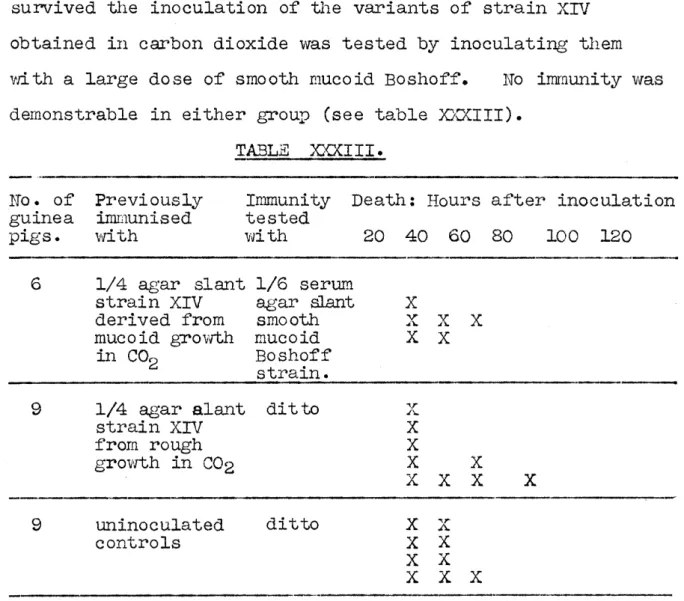
The resistance o:f the guinea pigs which had survived the inoculation of the variants of strain XIV obtained in carbon dioxide was tested by inoculating them vrlth a large dose of' smooth mucoid Boshoff. No immunity was demonstrable in either group (see table XXXIII).
TABLE XY..XIII.
no.
ofguinea pigs.
Previously immunised with
Immunity tested
v~i th
Death: Hours after inoculation
6 1/4 agar slant 1/6 serum strain XIV agar ~t
derived from smooth mucoid grovrth mucoid
in
co
2 Boshoff strain.9 l/4 agar alant ditto strain XIV
from rough growth in C02
9 uninoculated ditto controls
Summary.
20 40 60 80
X
X X X X X
"'\T .J\..
X X
X X
X X X X X X X X X X X X
100 120
X
A rough virulent strain was grovm on 50 per cent serum agar in carbon dioxide and a smooth mucoid grovrth resulted. After a day rough dissociants appeared. The smooth mucoid and the rough variant were sovm separately
onto plain agar in air and both grew rough. Neither culture was virulent for guinea pigs, but the strain derived from the smooth mucoid culture in carbon dioxide v~s moderately virulent for mice, the rough strain being completely aviru- lent. Guinea pigs which had received a large single dose of these variants were not more resistant to a large test
dose of the smooth mucoid Boshof~ strain than uninoculated controls.
The whole experiment itdth the original virulent strain XIV was then repeated from the beginning. After
24 hours in carbon dioxide the growth was again smooth mucoid
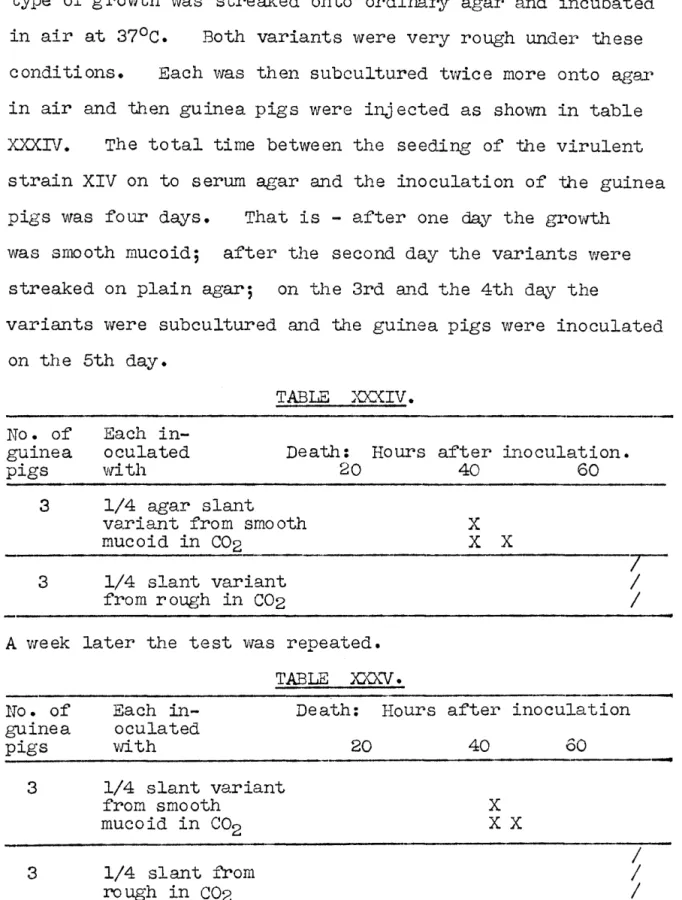
~~d a day later rough sectors and outgro\vths appeared in the smooth colony. Smears made from the smooth mucoid grovrth showed 100 per cent capsuled bacilli, and smears from the rough growth showed about 5 per cent capsuled bacilli. Each type of growth was streaked onto ordinary agar and incubated in air at 37°C. Both variants were very rough under these c ondi ti ons. Each was then subcultured twice more onto agar in air and then guinea pigs were injected as shovv.n in table
xxxrJ.
The total time between the seeding of the virulent strain XIV on to serum agar and the inoculation of the guinea pigs was four days. That is - after one day the growthwas smooth mucoid; after the second day the variants were streaked on plain agar; on the 3rd and the 4th day the
variants were subcultured and the guinea pigs were inoculated on the 5th day.
No. of guinea pigs
3
3
TABLE XXXIV.
Each in- oculated
with Death: Hours after inoculation.
1/4 agar slant variant from smooth mucoid in C02
1/4 slant variant from rough in C02
20 40 60
X X X
A week later the test was repeated.
TABLE JCO..'V •
r--
1 IlJo. of guinea pigs
Each in- oculated with
Death: Hours after inoculation
20 40 60
---·---
3
3
1/4 slant variant from smooth
mucoid in Co2 1/4 slant from rough in C02
X
XX
I
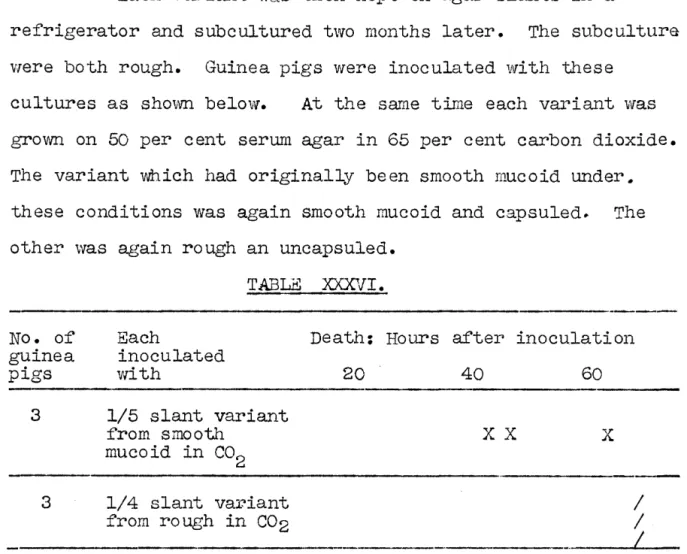
I IEach variant vtas then kept on agar slants in a
re~rigerator and subcultured two months later. The subcultura vrere both rough. Guinea pigs were inoculated with these
cultures as shown below. At the sar.ne time each variant was grown on 50 per cent serum agar in 65 per cent carbon dioxide.
The variant which had originally been smooth mucoid under.
these conditions was again smooth mucoid and capsuled~ The other was again rough an uncapsuled.
TABLE XXXVI.
·---
No. of guinea pigs
Each
inoculated with
Death: Hours after inoculation
3
3
115 slant variant
~rom smooth mucoid in
co
2114 slant variant from rough in C02
20 40 60
XX X
I I
Thus it was possible to isolate an avirulent rough uncapsuled variant ~rom a smooth mucoid virulent strain in carbon dioxide although both strains were very rough when grovr.n in air. These strains were unchanged after tv,ro months
storage both as regards their colony morphology in air and in carbon dioxide and as regards their relativ··e virulence (table XXXVI).
:rmmuni ty tests with variants of strain XIV.
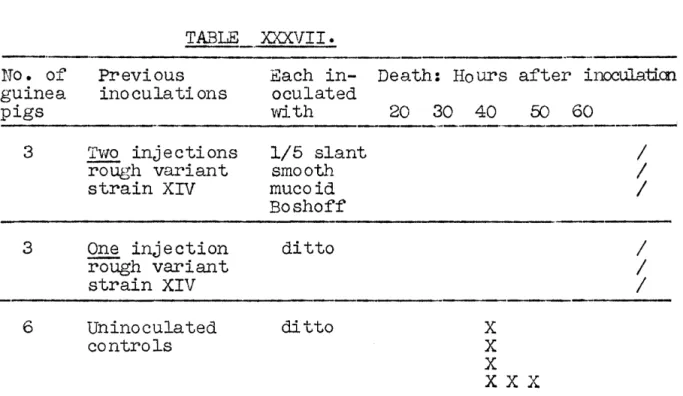
Three guinea pigs which had survived an inoculation with the rough variant (table XXXIV) received a second large inoculation of the same strain 18 days later. Tvvo weeks later an immunity test vvas carried out on these three guinea pigs and on three guinea pigs which had received one
inoculation of the rough variant (table XXXV). The smooth mucoid Boshoff strain was again used as the test organism.
TABLE XXXVII.
No. of guinea pigs
Previous Each in- oculated with
Death: Hours after inoculati.cn inc cula ti ens
20 30 40 00 60
~---"
3
3
6
Two injections rough variant strain XN One injection rough variant strain XIV Uninoculated controls
115 slant smooth mucoid Boshoff
ditto
ditto X
X X XXX
I I I I I I
All the guinea pigs previously inoculated with the rough variant survived. Moreover, this was the first
occasion on v~1ich one injection of an imrnw1ising strain
sufficed to protect solidly against the Boshoff strain. There was evidence that tl1e virulence of the Boshoff strain had
decreased since the early experlinents; but up to the present no guinea pigs inoculated with this strain had survived un- less previously immunised.
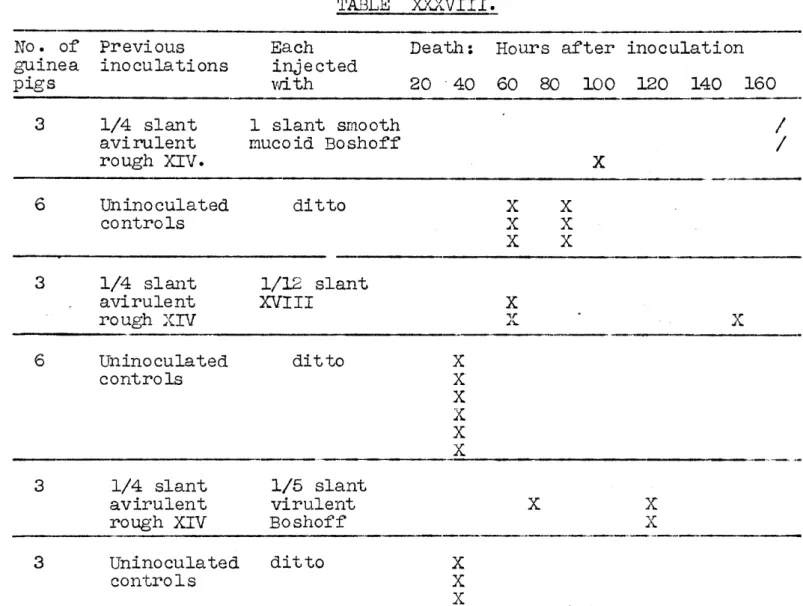
Six weeks later nine guinea pigs were each inoculated wi "k~ 114 of an agar slant of the avirulent variant of" strain XIV and their i~~unity tested after three weeks. Three test strains were used. (1) Smooth mucoid Boshoff, which had been used in the majority of the tests, but was now losing virulence. (2) Virulent XVIII recently isolated and definite·
ly virulent for rabbits. (3) Virulent Boshoff - old stock virulent strain - virulent for rabbits and sheep, but less
virulen~~~n
isolated 15 years ago and less virulent than strain XVIII.No. of"
guinea pigs
3
6
3
6
3
3
TABLE )O'"~XVIII.
Previous Each Death: Hours after inoculation inoculations injected
vlith 20 . 40 60 80 100 120 140 160
1/4 slant 1 slant smooth I
avirulent mucoid Bosho:r:r I
rough
xrv.
XUninoculated ditto X X
controls X X
X X
1/4 slant 1/12 slant
avirulent XVIII X
rough XIV \r .i'l.. X
Uninoculated ditto X
controls X
X y
.t'l..
X
X ··--···--· ..
-
1/4 slant l/5 slant
avirulent virulent X X
rough XIV Boshoff"
____________
...______
XUninoculated ditto X
controls X
X
It seemed that the smooth mucoid Boshof"f" strain had decreased further in virulence since the last test, as the uninoculated controls took considerably longer to die than before. The fact that two out of" three inrrnunised guinea pigs survived must be considered in relation to this. It was also probable that the immunising strain had lost some
potency, sine e in table X~CVII none o:f the immunised guinea pigs died although the test culture appeared to be more virulent than in the present experiment. For the rest, the immunised guinea pigs all survived considerably longer than the controls although very large doses of" virulent strains were used to test the immw1ity.
surm:ary.
mucoid
Strain XIV grew smooth on serum agar in carbon dioxide and readily produced rough variants. Subcultures from the smooth variant onto agar in air were rough and
in the one case virulent. Subcultures from the rough vari~~
were also rough in air but were completely avirulent for
guinea pigs. Guinea pigs which had received one inoculation of this avirulent strain showed a considerable resistance to a subsequent inoculation of virulent culture. It should be noted that in the first experiment where both the smooth mucoid and the rough variant of XIV were avirulent, neither produced an appreciable immunity. (Table XXXIII).
(1) Dissociation of virulent strain XIV <?n_50J?.er cent serum agar.
The successful dissociation of strain XIV on serum agar in carbon dioxide suggested that 50 per cent serum agar alone might be used in a similar vray. Strain XIV was there- fore streaked on to a small patch on the surface of 50 per
cent serum agar and incubated in air at 37°C. After 24 hours the gro\lvth was rough. After 48 hours the colony was rough and rather opaque, but at one spot near the IEripherythe
grov~h appeared flatter and more translucent. Each type of growth was streaked onto agar slant~ and incubatel in air.
After two more subcultures guinea pigs were inor,ulated as follows.
No. of guinea pigs.
3
3
Each
inoculated
·with
TABLE XXXIX.
Death:
l/4 slant from opaque centre of colony on serum agar
1/4 slant from trans- lucent wedge at margin of colony on serum agar
20
HOlL'S after inoculation
40
X
X
X X
60
X X
The experiment was repeated from the begi1u1ing.
Again the colony on serum agar showed an opaque centre, and a sharply demarcated more translucent wedge at the margin.
Each type of growth was streaked on agar slants, and after a further subculture, guinea pigs were inoculated as follows.
TABLE XL.
No. of guinea pigs
Each
inoculated with
Death: Hours after inoculation
20 40 60
3 1/4 slant isolated
from opaque centre X X X
3 1/4 slant isolated from translucent
margin XX X
A further attempt was made to obtain variants differing in virulence.
proceed for seven days.
In this case growth v,ras allowed to There was then a fairly clear cut differentiation into two types of growth: a translucent centre which projected in a number of rays to the margin of the colony with rough, :flat and dull sectors between. Each type of growth was streaked onto agar slants and injected
into guinea pigs after 24 hours.
T.ABLE XLI.
no.
of guinea pigsEach
inoculated with
Death: Hours after inoculation
3
3
1/4 slant sub- culture from
translucent centre part of culture 1/4 slant sub-
culture from rough part of culture
20
X
40
X X
X
60 X
It was apparent that strain XIV did not show a homogeneous colony 1no~phology on tho serum agar. The difference was fairly sharp but the extent to which these differences constituted dissociation was doubtful. Ho difference in virulence could be detected, nor did the different types of growth retain their characteristics on
80
subcultivation. Smears made from the culture on the serum agar showed a few capsuled organisms, although none could be fotL.YJ.d on plain agar. These capsules were not restricted to any particular area of the colony. \~en subcultures from the different types of grovvth were grown on EIJ per cent serurn
mucoid structure and all the bacilli showed capsules a:t ... ter
24 hours. Therefore the serum medium alone was not suit- able for experiments on rapid dissociation.
(2) Dissociation of virulent Drwrunond st~ain (Strain VII) on 50 Der cent seriun agar in carbon dioxide.
This strain had been used in some of the earlier experiments on dissociation. It was still very virulent·
and doses of the order of one hundred thousandth of an agar slant killed sheep in twenty-four hours. However the strain was not very stable and suspensions in glycerine-saline lost virulence fairly rapidly. The same technique was adopted as in the previous series of experiments with strain XIV •
.After 24 hours incubation in carbon dioxide the gro'Wth was
smooth mucoid. Twenty four hours later a few rough outgrovrths:
appeared at the periphery of the smooth growth and on the third day the rough grovrth had extended somewhat.
Each type of growth was streaked onto an agar slant in air and incubated. Both variants grew very rough. Two fUrther subcultures were made on agar in air on successive days and guinea pigs were then inoculated v'lith large doses of each variant, as shovvn in the table belo·w. At the same time each variant was streaked onto the surface o:f a tube o:f 50 per cent serum agar and incubated in 65 per cent
co
2 •Both variants grew smooth mucoid in the carbon dioxide.
No. of guinea pigs
3
3
TA.BLE XLII.
Each
inoculated with
1/3 slant variant :from smooth in Co 2 1/3 slant variant from rough in C02
Death:
20
X
X
X
Hours after inoculation
40 60
X X
X
The test was repeated two days later vvith the next
C!11hn11l +.11PA~ of' t.hA tWO VariantS •
50 Per cent serum agar slants were inoculated at the same time and incubated in 65 per cent carbon dioxide.
Both variants were smooth mucoid and developed capsules under these conditions.
:follows:
No. of guinea pigs
3
3
The result o:f the second guinea pig test was as
TABLE XLIII.
Each
inoculated with
1/4 slant variant from smooth in
co
21/4 slant variant from rough R in
co
2Death: Hours after inoculation
20 40
- - - · -··---·--·~----··---
X X
··~----··· _ _x_ ____ _
X X X
Both variants were virulent :for guinea pigs and when the two variants were streaked onto serum agar in carbon dioxide, both grew smooth mucoid and developed capsules.
Thus, although the variants had originally been selected because of a difference in colony morphology and capsule :formation in carbon dioxide, this difference had ceased to exist \\Then the guinea pigs were inoculated, so the :fact that both strains proved virulent was not surprising. The rough variant originally selected was probably contarninated with
capsuled forms at the time of picking.
The experiment was then repeated from the beginning and the very rough virulent Drummond was grovvn on serwn agar in carbon dioxide as before. The growth v1as smooth mucoid after 24 hours and the :following day rough outgrovvths were present; but no attempt was made to pick them until two days later. The culture was then clearly divisible into smooth mucoid and rough portions. Agar slants were streaked from the smooth muc.oid and :from the rough parts of the
culture and incubated in air. Both were very rough after 24 hours. The variants v1ere subcultured aga,in the following
day. These subcultures were again rough ru1d were used to inoculate guinea pigs as sho\vn in the table below. At the same time each variant vvas streaked onto serum agar and incubated in carbon dioxide. The strain originally obtained from the smooth mucoid growth in carbon dioxide was again smooth mucoid and capsuled, while the strain from the rough variant in carbon dioxide was again rough and ffi1owed no capsules.
TABLE XLIV.
No. of guinea pigs
Each
inoculated vrith
Death: Hours after inoculation
3
3
113 slant variant from smooth growth in C02
113 slant variant from rough gro\'lth in
co
220 40
X X X
60 80
I I I
A week later six guinea pigs each received 113 of a slant of the vcu.,iant from the rough growth in carbon
dioxide and all survived. The three guinea pigs which had first survived the rough variant (table XLIV), each received another large injection of the same strain two -weeks later.
None died.
Six weeks later subcultures were made from stored tubes of the two variants (a) onto agqr slants in air, (b)
onto serum agar incubated in 65 per cent carbon dioxide.
After twenty-four hours the former (a) were both rough and guinea pigs were injected with the cultures as shovm below
(table XLV). In the case of (b) the variant v~1ich had
originally been smooth mucoid/carbon dioxide was again smooth in mucoid and capsuled, while the other variant was rough and uncapsuled.
TABLE XLV.
l\To. of guinea pigs
Each
inoculated with
Death: Hours a£ter inoculation.
3
3
1/4 slant variant from smooth mucoid growth in
co
21/3 slant variant
£rom rough growth in
co
2SWl1IJary •
20
X
40 X X
60
The virulent Drwnmond strain grew smooth mucoid I I I
on 50 per cent serum agar in 65 per cent carbon dioxide and almost immediately commenced to throw off rough variants.
v~hen the smooth mucoid gro·wth and the rough growth were each grovm on ordinary nutrient agar in air, the colony form
in both cases vvas very rough. When guinea pigs were injected both variants proved virulent. The two variants were then
~ain grovm on serum agar in carbon dioxide and both proved to be smooth mucoid. In ·the light of previous work with similar variants it seemed most likely that a considerable number of smooth elements had been picked when transplanting the rough variant. In the second experiment (tables :JiliiV and XLV) the growth in carbon dioxide was allowed to develop for two days longer before the variants were picked in order to allow a very clear differentiation between the smooth mucoid and the rough growth. The subculture from the
smooth mucoid gro~~h proved virulent, and tl1e subculture from the rough growth avirulent. This result tended to confirm the opinion that the virulence of the ttrought' variant previously isolated was due to contamination with
smooth elements. ~~en the virulent strain and the aviru- lent strain vvere tested after a period of six weeks (both had been kept sealed in the interim) neither the appearance of the growths on serum agar in carbon dioxide, nor the relative pathogenicities had changed.
Three guinea pigs which had received one inoculation o:f the avirulent strain received a second inoculation 18 days later. The resistance of these three guinea pigs and o:f another six which had received one injection o:f "t.~e avirulent rough strain was tested a month later \vith the virulent
strain XVIII and the smooth mucoid Boshoff strain. The virulent test strains v1ere the same used to investigate the immunity conferred by the variant of strain XIV, and the tests were carried out at the s arne time so that the results are
strictly comparable with those shown in table XXXVIII. The same controls were used in each case, and are included in the present table to :facilitate coli~arison.
TABLE XLVI.
- - - -- - - - - ··- - - - --- - - - - - -·- -- - --- - - · - - - -··--- -
No. of guinea pigs
3
3
Previous
inoculations Each tested with
Two injections 1112 slant avirulent XVIII
Drumr~1ond (virulent)
One injection avirulent Drummond
ditto
Death:
20 40
Hours a:fter inoculation.
60 80 100
X
120 140 16C X
---· - ---
XX I
X
6 Untreated ditto X
3
6
controls X
X X
v .. 1\.
X
One injection 1 slant avirulent smooth Drummond mucoid
Bosh off
Untreated ditto v .i\, X
controls X X
X X
The three guinea pigs which received an injection of the avirulent strain six weeks after the original test
(see table XLV) were inoculated vvi th virulent A.'VIII three weeks later.
I I I
No. of
~ruinea
pigs
Previous inoculations
TABLE XLVII.
Each tested vvith
Death: Hours after inoculation 40 80 100 140 180 200
- - - -
-··---·-·3
9
One injection avirulent
ro ugh Drurru-Jond Controls
l/4 slant virulent XVIII.
ditto X
X X X X X X X X
X
I
X
---
·---~-The t able shows that the rough strain retained its power to inununise after six weeks storage. The immunity
conferred by the single injection of this variant was relative ly good. Nine contiX> ls died in 30 - 40 hours. Two of the immunised guinea pigs lived considerably longer than the
controls and one survived. The test dose was very large and the strain used a fai~ly recently isolated virulent strain.
In table XLVI it vvas shovm that guinea pigs
immunised vJi th the rough variant of virulent Drummond v"ere more resistant than uninoculated animals to a large test dose of virulent XVIII. Here too there was one survivor.
Vlhen a less virulent test strain was used all the immunised animals survived. The smooth mucoid Boshoff strain was not fully virulent and took a longer time to kill the controls than strain XVIII; nevertheless all the controls died and in no other experiment of tl1e series has any non-imn1unised guinea pig survived a test dose of the smooth mucoid Boshoff strain. It was certain that the three guinea pigs-which had received one lirununising injection resisted an inoculation o:f many killing doses of this test strain.
(3) Diss-ociation of Virulent Anthrax Strain XVIII on
50 per cent serum agar in 65 uer cent carbon d~o~ide.
This strain was isolated from the skin of a goat which had died of naturally acquired anthrax. The ovvner
the strain was isolated some of the virL1lent culture was streaked on a portion of a 50 per cent serum agar surface and incubated in 65 per cent carbon dioxide. After 24 hours the growth was smooth mucoid. After a further 48 hours
agar slants were streaked from the smooth mucoid and from the rough parts of tl1e colony. These were incubated at 37°C in air and both were very rough after twenty-four hours.
Each variant was then subcultured on two successive days and tested as follows.
TABLE XLVIII.
--- - - - · - - - - -
Ho. of guinea
pigs
Each
inoculated with
Death: Hours after inoculation.
20 40 60 80
---
-~------
3
3
1/3 slant sub- culture from smooth growth in
co
2- - - - -
l/3 slant sub- culture from rough growth in
co
2X X X
X X
--- ---
XThus there was no difference in virulence between the variants. The original strain XVIII (now about a week old) was again streaked onto 50 per cent serurn agar and incubated in 65 per cent carbon dioxide. After 24 hours the growth was smooth mucoid and on the following day rough outgrowths appeared. The smooth mucoid grovrth and a rough outgrowth were each streaked onto 50 per cent serum agar and incubated in 65 per cent carbon dioxide. After 24 hours the :former showed a mixture of smooth mucoid and rough gro~vth
and the latter was entirely rough. The smooth mucoid and the rough were again each streaked onto serum agar in carbon dioxide and again after 24 hours the former was smooth mucoid and capsuled and the latter rough and t.mcapsuled.
Each type was then streaked on nutrient agar in air and both grew very rough. At the s arne time each type was again
streaked on serum agar in carbon dioxide and again the former
was smooth mucoid and the latter rough. Guinea pigs were inoculated vvith the cultures grovvn on agar in air. These cultures were rough and m0rphologically indistinguishable from one another, although the parent cultures in carbon dioxide differed so markedly.
pig test ~vas as follows:-
TABLE XLIX.
The result of the guinea
No. of guinea pigs.
Each
inoculated with
Death: Hours after inoculation
3
3
114 slant variant from smooth mucoid growth in carbon dioxide.
114 slant variant from rough grovvth in
co
220 40
X
X X
60 80
I I
---
I Thus there was a clear cut difference in virulence between the variants. Six moPe guinea pigs were then eachinoculated vvith 1/4 slant of the ''rough" variant and all survived.
After six weeks storage each variant 1vvas streaked on an agar slant and both grew rough. At the same time each was streaked on 50 per cent serum agar and incubated in 65 per cent cru1bon dioxide. The variant originally isolated from the smooth mucoid growth in cax•bon dioxide was smooth mucoid and capsuled, whereas the other variant tvas again rough and uncapsuled. The subcultures on agar grovm in air were then tested on guinea pigs as follows.
TABLE L.
No. of guinea pigs.
3
Each
inoculated
\vith
1/3 slant variant from smooth mucoid growth in carbon dioxide.
3 113 slant variant :from rough growth in
co
2Death:
20
Hours after inoculation.
40 X X
60 80
showed that the distinctive characteristics of the variants had been retained in cultures stored for six vreeks.
Immunity tests \Vi th variants of strain XVIII.
The guinea pigs which survived in the experiment noted in table XLIX received a second injection of the 'rough' variant three weeks later. Twenty-five days later the
immunity was tested as shovm in the table below. The imr:1uni ty of six guinea pigs which had received one i1~ection of the
rough variant six weeks previously was tested at the same timeo The virulent strains were those used in the tests on strain VII and XrJ (tables XXJCVIII and XLIII), and the controls were also the s ar.1e.
TABLE LI.!..
- - ----·---
No. of Previous Zach Death: Hours after inoculation.
guinea inoculations tested
pigs~ with 20 40 60 80 100 140 180 200 40 80 3
3
Two injectionslll2 avirulent slant rough XVIII virulent
XVIII One injectbn ditto avirulent
rough XVIII
X X X
--- · - - - -
6 Controls ditto X
X X X X
---·-·---· ---"·---
X---·---·----
3
6
One injection 1 slant avirulent smooth rough X:VIII mucoid
Bosh off
Controls ditto -..r A X
X -..r A
X X
These tests were strictly comparable with the tests on strains XIV and VII, since they were carried out at the srune time and vv:i. th the same virulent strains. Three of the six guinea pigs tested against a large dose of virulent ~!III
survived and the other three guinea pigs lived considerably longer than the controls. This was a severe test since
I I I
I I I
No. of guinea pigs
strain XVIII was a fully virulent and fairly recently
isolated strain. The three guinea pigs tested against the less virulent smooth mucoid Boshoff strain all survived.
The six controls all died and up to the present no guinea pig injected vrlth this strain had survived unless previously immunised. When the results are compared with those obtained vd th strains XIV and VII (tables XXXVIII and XLII) it seemed as if the rough variant of XVIII gave the best limnunity.
The three guinea pigs which survived an injection of the rough avirulent variant of strain XVIII six weeks after the others (Table L) were tested four weeks later vdth
virulent XVIII.
Previous Inoculations
.ftjach tested
\4ith
TABLE LII.
Death: Hours after inoculation
40 80 120 160 200 240 280 320 360 400
---·---·-·-···---·----
---
3
9
One injection 1/4 slant avirulent virulent rough XVIII XVIII
Controls ditto X
X X X X X X X X
X X I
The guinea pigs immunised with the rough strain whicl::
had been kept for six weeks again showed a high de[,rree of resistance to virulent XVIII. One animal survived, one
lived more than a week and one a fortnight. All the controls died in 30 - 40 hours. This result must be compared v'li th table XLVII as the tests were done together. There seemed little difference in the iJnmunity produced by the two
strains, but again strain XVIII appeared slightly better.
Sumr.a.ary.
As in the case of strains XIV and VII, strain XVIII dissociated when grovm on serum agar in carbon dioxide.
The parent growth in carbonrlioxide was smooth mucoid and
gave rise to rough sectors. Subcultures ~rom each type of growth repeated the parent type when grown under carbon dioxide on serum agar, but both were very rough when grovm
in air. The variant from the smooth mucoid growth in carbon dioxide was shovm to be virulent, while the 'rough' variant was avirulent. A single large injection of the rough variani conferred a high degree of resistance on guinea pigs.
Immunity Tests on Sheep.
The outcome of the imn1unity tests on guinea pigs warranted a trial on sheep. To assess the value of rough strain XVIII as an immunisir.tg agent a comparison was made with an ordinary vaccine strain knovm as Batch 88. This batch had given good results in the laboratory titration but had proved too virulent for field use. Six sheep vvere
inoculated subcutaneously with B. 88 at double the strength used in the field tests. At the same time eight sheep received a subcutaneous injection of u1e rough variant of strain XVIII. The latter dose contained about twice as many bacilli as the dose of Batch 88. These inoculations were carried out two months after the rough variant of
strain XVIII had first been isolated and the immunity of the eh eep was tested five weeks later vvi th a large dose of ..
virulent organisms. The test dose was a l/100 dilution of a dense spore suspension of strain XX. This strain was isolated from a natural case of a.nthra~ in a bovine seven weeks previously and had been kept in a refrigerator since.
The actual NI.L.D. was not determined, as this would have involved the sacrif.ice of too many sheep, but the fate of the controls showed that the sheep received a large multiple of the H.L.D. The results o:f the experiment a:ce summarized in the :following :bable.
Sheep Nos.
45405 45408 45410 45411 45417 45426 45431 45442
45607 45449 45402 45434 45407 45412 44989 45003 45413 45377
45416 45375
TABLE LIII.
Previous
inoculations Each
tested Death: Hours a~ter inoculationo 1/100 slant
rough XVIII
tt It tl
It
tt
"
tt
tt
l c.c. 11100 dilution Batch 88
It
..
n tt tt
It
Controls
II
It
ft
tl
u n
with 20 40 60 80 100 120 140 1/lCO di---
1ution virulent XX 1 c.c.
tt
tl
tl
tl
tt It tt
tt
II X
tt
X
u X
tl X
tt v .1\.
tt X
II X
tt X
t1 X
"
X1 cc. 1/10' 000 dilution
strain XX
,,
Xt1 X
The results show clearly that the avirulent variant obtained in carbon, .. dioxide from strain XVIII was a much better imrnunising agent than an ordinary vaccine strain. The vaccine strain B. 88 was chosen because it had yielded good results in a previous titration, al~~ough it failed to stand up to the
present more severe test. The avirulent XVIII, however, seemed I I I I I I I I
This was to be expected :from the results obtained in the experiments with guinea pigs. When th.e experirnent was carried out it was thought that equivalent doses o:f the
avirulent variant and Batch 88 had been given. A recalcula- tion of tl1e dilution later, shov~d that a lru~ger dose of the avirulent strain had been administered. 'rhe results there- fore would tend to :flatter the avirulent strain; but it is very unlikely that the relatively small di±-.:ference in dosage
(about 750,000 as against 300,000 organisms) would have influenced the results as markedly as the table shovved.
See table XII :for a consideration of this point.
(4) Dissociation of virulent a~thr~~ strain XX on
50 per cent serum agar in 65 D~r cent carbon dioxide.
This strain v~s tested four days after it had been isolated from a natural case of anthrax. After 24 hours in carbon dioxide the growth was mainly smooth mucoid, but a few rough outgrovvths had appeared at the edge of the colony.
Each variant vvas then streaked onto agar and incubated in air~
After 24 hours both were very rough and gu"inea pigs were injected as follows.
TABlE LD/.
No. of guinea pigs
Each injected with
Death: Hours after inoculation
3
3
1/5 slant variant from smooth
growth in C02 1/5 slant variant from rough grovvth in C02
10 30
X X
X
50
X
X X
There was too little difference in the tirnes o:f 70
death to form an opinion as to tl1e relative virulence of the two strains.
Arter strain XX had been incubated in carbon dioxide for a further 24 hours, the cleavage into smooth mucoid and rough portions was more marked. Subcultures
vvere again made from each variant and grown in air. .Again these were very rough after 24 hours and bJUinea pigs were inoculated as follows.
TABLE LV.
---~---~~--··-·-
No. of guinea pigs
6
6
Each injected with
Death:
1/5 slant variant from smooth
growth in C02 (48 hours)
10
Hours after inoculation
30 X X X
X X X
50 70
---·----~---
1/5 slant vaniant from rough grovnh in
co
2 (48 hours).X X
X X
XX
In this latter case all the 6~inea pigs inoculated with the subculture from the smooth growth in carbon dioxide were dead before those inoculated with the rough variant commenced to die. In view of the large doses given, the difference was probably real. A c:ul ture was made from a guinea pig inoculated with the less virulent strain and three guinea pigs were inoculated with this culture. The three
died vvi thin 40 hours. Thus there was an abrupt return to full virulence after one passage. It is probable, therefore, that in selecting the~ rough variant some virulent bacilli
had been carried over, and that these were the killing agents.
The retarded deaths were probably due to the small dose of virulent bacilli in a predominatingly avirulent culture •
The exper~nent was repeated a week later. . After 24 hours in carbon dioxide the gro·wth was smooth mucoid vvith one or two rough sectors. After 48 hours the rough portions had increased in size and each variant was streaked onto
agar and incubated in air for 24 hours. Both cultures were then very rough, and blllinea pigs were inoculated as follows.
No. of guinea pigs
6
6
Each injected vii th
TABLE LVI.
Death:
10 20
Hours after inoculation.
30 40 50 6C
---
113 slant variant from smooth grov1th in C02 (48 hours)
113 slant variant from rough growth in C02 (48 hours)
X X X X X X
I I I I
__ _j_ _ _ I After strain XX had grovvn for another 24 hours in carbon dioxide variants vYere again picked (72 hours incuba-
After 24 hours growth in air each variant was very rough and guinea pigs were injected as follows.
No. of guinea pigs
6
6
Each injected vdth 113 slant variant from smooth growth in CO
-(72 h8urs) 113 slant variant from rough gro-vvth in C02
(72 hours)
TABLE LVII.
Death: Hours after inoculation.
10 20 30 40 50 60 70
X X
X X X
X
I I I I I I
Immunity tests
vn
th rough avirulen~ var.i~t from Strainxx.
The immunity of the guinea pigs which had received, the avirulent rough variant VJas tested a r.1onth after
inoculation. Six were tested vri th virulent X\!III. This test wa.·s done together with the second test on the avirulent variants of strains XVIII and VII so that the results can be compared with those in tables XLVII and LII. The other
six irnmunised guinea pigs were tested \vi th the smooth