A STUDY INTO PALLIATIVE CARE SERVICES FOR OFFENDERS WITH AIDS AT
WESTVILLE PRISON
BY
ANEETHA DEVI MOODLEY
Submitted in part fulfillment of the requirements for the degree of
MASTERS IN SOCIAL WORK
In the Department of Social Work in the Faculty of Humanities, University of KwaZulu-Natal
Supervisor: Or N. Gathiram
Date: January 2006
DECLARATION
I, Aneetha Devi Moodley, hereby declare that this dissertation
"A STUDY INTO PALLIATIVE CARE SERVICES FOR OFFENDERS WITH AIDS AT WESTVILLE PRISON"
is the result of my own work, except as indicated in the text by references and quotations. My supervisor has guided me with suggestions for refinement.
A. D MOODLEY
ABSTRACT
The study sought to determine what palliative care serviceswere provided to offenders at Medium B correctional center, which is located at Durban
Management Area. It identified the perceptions of offender-patientsabout the services they received. The study also identified challengesthat staff and offender-volunteer caregivers faced in rendering services within a correctional context in South Africa.
The sample consisted of three stakeholders, namely, offender-patientswho were terminally ill with AIDS at the prison hospital, staff and offendervolunteer
caregivers.
The methods of data collection comprised of content analysis, semi-structured interviews with offender-patients and focus group discussionswith staff and offender volunteer caregivers.
The study revealed that efforts were made by the Department of Correctional Services to provide services to terminally ill AIDS patients. Legislation and policy frameworks were consistently being developed by the Departmentto meet the needs of patients and to keep abreast with international bestpractices.
Some services were in accordance with the theoretical framework of palliative care. However, many challenges were experienced because of the contextual constraints in which the services were being rendered.
Recommendations to improve the delivery of services were made by all
participants in the study. The study concludes with the recommendations by the researcher and suggestions for future research.
ACKNOWLEDGEMENTS
I would like to extend my appreciation and gratitude to the following people, who encouraged, supported and assisted me to complete this study:
• To Or N. Gathiram for your guidance, motivation, patience and commitment to excellence. Thank you for the extra hours put in.
• To my husband Chris and my sons, Rouwellyn and Shadayne for your constant support, encouragement and faith in my abilities.
• To my colleagues and offenders at Durban Management Area who so willingly participated in this study.
• To Mr P T Gounden who edited this report.
• To Mrs M. Botes for sharing your computer expertise and for your willingness to assist with type setting of this report.
• To my family and friends. Thank you for understanding when
deadlines kept me away from you. Thank you so much for your
encouragement and support.
FOREWORD
Palliative care in HIV must be able to adapt to the fluctuating yet ultimately downward course of the HIV disease. The central role of medication adherence is important, but other factors can be equally important to optimizing clinical outcomes. These factors include socioeconomic factors aswell as personal characteristics: an understanding of the disease process; empowerment in relation to personal health; a safe place to live; freedom from pain and distressing symptoms; adequate nutrition; treatment for substance abuse, depression and other mental illness; hope; adequate help of family, friends and other caregivers, especially when functional status is diminished and disease progression is ongoing. These challenges can be met successfully by using a palliative care framework to approach the patient, providers, caregivers, family, loved ones and the health care system.
O'Neill, Selwyn et al: 2003
These challenges are, however, intensified when care is providedto offenders within the context of corrections.
TABLE OF CONTENTS
CHAPTER ONE
PAGE
1.
Introduction and Methodology 51.1
Introduction5
1.2
Research problem6
1.3
Motivation and value of the study7
1.4
Aims and objectives of the study7
1.5
Key questions8
1.6
Legislative and policy context of the study8
1.7
Theoretical framework of the study10
1.8
Research methodology11
1.8.1
Selection of a design11
1.8.2
Sampling method11
1.9
Methods of data collection13
1.9.1
Content analysis14
1.9.2
Semi-structured interviews with offender-patients15
1.9.3
Focus group discussions with staff16
1.9.4
Focus group discussion with offender-volunteer17
careqivers
1.10
Summary of data collection methods18
1.11
Data analysis19
1.12
Limitations of the study19
1.13
Ethical considerations20
1.14
Key concepts21
1.15 Structure of the report
23
CHAPTER TWO
PAGE
2. Theoretical overview of palliative care and related
2.1 Introd uction 24
2.2 Global statistics of HIV and AIDS 25
2.3 Prevalence of HIV And AIDS in prisons 25
2.4 Common challenges to HIV and AIDS treatment 27 and care in correctional settings
2.5 HIV/AIDS treatment and care 35
2.6 Palliative care 37
2.6.1 Definition of palliative care 37
2.6.2 Philosophy of palliative care 38
2.6.3 Principles of palliative care 40
2.6.4 Goals of palliative care 43
2.7 Ethical issues in palliative care 45
2.8 HIV and palliative care 46
2.8.1 Palliative care and the challenge posed by HIV 47 and AIDS
2.9 InteQrated team in palliative care 50
2.9.1 Specific roles of the integrated team members 51
2.10 A case for the need for training 55
2.11 Care for the careQivers 56
2.12 Palliative care to special populations: offender 58 patients
2.13 Community-prison partnership in palliative care 59
2.14 A case aQainst palliative care in prison 60
2.15 Compassionate release 61
2.16 Serving dyinQ patients in correctional centres 63
2.17 Conclusion 66
CHAPTER THREE PAGE
3. Results and discussion
673.1
Introduction 673.2
Sample characteristics 673.2.1
Age and marital status of respondents 683.2.2
Crime profiles of respondents 693.2.3
Medical details of participants 723.3
Care services and perceptions of the care services 733.3.1
Physical environment 733.3.2
Care services 753.3.2.1
Services by internal service providers 773.3.2.2
Specialist services 813.3.2.3
Services for the provision of medical assistance 82 devices3.3.2.4
Nutritional services 833.3.2.5
Services that facilitate medical releases 853.3.2.6
Volunteer services 863.3.2.7
Culturally relevant services 883.3.2.8
Provision for family contact and support services 893.3.2.9
Services that promote complaints and requests by 91offenders
3.3.2.10
Leisure and recreation services 913.4
Challenges experienced in providing palliative care 92 services in prisons3.5
Suggestions to improve delivery of palliative care 101 services to terminally ill patients at the prison hospital3.6
Conclusion 104CHAPTER FOUR
PAGE
4. Conclusion and recommendation
1054.1 Introduction 105
4.2 Palliative care services available at the prison 106 hospital and perceptions of the offender-patients
of these services
4.3 Challenges in providing palliative care services 114 within a correctional context
4.4 Recommendations 118
4.4.1 Recommendations proposed by research 118
participants
4.4.2 Recommendations by researcher 120
4.4.3 Recommendations for future research 121
4.5 Conclusion 122
• Bibliography
• Appendix 1
• Appendix 2
• Appendix 3
CHAPTER ONE
1.INTRODUCTION AND METHODOLOGY
1.1 Introduction
The provision of palliative care services for patients with Acquired
Immunodeficiency Syndrome (hereafter referred to as AIDS) is becoming critical.
During 2003, three million people died of AIDS related illnesses globally, which translates to 8219 deaths per day (UNAIDS, 2003:2). According to Mhlophe (2005:18) more than 340 000 South Africans died of AIDS-related diseases between 2004 and 2005.
Prisons are experiencing a similar situation. The Judicial Inspectorate of Prisons (Fagan, 2002: 16) reported that there has been an increase in the number of natural deaths in South African prisons, and that these natural deaths appear to be mostly caused by HIV and AIDS. Fagan (2003:1) anticipated that given the extent of the AIDS pandemic there will be a continued escalation in natural deaths at the rate of about 34% per annum in prisons. This will mean that about 15 000 prisoners will die in the next five years and in ten years from now the deaths could amount to about 35 000 and more per year from a total of
approximately 186 000 offenders. The Department of Correctional Services is now being confronted with dealing with an increasing number of offenders who are terminally ill with Aids and are in need of palliative care services. This study undertook to investigate the palliative care services for offenders with Aids at Durban Management Area.
1.2 Research Problem
Prisons in South Africa have to deal with an increasing number of offender- patients who are terminally ill with AIDS and are in need of care. They are under pressure by the World Health Organization's guidelines (WHO/GPAlDIR/93.3) to ensure that the services they provide are equivalent to those available to
communities. In South Africa several community organizations, notably the
hospice movement, is advocating the provision of palliative care services to AIDS patients in communities. The Department of Health's policy guidelines are also advocating the same (Mamopi Consultants & Associates, 2002:24). The provision of palliative care services to terminally ill offenders is also an
international trend (Thigpen & Hunter, 1998: 1).The Department of Correctional Services is striving to provide palliative care services to prisoners with HIV/AIDS.
However the provision of palliative care services within a correctional setting is complex and challenging.
This research was conducted to ascertain what palliative care services were available to offenders who were ill with AIDS at Medium B Correctional Center, Durban Management Area. The study also looked at the perceptions of the offender-patients about the palliative care services they received, and the challenges that staff faced in the rendering of palliative care services within a correctional context. Finally, the study determined the recommendations of the staff and offenders for the improvement of palliative care services within the prison.
1.3 Motivation And Value Of The Study
The researcher, as a manager at the Department of Correctional Services, was motivated to conduct this study because of the steadily increasing number of AIDS patients now reaching the terminal stage of the illness. There were major concerns about the provision of adequate palliative care services to terminally ill offender-patients. This study was therefore an attempt at being pro-active in the face of a growing problem.
Many policies have been adopted by the Department of Correctional Services, which deals with the service provision to offender-patients who are terminally ill with AIDS. The results of this study may influence new policies and practices based on the opinion of the main role-players, the recipients of the services and the service providers who have to ensure adequate care services within the constraints of the correctional environment.
It is envisaged that the study will also result in improvements in correctional centre-based care for the dying offender-patient, thus enabling them to die with dignity.
The study will be of value to the offenders and various practitioners involved in the delivery of palliative services to offenders. It should also be of interest to human rights activists and policy makers.
1.4 Aims And Objectives Of The Study
• To ascertain what palliative care services are available for offenders who are ill with AIDS at Medium B Correctional Center, Durban Management Area.
• To assist with the formulation of more focused policy, concerning the provision of palliative care services to offenders who are ill with AIDS and
• To make a contribution to the professional body of knowledge on how to improve palliative care services to offenders, as this is an under-
researched area.
1.5 KEY QUESTIONS
• What palliative care services are available for offender-patients who are terminally ill with AIDS at Durban Management Area?
• What are the perceptions of the offender-patients about the palliative care services that they receive?
• What challenges are encountered in the rendering of palliative care services?
• What are the recommendations of the staff and the offenders to improve the palliative care services?
1.6 LEGISLATIVE AND POLICY CONTEXT OF THE STUDY
The study was undertaken at Medium B Correctional Centre, one of forty two correctional centres in KwaZulu-Natal. Medium B Correctional Center is situated at Durban Management Area. This correctional facility is classified as a large maximum security facility in terms of the classification of the Department of Correctional Services. It has a prison hospital, which provides for both primary health care as well as in-patient treatment. This hospital provides a twenty-four hour health care service.
Prisoners are sentenced under the Criminal Procedure Act (Act No 51, 1977).
The Correctional Services Act, (Act No 111, 1998) regulates the incarceration of offenders and has many stipulations, which might impact on the provision of palliative care services.
In South Africa the Bill of Rights as enshrined in Chapter 2 of the Constitution of the Republic of South Africa, Act 108 of 1996 ensures the offenders rights to confidentiality, healthcare, dignity and to an environment that is not harmful to their health and well-being. The Department of Correctional Services has internal policies which guides service delivery. Chapter 3 of the Correctional Services B- Order deals with the provision of health care to offenders within correctional facilities. According to Section 37 of Chapter 3 of the B-Order, "the prison health service must provide a service for the diagnosis, assessment, treatment and care of prisoners with HIV/AIDS and those with HIV related diseases."The
Department of Correctional Services also follows the World Health Organization's Guidelines for the Management of HIV/AIDS in prisons.
According to the World Health Organization's equivalence rule with states that whatever health care and prevention is available to the communityat large
should also be available to the incarcerated community (WHO/GPAlDIR/93.3). In South Africa the Department of Health is advocating the provision of palliative care services to patients who are terminally ill via a home based care system (Mamopi Consultants and Associates, 2002:24). The Departmentof Correctional Services is attempting to replicate this policy in prisons. This is reflected in
section 38.2 of the B-Order. The following principles are contained in the policy guidelines (B-Order, S.38.2) and are applicable to palliative care:
• The right to a healthy and safe environment conducive to care
• Access to health care
• Confidentiality and privacy
• Informed consent of the patient
• Referral for a second opinion
• Exercise choice in health care
• Continuity of care
• Participation in decision making that affects his/her health
• Be treated by a named health care provider
• Right to refuse treatment
A further attempt to achieve equality of services with those in the community and to facilitate the provision of palliative care is evident in the Draft Policy on
Correctional Centre Based Care for Terminally III Patients. It is an adapted form of the home-based care system using volunteer caregivers. Based on this
practice this draft policy makes provision for the use of offenders as volunteers to care for offender patients who are terminally ill and need palliative care. It makes provision for selection and training of the volunteers, determinestheir scope of work, gratuity they will receive, ratio of care-giver to patient(1: 5), and care for the caregivers.
Thus the Department of Correctional Services has made effortsto constantly review and develop policies to meet the needs of prisoners and to meet international standards.
1.7 THEORECTICAL FRAMEWORK OF THE STUDY
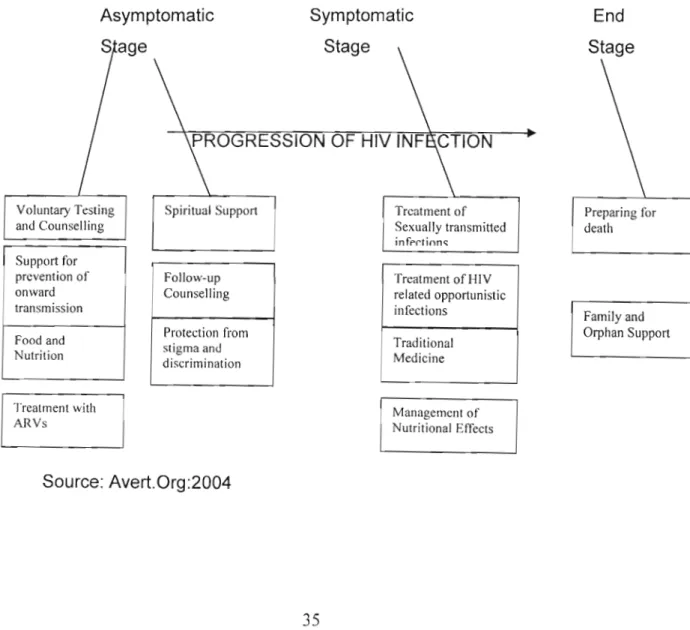
The treatment and care model (Avert.Org:2004) was used as the theoretical framework of this study. It outlines the various stages in the progression of HIV and AIDS from the point of diagnosis to bereavement. It proposesa continuum of care and clearly highlights the various types of services that are predominately required at the various stages of the illness. The need forpalliative care becomes more intense as the disease progresses to the terminal phase. It was chosen as it is compatible with palliative care theory and will be elaborated on later in the literature review (Chapter 2, Page 35). The themes of the data collected were based on this model.
1.8 RESEARCH METHODOLOGY
1.8.1 Selection Of A Design
Mouton (cited in De Vos and Strydom et ai, 2002: 137) defined a research design as a plan of how one intends conducting the research. Rubin and Babbie (cited in De Vos and Strydom et ai, 2002:138) further stated that the research design referred to all the decisions a researcher makes in planning the study, that is, decisions about the overall design to use, about sampling sources and procedures for collecting data, measurement issues, and data analysis plans.
According to De Vos and Strydom et al (2002: 109) " descriptive research presents a picture of the specific details of a situation, social setting or
relationship, and focuses on "how" and "why" questions. This study intended to capture this kind of information with regard to the provision of palliative care services at Durban Management Area. Thus a descriptive design was considered appropriate to meet the objectives of the study.
1.8.2 Sampling Method
A sample comprises the elements of the population considered for actual inclusion in the study, or it could be a small portion of the total set of objects, events or persons that together comprise the subject of our study (De Vos &
Strydom et ai, 2002: 199). The sample in this research was drawn from the offender and staff population at Medium B Correctional Centre, at Durban Management Area.
According to Rubin and Babbie (1997:237) two types of sampling methods exist, namely probability and non-probability sampling. Sarantakos (cited in De Vos &
Strydom et ai, 2000: 156) is of the opinion that in qualitative investigations non- probability sampling is used almost without exception. Since the main focus of this study was qualitative in nature, non-probability sampling was considered appropriate.
Sarantakos (cited in De Vos & Strydom et ai, 2000:156), described sampling in qualitative research as relatively limited, based on saturation, not representative, the size not statistically determined, involving low cost and access to the sample not being time consuming. These factors were considered when deciding on the sample in this research.
The sample comprised of three different target groups:
Sample One: Offender-Patients
The sample size depended on the number of offender-patients who were terminally ill with AIDS in the prison hospital at the time of the data collection stage of the study. They had to be physically, emotionally and psychologically well enough to be included in the study as determined by the nursing staff who were in daily contact with them. Seven male sentenced offender-patients met the above criteria. Although, theoretically, palliative care services start at diagnosis, it was decided that the sample should comprise of terminally ill patients at the prison hospital only, as data could be collected to illustrate the full progression of illness and the care services received at the various stages. The sample was also easily accessible.
Sample Two: Focus Group of Staff
Participants are selected because they have certain characteristics in common that relate to the topic of the focus group (De Vos & Strydom et ai, 2002:305).
The sample was drawn from the various staff groups providing services to AIDS patients within the prison. At the time of the study some of them were providing limited or no services to terminally ill patients at the hospital, but had provided services to HIV-positive offenders in the general offender population. They had thus provided services to offenders at the initial stages of the illness and
therefore had a good knowledge of the constraints of providing palliative care services within a correctional setting.
It was decided to include them in the sample as they were considered to be significant to the study by the offender-patients interviewed and by the integrated team model in palliative care (Chapter 2, Page 50). The following members of staff were included in the focus group:
• Nurse
• Social Worker
• Psychologist
• Chaplain
• Custodial Official
The doctor was unfortunately not available to attend the focus group discussion.
Sample Three: Focus Group of Offender-Volunteers
The researcher had not planned to include this sample in the study. However, during the interviews with offender-patients and staff it had become apparent that offender volunteers were providing palliative care services to offender-patients and were important to the study. Because of the qualitative nature of the study, which allows sampling to be undertaken after the actual investigation has commenced (De Vos & Strydom et ai, 2002:333), the researcher decided to include them in the study. Five members of the executive committee of the offender organization called the AIDS Control Committee, who work as offender- volunteer caregivers, were part of the focus group interviews.
1.9 Methods Of Data Collection
The study used a combination of quantitative and qualitative data- collection methods. The quantitative method of data collection focused on the demographic and factual information that were gathered from the files of offender-patients who were ill with AIDS and admitted to the prison hospital at Durban Management Area.
Babbie (1997: 160) defined qualitative research as the style of research used to describe, interpret or reconstruct the subjectively meaningful worlds of people.
The essence of the qualitative approach is to view events through the
perspective of the people being studied, the way they think and view the world.
This was the intention of the study.
The following data collection methods were used:
1.9.1 Content Analysis
Content Analysis is described as a quantitative data collection technique used for examining information or content and is used most often in descriptive research (Neuman in De Vos & Strydom et ai, 2003: 322). Some authors also describe this method of data collection as the record method (Bless & Higson-Smith,
2000:125). The researcher perused the offender-patients' institutional files and medical files, which also contained social work reports for the purposes of medical releases. This was done in order to obtain information of what palliative care services were available to the offender-patients. This also allowed the researcher to trail the services provided from diagnosis to bereavement since the continuum of care is an important component of the treatment and care model, which forms the theoretical framework of this study. The use of content analysis also served the purpose of creating objectivity by validating the information that was received from the staff. Italso limited the challenges around the receiving of information from staff that may be provided for the purposes of impressing the researcher. Obtaining information from records also served the purpose of minimizing the burden on the offender-patients to provide this information.
Information on the following broad themes were obtained from the files:
• Demographic information
• Progression of disease:
Diagnosis
Number of admissions to the prison hospital Discharge planning
• Overview of services provided by caregivers
• Type of specialist care referrals
• The support networks of offenders
1.9.2 Semi-structured Interviews With Offender-Patients
Generally semi-structured interviews are used to gain a detailed picture of a participant's belief about, or perceptions of, a particular topic(De Vos &
Strydom et ai, 2002:302). In this study semi-structured interviews allowed the researcher enough freedom to probe the perceptions of the offender-patients about the palliative care services that they received.
The researcher initially visited the hospital to observe the general functioning at the hospital and to meet with staff and offender-patients to explain about the proposed research and obtain consent from the offender-patients who were able to and wanted to participate. This visit also served the purpose of building rapport with the patients and staff and to make them feel comfortable and at ease with the researcher. These are important factors when collecting qualitative data according to De Vos&Strydom et al (2002:303).
The interviews with the offender- patients were conducted during a single session. However, if the physical and emotional states ofthe patients were such that they could not withstand a single interview session, they would have been conducted over two or three sessions of shorter duration.
The services of an interpreter were used with one research participant only.
The interpreter was trained in ethical issues, on the nature and sequence of questions and on the need to maintain confidentiality.
The researcher intended referring respondents to social workers at the prison if the interviews had evoked strong emotional reactions from the offender- patients about their illness, fear about dying or concerns aboutfamily. There was, however, no need for such referrals during or after the interviews.
The following broad themes were covered during the interviews:
• Services and support received
• Perception about the quality of service
• Resources and support available
• Recommendations
1.9.3 Focus Group Interviews with Staff
Once all the interviews with the offender-patients were concluded a focus group discussion was conducted with staff. Focus groups are a means of better
understanding how people think or feel about an issue, productor service.
The focus group discussion was guided by information that was obtained from the offender-patients and by reviewing of existing policy.
The following themes were discussed:
• Services provided
• Strengths and challenges in providing palliative care services in terms of:
Policy
Infrastructu re Resources
Support networks and services Teamwork
Planned management of care
1.9.4 Focus Group Interviews With Offender-Volunteer Caregivers
After the focus group interview with the staff a focus group was conducted with five members of the offender organization called the AIDS Control Committee, who offered voluntary palliative care and other services to offender-patients. The broad themes that were covered are similar to the group discussionwith staff, namely:
• Services provided
• Constraints experienced in rendering these services
• Recommendations for improvements
It was considered important to use triangulation for data-collection in this study.
Triangulation is using multiple methods to provide insights into the same events or relationships (De Vos & Strydom et ai, 2002: 341). Useof multiple methods of data-collection is particularly important in situations where power differences exist, as in prisons, and the respondents might be reluctantto answer honestly.
This ensured that the results were more reliable and valid.
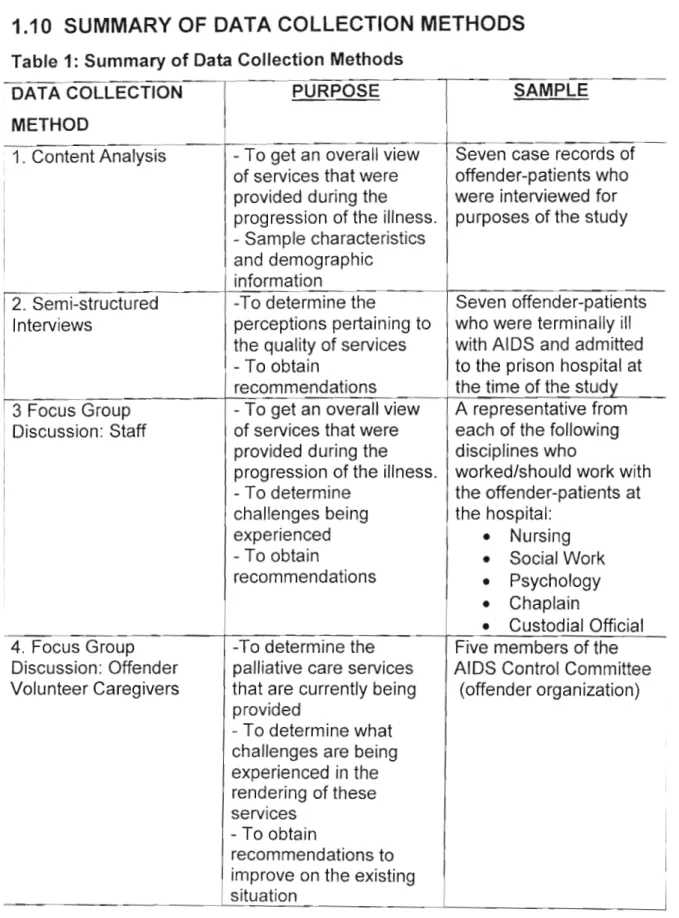
1.10 SUMMARY OF DATA COLLECTION METHODS
Table 1: Summary of Data Collection Methods
DATA COLLECTION PURPOSE SAMPLE
METHOD
1. Content Analysis - To get an overall view Seven case records of of services that were offender-patients who provided during the were interviewed for progression of the illness. purposes of the study - Sample characteristics
and demographic information
2. Semi-structured -To determine the Seven offender-patients Interviews perceptions pertaining to who were terminally ill
the quality of services with AIDS and admitted - To obtain to the prison hospital at recommendations the time of the study 3 Focus Group - To get an overall view A representative from Discussion: Staff of services that were each of the following
provided during the disciplines who
progression of the illness. worked/should work with - To determine the offender-patients at challenges being the hospital:
experienced
•
Nursing- To obtain
•
Social Workrecommendations
•
Psychology•
Chaplain•
Custodial Official 4. Focus Group -To determine the Five members of the Discussion: Offender palliative care services AIDS Control Committee Volunteer Caregivers that are currently being (offender organization)provided
- To determine what challenges are being experienced in the rendering of these services
- To obtain
recommendations to improve on the existing situation
1.11 DATA ANALYSIS
All the data collected and observations made were recorded by means of detailed process notes. The issue of tape recording was considered, but after deliberation with the prison staff and offenders, it was notpursued as it was felt that the respondents would feel intimidated by the equipment. The impressions of the interviews were noted immediately after the completion of the interviews. The responses of the research participants were thereafter processed into different themes and analyzed. After analysis the data was depicted using tables, direct quotations and direct transcripts from records where appropriate.
1.12 LIMITATIONS OF THE STUDY
There were several limitations to the study, namely:
• The researcher is English speaking and was compelled to utilize the services of an interpreter for one interview. The result could be that some information may be lost during the interpretation process and that
confidentiality could have been compromised.
• The medical practitioner, a key member of the palliative care team, was not available to attend the focus group discussion with staff.
• The researcher is employed in a managerial capacity at the Provincial Office of the Department of Correctional Services. As such colleagues and
offender-patients may have wanted to provide an "ideal" scenario, rather than depict the situation as is, in an effort to impress.
1.13 ETHICAL CONSIDERATIONS
Research with persons who are dying is particularly challenging and can be controversial. They are a vulnerable population in a situation complicated by physical decline and often debilitating symptoms of discomfitand distress. The situation is further complicated by the emotional intensity inherent in the
knowledge of impending death (Dean & McClement, 2002:376).
However, Beaver & Luker et al (1999:13) stated that the potential benefits to vulnerable persons of being involved in such research mightnot be immediately obvious. They are of the view that the respondent might believe that his
contribution will help others and this sense of altruism will indirectly benefit him.
Telling one's story might also be therapeutic for some.
It must be noted that the decision to include terminally ill offenders in the study was taken after deliberation on ethical considerations. The researcher
nevertheless considered it necessary to interview offender-patients' as these interviews would probably elicit valuable information. It wasfelt that hearing the voices of the recipients of services would enhance the valueof the study.
In undertaking this research the following are some of the methodological and ethical issues that were considered because of the sensitivenature of the study:
• Energy depletion: As terminally ill patients often lack energyto actively participate in research, the interviews were of relatively shortduration and concluded within forty-five minutes.
• Attrition: Researchers who work with the dying are inevitablyconfronted by attrition in participant numbers. Should this happen the researcher should not be discouraged from continuing.
• Benefits and risks: There should be an understandable explanation of risks and benefits, although palliative care patients in the terminal stages of the disease are unlikely to personally benefit from the research.
• Informed Consent: Informed consent is necessary even though the patient may frequently experience changes in cognition. In this study it was not necessary to apply process consent whereby consent is renegotiated as time passes and circumstances change.
All participants, that is, offenders and staff, completed consentforms prior to commencement of the interviews; copies are attached as appendix
"A","B" and "C" respectively.
• Emotional burden: Interviews may raise issues such as terminal illness, suffering and loss. The researcher needed to be prepared to postpone or even forego the research agenda in favor of responding with sensitivity and compassion when emotional distress is experienced. It was the researcher's intention to refer such cases to the prison social workers. It was, however, not necessary to refer any of the research participants to social workers as a result of emotional distress during the interviews.
The research proposal was approved by both the Ethics Committeesat the Department of Correctional Services and the University of KwaZulu Natal prior to commencement of the study.
1.14 KEY CONCEPTS
Hereunder are the definitions of the key concepts considered central to this study:
Palliative care: is described as care, which aims to achieve the best quality of life for patients suffering from life threatening and incurable illness, including HIV and AIDS. Crucial elements are the relief of all pain, that is, physical,
psychological, spiritual and social pain. It also looks at enabling and supporting
Prison: refers to an institution whereby all wrongdoers awaitingtrial and those found guilty and sentenced are kept and locked up againsttheir will for a
specified period from a month up to life imprisonment as determined by a court of law (Hornby, 1974:664).
Correctional Centre: the definition is the same as "prison" and both concepts have been used interchangeably in this study. This was necessary because Correctional Services is currently in a stage of transforming "prisons" into
"Correctional Centres", which will be places of new beginningsfor offenders, in line with the Department's rehabilitation focus. Thus all newerpolicies and documents use this terminology.
Prisoner: refers to a person kept or incarcerated for crime committed, has been tried and found guilty by a court of law, and sentenced to aparticular period of imprisonment (Sykes, 1982 :818).
Offender: is the same as the above definition and has been used
interchangeably with the term "prisoner" for the same reasons mentioned under
"Correctional Centre" above.
Offender-patients: refers to offenders/prisoners who are ill and confined to prison hospitals.
Prison hospital: means an inpatient health facility in prison which is equipped to care for, treat and house sick inmates as inpatients.
Terminally ill: refers to a medical diagnosis of a person who is ill, with little chance of recovery.
AIDS: is defined as a syndrome of opportunistic diseases, infections and certain cancers, which eventually kill a patient (Van Dyk, 1999: 10).
1.15 STRUCTURE OF THE REPORT
This report will consist of four chapters, which will cover thefollowing topics:
Chapter 1: Introduction and Methodology
Chapter 2: Theoretical Overview Of Palliative Care And Related Issues Chapter 3: Results and Discussion
Chapter 4: Conclusion and Recommendations
CHAPTER 2
THEORETICAL OVERVIEW OF PALLIATIVE CARE AND RELATED
ISSUES
2.1 Introduction
Palliative care is historically linked internationally to hospicework with cancer patients. Hospice programmes emphasize humane care designed to provide the best quality of life for terminally ill persons (Thigpen & Hunter, 1998: 1). With the advent of the HIV and AIDS pandemic, the principles underlying hospice care to cancer patients was extended to patients who were terminally ill with AIDS. Many challenges are faced by caregivers in rendering palliative care to AIDS patients in the terminal stages, because of the unpredictable nature of the disease and the stigma attached to it. Even more challenges are faced when offering palliative care to special populations such as offenders in correctional settings.
This chapter contains the theoretical overview of palliative care and related issues. The researcher considered it important to includethe following broad themes:
• The global statistics of HIV infections and AIDS related deaths.
• The prevalence of HIV and AIDS in prisons.
• The continuum of HIV and AIDS treatment and care.
• Challenges to HIV treatment and care in correctional settings.
• Palliative care with a specific emphasis of its applicabilityto correctional settings.
In this study overseas as well as local literature was consulted.
2.2 Global Statistics of HIV and AIDS
It is important to be aware of the global statistics of people who are infected with the virus or dying from the disease, as it provides an indication of the general extent of the problem and can be used to anticipate services and resources needed. It also guides the planning of services.
At the end of 2004 approximately forty million people were living with HIV/AIDS worldwide. Globally an estimated five million people were newly infected and three million people died of AIDS in 2004
(http://www.avert.org/worldstats.htm:2004). Sub-Saharan Africa, the most severely affected region of the world, accounted for over 3 million of these new infections and 2.3 million AIDS deaths. Every day in 2003 an estimated 14 000 people were newly infected globally with HIV. More than 95% of the HIV-infected people live in low and middle-income countries where accessto antiretroviral therapy and proper nutrition may be problematic
(World Health Organization, 2004:2).
South African statistics are of major concern. South Africa already had 4 million HIV and AIDS patients by December 2000 and 5.3 million by the end of 2003. It is anticipated that this figure could increase to 6.1 million infected people by 2005, and to 7.5 million people by 2010 (Body Positive, 2001:1). This means that by the end of 2005 15.25% of the South African population could be HIV-positive.
2.3 Prevalence Of HIV And AIDS In Prisons
Since the prison community emulates society, one can anticipate the problem in prison will follow similar trends, or even reflect a worse case scenario, as
research conducted by the Human Rights Watch/HIV/AIDS in Prison (2003:1) has shown that correctional institutions have six to ten times higher infection rates than the general population. Pagliaro and Pagliaro (1992: 201-214) agree that the prevalence of HIV infection and AIDS among inmates in correctional institutions is increasing worldwide at such an alarming rate that this population
groups for HIV
According to the Human Rights Watch Prison Project (2003: 2) in the United States in 1994 there were 5.2 cases of AIDS per 1000 prisoners, nearly six times the incidence found in the general population. According to the same source
(Human Rights Watch Prison Project, 2003: 2) French prisoners are estimated to be HIV-positive at a rate roughly ten times than that of adults in the general community. Similarly, prisoners in Brazil and Argentina, haveeven higher levels of HIV infection compared to members of the community.
A study tabled during the International AIDS Conference in Durban in 2000 (Presentation to the Portfolio Committee on Correctional Services: HIV/AIDS Debate, 2002: 1) revealed that in Zambia the infection rate amongst prisoners was 27%. According to the same source a UNAIDS report in 1999, rated Zambia as having the fifth highest infection rate in Africa, while South Africa was rated sixth. It can therefore be assumed that the prevalence in SouthAfrican prisons may not differ that much from that of Zambia.
A survey conducted at Medium B prison in Durban found an even higher percentage of HIV positive prisoners in the prison population. Goyer
(2003:4) estimated that 41 % of the prison population was HIV-positive during 2002. However, the Department of Correctional Services advised that care should be taken in extrapolating from this sample as it was not representative of all South African prisons (Presentation to the Portfolio Committee on Correctional Services: HIV/AIDS Debate, 2002: 1). However, these estimates are nonetheless alarming even if it is in one South African prison. These figures have major
implications for the provision of care services for AIDS patients in prison since the global trend is an increase in numbers of people in theterminal phase and dying of AIDS.
2.4 Common
\"nallellyt:~ I V l i l Y ru,,,,, " . _ _ . . ... _In Correctional Settings
The provision of treatment and care for HIV/ AIDS offenders is more complex in a correctional setting. UNAIDS (2003:1) reports that patientswith HIV and AIDS in the general population have rights to health, security of person, equality before the law and freedom from inhuman and degrading treatment. The World Health Organization's equivalence rule states unequivocally that whatever health care and prevention is available to the community at large should also be available to the incarcerated community (WHO/GPAlDIR/93.3:1).
The upholding of patients rights are more complicated when dealing with
prisoners as other stakeholders who come into contact with prisoners also have rights. Therefore, the rights of prisoners, prison personnel, and those of
communities from where prisoners come and to which they return, have got to be balanced and carefully considered in treatment and care models (Human Rights Watch Prison Project, 2003:3). Protecting those on the inside ultimately protects those on the outside, as offenders come from and return to communities.
In South Africa" more than 25 000 prisoners were released from prison every month and the same number received from the courts" (Fagan, 2004: 18), highlighting the large number of offenders that move in and out of prisons to communities on a monthly basis, making the problem difficultto handle.
According to Perez (1997: 3) and Haggerty (2000: 2-5), someof the challenges faced in providing care and treatment to HIV/AIDS patients in correctional settings are as follows:
• Security Versus Care
Prisons are mostly concerned with security, limiting prisonermovement and keeping tight control on when and where prisoners are in specified locations (Haggerty, 2000: 2). This focus on security impacts negativelyon the provision of and access to care and treatment. Haggerty (2000: 2) further states that more resources, energy and time are spent on security rather than on treatment and
• Inadequate Access To Health Care
Perez (1997:3) is of the opinion that the most serious problem faced by HIV- infected prisoners is the lack of adequate medical care in prisonsfor the
treatment of HIV and AIDS. Perez (1997:3) further states thatpatients with HIV infections do not receive appropriate medication or physical examinations, and lack access to proper laboratory monitoring of viral levels and T-cell counts. This lack of services fosters a system in which inmates suffer with severe
complications, despite proven prophylaxis medication thatmight offer relief.
Perez (1997:3) also states that there is often no chronic care system that exists within correctional systems. Health care, including HIV care, is managed incident to incident, with no continuity of care and no one providerwho is managing the whole patient.
• Supportive Services and Counselling
As reflected in the treatment and care model (Avert.Org: 2004) supportive services are essential in the proper management of HIV andAIDS patients.
Supportive services are also central to palliative care. In prisons there are very few support systems for inmates with HIV or AIDS. Prisoners lack support from family and friends from the outside as visiting times are restricted by prison policy. In addition offender-patients who are hospitalized are removed from other inmates in the prison. These inmates can be a tremendous source of support for the patient.
Staff may be also culturally insensitive or outwardly reluctantto effectively counsel people infected with HIV (Perez, 1997: 3).
In many facilities, the staff are either poorly trained, or nottrained at all to understand the nature of the HIV pandemic and how to react or empathize with prisoners.
This, coupled with correctional staff having to deal with large numbers of patients with limited resources at their disposal, and the lack of active support from
management may overwhelm them. The lack of support and counseling for patients who are ill with HIV and AIDS in a prison situation tends to disempower patients and increases their feelings of hopelessness and helplessness.
• Stigmatization and Lack Of Confidentiality In Prisons
AIDS is a disease that causes the sufferer to be stigmatizedand marginalized by society (Perez, 1997: 3). The stigma of the disease is of particularsignificance in prison, because of the institutional nature of the environment. Many prisoners refuse to be tested and remain undiagnosed because there is little confidentiality in prison. There are many mechanisms in prison that maycause an offender's status from being revealed without him/her wanting to disclose his/her status, for example, non-medical people may get access to medical recordsthat are
confidential; staff may have a list of all inmates who are scheduled to see a visiting doctor; or they are exposed when having to wait in medical lines outside the prison hospital. The negative attitudes of staff towardsprisoners may also prevent the former from maintaining confidentiality (Haggerty, 2000: 3).
• Adherence To Medication
Adherence to medication is vital to treatment and successful patient outcomes. In the general community there are two ways of dispensing medication, namely, keeping on person (KOP) and directly observed therapy (DOT). These methods are used to administer medication in prisons.
With KOP, inmates are issued a days or a week's worth ofmedication to keep in their cells and take at the appropriate times. However, prison rules and policies make the implementation of this system a challenge, as the prison schedule may not allow for appropriate meals or fluids being available atthe appropriate time (Haggerty, 2000: 4).
Medication is often stolen for re-sale to other inmates. Also as discussed earlier the issue of lack of confidentiality in the prison compoundsthe problem. DOT means that the inmates must be released from their cells to stand in a pill line.
Someone supervises the taking of the medicine and ensuresthat it is swallowed.
Lock-up or strict security rules often make it impossible for inmates to go to the pill line. To make matters worse, medication delivery often breaks down when inmates are transferred from one institution to another or even one section to another within the same institution, or are taken to court (Haggerty, 2000: 4).
According to Haggerty (2000:4) a further challenge is thatthe HIV population is spread throughout the entire prison system and amongst all health care
providers, making the dispensation and monitoring of adherence to medication even more difficult.
• Inadequate Specialist Medical Care
According to Haggerty (2000:2) there is generally a lack ofHIV-specific medical expertise in prisons, as the poor working conditions and uncompetitive
remuneration rates draw doctors to prison who have little or no first hand experience in treating HIV in their communities. Haggerty(2000:2) is of the opinion that this limited knowledge of HIV/AIDS is dangerous considering that studies have shown a direct correlation between practitioners' HIV experience and positive patient outcomes. Engle (1999:4) is also of the opinion that
infectious disease specialists should be seeing patients initially, before deciding on a course of therapy. Making that initial determination oftherapy has a major impact on whether therapy will be changed later on. This lack of specialist care is a problem in the prison. In addition AIDS patients often needto be seen by a variety of specialists for different types of opportunistic infectionsthey develop in the course of the disease. This is difficult in the prison where co-ordination of specialist care is hard to achieve.
Engle (1999: 4) discusses an interesting managed care system developed by the Department of Correctional Services in New York which, ifmanaged well, could be considered as an example in dealing with the problem of uncoordinated
services. The managed care system is based on highly formalized procedures in working with outside service providers. The prison doctor arranges the
consultation with an appropriate specialist. The specialist consultantexamines the patient and makes recommendations, which are sent to the prison doctor for
implementation. However even in this managed care system practical problems were experienced. There was no consistent system to ensure that the specialist's recommendations were followed.
There was little or no co-ordination between the specialist and the primary care physician. They never talk to each other, but just pass the patient's papers back and forth (Engle, 1999: 5). Thus the provision of adequatespecialist care in prisons is a worldwide problem. This gap in the treatment and care continuum can have negative repercussions for the holistic treatmentof the patient.
• Lack of Education, Prevention and Awareness Programs
Educational and awareness programs are important to patients who are
terminally ill with AIDS. Programs can empower them with information about, for example, healthy living and treatment compliance. These programs are scarce in prisons where the focus is still largely on prevention of the spread of HIV. There is a need to ensure that there is a balance in the various programs because, as discussed earlier, more people are in the terminal phases and dying of AIDS.
However, even where education and awareness programs are in place, implementation of the information learnt is difficult becauseof contextual constraints.
• Difficulties In Addressing Cultural and Traditional Practices in Prisons
According to Sandoval (2003: 301 )it is important to have an understanding of the cultural context within which palliative care services will be provided. In 1998 the World Health Organization supported the use of traditional healers in treating patients with HIV/ AIDS. They cited many benefits to traditional healing.
Treatment tends to be more personal and, whilst it may be mixed up with religion and superstition, it is more supportive of the patient as a person rather than simply as a subject (Eden, 2001 :1). This is confirmed by otherliterature.
Felhaber (cited in Van Dyk (1999: 119) that traditional African treatment is holistic in nature because it involves physical, spiritual, psycho-social and transpersonal aspects in its practices, that is, it not only takes physical signs and symptoms into consideration, but also the state of the patient's social and spiritual relationships, as well as certain internal psychic states such as anxiety and guilt.
People with HIV and AIDS may become frustrated with the management of their disease and may be willing to try anything in the hope of staying healthy for longer. Traditional treatment is thus in line with the principles of palliative care, which advocates holistic treatment and care.
Cultural and traditional practices are often not practiced in a prison situation because of the difficulty in dealing with large numbers of offenders with different belief systems.
In the researcher's opinion there is a further problem in South Africa in that the health professionals who visit prisons may not speak the language of the majority of the inmates and understand the culture of the prisoners. This could cause misunderstandings and frustrations in the provision of treatment and care for the patient.
• Inadequate Knowledge of the Prevalence of HIV and AIDS in Prison
Most correctional facilities worldwide do not accurately knowthe prevalence of the infection rate in their facilities (Engle, 1999: 1). This makes it difficult to plan for services. In South Africa it is difficult to estimate the prevalence rate as mandatory testing is considered unconstitutional and againstthe rights of the incarcerated individual. It is also against the World Health Organization's guidelines in dealing with HIV and AIDS in prisons (WHO/GPAlDIR/93.3). It is encouraging to note however that the Department of Correctional Services in South Africa is in the process of embarking on a prevalenceand attitude study relating to HIV and AIDS, with the participants in the study remaining anonymous to overcome this limitation (Presentation to the Portfolio Committee on
Correctional Services: HIV/AIDS Debate, 2002:1).
• Complications Caused by Prison Rape
It is conservatively estimated that one in ten prisoners will be raped at least once during incarceration (McMurray, 2002: 5). This complicates the management of offender-patients with AIDS.
According to U. S. Supreme Court Justice Harry A. Blackmun in Farmer v.
Brennan "Shame, depression, and a shattering loss of selfesteem accompany the perpetual terror the victim must thereafter endure" (Ludlow, 2000:4). The victim has to deal with both severe physical and psychological pain, which might impact on his responses to the care services being offered to him. The trauma associated with rape was confirmed by Rape Crisis who had conducted a training program with rape survivors at Pollsmoor Prison in the Western Cape between August and October 2001. They found that for many survivors the possibility of facing HIV and AIDS, in addition to the trauma of the violation of rape, is an overwhelming concern (Harvey, 2002:4).
Services available at the asymptomatic stage of the treatmentand care model will also be important for people who have contacted AIDS through rape. Since there is a possibility of prisoners becoming infected with HIVbecause of rape in prison, care and support has to form part of the treatment process to cope with this double trauma. As already discussed this is inadequate in prisons. For rape survivors in prison, the typical support networks of family and friends are not available; access to health facilities is limited and there appearsto be no structure to deal with the immediate trauma (Harvey, 2002:4).
From the above one can see that there are many challenges in prison to providing treatment and care to offender-patients generally and specifically to those who are infected with HIV/AIDS.
2.5 HIV/AIDS Treatment And Care
A treatment and care model as reflected in Avert.Org
(http://www.avert.org/treatmentandcare.htm:2004)ispresentedbelow.This model is important to this study because it highlights the progression of different stages of the disease that a patient who is diagnosed with HIV and/or AIDS follows. It presents a continuum of care that starts at the diagnosisof the disease and continues through to the period of bereavement. Patients may move back and forth between the various stages depending on their responseto the treatment.
A Treatment & Care Model
Diagram 1: Treatment & Care Model
End Stage
Preparing for death Treatment of
Sexually transmitted
inff"r.ti()n~
Symptomatic Stage
PROGRESSION OF HIV INF CTION
Spiritual Support
Asymptomatic Sage
Voluntary Testing and Counselling Support for prevention of onward transmission Food and Nutrition
Follow-up Counselling Protection from stigma and discrimination
Treatment of HIV related opportunistic infections
Traditional Medicine
Family and Orphan Support
Treatment with ARVs
Management of Nutritional Effects
Source: Avert.Org:2004
In terms of the above model HIV-positive people have differing needs according to the stage of their infection. Caregivers need to be aware of these needs in
order to respond appropriately. The first stage in the continuum is when people are asymptomatic, that is, when they have no signs or symptoms of their
infection. At this stage they need support to prevent the onward transmission of the disease, they need to ensure that they are eating well, they may need to start on antiretroviral treatment and they need spiritual support, counselling and
protection from stigma and discrimination, as this adds to the trauma of dealing with the diagnosis (Avert.Org: 2004).
The second stage is when people have symptoms of HIVinfection and need to be treated for the various opportunistic infections. In this stage it is important for caregivers to be culturally sensitive when providing care and treatment as some patients may want to engage traditional healers to supplementthe treatment being received (Avert.Org: 2004).
The third stage relates specifically to the support and care of people who are terminally ill and nearing the end of their lives. People who are nearing death are frequently afraid of dying in great pain. Patients need to beassured that pain relief will be carried out to the point of death. Caregivers from Msunduzi Hospice agree that pain control becomes significant at stage three of this model. As such pain control is one part of a comprehensive approach to care for a patient and his family (Msunduzi Hospice Workshop: 2004). This service forms part of the
continuum of holistic care that is inherent in the palliative care paradigm (Avert.Org: 2004).
Preparation for death forms an essential part of the end stage of the model.
Some patients may want to talk about their fears of dying, or may want to finalize plans for their families. Family and child support is also considered important at this stage. The above-mentioned treatment and care model is generic and could be applicable within a correctional environment.
2.6 Palliative Care
Palliative care is a model of care that is increasingly being used in communities and in correctional settings world wide to deal with AIDS patients. Palliative care aims to achieve the best quality of life for patients (and theirfamilies), suffering from life threatening and incurable illness, including HIV and AIDS. Crucial elements are the relief of all pain, that is physical, psychological, spiritual and social, and enabling and supporting caregivers to work through their own emotions and grief. It is a misconception that palliative care deals only with patients who are approaching death. Central to this philosophy is the belief that everyone has the right to be treated, and to die, with dignity, and that the relief of pain is a human right and essential to this process (UNAIDSTechnical Update, 2000: 2). The following definitions will expand the conceptfurther.
2.6.1 Definition of Palliative Care
The World Health Organization defines palliative care as:
U The active total care of patients whose disease is not responsive to curative treatment. Control of pain, of other symptoms, and of psychological, social and spiritual problems, is paramount. The goal of palliative care is achievement of the best quality of life for patients and their families" (Doyle, Hanks et ai, 2003: 3).
By way of expanding and explaining the definition, the World Health Organisation extends it as such: U Palliative care affirms life and regards death as a
normal process ... neither hastens nor postpones death ...provides relief from pain and other distressing symptoms .... integrates the psychological and spiritual aspects of care ... offers a support system to help the family cope during the patients illness and in their own bereavement" (Doyle, Hanks et aI, 2003: 3).
The HIV/AIDS Bureau of the Health Resources and Services Administration in the United States Department of Health and Human Services (O'Neill & Barini-
Garcia, 2003:1) has adopted the following working definition:
U Palliative Care is patient and family-centred care. It optimizes quality of life by active anticipation, prevention, and the treatment of suffering. It emphasizes use of an interdisciplinary team approach throughout the continuum of illness, placing critical importance on the building of respectful and trusting relationships.
Palliative care addresses physical, intellectual, emotional, social, and spiritual needs. It facilitates patient autonomy, access to information, and choice."
Doyle, Hanks et al (2003: 3) add that palliative care remains sensitive to
personal, cultural and religious values, beliefs and practices. It may be combined with therapies aimed at reducing or curing the illness, or itmay be the total focus of care.
Thus in reviewing the above definitions palliative care looks at the total needs of the patient, is family centred, is culturally sensitive, and takes into account the need for care for the caregivers. It is holistic in its approach and occurs on a continuum.
2.6.2 Philosophy Of Palliative Care
Palliative Care emphasizes the maintenance of human dignity, quality of life, comfort and concern for the individual, his/her family and significant others. The philosophy of palliative care also states that it may start ata time of diagnosis and becomes more intensive as treatment changes to symptom management, support, and preparation for death as depicted in the treatmentand care model discussed earlier.
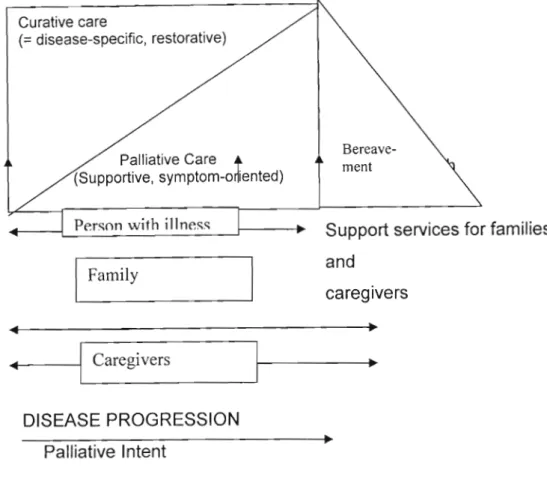
This continuum of care can also be graphically depicted as reflected below:
Diagram 2: Integrated Model Including Both Curative and Palliative Care
Curative care
(= disease-specific, restorative)
Palliative Care -+
(Supportive, symptom-orliented)
Person with illness
I
Family...---1
CaregiversDISEASE PROGRESSION Palliative Intent
(Source: World Health Organisation: 1990)
Bereave- ment
Support services for families and
caregivers
This model is based on a continuum of care, depicting the type of care with the progression of the disease. This aspect makes it compatible with the treatment and care model discussed earlier (Avert.Org: 2004). The palliative care intent becomes more significant with the progression of the illness proceeding into death.
It is important to understand the philosophy of palliative care as it guides practice.
The suggested philosophy of palliative care by the Canadian Palliative Care Association (1995: 16) states that:
Every individual has the right to make an informed decision about health care options that will help to optimize the quality of his life during a Iife- threatening illness, and especially when dying;
Palliative care strives to meet the physical, psychological, social, and spiritual needs of individuals and families with due regard to their personal, cultural and religious values, beliefs and practices;
Care should be delivered in a client focused, family-centred environment;
The individual has a right to access palliative care from an interdisciplinary team of appropriately trained professionals and volunteers, who receive continuing palliative care education and evaluation;
The individual has a right to quality of life by means of effective pain
control and managing of symptoms effectively as a patient will not respond to counseling if he is in pain and/or is nauseous.
Therefore from the above discussion one can assume that in prisons where there is denial of civil liberties and security plays a major role, the philosophy of
palliative care would be difficult to put into practice.
2.6.3 Principles Of Palliative Care
The following principles of palliative care have been derived from the philosophy.
It is important to this study as it guides practice. The principles have been adapted from the Canadian Palliative Care Association, 1996: 16-17 and Saskatchewan Health, 4-5 (Frohlich, 2003:19).
• Comprehensive Care
Palliative care is comprehensive in that it is directed towards meeting the
physical, psychological, social, and spiritual needs of individuals and families with due regard to their personal, cultural and religious values, beliefs and practices.
• A Trajectory of Care
Palliative care has three phases:
Initial/Acute Phase: refers to care at the time of diagnosis or when the prognosis changes. The focus at this stage is on aggressive interventions.
Chronic Phase: refers to "being ill" and involves the management of symptoms.
Final Phase: is defined by the person's creative management of his/her mortality with an emphasis on physical care and symptom management.
The above phases can be equated to the three stages of the treatment and care model discussed earlier.
• Access To Care
Patients should have access to care twenty- four hours per day, seven days per week. In order for patients to access the care services, these services should be provided in an understandable language.
• A Client-Centred Approach
The individual and family control the decisions that determine the patient's care. Information should be available to the patient and family members to enable them to make informed decisions.
• Right To Information
The individual has the right to be informed about his/her disease, potential treatments and outcomes, appropriate resources and options. This
information enables him to make decisions about his care and treatment.
• Right To Choice/Empowerment
The individual has the right to be heard, the right to be informed, and the right to share in decisions in collaboration with the service provider and caregivers. The choice of the individual about the care and the care setting needs to be respected.
• Interdisciplinary Team
Care to the patient is provided by an interdisciplinary team of caregivers, who have a diversity of training among them, and who sharethe goal of improving the quality of life of the individual.
• Continuity Of care
A coordinated, continuous plan of care is maintained across all settings from the time of admission of the patient to bereavement supportof the family.
• Quality of care
Care is delivered within the accepted standards of care, conductand clinical practice for palliative care. These standards include issues like providing the patient and family with choices about care, pain and symptom management; psychological, social and spiritual support; grief and bereavement support; emergency services; and continuum of care with an effective referral system in place.
• Education, Information, Research and Advocacy for Palliative Care Education, information, research and advocacy for the development of palliative care standards and resources are essential to improvethe delivery of care services.
• Evaluation
Palliative care services should be evaluated regularly to maintain the standards of conduct and practice (Frohlich, 2003:19).
Fox in O'Neill and Selwyn et al (2003: 18) also lists core elementsthat he
believes are important to palliative care. The researcher will elaborate on those not discussed by The Canadian Palliative Care Association, 1996; 16-17 and Saskatchewan Health; 4-5 as mentioned above:
• Palliative care depends on effective communication and relationship building between the patient, family and caregivers, within a model of diverse expertise and interdisciplinary teamwork. It cannotbe practiced within a framework of authoritative hierarchy where the patient and family are dictated to by caregivers.
• The goals of care include relief of suffering, control of symptoms, and restoration of functional capacity, to ensure that the dignityof the patient is not impaired.
• Caregivers in palliative care consider the patients' subjectiveexperiences, for example, his/her experience of pain, to be as importantas objective clinical data gathered during the treatment process.
• Diagnosis is not a pre-determined goal and is only pursued if it conforms to patient-determined goals of care.
• The treatment and care plan is tailored specifically to each patient, according to the patient's values and preferences, and notdecided unilaterally by the physician.
2.6.4 Goals Of Palliative Care
According to Q'Neill and Selwyn et al (2003:17) palliative care seeks to provide the best quality of life for patients and families using a model in which the goals of care are collaboratively developed with care providers according to the wishes of the patients and families. This model emphasizes communication,
collaboration, and the willingness to accept pati