The need to respond to the lack of basic services and poverty in rural and peri-urban areas has increased. The dissertation puts forth the hypothesis that "community development through housing access is not an appropriate development mechanism for rural and peri-urban areas". The dissertation concludes with suggestions for sustainable livelihood approaches for rural and peri-urban areas.
The research also recognizes that the housing package may be a basic requirement for rural and peri-urban areas.
DEFINITION OF TERMS
INTRODUCTION Scope of Work
- RESEARCH GOALS .1 Purpose
- SCOPE AND DELIMITATIONS
- CHAPTER OUTLINE .1 Chapter 1
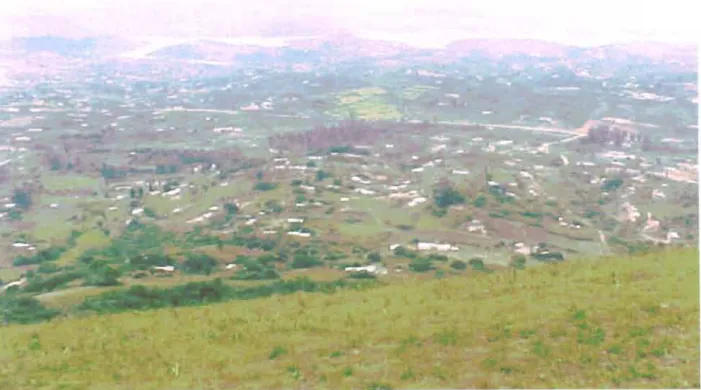
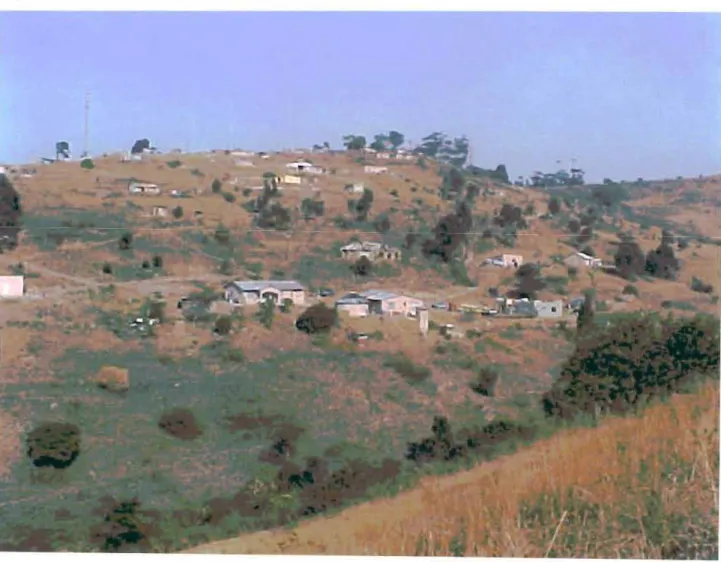
This project falls within the peri-urban and rural parts of the north-western areas of the eThekwini region. The research is based on the researcher's experiences in coordinating and planning the Intathakusa Integrated Development under which the Etafuleni community falls. Within Intathakusa, there is a focus on the Etafuleni community to provide relevant support for the research's claims.
Chapter seven suggests solutions to the problems raised in the earlier parts of the thesis.
Scope of Chapter
LITERATURE REVIEW 1 Background
- NATIONAL POLICY FRAMEWORK
- PROVINCIAL INITIATIVES
- CONCLUDING REMARKS
However, this is still limited and the vast majority of rural areas and municipalities belonging to the remaining provinces are struggling to deal with the problem of internally displaced persons. The law appears to be biased towards urban areas and it is this bias that has caused rural and suburban areas to develop along the same lines as urban areas. Thus, the RNP for rural and suburban areas must ensure that the interpretation of the law is favorable to these environments.
However, it should be interpreted in a way that allows for development. ISRDS is not connected yet.
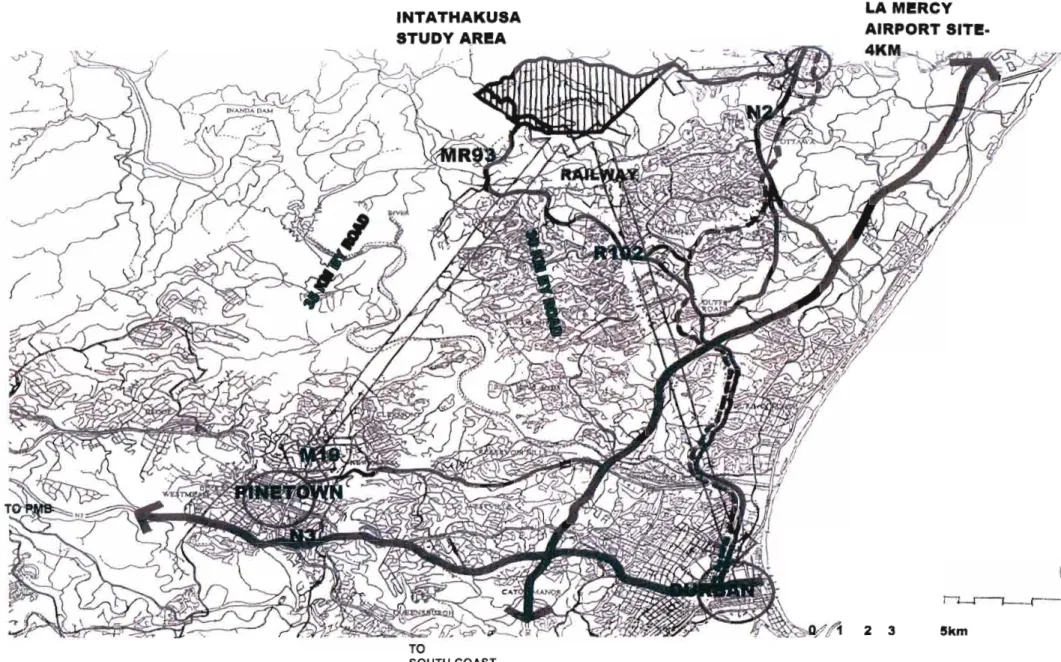
CASE STUDY: INTATHAKUSA INTEGRATED DEVELOPMENT Scope of Chapter
This is evident in the division of classes that exists between parts of the area. The development of this combination of options fell outside the mandate of the Housing Department. The findings of the study revealed that the area had high levels of crime, illiteracy and unemployment (Institute of Natural Resources, 1998).
This is how the three community areas are included as part of the development of Etafuleni. This was again outside the jurisdiction of the project leader, who could only help by providing advice. However, these challenging processes appear to be critical to the sustainability of the project.
It became crucial that a relationship of trust was built between the new members of the Development Forum and the project team. This brings us to the end of the history and development processes of these areas. The second phase of the project was to give all the plants a medicinal, historical and traditional meaning.
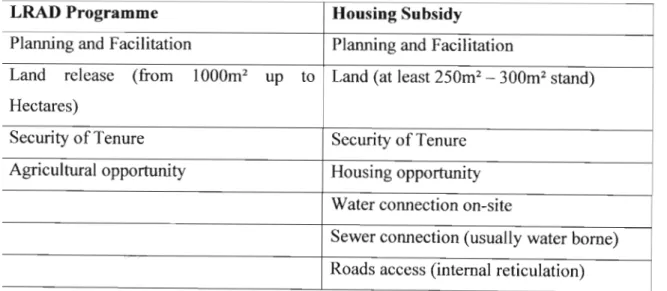
It was argued that the LRAD would not conflict with the use of the housing subsidy. Due to its location in the river basin, the project was linked to the river basin management program.
RESEARCH METHODOLOGY AND JUSTIFICATIONS 1 Background
The contribution of respondents from the local level was seen as key in raising relevant issues, challenges and suggestions. Their exposure and experience with IDP implementation struggles and developments within the newly incorporated rural and peri-urban areas became relevant to the research discussions. These questionnaires targeted the representatives of the Intathakusa community, because they were the best informed regarding the progress and discussions of the project throughout its course.
These categories are based on the objectives of the study and the issues that emerged from the literature review. All the questions were looking for information based on the opinions and experiences of the respondents. For the community representatives, the first set of questions explored the origins of the people of the Etafuleni community, and this information was used in the case study presentation.
The rest of the information related to their attitudes and opinions on development issues. Prior to distribution of the questionnaires, target individuals were contacted, usually by telephone, and told the background and objectives of the study. In addition, a note was attached to the questionnaire requesting completion of the questionnaire and explaining the reason for the study.
All the questionnaires in this group were delivered to the Chairman of the Development Forum, who then distributed them at one of their meetings. Some of the information from the community representatives was discussed in the presentation of the case study in chapter three.
CHAPTERS
DEVELOPMENT PRACTITIONERS' RESPONSES
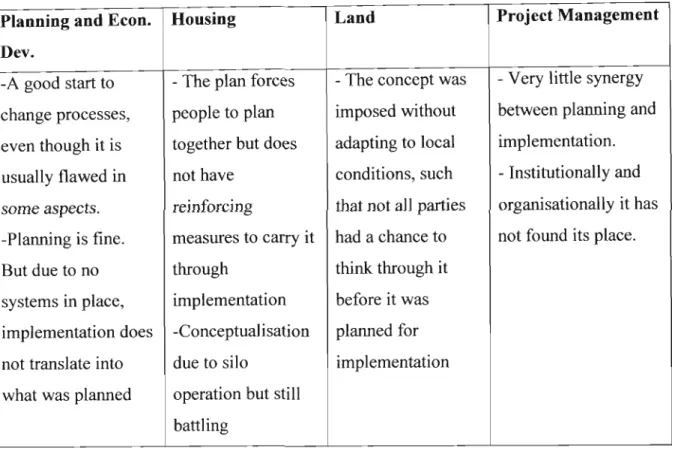
There is clear evidence that the development of the concept played an important role in unifying all planning efforts. It would have been interesting to obtain the views of national and provincial government departments on this issue. The remaining fifty percent were divided between different views on which level seemed better able to handle the implementation of the processes.
In environmental terms, this would mean that the natural processes of the environment are used in a way that allows resources to be renewed naturally. It is also seen as one of the important building blocks of the development of these areas. The answers related to the origin of the area are used in the third chapter and only the answers related to the development processes in the area are presented in this section.
The Etafuleni area has unique geographical features that had to be taken into account in the development plan of the area. This question was asked to explore people's understanding of the development struggles the project went through, and also to ascertain their views on the process itself. It shows an understanding of the balance between what the government can afford to do and what people should be able to do for themselves.
These responses reflect that people seemed to have carefully considered the potential benefits and opportunities of the project. People want to be really involved in the implementation so they feel a sense of ownership of the process.
CONCLUDING REMARKS
If there are jobs that can be offered in connection with the implementation of the project, priority must be given to local people to expand their knowledge and experience base. People are excited about the job opportunities that tourism opens up and the fact that tourists will visit the area; they feel that their area is being lifted. People must not be consulted for unskilled labour, but work must be done to equip people to assist with qualified labor in future projects.
This question was asked so that people could raise issues that may have been critical and not covered by the questionnaire. There were indeed some very optimistic responses to this question, but the responses also reflect a community that is involved in development discussions and processes and thus knows what needs to be provided. Interestingly, it was found that almost all the jobs open for local work in community projects are for unskilled labour.
Opening up opportunities for local people beyond the unskilled workforce would actually increase their skill base and provide people with the experience to compete in the job market.
ANALYSIS OF DATA Scope of chapter
- CONCLUSION
- TESTING THE HYPOTHESIS
- RECOMMENDATIONS
- SUGGESTIONS FOR FURTHER RESEARCH
This raises important considerations, which should drive some of the interventions in rural and peri-urban areas. As discussed earlier, there are problems with the continuation of the housing subsidy-led process in the development and delivery of basic services in rural and peri-urban areas. There is therefore a need for a new bundle specifically designed to deliver in rural and peri-urban areas.
There is some truth to the argument that development is more expensive to manage and achieve in rural and peri-urban areas. To avoid unnecessary costs, it is important to adapt processes to suit the delivery of services in rural and suburban areas. These issues present a major challenge within urban environments, and become even more serious in rural and suburban areas.
A failure to provide services to rural and suburban areas has led to this competition with urban areas for resources. The first proposal is based on a need to overcome the impracticality of the housing subsidy system as a funding mechanism in rural and suburban areas. This is complicated by the inability of the LRAD program to assist non-urban communities.
This dissertation has argued that there is a need for different approaches towards the development of rural and peri-urban areas. The main recommendation is that there should be a policy overhaul that allows for a new package of provision for rural and peri-urban areas.
Professional Questionnaire
- PERSONAL DETAILS
- INTEGRATED DEVELOPMENT
6 Do you have examples of projects or processes where you tried to implement or see the concept of integrated development being challenged. 8 How do you think we can ensure delivery using this integrated development and planning tool. What in your understanding is sustainable development as far as peri-urban and rural areas are concerned.
13 What are some of the thoughts that come to mind that you think are critical to addressing sustainable development. 14 Would you think agriculture is a suitable alternative development option for rural and suburban development. 15 Would you subscribe to the thinking that agriculture is the tool to achieve extra-urban and rural livelihoods?, if yes, please elaborate.
20 Where do you think we are lacking in our operations?, please elaborate and suggest solutions. My research is on the topic of integrated development and the effects of using the housing process as an engine for social physical development. Development has been talked about for a long time in Etafuleni, what do you think delayed the development processes in the past years.
Etafuleni was conceived as an integrated development of housing and urban agriculture, this is what all the people wanted. In your opinion, what needs to be done in order for development to be sustainable in the long term.