TEACHER ASSESSMENT PRACTICES: A CASE STUDY OF THREE GRADE 9 MATHEMATICS TEACHERS IN THE NORTHERN REGION OF KWAZULU-NATAL PROVINCE
MICHAEL MSAWENKOSI THABETHE
A dissertation submitted in partial fulfillment of the requirements for the degree of Masters of Education
University ofKwaZulu-Natal
2009
ABSTRACT
The research project explored the Grade 9 mathematics teachers' assessment
practices in the context of the National Policy on Assessment and
Qualifications for Schools in the General Education and Training Band in
South African Schools. The research project also explored the mathematics
teachers' understanding of the assessment policy in Mathematics and the
impact of teachers' understanding of assessment on their assessment
practices. The research project was a case study of three Grade 9
Mathematics teachers from three schools in Obonjeni District in the
Northern Zululand Region in KwaZulu-Natal Province. The data was
collected through observations of teachers teaching Grade 9 Mathematics
lessons, analysis of teachers' planning and assessment documents and
teacher interviews. Each teacher was observed teaching his/ her lessons five
times. Based on the results obtained it was concluded that: (a) teachers have
different understandings of the same assessment policy and this resulted in
teachers implementing the assessment policy differently. (b) teachers are
using some of the assessment practices that are recommended in the
assessment policy. and (c) teachers' understanding of assessment does not
influence their assessment practices. Finally, recommendations made
concerning assessment practices, could lead to teachers' better
understanding of assessment.
DECLARATION
I, the undersigned, hereby declare that the work contained in this thesis is my own original work and that I have not previously in its entirety or in part submitted it at any university for a degree.
-M-ic-h-a~wenkOSi fJ}~ Thabethe 01 December 2009
ETHICAL CLEARANCE APPROVAL NUMBER
HSS/0087/08M
ACKNOWLEDGEMENTS
I would like to thank the LORD, ALMIGHTY, for giving me strength that sustained me throughout my studies till today.
My supervisors Linda Van Laren and Angela lames, for their motivation, guidance, support and dedication, constructive feedback from the beginning of the thesis until the end.
Special thanks to Crispin Hemson for his tireless help in editing my work.
A special thanks to my family for their support and for their understanding of my busy schedule.
I would also like to thank my friends and colleagues who always assisted
and supported me. Their motivation, prayers and moral support helped and
sustained me in copying with my work. May the good Lord bless and keep
them.
TABLE OF CONTENTS
Abstract
11Declaration
111Ethical Clearance Approval number .iii
Acknowledgement .iv
List of tables xi
List of figures xi - xii
Table of Contents v - xii
CHAPTER ONE 1HE STUDY IN CONTEXT 1 - 9
1.1 Introduction 1 - 2
1.2 Background of the study 2 - 5
1.3 Purpose of the study 5 - 7
1.4 The rationale of the study 7 - 8
1.5 Organization of the report 8 - 9
CHAPTER TWO: REVIEW OF RELATED LlTERATURE 10 - 37
2.1 Introduction l 0
2.2 The meaning of assessment 10 - 11
2.3 The purpose of assessment. 12
2.4 Conceptions of assessment 12
2.4.1 Historical conceptions about assessment 13 - 15 2.4.2 Contemporary conceptions about assessment. 15 - 17
2.5 Teachers and assessment 17
2.5.1 Teachers and classroom assessment. 17 - 24
2.5.2 Teachers' assessment practices 24 - 28
2.6 The new policy on assessment in Mathematics in South Africa 28 2.6.1 Learning outcomes and assessment standards 28 - 30 2.6.2 Continuous assessment in the Mathematics Learning Area .30 - 32
2.7 Theoretical framework 32 - 36
2.8 Conclusion 36 - 37
CHAPTER THREE: RESEARCH DESIGN AND
METHODOLOGy 38 - 55
3.1 Introduction 38
3.2 Research design 38 - 41
3.3 Critical questions .41
3.4 Context of the study .42
3.5 Selection of schools .42 - 44
3.5.1 Gaining access .44
3.6 Data collection process 45
3.7 Methods of collecting data .46
3.7.1 Documents analysis .46 3.7.1.2 Document analysis instrument as a research tooL .47
3.7.2 Observations 47 - 48
3.7.2.1 The observation schedule as a research tooL .48 - 49
3.7.3 Interviews 49 - 50
3.7.3.1 Interview schedule as a research tooL 50 - 51
3.8 Data analysis 51
3.8.1 Analysis of data from observation schedule and
assessment documents , 51 - 52
3.8.2 Analysis of the transcribed data from interview schedule 52
3.9 Limitations of the study 52 - 53
3.10 Rigour of the research study 53 - 54
3.11 Ethical issues 54 - 55
3.12 Chapter summary 55
CHAPTER FOUR: PRESENTATION OF DATA ANALySIS 56 - 86
4.1 Introduction 56
4.2 Case studies 57
4.2.1 Case 1: THABANE 57 - 66
4.2.1.1 Thabane's understanding of assessment in Mathematics...57 - 59
4.2.1.2 Thabane' s understanding of the assessment policy
in Mathematics 59 - 60
4.2.1.3 Thabane's assessment practices 61
4.2.1.3.1 Oral assessment 61 - 62
4.2.1.3.2 Written assessment , 62 - 64
4.2.1.4 General comments 64 - 65
4.2.1.5 The influence of Thabane's understanding of assessment in his
assessment practices 65 - 66
4.2.2 Case 2: MANDLA 66 - 74
4.2.2.1 Mandla's understanding of assessment in Mathematics 66 - 68 4.2.2.2 Mandla's understanding of the assessment
policy in Mathematics 68 - 69
4.2.2.3 Mandla's assessment practices 69
4.2.2.3.1 Oral assessment. 69 - 70
4.2.2.3.2 Written assessment 70 -72
4.2.2.4 General comments '" 72 - 73
4.2.2.5 The influence ofMandla's understanding of assessment on his
assessment practices 73 - 74
4.2.3 Case 3: NELLIE 74 - 82
4.2.3.1 Nellie's understanding of assessment in Mathematics 75 - 76 4.2.3.2 Nellie's understanding of the assessment policy in
Mathematics 76 - 77
4.2.3.3 Nellie's assessment practices 77
4.2.3.3.1 Oral assessment. 78
4.2.3.3.2 Written assessment 78 - 81
4.2.3.4 General comments 81 - 82
4.2.3.5 The influence ofNellie's understanding of assessment on her
assessment practices 82
4.3 The cross-case study 83
4.3.1 Teachers' understanding ofassessment 83 - 84 4.3.2 Teachers' assessment of different skills 84 - 85
4.3.3 Teachers' assessment practices 85
4.4 Summary 85 - 86
CHAPTER FIVE: CONCLUSIONS AND RECOMMENDATION....87 - 95
5.1 Introduction 87 - 88
5.2 Synthesis of the findings 88
5.2.1 Question 1: Teachers' understanding assessment 88 - 89 5.2.2 Question 2: Teachers' assessment practices 90 - 91 5.2.3 Question 3: The influence of teachers' understanding of assessment on
their assessment practices 92 - 93
5.3 Recommendations 93
5 3 1 A
. . ssessment po ICY Imp IcatlOnsr . l' .
935.3.2 Teacher professional development. 94
5.4 Implications for further research 94
5.5 Conclusion 94 - 95
References 96 - 106
Appendices 107 - 115
LIST OF TABLES
Table 1: The old and new classroom according to Curriculum 2005 3
Table 2: CASS framework 31
Table 3: Formal CASS programme for Grade 9 .32
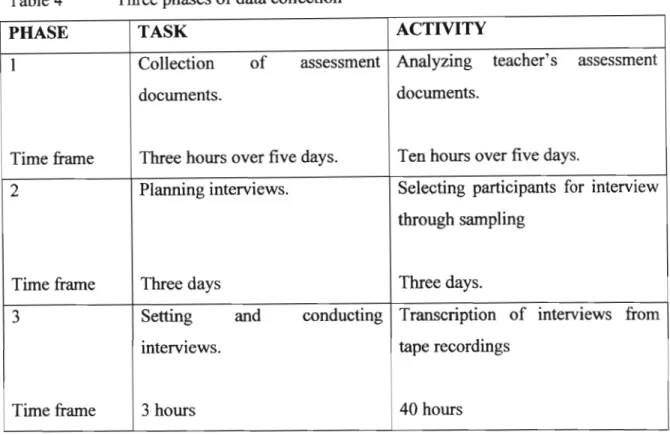
Table 4: Three phases of data collection .45
Table 5: Rigour criteria in this study 54
Table 6: Teachers' understanding of assessment. 83 Table 7: Teachers' assessment of different skills 84
LIST OF FIGURES
Figure 1: Thabane's frequency of assessment levels 61 Figure 2: Thabane's frequency of assessment levels in skill
for control tests 62
Figure 3: Thabane's assessment level for classwork exercises and worksheet
actIVItIes 63
Figure 4: Thabane's weighting of skills for projects and assignments 64 Figure 5: Mandla's frequency of assessment levels 69 Figure 6: Mandla's frequency of assessment levels for controlled .
tests 70
Figure 7: Mandla's frequency of assessment levels for classwork and
worksheet actIvItIes 71
Figure 8: Mandla's frequency of assessment levels for projects and
assignments 72
Figure 9: Nellie's frequency of assessment levels 78
Figure 10: Nellie's frequency assessment levels for controlled tests 79 Figure 11: Nellie's frequency assessment levels for classwork and worksheet
actIvItIes 80
Figure 12: Nellie's frequency of assessment levels for projects and
assignments 81
CHAPTER 1: THE STUDY IN CONTEXT
1.1 INTRODUCTION
The political, social and economic changes in South Africa over the past 15 years have been accompanied by considerable changes in the education system. One of the key imperatives of the new curriculum in South Africa was the implementation of an effective assessment system for providing relevant and timeous information to all roleplayers for use in improving learning in schools (Kanjee, 2009). In particular, the development of assessment systems at the classroom level for addressing the needs of teachers was a key priority (Department of Education (DoE), 1998, 2007). The development of assessment systems at classroom level has a number of challenges (Kanjee, 2009). Specifically, assessment systems that support teachers in addressing the learning needs of learners, have been found wanting as evidence by the range of different studies on this matter (DoE, 2000; Pryor & Lubisi, 2002; Ramsuran, 2006; Vandeyar &
Killen, 2007; Kanjee, 2009).
With the introduction of the new curriculum and its philosophy of outcomes based education (OBE), a number of assessment related policies and guidelines that placed greater emphasis on classroom assessments were introduced. Specifically, these were the Assessment Policy in the General Education and Training Band, Grade R to 9 and Adult Basic Education and Training (ABET) (DoE, 1998), the interim policy framework for the assessment and promotion of learners in Grade 9 (DoE, 2003), and the national protocol on assessment for schools in the General and Further Education and Training Bands, Grades R to 12 (DoE, 2005b). Most recently the 1998 assessment policy was revised to align it with curriculum changes implemented in the National Curriculum Statements for General and Further Education and Training Bands (Kanjee 2009). The new assessment policy (DoE, 2007) placed greater emphasis on classroom assessment by outlining the range of assessment information available to teachers, specifying the frequency and types of assessment information required for reporting on learner performance at the different grade levels and providing templates for recording and reporting the performance of
learners, for example, learner profiles. However, Vandeyar and Killen (2007) note that while the revised policy makes several major advances in simplifying assessment in South African schools, there are no guidelines that would enhance the validity and reliability of the information that will be reported. Similarly, Kanjee (2009) notes that only limited learning and teaching resources are available to specifically assist teachers in improving their classroom assessment practices.
This introductory chapter will now briefly highlight literature on assessment policy, teachers' understanding of assessment and struggles that teachers have with the implementation of the policy. This review includes the background and purpose, the critical questions and rationale for the study. The chapter, finally, gives the organisation of the report.
1.2 BACKGROUND OF THE STUDY
South Africa has embarked and is still embarking on radical curriculum change. The curriculum change has been stimulated by major political changes which occurred in the country during the 90's. This political change brought about the abolition of apartheid and the production of a democratic South Africa. Throughout the 90's education debates focused on lifelong learning and increased mobility for learners. A new curriculum, the National Curriculum Statement (NCS), was developed by the National Department of Education and implemented in 2003.
A distinguishing feature of the NCS is its up-front political agenda. The NCS is a vehicle for restructuring South African society along democratic principles. This is captured in the introduction to the National Curriculum Statement. The curriculum is seen to be at the heart of the education and training system. In the past the curriculum has perpetuated race, class, gender and ethnic divisions and has emphasized separateness, rather than common citizenship and nationhood. It is therefore imperative that curriculum reconstruction should reflect the values and principles of our new democratic society (DoE, 1997).
A new curriculum, which has been developed over the past 15 years and is currently being implemented in schools, is often presented as a complete break from the past, as the antithesis of the apartheid curriculum (see table 1). Table 1 represents a dichotomous picture of the old and new classrooms; they are either of one type of the classroom or the other. It is not surprising that most teachers prefer the image of the new, particularly when the old is presented as a manifestation of apartheid.
OLD CLASSROOM NEW CLASSROOM
Passive learners Active learners
Rote-learning Critical thinking, reasoning, reflection and action
Syllabus IS content-based and broken An integration of knowledge; learning
down into subjects relevant and connected
Textbooks/worksheets bound and teacher- Learner-centred; teacher IS facilitator;
centered teacher constantly uses group work and
team work
Teachers responsible for learning; Learners take responsibility for their motivation dependent on the personality learning; learners motivated by constant of the teacher feedback and affirmation of their worth Content placed into rigid time-frames Flexible time-frames allow learners to
work at their own pace
Table 1: The old and new classroom according to Curriculum 2005 (DoE, 1997; pp.6-7)
The new curriculum for South African schools is characterized by its Outcomes Based approach presenting educational reform, driven by policy (National Curriculum Statement Grade (NCS) R-9, 2002). The vision for the NCS was improving all learners' learning outcomes (DoE 1998). The National Department of Education (DoE) produced assessment policy documents that focuses "on the achievement of clearly defined outcomes" (DoE, 2007, p. 5).
knowledge, The Outcomes Based Education (OBE) approach represents a new paradigm in education that aims "to equip all learners with the knowledge, skills and orientation needed for success" (DoE, 2002, p. 2) after schooling. According to DoE (1998, p. 9)
"OBE is an approach that embraces the capacity of learners to respond to wise guidance by teachers"
As part of the curriculum reform process, it is necessary for assessment strategies and techniques to be reviewed. Changes to assessment have always been recognized as an important means of achieving curriculum change (Pretorius, 1998; Clarke, 1996; Noona
& Renihan, 2006).
Traditionally, in South African schools, many teachers assessed learners' mathematical understanding through tests and examination. Assessment, only in the form of tests and examinations, was a practice associated with the old curriculum. The DoE's assessment policy document (2007) offers a new dimension to assessment in South Africa. This policy (DoE, 2007) stresses that the main purposes of assessment are individual growth and development of the learner. This document also stresses that to achieve this individual growth and learner development; teachers must use a variety of appropriate assessment strategies that adequately assess learner achievement and development of skills for lifelong learning. For that reason, this research will explore teachers' understanding of assessment, their (teachers) perceptions about assessment policy in Mathematics and the influence of these perceptions on teachers' assessment practices.
The National Policy on Assessment and Qualifications for Schools in the General Education and Training Band document (2007) states that ''teachers have the responsibility to assess the progress of learners in achieving the expected outcomes"
(DoE, 2007, p.7). Furthermore, it states that "assessment instruments and procedures must be appropriate to the intensity and the nature of the support needed by a learner"
(ibid., p. 7).Italso emphasizes the purpose of assessment as:
Assessment is the integral part of teaching and learning and should be planned for when developing ... lesson plans. The strategies and forms of assessment used
should be appropriate for the skills and the range of competencies being assessed as well as for the ... developmental needs ofthe learner. (DoE, 2007, p .6).
Mathematics assessment is a mechanism for the construction of learners' Mathematics competence (Clarke, 1996). The aim of assessment is to promote "learners' Mathematical growth and competence" (DoE, 2007, p. 7). Thus teachers' assessment strategies are crucial to the construction of learners' Mathematical competence (DoE, 2007). This study however focuses on the teachers' understanding of assessment and how teachers use assessment strategies.
1.3 PURPOSE FOR THE STUDY
The NCS policy documents advocate an approach that sees assessment as being integrated with teaching and learning. This approach in which assessment is "inextricably linked" to teaching and learning (DoE, 2007, p. 20) indicates a shift in emphasis from a summative to a formative purpose of assessment, with feedback to learners as one of the mechanisms of promoting formative assessment.
As a Mathematics subject advisor, it is the researcher's view that new assessment policies as outlined in the assessment policy of the DoE (2007), aim to change teachers' assessment practices in Mathematics. Good assessment practices are crucial to sound construction of Mathematics knowledge. As a crucial element in the assessment, teachers' assessment practices are sometimes ignored. The Department of Education's assessment policy is reticent about teachers' assessment practices. Therefore, issues around teachers' assessment practices need to be foregrounded in order to improve the effectiveness of assessment. The new assessment policies introduced an entire new set of demands that most teachers found difficult to address. Vandeyar and Killen (2007) describe how the three Grade 4 Mathematics teachers still held very strong teacher- centred conceptions of assessment, and that this was manifested in their classroom practice which conflicted with the outcomes based approach to assessment. They conclude that teachers need to be trained in the new pedagogy since teachers "cannot use assessment strategies that they do not understand or for which they lack the skills ... "
(p.1l2). Similarly Hariparsad's (2004) comparative case study of two Grade 8 science teachers showed how the respondents had a surface understanding of the new assessment policies and were unable to reconcile it to their own deep rooted assessment beliefs and capacities. This led them to privilege the traditional examinations and tests in their practice. Sokopo (2005) mirrors the above fmdings on teachers' lack of understanding and their struggles with implementation, and notes that teachers have essentially believed that classroom assessment was merely for the accumulation of marks, and thus, they reduced the curricular outcomes to a checklist.
Lubisi (2000, p. 4) points out that ''there is very little research based on assessment practices of South African teachers located in various school contexts". Vandeyar &
Killen (2007, p.lll)) assert that "many teachers in South African schools are unable to adapt their assessment practices according to the changing demands of the workplace".
Kanjee (2009) notes that, in South Africa, there is a shortage of resources to assist teachers in improving their assessment practices. With this background in mind and with the emphasis on integration of assessment with teaching and learning as it is required in the National Assessment Policy (DoE, 2007), the researcher has decided to explore the Mathematics teachers' assessment practices in the classroom context.
The purpose of this research project was to explore Grade 9 Mathematics teachers' assessment practices in general. To accomplish the purpose of this study, the following research questions were developed:
I. What are the Grade 9 Mathematics teachers' understandings of the assessment policy in Mathematics?
2. What classroom assessment practices are used by Grade 9 Mathematics teachers?
3. What impact does teachers' understandings of the assessment policy in Mathematics have on their classroom assessment practices?
The researcher considers that this research project is beneficial to policy makers in making sense of the assessment practices used by Mathematics teachers in the Senior
Phase of the General Education and Training Band (GET) against the background of continued major change in the South African education system. The results of this study will benefit policy makers, subject advisors and teachers. The results of the project could provide insight into Mathematics teachers' understanding of assessment and assessment practices so that policy makers could consider these insights in reflecting on and developing policy. Furthermore the findings of the research project will provide Mathematics subject advisors with a research basis for use in their planning and carrying out of support for Mathematics teachers in various school contexts. Additionally, the findings of this study would provide Mathematics teachers with data which could inform their reflections on their own perceptions about assessment and classroom assessment practices.
1.4 THE RATIONALE FOR THE STUDY
The researcher has been a Mathematics teacher in Secondary School, a Mathematics lecturer at a College of Education in KwaZulu-Natal and a Mathematics subject advisor in the past twenty years. From the researcher's informal discussion with teachers, one of the challenges in fulfilling the aspirations of the new assessment policy (which is that assessment is there to improve learning), is that there is an increasing pressure on teachers to use a variety of assessments strategies. Observations from school visits by subject advisors, particularly in Mathematics, reveal that teachers are experiencing problems with planning of different assessment activities. The provision of resources, the establishment of a culture of teaching and learning, the management of assessment, equity and access, and the lack of discipline are some of the issues and problems that are very pertinent in assessment practices (Kotze, 2002). According to Kotze (2002), "a good practically manageable system of education is necessary to address the problems to meet the needs of the intended audience as diversified at present as South Africa" (p.77).
Assessment as portrayed in the NCS (DoE, 2007) should be integrated with learning and teaching. The NCS recognizes that assessment should concentrate on the process of learning rather than on the product. Therefore, the way assessment is conceptualized by
Mathematics teachers becomes crucial in the teaching and learning of Mathematics. It is through this crucial conceptualization of assessment by Mathematics teachers and the researcher's involvement in Mathematics that the researcher embarked on this study.
A number of reasons for the manner in which teachers engaged with assessment are noted. Vandeyar & Killian (2007) found that the teacher's approaches to assessment were influenced by their backgrounds, and their capacity to implement the curriculum.
Working with six Grade 7 and 9 teachers (respectively), Van Laren & lames (2008) however found that teachers had a limited understanding of the new assessment policy.
Van Laren & lames (2008) further note that the assessment policies were perceived by some teachers as an externally mandated change in which the individual teacher does not feature. Itis in the light of the above literature that this study aims at exploring Grade 9 Mathematics teachers' understanding and practice of assessment.
1.5 ORGANISATION OF THE REPORT
The report is made up of five chapters, which are divided into several sections and subsections according to various issues. The following is a description of what is contained in each chapter.
The first chapter introduces the study and gives a brief background of the study. The purpose of the study is discussed. The research questions that are central to the study are stated. The rationale for the study is also given. The chapter, [mally, gives brief descriptions of the chapters contained in the research report.
The second chapter contains the reVIew of the literature related to assessment and assessment practices. The purpose and conceptions of assessment is discussed. Issues related to teacher practices and assessment, the new policy on assessment in Mathematics and continuous assessment in the Mathematics Learning Area are also discussed. The chapter then gives the review of curriculum change theory as the theoretical framework upon which the study is based.
The third chapter is dedicated to a discussion of the methods and procedures. The design of the study, the context and the selection of sites, the process of collecting data and the methods of collecting data are discussed in the third section of the chapter. The last section of the chapter is dedicated to the analysis of data and the limitations of the study.
The chapter also considers the rigour and the ethical issues of the study. The chapter ends with a summary.
The fourth chapter gives the analysis of the results as they emerged from the data collected. The analyses of the results are presented in case form. Firstly three individual cases are presented and followed by the cross case analysis of the three participants.
Finally a summary ofthe three cases is provided.
The fifth chapter gives the synthesis of the findings of the study. Itis in this chapter that the critical questions that guided the study are answered. The recommendations, suggestion and implications for future research are presented in this chapter. Finally, the conclusion of the report is provided.
CHAPTER 2: REVIEW OF RELATED LITERATURE
2.1 INTRODUCTION
It was indicated in the previous chapter that, the National Assessment Policy document(DoE, 2007) emphasizes that teachers have the responsibility to assess the progression of learners in achieving the expected learning outcomes. Assessment was traditionally regarded as an afterthought and was not integrated into the teaching and learning process. Assessment was mainly done in the form of tests and examinations.
However, the introduction of the NCS shifted the ways of assessing learners from traditional ways to an outcomes-based approach. The outcomes-based approach to assessing learners emphasize that assessment should be an integral part of teaching and learning.
This chapter presents a review of literature related to assessment. Inorder to understand the conceptions of assessment, the discussion fIrst addresses the meaning and the purpose of assessment. This will be followed by a detailed account of the conceptions of assessment, both historical and contemporary. The Issues surrounding teachers' classroom assessment and assessment practices will be discussed next. The new assessment policy and the notion of continuous assessment in Mathematics will be discussed. Finally a detailed conclusion of the assessment issues is given in the chapter.
2.2 THE MEANING OF ASSESSMENT
If assessment is to play a powerful role in conveying information clearly and directly to learners about their learning and to teachers about their teaching (DoE, 2002; DoE, 2005), and is to be an integral part of education that is linked to all learning activities and is to be at the heart of educational endeavor (Clarke, 1996) then the question is: What is assessment?
Schafer (1994, p. 4) defines assessment as " .... to make a decision about something, to examine or test the performance of individual; to evaluate or judge on the basis of criteria such as correctness, validity and empirical evidence; the process and outcome of assessing- an assessment". Similarly, McMillan (2007) defines assessment in the classroom context as "the gathering, interpretation, and use of information to aid teacher decision making" (p.5). Gardner (1992) cited in Clarke (1996, p.!7) defines assessment as the "obtaining of information about the skills and potentials of individuals, with dual goals of providing useful information to individuals and helpful data to the surrounding community". According to Black & William (2004), the information obtained through assessment is used to offer learners information to be used to modify their learning activities. In this study, assessment is used to refer to the process of collecting evidence of achievement by one or a number of means (methods) and making judgments of the evidence in order to make inference about an individual learner's Mathematical competence (DoE, 2007).
According to Lubisi (2000, p. 133), "practice refers to what teachers do in their daily professional life in school and classroom". Practice is therefore here (in this research project) conceived as that which can be observed by another person. Lubisi (2000) asserts that assessment practices refer to what teachers do in their daily professional lives in the school and classrooms to acquire evidence about learner's competence.
In this study the term 'assessment practices' will be understood in terms developed by Black & William (2004). Assessment practices refer to all the activities undertaken by teachers and learners which provide information to be used as feedback to modify the teaching and learning activities in which they are engaged. Itwould appear, as lames &
Van Laren (2006) point out, that exploration of teachers' assessment practices could give critical insight into what teachers' understand about assessment.
2.3 THE PURPOSE OF ASSESSMENT
Since this study sought to explore teachers' understanding of assessment the purpose of assessment will be investigated in this study. The reason for focusing on the purpose of assessment is because teachers have the responsibility to assess the progress of learners in achieving the expected outcomes and to report to parents, and other role players, on the levels of achievement acquired by learners during the learning process (DoE, 2007).
The issue of the purpose of assessment is central to educational reform. Clarke (1997) sees assessment as having three fundamental purposes; to model, monitor and inform.
Stating its purpose as to 'inform' is a reference to the results of assessment (what is often referred to as feedback). At its roots, assessment is a communication process informing learners, parents and other role-players about what learners have learnt. Assessment is "a continuous communication process between teachers and learners" (Livinchevski, Kutcher & Olivier, 1999, p. 3). A similar notion is presented by Clarke (1997) when he defmes assessment as "an opportunity for mutual feedback and a source of investigations for actions" (p. 2). This research project will focus on only one purpose of assessment, which is 'to inform'.
2.4 CONCEPTIONS OF ASSESSMENT
This reVIew of literature is organized into three mam sections: (1) historical and contemporary conceptions about assessment, (2) teachers and classroom assessment; (3) teachers' assessment practices. Section one, historical conceptions about assessment, begins with the beginnings of educational assessment and concludes with modern assessment practices in South African education system. Section two focuses on the research on teachers and assessment in Mathematics. Section three focuses on teachers' assessment practices. The third section of the chapter ends with the voice of the Assessment Policy in the Mathematics Learning Area
2.4.1 Historical conceptions aboutassessment
Assessment in education has a long tradition in developed and in developing countries.
There has never been a time in the history of public schools without some form of assessment in place (Cuban, 2004). There have been oral examinations during colonial time in the American public schools (Congress of the United States, 1992). In 1845, Horace Mann convinced the Boston School District to replace oral quizzes with written test in the United Kingdom (Gerberich, 1963). In South Africa, up to the early 80s, assessment was driven by authoritarian concerns for learning, by rote, what had been canonized by apartheid education bureaucrats as worthwhile knowledge in all subjects.
Adherence to routine and reliance on testing and examinations as assessment methods were associated with the ideology of teaching and learning in South Africa.
Despite the dominance of testing and examinations on assessment, particularly in Afrikaner and African schools, not all teachers in these schools subscribed to (or even practiced) this ideology of teaching and learning. In South Africa, progression through schooling was based on passing year by year from one grade to another until one passed the Senior Certificate examinations, which doubled as a school-leaving certificate and university entrance qualification (National Education Policy Initiative (NEPI), 1992).
Early in the 1970's, 'ability' differentiation was introduced into South African schooling.
Here learners could follow different curricular packages according to their 'abilities'.
These packages not only entailed differences in terms of some subject content, they also entailed differences in the level of difficulty. In the junior secondary phase (Grade 4 to 10), learners could offer subjects at 'Ordinary' or 'Lower' Grade. At Grade 11 and 12, learners could offer subjects at 'Lower', 'Standard' and 'High' Grades.In order to obtain a matriculation exemption, learners had to take a certain number of subjects at Higher Grade.
As indicated above, progression through schooling was based on passing year by year from one grade to another until one passed the Senior Certificate examination (National
Education Policy Initiative, 1992, p.25). Certification for the university entrance was associated with the South African Joint Matriculation Board (JMB). The 1MB was established in 1916 to conduct matriculation (university entrance) examination for the University of South Africa, Cape Town and Stellenbosch (Trumpelmann, 1991). There was a relationship between what the JMB did and the political development of the South African state at the time. When 1MB was founded, it had the sole right to run the matriculation examination.
The interesting point in this study about mathematics assessment is how teachers are expected to make sense of learner's written work through marking, given the dominance of written work in assessment in general, and in mathematics in particular. The DoE assessment bulletin (1989) puts emphasis on the need for 'objectivity/ and consistency in marking. For these purposes it stipulates a method of marking which uses 'method' (M), 'accuracy' (A), and 'accuracy consistency' (AC) marks to assess learners test responses.
A method mark is awarded if a learner used a correct method at a particular step of the solution. An accuracy mark is awarded if a learner's answer is accurate at a particular step of the solution. An accuracy consistency mark is awarded if a learner's answer at a particular step is accurately consistent with an answer at an earlier step of the solution.
The accuracy consistency mark was largely designed to reward learners who might have made calculation errors earlier, but carried those early inaccuracies consistently as they went though the rest of the problem (that is, a learner should not suddenly get the correct accurate answer from early inaccurate answers). This method of marking has been used in the marking of Grade 12 mathematics final year examination scripts.
In summary, one can conclude that assessment in mathematics in South African schools might be perceived to have been largely dominated by a view of mathematical competence as an ability to understand and apply mathematical concepts (in some cases, formulae) in fairly routine problem solving situations. Written tests, exams and textbook exercises appear to have been the dominant methods of assessment. Given the influence of Grade 12 school exams, it could be argued that assessment has been dominated by summative purposes. Within this broad categorization, however, one has to keep in mind
that there is a spectrum of conceptions and practices which could be associated with different teachers in the same school or in different schools.
2.4.2Contemporary conceptions about assessment
This section of the literature review is organized into three sections. In the fIrst section, general assessments are discussed, then in an attempt to categorize; formative, summative and official assessments are defmed. The next section will include major studies and literature reviews on the impact of the teacher and classroom assessment. Finally, teachers' assessment literacy will be defmed and explored.
According to Airasian (2000) there are three different types of assessments: formative, summative and official. "Formative assessments are used to change or improve ongoing classroom processes while learning is still in progress". "Summative assessments are used to evaluate the outcomes of teaching and learning and take the form of tests, projects, and examinations" (Airasian, 2000, p.94). Formative and summative assessments take place in the classroom; therefore, they are also called classroom assessments. Official assessments are formal and systematic tests that are required by school and departmental officials for purposes such as "testing learners, grading learners and learner placements" (Airasian, 2000, p.95).
Lambert and Lines (2000) defIned assessment as "the process of gathering, interpreting, recoding, and using information about learners' responses to educational tasks" (p. 4).
They suggest that the four purposes of assessment are: a) to provide information about the level of learners' achievement at points during and at the end of the school, b) to provide feedback to teachers and learners about progress to support future learning, c) to contribute to the information on which judgments are made concerning the effectiveness or quality of individuals and institutions in the system as a whole.
The purposes of assessing vary considerably across many groups of people within the education community (Matthews, 2007). Nagy (2000) suggests that there are three roles
of assessment; gatekeeeping, accountability, and instructional diagnosis. For example, policymakers use assessments to monitor the quality of education and to formulate policies. Administrators identify programme strengths and weaknesses to plan and improve programmes. Teachers use assessment to perform individual diagnosis, monitor learner progress, carry out curriculum evaluation, and determine grades. Finally parents and learners use assessments to assess learner strengths and weaknesses, determine school accountability, and make informed educational and career decisions (North Central Regional Educational Laboratory (NCREL), 1991).
Assessing for different purposes and for different groups of people can result in intense stress for all involved. Barksdale-Ladd & Thomas (2000) interviewed 59 teachers and 20 parents in two large states in the United States that have standards, benchmarks and standardized tests to assess learners on the standards. They found that teachers and parents were unanimous about the intense stress, the undermining of meaningful instruction and learning, and the high stakes in involved. Interestingly, teachers did not want to see a total dismissal of assessment practices. Barksdale-Ladd & Thomas encouraged best practices in assessment, including: a) providing feedback to help learners improve their learning; b) making assessment a part of a learner's work, which can go into a working portfolio; c) using data to inform instruction and help teachers to improve instruction; and e) using more than one type of measurement for assessing learners' learning (Barksdale-Ladd & Thomas, 2000). Additionally, Shellard (2005) suggests that teachers use frequent assessments of learner performance. The data produced from these assessments can be used to determine how well learners are doing and identify areas where intervention or changes in instruction are needed.
This situation is similar in South African where there are assessments standards upon which learners are to be assessed for the attainment of learning outcomes. There are standardized Common Tasks for Assessment (CTA's) for the Grade 9 that involve: a)
"gathering and collecting evidence of learner achievement; b) evaluating this evidence against the outcomes; c) recording the fmdings of evaluation; d) and using this
information to understand and thereby assist the learner's development and improve the process of learning and teaching" (DoE, 2007, p.5).
To summarize, assessments are a judgment of learner's achievements. There are different purpose and types of assessments, which are used for varying reasons to inform different groups of people. Although assessments can cause stress to learners, teachers, and parents, teachers tends to recognize the benefits of assessment when administered using best practices.
2.5 TEACHERS AND ASSESSMENT
This section is subdivided into two parts. The first one will be teachers and classroom assessment and it will be followed by teachers' assessment practices.
2.5.1 Teachers and classroom assessment
While many studies have focused on large-scale standardized testing progremmes, classroom assessment, (both formative and summative), has received increasing attention (Airasian, 2000; Black & William, 2004; Crooks, 1998; Popham, 2002; Stiggins &
Conklin, 1992; Stiggins, 2001; Matthews, 2007; Kanjee, 2007, 2009). Teachers spend vastly greater amounts of time preparing and designing classroom assessment activities than standardized examinations; therefore, a greater impact is made through classroom assessment (Crooks, 1988; Stiggins & Bridgeford, 1998). In fact, teachers spend at least one third of their professional time on assessment activities that inform a variety of decisions made daily and those decisions directly influence learners' learning experiences (Stiggins& Cronklin, 1992). Reviews of the research by Natriello (1996), Crooks (1998) and Black & William (2004) have demonstrated that substantial learning gains are possible when teachers introduce new classroom assessment strategies, particularly formative assessment strategies.
Natriello (1996) provided a conceptual framework in which the steps of classroom assessment process were dived into eight steps. The eight steps are: a) establishing purpose for evaluating learners; b) assigning task to learners; c) setting criteria for learner performance; d) setting standards for learner performance; e) sampling information on learner performance; f) appraising learner performance; g) providing feedback to learners' performance; and h) monitoring outcomes of the evaluation oflearners (p. 156).
Each of the stages of the model suggested features that teachers must attend to because they may have an impact on learners.
Crooks (1998) reVIew of literature from 14 specific fields of research focused on relationships between classroom assessment practices and learner performance outcomes.
The primary conclusion was that classroom assessment has a powerful direct impact. For instance, a classroom assessment guides learner judgments about what is important to the learner, while it also affects learners' motivation and self-perceptions of competence.
Crooks also concludes that grades, considered a summative function of assessment, have been too dominant and that more emphasis should be given to using classroom assessment formatively to assist in learning. The feedback given to learners should focus
"on the task; should be given regularly and while still relevant, and should be specific to the learning task" (Crook, 1998, p. 45).
Black & William (2004) used Natriello (1996) and Crooks (1998)' reVIew of the literature as a baseline for their seminal review in an effort to build on previous work. In their synthesis of studies on classroom assessment they concluded that the use of formative assessment by teachers had typical effects on learner achievement. They stressed that no reform or policy aimed at improving classroom assessment through official testing will be successful because "learning is driven by what teachers assess in the classroom" (Black & William, 2004, p. 140). Suggestions for classroom assessment practices included enhancing feedback, adjusting instruction and re-teaching. They concluded that the primary difficulties teachers had with classroom assessment centered on three issues: effective learning, the negative impact of classroom assessments, and the managerial role of assessments. Effective learning from assessments diminished because
teachers encouraged rote and superficial learning practices, while practice such as questioning and classroom discussions have not been critically reviewed in relation to classroom assessment. Assessments typically left a negative impact on learners due to the approaches used by teachers. Black & William reiterated Crooks' (1998) thoughts on grading, stating that it was overemphasized, while useful feedback to learners by teachers was underemphasized. In addition, teachers tended to create a competitive atmosphere through comparing learners with one another, causing low-achieving learners to believe that they cannot learner. Teachers used assessment to fulfill a managerial role to fill a grade book, rather than to diagnose learner difficulties. Finally, classroom assessment typically looked like official standardized tests and the results are not addressed once they were recorded (Black& William, 2004).
The reviews of literature have presented evidence that there is a positive relationship between teachers using classroom assessment strategies and the impact on learner achievement through various measures. Knowledge of assessment and proficiency in assessment are important among classroom teachers. This concept is generally referred to as assessment literacy (Matthews, 2007). Assessment literacy refers to a teacher's knowledge about the basic principles of sound assessment practices, including terminology, the development and use of assessment methodologies and techniques, and familiarity with standards of quality in assessment. Increasing, this knowledge includes familiarity with alternatives to traditional measurements of learning (Hearne, 2001).
Assessment-literate teachers choose appropriate formats to assess different achievement targets and clearly understand the strengths and weakness of each of those formats (Stiggins & Conklin, 1992). Examples of teacher-created assessments are teacher- developed tests, classroom discussions, questioning, homework and teacher-developed topics for projects. Additionally, assessment literate teachers match item with course objectives and instruction to ensure content validity (Black &Wiliam, 2004). Such teachers provide opportunities for learners to express their understanding through authentic assessments, because they know this will ensure the interaction necessary for learning to occur (Black & Wiliam, 2004).
Stiggins & Conklin (1992) administered questionnaires to teachers about their levels of concern about quality of teacher-made assessments. They found that the quality of classroom assessment varied with grade levels and slightly with subject areas. For example, Mathematics and Science teachers were more concerned about the quality of the tests they produced than were writing teachers.
Another suggestion for teacher-made assessment is to tap into high-order thinking skills only after teachers have presented a solid base of knowledge of what they are teaching.
Stiggins (2001) encouraged teachers to use higher order questions ill classroom assessment. For example, in a study on measuring thinking skills ill classroom assessment, Stiggins& Griswold (1989) analyzed writing assessments written by a group of 36 teachers from grades 2 through to 12. Utilizing the Quellmalz taxonomy (Stiggins, Rubel & Quellmalz, 1986) - recall (Knowing), comparison (using Routine procedures in familiar situations), analysis (use of Multi-step procedures in unfamiliar situations), inference and evaluation (Reasoning and Reflection) - the researchers found that across the grades questions of recall (Knowing) and comparison (using Routine procedure) dominated in classroom assessment while analysis (using Multi-step procedure) and inference and evaluation (Reasoning and reflection) were rare. It should be pointed out that, in this study, these categories were used for the classification of skills in the analysis of data from observations and document analysis. Stiggins (2001) declared that the foundation of academic competence rests on knowledge and understanding. Teachers cannot write higher-level questions without establishing a foundational knowledge base in mathematics.
Teachers develop the majority of their assessment methods, or they adapt assessment methods from a text-based format. It is imperative that they have the knowledge to design, develop, use and value methods for assessing learners. Teachers must know how to match teaching objective with assessment items, as well as use the appropriate assessment format (Black & William, 2004). When assessing, teachers must be sure to establish a solid knowledge base, but it is also important to push learners into higher-
order thinking. An easy way to accomplish higher levels of thinking IS through performance assessments (Black & William, 2004).
While research indicates that there are many resources that identify strategies for improving assessment literacy, it has also illustrated weaknesses among practising teachers in the area of improving assessment literacy. Brown (2004) administered a 50 item survey to 525 New Zealand primary school teachers. One of the concerns of the survey was improvement of teaching and learning. The fmdings of Brown's (2004) research indicated that all teachers that participated in the survey agreed with the improvement conception.
A study of teachers' perceptions about assessment in the United States (U.S), revealed teachers' underlying beliefs about assessment. The fmdings may help explain the struggles in changing assessment practices. Hargreaves (2005) surveyed 83 teachers asking them for their defInition of "assessment" and "learning". Two categories emerged from their definition of "assessment": measurement and inquiry. Measurement relates to the final judgment of learners' work, and inquiry relates to assisting learners discover what they know about content. The first category, assessment-as-measurement, was the prevalent definition by teachers in the study. Similarly, two related conceptions about
"learning" were learning-as obtaining-objective and learning-as-construction of knowledge. The first conception, learning-as-obtaining objectives, was predominant, once again demonstrating teachers' beliefs that assessment should be used as an end product only.
In addition to teachers' beliefs about assessment, a lack of professional development and training may explain teacher's lack of assessment literacy. For instance, Plake, Impara &
Fager (1993) in United States, developed a survey based on the Standards for Teacher Competence in Educational Assessment of Students. The standards addressed a number of broad areas in assessment. Among others they addressed: a) choosing assessment methods appropriate for instructional decisions; b) developing assessment methods appropriate for instructional decisions; c) administering, scoring, and interpreting the
results of assessment methods; d) using assessment results when making decisions about planning teaching, developing curriculum improving learner performance; e) communicating assessment results to learners, parents and other stakeholders. The results of the survey were that teachers were very poor in communicating assessment results.
Numerous studies focused on the severe lack of training on assessment practices that teachers receive (Black & William, 2004; Cizek & Fitzgerald, 1996). These studies revealed that teachers who have taught for several years still lack in assessment practices, thus teachers do not tend to acquire skills in this area of their work through "on the job"
training (Cizek & Fitzgerald, 1996 p. 170). The studies, nevertheless, also found that teachers believed that it was important to do whatever would help learners succeed.
McMillan (2007) agreed with Citzek & Fitzgerald (1996), but demonstrated that external factors- like departmental policies and classroom realities- like absenteeism and disruptive behavior, created tensions that influenced teachers' decision-making in their assessment practices.
Research literature has also described training for teachers on assessment with indications of success. Lukin (2004) reported on the findings on two programmes that were designed to provide training to experienced teachers. The evidence from the programmes suggested that all training models had a positive impact on teacher confidence, knowledge, and skills in key areas of assessment.
Teachers' assessment literacy is a vital key in classroom practices. Teachers with strong assessment literacy possess a working knowledge of when and how to design, develop, use and value a wide variety of methods for assessing learner achievement (Stiggins &
Conklin, 1992). The majority of research illustrated that teachers lacked assessment literacy skills, however, there is growth in teacher training and professional development in this area in South Africa (McMillan, 2007; Adler, Pournara& Graven, 2000).
Based on extensive literature reviews (Crooks, 1998; Natriello, 1987; Black & Wiliam, 2004) and the studies on teachers and classroom assessment (Rogriguez, 2004; Black &
William, 2004; Bloom 1984), numerous strategies are listed as non-negotiable in
classroom assessment. In this view, the strategies are broadly addressed as (1) assessment strategies used during instruction, (2) teacher adaptation of instruction per assessment data, (3) teacher feedback per assessment data, (4) teacher development of peer and self- assessment strategies, and (5) the formative use of summative assessments.
Integration of summative and formative assessment is perhaps the key factor to successful use of classroom assessments. Teachers take summative data but rather than use it to make a fmal judgment about learner performance, it is used formatively to provide learners with the information they need to improve achievement. Beck &
Murphy (1993) defined summative assessment as "assessments given at the end of units, term, and at the end of a course, which are designed to judge the extent of learning in the course" (p. 117). They contrasted these with formative evaluations, which elicit evidence that yields interpretations that form the basis for successful action in improving performance (Black& William, 2004). To integrate formative and summative assessment practices, teachers take summative assessment data and use it to make instruction decisions to improve learner performance (Black & William, 2004). The integration of summative and formative assessments will assist teachers in giving feedback.
Parents' opinions about teachers' feedback influence learner's thoughts on assessment and their performance. Teachers need to be trained in writing feedback with a focus on keeping the feedback descriptive rather than evaluative (Black & William, 2004).
Feedback should be more than giving a letter grade or number. It should be given frequently in a nonjudgmental manner. The purpose of feedback is to close the gap between where a learner should be and where they actually are performing. By providing feedback, learners are invited to think about their learning along with teachers.
An important feature about feedback is that it should be used to close a gap, referring to the level at which the learners are performing and the desired level of achievement. If information is simply "recorded, passed to a third party who lacks either the knowledge or the power to change the outcomes, or is too deeply coded to lead to appropriate action,
the control loop cannot be closed, and 'dangling data' IS substituted for effective feedback" (Sadler, 1989, p.125).
2.5.2 Teachers' assessment practices
According to Morgan (2006), Ruthven (1987) and Watson (1998), mathematics teachers' assessment practices are influenced by factors such as past historical context and experience, ways in which they were assessed as learners themselves and conditions and constraints present in schools.
Assessment in Mathematics must be developmental (DoE, 2005b, 2007). The development of assessment tasks should recognize that learning is developmental in nature. If a learner is assessed relative to hislher level of development, then teachers have to look at learner achievements relative to himlher as opposed to specified norms or performances of other learners. This will mean assessing a learner in terms of what he/she is ready to do/can do, rather than in educators' set standards (Gipps, 1994).
Fairbrother (1989) argues that assessment practices will have to explore evidence of the development of processes or procedure, while also recognizing understanding of mathematical context. Hodson (1993) claims that classroom assessment should promote learning.
Classroom assessment practices take place during the classroom interaction between the teacher and the learner. Classroom discourse plays a significant role in this interactive activity. The Standards for Teaching Mathematics (National Council of Teachers of Mathematics [NCTM], 1991) addresses the learners' role in discourse and learning environment of mathematics classroom. The NCTM (1991, p. 45) states that ''teachers should promote classroom discourse in which learners listen to, respond to and question the teacher and one another". Classroom discourse must help teachers to identify, diagnose and address problems and misconceptions that learners possess (Korze, 2002).
The NCTM (1991, p. 57) documents also emphasise that "teachers should create a
learning environment that fosters the development of learner's mathematical power by respecting and valuing learners' ideas and ways of thinking".
According to Fairbrother (1989) cited in Kotze (2002) theories on learning modes and assessment methods need to be brought together. Shepard (2000) notes that curriculum must provide a close link between instruction for meaningful learning and meaningful assessment. Formative (classroom-based) assessment offers such a link by providing
\learners with opportunities to improve their learning. Learners receive meaningful information that will help them to see what they do well and what they need to work on more (Shepard, 2000).
This study explored the Grade 9 mathematics teachers' assessment practices within the New Assessment Policy (DoE, 2007) in South African schools. The policy expects teachers to assess learners using a range of assessment procedures, which are based on Outcomes Based Education (OBE) principles (DoE, 2002). Assessment is described in the National Protocol for Assessment (DoE, 2005a, p. 3) as "a process of collecting, synthesizing and interpreting information to assist teachers, parents and other stakeholders in making decisions about the progress of learners". It goes on to say that:
"classroom assessment should provide an indication of learner achievement in the most effective and efficient manner by ensuring that adequate evidence of achievement is collected using various forms of assessment." This process of collecting evidence entails making sense of a learner's knowledge, skills and attitudes in a direct or indirect human interaction process. In short, one of the key purposes of assessment is to inform the teacher about the knowledge and skills of the learner so that the teacher can plan appropriate instruction and, where necessary, intervention activities for those learners who are not performing at the level that is expected of them. In other words, effective assessment shapes classroom practice - it determines how teachers plan and execute their instruction in response to the needs of their learners. The knowledge and skills that learners should attain at each grade level in the mathematics learning area are listed in the Assessment Standards of the Subject Statement. The Assessment Standards and lor combinations of Assessment Standards determine and describe the knowledge and skills
that must be assessed. In conducting this important task, teachers need to use an objective manner of classifying their assessment tasks / or questions in using the Assessment Standards to assess the knowledge and skills.
In this research report "assessment" will refer to the process of acquiring evidence by one or a number of means (methods) and making judgments of the evidence in order to make inferences about an individual learner' s mathematical competence.
According to Lubisi (2000, p. 133), practice refers to "what teachers do in their daily professional life in school and classroom". Practice is therefore here (in this research project) conceived as that which can be observed by another person. In view of what Lubisi is saying, assessment practices refer to what teachers do in their daily professional lives in the school and classrooms to acquire evidence about learner's competence.
In this research project report, the term assessment practices will be using the meaning that Black & William (2004) developed. Assessment practices refer to all the activities undertaken by teachers and learners which provide information to be used as feedback to modify the teaching and learning activities in which they are engaged.Itwould appear as lames & Van Laren (2006) point out that exploration of teachers' assessment practices could give critical insight into what teaching and learning occurs in the classroom. The Subject Assessment Guidelines for Mathematics Senior Phase (DoE, 2005b, p.29) recommends the following forms of assessment for mathematics learning area:
Mathematical Investigations; Projects and Assignments; Test and Examinations; and Classwork and Homework. In this research project, these forms of assessment will be used to classify the assessment practices for data analysis purposes.
The Subject Assessment Guidelines for Mathematics (DoE, 2005b) uses Bloom's taxonomy to classify assessment tasks into different levels of cognitive demands. The Trends in Mathematics and Science Survey (TIMMS) programme (Mullis, Martin &
Smith, 200 I) has developed a description of what they have called Mathematics Cognitive Domains. This characterization gives useful levels that not only provide a
description of each of the levels but also a detailed list of the skills that are required for performance at each level. According to the Subject Assessment Guideline for Mathematics (DoE, 2005b) these levels are: knowing, applying routine procedures in familiar contexts, applying multi-step procedures in a variety of contexts and reasoning and reflection. These levels, for the purposes of this research project report, will be used to classify the levels at which skills and processes will have to demonstrate by learners to indicate the achievement of learning outcomes and attainment of assessment standards.
Brookes (1994, p.3) points out that "assessment is integral to teaching and learning". Itis therefore important to understand the context in which the teachers' assessment practices takes place.
The complex and problematic nature of classroom assessment, as addressed by lames &
Van Laren (2006), is evident from Bhika's (2004) view that it comprises of three non- linear, inter-related points as a triangle with each point represented by teaching, learning and assessment. Lubisi (2002, p. 20) extends this view by stating that classroom assessment manifests itself in various modes, techniques and the principle of the integration of teaching, learning and assessment blurs the boundaries between these three processes, thus posing a greater challenge for researching classroom assessment.
Teachers in South Africa, when assessmg learners, are expected to use VarIOUS
assessment practices but according to Bhika, (2004):
"Teachers' assessment practices could be based on their past historical context and experiences, in other words what they are familiar with, by following the existing traditional practices present at schools and by the present conditions, opportunities and constraints present in the classroom and school. In other words they will use assessment in a linear, sequential manner, mostly for grading and promoting students rather than connecting it to teaching and learning" (p. 27).
This point IS also confirms what Lubisi (2002) who said that 'perceptions about behaviour, work habits and mathematical ability mediate teachers' assessment practices'.
Teachers often have both little confidence and little competence using varied assessment practices in the classroom (Bhika, 2004). Itis in this light that lames& Van Laren (2006) suggest that it is necessary to recognize the individual, personal and educational needs/constraints that teachers experience in their use of assessment practices in order to develop the understanding of teachers' assessment practices.
2.6. THE NEW POLICY ON ASSESSMENT IN MATHEMATICS IN SOUTH AFRICA
The Assessment Policy document states that a 'paradigm shift' is needed in assessment practice in South Africa. This shift is characterized as a "move from the judgmental to the developmental role of assessment" (DoE, 2007, p. 4). 'Continuous' assessment (abbreviated in the document as CASS) anchored on formative assessment is said to be the tool through which this 'paradigm shift' is to be achieved. The document advocates the use of different methods of collecting assessment evidence, stating "CASS should not be interpreted merely as being the accumulation of a series of traditional tests" (p. 8).
The Assessment Policy document states that assessment in the National Curriculum Statement (NCS) has to be linked to the five Learning Outcomes for Mathematics at a specific Grade and has to be " integral to teaching and learning" (p.2).
2.6.1 Learning Outcomes and Assessment Standards
The Learning Outcomes (LOs) and Assessment Standards (ASs) in the Mathematics Subject Statement have been selected with the needs of the learner as a citizen in mind.
Knowledge, skills and values are organized through five Learning Outcomes in Mathematics. Teachers must understand how the knowledge and skills are organized in Mathematics when they design their design their assessment tasks.
Teachers must understand that the purpose of the Mathematics is to equip learners to participate in and contribute to the world in which they live. This approach to Mathematics should be reflected in teacher's assessment which needs to be relevant and where possible be practical with learners developing through the experience, acquiring knowledge skills and values that are necessary for living in a democratic and changing society.
Teachers must understand that the wording of Assessment Standards often gives an indication of the most appropriate form of assessment to be used to gather evidence of learning performance. For example, the Grade 9 (L03) Assessment Standard, below, is well suited to be assessed by means of an investigation and/or project:
"Investigates and compare (alone and lor as a member of a group or team) two- dimensional shapes and three-dimensional objects studied in this grade according to properties listed be above by:
• Making models of geometric objects using polygons they have cut out;
• Cutting open models or geometric objects (e.g. boxes) to trace their nets;
• Drawing shapes on grid paper" (DoE, 2005b, p. 3).
Itis, however, important for teachers to understand that the form of assessment to be used to assess the various Assessment Standards is neither prescribed nor fixed. Teachers should make use of their own professional judgment to select the form of assessment that is most appropriate for the purpose of assessment. It should be noted, however, that the policy is not specific about the meaning of professional judgment.
"Apart from the Assessment Standards, there are other factors that influence the choice of the assessment: a) time available for the assessment; b) available resources; c) point of departure (where are you with the work) for example if you are starting to develop a new concept, give an investigation, or if learners have already mastered a concept, then give an assignment or a project" (DoE, 2007, p. 3).