The analysis of the current study revealed that an overwhelming amount of disciplinary and control metaphors were used by. In light of the findings of the current study, more qualitative, critical research in the field of careers is recommended in the hope of developing career psychology more appropriately and meaningfully in South Africa.
Defining careers
The review goes on to consider how a Foucauldian approach sheds light on the career as an entity linked to the dynamics of modern disciplinary power. Similarly, Hearn (1977, as cited in Storey, 2000) defines career as "nothing narrower than significant relationships between the individual and work, and the individual, work, and wider life over an extended period" (p. 275).
The history of work
At this point it is clear how ideology and religious institutions played a role in the early development of the work ethic. Capitalism is concerned with the accumulation of profit and requires the support of the work ethic to survive.
Emergence of the concept of careers
Third, there is a focus on paid work, which in turn has a direct impact on a person's self-esteem (Richardson, 2000). In other words, career ideology suggests that as the amount of paid work increases, so does a person's self-esteem.
A Foucauldian analysis of the development of career
The subjectivity of careers and career ladders was presented as a more subtle and 'humane' way to discipline and control workers (Savage, 1998) and thus to increase work ethic. Rose (1989) and Beder (2000) suggest that efforts to improve work ethics have been made by engineers, scientific management strategies, social.
Control, discipline and freedom
The new work ethic, on the other hand, focuses on subjectivity, individuality and employee autonomy (Savage, 1998). The work ethic and therefore the 'self' emerged from a political framework, and the construction of careers is also historically, politically and socially shaped.
Work and identity
This socially constructed career system functions to build the self-esteem of the privileged and therefore maintains the prevailing power structures found in society (Richardson, 2000; Inkson, 2007). In this way, career ideology serves to perpetuate the power structures and hierarchies of privilege as it favors the needs of the already privileged at the expense of those on the periphery of society.
Career psychology development in South Africa
The preceding discussion confirms that economic, political and social factors have significantly influenced careers in South Africa. These factors continue to be influential if we consider that inequality continues to exist in the post-apartheid context of South Africa.
Career theories in South Africa
This means that in a culture ruled by a competitive Western market economy. considered to be a culture associated with white people) that a black individual may give up his collectivist values and adopt the individualistic approach of the West for the sake of career advancement (Mkhize et al., 1998). As a result, however, these individuals may experience guilt due to the value attached to their abandoned collectivism, which emphasizes family and community (Mkhize et al., 1998).
The notion of 'new' careers
This means that the 'new' career is characterized by independence, and success is achieved individually. First, the 'new' career has even more psychological significance than the traditional career form.
An overview of El-Sawad's (2005) study
In conclusion, El-Sawad (2005) argues that the traditional career is clearer than suggested by commentators. According to El-Sawad, those who have announced the extinction of the traditional career should therefore think again” (p. 36).
Metaphors defined
Thus, El-Sawad (2005) opens up the criticism to a wider community, as he suspects the disappearance of traditional careers in the world of work in general. El-Sawad (2005) builds on the contributions of Alvesson, Lakoff, and Johnson, and Tietze, Musson, and Cohen to suggest that metaphor has the ability to reveal “new conceptual insights” into careers (p. 24).
Metaphors and organisations
Discipline and control are evident in the deceptive power plays that operate in political systems. First, metaphors are useful in the way they extract a single general fact from several facts.
Conclusion
This chapter will therefore first provide an overview of the study conducted by El-Sawad (2005) as reported in the methods section of her published article and will point out how the present study's design is similar and different from hers. El-Sawad's (2005) published article provides only a brief overview of the design of her particular study.
Qualitative, critical-interpretive research design
Research participants
She has been working at this hospital for 19 years, five of them full-time. Since qualifying, Pricilla has been working full-time for the same company for ten years.
Method of data collection
He has worked for this company for three years and during this time he has been promoted twice. Hugo has worked as an engineer in training, a technical specialist role, for three years;.
Method of data analysis
The rest of the document is then scanned for other metaphors until only the connecting words, words irrelevant to the target domain, and abstracts that have no association with the metaphors remain. Here, the process was guided by the metaphors identified by El-Sawad (2005) in her study. The transcripts were scanned for metaphors until only connecting words and abstracts that had no association with the metaphors were left.
Once the researcher was content with metaphors that were categorized into themes; metaphors were tested to see if they still made sense if returned to their original texts (transcripts) and in their entirety as new.
Ethical considerations
Credibility, transferability and dependability
The results of the current study also confirm the transferability of El-Sawad's (2005) research as her findings were found to be applicable to the South African context. As previously mentioned, the researcher and her supervisor collaborated in the analysis of the transcripts, which contributed to the triangulation of the data and ensured that the metaphors were objectively and thoroughly supported by evidence, thus minimizing individual biases and overinterpretation. This follow-up chapter provides an analysis and discussion of the metaphors used in the career narratives of the six South African university-level employees.
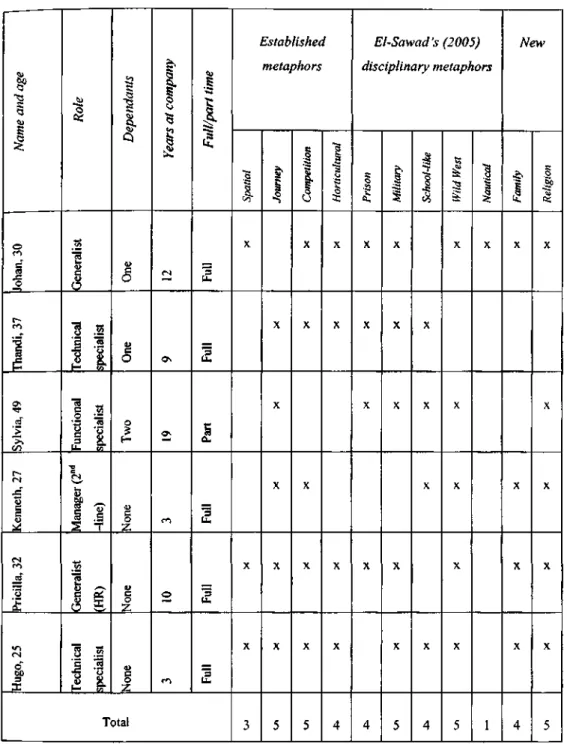
This table is a replication of the one produced by El-Sawad (2005) in her study, which can be referred to, to compare the findings of current studies against it (see Appendix A).
Established career metaphors
Spatial and journey metaphors
Even though Johan doesn't have the training to allow him the career advancement he wants, he realizes that there are still people in the company who are interested in his career. Five of the six participants in the current study used travel metaphors to discuss their careers. Kenneth's metaphor shows that the pace of one's progress is an important feature of the career journey.
Therefore, the idea of the career management department was "launched" or "launched" as Thandi expresses it.
Competition metaphors
Kenneth's career record shows that 'winning' is important to him and that competition in the workplace and at university have similar aspects in common. It is likely that the competition Kenneth faced during his tertiary education could have prepared him to expect a similar scenario in the workplace. While Kenneth admits that his career development has been accelerated by the country's engineering shortage, he also suggests that his career success has to do with personal dedication.
He suggests that "I was quite lucky to get this position" given that his employment and 'training' time with the company has been so short.
Horticultural metaphors
During Thandi's nine-year tenure at the company, she was cut twice, meaning she was retrenched twice. Hugo indicates that the employees (including his manager and mentor) who were involved with him and the other engineering students during their studies, “would like us to grow in the company”. Pricilla feels like she has 'grown' in the company, because she started as a 'little plant'.
She suggests that she has received practical training from people in the organization as she constantly asks for more experienced people's advice.
Disciplinary career metaphors
- Becoming a 'lifer' - career as imprisonment
- Military metaphors
- Career as school-like surveillance
- Nautical career metaphors
In the present study, four of the six participants used prison metaphors where they express the desire to 'leave' their organization but are unable to do so. In the current study, five of the six participants drew on military imagery to depict their careers. The present study shows the use of school-like supervision metaphors by four of the six participants.
Five of the six participants in the current study described their careers using Wild West metaphors.
New disciplinary metaphors
Family as team metaphors
Four of the six participants in the current study drew on family as a team metaphor to describe their careers. Gibson and Zellmer-Bruhn (2001) explore hidden differences in the ways teams are defined, which provides us with further insights into the functioning of an organization. Pricilla notes that her relationship with her manager has extended to a personal level, even though he holds a more powerful position in the organization.
It is ironic, then, that the "friendship" that Hugo assumes will resolve the conflict in the organization is actually a way for engineers to more easily exert their control and discipline over the rest of the employees.
Religion metaphors
Analysis of the metaphors produced by participants in the current study confirms that traditional careers are sustainable in the South African context. Analysis and critical discussion of participants' metaphors in the present study did not reveal employees who are free of constraints. This was the case in the current study, where participants showed some awareness and (worryingly) 'acceptance' of the regulatory nature of their careers.
The identification of metaphors may have been limited by the analytical framework borrowed from El-Sawad (2005).
Becoming a iifer'? Unlocking career through metaphor
Amal El-Sawad*
The surveillance of the 'disciplinary gaze', Gray argues, only partly explains the disciplinary effect of career. All participants describe the disciplinary dimensions of career (often through metaphors), while at the same time demonstrating at least partial acceptance of the discourse on career. The evidence presented in this article suggests that metaphor analysis can fulfill its promise when applied to the study of career.
Careers and the wealth of countries: a macro perspective on the structure and implications of career forms.