AFRICAN HUMAN MOBILITY REVIEW
Volume 5 Number 1, January – April 2019
Book Review: Children of Hope: The Odyssey of the Oromo Slaves from Ethiopia to South Africa by Sandra Rowoldt Shell
Decomposing Remittances from International Migration over Human Capital Development: Lesson from Nigeria Experience
Migrant Remittances Inspired Enterprises in Tsholotsho: Issues of Sustainability
Precarious Mobility: Infrastructures of Eritrean Migration through the Sudan and the Sahara Desert
The Value of Human Dignity in the Refugee Protection
The Migration Processes in Ghana: The Case of Northern Migrants
ii
AHMR
_________________________________________________________________________________
Chief Editor
Prof Mulugeta F. Dinbabo University of the Western Cape, South Africa Board Members
Dr Beneberu Assefa Wondimagegnhu Bahir Dar University, Ethiopia Dr Delali Margaret Badasu University of Ghana, Ghana
Dr Edmond Agyeman University of Education, Winneba, Ghana Dr Ernest Angu Pineteh University of Pretoria, South Africa Dr Joseph Yaro University of Ghana, Ghana
Prof Laurence Piper University of the Western Cape, South Africa Dr Linda Oucho African Migration and Development Policy Centre, Kenya Prof Loren Landau University of Witwatersrand, South Africa
Dr Lothar Smith Radboud University, Netherlands
Dr Meselu Alamnie Mulugeta Bahir Dar University, Ethiopia
Prof Raul Delgado Wise Universidad Autónoma de Zacatecas, Mexico Dr Razack Karriem University of the Western Cape, South Africa Dr Sharon Penderis University of the Western Cape, South Africa Prof Simon Bekker University of Stellenbosch, South Africa Prof Shimelis Gulema Stony Brook University, New York Prof Thomas Faist Bielefeld University, Germany
____________________________________________________________________________________
AHMR is an interdisciplinary peer-reviewed on-line journal created to encourage and facilitate the study of all aspects (socio-economic, political, legislative and developmental) of Human Mobility in Africa. Through the publication of original research, policy discussions and evidence research papers, AHMR provides a comprehensive forum devoted exclusively to the analysis of contemporaneous trends, migration patterns and some of the most important migration-related issues. AHMR is published by the Scalabrini Institute for Human Mobility in Africa (SIHMA) a member of the Network of the Scalabrinian Centers for Migration Studies, with institutions in New York, Paris, Rome, Buenos Aires, Sao Paulo and Manila. AHMR is accredited by the Department of Higher Education and Training (DHET) in South Africa.
Articles and reviews in AHMR reflect the opinions of the contributors. All rights reserved. No part of this publication may be reproduced without the written permission from the publisher.
ISSN 2410-7972 (online) ISSN 2411-6955 (print). Webpage: www.sihma.org.za Copyright © 2019 by the SCALABRINI INSTITUTE FOR HUMAN MOBILITY IN AFRICA
47, Commercial St, 8001 Cape Town – South Africa Tel. 0027 021 461 4741, Email: [email protected]
iii
African Human Mobility Review
___________________________________________________________________________
African Human Mobility Review, Vol. 5, No. 1 (April 2019)
1439 Book Review: Children of Hope: The Odyssey of the Oromo Slaves from Ethiopia to South Africa by Sandra Rowoldt Shell
1443 Decomposing Remittances from International Migration over Human Capital Development: Lesson from Nigeria Experience Asogwa Ikechukwu Sebastine, Anumudu Charles Nnamdi, Ugwuanyi Charles Uche and Ogbuakanne Maryann Uche
1459 Migrant Remittances Inspired Enterprises in Tsholotsho: Issues of Sustainability
Gracious Maviza, Mandlenkosi Maphosa, Nevel Tshuma, Zenzo Dube and Tomson Dube
1482 Precarious mobility: Infrastructures of Eritrean Migration through the Sudan and the Sahara Desert
Tekalign Ayalew Mengiste
1510 The Value of Human Dignity in the Refugee Protection Callixte Kavuro
1535 The Migration Processes in Ghana: The Case of Northern Migrants Shamsu Deen-Ziblim and Adadow Yidana
1439
Book Review
Children of Hope: The Odyssey of the Oromo Slaves from Ethiopia to South Africa, by Sandra Rowoldt Shell. Ohio University Press, 2018, 352 pages. ISBN: 978- 0-8214-2318-9. Hardcover price: $49.95.
Hewan Girma
University of North Carolina
Sandra Rowoldt Shell’s recounting of 64 first-person narratives of enslaved Oromo (Ethiopian) children is an innovative and well-written piece of research. As the Horn of Africa is an under-researched geographic area for the study of both domestic and external slave trades, the plurality of these first- person slave narratives has much to teach the reader about the sensitive topic of African domestic slavery. While we can question if these accounts of the enslaved children (aged 10–19, with an average age of 14 at the time of the interviews) are typical, they nonetheless reveal a complicated and detailed history of slavery from the Horn of Africa.
Shell systematically coded the narratives to highlight trends and generate keen insights into the ordeal of the children’s first passage (moments of capture, identities of initial captors and subsequent slave traders, the commodity value of the enslaved, gender differences in terms of treatment and value, periods of domestic servitude, pre-capture social status, parental occupation, etc.). Shell employs prosopography, a methodology of quantitative history (cliometrics) to systematically analyse the collective characteristics of the biographies. Although she provides a brief synopsis of each of the 64 narratives in an appendix, Shell analyses them as a group, highlighting similarities and variations in the children's’ experiences. In addition to the narratives, Shell uses archival data, such as the records of the Royal Navy which liberated the children, and missionaries who interacted with the children at different times post-emancipation. Additionally, Shell refers to other external sources such as school records, a survey on repatriation issued by the Lovedale Missionary Institute in 1903, death registers, personal correspondence, and other official documentations, thus providing for a more complete picture. Moreover, to complete her rigorous methodological arsenal, Shell employs Geographic Information System (GIS) to map out the internal
1440 journeys the children took before reaching the coastal areas and being transported out of Africa across the Red Sea.
The practice of slavery, both domestic and international, was widespread in the Horn of Africa in the 18th and 19th centuries. It was only outlawed and abolished in Ethiopia in 1936 under the regime of Haile Selassie. Domestic African slavery has been alternatively interpreted as ‘rights-in-persons’ and
‘slavery-to-kinship’ continuum within an intricate system of African social and kinship relationships. In the example of the Oromo, the practice known as guddifachaa meant that child war captives were adopted and therefore incorporated into the victors’ kin group. In effect, this became a system of kinship absorption or ambiguous slavery, although disagreements on these interpretations abound. In the late 1880s, Ethiopia experienced a devastating drought and ensuing famine that wiped out one-third to one-half of the country’s population. Bartering children for food became a means of survival, and Shell aptly notes that “enslavement was an individuated, not a collective process” (p. 191).
Shell indicates that there was no “concerted plan to enslave a particular group,” but that circumstances brought together 64 children who “shared a common heritage and a broad, common area of origin” (p. 194). While 83% of the enslaved children are of Oromo origin, 7% were Kafficho, 2.4% were Shangalla, Gurage, and Yamo, and the ethnicities of 7.1% of the children could not be determined. Shell erroneously asserts that these other ethnic groups are cognate with the Oromo or share strong genealogical or political links to the Oromo. In fact, these other ethnic groups were raided and enslaved, not just by highlanders, but also by Oromo slavers. Unfortunately, this is not the only place where Shell makes an erroneous assertion about ethnic identity in Ethiopia. The enslaved children repeatedly describe their captors and slavers as ‘Sidama’, which Shell misinterprets as Abyssinian. For an Afaan Oromo speaker during the turn of the 20th century, ‘Sidama’ was a generic term that referred to non-Oromos, outsiders, aliens, or enemies. Therefore, equating
‘Sidama’ with Abyssinian is reductive and incorrect. This misrepresentation is a disservice to the author’s otherwise brilliant scholarship as it stretches the narratives of the enslaved children to fit within a particular contemporary narrative. It also highlights the author’s limited knowledge about crucial aspects of Oromo history, their internal migrations, and their encounters with other communities. A discussion of the place of the Oromo in the larger story of local and transnational networks of slave trade in the Indian Ocean World is missing.
1441 Shell argues that “any a priori assumptions that slaves were garnered from only the poorest and humblest of Ethiopian society have to be abandoned” (p.
50), and advocates for an understanding that the children came from a broad spectrum of social strata, even royal lines. Although the enslaved children emanated from all socioeconomic backgrounds, their religious status is revealing. The Ethiopian Orthodox Church purposely neglected to penetrate the southern territories of its empire, enabling a continued source of subservient populations. As a result, the Oromo either retained their traditional belief system of Waqqifecha, which is closely linked with the Gaada system of governance, or converted to Protestantism and Islam. All of these religions were subjugated compared to the older Ethiopian Orthodox tradition. This also meant that the Oromo population could be used as slave labour by the more dominant ethnic groups based on religious grounds.
Shell makes some problematic and indefensible comparisons between the racial segregation of South Africa’s apartheid regime and Ethiopia’s present- day system of ethnic federalism. How can one conscionably compare a system of white (colonial) supremacy with indigenous ethnic federalism? She further rehashes a limited history of the ‘colonization’ of Oromo principalities by the Abyssinian Empire without providing the necessary nuanced context to understand this complicated history of state expansion. For instance, while Shell mentions the system of guddifachaa, whereby individual children are adopted into a new family, she neglects to address the system of mass assimilation campaigns knows as mogassa, where entire communities are voluntarily or forcibly integrated into the Oromo group, thus gradually increasing the size of the Oromo population. Shell ardently criticises Ethiopian studies for bypassing the history of the Oromo, whom she paints as singularly oppressed, blurring the boundary between scholarship and political practice.
Yet, Ethiopian studies has made tremendous strides over the last 60 years that take into account most of the criticism that Shell levels. Nonetheless, since this problematic historical reexamination of the ethnic plurality of Ethiopia is not the key intervention of this book, it can be begrudgingly overlooked.
While the internal trade of domestic slavery was controlled locally, Arabs governed the Red Sea trade. From initial capture to the Red Sea crossing, the enslaved took slow and intricate internal routes and were used as domestic slaves. The author limits her analysis to the length of time between initial capture and arrival at the Red Sea crossing (from 1 to 9 years), and notes differences in the children’s treatment based on gender. Since the girls were viewed as more valuable, their trek was generally shorter than that of the boys.
1442 Moreover, while the first passage (from capture to the coast) was arduous, the middle passage across the Red Sea (unlike the Trans-Atlantic Slave trades) took a matter of hours. In 1888 and 1889, the enslaved children were loaded into dhows with the intended destination of the Arabian slave market. When the dhows carrying the enslaved children were intercepted by the British Royal Navy, the enslaved children regained their freedom. The year of the Oromo children’s liberation coincides with the ascendency of King Menelik II to Ethiopia’s imperial throne in 1889. The children became ‘prize slaves’ as the British were rewarding the liberation of slaves after the abolition of the slave trades in 1807. The irony that the Europeans who were the biggest instigators and beneficiaries of African slave trades later became the self-styled saviors of enslaved Africans is somehow lost in this narration.
After reaching Aden, the British decided that sending the children back to Ethiopia would potentially condemn them to a life of slavery. The Lovedale Missionary Institute in the Eastern Cape of South Africa (founded in 1824 by the Glasgow Missionary Society) would eventually become the home of the enslaved Oromo children. The gender differences upon arrival were marked.
The author notes that the girls seem traumatized, probably due to sexual trauma that the narratives fail to capture. Since Lovedale was the leading missionary institution of its era in South Africa and educated many future leaders, the Oromo children received unrivaled education. While Shell implies that race did not matter in the integration of the Oromo children in South Africa, it is impossible to imagine this to be the unadulterated reality. After receiving their education in South Africa, between 1900 and 1908, 21 of the 64 Oromo children eventually returned to Ethiopia (8 independently and 13 with German assistance). Others either died or permanently remained in South Africa. The fates of the rest are unknown.
Overall, this book provides the reader a complete overview of the children’s lives from pre-capture to enslavement to eventual return to their homeland. It is unequivocally a must-read for any person interested in the African slave trade, particularly as it concerns the first passage. For future research, it would be informative to learn about the long-term fairings of the survivors and their lives in South Africa and Ethiopia.
1443
Decomposing Remittances from International Migration over Human Capital Development: Lesson from Nigeria Experience
Asogwa Ikechukwu Sebastine, Anumudu Charles Nnamdi, Ugwuanyi Charles Uche and Ogbuakanne Maryann Uche
Abstract
The aim of this study is to ascertain the distribution of international remittance inflow as opposed to the level attained in education before migration. The study uses the Gini coefficient decomposition analysis for the emigrants’ remittances and the logistic regression model to ascertain the distribution of emigrants’
remittances as opposed to the level of human capital development in education completed before migration. Evidence from the study shows that the level of education completed before migration contributes to the unequal distribution of remittances across the emigrating groups. The Gini coefficient for primary school or lower, secondary, technical, tertiary and other levels of education are 0.09, 0.08, 0.07 and 0.08 respectively with their corresponding Theil indices being 0.014, 0.011, 0.001 and 0.011 respectively. These statistics suggest that the advancement in human capital development in education before migration would reduce the inequality in remittance inflow. The policy implication of this finding supports the migration policies that encourage education before migration as it reduces the inequality in the remittances.
Keywords Nigeria, remittance, human capital development.
Department of Economics, Michael Okpara University of Agriculture, Umudike, Abia State, Nigeria and Department of Economics, University of Nigeria Nsukka. Email:
Department of Economics, Michael Okpara University of Agriculture, Umudike, Abia State, Nigeria. Email: [email protected]
Department of Economics, Michael Okpara University of Agriculture, Umudike, Abia State, Nigeria. Email: [email protected]
Centre for Entrepreneurship and Development Research (CEDR), University of Nigeria, Nsukka. Email: [email protected]
1444 Background to the Study
According to the International Organization for Migration (IOM), the United Nations (UN) migration agency, a migrant is any person moving or who has moved across international borders or within a state away from his or her habitual place of residence (IOM, 2017). This implies that migration is the overall movement of people between countries, which applies to both immigration and emigration. Immigration refers to people coming into a country while emigration refers to people leaving a country for a different country. According to Stalker (1997), International migration is one of the major keys that drives the globalization process. Likewise, IOM (2016) reveals that international migration is a force for development and international cooperation for both countries of origin and countries of destination. Since the late 1980s, migration across borders has been rapidly increasing and high to industrialized countries over time than the migration to developing countries.
For example, the growth rate of the migrants’ stock for industrialized countries between 1990 and 2015 rose to 3.0% from 2.9% during the period 1975 to 1990, while the migrants’ stock for developing countries declined to 0.5% during the period 1990 to 2015, from 2.6% stock during the period 1975 to 1990 (UN, 2016 and Zlotnik,2004). The recent UN’s 2017 International Migration Report also reveals that international migrant statistics have continued to grow rapidly over the past fifteen years, reaching 258 million in 2017, (UN, 2017). In terms of overall international migration, in 2015 two- thirds of all international migrants lived in Europe, estimated at 76 million (78 million in 2017), while 75 million lived in Asia (in 2017) this had increased to 80 million). In 2015 Northern America hosted the third largest international migrants, estimated at 54 million (58 million in 2017) followed by Africa with 21 million (up to 25 million in 2017), Latin America and the Caribbean with 9 million (up to 10 million in 2017) and Oceania remained steady at 8 million (UN, 2016, 2017). The percentage growth rate of international migrants from 2000-2010 is 23.69%, 2010-2013 is 8.411%, and 2013-2015 is 5.172%.
Hence, over the period 1995-2017, the international migration growth rose to 93% and this demonstrates a significant growth in the global migration patterns, (UN, 2017).
Despite the fact that sub-Saharan Africa as a host, receives more refugees as caused by conflict and political instability, the region sends forth both skilled and unskilled labourers to the rest of the world, leading to a labour supply to other countries. Nigeria, Côte d’Ivoire and South Africa have emerged as the top recipients of intra-sub-Saharan migration with 0.9 million, 2.3 million and
1445 2 million people as the stock of migrants respectively. In recent times, the majority of immigrants in Nigeria are from Economic Community of West African States (ECOWAS) countries, but not as refugees, since the refugees constitute a small proportion of the overall immigrants stock of 0.9% from 2007 to the present time (Afolayan, 2009). Nigeria as an important destination for migrants in the West African region, has increasing numbers of emigrants in return. Nigeria as a host country or country of origin to immigrants as well as a sending country for emigrants has experienced some economic improvement as a result of the migration through remittance. However, it is currently unclear if the inflow of foreign remittances is spread equally or unequally across the emigrants, especially considering the level of human capital development of the emigrants before migration.
It is becoming evident that Nigeria as a developing country is traditionally an important destination for migrants in Africa, but Nigeria also sends forth emigrants to other countries. The implication of the rising emigration from Nigeria has resulted in a negative net migration rate per 1000 people to -0.3%
in 2005 from -0.2% in 2000; the trend, as projected, got worse in 2010 to - 0.4% and that, that about 1,041,284 Nigerian nationals lived abroad with 0.6% of the country’s population to be emigrants (Afolayan 2009) . The study further reveals that Nigerian emigrants majorly live in Sudan (24%), United States (14%), United Kingdom (9%), Cameroon (8%) and Ghana (5%), (Afolayan 2009) and that in 2013, two-thirds of emigrants from Nigeria, which is 64.4%, were residing in more developed regions,(UN, 2013). This conforms to the projection of the United Nations on the rising Nigerian emigration rate.
Current estimates in 2017 shows that Nigerian international migration as a percentage of the total population is 0.6% from and this represent a rise from 0.4% in the year 2000, (UN, 2017). Likewise, IOM,(2018) report reveals that the international migration by major region of residence as at 2015 for Africa was 22million, Asia was 76million, Europe was 77million, Caribbean was 9million, America was 54million and Oceania was 8million.
It is not in doubt that there are wide-ranging impacts of migration on development such as human trafficking, social development, health, environment, employment and the labour force. The most common impact of emigration is on the remittance inflow into Nigeria. According to Afolayan (2009), the inflow of remittances into Nigeria prior to 2004 was under $2.0 billion but rapidly rose to $2.3 billion in 2004, $6.5 billion in 2005, $10.6 billion in 2006, and $18.0 billion in 2007. In the recent time, the annual growth rate of remittance inflow in Nigeria for 2015, 2016, 2017 and 2018 were 1.69%, -
1446 6.99%, 11.79% and 10.49% respectively, (World Bank 2017). However, a major factor to be considered here, is the impact of the level of human capital development in education acquired by the emigrants before migration, on the remittance inflow. A related factor is the distribution of the total remittance inflow over the level of human capital development in education acquired by emigrants before migration. In the light of Afolayan (2009), the propensity to migrate is particularly high among the highly skilled or educated and further reveals that in 2000 that 10.7% of the highly skilled population who were trained in Nigeria worked abroad, which is an example of the so-called ‘brain drain’, which impacted most severely on the medical sector.
Despite the gains from international migration, government policies had constantly tried either to maintain the current migration or to decline it. For example, among the 195 countries with Nigeria inclusive a large majority of governments (73%) either had policies to maintain the current level of immigration or they were not intervening to change it, while 16% had policies to lower and 11% had policies to raise it. It is on this premise that the following two key questions are raised. Firstly, what is the distribution of the total amount of remittance, as opposed to the level of human capital development in the education acquired before migration? Secondly, does the level of education acquired before migration have a significant effect on the total amount of remittance inflow?
Theoretical Literature Review
International migration is as old as human existence. It is difficult to discuss global integration without recognizing the role of migration (UN, 2013).
Several theories have discussed migration with a variety of views and concepts both in economic, social and psychological concepts yet there is no unified model on what, why and how people migrate. Some of the theories of migration have both macroeconomic and microeconomic foundations and these are discussed below.
Early Theory of Migration and Neoclassical Macro-Theory
The early theory of migration is based on the economic analysis of Smith’s (1776) “Inquiry into the nature and causes of the wealth of nations” and is further buttressed by the views of Lewis (1954), Hicks (1963) and Harris and Todaro (1970) on labour market theory, as cited by Olejarova (2007). While the early theory on migration focused on domestic migration, it was closely linked to the location model from regional economics and economic
1447 geography. Smith emphasized that there is greater spatial dispersion of wages than commodity prices. This further suggests that migration is potentially a response to spatial disequilibrium in the labour markets. The formalized model of Smith’s hypothesis to show that labour moves from location ‘i’ to location ‘j’ if the wage is higher in ‘j’ than in ‘i’ and that the volume of migration is related to the wage differential, as illustrated below:
Mij = βij(Wj-Wi),…(1)
Where W is the wage, M is the number of migrants and β reflects barriers to migration, such as distance, policy restrictions, etc. that may reduce the speed at which wages adjust to migration. The parameter takes on higher value when the barriers to migration are reduced.
On the other hand, the contributions of British geographer, Ravenstein (1889) and American economist, Jerome (1926) added to the formulation of a set of migration laws:
a) most migrants move only a short distance and usually to large cities;
b) cities that grow rapidly tend to be populated by migrants from proximate rural areas and gaps arising in the rural population generate migration from more distant areas;
c) out-migration is inversely related to in-migration;
d) a major migration wave will generate a compensating counter-wave;
e) those migrating long distance tend to move to large cities;
f) rural persons are more likely to migrate than urban persons; and g) women are more likely to migrate than men.
The highlighted laws were jointly summarized, using the gravity model of migration, which states that the product of the population of the origin and destination are inversely proportional to the distance between the two, as illustrated below:
Yp = P(1)P(2)/D,…(2)
Where Yp is the product of migration, P(1) is the origin population and P(2) is the destination population and D is the distance between origin and destination.
1448 Dual Labour Market Theory
The dual labour market theory, like other macroeconomic theories, queries the rational choice in decision-making about migration made by individuals and argues that international migration stems from the intrinsic labour from modern industrial societies. Piore (1979) laid the claim that the lasting demand for immigrant labour is associated with the economic structure of developed countries. The sub-sectors of the economic structure include: a high wage-level sector and a low wage-level sector. The high wage-level sector comprises a capital-intensive method of production while the low wage-level sector is characterized by the labour-intensive method of production.
Empirical Literature
Despite migrants being the most vulnerable members of a society, evidence has shown that there are both positive and negative sides of international migration, which are determined by a number of factors. Naude (2009) lists conflicts, environmental and economic factors as the key determinants of migration. The paper stresses further that conflict is a major cause of forced migration in sub-Saharan Africa. The environmental degradation, desertification and deforestation along with other natural disasters like floods or drought are all factors that force migrants into migration as a coping strategy. African as an agro-based region records increased migration of labour in the face of the existing environmental pressure (Grote and Warner, 2009). Similarly, Adepoju (2005) sheds light on migration in West Africa, stating that migration in this region is caused by population pressure, inequality, poverty, poor economic performance and economic conflicts during pre-colonial and colonial era. Zoomers and Naerssen (2007) also state that the high rate of migration in Africa is a consequence of increasing problems with the multi-cultural society in the receiving area, combined with a fear of invasion. Lidak’s (2014) empirical evidence on the impacts of migration shows that migration brings a large number of problems to European countries, that fundamentally influences the policies of liberal democratic nation states.
The literature analyses international migration on two dimensions, namely the micro and the macro levels. The macro theories explain the structural conditions that influence the international migration flow, including economic, political and cultural factors. The micro theories, on the other hand, approach it from an individual level of decision-making. The statistics of study from Darkwah and Verter (2014), reveals that Europe received about half a million
1449 people illegally, who were mostly economic migrants from Asia and Africa.
Regarding the determinants of international migration, unemployment and population pressure are among the key determinants of migration in Nigeria.
In the work of Darkwah and Verter (2014), the linear regression model result showed that the log of unemployment, the log of remittances and the log of population were the significant factors determining emigration from Nigeria with 0.15%, 0.05% and 11.3% positive magnitudes respectively. The study tends to mirror migration and remittance situation in the Nigerian context, although the use of time series data for the analysis limits the knowledge on the patterns of emigration and inequality in the households in Nigeria.
A study by Ratha, Mohapatra and Scheja (2010) reveals that international migration is a channel of remittance access with positive impacts on the development of an economy, in both sending and receiving countries. Ratha et al. (2010) draw attention to the social impacts of international migration on poverty, inequality and human capital development, despite the negative impacts and social costs of international migration. A study on Nigeria by Fonta,Onyukwu and Nwosu (2011) reveals that remittance income could play an important role in mitigating poverty and income inequality. It also found that the impact of remittances is unevenly distributed across the different regions by gender and by levels of educational attainment. The evidence from the study using the Foster-Greer-Thorbecke (FG 1984) model states that a scenario where the head of the household without formal education, who receives remittances, reduces poverty by 0.07%. On the other hand, if the head of the household had attained a tertiary-level education and receives remittances, the poverty rate declines by over 0.22% (Fonta et al., 2011).
Although the findings from this study seem interesting, the findings do not take into consideration the knowledge and the skills-level attained by the emigrants prior to migration, who send remittances to their home countries – which is the focus of this study. That knowledge could mirror the welfare status of the households back home, thereby validating the level of significance of the findings.
The decision to migrate varies from individual to individual. According to King (2012), the phenomenon of the immobility of people raises a series of questions on migration adventure. For example, if about 97% of the world’s population does not migrate, does the 3% of the world’s population who are migrants, have a peculiar reason for doing so? Is immobility linked to the lack of access to travel resources? Is it a choice of the population of a country to choose to be immobile? What are the factors that can determine the patterns
1450 of international migration? Are there common drivers of international migration? Which patterns of international migration best explain the migration patterns in Africa?
Yaro (2017) posits that West Africa has a long history of population mobility, both in the continent and internationally. On the African continent, with its 54 countries, 35.7% of migration is from central Africa, 5.8% is from Southern Africa and 44.6% is from West Africa.
Analytical framework
This study uses the Gini decomposition technique to analyze the extent of equal and unequal distribution of the international remittances in relation to some level of human capital development in education attained before migration. According to Stark et al. (1986) as cited in Fonta et al. (2011), the Gini coefficient is a measure of inequality of a distribution and it is defined as the ratio with values between 0 and 1. The income inequality, G, is calculated as follows:
) 3 ,...(
1
ki
k k k
t
R G S
G
Where Sk = household share of income source k on total income, Gk = the source Gini and Rk = Gini correlation of income from source k with the distribution of total income. Following the equation (3), we are therefore allowed to decompose, firstly, the total remittance income upon distribution or inequality as a function of the level of skills that the emigrants attained before migration (Sk); secondly, the extent of the equal or unequal remittance distribution (Gk);
thirdly, how remittance inflow sources and the distribution of total remittances are correlated (Rk). This determines the extent to which the level of human capital development in education influences the odds of remittance inflow.
In the second experiment estimating the impact of the level of human capital development in education acquired before migration, on the odds of emigrants’ remittance inflow, this study uses a logistic regression model.
Logistic Regression Model
Logistic regression is a mathematical model used to describe the relationship of several Xs to a dichotomous dependent variable. The functional form of the
1451 logistic regression model as stated by Kleinbaum and Klein (2010) is as follows:
F(Z) = ..0 ( ) 1
) 4 ( ...
...
...
...
1 ) 1 (
z f for
z
F z
Z is the vector of the explanatory variables and coefficients. Below is an illustration of the prediction of the probability of a logistic regression model.
) 6 ( ...
...
1 ) (
) (
1 ) 1 ( Pr
1 1
1 1
k i
k k k k i
k
x x k
k
k
k k k k
kx L x
L Y
ob
The Prob(Y = 1) is the probability of an occurrence or treatment as opposed to the event not occurring or not being treated. Below is an illustration of the model, in a compact and linear form:
) 7 ( ...
...
...
1 ) ( )
( ) /
( i i i Xi i
P Log P W
E x X W
P
The dependent variable Wi is a linear function of the vector of conditioning variable Xi while the log
1 ( )
) (
w p
w p
is the natural log of the treatment odds.The functional form of the regression model above allows this study to estimate the impact of skills and the duration of stay of the emigrants on the odds of remittance inflow into Nigeria as specified below:
) 8 ....(
...
_ _
_ ))
( 1
) ( (
5
4 3
2 1
i location
sex group migration stay
duration level
skilled R
P R Log P
Where log(P(R)/1- P(R) is the odds ratio of the emigrants ever sending money as opposed to not sending money. If the emigrant ever sends money, the probability P(R) of response takes yes or 1, but if the emigrant never sends money 1- P(R), the outcome takes no or 0. The skills level of the emigrant is the level of skill attained by the emigrant before migration. The level of skills of the emigrants is classified as ‘primary school or lower’, ‘secondary level
1452 technical/vocational school’, ‘tertiary/university’, ‘others’ and ‘people that don’t know’. The duration of stay is defined as the length of period the emigrant lived abroad since migration. Sex is classified into male or female.
Although the level of skills attained by the emigrants before migration is primarily the variable of interest for this study, the other variables are used to check for interaction effects.
Data Source and Scope of the Study
The scope of this study is limited to Nigeria, using survey data on migration from Nigeria by the International Organization for Migration (IOM) in 2009.
The performance of emigrants is measured by the dichotomous outcome of whether the emigrants ever send money to the home country or not. The level of skills of the emigrants is measured in terms of education levels attained before migration, taking into consideration primary education, secondary education, tertiary education and other unspecified training, as well as socio- economic characteristics of the emigrants, including gender, location and duration of stay.
Analysis and Discussion Inequality Decomposition
The inequality aversion shows how sensitive income difference is to inequality aversion. The more positive e > 0 is, the more sensitive A(e) is to income difference at the bottom. Table 1 shows that remittances are less sensitive to the inequality on the emigrant level of human capital development. For example, A(1) = 0.01383, which is very close to zero.
Table 1: Atkinson indices, A(e), where e > 0 is the inequality aversion parameter
All Obs A(0.5) A(1) A(2)
0.00676 0.01383 0.02906
Computed by authors using Stata 12.
Inequality Decomposition of Remittances by Sub-Groups
The Gini coefficient is the aggregate numerical measure of income inequality ranging from 0, which is perfect equality, to 1 for perfect inequality. The higher the value of the coefficient, the higher the inequality of income distribution;
the lower it is, the more equal the distribution of income. Table 2 below shows
1453 that emigrants’ remittances across the levels of human capital development in education attained before migration, are generally close to equal distribution.
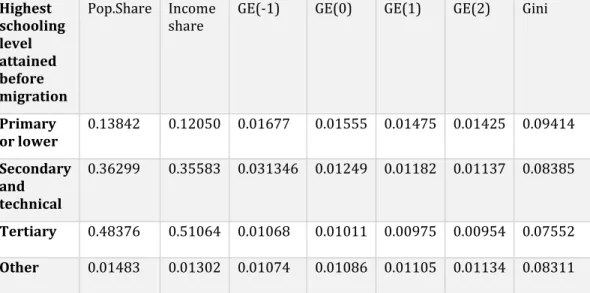
But from the groups of the level of human capital development, the Gini coefficient for primary school or lower, secondary and technical, tertiary and others are 0.09, 0.08, 0.07 and 0.08 respectively with their corresponding Theil indices at 0.014, 0.011, 0.001 and 0.011 respectively. These statistics suggest that the advancement in human capital development (education) before migration reduces the inequality in remittance inflow. The policy implication of these findings is that migration policies with human capital development can reduce the inequality in the remittances. This is supported by the Gini coefficient of the primary or lower level of human capital development (0.09414) which remained higher than other levels of human capital development.
Table 2: Sub-groups indices GE_k(a) and Gini_k Highest
schooling level attained before migration
Pop.Share Income
share GE(-1) GE(0) GE(1) GE(2) Gini
Primary
or lower 0.13842 0.12050 0.01677 0.01555 0.01475 0.01425 0.09414 Secondary
and technical
0.36299 0.35583 0.031346 0.01249 0.01182 0.01137 0.08385
Tertiary 0.48376 0.51064 0.01068 0.01011 0.00975 0.00954 0.07552 Other 0.01483 0.01302 0.01074 0.01086 0.01105 0.01134 0.08311
Computed by authors using Stata 12.
Logistic Regression Result
Table 3 below with the results, shows the estimated odds of the logistic model for the study after 4 iterations. The odds of the emigrants sending money home is categorized as the probability of the emigrants sending money home (yes or 1) as opposed to the emigrants not sending money home after migration (no or 0). The odds ratio column represents the odds of Y = 1 (sending money
1454 home) with the change in the independent variables. If the odds ratio is greater than one, then the odds of Y = 1 increase but if the odds ratio is less than 1, the odds of sending money decreases. With the focus on the level of human capital development in education attained by the emigrants before migration, the increase in the education levels of the emigrants increases the odds of the emigrants sending money, is higher than the emigrant with primary school education only. The tertiary education level proved significantly different from the other levels of education or skills attained before migration. The increase in the duration of stay by the emigrants also increases the odds of the emigrants’ remittances. The presence of the emigrants from the rural areas also increases the odds of the remittance. On the other hand, the presence of female emigrants decreases the odds of the remittances, showing them to be lower than with the presence of males. Additionally, the presence of emigrants from African and other countries decreases the odds of emigrant remittance, making them lower than those of the Organization of Economic Cooperation and Development (OECD).
The variation explained in the model of the emigrants sending money home with the presence of the level of human capital development in education of the emigrants before migration, is 14.67%, but the model is significant with a probability value of 0.000 and the L-R Chi2(8) is 147.50.
Number of iteration = 4 Number of Observation = 769 LR Chi2(8) = 147.50
Prob > Chi2 = 0.0000 Pseudo R2 = 0.1467
Log likelihood = --428.82172
1455 Computed by authors using stata 12.
Policy Recommendations
Although the inequality in emigrants’ remittances as opposed to the level of human capital development (education) before migration is not quite pronounced, there is still no perfect equality.
Migration policies that promote human capital development in education before migration will significantly improve the unequal distribution of international remittances, as opposed to the level of human capital development. The promotion of human capital development in education before migration will also increase the odds of the inflow of international remittances in Nigeria. In order to achieve a perfect distribution in international remittances as opposed to the level of human capital development in education, the government could introduce and implement a policy mandating the attainment of specified levels of education, for emigration control in the country. Furthermore, human capital development Table 3: Odds ratio result
Odds-Remittance Odds
Ratio Std.Error Z P>/Z/ 95%
Conf. Interval Education
group:_Secondary 1.427838 0.4721536 1.08 0.281 0.7468028 2.729933 Education
group:_Tertiary 3.573276 1.20584 3.77 0.000 1.84425 6.923306 Education
group:_Others 0.2211937 0.1843808 -
1.81 0.070 0.0431753 1.13321
Females 0.4488508 0.0827441 -
4.35 0.000 0.3127418 0.6441961 Duration of stay 1.090695 0.0205603 4.61 0.000 1.051133 1.131746 Location:_Rural 1.298179 0.2227823 1.52 0.128 0.9273825 1.817233 Int.migration:_Africa 0.4140167 0.0798218 -
4.57 0.000 0.2837314 0.6041272 Int.migration:_Others 0.2509643 0.1200782 -
2.89 0.004 0.0982516 0.6410385
1456 in education would balance the effects the emigration of a high-skilled labour force – the so-called ‘brain drain’ – with the high inflow of international remittances into the country.
Conclusion
This study has established the impact of human capital development in education before migration, on the unequal distribution of international remittances. It was the aim of this paper to study the international remittance distribution as opposed to the level of the human capital development attained before migration. It applied a logistic-based regression model to determine the effects of the level of human capital development on the odds of sending money back to the households. Further study is required to investigate the decomposition of remittances to the households, both for the emigrants and non-migrants, as opposed to the level of human capital development. This will ascertain if there is a difference in the effects of human capital development as a treatment variable on remittances to the households, if data were available.
References
Adepoju, A.2005. Migration in West Africa. A paper prepared for the policy analysis and research programme of the global commission on international migration. Global commission on International Migration GCIM. From
<www.gcim.org> (Retrieved April 20, 2019).
Afolayan, A. 2009. Migration in Nigeria. A Country Profile 2009. International Organization for Migration (IOM). From <www.iom.int> (Retrieved February 5, 2019).
Darkwah, S.A. and Verter, N. 2014. Determinants of international migration:
The Nigerian Experience. Acta Universitatis Agriculturae et silviculturae Mendelbianae Brunesis. 62. From <https://bit.ly/2L1Ftfp> (Retrieved February 5, 2019).
Fonta, M.W., Onyukwu, O.E., and Nwosu, O.E., 2011. International remittance inflows and household welfare: Empirical evidence from Nigeria. Research Journal of Finance and Accounting.
Grote, U. and Warner, K. 2009. Environmental change and forced migration.
Brief 39, Migration and displacement in sub-Saharan Africa: The security- migration Nexus II. Bonn International Center for Conversion (BICC).
1457 International Organization for Migration (IOM). 2017. Who is a migrant?
International Organization for Migration. United Nations Migration Agency.
From <www.iom.int/home> (Retrieved April 24, 2019).
IOM, 2018. World Migration Report. International Organization for Migration.
UN Migration Agency. <www.iom.int> (Retrieved April 19, 2019).
Jerome, H. 1926. Migration and business cycles. Cambridge, Mass.: National Bureau of Economic Research (NBER), pp.77-88.
King, R. 2012. Theories and typologies of migration: An overview and a primer.
Willy Brandt Series of Working Papers in International Migration and Ethnic Relations. Sweden: Malmo University. From <www.bit.mah.se/muep>
(Retrieved February 5, 2019).
Kleinbaum, G.D. and Klein, M. 2010. Logistic regression, statistics for biology and health: A self-learning text. Third Edition. New York: Springer-Verlag.
Lidak, J., 2014. International migration, Europe and migration from Africa.
Asian African Studies, 23(2): 226-254.
Naude, W. 2009. Forced migration and conflict in sub-Saharan Africa. Brief 39, Migration and displacement in sub-Saharan Africa: The security-migration Nexus II. Bonn International Center for Conversion (BICC).
Olejarova, E. 2007. Labour migration as a socio-economic phenomenon:
Slovakia and the Czech Republic in a comparative perspective. Department of International Relations and European Studies, Central European University.
Piore, M.J. 1979. Birds of passage: Migrant labour in industrial societies.
Cambridge: Cambridge University Press.
Ratha, D., Mohapatra, S. and Scheja, E. 2010. Impact of migration on economic and social development: A review of evidence and emerging issues. Policy Research Working Paper, Global Forum on Migration and Development.
Washington DC: World Bank.
Ravenstein, E.G. 1889. The law of migration. Journal of the Royal Statistical Society, 52(2): 241-305. From <www.jstor.org/stable/29> (Retrieved February 5, 2019).
Stalker,P. 1997. Global nation: The impact of globalization on international migration. Employment and training department, international labour office, Geneva. International Labour organization. From <www.ilo.org> (Retrieved February 18, 2019).
1458 United Nations (UN). 2013. International Migration Report 2013 (ST/ESA/SER.A/346). Department of Economic and Social Affairs, Population Division. From <https://bit.ly/2KZxmQq> (Retrieved April 20, 2019).
United Nations (UN). 2016. International Migration Report 2015: Highlights (ST/ESA.SER.A/375). Department of Economic and Social Affairs, Population Division. From <https://bit.ly/2W2pdeV> (Retrieved April 20, 2019).
United Nations (UN), Department and Social Affairs, Population Division 2017.
International Migration Report 2017 Highlights (ST/ESA/SER.A/404).
<www.un.org> (Retrieved 7 April, 2019).
United Nations, Department of Economic and Social Affairs Population Division, 2013. International Migration Policies: Government views and priorities. ST/ESA/SER.A/342. <www.un.org> (Retrieved April 20, 2019).
World Bank, 2016. Migration and Development: A Role for the World Bank Group. <www.worldbank.org> (Retrieved April 20, 2019).
World Bank, 2017. Migration and Remittance Data. From
<www.worldbank.org> (Retrieved 19 April, 2019).
Yaro, J.A. 2017. Migration in West Africa: Patterns, issues and challenges. From
<www.Waifem-cbp.org/migration> (Retrieved February 5, 2019).
Zlotnik, H. 2004. International migration in Africa: An analysis based on estimates of the migration stock. Migration Policy Institute (MPI). From
<https://bit.ly/2XLCIjV> (Retrieved February 5, 2019).
Zoomers, A. and Naerssen, T. 2007. International migration and national development in sub-Saharan Africa: Viewpoints presented at the Conference on Trans-nationalization and developments towards a north-south perspective, Center for Interdisciplinary Research, Bielefeld, Germany, 31 May to 1 June 2007.
1459
Migrant Remittances Inspired Enterprises in Tsholotsho:
Issues of Sustainability
Gracious Maviza Mandlenkosi Maphosa, Nevel Tshuma, Zenzo Dube
and Tomson Dube
Abstract
Following unprecedented and protracted political and economic crises during the period spanning 2000 to 2009, Zimbabwe experienced increased migration of its populace to the diaspora. One notable positive result of this migration phenomenon has been an increase in the inflows of remittances, which have partly inspired the emergence of enterprises. In February of 2009, Zimbabwe introduced the multi-currency system, which introduced new dynamics related to the sustainability of these enterprises. This, coupled with the foregoing, called for the review of the sustainability of remittance-inspired enterprises to ensure their potential for survival in the interim and the long term. As such, the present study was guided by a framework produced by the International Labour Organization (ILO), which lists the six basic conditions necessary for nurturing sustainable enterprises. This study made use of both primary and secondary data that included a household survey carried out on 40 households and 10 key informant interviews. In line with five of the six pillars of the ILO framework, the study found the following: 1) there is a governance framework instituted by the District Council that regulates the operations of businesses; 2) the infrastructure to support businesses is either not in place or is in a poor state; 3) enterprises practice responsible stewardship of the environment; 4) the society and culture is supportive of enterprise formation; and 5) the macro-economic environment is riddled with uncertainties. The study concludes that whilst remittances
Institute of Development Studies, National University of Science and Technology, Bulawayo, Zimbabwe.
Institute of Development Studies, National University of Science and Technology, Bulawayo, Zimbabwe.
Institute of Development Studies, National University of Science and Technology, Bulawayo, Zimbabwe.
Institute of Development Studies, National University of Science and Technology, Bulawayo, Zimbabwe.
Institute of Development Studies, National University of Science and Technology, Bulawayo, Zimbabwe.
1460 provide seed capital for entrepreneurs to invest in Tsholotsho, the environment does not adequately support the sustainable running of those enterprises.
Keywords Migrant, remittances, sustainability, enterprises, Zimbabwe, Tsholotsho.
Introduction
From 2000 to 2009, Zimbabwe experienced a mass exodus of its populace to the diaspora due to the economic meltdown and political unrest that characterised this period. This phenomenon created different economic opportunities across the country, with the massive inflow of remittances to Zimbabwe from migrants leading to a significant emergence of enterprises in areas such as Tsholotsho.
This article seeks to address the questions that ensued from a study carried out in the same area, which sought to follow the distribution of remittance use between consumption and investment, analysed the kind of investments remittances promote in the local economy, and examined the impact of remittances on local development (Ncube & Gomez, 2011; Ncube & Gómez, 2015). Ncube and Gómez’s (2011; 2015) study used the ‘follow the money principle’ ethnographic technique. It involved recording several rounds of transactions in a village in rural Zimbabwe after receipt of cash from abroad.
The study paid attention to four indicative aspects of local development, namely income generation, agricultural productivity and growth, job and enterprise creation, and infrastructure improvements. Ncube and Gómez (2015: 191) found that remittances:
[...] Promote micro-enterprises and employment generation; increase the households purchasing power, which revitalises entrepreneurial skills among those that are inclined towards own-employment and leads to investments that add diversity and income to the local economy, resulting in what is referred to as productive consumption.
Furthermore, the study revealed that “productive consumption created opportunities for investment in growth-oriented SMEs, whether their owners are receivers of remittances or not” (Ibid). On one hand, the receivers formed a consumptive class with limited motivation to run new businesses. As such, they mainly focused on upgrading agricultural activities. On the other hand, the non-receivers formed a pool of low-wage labour (Ncube & Gómez, 2015).
The results from the study indicated that “the enterprises and jobs created were not particularly of high quality or innovative and their sustainability in
1461 the event that remittances cease flowing in was not ascertained” (Ncube &
Gómez, 2015: 191). This uncertainty necessitated further research into the sustainability of these remittance-inspired enterprises.
Furthermore, in February 2009, Zimbabwe introduced the multi-currency system, which brought new dynamics related to the sustainability of these enterprises. This, coupled with the foregoing, called for review of the sustainability of these remittance-inspired enterprises to ensure their potential for survival in the interim and the long term. To this end, this article amplifies the current understanding in development discourse that the Matabeleland region has had the highest incidence of emigration in the country and has experienced significantly high returns from remittances (Maphosa, 2005; Ncube & Gómez, 2011). According to Maphosa (2005: 3),
“remittances are the most important source of income for many households in the Southern [and Northern] districts of Zimbabwe.” In Tsholotsho, this high turnover of remittances has seen an increase in the development of enterprises that have possibly improved the employment rate in the region.
However, the sustainability of these remittance-inspired enterprises has not been established notwithstanding their high prevalence. Thus, this article investigates the sustainability of remittance-inspired enterprises in Tsholotsho District. This is done in light of the dynamics of the multi-currency systems and their broad impacts on enterprises.
Remittances and Entrepreneurship
Globally, remittances are worth billions annually with the World Bank (2018) estimating that in 2017 remittances amounted to US$613 billion. The World Bank (2018) goes on to indicate that remittances to low- and middle-income countries increased from US$429 billion in 2016 to US$466 billion in 2017.
For southern Africa, the remittances totalled US$38 billion in 2017 (Ibid). In 2017, the top remittance-receiving countries included India (US$65,380 million), China (US$62,850 million), Philippines (US$32,795 million), Mexico (US$30,534 million), Nigeria (US$18,956 million), and Egypt (US$18,199 million) (KNOMAD, 2019). In Zimbabwe, diaspora remittances have been steadily rising from a low of approximately US$300 million in 2009 to a high of US$939 million in 2015 (Reserve Bank of Zimbabwe, 2017; IOM, 2018).
In countries affected by long-term crises, migration is often seen as a key coping survival strategy, which leads to the formation of diasporas that play an important role in sustaining the livelihoods of those who remain behind.
Remittances are viewed as counter-cyclical. They increase during periods of
1462 crisis and therefore play an important role in enabling some people to survive in such periods. Zimbabwe’s migration trends and the size of the Zimbabwean diaspora population, although varied and contested, seem to confirm this view; the number of Zimbabweans migrating to the diaspora has been steadily increasing, especially during peak crisis periods. To this end, estimates of Zimbabweans in the diaspora range from a low of 571,970 living in the top five countries of destination (IOM, 2018) to an estimate of 1,253,100 (Ratha, Mohapatra, & Scheja, 2011) to a high of over 3,000,000 said to have emigrated over the last decade, with roughly two thirds of these migrants heading to South Africa (Von Burgsdorff, 2012). The top five countries of destination and their Zimbabwean populations in 2018 are as follows: South Africa (358,109), the United Kingdom (115,708), Malawi (35,287), Australia (34,034), and Botswana (28,832) (IOM, 2018). The significance of the size of the Zimbabwean diaspora community becomes clearer if one juxtaposes it with the size of Zimbabwe’s population of 13,061,239 in 2012 (IOM, 2018).
Maphosa (2005) notes that remittances from South Africa are the most important source of income for many households in the Southern districts of Zimbabwe. Indeed, Zimbabwean migrants working in South Africa, including undocumented migrants, remit significant amounts from their host country to their communities of origin (Ibid). Remittances are defined as “income (in any form) received by a household in one distinct place, from individuals or households living in another place” (Savage & Harvey, 2007: 10). However, for the purposes of this study, the remittances in question refer to money sent to Zimbabwe by emigrants in the diaspora.
Zimbabwe is one of the top ten emigrating countries in the sub-Saharan region (IOM, 2009). Most Zimbabweans in the neighbouring countries remit cash at least once a month. Those within the SADC region visit Zimbabwe frequently and, as such, are more able to remit in person (Ibid). It is estimated that Zimbabweans in South Africa remitted ZAR 5.1–6.8 billion, which is US$680–
905 million in 2011 (Von Burgsdorff, 2012). Remittances are now seen as a way of reducing poverty (IOM, 2009). It can be noted that remittances ease survival for the vulnerable and for some remittances can sustain local trading.
Chalise (2014) holds that a good investment climate with well-developed financial systems and sound institutions is likely to lead to a higher degree of remittances invested in physical and human capital. It is argued that remittances form a source of savings and capital for investment in education, health, and entrepreneurship, all of which have an effect on productivity, employment, and growth in both the short term and the long term (Nzima,
1463 2013; Mishi & Mudziwapasi, 2014; Nzima, et al. 2017). However, the largest impact on growth and development occurs when remittances fund productive investment.
Poverty tends to be higher in rural areas than in urban areas, and remittances are viewed as central elements of household strategies to overcome poverty and development constraints (De Haas, 2007). A significant number of studies reveal that households receiving remittances from across borders have a higher propensity to invest than non-migrant households when controlling for income and other relevant household variables per se (Ibid). De Haas (2007) notes that the extent to which money is remitted, and how and where remittances are spent by the recipient, essentially depends on the migrant’s social and economic position in the destination country, as well as on the investment conditions in the countries of origin. Jokisch (2002) posits that remittances have helped migrants to invest in land, cattle, and housing, and in some cases, remittances have not been focussed on agricultural improvements. They have also been used to pay for education and health, settle debts, perpetuate emigration, and fund luxurious consumption, such as large homes (Ibid).
Some scholars (Nzima, 2013; Ncube & Gómez, 2015; Nzima, Duma, & Moyo, 2016) argue that the ultimate impact of remittances on local development would be reflected by indicators such as employment creation, start-ups and investments in small enterprises, and an overall increased competitiveness. In their study carried out in Village 2 of Ward 19 in Tsholotsho District, Zimbabwe, Ncube and Gomez (2015) found that the recipients of remittances purchased assets that boosted their income streams and sustained them in the event of shocks. Inter alia, these assets included scotch-carts, livestock, solar panels, brick under asbestos, and zinc housing structures. Ncube and Gomez’s analysis revealed that the remittances increased household purchasing power, awakened entrepreneurial skills and thus led to investments that added diversity and income to the local economy. Maphosa's (2005) remittance study in Ward 7 of Mangwe District in Matabeleland, South Province of Zimbabwe, revealed that 31.2 percent of remittances were invested in agriculture. Ten percent was invested in the business sector, such as in general dealer shops, grindings mills, and bottle stores, amongst others.