EXAMINER’S COPY
Voice Interfaces in Mobile Human-Robot Collaboration for Advanced Manufacturing Systems
Submitted By:
Shane Pather (BScEng, UKZN)
214508491 November 2019
Prof. Glen Bright and Mr. Christian Basson, Mr. Avern Athol-Webb
Submitted in fulfilment of the academic requirements for the degree of Master of Science in Engineering at the School of Mechanical Engineering, University of
KwaZulu-Natal
Page | 1
DECLARATION
Declaration by Author I, Shane Pather, declare that
(i) The research reported in this dissertation, except otherwise indicated, is my original work.
(ii) This dissertation has not been submitted for any other degree or examination at any other university.
(iii) This dissertation does not contain other persons’ data, pictures, graphs, or other information unless specifically acknowledged as being sourced from other persons.
(iv) This dissertation does not contain other persons‟ writing unless specifically acknowledged as being sourced from other researchers. Where other written sources have been quoted then:
a) their words have been rewritten but the general information attributed to them has been referenced;
b) where their exact words have been used, their writing has been placed inside quotation marks, and referenced.
(v) Where I have reproduced a publication of which I am an author, co-author, or editor, I have indicated in detail which part of the publication was written by myself alone and have fully referenced such publications.
This dissertation does not contain text, graphics, or tables copied and pasted from the internet unless specifically acknowledged, and the source being detailed in the dissertation and in the References sections.
Signed: Date:
Mr. S. Pather Declaration by Supervisor
As the candidate’s Supervisor I agree to the submission of this dissertation.
Signed: Date:
Professor G. Bright Declaration by Co-Supervisor
As the candidate’s Co-Supervisor I agree to the submission of this dissertation.
Signed: Date:
Mr. C.I Basson
Page | 2
ACKNOWLEDGEMENTS
First and foremost, I would like to thank the Lord for the knowledge and strength he has given me to complete the research presented in this dissertation. I would also like to acknowledge the love and support of my family during the undertaking of this degree. A special thanks also goes out to my supervisors Prof. Glen Bright and Mr. Christian Ivan Basson for providing me with the platform to further my research in the field of Engineering. I would also like to thank Dr.
Alexandra Birch, a Senior Research Fellow at the University of Edinburgh for her guidance with problems faced by modern voice interface technology.
Page | 3
DEDICATION
Dedicated to the Lord, my family and the memory of my father
“Necessity is the mother of invention”
~ Plato ~
Page | 4
PREFACE
This paper investigated a conceptualized methodological approach for the integration of voice interface technology into a manufacturing environment. Voice interface technology was investigated to develop an operational benchmark – when subjected to simulated manufacturing conditions. The study subsequently established an optimization for the accuracy and reliability of a voice interface system. A proposed method of application for manufacturing environments using a mobile robot design was also investigated. The design of the voice interface optimization system focused on phrase accuracy and reliability; when subjected to common manufacturing noise conditions. The voice interface optimization system was subjected to a simulated manufacturing environment to create synthetic data, the data was empirically analyzed and tested to formulate appropriate conclusions. The mobile robot design paired with voice interface technology was developed to create a platform for the implementation of voice interfaces into manufacturing environments. The mobile robot was subjected to path accuracy testing to establish the validity of its embedded navigation system. Testing of the mobile robot design was carried out in a simulated manufacturing environment.
Page | 5
DECLARATION OF PUBLICATIONS
Presented below are the peer-reviewed publications that include the research presented in the dissertation. The undersigned agree that the following submissions were made and accepted as described and that the content therein is contained in this research.
Publication 1: IEEE Africon – 2019 (Accepted)
Pather, S. Basson, C and Bright, G. “An Elementary Review of Cloud Computing with Implications for Manufacturing Systems”, IEEE Region 8 flagship conference in Africa.
Published August 2019, 4 Pages.
Shane Pather was the lead author of this paper and conducted all research the supervision of Professor Glen Bright and Mr. Christian Basson.
Page | 6
ABSTRACT
Proliferating instances of voice interface technology outside the manufacturing domain has posed the question; why does the manufacturing domain lack voice interface technology? The fourth industrial revolution (Industry 4.0) has changed the face of modern manufacturing. Progressive development in the manufacturing domain proliferates with instances of Cyber-Physical Systems (CPS). These systems have proven to refine the manufacturing domain through effectively analyzing, monitoring, and creating an interoperable, automated, cyber-machine-centred environment. A fundamental aspect of CPS is data acquisition. Naturally, sensor-based tools and industrial communication technology must be considered to create an environment aligned to the ideals of Industry 4.0. The research that follows was motivated by the need for versatile and flexible mediums of communication within CPS. The research efforts aligned itself to establishing an effective means of incorporating voice interface technology into the manufacturing domain.
Due consideration was taken into the high levels of flexibility, reconfigurability, and adaptability associated with customizable manufacturing. The demand of intricacy and precision associated with robotic operations requires highly flexible communication interfaces. The research that follows firstly attempted to understand the reasons for absence, and implication of voice interface technology in manufacturing environments. The purpose of this paper was to investigate the performance of leading voice interface technology when subjected to manufacturing environment conditions. Additionally, an attempt was made to develop a structured conceptualized methodological approach for the implementation of voice interface technology into manufacturing environments. This area of research was explored to develop a platform for flexible robotic operations; as compared to the conventional tool-centered approach.
The field of voice interface technology introduces itself as a relatively new communication medium, and though these systems rapidly advance, methods of development present themselves as proprietary work of the technological institutes facilitating advancement. As such, the methodology structure that resulted was developed from a combination of work presented from academic literature, information gained from enrolment into courses facilitated by industrial experts, attending a workshop facilitated by a senior research expert in the field of voice technology, interviews with academic personnel, interviews with industrial experts and consultation with industrial engineers. Research and consultation presented critical areas of concern within voice interface technology for manufacturing environments being; lack of implementation methods in manufacturing environments, high levels of language fluency requirements, low interpretability constraints, being highly sensitive to the environment of use, and a low adaptability to different languages. Due to the lack of performance data, leading voice
Page | 7 interface technology, “OK Google”, was introduced into a simulated manufacturing environment.
Performance data was extracted using Googles Web-based voice data-logging system. A python programme was designed for the analysis of the accuracy and reliability of the extracted data – with key focus being placed on the phrase recognition rate. Thereafter, the data was subjected to a probability distribution analysis, namely, the probability density function. This was done to identify the validity of the results and a means of identifying inconsistencies. Results showed that
“OK Google” was capable of operating at a minimum phrase recognition rate of 69% when attempting to identify a phrase in a quiet room environment. The maximum phrase recognition rate for a quiet room environment being 93.5%. Additionally, “OK Google” proved incapable of executing a task when subjected to 70 and 80 decibel (dB) ranges. As such, the results obtained displayed a need for an optimization design of “OK Google”, so as to allow for implementation validity in manufacturing environments. The optimization design encompassed the use of web- based servers, and a cloud-based internet platform (IoT platform). This was done in an attempt to conform to the fourth industrial revolution, and to increase the reputability of voice technology in environments previously deemed unfit for implementation. The voice interface optimization design was subjected again, to a probability distribution analysis, and was introduced into a mobile navigation robot design to facilitate the ability to carry out task-based operations based on voice commands. The optimization system proved to increase the ability of “OK Google” when subjected to 70 and 80 dB ranges. The minimum and maximum recognition rates obtained for the above range was found to be 12% and 91.17 %, respectively. All tests were carried out in the Mechatronics and Robotics workshop at the University of KwaZulu-Natal so as to simulate a manufacturing workspace.
Results of the voice interface optimization design proved to display highly favourable results when compared to the operational benchmark considered outside the optimization. When subjected to interference levels previously displaying low-levels of phrase accuracy and reliability, the optimized system incorporating cloud-based IoT platforms and Web-based servers displayed optimization results with increases of up to 100 %. Additionally, the integration of the mobile navigation robot with the voice interface technology proved highly accurate, though precision was limited to a minimum of 111.5 cm and a maximum of 285.5 cm from the desired geographical location. The results acquired proved the validity of voice interfaces for manufacturing environments. The research promoted the scientific contribution of the investigation, generation, analysis, and design of an intelligent voice-controlled mobile communication system, with the ability to be implemented into manufacturing and plant-based environments.
Keywords — Voice-Interfaces, Mobile Robotics, Flexible Manufacturing
Page | 8
ACRONYMS
AMS Advanced Manufacturing Systems CMS Cellular Manufacturing Systems CNS Computer Numeric control CNS Convolutional Neural Networks
Db Decibels
DMS Dedicated Manufacturing Systems DPM Deformable Parts Model
EssER Essential Element Region FMS Flexible Manufacturing Systems
FR Facial Recognition
IaaS Infrastructure-as-a-Service IFTTT If Then, Then That
NGMS New Generation Manufacturing Systems NI National Instruments
NIST National Institute of Standards and Technology OFIQ Objective Face Image Quality
PaaS Platform-as-a-Service PRR Phrase Recognition Rate RFIQ Relative Face Image Quality
RIQ Face Image Quality
RMS Reconfigurable Manufacturing Systems SaaS Software-as-a-Service
Page | 9
STT Speech to Text
TTS Text to Speech
VRTC Vibration Research and Testing Centre
W3C World Wide Web Consortium
WCAG Web Content Accessibility Guidelines WER Word Error Rate
Wi-Fi Wireless Fidelity
Page | 10
NOMENCLATURE
∫ Region of desired density function
D Number of words Deleted
f (x) Probability density function
f (X) Probability density function of continuous random variable
I Number of words Inserted
N Number of words detected
PRR Phrase recognition rate
R System Reliability
S Number of words Substituted
t Time (seconds)
WER Word Error rate
Page | 11
TABLE OF CONTENTS
1. Introduction ... 1 1.1 Background __________________________________________________________1 1.2 Manufacturing challenges _______________________________________________1 1.3 Motivation for the study ________________________________________________2 1.4 Purpose of research ___________________________________________________3 1.5 Project objectives _____________________________________________________3 1.6 Scientific contribution of the dissertation __________________________________3 1.7 Research question _____________________________________________________4 1.8 Research publications __________________________________________________4 1.9 Outline of dissertation _________________________________________________5 1.10 Chapter summary _____________________________________________________5 2. Literature Review ... 6
2.1 Introduction _________________________________________________________6 2.2 Reconfigurable Manufacturing Systems ____________________________________6 2.2.1 Dedicated Manufacturing Systems ___________________________________7 2.2.2 Flexible Manufacturing Systems _____________________________________8 2.2.3 RMSs Features and Market Contribution_______________________________9 2.2.4 RMS – Areas of Concern __________________________________________ 10 2.3 Understanding the programming process of robotic systems _________________ 10 2.4 Communication Networks ____________________________________________ 11 2.4.1 Cloud Networks ________________________________________________ 12 2.4.2 Cloud Service Models ____________________________________________ 13 2.4.3 Cloud Computing Deployment Models ______________________________ 15 2.4.4 Cloud Computing in Manufacturing _________________________________ 16 2.4.5 Wi-Fi and Bluetooth Communication ________________________________ 17 2.4.6 Wireless communication for Advanced Manufacturing Systems __________ 17 2.4.7 Voice interface communication ____________________________________ 18 2.4.9 The field of Pattern recognition ____________________________________ 22 2.5 Cobots in Manufacturing (Collaborate Robots) ____________________________ 25 2.5.1 Applications of cobots ___________________________________________ 26
Page | 12 2.6 Chapter conclusion __________________________________________________ 28 2.7 Chapter summary ___________________________________________________ 28 3. Methodology ... 30
3.1 Introduction _______________________________________________________ 30 3.2 Methodological structure - Senior research expert _________________________ 31 3.3 Methodological structure - Industrial engineering consultant _________________ 31 3.4 Methodological structure - Literature ___________________________________ 32 3.5 Methodological structure – Course enrolment ____________________________ 32 3.6 Methodological structure – Industrial software expert ______________________ 32 3.7 System design methodology for implementation __________________________ 33 3.3.1 User requirement specifications ___________________________________ 34 3.3.2 Functional specifications _________________________________________ 34 3.3.3 Design specifications ____________________________________________ 34 3.3.4 Configuration specifications _______________________________________ 35 3.8 Chapter summary ___________________________________________________ 35 4. Electronic Design ... 36
4.1 Introduction _______________________________________________________ 36 4.2 Voice interface system _______________________________________________ 36 4.2.1 User requirements ______________________________________________ 36 4.2.2 Component functional specifications _______________________________ 37 4.2.3 Component selection matrix ______________________________________ 37 4.2.4 Configuration specifications _______________________________________ 40 4.2.5 System build overview ___________________________________________ 44 4.2.6 Software design specifications _____________________________________ 45 4.3 Navigation system ___________________________________________________ 51 4.3.1 User requirements ______________________________________________ 51 4.3.2 Component functional specifications _______________________________ 51 4.3.3 Component selection matrix ______________________________________ 52 4.3.4 Configuration specifications _______________________________________ 53 4.3.5 System build ___________________________________________________ 55 4.4 Software design specifications _________________________________________ 57
Page | 13 4.5 Final assembly considerations _________________________________________ 57 4.6 Chapter summary ___________________________________________________ 57 5. Data Analysis ... 58
5.1 Introduction _______________________________________________________ 58 5.2 Voice interface - System analysis _______________________________________ 58 5.2.1 Voice interface data: Eight-word phrase _________________________ 58 5.2.2 Voice interface data: Six-word phrase ___________________________ 63 5.2.3 Voice interface data: Four-word sentence ________________________ 67 5.2.4 Voice interface data: Two-word phrase __________________________ 72 5.2.5 Voice interface data: One-word phrase __________________________ 76 5.3 Mobile navigation - System analysis _____________________________________ 81 5.4 Chapter summary ___________________________________________________ 83 6. Discussion ... 84
6.1 Application of design _________________________________________________ 94 6.2 Chapter summary ___________________________________________________ 95 7. Conclusion ... 96
7.1 Recommendations __________________________________________________ 98 7.2 Chapter summary ___________________________________________________ 98 8. References ... 99 9. Appendix A: Certificates ... 103 10. Appendix B: System Design ... 106 10.1 Decibel range metre and Interference generator __________________________ 106 10.2 Python accuracy analysis code ________________________________________ 107 10.3 Calibration equipment ______________________________________________ 112 10.4 Calibration procedure LabVIEW _______________________________________ 115 10.5 Final configurations and designs _______________________________________ 115
11. Appendix C: Cloud-based IoT Platform and Web-based Server Information 121
11.1 Instructions for IoT platform: _________________________________________ 121 11.2 Instructions for Web-based server: ____________________________________ 122 12. Appendix D: Software Design ... 123
Page | 14 13. Appendix E: Phrase Accuracy data ... 144
Page | 15
LIST OF FIGURES
Figure 2-1: Mapping several types of manufacturing systems in capacity-functionality coordinates
[9] ... 7
Figure 2-2: Cloud Computing services provided [20] ... 14
Figure 2-3: Data flow - Cloud Computing to Cloud Manufacturing ... 17
Figure 2-4: Amazons state changes in voice interfaces using speech recognizer [30] ... 19
Figure 2-5: Smart household voice interface [32] ... 20
Figure 2-6: Taxonomy of SRS [7] ... 21
Figure 2-7: Web Application Architecture ... 22
Figure 2-8: Identification rate based on proposed OFIQ and RFIQ [38] ... 24
Figure 2-9: Face verification rate vs False acceptance rate [38] ... 24
Figure 2-10: Approach to finding essential elements from an image [39] ... 25
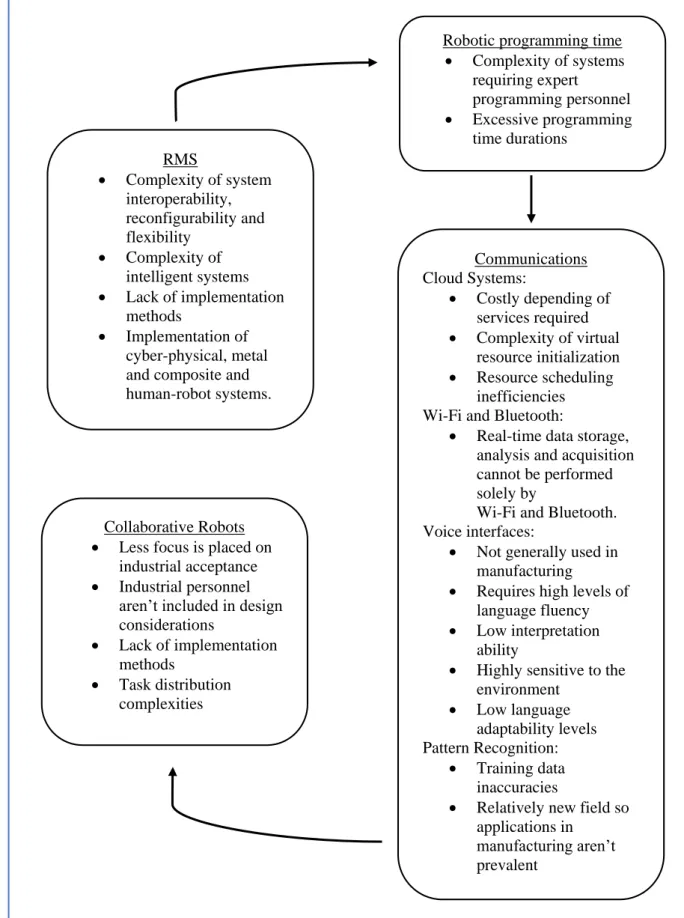
Figure 2-11: A summary of potential areas of growth and improvement for Advanced Manufacturing Systems ... 29
Figure 3-1: GAMP Framework [50] ... 33
Figure 4-1: User Requirements – Voice Interface System ... 36
Figure 4-2: Advanced Manufacturing Laboratory - University of KwaZulu-Natal ... 40
Figure 4-3: Voice Interface System- Device Configuration ... 43
Figure 4-4: Schematic overview - voice system ... 44
Figure 4-5: System decomposition – Benchmark Data Extraction Unit ... 45
Figure 4-6: Flow design – Benchmark Data Extraction Unit ... 46
Figure 4-7: System decomposition – IoT system ... 48
Figure 4-8: Flow design – IoT system ... 50
Figure 4-9: Mobile robot system overview ... 51
Page | 16
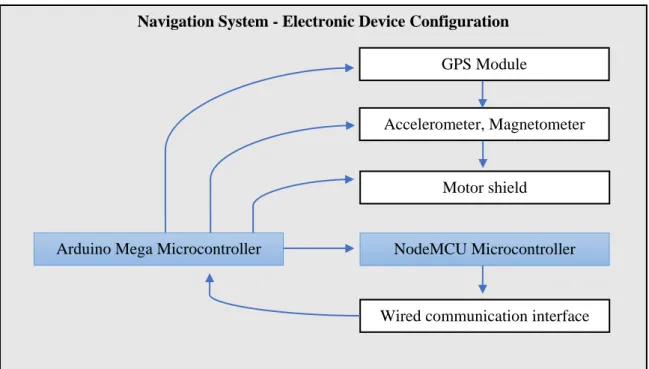
Figure 4-10: Navigation System- Device Configuration ... 54
Figure 4-11: Schematic overview - Mobile robot ... 56
Figure 5-1: Probability Density Function: Eight-word phrase at 30 decibels ... 59
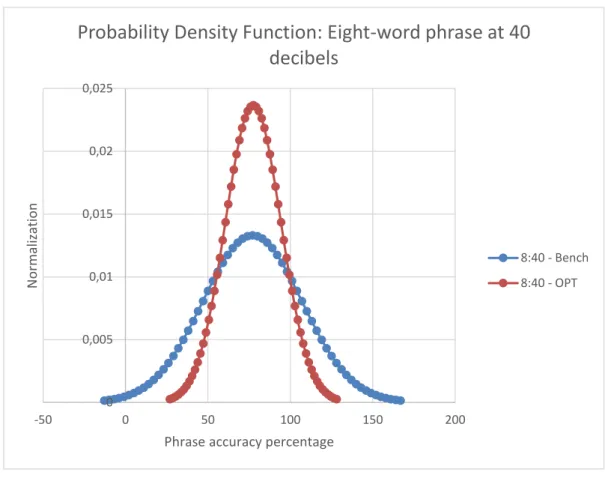
Figure 5-2: Probability Density Function: Eight-word phrase at 40 decibels ... 60
Figure 5-3: Probability Density Function: Eight-word phrase at 50 decibels ... 60
Figure 5-5: Probability Density Function: Eight-word phrase at 60 decibels ... 61
Figure 5-4: Probability Density Function: Eight-word phrase at 70 decibels ... 61
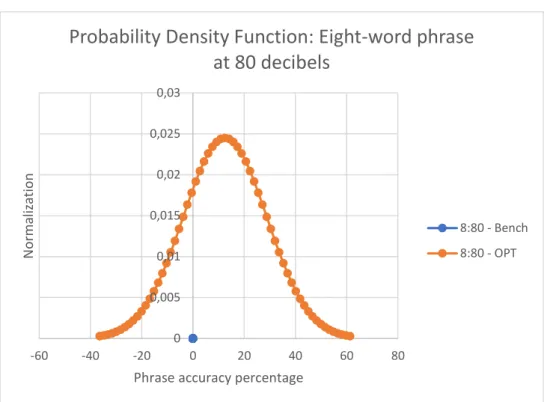
Figure 5-6: Probability Density Function: Eight-word phrase at 80 decibels ... 62
Figure 5-7: Eight-Word Phrase Results Summary ... 62
Figure 5-8: Probability Density Function: Six-word phrase at 30 decibels ... 64
Figure 5-9: Probability Density Function: Six-word phrase at 40 decibels ... 64
Figure 5-10: Probability Density Function: Six-word phrase at 50 decibels ... 65
Figure 5-11: Probability Density Function: Six-word phrase at 60 decibels ... 65
Figure 5-12: Probability Density Function: Six-word phrase at 70 decibels ... 66
Figure 5-13: Probability Density Function: Six-word phrase at 80 decibels ... 66
Figure 5-14: Six Word Phrase Summary ... 67
Figure 5-15: Probability Density Function: Four-word phrase at 30 decibels ... 68
Figure 5-16: Probability Density Function: Four-word phrase at 40 decibels ... 69
Figure 5-17: Probability Density Function: Four-word phrase at 50 decibels ... 69
Figure 5-18: Probability Density Function: Four-word phrase at 60 decibels ... 70
Figure 5-19: Probability Density Function: Four-word phrase at 70 decibels ... 70
Figure 5-20: Probability Density Function: Four-word phrase at 80 decibels ... 71
Figure 5-21: Four Word Phrase Summary ... 71
Page | 17
Figure 5-22: Probability Density Function: Two-word phrase at 30 decibels ... 73
Figure 5-23: Probability Density Function: Two-word phrase at 40 decibels ... 73
Figure 5-24: Probability Density Function: Two-word phrase at 50 decibels ... 74
Figure 5-25: Probability Density Function: Two-word phrase at 60 decibels ... 74
Figure 5-26: Probability Density Function: Two-word phrase at 70 decibels ... 75
Figure 5-27: Probability Density Function: Two-word phrase at 70 decibels ... 75
Figure 5-28: Two Word Phrase Summary ... 76
Figure 5-29: Probability Density Function: One-word phrase at 30 decibels ... 77
Figure 5-30: Probability Density Function: One-word phrase at 40 decibels ... 78
Figure 5-31: Probability Density Function: One-word phrase at 50 decibels ... 78
Figure 5-32: Probability Density Function: One-word phrase at 60 decibels ... 79
Figure 5-33: Probability Density Function: One-word phrase at 70 decibels ... 79
Figure 5-34: Probability Density Function: One-word phrase at 80 decibels ... 80
Figure 5-35: One-Word Phrase Summary ... 80
Figure 5-36: First Iteration ... 81
Figure 5-37: Second Iteration... 81
Figure 5-38: Third Iteration ... 82
Figure 5-39: Forth Iteration ... 82
Figure 5-40: Fifth Iteration... 83
Figure 6-1: Proposed application by Eskom ... 94
Figure 8-1: Certificate Obtained ... 103
Figure 9-2: Certificate Obtained ... 104
Figure 9-3: Certificate Obtained ... 105
Page | 18
Figure 10-1: Decibel range metre ... 106
Figure 10-2: Interference generator ... 107
Figure 10-3: National Instruments Precision Mic ... 112
Figure 10-4: Calibration Control Tower ... 112
Figure 10-5: VRTC Testing Facility ... 113
Figure 10-6: Calibration Interference Generator ... 113
Figure 10-7: CompactDaq ... 114
Figure 10-8: Calibration Test data ... 114
Figure 10-9: Interference configuration ... 115
Figure 10-10: Mobile device and microphone used ... 116
Figure 10-11: Interference cancelling device ... 116
Figure 10-12: Mobile robot motor layout ... 117
Figure 10-13: Navigation system front view... 117
Figure 10-14: Navigation system top view ... 118
Figure 10-15: IoT platform integration ... 118
Figure 10-16: Tool handling and compass configuration ... 119
Figure 10-17: Full final design ... 119
Figure 10-18: Eskom readings 1 ... 120
Figure 10-19: Eskom reading 2 ... 120
Figure 13-1:Phase Recognition Rate: Eight-word phrase at 30 decibels ... 144
Figure 13-2: Phase Recognition Rate: Eight-word phrase at 40 decibels ... 144
Figure 13-3: Phase Recognition Rate: Eight-word phrase at 50 decibels ... 145
Figure 13-4: Phase Recognition Rate: Eight-word phrase at 60 decibels ... 145
Page | 19
Figure 13-5: Phase Recognition Rate: Eight-word phrase at 70 decibels ... 146
Figure 13-6: Phase Recognition Rate: Eight-word phrase at 80 decibels ... 146
Figure 13-7: Phase Recognition Rate: Six-word phrase at 30 decibels ... 147
Figure 13-8: Phase Recognition Rate: Six-word phrase at 40 decibels ... 147
Figure 13-9: Phase Recognition Rate: Six-word phrase at 50 decibels ... 148
Figure 13-10: Phase Recognition Rate: Six-word phrase at 60 decibels ... 148
Figure 13-11: Phase Recognition Rate: Six-word phrase at 70 decibels ... 149
Figure 13-12: Phase Recognition Rate: Six-word phrase at 80 decibels ... 149
Figure 13-13: Phase Recognition Rate: Four-word phrase at 30 decibels ... 150
Figure 13-14: Phase Recognition Rate: Four-word phrase at 40 decibels ... 150
Figure 13-15: Phase Recognition Rate: Four-word phrase at 50 decibels ... 151
Figure 13-16: Phase Recognition Rate: Four-word phrase at 60 decibels ... 151
Figure 13-17: Phase Recognition Rate: Four-word phrase at 70 decibels ... 152
Figure 13-18: Phase Recognition Rate: Four-word phrase at 80 decibels ... 152
Figure 13-19: Phase Recognition Rate: Two-word phrase at 30 decibels ... 153
Figure 13-20:Phase Recognition Rate: Two-word phrase at 40 decibels ... 153
Figure 13-21: Phase Recognition Rate: Two-word phrase at 50 decibels ... 154
Figure 13-22: Phase Recognition Rate: Two-word phrase at 60 decibels ... 154
Figure 13-23: Phase Recognition Rate: Two-word phrase at 70 decibels ... 155
Figure 13-24: Phase Recognition Rate: Two-word phrase at 80 decibels ... 155
Figure 13-25: Phase Recognition Rate: One-word phrase at 30 decibels ... 156
Figure 13-26: Phase Recognition Rate: One-word phrase at 40 decibels ... 156
Figure 13-27: Phase Recognition Rate: One-word phrase at 50 decibels ... 157
Page | 20 Figure 13-28: Phase Recognition Rate: One-word phrase at 60 decibels ... 157 Figure 13-29: Phase Recognition Rate: One-word phrase at 70 decibels ... 158 Figure 13-30:Phase Recognition Rate: One-word phrase at 80 decibels ... 158
Page | 21
LIST OF TABLES
Table 2-1: Comparison of existing Manufacturing Systems [10] ... 8 Table 2-2: Intensity Scale... 9 Table 2-3: Adaptability Scale... 9 Table 2-4: Variance Scale ... 9 Table 2-5: Cloud Computing Characteristics [18] ... 12 Table 2-6: Functionality comparison of Cloud Computing service models [21] ... 14 Table 4-1: Selection Matrix- Voice Interface System ... 38 Table 4-2: Selection matric – Mobile robot ... 52
Page | 1
1. INTRODUCTION
1.1 Background
The rationale for this research originated from the need to align manufacturing systems to the proliferating technological age. The ability of a manufacturing environment to grow and thrive in the industrial domain is highly dependent on innovation. Innovation can directly relate to product innovation or manufacturing innovation; conventionally. This dissertation however, contributed to innovation in manufacturing environments, by creating a platform to refine the manufacturing workforce. This dissertation aimed at creating a system that improves the way people work, with the goal of improving manufacturing through innovative systems for people. Flexibility is key for an innovative environment - not just for manufacturing machinery, but for manufacturing environments as a whole. This characteristic is essential due to its ability to reduce production times and create a more conductive environment for product customizability. Additionally, if manufacturing environments are considered, it provides a highly evolved platform for process optimization [1]. Research conducted in this dissertation accounted for the areas of concern presented by modern manufacturing and aimed at scientific contributions accentuated towards these concerns.
1.2 Manufacturing challenges
The age of product customizability dawns over modern manufacturing. Much is known about what needs to be done, however, very little is known of how it can be done. When delving into the crux of customizability, essentially, one factor predominantly emerged - flexibility. In modern times, customers opt for products that need not specifically apply to aesthetics, but changing physical characteristics. As such, production equipment needs to not just grow, or be optimized, but these machines need to evolve. Evolution however, seems to have plateaued. It was found that a variety of contributing factors accompanied this state of limbo – but not for the lack of trying, these factors included; [2] [3] [4] [5]
Development of flexible systems being confined to the academic domain with less focus placed on industrial applications,
An absence of a methodological structure for implementing flexible systems into the industrial domain,
An absence of due consideration being given to human integration of flexible systems,
Excessive programming times required for system reconfigurability,
High costs associated with the development of a highly flexible manufacturing environment, and
Page | 2
High costs associated, with adapting pre-existing systems to provide flexibility.
1.3 Motivation for the study
The initial stages of the dissertation saw the authors attempting to gauge the state of manufacturing environments as a whole. The approach taken was not solely focused on optimization of pre-existing systems, but rather, in establishing why the areas of concern presented in Section 1.2, persisted. The field of engineering spans across the globe in a variety of fields and at present, engineering progresses along the lines of digitalization; with systems of collaborative hybrid human and robotic operations, additive and subtractive processes, metal and composite materials, and cyber and physical systems [6]. When due consideration was taken into the high levels of reconfigurability, adaptability, and flexibility required of machinery for customizable manufacturing, the authors of the dissertation opted to focus on machine flexibility associated with the fourth industrial revolution. As such, focus was placed on cyber-physical systems. The reason for this choice was due to modern industries moving operational functions towards a digital platform. It was established that the demand of intricacy and precision associated with robotic operations required highly flexible communication interfaces. Communication interfaces were researched, and it was found that the advent of voice-assistants to the modern age had the potential to completely shift conventional tool-centered manufacturing processes to a new, and more versatile, flexible approach. Voice assistants could change the way manufacturers view communication. These assistants focused on automation, but the style of automation revolved around an essential, human-centered approach. Years of preparation and advances in the field of machine learning and artificial intelligence had contributed to the highly efficient systems we know them to be. Improved interactions of human-to-human and human-to-computer systems were but a few instances of commonly ventured system integrations of voice assistants [7]. There were however, a reasonable area of concern within the field of voice assistants, but more specifically to the field of academia and, as this dissertation dictates, manufacturing. Though voice assistants proliferated in instances of cellular devices, they seemed to be confined within the cellular domain. Additionally, though much advancements have been made in the field of voice assistants, these advances remain proprietary to the facilities creating this growth, namely corporations such as Google and Amazon. Due to the nature of these facilities and the environment in which they operate, much less effort is placed on integration of voice-assistants into manufacturing platforms. As such, the research that follows firstly attempted to understand the reasons for absence, and implication of voice interface technology in manufacturing environments. The purpose of the paper being to investigate the performance of leading voice interface technology when subjected to manufacturing environments. Additionally, an attempt was made to develop a structured conceptualised methodological approach for the
Page | 3 implementation of voice interface technology into manufacturing environments. Research found motivated the development of a platform for flexible robotic operations; as compared to the conventional tool-centered approach.
1.4 Purpose of research
The research was motivated by the need for a versatile and flexible medium of communication within CPS. The research efforts aligned itself to establishing an effective means of incorporating voice interface technology into the manufacturing domain. The research that follows attempted to understand the reasons for absence, and implication of voice interface technology in manufacturing environments. The purpose of this paper was to investigate the performance of leading voice interface technology when subjected to manufacturing environment conditions.
This paper established performance data for voice assistant “OK Google”. Upon analyzing the performance data, it was established that the voice assistant needed to be optimized to allow for integration into a manufacturing domain. As such, the assistant was optimized using an IoT based platform and web-based server. The dissertation also developed a means of implementation of the voice assistant into a manufacturing environment through the integration with a mobile navigation system design. The mobile navigation system design facilitated the use of a voice assistant in a manufacturing domain.
1.5 Project objectives
The objectives of the research were to:
1. Research and establish a list of the essential areas of concern within manufacturing 2. Research and develop a conceptualized methodological approach for integrating voice
assistants into manufacturing environments
3. Generate synthetic voice-assistant data using a simulated manufacturing environment 4. Research and optimize voice-assistant technology, conforming to the fourth industrial
revolution
5. Analyze the performance of the optimized system and evaluate applicability of the optimized system.
6. Research, design and implement a suitable mechatronic system integrating voice interfaces with mobile robots. The system must include the development of the electronic hardware, the programming of machine control algorithms, and the creation of a suitable interface for human interaction.
1.6 Scientific contribution of the dissertation
This dissertation aimed to contribute to the scientific community in the following areas;
Page | 4
The generation of operational benchmark data of a voice interface when subjected to manufacturing conditions
The design of a flexible mechatronic system capable of carrying out operations based on voice commands
The generation of a structured methodological approach for the generation, analysis, optimization and implementation of voice-interfaces into manufacturing environments.
The analysis of the baseline accuracy, phrase error rates (PER) and reliability of voice- assistants when subjected to industrial conditions.
The optimization of a voice-interface system for manufacturing environments with the optimization approach conforming to the ideals of the fourth industrial revolution; with the analysis of the accuracy, phrase error rates and reliability thereof,
Developing a conceptualized practical approach for implementation of voice-assistants into the manufacturing domain.
1.7 Research question
The research question addressed in the dissertation related to flexible human-robot communication, the research question addressed is stated below:
How can a mechatronic system be designed for a manufacturing environment that integrates voice interface technology and mobile robotics?
1.8 Research publications
Presented below is the peer-reviewed publication that included the research presented in the dissertation. The undersigned agree that the following submissions were made and accepted as described, and that the content therein is contained in this research.
Publication 1: IEEE Africon – 2019 (Accepted and Published)
Pather, S. Basson, C and Bright, G. “An Elementary Review of Cloud Computing with Implications for Manufacturing Systems”, IEEE Region 8 flagship conference in Africa.
Published August 2019, 4 Pages.
Shane Pather was the lead author of this paper and conducted all research the supervision of Professor Glen Bright and Mr. Christian Basson.
Page | 5 1.9 Outline of dissertation
Chapter 1 – Introduction: The introduction chapter provides the reader with key insight in the background of the research dissertation, manufacturing challenges encountered, the motivation for study and lastly, the dissertation objectives.
Chapter 2 – Literature Review: A new approach to literature evaluation was presented into this chapter. Research was conducted to isolate key issues presented with the manufacturing domain and research thereafter focused on highlighting these issues and addressing them.
Chapter 3 – Methodology: The Methodology chapter provides the structured and validation methods initiated throughout the dissertation. It presented the approaches considered and the reason as to why the methods were considered.
Chapter 4 – Electronic Design: This chapter encompasses the design component of the dissertation. Functionality requirements, selection methods, configurations and system assembly can be viewed in this chapter.
Chapter 5 – Data Analysis: This chapter embodies the testing results and evaluation of the data extracted from the designed systems.
Chapter 6 – Discussion: This chapter summarises the findings of the dissertation, highlights on the systems performance and contributions, as well as provides insight into the applications of the designed system.
Chapter 7 – Conclusion: The dissertation concludes with the objectives breakdown and how they were met, and provides insight into the future work to be addressed and considered.
1.10 Chapter summary
Chapter one, the introductory chapter, outlines the rationale for the research conducted so as to justify content validity. Research objectives were outlined in this chapter. Furthermore, motivation for the research was expounded and the issues concerning the implementation of voice technology in a manufacturing environment was discussed. Chapter one additionally provided a short summary of each chapter of the dissertation.
Page | 6
2. LITERATURE REVIEW
2.1 Introduction
The major advent for manufacturing in the 21st century can be confined to something very simple, yet quite complicated. A factor of mild subtlety; though it possesses a high level of complexity.
This somewhat unbridled factor that seems to define the future of manufacturing is that of Product Customizability. Customers opt for products that not only suit their needs but also their desires.
This, however, introduces a variety of complications for production equipment in manufacturing environments. Delving into the depts of manufacturing literature, the subsequent chapter attempts to create an understanding of the complications faced by Advanced Manufacturing Systems.
Thereafter, an attempt is made to provide an approach to solve some of the limitations presented.
The Literature review that follows covers the following research areas;
Reconfigurable Manufacturing Systems,
Programming of Robotic Systems,
Communication Networks, and
Collaborative Robotic Systems
2.2 Reconfigurable Manufacturing Systems
The research that follows in this section was conducted to gain an understanding of the manufacturing systems that currently exist, their working structure and the problems they face.
Manufacturing systems at their core, posses a manifold of inherent limiting factors when contested by dynamic market challenges. In response to these challenges, New Generation Manufacturing Systems (NGMSs) attempt to accentuate on areas such as flexibility, reconfigurability, and artificial intelligence. Additionally, NGMSs need to be highly interoperable. These systems are likely to be comprised of cyber and physical systems, metal and composite materials, and hybrid systems of human and robot collaboration [6]. The conceptualization of the paradigm of Reconfigurable Manufacturing was devised through the collaboration between researchers in Europe and the United States. The definition that followed stated [8] :
“ A Reconfigurable Manufacturing System is a system that combines the advantages of Dedicated Manufacturing Systems and Flexible Manufacturing Systems by designing it at the outset for rapid change in structure, as well as in its machines and controls, in order to quickly adjust production capacity and functionality in response to market or product changes.”
Page | 7 The aforementioned definition provides a pellucid view of Reconfigurable Manufacturing Systems (RMSs). As the definition states, RMSs embody the advantages of Dedicated Manufacturing Systems (DMSs) and Flexible Manufacturing Systems (FMSs). The efficacy of RMSs can be attributed to its intermediate relationship of product variety and product capacity (Figure 2-1). To fully grasp the functionality of RMSs; DMSs and FMSs were researched.
Research was carried out to understand the collaborative union of DMSs and FMSs in RMSs
Figure 2-1: Mapping several types of manufacturing systems in capacity-functionality coordinates [9]
2.2.1 Dedicated Manufacturing Systems
Historically, DMSs was the first manufacturing system; introduced at the beginning of the 20th century. DMSs are designed specifically for the production of a single, or a bounded group of products. The dedicated nature of DMSs provides for a significantly lower capital startup as compared to FMSs. DMSs can be affiliated with transfer line technology, fixed automation, robust system performance and dedicated machinery as a whole. Characteristically, DMSs is capable of handling high production rates of core products; though inefficiency does present itself with low levels of flexibility. As such, featured products for DMSs are required to be constant throughout the systems lifecycle. Additionally, product customizability for DMSs invariably requires a significant cost incurred by companies. These costs fall along the lines of machine change-overs, implementation, and adaptability [9].
Page | 8 2.2.2 Flexible Manufacturing Systems
FMSs are systems that consist of computer numeric control (CNC) machine tools. These tools are interconnected by automatic material handling and storage systems and controlled by an integrated computer system. FMSs are very advantageous when viewed from a flexibility perspective, though they do possess their share of limitations. Limitations accompanied by FMSs present themselves in the form of low throughputs – as compared to DMSs, and dedicated equipment fostering increased component costs. Cellular Manufacturing Systems (CMSs) are capable of overcoming some of the limitations of DMSs and FMSs. These systems use multiple independent working cells dedicated to product families with similar processing requirements.
However, CMSs are specifically designed for the production of a specific set of products with stable demand levels and long lifecycles [10]. A tabular assessment of the aforementioned manufacturing system can be viewed in Table 2-1. Key attributes are paired against each other and evaluated on an intensity, adaptability and variance scale [11]. The appropriate scales are provided in
Table 2-2, Table 2-3 and Table 2-4.
Table 2-1: Comparison of existing Manufacturing Systems [10]
DMS FMS CMS RMS
Cost per part Low Reasonable Medium Medium
Demand Stable Variable Stable Variable
Flexibility No Medium Medium Customizable
Machine structure Fixed Fixed Fixed Changeable
Product family formation No No Yes Yes
Productivity Very high Low High High
System structure Fixed Changeable Fixed Changeable
Page | 9
Variety No High High High
Table 2-2: Intensity Scale
0 1 2 3 4
Low Reasonable Medium High Very High
Table 2-3: Adaptability Scale
Table 2-4: Variance Scale
0 1
Variable Stable
Predominantly, the characteristic traits of RMSs appeal to changing markets. These characteristics have been further analysed below. In due relation to the framework and the predecessors of RMSs, research progresses along the lines of evolving system configurations and layouts [12].
2.2.3 RMSs Features and Market Contribution
Research conducted on RMSs found six defining features forming the core structure of RMS [13].
These features include; Convertibility, Scalability, Modularity, Intergrateability, Customization, and Diagnosability. A brief exposition of these characteristics are provided below.
Convertibility: This is the ability of a system to transform its functionality to suit new requirements of production.
0 1 2
Fixed Changeable Customizable
Page | 10
Scalability: This refers to the ability of a system to modify its production capacity. This is achieved by adding or subtracting manufacturing resources or changing the components of a system.
Modularity: This characteristic refers to operational functions being compartmentalized into units. With this being achieved, units can be manipulated between alternate production schemes to allow for the best possible arrangement.
Integrability: Integrability focuses on the rapid and precise integration of modules. This is achieved by facilitating communication and integration of information, mechanical and control interfaces.
Customization: Customization focuses on the customer. It refers to the ability of a system to produce customized products based on customer specification.
Diagnosability: Diagnosability accentuates on monitoring techniques that evaluate the state of a system. This allows for the detection and diagnoses of product defects;
providing a platform for effective condition monitoring.
2.2.4 RMS – Areas of Concern
Given the embedded encapsulating characteristics of RMS, it is easily noticeable why cooperative heads and factories of the future would hold RMSs at quite a high predilection. In retrospect, customizable manufacturing should be of utmost importance for any manufacturer seeking progressive growth. Research on RMSs however, did present a variety of system complications [2]. One complication presented itself as being quite ubiquitous. That complication being implementation. Many publications expound the introduction of RMSs into conventional manufacturing systems; though less accentuation is directed towards an actual methodological approach [3]. Additionally, a large contributor against implementation lies in a manufacturers sense of comfortability. Manufacturers are resistant to change, though their resistance is quite understandable. Innovation halts when successful industries thrive on outdated technology – in a technologically advanced age. Though, with the absence of clearly defined methodologies, steep learning curbs of intricate systems, and the absence of backward-compatible knowledge adaptability [4]; resistance can be proved warranted. The proliferating instances of innovation in industry, however, is key. Learning factories have played a significant role in this through a knowledge share between academics and industry. Small scale reconfigurable manufacturing systems, as well as flexible and assembly systems, have been simulated for the purpose of skills development and eventual ease of transition into a more customizable manufacturing environment [5].
Page | 11 2.3 Understanding the programming process of robotic systems
The research that follows in this section was conducted as directed by an industrial programming expert (Appendix A). Suggestions were made to understand general programming procedures for robotic devices and their impact on manufacturing.
Time is an entity that can be considered to govern all and is undoubtedly a critical factor to consider in manufacturing. Programming of robotic systems in Advanced Manufacturing Systems can be viewed as quite a time-consuming process. Working along the lines of customizability, proliferating instances of customizable products would require programming times for reconfigurable systems to be significantly reduced [14]. This would aid in systems being able to adapt more easily to changing market demands. Additionally, large scale reconfigurability of machines is limited by a lack of expertise. In hindsight, these limitations pave the way for the furtherance of an innovative approach to programming reconfigurability. One such solution, as described in literature, promotes the implementation of a network of interoperable robots, with a master-slave interface. This perspective reduces programming time by temporarily cutting out the middle man, i.e. the programmer. It considers the general approach of humans physically programming a machine, and proposes a system of machines programming each other; given that one machine i.e. the master, has already been programmed. With this approach, however, although programming time can be reduced, reconfigurability still requires an expert to be physically present with the robot he wishes to reprogram. This leaves minimal room for adaptation, especially if experts are off-sight, or if the equipment and software used is not native.
Self-sustainable robots refer to an area of communication that doesn’t require experts to carry out tasks such as software updates for changing products. If self-sustainability is achieved, critical issues of reconfigurability could be alleviated. These issues include automatic compensation to limiting variables, adaptability to new processes and ease of programming. Human interaction would still be required; however, off-site programming could be achieved through humans and machines communicating over the internet. Additionally, internet platforms could facilitate global robot communication and information sharing between local robotic systems [15].
2.4 Communication Networks
The research that follows in this section was conducted as a branch of the prior research conducted on programming time of robotic systems. The research proceeded to evaluate modern and common communication networking mediums, their general structure, and their influence on Advanced Manufacturing Systems. An attempt was made to gain insight into communication mediums that could possibly facilitate robotic-to-robot and human-to-robot communication.
Page | 12 Networks provide a platform for interoperable, integratable manufacturing systems. Delving into communication and information sharing on networks, a number of networking systems were broadly analyzed. These systems were assessed and viewed in terms of contributors to Advanced Manufacturing Systems.
2.4.1 Cloud Networks
The National Institute of Standards and Technology (NIST) defined Cloud Computing as,
“ A model for enabling ubiquitous, convenient, on-demand network access to a shared pool of configurable computing resources (e.g., networks, servers, storage, applications, and services) that can be rapidly provisioned and released with minimal management effort or service provider interaction ”.
Research conducted on Cloud Computing found five core defining characteristics, three service models and four deployment models [16]. Given the appealing characteristics of Cloud Computing, technology advances in adopting Cloud Computing into Manufacturing. Thus, creating a Cloud Manufacturing environment [17]. NIST further proceeds to define the characteristics of Cloud Computing to be; Broad network access, On-demand self-service, Rapid elasticity, Resource pooling, and Measured service. These characteristics are further elaborated on in Table 2-5.
Table 2-5: Cloud Computing Characteristics [18]
Characteristic Description
On-demand self-service In the absence of a service provider, end users have the ability to acquire computing features such as storage and server time. Prior to Cloud Computing, additional computational features required either additional hardware procurement or manipulating existing servers.
Broad network access Cloud systems facilitate communication over the Internet. Given this medium, end-users have a variety of access options at their disposal. Much like an email login; given the supporting hardware, software and authorization credentials, end users have the ability to access cloud systems anywhere in the world.
Page | 13
Rapid elasticity End-user provisioning capabilities tend to be unlimited, with the ability to appropriate such provisions in any quantity, at any time.
Resource pooling End- users have the ability to be assigned or reassigned physical or virtual resources as per demand. The provider pools computing resources for multiple customers using a multi-tenant model.
Measured service A combination of infrastructure management, optimization of workloads, self-service management, and monitoring resources provides a reason for cloud adoption. Resource control and optimization are automated by leveraging a metering capability – appropriate to the type of service being used.
2.4.2 Cloud Service Models
Cloud Computing can be viewed as having three service models; that being Platform-as-a-Service (PaaS), Infrastructure-as-a-Service (IaaS) and Software-as-a-Service (SaaS). A brief description of these service models are listed below [19]:
Platform as a service: This model supplies a platform for developers to create applications and software.
Infrastructure-as-a-service: This model supplies computing resources like storage, servers and other peripherals which can be acquired as a service.
Software-as-a-service: In this model, the initial development of applications and software takes place on the platforms provided by the PaaS layer.
The aforementioned models have an associated definite structure. As a whole, these models form a Cloud Computing stack. The Cloud Computing stack is depicted in Figure 2-2.
Page | 14 Figure 2-2: Cloud Computing services provided [20]
The service models provided by Cloud Computing are accompanied by a variety of functional providers; though these providers are not consistent for every layer of the cloud. Table 2-6 provides a comparison of the Cloud Computing stack. Each stack layer is compared to the subsequent layer, and likely functional providers are compared across the structure.
Table 2-6: Functionality comparison of Cloud Computing service models [21]
Attributes SaaS PaaS IaaS
Service providers Google apps, office live
Azure, Netsuite IBM, Amazon.
Runtime management
By the customers By the vendor By the vendor
Data management By the customers By the developer By the vendor
Application management
By the customers By the developer By the vendor
Page | 15 Used by Business Users Developers and
deployers
System manager
Visibility End users Application
developers
Network architects
Type of services Dynamic infrastructure service
Integration as a service
Dynamic application services
No of providers Large numbers of application in the cloud
Few cloud platforms
An elite group of providers
Server management By the vendor By the vendor By the vendor
2.4.3 Cloud Computing Deployment Models
Deployment in this context refers to a means of accessing cloud service. Methods of deployment can be divided into four categories. These methods were found to be client dependent and used based on the need requirements of the client. The deployment methods found in research included;
Private, Community, Public, and Hybrid Cloud distributions. An elaboration of these methods are provided below [22].
Private cloud: This model provides for the exclusive use of the cloud infrastructure for a single organization comprising of multiple business units. This type of model may be managed, operated and owned by the organization itself, third-party organizations, or a combination of both. This type of model may, or may not reside on the premises intended for operation.
Examples of Private cloud: VMware and Amazon EC2
Community cloud: This model allows for the exclusive use of the cloud infrastructure by a specific community of consumers. Application of this model is suited for consumers from organizations that have a shared mission, security requirements, policies, and compliance considerations.
Ownership, management, and operations are carried out by single or multiple organizations in the community, a third party organization or a combination of the two. Additionally, as was the case for a Private cloud, this model may, or may not reside on the premise intended for operation.
Page | 16 Examples of Community cloud: Google Apps for government and Microsoft Government Community Cloud
Public cloud: This cloud model is for general public use. Ownership, management, and operation are carried out by businesses, organizations, academic institutes, and combinations of these. This model resides on the site of the intended operation.
Examples of Public cloud: Blue Cloud by IBM and Azure services platform by windows
Hybrid cloud: The Hybrid cloud model is composed of two or more distinct cloud infrastructures.
These could be Private, Community, or Public infrastructures, with each of the distinct infrastructures still remaining unique entities. However, these infrastructures are bound by proprietary or standardized technology, thus allowing for application and data portability.
Examples: CTERA and Red hat open hybrid cloud 2.4.4 Cloud Computing in Manufacturing
Manufacturing systems designed for high levels of reconfigurability generate high volumes of data. As such, the efficiency of the reconfigurable system largely depends on how its data is processed and analysed. Essentially, Cloud Computing provides for the transition of computation.
The transition shifts computation, management, and operation of computing resources (Hardware and software), to renting these resources. Cloud Computing could aid in manufacturing in areas such as;
Low machinery start-up costs – In the absence of embedded computational requirements of a machine, low-cost systems can be designed to carry out operations alone and not computation.
Scalability and ease of access – Given the platform of resource pooling of Cloud Computing being over the internet, an increase or decrease of computational needs can be done based on a machine’s needs requirement.
Lower risk on resource provision – By outsourcing the computational workload, areas of concern such as miscalculations and computational machine shut are eliminated, as these are areas allocated to cloud experts.
Additionally, Cloud Computing has the ability to boost the efficiency of procedures in manufacturing that require a large amount of computational effort, such as modelling during the design process [23]. Adopting Cloud Computing into manufacturing has two approaches. The first being directly offering manufacturing software on the cloud as a service, and secondly;
providing manufacturing capabilities as an entirely new type of cloud service [24]. The general
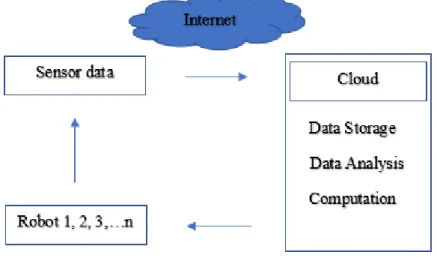
Page | 17 approach to data transmission from the manufacturing environment to the cloud can be viewed in Figure 2-3. Sensor data is sent over the internet to the cloud. After processing, recipients of the processed data can be any machine that has access to the same cloud network.
Figure 2-3: Data flow - Cloud Computing to Cloud Manufacturing 2.4.5 Wi-Fi and Bluetooth Communication
Wireless technology is designed at the outset for rapid reduction in implementation time and costs, and reduction in safety hazards created by wired networks. In 1997, Wi-Fi (Wireless fidelity) was introduced by IEEE 802.11 standards. This allowed users to connect to the internet from any geographical location. This service, however, was quite a costly affair until 2002, in 2003, a new 802.11g was released that allowed internet access from wireless access points as we know it to be today [25]. Bluetooth, on the other hand, is a wireless technology standard based on a radio system. It is designed for short-range communication. General data exchange spans a distance 10 – 100m depending on the class of Bluetooth used. Bluetooth specifications are governed by the Bluetooth Special Interest Group (SIG) and is an open specification. Both Wi-Fi and Bluetooth facilitate a platform for wireless communication, the main difference between the two lies in their design purpose. Primarily, Bluetooth is used for connecting devices without the use of cables, whereas Wi-Fi provides devices with access to the internet [26].
2.4.6 Wireless communication for Advanced Manufacturing Systems
The industrial landscape has been reshaped entirely by the Fourth Industrial revolution (Industry 4.0). The exponential rate at which technology advances requires constant change, and adaptability of existing systems and frameworks [1]. One of the major challenges for the future of manufacturing is dealing with collaborative systems of hybrid human and robotic operations, additive and subtractive processes, metal and composite materials, and cyber and physical
Page | 18 systems. Focusing on cyber-physical systems, these systems have proven to be efficient in operations such as monitoring, analysing, automation and communication. Understanding this, it is easy to grasp why the issue of wireless connectivity of manufacturing systems needs to be focused on. Wireless communication and sensor-based technology are largely contributing to Industry 4.0 and the cyber-physical environment. This being in an attempt to create an intelligent, smart working environment [6]. Smart working environments, however, associate themselves with a variety of complications. That being, real-time data acquisition, storage, and data analysis using machine learning techniques [27]. As such, many researchers are moving towards cloud management. In turn, this imposes three key problems. That being; implications and costs associated with virtualizing resource management, life cycle management, and scheduling of cloud resources. Solutions to industrial problems of today present development of machinery with relatively high complexity. This essentially contributes to incurring additional costs for implementation, costs associated with training skilled labour, and costs associated with skilled persons carry out maintenance operations when required. Traditional approaches to increase production efficiency need to be re-evaluated from its traditional sense. A likely solution to this problem can be extracted from analysing communication environments. Communication environments can be viewed as having two sub-divisions. Human-centered and cyber-centered.
With the increasing complexity requirements of machines, tasks of reconfigurability, adaptability, and flexibility can be allocated to humans to perform. This would essentially reduce the processing requirements and level of complexity required of a machine in carrying out a complex task [28].
2.4.7 Voice interface communication
The field of voice assistants is a relatively new communication paradigm. Understanding the general communication approaches outlined in the aforementioned research, voice interfaces provide a new and vibrant approach to communication mediums. Speech processing robots such as Pepper and voice interfaces such as Amazon Alexa, OK Google, Siri, and Cortana move away from the traditional screens, keyboard, and mouse communication tools. They provide a natural communication medium which has consequently contributed to their rapid rise in global markets.
However, due to the fact that these systems are relatively new, they do present a variety of complications [29]. These complications include:
Voice interfaces requiring highly fluent sentences for efficient processing,
The inability of voice interfaces to effectively interpret a sentence pause,
A high level of sensitivity to environments with high levels of noise, and
The inability of voice interfaces in constructing responses based on ambiguous commands
Page | 19 The aforementioned complications presented are largely attributed to human speech. According to George Mahl, on average, human emit discontinuities in speech every 4.4 seconds. This action is a result of humans occasionally stopping to think, as an example [30]. Research does, however, present methods to facilitate fluent speech transmission. One such method involves voice interface companies incorporating automatic speech recognition and natural language understanding to comprehend if a user command is complete. Figure 2-4, as adopted from Amazon, illustrates state changes by the inclusion of a speech recognizer component. The connectors give an indication of the state transitions and the boxes represent the speech recognizer.
Figure 2-4: Amazons state changes in voice interfaces using speech recognizer [30]
Other systems attempting to close the communication gap between voice interfaces and humans display methods that showcase the relatively new nature of voice interfaces as a communication medium. Such approaches include using a push button as a medium to identify sentence pauses and designing voice interfaces at the outset to output information based on specific words as command inputs, rather than complicated sentences [31].
Applications of Voice Interfaces
Many applications of voice interfaces present themselves outside the manufacturing environment.
Though, if implemented in manufacturing, these communication mediums could prove to be highly beneficial. Iqbal et al presents the use of voice interfaces for controlling electrical devices.
Directive: Speech Action: Wait for User
Directive: Speech Action: Wait for User
Action: Speech Timeout elapsed Event: Expect Speech Timeout Action: Recognize event completed
Action: User starts interaction Event: Recognize
Action: Client stops recording
Action: Final Streaming and waiting for results
Action: User starts interaction Event: Recognize
Page | 20 This approach focuses on improving the lives of disabled individuals in a household. An overview of the approach is depicted in Figure 2-5 [32].
Figure 2-5: Smart household voice interface [32]
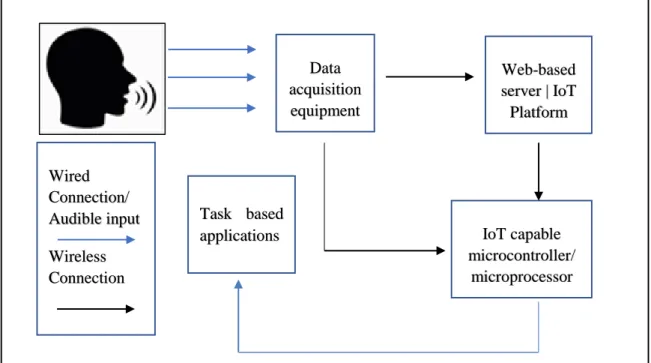
Figure 2-5 represents a voice, or optional text command being sent to Amazon Alexa. Thereafter, the service interprets the input voice command and transmits a specific General-Purpose Input/output (GPIO) to the pins on a Raspberry Pi. Appliances in this layout receive commands from the Raspberry Pi wirelessly, alternatively, a wired connection could be made for smaller layouts. Additionally, connectivity between regular appliances and Alexa and formed using Alexa-enabled smart plugs.
Applications of voice interfaces can be viewed as being quite diverse. Kandhari et al presents a paper that accentuates on a cloud-based Speech
![Figure 2-1: Mapping several types of manufacturing systems in capacity-functionality coordinates [9]](https://thumb-ap.123doks.com/thumbv2/pubpdfnet/10715143.0/29.892.176.758.309.606/figure-mapping-types-manufacturing-systems-capacity-functionality-coordinates.webp)
![Table 2-6: Functionality comparison of Cloud Computing service models [21]](https://thumb-ap.123doks.com/thumbv2/pubpdfnet/10715143.0/36.892.221.716.104.401/table-functionality-comparison-cloud-computing-service-models-21.webp)
![Figure 2-4: Amazons state changes in voice interfaces using speech recognizer [30]](https://thumb-ap.123doks.com/thumbv2/pubpdfnet/10715143.0/41.892.125.793.384.753/figure-amazons-state-changes-voice-interfaces-speech-recognizer.webp)