Archived at the Flinders Academic Commons:
http://dspace.flinders.edu.au/dspace/
‘This is the peer reviewed version of the following article:
Fletcher, C., Wilson, C., Hutchinson, A. D., & Grunfeld, E.
A. (2018). The relationship between anticipated response and subsequent experience of cancer treatment-related side effects: A meta-analysis comparing effects before and after treatment exposure. Cancer Treatment Reviews, 68, 86–93. https://doi.org/10.1016/j.ctrv.2018.06.009, which has been published in final form at
https://doi.org/10.1016/j.ctrv.2018.06.009
© 2018 Elsevier. This manuscript version is made available under the CC-BY-NC-ND 4.0 license:
http://creativecommons.org/licenses/by-nc-nd/4.0/
Accepted Manuscript
Systematic or Meta-analysis Studies
The relationship between anticipated response and subsequent experience of cancer treatment-related side effects: A meta-analysis comparing effects before and after treatment exposure
Chloe Fletcher, Carlene Wilson, Amanda D. Hutchinson, Elizabeth Alice Grunfeld
PII: S0305-7372(18)30103-8
DOI: https://doi.org/10.1016/j.ctrv.2018.06.009
Reference: YCTRV 1778
To appear in: Cancer Treatment Reviews Cancer Treatment Re- views
Received Date: 29 December 2017 Revised Date: 13 June 2018 Accepted Date: 14 June 2018
Please cite this article as: Fletcher, C., Wilson, C., Hutchinson, A.D., Alice Grunfeld, E., The relationship between anticipated response and subsequent experience of cancer treatment-related side effects: A meta-analysis comparing effects before and after treatment exposure, Cancer Treatment Reviews Cancer Treatment Reviews (2018), doi:
https://doi.org/10.1016/j.ctrv.2018.06.009
This is a PDF file of an unedited manuscript that has been accepted for publication. As a service to our customers we are providing this early version of the manuscript. The manuscript will undergo copyediting, typesetting, and review of the resulting proof before it is published in its final form. Please note that during the production process errors may be discovered which could affect the content, and all legal disclaimers that apply to the journal pertain.
1 The relationship between anticipated response and subsequent experience of cancer treatment-related side effects: A meta-analysis comparing effects before and after treatment
exposure
Chloe Fletcher1, Carlene Wilson1, 2, 3,Amanda D. Hutchinson4, Elizabeth Alice Grunfeld5
Chloe Fletcher1 (corresponding author) BSc
B Hlth Sc (Hons)
Phone: +61 8 7421 9957, Email: [email protected] Carlene Wilson1, 2, 3
BA (Hons) MBA PhD
Amanda D. Hutchinson4 BA (Hons)
M Psych (Clinical) PhD
Elizabeth Alice Grunfeld5 BSc (Hons)
MSc PhD
1. Flinders Centre for Innovation in Cancer, College of Medicine and Public Health, Flinders University, GPO Box 2100, SA 5001
2. Olivia Newton John Cancer Wellness and Research Centre, 145 Studley Road, Heidelberg, VIC 3084
3. School of Psychology and Public Health, La Trobe University, Bundoora, VIC 3086 4. School of Psychology, Social Work and Social Policy, University of South Australia,
GPO Box 2471, SA 5001
5. Department of Psychological Sciences, Birkbeck College, University of London, Mallet Street, London, WC1E 7HX, UK
2 The relationship between anticipated response and subsequent experience of cancer treatment-related side effects: A meta-analysis comparing effects before and after treatment
exposure
Abstract
Objective: To review the evidence for a systematic relationship between cancer patients’ pre- treatment expectations (anticipated side effects) and subsequent experience of treatment- related side effects, and to compare this relationship in patients with no prior treatment experience (cognitive expectations) and with some prior treatment experience (conditioned response).
Methods: A total of 12,952 citations were identified through a comprehensive search of the literature published on or before November 2016 and screened against inclusion criteria.
Studies were eligible if they included participants undergoing curative treatment for cancer, measured a treatment side effect, examined the relationship between anticipation and experience of side effects, and reported quantitative data.
Results: Thirty-one studies were included in the review and meta-analysis (total N = 5,069).
The side effects examined were nausea (anticipatory and post-treatment), vomiting, fatigue, pain, problems with concentration, and skin reactions. Meta-analyses indicated significant and positive associations between anticipation and subsequent experience for all included side effects in patients with no prior treatment exposure (r = 0.153 – 0.431). Stronger associations were found for all included conditioned side effects in patients with previous treatment experience (r = 0.211 – 0.476). No significant differences were found when overall effect sizes for patients with and without prior treatment exposure were compared for each side effect, except for anticipatory nausea (p = 0.012).
3 Conclusion: These results may have implications for future interventions that target patients’
expectations of cancer treatment-related side effects. Future research could explore patient reports of messages received about likely treatment effects both before and during treatment.
Keywords: cancer, cancer treatment, conditioning, expectancies, expectancy, side effects
4 1. Introduction
Cancer patients report experiencing a range of treatment-related side effects including pain, fatigue, nausea and vomiting, and even cognitive decline, although the nature and extent of these can vary between individuals undergoing the same treatment [1]. Some side effects, such as nausea, may be more common depending on the type of chemotherapy that the patient receives. Other individual differences contribute to the experience of these side effects, above and beyond variations in the specific treatment provided. These effects have been variously described as expectancy, conditioning and nocebo effects with considerable overlap in theorising around each [2, 3]. Response expectancies could be described as largely cognitive and reflect anticipation of subsequent experience prior to any treatment. In general, the side effects that a patient experiences are attributed to exposure to information about possible negative experiences of treatment. By contrast, it is possible to interpret some of the negative side effects of treatment as arising from conditioning. According to this
interpretation, exposure to treatment (i.e., the unconditioned stimulus), which results in a negative experience (i.e., the unconditioned response), may become paired with contextual cues, such as attendance at the infusion suite (i.e., the conditioned stimulus), and result in a similar negative response (i.e., the conditioned response; nausea).This response may be experienced either before or after treatment but requires at least one trial that pairs treatment with side-effects.
By contrast, nocebo effects (the negative equivalent to the placebo effect) have been described as being mediated by both expectations (i.e., response expectancies) and previous experience (i.e., conditioning). Stewart-Williams and Podd [4] suggest that although
conditioning and direct information provision can each shape conscious expectations, classical conditioning without changed expectations (i.e., without conscious learning), can also produce negative outcomes.
5 One possible strategy for discriminating between a non-conditioned (“expected”) and a conditioned side effect is to note the incidence of the side effect before and after exposure to any treatment. “Side effects” generated before the patient has received any treatment (e.g., anticipatory nausea before attendance for first chemotherapy session) are likely due to
expectations (also called “response expectancies”). Comparable side effects experienced after one or more treatment cycles may reflect learning via conditioning, or response expectancies, or both. The finding that “repeated exposure to chemotherapy increases risk for the
development of Anticipatory Nausea and Vomiting (ANV) conforms to a classical conditioning model, wherein repeated pairings of unconditioned (i.e., chemotherapy) and conditioned stimuli (e.g., the clinic, the nurse) produce nausea and vomiting even before administration of emetogenic agents” (p. 173) [5]. This observation confirms the importance of identifying the stage of treatment at which side effects are first reported, and whether these change over the treatment course.
A recent meta-analysis of cancer treatment side effects was undertaken by Sohl, Schnur and Montgomery [6]. The study aimed to determine the size of the relationship between “expectations for non-volitional responses” (p. 775) (response expectancies)
associated with cancer treatment and patients’ experiences of these side effects. On the basis of 14 included studies, results confirmed a medium-sized association (r = 0.36) between response expectancies and experienced side effects. Importantly, treatment exposure resulted in stronger associations supporting the potential importance of the contribution of classical conditioning.
The current review aims to replicate and update the Sohl, Schnur and Montgomery [6]
paper in order to re-evaluate the evidence for a systematic relationship between cancer patients’ expectations, duration of exposure to treatment, and experience of cancer-treatment- related side effects. The current review builds upon their analysis by comparing the
6 relationship between patients with no prior treatment experience (where the effect must raise from cognitive expectations) and those with some prior treatment experience (where the response may include a conditioned response) for each side effect. The treatment side effects included in the review replicate and extend those reported by Sohl, Schnur and Montgomery [6], and include nausea (anticipatory and post-treatment), post-treatment vomiting, fatigue, pain, skin reactions, and problems with concentration. It was hypothesised that associations between side effects and experience would be greater in patients with some treatment experience (conditioned side effects with and without a possible contribution from
expectations) than in patients without prior treatment experience (response expectancy effects only; no conditioning).
2. Methods
2.1. Search strategy
The first author (CF) conducted an extensive systematic search of the literature published up to and including November 2016 using MEDLINE, PubMed, SCOPUS,
PsycINFO, Informit, Web of Science, and CINAHL databases. The search string combined terms relating to expectancies, side effects, cancer treatments, and cancer. The full search string is outlined in Supplementary Table 1. Searches were limited to studies conducted with human participants and published in English. Reference lists of extracted articles were manually searched for additional, potentially eligible studies that were not retrieved from the database searches.
The initial search was conducted on the 26th of July 2015. A total of 11,343 citations were identified through the search (11,339 from electronic database searches and four
through manual searching of reference lists). Duplicate articles were removed (n = 2,868) and the first and fourth authors (CF and EG) independently reviewed the remaining 8,475 titles for relevant articles. There was almost perfect (99%) agreement between reviewers (Kappa =
7 0.74, p < 0.001). Abstracts of potentially eligible articles (n = 225) were reviewed
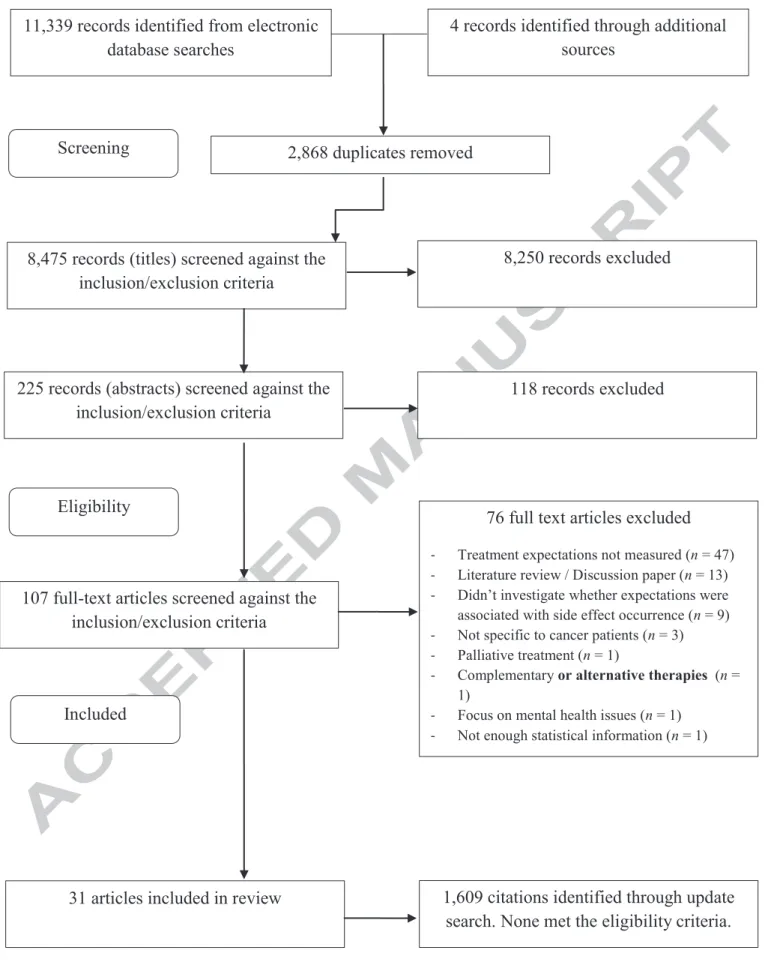
independently by the first and second authors (CF and CW). Reviewers agreed on 70% of decisions (Kappa = 0.33, p < 0.001) with final agreement negotiated, where required. The full-text of the remaining articles (n = 107) were obtained and screened against the inclusion criteria and a further 76 articles were excluded as they did not meet the eligibility criteria (see Figure 1 for the PRISMA flow diagram for reasons for exclusion). Any disagreements about inclusion were resolved through discussion among the research team.
The remaining 31 articles met the inclusion criteria and were included in the meta- analysis. This included one article that described two separate studies and another two articles describing the same study (these data were included only once). An updated search was conducted on the 23rd of November 2016 to identify articles published since the initial search was conducted. An additional 1,609 citations were identified; however none of the studies met the inclusion criteria. The meta-analysis included all of the studies analysed by Sohl, Schnur and Montgomery [6], except for two studies that did not include a measure of
anticipated response to treatment [7, 8] and an additional 14 studies identified in the literature search.
2.2.Selection criteria
Studies were eligible for inclusion if they examined the relationship between patient anticipation of side effects and their subsequent occurrence, duration, frequency, or severity in patients undergoing cancer-related treatment. This included patients with no previous treatment experience (potential “cognitive expectations” effect) or with some previous treatment experience (potential “conditioned response”). The side effects included were nausea, vomiting, fatigue, pain, skin reactions, and problems with concentration.
Eligible studies were required to meet the following criteria:
8 1) included participants undergoing curative treatment for cancer;
2) employed a measure of anticipated response to treatment;
3) examined the relationship between anticipation and experience of cancer treatment- related side effects; and
4) reported quantitative data (either an effect size or enough statistical information to calculate an effect size).
Studies were excluded during the screening process if; anticipation of treatment- related side effects was not measured, the study was a review or meta-analysis of the literature, the associations between anticipated and experienced side effects were not
reported, the sample was not cancer patients, the study focussed on mental health issues, or if treatment was palliative or involved complementary and alternative therapies (i.e., not adjuvant therapies used for curative purposes).
2.3.Quality assessment
The first and third authors (CF and AH) assessed the methodological quality of studies included in the meta-analysis using the Qualsyst tool [9], which was developed for assessment of the quality of both qualitative and quantitative studies that employ any study design. The Qualsyst tool for assessment of the quality of quantitative studies is comprised of 14 items that are scored as yes, partial, no or not applicable. Examples of the items are; is the question/objective sufficiently described, is the sample size appropriate, and have they controlled for confounding. A summary score was calculated for each paper and then a final score was calculated by dividing the summary score by the total possible score (determined by subtracting the Not Applicable responses). Mean quality score for each paper was
calculated by averaging the scores given to each paper by the two assessors. These scores are documented in Supplementary Table 2 (range: 0.66 to 1.0). The scores assigned by the first
9 assessor ranged from 0.59 to 1.0 (mean: 0.81, standard deviation: 0.09). The scores assigned by the second assessor ranged from 0.64 to 1.0 (mean: 0.85, standard deviation: 0.10). Both assessors assigned the same score to six studies (19%). Good inter-rater reliability was observed (r = 0.60). Discrepancies in the scores of the remaining studies ranged from 0.01 to 0.18 and were resolved through discussion. Articles were not excluded from the meta-
analysis based on a threshold Qualsyst score.
2.4.Data extraction
The first author (CF) extracted key descriptive data and effect sizes for the relationship between anticipated response and subsequent experience of side effects.
Descriptive data extracted related to the study design (e.g., cross-sectional,
longitudinal/prospective, experimental), sample size, sample characteristics (e.g., gender, cancer type, treatment type), whether participants had previous experience of cancer treatment, instrument used to measure anticipation of treatment-related side effects, when anticipation of side effects was measured (e.g., before first treatment, before treatment other than the first, before multiple treatments), which side effects were experienced, and whether occurrence, duration, frequency, or severity (or combination) of side effects were assessed.
Reported effect sizes or statistical information needed to compute effect sizes for the
relationship between anticipated response and subsequent experience of side effects were also extracted.
2.5.Data analysis 2.5.1. Effect size
The effect size correlation coefficient (ESr) was used as the outcome in the meta- analysis. Positive values indicated an association between anticipated response and
subsequent experience of the side effect measured by indices including, duration, frequency,
10 and severity. Effect sizes (Pearson’s r) were directly available in many of the studies [10-21].
In cases where a correlation coefficient was not reported, mean side effects scores and standard deviations [22], t-tests [23], number of side effect events and non-events [24], chi- square statistics [25-27], odds ratios [28-31], change in R square [23], or Beta-coefficients [32-39] were used to estimate effect sizes utilizing formulas suggested in the literature [40, 41].
Several studies reported results for multiple indices of side effects (e.g., nausea duration, nausea severity, and nausea unpleasantness) or multiple time-points (e.g., cycles of chemotherapy). In these cases, an average effect size was calculated for each separate side effect so that each study contributed only one effect size for each side effect to the meta- analysis.
2.5.2. Meta-analysis
The meta-analysis was conducted using Comprehensive Meta-Analysis Software V3 [42]. Analyses were conducted separately for each side effect and for patients with and without prior treatment experience. Overall effect sizes were calculated when relevant data were available from at least three studies. Following recommendations by Borenstein and colleagues [40], a random-effects modelling approach was used to account for variation in sampling in the included studies. Q tests were conducted to investigate differences in effect sizes in patients with no prior treatment experience versus some prior treatment experience.
2.5.3. Heterogeneity
The I2 statistic was calculated for each analysis to assess the consistency of the results of included studies. The I2 statistic describes the percentage of total variation between study results that is due to genuine underlying differences (heterogeneity) rather than chance [43].
11 It is a measure of inconsistency of results. According to Higgins and colleagues [43], levels of heterogeneity can be described as low (I2 = 25%), moderate (I2 = 50%), and high (I2 = 75%), with a lower level indicating less inconsistency in results.
2.5.4. Publication bias
Publication bias was assessed using Rosenthal’s [44] Classic Fail-Safe N (Nfs), Orwin’s [45] Nfs, and Egger’s test [46]. Rosenthal’s Nfs estimates the number of unpublished studies reporting null results that would be needed to increase the P-value for the meta- analysis to above 0.05. Orwin’s Nfs takes a more conservative approach to estimate the
number of studies needed to reduce the effect size to a specified level other than zero (defined in the present meta-analysis as r ≤ 0.05). An effect size was considered to be robust if
Rosenthal’s Nfs was larger than 5k + 10, where k is the number of studies included in the analysis. Rosenthal’s Nfs of less than the recommended criterion (5k + 10) indicated potential publication bias, which was further investigated using Egger’s test. Where Egger’s test confirmed a publication bias, an adjusted effect size was estimated using Duval and
Tweedie’s [47] trim-and-fill method, which uses imputations of missing results to recalculate the effect size.
3. Results
3.1.Study Characteristics
The meta-analysis included the results of 31 studies with a total of 5,069 participants.
Studies had an average sample size of 164 (ranging from 20 [16] to 911 [29]). Fifteen of the studies included participants with breast cancer [11, 13-17, 20, 22, 25, 26, 28, 30, 32, 35, 36].
Other cancers studied included ovarian [23] and mixed cancer types [10, 12, 18, 19, 21, 23, 24, 29, 31, 33, 34, 37-39]. One study did not specify the types of cancer that participants were diagnosed with [27]. The most commonly studied side effect was post-treatment nausea (77%
12 [10-12, 14, 15, 17, 19-25, 27, 29-31, 33-39]), followed by post-treatment vomiting (39% [11, 17, 20, 23, 24, 27, 28, 31, 34, 36-38]), fatigue (29% [11, 13-15, 20, 24, 33, 37, 38]), pain (23% [11, 14-16, 24, 37, 38]), anticipatory nausea (16% [12, 13, 26, 30, 32]), skin reactions (13% [18, 24, 37, 38]), and problems with concentration (6% [37, 38]).
Study designs were predominantly prospective and longitudinal. Several studies were randomised controlled trials, comparing antiemetic regimens [39], or testing whether the assessment of patients’ expectations of side effects were related to their experience of side effects [33], the effectiveness of a pre-surgery hypnosis session in reducing post-surgery pain [16], and the effectiveness of educational or informational interventions to reduce post- treatment nausea [19, 21]. Another study analysed data collected from participants in the control arm of a larger randomised controlled trial [17]. Studies used a variety of instruments to measure patients’ anticipation of side effects, including the Side Effect Expectancy
Questionnaire [10, 12, 18, 19, 21-26, 30, 32], the Symptom Experience and Expectation Interview Schedule [27], visual analogue scales [11, 13-16, 20, 29, 31, 37, 38, 48], and other Likert-type scales [17, 33-36, 39]. The actual experience of side effects was assessed using the Morrow Assessment of Nausea and Emesis [12, 30, 34, 36], the Brief Pain Inventory [15], the Rhodes Index of Nausea and Vomiting [27], the MASCC Antiemesis Tool [31], patient report diaries [17, 19-23, 28, 29, 39, 48], symptom checklists [32, 35], visual analogue scales [10, 11, 13, 14, 16, 18, 29, 33, 37, 38], and other Likert-type scales [13, 17, 19-21, 23-25, 48].
Most studies included participants undergoing chemotherapy (80% [10-13, 17-20, 22- 33, 35-39]). The remaining studies included participants undergoing surgery [14-16] and radiotherapy [18, 21]. Twenty-six of the studies measured anticipation of side effects prior to the first treatment, two studies measured anticipation prior to each of multiple cycles of treatment (one of which also measured anticipation prior to the first treatment), and the final
13 three studies measured anticipation prior to any treatment session but not the first.
Experience of the side effect was measured after the first treatment in 13 of the studies, after each of multiple treatment sessions in 13 of the studies, and any treatment other than the first in five studies.
3.2. Association between anticipation and experience of side effects
Analyses were conducted to investigate the overall effect of anticipation on each of the seven side effects: anticipatory nausea, post-treatment nausea, post-treatment vomiting, fatigue, pain, skin reactions, and problems with concentration (Table 1). Analyses were also conducted to investigate differences in effect sizes for each side effect in patients with and without previous treatment experience (Table 2). An insufficient number of studies meant that analyses could not be conducted for anticipatory nausea in patients with no prior
treatment experience and for pain, problems with concentration, and skin reactions in patients with some previous treatment experience.
3.2.1. Overall effect of anticipation on side effects
Results indicated significant, medium, positive associations between anticipated effects of treatment and experience of anticipatory nausea (ESr = 0.442), fatigue (ESr = 0.325), pain (ESr = 0.364), and problems with concentration (ESr = 0.431). Significant, small, positive associations were found between anticipation and experience of post- treatment nausea (ESr = 0.230), vomiting (ESr = 0.181), and skin reactions (ESr = 0.290).
Findings for anticipatory nausea, post-treatment nausea, vomiting, fatigue, pain, and problems with concentration appeared to be robust, with Rosenthal’s Nfs exceeding the recommended criterion, 5k + 10. This was not the case for the effect size for skin reactions, where Rosenthal’s Nfs (N = 20) was less than the recommended criterion (N = 30). This indicated a potential publication bias, however this was not confirmed by Egger’s test (p =
14 0.122). Only two studies investigated the relationship between anticipation and problems with concentration therefore the potential for publication bias could not be assessed.
3.2.2. Effect of anticipation on side effects in patients with no prior treatment experience
Significant associations were found between anticipation and experience of each of the side effects, with medium, positive associations for fatigue (ESr = 0.337), pain (ESr = 0.366), and problems with concentration (ESr = 0.431) in patients with no previous treatment experience. Small, positive associations were found for post-treatment nausea (ESr = 0.200), post-treatment vomiting (ESr = 0.170), and skin reactions (ESr = 0.278). There was evidence of potential publication bias in the finding for post-treatment vomiting, with the
recommended criterion (N = 45) exceeding Rosenthal’s Nfs (N = 42). Egger’s test supported the presence of a publication bias (p = 0.012). Therefore, imputations of missing results were used to calculate an adjusted effect size (ESr = 0.153), which was considerably smaller than the unadjusted effect for post-treatment vomiting. The recommended criterion (N = 25) also exceeded Rosenthal’s Nfs (N = 12) indicating potential publication bias in the finding for skin reactions, however this was not supported by Egger’s test (p = 0.220) and an adjusted effect size was not calculated.
3.2.3. Effect of anticipation on side effects in patients with prior treatment experience
Significant, medium, positive associations were found between anticipation and experience of anticipatory nausea (ESr = 0.476) and post-treatment nausea (ESr = 0.288) in patients who had some prior treatment experience. Significant, small, positive associations were also found for post-treatment vomiting (ESr = 0.211) and fatigue (ESr = 0.266). The effect size for pain was medium in size (ESr = 0.235), but was not significant. Overall effect sizes could not be calculated for problems with concentration and skin reactions because there were not enough data to run the meta-analysis. Rosenthal’s Nfs (N = 13) was less than
15 the recommended criterion (N = 35) for post-treatment vomiting, indicating a potential
publication bias. Egger’s test was conducted, but did not provide evidence of a publication bias (p = 0.881). Rosenthal’s Nfs also indicated potential publication bias in the finding for fatigue, however this was not supported by Egger’s test (p = 0.933).
3.2.4. Differences in effect in patients with and without prior treatment experience
Contrary to the main hypothesis, no significant differences in effect sizes were found in patients with and without prior treatment experience for post-treatment nausea, post- treatment vomiting, fatigue, pain, problems with concentration, and skin reactions (Table 4).
The difference between effect sizes for the relationship between anticipation of side effects and the experience of anticipatory nausea in patients with and without prior treatment experience was significant (p = 0.012), with a greater effect size for patients with prior treatment experience (ESr = 0.476). However, only one study examined anticipation of side effects and the experience of anticipatory nausea in patients with no previous treatment experience with results indicating only a non-significant, small, positive association (r = 0.036 [12]), so this result should be interpreted with caution.
4. Discussion
Results of the meta-analysis confirmed those of Sohl, Schnur and Montgomery [6]; a medium effect size which varied with previous treatment experience. Our results extend these previous results by analysing additional treatment side effects and side effects based on prior or no prior experience of treatment separately. When studies that measured side effects in patients with and without previous treatment exposure were analysed together (See Table 1), the largest effect sizes were reported for anticipatory nausea and problems with
concentration, although the conclusiveness of the latter is mitigated by the fact that only two studies were included. Nonetheless, future research in the area of anticipated cognitive
16 impairment following cancer treatment is required, particularly given the rising report of this form of potential impact from treatment in both the scientific (e.g., Janelsins et al. [49]) and non-scientific media (e.g., the New York Times [50]) including non-government cancer support organizations around the world (e.g., MacMillan in the UK [51], the Breast Cancer Network in Australia [52], and the Fred Hutchinson Center in the US [53]).
It is also interesting to note that although all side effects were positively associated with anticipation, post-treatment vomiting had the smallest effect size. Subsequent analysis separated studies where side effects were measured in patients who had not been previously exposed to treatment (see Table 2), from those where patients had previous treatment exposure (see Table 3). In the first case, the mechanism is hypothesised to involve response expectancies based upon information obtained directly or indirectly from expert or lay
sources, whereas for the second conditioning could be at least part of the explanation. In both of these, post-treatment nausea remained the smallest effect, and was actually reduced to non- significance in patients with no prior treatment experience after adjusting for publication bias.
This result could reflect real or anticipated effects of any anti-emetics provided, an issue future research might address.
We undertook a direct comparison between studies reporting data after a single treatment exposure (where the opportunity for classical conditioning of response was eliminated) with studies where side effect experience was measured after the patient had received multiple treatment cycles (where effects were likely a combination of expectations raised before treatment (i.e., cognitive expectancies) and reactions learned though experience (i.e., conditioned responses). The findings for anticipatory nausea confirmed those of Sohl, Schnur and Montgomery [6]. The experience of anticipatory nausea was more strongly related to anticipation among patients who had some previous treatment experience, in comparison to patients with no treatment experience, therefore highlighting a potential
17 influence from classical conditioning. Contrary to the hypothesis, there were no significant differences in effect sizes in patients with and without previous treatment experience for all other side effects. Although non-significant, larger effect sizes were found for post- treatment nausea and post-treatment vomiting in patients with previous treatment experience compared to patients without previous treatment experience. Further research might usefully consider the anticipated effectiveness of anti-emetic treatments. A small number of the studies included in the meta-analysis did control for the use of anti-emetic treatments or describe the relationship between anti-emetic use and subsequent nausea and vomiting [10, 22, 23, 29-31, 34, 35], however none specifically examined patients’
anticipation of the effectiveness of anti-emetic treatments. Interestingly, effect sizes for fatigue and pain were smaller in patients with previous treatment experience compared to patients without previous treatment experience.
The implications of the findings for clinical practice should be considered. Several studies included in this review recommended providing patients with information prior to treatment in order to alter patient expectations. Although intervention studies provided some support for the use of acupressure bands for reducing nausea [21] and hypnosis for reducing post-surgery pain and distress [16], manipulations of the information given to patients did not result in changes in side-effects [16]. Shelke et al. [19] found that providing information about the effectiveness of an antiemetic successfully altered patient expectations. However, pre-intervention anticipation and not post-intervention anticipation was predictive of
subsequent side effects. This suggests that simply changing patient education regarding side effects may not be effective in reducing expectancy effects.
The data presented here are subject to significant limitations. The most significant of these is the inability to account for variance arising from an array of variables likely to impact both the predictor variable, anticipated effect of treatment, and the outcome variable, report
18 of side effects. For example, it is possible that variables like education, IQ, depression,
anxiety, locus of control and optimism would all impact ratings of anticipation and the side effects experienced, and the extent to which these are positive or negative, irrespective of messages received about likely effects or any conditioning experienced. There is some support for this from an experimental study of pain expectancies, which found that pain expectancies played a mediating role between catastrophizing and depression and the actual pain experienced [54], although further research is required to test this. Furthermore, the nature and intensity of the chemotherapy regime and the medication provided to alleviate side effects are all potential confounds of reported side effects. There may also be a
differentiated impact of the type of treatment on the side effects that patients
experience; in particular, some treatments have a cumulative effect and may result in long-term residual toxicity. This was not examined in the present study due to the small number of studies that included participants undergoing treatment other than
chemotherapy. This residual effect may also require consideration alongside the effect of response expectancies and classical conditioning. More research is needed to examine the relationships between anticipation of side effects and actual experience of side effects in patients undergoing radiotherapy and surgery before meta-analysis can be conducted to provide meaningful insight.
Our results confirm existing findings; anticipation of side effects positively predict the experience of these. In addition, our findings extend those of others by demonstrating their impact in a reasonably recent area of research in side effects of cancer treatment; cognition.
Importantly, they highlight the potentially “additive” effects of conditioning following treatment on the impact made from expectations generated before any treatment, but only for anticipatory nausea. The failure to find an additive influence from treatment experience for other side effects suggests an important role for cognition in predicting treatment experience.
19 Future research could usefully explore patient reports of messages received about likely treatment effects both before and during treatment, and from whom these messages originate.
In terms of conditioned responses, interview data could identify cues (i.e., the conditioned stimulus) that precede anticipatory nausea and vomiting in an attempt to develop strategies that could mitigate these associations. Further exploration of the anticipated outcomes attached to preventive therapies for side effects might also usefully identify strategies for minimisation of adverse treatment events. An increasing focus on the importance of measuring patient reported outcomes in cancer patients and survivors bodes well for
increased concern about patient reported side effects and improved commitment from health providers to assist in their mitigation.
20 Acknowledgements
This research did not receive any specific grant from funding agencies in the public, commercial, or not-for-profit sectors.
Competing Interest Statement
The authors have no competing interests to report.
References
[1] Roscoe JA, Jean-Pierre P, Shelke AR, Kaufman ME, Bole C, Morrow GR. The role of patients' response expectancies in side effect development and control. Current Problems in Cancer. 2006;30:40-98.
[2] Colloca L, Sigaudo M, Benedetti F. The role of learning in nocebo and placebo effects.
PAIN. 2008;136:211-8.
[3] Colloca L, Petrovic P, Wager TD, Ingvar M, Benedetti F. How the number of learning trials affects placebo and nocebo responses. PAIN. 2010;151:430-9.
[4] Stewart-Williams S, Podd J. The placebo effect: Dissolving the expectancy versus conditioning debate. Psychological Bulletin. 2004;130:324-40.
[5] Kamen C, Tejani MA, Chandwani K, Janelsins M, Peoples AR, Roscoe JA, et al.
Anticipatory nausea and vomiting due to chemotherapy. European Journal of Pharmacology.
2014;722:172-9.
21 [6] Sohl SJ, Schnur JB, Montgomery GH. A meta-analysis of the relationship between
response expectancies and cancer treatment-related side effects. Journal of Pain and Symptom Management. 2009;38:775-84.
[7] Andrykowski MA, Redd WH, Hatfield AK. Development of anticipatory nausea: A prospective analysis. Journal of Consulting and Clinical Psychology. 1985;53:447-54.
[8] Tomoyasu N, Bovbjerg DH, Jacobsen PB. Conditioned reactions to cancer chemotherapy:
percent reinforcement predicts anticipatory nausea. Physiology and Behavior. 1996;59:273-6.
[9] Kmet LM, Lee RC, Cook LS. Standard quality assessment criteria for evaluating primary research papers from a variety of fields. Alberta, Canada: Alberta Heritage Foundation for Medical Research; 2004.
[10] Andrykowski MA, Gregg ME. The role of psychological variables in post-chemotherapy nausea: Anxiety and expectation. Psychosomatic Medicine. 1992;54:48-58.
[11] Cobeanu O. Attentional bias and treatment related symptoms in breast cancer patients undergoing chemotherapy: Preliminary results of an exploratory study. Erdelyi Pszichologiai Szemle. 2013;14:57-70.
[12] Hickok JT, Roscoe JA, Morrow GR. The role of patients' expectations in the
development of anticipatory nausea related to chemotherapy for cancer. Journal of Pain and Symptom Management. 2001;22:843-50.
[13] Montgomery GH, Bovbjerg DH. Specific response expectancies predict anticipatory nausea during chemotherapy for breast cancer. Journal of Consulting and Clinical
Psychology. 2001;69:831-5.
[14] Montgomery GH, Bovbjerg DH. Presurgery distress and specific response expectancies predict postsurgery outcomes in surgery patients confronting breast cancer. Health
Psychology. 2004;23:381-7.
22 [15] Montgomery GH, Schnur JB, Erblich J, Diefenbach MA, Bovbjerg DH. Presurgery psychological factors predict pain, nausea, and fatigue one week after breast cancer surgery.
Journal of Pain and Symptom Management. 2010;39:1043-52.
[16] Montgomery GH, Weltz CR, Seltz M, Bovbjerg DH. Brief presurgery hypnosis reduces distress and pain in excisional breast biopsy patients. International Journal of Clinical and Experimental Hypnosis. 2002;50:17-32.
[17] Roscoe JA, Bushunow P, Morrow GR, Hickok JT, Kuebler PJ, Jacobs A, et al. Patient expectation is a strong predictor of severe nausea after chemotherapy - A University of Rochester Community Clinical Oncology Program study of patients with breast carcinoma.
Cancer. 2004;101:2701-8.
[18] Ryan JL, Bole C, Hickok JT, Figueroa-Moseley C, Colman L, Khanna RC, et al. Post- treatment skin reactions reported by cancer patients differ by race, not by treatment or expectations. British Journal of Cancer. 2007;97:14-21.
[19] Shelke AR, Roscoe JA, Morrow GR, Colman LK, Banerjee TK, Kirshner JJ. Effect of a nausea expectancy manipulation on chemotherapy-induced nausea: A University of
Rochester cancer center community clinical oncology program study. Journal of Pain and Symptom Management. 2008;35:381-7.
[20] Zachariae R, Paulsen K, Mehlsen M, Jensen AB, Johansson A, Von Der Maase H.
Chemotherapy-induced nausea, vomiting, and fatigue - The role of individual differences related to sensory perception and autonomic reactivity. Psychotherapy and Psychosomatics.
2007;76:376-84.
[21] Roscoe JA, Bushunow P, Jean-Pierre P, Heckler CE, Purnell JQ, Peppone LJ, et al.
Acupressure bands are effective in reducing radiation therapy-related nausea. Journal of Pain and Symptom Management. 2009;38:381-89.
23 [22] Higgins SC, Montgomery GH, Bovbjerg DH. Distress before chemotherapy predicts delayed but not acute nausea. Supportive Care in Cancer. 2007;15:171-7.
[23] Roscoe JA, Hickok JT, Morrow GR. Patient expectations as predictor of chemotherapy- induced nausea. Annals of Behavioral Medicine. 2000;22:121-6.
[24] Cassileth BR, Lusk EJ, Bodenheimer BJ, Farber JM, Jochimsen P, Morrin-Taylor B.
Chemotherapeutic toxicity - The relationship between patients' pretreatment expectations and post-treatment results. American Journal of Clinical Oncology: Cancer Clinical Trials.
1985;8:419-25.
[25] Montgomery GH, Bovbjerg DH. Pre-infusion expectations predict post-treatment nausea during repeated adjuvant chemotherapy infusions for breast cancer. British Journal of Health Psychology. 2000;5:105-19.
[26] Montgomery GH, Tomoyasu N, Bovbjerg DH, Andrykowski MA, Currie VE, Jacobsen PB, et al. Patients' pretreatment expectations of chemotherapy-related nausea are an
independent predictor of anticipatory nausea. Annals of Behavioral Medicine. 1998;20:104-8.
[27] Rhodes VA, Watson PM, McDaniel RW, Hanson BM, Johnson MH. Expectation and occurrence of postchemotherapy side effects: nausea and vomiting. Cancer Practice.
1995;3:247-53.
[28] Booth CM, Clemons M, Dranitsaris G, Joy A, Young S, Callaghan W, et al.
Chemotherapy-induced nausea and vomiting in breast cancer patients: a prospective observational study. Journal of Supportive Oncology. 2007;5:374-80.
[29] Molassiotis A, Aapro M, Dicato M, Gascon P, Novoa SaA, Isambert N, et al. Evaluation of risk factors predicting chemotherapy-related nausea and vomiting: results from a European prospective observational study. Journal of Pain and Symptom Management. 2014;47:839- 48.e4.
24 [30] Watson M, Meyer L, Thomson A, Osofsky S. Psychological factors predicting nausea and vomiting in breast cancer patients on chemotherapy. European Journal of Cancer.
1998;34:831-7.
[31] Molassiotis A, Stamataki Z, Kontopantelis E. Development and preliminary validation of a risk prediction model for chemotherapy-related nausea and vomiting. Supportive Care in Cancer. 2013;21:2759-67.
[32] Andrykowski MA, Jacobsen PB, Marks E, Gorfinkle K, Hakes TB, Kaufman RJ, et al.
Prevalence, predictors, and course of anticipatory nausea in women receiving adjuvant chemotherapy for breast cancer. Cancer. 1988;62:2607-13.
[33] Colagiuri B, Dhillon H, Butow PN, Jansen J, Cox K, Jacquet J. Does assessing patients' expectancies about chemotherapy side effects influence their occurrence? Journal of Pain and Symptom Management. 2013;46:275-81.
[34] Haut MW, Beckwith BE, Laurie JA, Klatt N. Postchemotherapy nausea and vomiting in cancer patients receiving outpatient chemotherapy. Journal of Psychosocial Oncology.
1991;9:117-30.
[35] Jacobsen PB, Andrykowski MA, Redd WH, Die-Trill M, Hakes TB, Kaufman RJ, et al.
Nonpharmacologic factors in the development of posttreatment nausea with adjuvant chemotherapy for breast cancer. Cancer. 1988;61:379-85.
[36] Molassiotis A, Yam BM, Yung H, Chan FY, Mok TS. Pretreatment factors predicting the development of postchemotherapy nausea and vomiting in Chinese breast cancer patients.
Supportive Care in Cancer. 2002;10:139-45.
[37] Olver IN, Taylor AE, Whitford HS. Relationships between patients' pre-treatment expectations of toxicities and post chemotherapy experiences. Psycho-Oncology. 2005;14:25- 33.
25 [38] Whitford HS, Olver IN. When expectations predict experience: The influence of
psychological factors on chemotherapy toxicities. Journal of Pain and Symptom Management. 2012;43:1036-50.
[39] Colagiuri B, Roscoe JA, Morrow GR, Atkins JN, Giguere JK, Colman LK. How do patient expectancies, quality of life, and post-chemotherapy nausea interrelate? Cancer.
2008;113:654-61.
[40] Borenstein M, Hedges LV, Higgins JPT, Rothstein HR. Introduction to Meta-Analysis:
Wiley; 2009.
[41] Peterson RA, Brown SP. On the use of beta coefficients in meta-analysis. Journal of Applied Psychology. 2005;90:175-81.
[42] Biostat. Comprehensive Meta-Analysis Software Version 3.0. 2014.
[43] Higgins JPT, Thompson SG, Deeks JJ, Altman DG. Measuring inconsistency in meta- analyses. BMJ. 2003;327:557-60.
[44] Rosenthal R. The "file drawer problem" and tolerance for null results. Psychological Bulletin. 1979;1979:638-41.
[45] Orwin RG. A fail-safe N for effect size in meta-analysis. Journal of Educational Statistics. 1983;8:157-9.
[46] Egger M, Davey Smith G, Schneider M, Minder C. Bias in meta-analysis detected by a simple graphical test. BMJ. 1997;315:629-34.
[47] Duval S, Tweedie R. Trim and fill: A simple funnel-plot-based method of testing and adjusting for publication bias in meta-analysis. Biometrics. 2000;56:455-63.
[48] Zachariae R, Paulsen K, Mehlsen M, Jensen AB, Johansson A, Von Der Maase H.
Anticipatory nausea: the role of individual differences related to sensory perception and autonomic reactivity. Annals of Behavioral Medicine. 2007;33:69-79.
26 [49] Janelsins M, Heckler CEP, L. J., Kamen C, Mustian KM, Mohile SG, Magnuson A, et al. Cognitive complaints in survivors of breast cancer after chemotherapy compared with age- matched controls: an analysis from a nationwide, multicenter, prospective longitudinal study.
Journal of Clinical Oncology. 2017;35:506-14.
[50] Parker-Pope T. Chemo brain may last 5 years or more, . The New York Times: The New York Times; 2011.
[51] Macmillan Cancer Support. Chemo brain. Macmillan Cancer Support; 2016.
[52] Breast Cancer Network Australia. Chemo brain. 2017.
[53] Fred Hutchinson Cancer Research Center. Chemobrain. 2017.
[54] Sullivan MJL, Rodgers WM, Kirsch I. Catastrophizing, depression and expectancies for pain and emotional distress. PAIN. 2001;91:147-54.
27
Figure 1. Study flow diagram for systematic review.
Identification
11,339 records identified from electronic database searches
2,868 duplicates removed Screening
8,475 records (titles) screened against the inclusion/exclusion criteria
8,250 records excluded
225 records (abstracts) screened against the inclusion/exclusion criteria
Eligibility
107 full-text articles screened against the inclusion/exclusion criteria
Included
31 articles included in review
118 records excluded
76 full text articles excluded
- Treatment expectations not measured (n = 47) - Literature review / Discussion paper (n = 13) - Didn’t investigate whether expectations were associated with side effect occurrence (n = 9) - Not specific to cancer patients (n = 3) - Palliative treatment (n = 1)
- Complementary or alternative therapies (n = 1)
- Focus on mental health issues (n = 1) - Not enough statistical information (n = 1)
4 records identified through additional sources
1,609 citations identified through update search. None met the eligibility criteria.
28 Table 1. Meta-analysis results for the relationships between expectations of side effects and actual experience of side effects in patients
receiving treatment for cancer.
Note: *p < 0.05, **p < 0.01, ***p < 0.001.
k; number of studies; N, Number of participants; r, Pearson correlation coefficient; CI, Confidence Interval; I2, I2 statistic; Nfs, Fail-Safe N; %, Percentage.
Side effect Effect size 95% CI Rosenthal’s Orwin’s I2
k N r Lower Upper Nfs Nfs %
Anticipatory nausea 5 359 0.442** 0.173 0.649 74 42 84.24***
Post-treatment nausea 25 4,054 0.230*** 0.161 0.297 827 53 75.520***
Post-treatment vomiting 11 1,166 0.181*** 0.123 0.238 91 30 0.00
Fatigue 9 672 0.325*** 0.196 0.443 140 51 64.07**
Pain 6 386 0.364*** 0.174 0.528 67 38 71.26**
Problems with concentration 2 146 0.431*** 0.287 0.556 - - 0.00
Skin reactions 4 858 0.290* 0.003 0.534 20 4 87.913***
29 Table 2. Meta-analysis results for the relationships between expectations of side effects and actual experience of side effects in patients who had no previous treatment experience.
Note: *p < 0.05, **p < 0.01, ***p < 0.001, a Only one study examined expectancies and experience of anticipatory nausea prior to any treatment, therefore there were not enough data to run the meta-analysis. b Egger’s test confirmed a publication bias, therefore adjusted effect size
calculated using Duval and Tweedie’s trim-and-fill method. c Only two studies examined the relationship between response expectancies and problems with concentration, therefore publication bias analysis could not be conducted. Results should be interpreted with caution.
k; number of studies; N, Number of participants; r, Pearson correlation coefficient; CI, Confidence Interval; I2, I2 statistic; Nfs, Fail-Safe N; %, Percentage.
Side effect Effect size 95% CI Rosenthal’s Orwin’s I2
k N r Lower Upper Nfs Nfs %
Anticipatory nauseaa 1 - 0.036 - - - - -
Post-treatment nausea 17 3,553 0.200*** 0.121 0.277 372 30 78.726***
Post-treatment vomiting 7 901 0.170*** 0.104 0.234 42 17 0.00
Adjusted effect size b 0.153 0.092 0.213
Fatigue 6 526 0.337*** 0.180 0.477 87 35 72.636**
Pain 5 330 0.366** 0.141 0.554 50 32 76.975**
Problems with concentrationc 2 146 0.431*** 0.287 0.556 - - 0.00
Skin reactions 3 802 0.278 -0.065 0.562 12 3 91.243***
30 Table 3. Meta-analysis results for the relationships between expectations of side effects and actual experience of side effects in patients who had some previous treatment experience.
Note: *p < 0.05, **p < 0.01, ***p < 0.001. a Only two studies examined the relationship between response expectancies and pain, therefore publication bias analysis could not be conducted. Results should be interpreted with caution. b None of the included studies examined the relationship between response expectancies and problems with concentration in patients with previous treatment experience. c Only one study examined expectancies and experience of skin reactions in patients with previous treatment experience, therefore there was not enough data to run the meta-analysis.
k; number of studies; N, Number of participants; r, Pearson correlation coefficient; CI, Confidence Interval; I2, I2 statistic; Nfs, Fail-Safe N; %, Percentage.
Side effect Effect size 95% CI Rosenthal’s Orwin’s I2
k N r Lower Upper Nfs Nfs %
Anticipatory nausea 5 359 0.476*** 0.237 0.660 90 46 81.44***
Post-treatment nausea 11 707 0.288*** 0.184 0.386 142 49 46.38*
Post-treatment vomiting 5 390 0.211*** 0.096 0.320 13 17 12.99
Fatigue 4 271 0.266** 0.090 0.427 11 18 36.20
Paina 2 86 0.235 -0.072 0.500 - - 32.31
Problems with concentrationb 0 - - - - - - -
Skin reactionsc 1 - - - - - - -
31 Table 4. Between groups analysis for the relationships between expectations of side effects and actual experience of side effects in patients with and without previous treatment experience
Note: *p < 0.05, **p < 0.01, ***p < 0.001.
a Only one study examined response expectancies and experience of anticipatory nausea in patients with no previous treatment experience (r = 0.036 [12]), therefore result should be interpreted with caution. b None of the included studies examined response expectancies and experience of problems with concentration in patients with previous treatment experience.
Side effect Heterogeneity
Q df p
Anticipatory nauseaa 6.353 1 0.012*
Post-treatment nausea 1.817 1 0.178
Post-treatment vomiting 0.772 1 0.380
Fatigue 0.375 1 0.540
Pain 0.516 1 0.472
Problems with concentrationb - - -
Skin reactions 0.079 1 0.778
32 Supplementary Materials
Supplementary Table 1. Search string
(expectation OR expectations OR expectancy OR expectancies OR expect* OR anticipatory OR anticipations OR anticipat* OR somatic OR somatisation OR somati* OR nocebo) AND (“side effects” OR “adverse effects” OR “treatment side effects” OR outcomes OR “adverse outcomes”
OR nausea OR emesis OR vomit* OR fatigue OR cognitive OR cognition OR memory OR attention OR concentration OR hair loss OR alopecia OR neuropathy OR anxiety OR depression OR survival OR morbidity OR mortality OR breathlessness OR dyspnoea OR libido OR appetite OR constipation OR diarrhoea OR pain) AND (radiotherapy OR chemotherapy OR surgery OR treatment) AND (cancer OR neoplasm OR oncology)
33 Supplementary Table 2. Study characteristics
Study n Side effect type Cancer type Treatment type Treatment experience Expectancies measured before treatment no.
Side effect measured after treatment no.
Andrykowski, 1988 [32]
Qualsyst score: 0.82
77 Anticipatory nausea Breast Chemotherapy No previous treatment experience
First First and subsequent
Andrykowski, 1992 [10]
Qualsyst score: 0.89
65 Post-treatment nausea
Mixed Chemotherapy No previous treatment experience at first treatment Some previous treatment experience at subsequent treatments
First First and subsequent
Booth, 2007 [28]
Qualsyst score: 0.91
143 Post-treatment vomiting
Breast Chemotherapy Some previous treatment experience
Multiple treatments Cessation of chemotherapy or maximum of 6 treatment cycles
Cassileth, 1985 [24]
Qualsyst score: 0.66
56 Post-treatment nausea Post-treatment vomiting Fatigue Pain
Skin reactions
Mixed Chemotherapy No previous treatment experience at first treatment Some previous treatment experience at second treatment
First First and second
(analyses conducted using side effects reported following second treatment)
Cobeanu, 2013 [11]
Qualsyst score: 0.69
30 Post-treatment nausea Post-treatment vomiting Fatigue Pain
Breast Chemotherapy Some previous treatment experience
Treatment other than the first
Treatment other than the first
Colagiuri, 2008 [39]
Qualsyst score: 0.82
671 Post-treatment nausea
Mixed Chemotherapy No previous treatment experience
First First
Colagiuri, 2013 [33]
Qualsyst score: 0.75
91 Post-treatment nausea Fatigue
Mixed Chemotherapy No previous treatment experience
First First
34
Study n Side effect type Cancer type Treatment type Treatment experience Expectancies measured before treatment no.
Side effect measured after treatment no.
Haut, 1991 [34]
Qualsyst score: 0.84
36 Post-treatment nausea Post-treatment vomiting
Mixed Chemotherapy No previous treatment experience at first treatment Some previous treatment experience at subsequent treatments
First First and subsequent
Hickok, 2001 [12]
Qualsyst score: 0.80
63 Anticipatory nausea Post-treatment nausea
Mixed Chemotherapy No previous treatment experience at first treatment Some previous treatment experience at third treatment
First First and third
Higgins, 2007 [22]
Qualsyst score: 0.91
56 Post-treatment nausea
Breast Chemotherapy No previous treatment experience
First First
Jacobsen, 1988 [35]
Qualsyst score: 0.83
45 Post-treatment nausea
Breast Chemotherapy No previous treatment experience at first treatment Some previous treatment experience at subsequent treatments
First First six treatments
Molassiotis, 2002 [36]
Qualsyst score: 0.95
71 Post-treatment nausea Post-treatment vomiting
Breast Chemotherapy No previous treatment experience
First First
Molassiotis, 2013 [31]
Qualsyst score: 0.96
286 Post-treatment nausea Post-treatment vomiting
Mixed Chemotherapy No previous treatment experience
First First, second, and third
cycles
Molassiotis, 2014 [29]
Qualsyst score: 0.88
Cycle 1: 911 Cycle 2:
888 Cycle 3: 769
Post-treatment nausea
Mixed Chemotherapy No previous treatment experience at first treatment Some previous treatment experience at second and third treatments
First First, second, and third
cycles (data only for first cycle)
Montgomery, 1998 [26]
Qualsyst score: 0.88
59 Anticipatory nausea Breast Chemotherapy No previous treatment experience
First Sixth