In this study, the determinants of the size of the penalties given under the Fair Trading Act 1986 (Act) have been examined. The introduction of the Trade Act in the same year further obscures the policy rationale behind the Fair Trading Act. The reforms were based on the proposition that efficiency and equity concerns could be separated and that the market achieves greater economic efficiency from open competition7 with minimal or no barriers to entry.8 The availability of information and the reputation of traders supported by contract law were important basis for the efficient functioning of markets.
THE COMMERCE COMMISSION
It would be interesting from a legal and economic perspective to assess the optimality of these decision-making processes. The decision-making process of the Commerce Commission with Fair Trading Act Issues, June 1997/9811. It is appropriate and/or possible for the Commission to investigate Meets at least one of the three.
THE THEORY OF OPTIMAL JUDICIAL SENTENCING
The Theory of Optimal Penalties
An important assumption of optimal punishment theory is that criminal activity can be socially valuable. This has important implications for the use of the model in the Fair Trading Act. The optimal punishment is therefore equal to the value of the marginal damage caused to society.18.
The Theory of Optimal Judicial Sentencing and the Fair Trading Act
THE MODEL OF OPTIMAL FAIR TRADING ACT SENTENCING
In this section, an econometric model is developed to test the ability of the theory of optimal penalties to explain the variation in the size of average penalties under the Fair Trading Act. The maximum fines in the Act can be treated as if they were the "maximum fines" discussed by Garoupa in his synthesis of the theory of optimal punishments. The restricted model mainly includes those variables that approximate the "optimality considerations" in the theory of optimal punishments.
Econometric Regression Model
As mentioned in the previous section, the theory is amenable to econometric analysis in the context of the Fair Trading Act because fines are the only penalty in the law. Because the data was collected before considering theory, two variants of the econometric model are examined: an unrestricted variable model and a limited variable model.
Explanatory Variables
While this does not necessarily define the "market" in which the defendant operates, it is the best approximation given the details provided in the cases.). Market share The share of the product that the defendant sells in the New Zealand domestic market (local or. Extent of deviation from the truth The extent to which the breach represents a deviation from the truth.
Some of the variables were omitted from the analysis due to shortcomings in the quantification of the data and the consistency of the information provided in the cases, or because they represented outliers.25 No integrative economic theory underlies the selection of these explanatory variables. 25 Details of the variables that have been omitted, and why they have been omitted, are given in Appendix B. Prejudices about consumer choice Financial harm to consumers Safety biases to consumers Financial biases to producers Attempts to correct the infringement Incidental profit.
The explanatory variables in the restricted model are selected from Garoupa's synthesis of the theory of optimal punishments.26 As explained in the previous section, although the theory of optimal punishments is not expressly a theory of judicial sentencing, considerations are relevant to the determination of the optimal size of the penalty is relevant to sentencing, provided that sentencing involves a decision on the size of the penalty. A specific data quantification technique was used to convert some of the raw data into usable variables, as explained in Appendix B. By comparing the models' statistics, the constraints (i.e. the variables excluded from the constrained model) are accepted using a joint significance test with 5% significance.28 This means that, collectively, the omitted variables do not (statistically) significantly explain variation in the size of the punishment to a degree large enough to justify their inclusion not.
Additional linear restrictions were considered but were not adopted.29 The linear restrictions were designed to isolate the effects of groups of the variables in Table 2.
Data
Estimation
ECONOMETRIC RESULTS AND INTERPRETATION A. Results
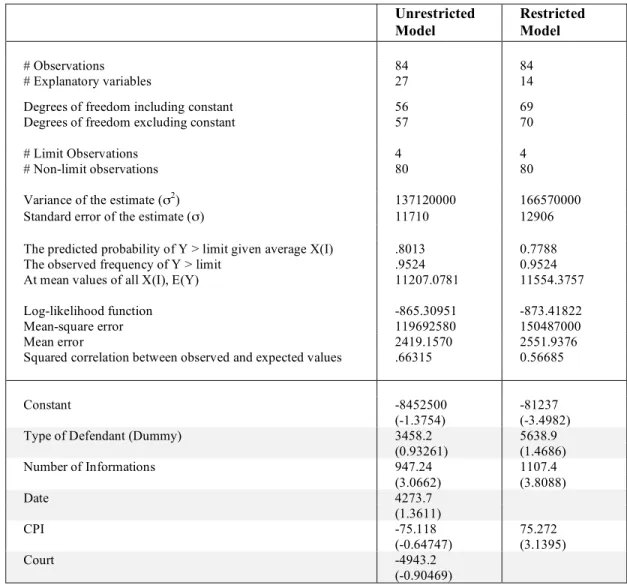
Shazam (version 7), an econometric computer program, was used to generate the econometric results for this study. The restricted model incorporates the economic theory of judicial sentencing and therefore tests the economic explanation of what determines the magnitude of punishment under the Fair Trading Act. If the unrestricted model has no more explanatory power than the constrained model, then the economic basis of the constrained model is supported by the data.
Interpretation
The variance of the estimate (σ2) and the standard error of the estimate (σ) are the variance and standard deviation of μ, the error term. The standard error of the estimate, which is the square root of the variance, is easier to interpret. The average of the estimated penalty is given by the statistic E(Y), at the average values of all X(I).
The mean error and squared correlation provide a measure of the 'fit' of the model to the data. The mean squared error and the mean error show us the variation of the estimated penalty values from the observed data. As with the standard error of the estimate, the mean error is easier to interpret.
For example, in the limited model, a unit increase in 'Intent' results in a $6,002.00 increase in the size of the total penalty. Unfortunately, the standard errors of the coefficients in the Shazam output are normalized coefficients, not regression coefficients. This means that their interpretation tells us nothing about the variation of the regression coefficients.
The t-statistics are therefore still relevant despite the fact that the standard errors of the normalized coefficients are used to calculate them.
Statistics
CONCLUSION
The aim was to test the ability of this model to explain the average variation in the magnitude of sentences given under the law. The econometric analysis revealed that some of the optimality considerations are statistically significant in determining the change in the size of fines under the law. However, considerations of optimality do not explain all the variation in the magnitude of penalties.
The regression coefficients for these variables show that, all other things being equal, a unit increase of 'Intent' increased the total penalty by a unit increase of 'Prior Violations', decreased the penalty by a unit increase of 'CPI', increased the total The fine was increased by $75.27, a unit increase of the 'Defendant's Ability to Pay' increased the fine by one unit. The negative correlation between 'Prior Offenses' and the size of the total sentence is the only inconsistent result in the study. . The meaning of “CPI” and the meaningful but controversial sign of “Prior Offenses” also suggest that time has an important effect on the magnitude of penalties imposed under the law.
Although the Commission can do little directly about this, some further work may reveal, for example, that over time courts develop an awareness of the. More than 50% of the size of fines awarded under the Act is explained by "optimality considerations". This included most Trade Commission cases brought under section 40 of the Fair Trading Act until the end of 1998.
Some cases were not included in the investigation either because they were not finalized or because the Commission was still awaiting written rulings or comments on the sentencing.
Data Collection
The data for this study were obtained from the Commerce Commission Fair Trading Act proceedings. However, the cases that were available tended to be those that were successful and resulted in convictions.
Data Recording
This technique weighs the relative importance each judge placed on the hypothesized variables during sentencing. 0 – not a variable explicitly considered by the judge 1 – variable mentioned by the judge without emphasis. 3 – much emphasis, often a statement that a factor is a significant mitigating or aggravating factor, or the main reason for the size of the sentence.
In addition, this technique records whether the judge considered the variables to be aggravating or mitigating.
Data Selection
Each variable is subjectively assigned an absolute value between 0 and 3. The categorizations are as follows:. In relation to the 'City' variable, Christchurch was included as a dummy for reasons of interest. The maximum sentences were usually given in Christchurch and Christchurch takes a large proportion of Fair Trading Act cases.
In terms of the theory of optimal penalties, the maximum penalty (F) is assumed to be represented by the legislative maximum in the Fair Trading Act. The number of complainants would have allowed the use of the 'Complaint Origin' variable in the study. Ex-post: benefit to the infringer refers to the actual benefit minus any costs of correcting the infringement and/or preventing further infringements.
However, courts take into account whether compensation orders have been made, whether there has been particularly bad publicity, or simply whether the defendant has voluntarily incurred costs in mitigating the effect of the breach. It could therefore be argued that these 'other' sanctions are a form of punishment - they can be used to calculate an imputed sentence. Garoupa notes that a weakness of the model is that it does not feature strategic behavior or interdependent behavior. The maximum fines provided for in the FTA clearly do not represent the maximum wealth of individuals.
Hill, Bernard and Mark Jones Fair Trading in New Zealand - The Fair Trading Act 1986 (Butterworths, Wellington, 1989.). J., "The Economics of Consumer Protection: A Critique of the Chicago School Case Against Intervention", Adelaide Law Review Research Paper, 1982. Mitcahell and Steven Shavell, "An Economic Theory of Public Enforcement", Journal of Economic Literature, Vol XXXVIII, No. 1, March 2000.