Incidence by Age and Gender:
Some Evidence from New Zealand
Omar Aziz, Norman Gemmell and Athene Laws
WORKING PAPER 10/2013 June 2013
Working Papers in Public Finance
Chair in Public FinanceVictoria Business School
economists, accountants, finance, law and tax specialists, to a wider audience. Any opinions and views expressed in these papers are those of the author(s). They should not be attributed to Victoria University of Wellington or the sponsors of the Chair in Public Finance.
Further enquiries to:
The Administrator Chair in Public Finance
Victoria University of Wellington PO Box 600
Wellington 6041 New Zealand
Phone: +64-4-463-9656 Email: [email protected]
Papers in the series can be downloaded from the following website:
http://www.victoria.ac.nz/cpf/working-papers
The Distribution of Income and Fiscal Incidence by Age and Gender: Some Evidence from New Zealand
∗Omar Aziz
a, Norman Gemmell
band Athene Laws
ca Senior Analyst, New Zealand Treasury
b Chair in Public Finance, Victoria University of Wellington, New Zealand
c Student Intern, Victoria University of Wellington, New Zealand
April 2013
Abstract
This paper examines the age and gender dimensions of income distribution and fiscal incidence in New Zealand using Household Expenditure Survey (HES) data for 2010 and a non-behavioural micro-simulation model. Since many fiscal policies are likely to have quite different incidences across age groups and genders, and with population ageing changing the age and gender composition of the voting population in many countries, age/gender dimensions of fiscal incidence become increasingly relevant. While this single
‘age distribution snapshot’ cannot fully capture lifecycle incidences, it avoids the complex and uncertain assumptions implicit in the latter and is an important component of life- time redistribution calculations. We explore alternative methods of intra-family allocation of resources including ‘unequal share’ assumptions based on recent research into how families allocate their spending. Our evidence, which in general is not highly sensitive to sharing assumptions, suggests a strong ‘life cycle’ aspect to fiscal incidence whereby net tax liabilities are low, and generally negative, at younger and older ages but positive during much of the ‘working age’ period. Women, on average, are found to have a systematically and persistently lower net fiscal liability than men, most pronounced at older ages when greater female longevity exercises a strong influence. Nevertheless, considerable heterogeneity of fiscal incidence for both men and women is observed with the distributions of various fiscal incidence measures showing substantial overlap.
Disclaimer:
Access to data used in this study was provided by Statistics New Zealand under conditions designed to give effect to the security and confidentiality provisions of the Statistics Act 1975. The results presented in this study are the work of staff at Victoria University of Wellington and the New Zealand Treasury and not Statistics New Zealand.
∗We are grateful to John Creedy and Jesse Eedrah for helpful discussions and comments on an earlier draft of this paper.
Introduction
This paper contributes to the literature on fiscal incidence by examining the age and gender dimension of redistribution through taxation and government spending in New Zealand. Lifecycle events vary for males and females resulting in different interactions with the labour market, taxation and welfare system across the age range. The purpose of this paper is to assess the extent to which income profiles, taxation and transfer incidences vary across genders associated with their respective life trajectories under certain assumptions. The analysis is based on New Zealand Household Expenditure Survey (HES) data for 2010 which includes information on households’ and individuals’ incomes, taxes, transfers etc, and personal characteristics such as age and gender. Following Aziz et al (2012a), analysis of health and education expenditure incidence is based on micro data obtained from HES and the Ministry of Health.
Most fiscal incidence studies have focused on the size distribution of various income and tax/spending measures across deciles or other decompositions of the income distribution.
Alternatively, summary distribution metrics, such as Gini coefficients, Atkinson indices, concentration curves and welfare dominance measures are reported.1 Surprisingly, evidence on annual fiscal incidence by age and gender is relatively limited. To the extent such evidence has been produced it has generally arisen as a by-product in the context of
‘generational accounting’ attempts to measure the ‘true’ long-term assets and liabilities of governments (see Auerbach et al., 1991, 1992, 1994; Haveman, 1994), or is an input into studies of lifetime redistribution (see, for example, Nelissen, 1998, Ter Rele, 2007).
Lifetime and inter-generational aspects of redistribution are clearly important for understanding the long-run distributional and sustainability impacts of fiscal policy settings. However, knowledge of annual age/gender dimensions can also be important for the political economy of fiscal policy reform. For example, the likelihood of a particular policy reform being supported by voters at a point in time will depend in part on the age distribution of the immediate (as well as longer-term) costs and benefits of that reform.
Indeed, if voters have relatively short time horizons, arguably the near-time incidences of reform are paramount for voting behaviour.
Since many fiscal policies are likely to have quite different incidences across age groups and genders, and with population ageing changing the age and gender composition of the voting population, this age/gender dimension of fiscal incidence becomes increasingly relevant. The recent rise of the so-called ‘grey power’ demographic among voters in many OECD countries, which is likely to become more prominent in future, suggest that this
1 See, for example, Jenkins and Lambert (1997) for an application of these and similar approaches to the UK, and Makdissi and Wodon (2002) on the use of consumption dominance curves applied to indirect tax reform. Gemmell and Morrissey (2005) provide a review of fiscal incidence methods and studies for
aspect of fiscal redistribution will become an increasingly relevant input into fiscal policy debates.
The paper is organised as follows. Section 1 highlights previous literature that has examined lifecycle or age/gender aspects of fiscal incidence. Section 2 then outlines the methodology of the micro-simulation model used in the analysis. Section 3 provides an overview of the demographic profile of New Zealand in 2010, by age and gender.
Incidence results are reported in subsequent sections. Section 4 first discusses the distribution of market income before government intervention or family dynamics play their roles. Section 5 analyses the conversion of market income to disposable income through the direct tax, transfer and intra-family sharing mechanisms. Section 6 incorporates indirect taxation and government expenditure on health and education to analyse the impacts on final income. Section 7 discusses net fiscal incidence, while section 8 draws out some life-time incidence implications for New Zealand from our results and compares them with US and Australian tax-and-transfer incidence results derived from generational accounting. Section 9 concludes.
1. Previous Literature
The motivation for annual fiscal incidence research is often the inequality or poverty consequences of taxes and public spending and hence the primary focus of most studies is the allocation of fiscal burdens by household or individual income levels. Surprisingly, age or gender aspects are generally either ignored or are incidental. This is understandable where the primary concern is with the effect of taxes and expenditures on an individual’s consumption possibilities; in which case, whether that individual is male or female, young or old, is of limited relevance. Nevertheless age and/or gender can be important determinants of where in the distribution of income or consumption a particular individual is likely to be found. Hence, despite being important inputs into fiscal incidence analyses, most previous studies appear not to have been concerned with age/gender outcomes.
Age, and to a lesser extent gender, has of course figured prominently in lifetime redistribution evidence and estimates of generational accounts. Auerbach et al (1991, 1992) suggested ‘generational accounting’ as a more robust method of assessing the overall intergenerational fiscal liabilities of taxpayers. That is, rather than using annual budget deficits as a measure of net fiscal liabilities, the evolution of implicit assets and liabilities over future years are also important determinants of the sustainability of fiscal settings. However, to apply generational accounting to the government’s budget requires many assumptions regarding future unknowns, including the impact of current and future fiscal policy on future generations. Importantly it requires information on, or assumptions about, the net fiscal liabilities/assets of each of a set of age cohorts over many decades, which has led some to question the reliability of this sort of evidence. In any case, while Auerbach et al (1992, 1994, 1999) and others have produced evidence for a number of
countries on these cross-cohort net fiscal liabilities, they have not in general examined the age and gender distribution at a point in time, nor explored how these relate to final inter-generational outcomes.2
Studies of lifetime, rather than annual, redistributional impact of fiscal policy typically use microsimulation methods, and assumptions similar to those embedded in generational accounting methods, to derive life-time incidences of fiscal variables. However as Ter Rele (2007) points out, in addition to the complex modelling and assumptions required, most such studied have focused on specific parts of the tax/transfer/expenditure system.3 Ter Rele (2007) on the other hand provides a simpler approach and is able to examine lifetime net fiscal incidence more completely. However, even here, age/gender dimensions are implicit within the analysis rather than a focus of specific attention.
A number of studies have explored the age and/or gender dimension to redistribution or fiscal incidence in more detail. Early work by Deaton and Paxson (1994) for example, established that, as predicted by the permanent income hypothesis, both income and consumption inequality tend to increase systematically with age. Both Nelissen (1998) and Ter Rele (2007) compare annual versus lifetime inequality effects of Dutch fiscal interventions – Nelissen examines social security in particular, while Ter Rele covers a range of taxes, cash and non-cash transfers. Both find that lifetime redistributive impacts are smaller than annual equivalents. Creedy and Van de Ven (2001) examine how Gini inequality measures of taxes and transfers change over the life cycle for males and all household members combined in Australia using a micro-simulation model.
Bridges and Choudhury (2007) also focus on the distribution of social security benefits (in the US). Examining differences across various age cohorts close to retirement from 1988 to 2003, they find that social security benefit wealth tended to increase for later cohorts, and to be higher for women than for men.
Changes in the role of women in the labour market has also been found to be important for gender aspects of income inequality. Del Boca and Pasqua (2003), for example, examine whether greater female participation in Italy is associated with a widening or narrowing of income inequality. Their evidence leads them to argue that greater female participation led to less income inequality overall than would otherwise have been expected. Lu et al (2011) undertake a similar exercise, examining the growth of family earnings inequality in Canada. They find that changes in family income inequality are
2 See also Ablett (1996) and Cardarelli et al (2000) for generational accounts for Australia and the UK respectively. As we note later, the net fiscal incidence profiles across age groups by gender that we produce for New Zealand at a given point in time reveal remarkably similar patterns to the cross-time incidence that Auerbach et al (1992, 1994) produce for the US and Ablett (1996) for Australia.
3 See, for example, Atkinson et al (1999), Creedy (1992, 1997), Creedy et al (1993, 2001), Leibman (2001), Gustman and Steinmeier (2000), Nelissen (1998), Fullerton and Rogers (1996).
related to changes in the extent of assortative mating, changes in household composition between singles and couples, and differences in the growth rates of employment and wages for males and females. These studies all highlight that age and gender dimensions to income (re)distribution have important compositional and other effects that are also changing over time.
For New Zealand there is currently little age- or gender-based analysis of the income distribution or fiscal incidence. On income inequality, Maloney and Pacheco (2012) examined the effects of government intervention via minimum wage legislation rather than via tax/spending variables, exploiting differential changes in the legislated minimum wage for teenagers and adults. They found that, while most minimum wage workers live in lower income households, a substantial fraction do not. However they found that in New Zealand, ‘increases in both teenage and adult minimum wages result in a greater concentration of minimum wage workers in the bottom of the income distribution’
(p.673).
Finally, fiscal incidence by income decile in New Zealand (1988 to 2007), and the distributional effects of projected long-term demographic changes and labour force participation, 2010-60, have been examined by Aziz et al. (2012a, b). Aziz et al. (2012a) ignored age/gender dimensions while the fiscal incidence effect of population ageing was the primary motivation for Aziz et al. (2012b), which reports evidence on the distribution of tax and spending across age groups in 2010 but is primarily concerned with projected changes in income inequality, poverty and fiscal incidence over the next fifty years.
This brief review of literature suggests that, despite the relevance of evidence on the (annual) age and gender aspects of fiscal incidence for policy advice around tax, transfer and expenditure reforms, there is surprisingly little available. Following discussion of the fiscal incidence framework we use, subsequent sections describe how we explore this in more detail for New Zealand in 2010.
2. Incidence Methodology
The traditional methodologies for undertaking fiscal incidence analysis are well established.4 As with most previous studies, this paper does not aim to capture the overall ‘impact of government’ on individuals’ incomes or consumption. Governments, including in New Zealand, often intervene in economic activity in ways that are not captured by their taxation and expenditure policies alone. Even within this limited form of fiscal intervention, fiscal incidence analysis generally ignores general equilibrium interactions and responses. These can often be shown at the micro level to be important
4 See Cullis and Jones (2009) for a summary treatment, and Martinez-Vazquez (2001) and Harding et al.
(2007) for more detailed conceptual discussion and an application to the UK. Gemmell (1985) proposed a method to examine the sensitivity of fiscal incidence outcomes to the omission of some hard-to-allocate public expenditure categories.
but their importance at the aggregate level is much harder to ascertain. In addition, since a ‘no government’ counterfactual is never available, we follow standard practice and treat the pre-tax-and-transfer, or ‘market’ income distribution as the benchmark against which changes due to fiscal interventions are compared.
Interpretation of fiscal incidence results always requires caution. The allocation of both taxes and expenditures to individuals is a difficult task, known in principle to depend on a variety of conditions and response elasticities. For public expenditures especially, such as on health and education, allocating the costs to individuals on a pro-rata basis to the users of the services provided out of that public expenditure can be a crude approximation to presumed incidence, even before allowing for general equilibrium responses. We therefore regard the results reported below as preliminary evidence on the approximate direct impact of taxes, transfer payments and some government expenditures on individuals in New Zealand in 2010. More sophisticated analysis would be required before drawing conclusions regarding the distribution of the economic or welfare gains and losses associated with these fiscal variables.
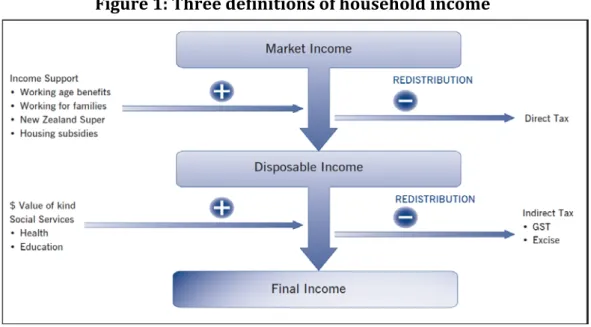
In the standard analysis, three concepts of income are useful in framing the redistributive effects of government policy. Figure 1 outlines the process whereby disposable and final incomes are derived from the interaction of market income, direct and indirect taxation and government spending.
Figure 1: Three definitions of household income
Market income refers to income from wages and salaries, investments, self-employment, and from other forms of taxable income earned by private means. With the addition of income support and the removal of direct taxation, market income is converted into disposable income, reflecting the income available for household consumption or savings.
Final income takes into account the distributive effects of in-kind publicly provided goods, Source: Aziz et al. (2012a)
measure of the economic resources available to a household than does market or disposable income.
The methodology this paper follows that of Aziz et al. (2012a). The 2009/10 Household Economic Survey (HES) and Treasury’s non-behavioural tax-benefit micro-simulation model, Taxwell, are used to model the distribution of taxes, transfers and social spending.
The HES survey collects detailed micro-level data on household income, expenditures and characteristics such as family type, ethnicity and gender. Rules of the tax and welfare system are applied to the HES to derive individual direct tax liabilities and eligibility for income support. Expenditure data, including consumption of alcohol, tobacco and fuel, are used to impute indirect taxes such as GST and excises. Health and education expenditure are allocated on the basis of average costs for individuals based on their demographic characteristics and indicators of socio-economic deprivation.
Adult Equivalence Scales
The unit of analysis for the age-based fiscal incidence is the individual. However, since some ‘family’ transfers, and expenditures out of disposable income are made at the household level, a number of assumptions are required to allocate household resources to individual members. That is, a suitable ‘sharing rule’ within households is required. Aziz et al. (2012a) assume that disposable income sharing is the main mechanism for intra- family sharing and use a sharing rule to allocate resources among family members.
One such sharing rule would be to treat all family members equally; for example where disposable income is assumed to be divided equally among all household members with expenditure tax incidence allocated similarly. However, in line with previous studies, we argue that such a sharing rule does not capture typical household sharing in practice.
Rather, the mechanics of adult income equivalence scales provide a more suitable metric.
By design, these equivalence scales aim to captures the impact of household composition on income, consumption etc on an adult-equivalent basis, recognising the impact of economies of scale and that children require fewer resources than adult household members. As discussed further below, we assume disposable (as opposed to market, or post-transfer) income sharing and divide a family’s disposable income among its individual members using the consumption weights in the ‘OECD-modified equivalence scale’. We also undertake some sensitivity testing of this scale in section 7.
Typical equivalence scales can be closely approximated by the form in equation (1):5
𝐸 = (𝛼𝐴+𝛽𝐶)𝛾 (1)
where E is an equivalence index, A is the number of adults in the family, α the weighting associated with adults, C the number of dependents in the family, β the weight associated
5 See, for example, Jenkins and Cowell (1994), Creedy and Sleeman (2006).
with dependents and γ captures family economies of scale. Hence an adult-equivalent income metric for a family or household is derived by dividing family or household income by the equivalisation index in (1).
As an alternative several studies, and Eurostat, have adopted the specific ‘OECD-modified equivalence scale’ index, which takes the following form6:
𝐸 = 1.0 + 0.5(𝐴 −1) + 0.3𝐶 (2)
This scale allocates a weighting of 1 to the primary earner in the family, each subsequent adult receives a weighting of 0.5, and dependents a weighting of 0.3. In this case, the economies of scale parameter, γ, in equation (1) implicitly takes a value of 1.0 in equation (2), reflecting no adjustment for scale economies. In effect these are accommodated by the equivalisation factor for each additional adult. In the analysis below, we use the OECD scale in equation (2) as our family sharing rule.
Family Income Sharing
In addition to household income equivalisation, the scale weights can be used to allocate consumption shares in the modelling of intra-family resource sharing dynamics.
Traditionally, intra-family resource sharing was treated as something of a ‘black box’
whereby intra-family income dynamics were treated as incidental to family consumption patterns. This practice perhaps reflects early conceptual analysis of household consumption such as Samuelson’s (1956) extension of the individual consumption function to households by assuming the latter acted as a single unit with a single utility function. Similarly, Becker (1964, 1974, 1981) and Ray (1983) maintained this unitary model of the family in their analysis of marriage and family decisions. The implication is that each individual within a family has the same access to resources and material quality of life.
Subsequently, a growing consensus has emerged that these ‘common preference,’ single family utility function models do not accurately represent family consumption behaviour.7 This recognises that families are comprised of individuals who are likely to have different preferences and who will each try to exert these preferences within the family. As Phipps and Burton (1996) note, ‘ignoring family relations will lead not just to simpler explanations of behaviour but to inaccurate explanations of behaviour’. More recent models have applied game theoretic frameworks to family behaviour using threat points to model power dynamics (see Cherchye et al., 2011; Lundberg and Pollak, 1996;
Browning et al., 1994 among others).
6 This scale is based on the one proposed by Hagenaars et al (1994).
7 See, for example, Phipps and Burton (1995, 1996, 1998), Browning et al. (1994), Findlay and Wright (1996), Lundberg and Pollak (1996), Cherchye, Demuynck and De Rock (2011), Thomas (1990) and Lee (2007).
Empirical evidence appears increasingly to reject the common preference model of family behaviour and adopts unequal consumption scales. For example, quantitative analysis undertaken on the Canadian Family Expenditure Surveys by Browning et al. (1994) found that allocations of expenditures on each partner depended significantly on their relative incomes and that multi-person households cannot be considered as a single decision maker. Phipps and Burton (1998) later utilised the 1992 Canadian Family Expenditure Survey to show that spouse’s incomes do not always exert identical effects on a family’s consumption pattern. Their study found that husbands and wives were more likely to allocate their own income towards private consumption instead of pooling and distributing resources evenly. A similar result was found in the case of private consumable income (“pocket money”) in South Korea. Lee (2007) showed that the value of a person’s pocket money is significantly more responsive to his or her earnings than to the spouse’s.
Similarly, Thomas (1990) found that women in Brazil were more likely than men to allocate additional income to expenditure areas that improved family health outcomes, again challenging the hypothesis that family income, not individual income, dictates consumption behaviour.
Given this literature, in our benchmark analysis we employ the OECD-modified equivalence scale as a consumption scale reflecting the more-than-proportionate influence the primary earner has on household consumption. In Appendix 3 we examine sensitivity to this assumption of unequal family sharing and show that, whilst there is a strong effect on indirect taxation of the ‘equal/unequal’ consumption allocation assumption, the overall effect on net fiscal incidence is small.
Finally, a useful property, though not a requirement, of fiscal incidence studies such as this is that the aggregation of individuals’ weighted resources is equal to administrative totals. When economies of scale are captured using the form in (1) this results in individuals’ effective resources summing to a higher value than obtained by simple aggregation of administrative data. The form of the OECD modified equivalence scale in (2), however, by setting an economies of scale weight of one, but incorporating unequal sharing, captures this property and provides a helpful methodological framework here.
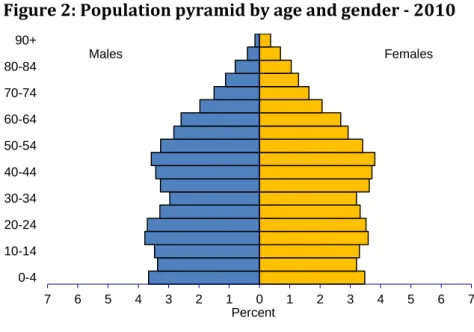
3. Demographic Patterns and the Distribution of Market Income in New Zealand Before examining the role of age and gender in income distribution and fiscal incidence it is useful to note the age/gender composition of the New Zealand population and the distribution of ‘original’ or ‘market’ income. The demographic pyramid in 2010 is shown in Figure 2. Of a total population of 4.25million people, 49% are male and 51% female.
However, the ratio of males to females can be seen to declines with age, most notably for the over 80 age group, of which only 39% are male.
It is recognised that ‘pre-taxes-and-transfers’ income (generally referred to as ‘original’ or
‘market’ income) is not independent of the extent of taxes and transfers faced by individuals and households face. However, we adopt market income as a ‘natural
benchmark’ income distribution against which to compare the impacts of taxes, transfers, etc.
In this, and the next, section we examine the transitions from market to final income on a per capita basis. Later sections, and Appendices 1 and 2, discuss aspects of the distribution within age/gender cohorts and how aggregate distributions differ from their per capita equivalents; that is, incorporating the different sizes of each age/gender cohort.
Figure 2: Population pyramid by age and gender - 2010
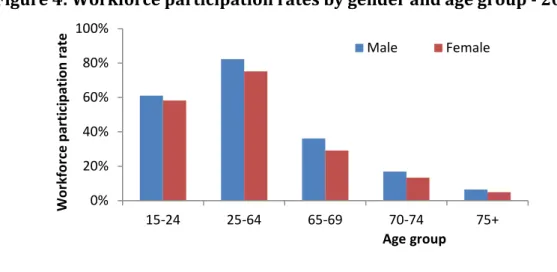
Figure 3 shows the average market income earned across genders and age groups in New Zealand. The data presented is an average of market income of all citizens, including those not in the workforce. The mean therefore incorporates market participation rates, such as those shown in Figure 4, where, for example, the lower participation rate for women contributes to the gender-based market income discrepancy observed in Figure 3.
Figure 3: Market income per capita by gender and age group - 2010
7 6 5 4 3 2 1 0 1 2 3 4 5 6 7
0-4 10-14 20-24 30-34 40-44 50-54 60-64 70-74 80-84 90+
Percent
Males Females
- $ 10,000 $ 20,000 $ 30,000 $ 40,000 $ 50,000 $ 60,000 $ 70,000
Market income per capita
Age group male
female
From the age of 20 onwards women earn on average significantly less market income than men of the same age due, in part, to lower labour force participation as demonstrated in Figure 4. They may instead be employed in unpaid work such as child- rearing which seems most plausible in explaining the largest discrepancy between 20 and 49 years of age. Also, once in the workforce, differences in average pay and higher rates of part-time employment may contribute to lower market income for women. The average hourly pay rate for those in the workforce aged 15-64 is $23.69 for women and
$28.21 for men. Furthermore, male workforce participants work on average 37.2 hours per week compared with 28.9 hours per week for females. This dual effect means that even when only those in the workforce are considered, market income is significantly lower for women than men.
The large drop in market income for men at the age of 65 is attributable to the large work disincentive provided by New Zealand’s universal pension (‘NZ Superannuation’; NZS). As Gorman et al (2012, p.34) found, for those reaching the entitlement age of 65, NZS
“substantially reduces the likelihood of remaining in the labour force.”
Figure 4: Workforce participation rates by gender and age group - 2010
4. From Market to Disposable Income
As in most mixed market economies, disposable income in New Zealand differs from market income due to government’s redistributive policies in the form of income support targeted predominantly at low-income households, families with children and pensioners, and direct taxes (mainly personal income taxes) deducted from market incomes. Transfer payments included in this analysis are working age benefits (such as for the unemployed and disabled), family tax credits, New Zealand Superannuation, and housing subsidies such as the Accommodation Supplement and Income-related Rents. Figures 5 and 6 show the distributions, by age and gender, of direct taxation and the income support system respectively.
Figure 5 reveals that the distribution of direct taxation per capita closely resembles the profile of individuals’ market incomes in Figure 3. Contributions to direct tax revenues, by both genders, rise sharply during ages 20-40, become relatively flat till around ages 50-60,
0%
20%
40%
60%
80%
100%
15-24 25-64 65-69 70-74 75+
Workforce participation rate
Age group
Male Female
then declining. The sharp increase in direct taxation paid by women in particular in the 65-69 year old age group is likely due to their entitlement to the taxable Superannuation (NZS) at 65. That is, for many women attaining the age of 65, and receipt of NZS, involves an increase in their income.
Figure 5: Direct tax per capita by age group and gender - 2010
A possible reason for the absence of a similar spike in 65-69 year old men may be the tendency for men to have higher participation in the labour market at age 60-65 and to maintain higher labour market activity after NZS eligibility is reached. Relative to men, women have a lower workforce participation rate and full-time equivalent rate pre-65, and thus do not exhibit such a reduction in income at age 65 (Figure 3).
Figure 5 also suggests a drop in direct tax paid by women at ages of 40-44. This is associated with a reduction in taxable welfare benefits for this age group, as shown in Figure 6. This is most likely due to a decrease in family benefits after child-rearing ages.
This decrease in taxable benefits is later counteracted by an increase in taxable market income in the 45-59 year old age group as demonstrated in Figure 3.
Figure 6: Income support per capita by gender and age group - 2010
$- $2,000 $4,000 $6,000 $8,000 $10,000 $12,000 $14,000 $16,000 $18,000
Income tax per capita
Age group male
female
$- $5,000 $10,000 $15,000 $20,000 $25,000
Income support per capita
Age group male
female
Figure 6 shows the age/gender distribution of government income support which includes working-age and retirement benefits, Working-for-Families tax credits, and housing assistance (accommodation supplement and Income Related Rents). The Figure shows that more income support is granted to women than men between the ages of 15 to 64.
This partly reflects their lower workforce participation rate, higher rate of providing for dependents and increased likelihood of being a sole parent. The male-female difference peaks during the child-rearing ages of 35-39 when women receive income support that is, on average, 4.8 times that of the income support payments to men of the same age. The gap narrows after typical child-rearing age, around 50, onwards, but still remains above that of men.8
After the superannuation entitlement age of 65, women on average still receive more income support than men with the discrepancy reach 20% in the over-80 demographic group. Life expectancy affects trend given that women are expected to live longer: life expectancy at birth averaged over 2008-2010 was 78.8 years for men and 82.7 years for women.9 This results in women, on average, outliving their partners. As a result, a higher proportion of retirement age men live in couples and receive the lower NZS allowance.10 Similarly, singles, more commonly women, may be entitled to other forms of income support such as Accommodation Supplement which further contributes to differences in the average amount of income support received by males and females in this age group.
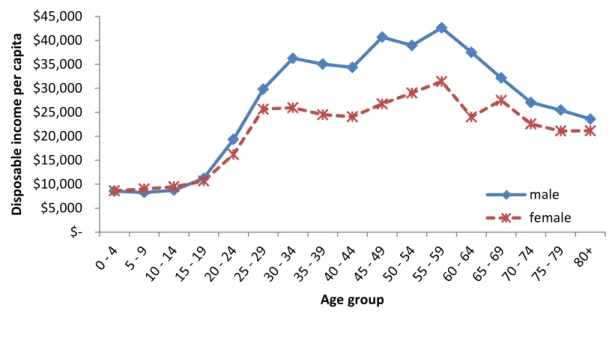
Figure 7: Disposable income per capita by gender and age group - 2010
8 Working-for-Families tax credits are assumed to be received by the person designated the ‘carer’ of dependants in a family. For couples with children, the carer is assumed to be the person who has reported being the spouse of the principal earner in the HES. In sole-parent families, the carer is the principal earner.
9 See Statistics New Zealand (2012b).
10 The NZS rate for couples is less than twice the rate for singles, designed to reflect real sharing economies within retired families.
$- $5,000 $10,000 $15,000 $20,000 $25,000 $30,000 $35,000 $40,000 $45,000
Disposable income per capita
Age group
male female
The interaction of market income, direct taxation, income support and intra-family sharing determines the distribution of disposable income. This is shown in Figure 7. This suggests, for example, significant levels of disposable income for under 15 year olds, despite their general lack of market income or income support, resulting from intra-family sharing of resources, whereby children are assumed to receive a share of family disposable income.
Comparing Figures 7 and 3 it can be seen that this first stage of income redistribution has narrowed the gap in incomes between working-age males and females . for example, the per capita percentage difference between incomes of 30 to 64 year old men and women decreases from 89% for market income to 43% for disposable income.
Intra-family sharing means that the pattern of disposable income is not only related to an individual’s own market income but also to the levels of market income earned by other family members. Therefore the relationship between primary earner’s income and spouse’s income can yield some insight into the distributional changes observed between market and disposable incomes.11
Table 1 below allocates couples to cells based on the ($10,000) market income band of the primary earner and that of the secondary earner. For example, for couple households in row 2 where the principal earns $1-10,0000, 68% of secondary earners earn incomes in the same band while 5% exceed this band and 27% are below (the latter earning $0 in this case). In principle the diagonal of the table captures those couples where both partners earn in the same $10,000 band. Over all bands 23% of couples are in this category - where both earn in the same income band. A further 18% can be shown to earn within one income band deviation from each other.12 This confirms a known tendency for couples to make partnering and/or lifestyle decisions involving similar income levels.
Despite this, there are significant numbers of couples in which one partner earns substantially more than the other. For example, based on the actual numbers underlying Table 1 and aggregating the nine cells in the lower left-hand corner of Table 1 reveals that just under 70,000 couples (7% of the total) have one partner earning over $80,000 in market income and the other less than $20,000. A further 9% have one partner earning between $50,000 and $80,000 and the other earning less than 20,000. In cases like these, intra-family sharing may result in an individual with a low market income enjoying significantly higher disposable income. Given that, on average, women receive lower
11 In the HES, the classification of ‘primary earner’ is self reported by the household and is not always aligned with the highest market income earner. For example, a primary earner may temporarily have a lower salary than their spouse.
12 That is, either one band above or one band below. The figures in the text were calculated from the original data where numbers in all individual cells are available. Table 1 suppresses some data, for confidentiality reasons, by combining some cells.
market income than their spouses, this effect contributes to the reduction in gender discrepencies in disposable income.13
Table 1: Percentage of Secondary Earners (by principal/secondary salary band)
Principal Salary ($000)
Secondary Earner Salary ($000)
0 - 0 0 - 10 10-20 20-30 30-40 40-50 50-60 60-70 70-80 80-90 90-100 100+ Grand Total
0 - 0 80% 15% 1% 4% 54,534
0-10 27% 68% 3% 2% 93,592
10-20 28% 32% 32% 5% 3% 58,203
20-30 26% 27% 24% 20% 3% 68,654
30-40 24% 13% 16% 24% 21% 3% 95,624
40-50 14% 10% 9% 25% 24% 16% 1.% 122,821
50-60 11% 10% 10% 17% 19% 17% 16% 114,344
60-70 9% 15% 7% 12% 18% 21% 8% 11% 91,911
70-80 9% 10% 8% 18% 11% 17% 14% 9% 5% 74,961
80-90 9% 20% 12% 15% 6% 11% 8% 5% 8% 6% 47,423
90-100 6% 11% 13% 7% 22% 6% 11% 9% 3% 11% 34,384
100+ 11% 10% 11% 13% 10% 13% 9% 7% 4% 3% 2% 7% 118,468 Grand
Total 20% 20% 11% 14% 12% 10% 6% 3% 1% 1% 0% 1% 974,920
5. From Disposable Income to Final Income
Analysis of disposable income does not take into account the significant effects of in-kind publicly provided goods and services or that of indirect taxation such as GST and excises.
This section examines the incidence of both these fiscal variables. In the case of in-kind provisions, we focus on the two largest spending categories: publicly-provided healthcare and education. This is not to deny that benefits are accrued through other public services such as defence or environmental protection but they are excluded here due to the lack of a clear, acceptable methodology to allocate such benefits to individuals.
Focusing first on indirect taxes, the New Zealand system involves a VAT-type ‘goods and service’ tax (GST) at a uniform 15% on almost all goods and services (except financial services,) and a number of excises dominated in revenue terms by those on fuel, alcohol and tobacco. From the HES data on household expenditure by age and gender, together
13 The assumption regarding intra-family sharing used in this analysis affects the distribution of disposable income across genders and age-groups. Sharing disposable income among members of a family involves sharing between the primary and secondary earners and sharing by both primary and secondary earners with children. Section 7 addresses the sensitivity of the results in Figure 7 by varying the assumptions regarding the sharing rule.
with the intra-household sharing rule discussed earlier, allows expenditures and associated indirect taxes to be allocated to individuals.
For all indirect taxes combined (GST and excises), Figure 8 shows the average liability of indirect tax by gender and age.
Figure 8: Indirect tax per capita by gender and age group - 2010
The figure indicates a generally rising profile of indirect tax payments by both genders from early adulthood to the late-50s age group, with declines from around age 60 or 65.
This likely reflects the tendency for disposable incomes to rise over the working life and decline in retirement. As expected, given the roughly proportional system of indirect taxation and limited effects of age-related savings rate differences, the age distribution of indirect tax payments looks quite similar to that of disposable income.14
On gender differences, slightly more indirect tax is attributed to women than men in the under 25 age range, peaking at a difference of 23% per capita for the 10-14 age group.
However, from ages 25-69 men on average pay 28% more per capita than women. This difference is sensitive to the method of intra-family allocation of disposable income and indirect taxes included in the analysis. As men are more often declared as principal earners, the methodology grants them greater control over resources and therefore spending, explaining the higher values of indirect tax attributed to them. The greater relative number of women in the 80+ age group results in a greater incidence of indirect tax attributed to them. Despite this, men pay on average over all ages 21% more per capita in indirect tax than women.
14 See Gibson and Scobie (2001) for discussion of the age-relatedness of savings in the HES. They find that savings rates are mildly hump-shaped with age in New Zealand, over 1983-98.
$- $500 $1,000 $1,500 $2,000 $2,500 $3,000 $3,500 $4,000 $4,500 $5,000
Indirect Tax per capita
Age group
male female
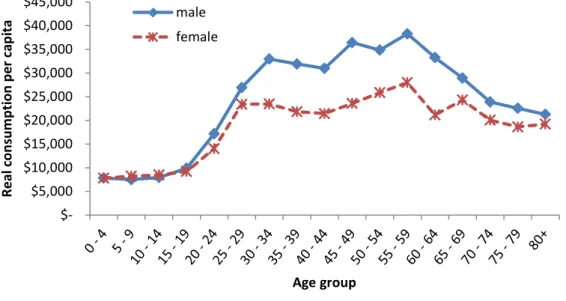
Figure 9: Real consumption per capita by gender and age group – 2010
Netting off these indirect taxes provides a measure of the real consumption out of individuals’ disposable income, but before taking into account of consumption of publicly provided health and education. Figure 9 shows the distribution of this ‘real private consumption’ by age and gender. As with pevious charts for market and disposable income, this also displayes the ‘hump shaped’ profile, first rising with age - especially during the 20s to 30s age range, followed by a flatter period in the middle years and decline (more rapidly for men) in older ages. The overall effect for women is a relatively flat incidence of real private consumption over the adult years with annual values generally fluctuating between $20,000 and $25,000.
Since consumption of education and healthcare are important components of many households’ overall consumption bundles, and much of this occurs via government provision (generally free at the point of consumption in New Zealand) allocating this consumtpion across individuals is potentially important to gain a more accurate picture of the overall incidence impact of tax and spending settings.15
Figure 10 focuses on education expenditure per capita. Not surprisingly, this demonstrates the bulk of education spending on younger age groups and, for males and females younger than 15 years of age, is allocated roughly equally. Interestingly, there is noticeably higher spending on women in the 20-24 year old age group: women, on average, receive 62% more funding than men. This may stem from more women attending tertiary education or from women proportionately attending more expensive forms of tertiary education, such as university.16 At older ages, the higher incidence of
15 In New Zealand, state-provided tertiary education often involves the payment of some fees per course, but students are generally eligible for government allowances and loans that cover most or all of those fees.
16 Earlier evidence from Craig (2002), for example, shows that in New Zealand ”significantly more females than males qualified for university entrance at bursary level from 1997 to 2000, and that for the year 2000 more females (6,932) than males (5,225) enrolled in bachelor degrees”. Evidence for medicine (a relatively
$- $5,000 $10,000 $15,000 $20,000 $25,000 $30,000 $35,000 $40,000 $45,000
Real consumption per capita
Age group male
female
education spending for women from 30-44 may be attributable to part-time education and retraining during child-rearing years. There is negligible allocation from 65 onwards and none from 75.
Figure 10: Education expenditure per capita by gender and age group - 2010
Figure 11: Health expenditure per capita by gender and age group - 2010
Figure 11 shows average per capita health expenditure disaggregated by age and gender.
Apart from the 0-4 age group, the incidence of health spending rises smoothly with ageing but at as increasing rate as the oldest age ranges approach. In the 70-79 year old age brackets, men appear to cost more per capita than women but in the 80+ age range, this trend reverses. Some literature suggests that proximity to death is an important determinant of health costs. For example, Mays (2012) reports that typically half of an individual’s lifetime health costs are generated in the last 12 months of their lives. Given that the average life expectancy of males falls in the 70-79 year old age bracket, this may
expensive university subject) in New Zealand in 2009 also suggest higher female participation; see Poole et al
$- $1,000 $2,000 $3,000 $4,000 $5,000 $6,000 $7,000 $8,000
Education expenditure per capita
Age group
male female
$- $2,000 $4,000 $6,000 $8,000 $10,000 $12,000 $14,000 $16,000
Health expenditure per capita
Age group male
female
lie behind the per capita difference. Across child-bearing age ranges, women receive more healthcare on average than men given costs of birth, pre-natal and post-natal care.
The overall impact of all of these government inteventions (direct and indirect taxes, education, health and transfers spending) on average final incomes by age and gender is shown in Figure 12. It can be seen that final income is similar across genders until the ages of 25-29 when men begin to receive more. The discrepancy is less than for both market and disposable income as a consequence of state assistance and intra-family sharing. The per capita difference for men and women between the ages of 30 and 64 falls from 89% for market income to 43% for disposable income and then further to 35%
for final income. This is sumamrised in Figure 13 which shows that gender-based variation between means is substantially reduced across all age groups when market income is shared and converted to disposable and then onto final income. This is especially the case at older ages – largely due to the rate of NZS being the same for men and women.
Figure 12: Final income per capita by gender and age group - 2010
The life-cycle smoothing effect of government taxing and spending interventions can also be seen clearly in Figures 14 and 15 (for males and females respectively). Government actions redistribute income away from those aged approximately 25 to 64 towards either end of the age spectrum. Both figures show the transition from market income through disposable income to final income across the age. It is interesting to note that, for women, far less redistribution from middle aged occurs compared to that for men. This largely stems from their lower market income. In addition, indirect taxation and government provision has very little effect on the transition from disposable income to final income for middle aged individuals, but it substantially raises the consumption of children and the elderly. For adult females in particular, the age distribution of final income becomes surpringly ‘flat’ and especially when compared with female market incomes.
$- $5,000 $10,000 $15,000 $20,000 $25,000 $30,000 $35,000 $40,000 $45,000
Final income per capita
Age Group
male female
Figure 13: Percentage differences between incomes of males and females by age group and income type
Figure 14: Three concepts of income – males, 2010
Figure 15: Three concepts of income – females, 2010
0%
20%
40%
60%
80%
100%
120%
140%
160%
Percentage difference between men and women
Age group Market income
Disposable income Final income
- $ 10,000 $ 20,000 $ 30,000 $ 40,000 $ 50,000 $ 60,000 $ 70,000
Average income
Age group Market income
Disposable income Final income
- $ 10,000 $ 20,000 $ 30,000 $ 40,000 $ 50,000 $ 60,000 $ 70,000
Average income
Age group Market income Disposable income Final income
6. Net Fiscal Impacts
As we noted in the Introduction, one of the interesting questions that generational accounting attempts to answer is the net life-time liability of government taxing and spending across different age cohorts. We cannot answer that question directly here, where effectively we only have information from a single snapshot (in 2010) for each of a set of different birth cohorts (aggregated into five-year age bands). Nevertheless we might expect that the age, and gender, distribution of net fiscal incidence provides useful information on the patterns of change associated with the ageing process.
Figure 16: Net fiscal impact per capita by gender and age group - 2010
Figure 16 shows this gender-specific age distribution of net fiscal incidence; that is the incidence of tax revenue minus expenditure. Direct and indirect taxation contribute positively to net fiscal impacts offset by the effects of government spending in the form of income support, education and health expenditure. Of course, since not all government expenditure is included in the analysis, a positive net fiscal value here is not equivalent to the individual being a net contributor to the government budget overall. Nevertheless, for those expenditures that are more readily attributable to individuals (and distinguishable by age and gender) the data reveal the net positive/negative contributions.
The data illustrated in Figure 16 suggest that, on average, males start having positive net fiscal impact - their per capita tax revenue exceed the (allocated) expenditure they receive - in their early twenties. Women, on average, do not pas this ‘break even’ point until their mid-40s. This is due to a combination of lower workforce participation, higher health and education spending, higher income support and lower direct and indirect taxation.
A possible causal link may lie behind the high value of per capita education expenditure observed for women aged 30-44 and the lagged increase in per capita market income and
-$40,000 -$30,000 -$20,000 -$10,000
$0
$10,000
$20,000
Net fiscal impact per capita
Age group
male female
direct tax for females in the 45-49 year age group. One possible hypothesis is that re- training during child-rearing years that precedes re-entry to the labour market results in an increase in market income and consequently higher direct taxation. The combined effect of decreased education expenditure and increased direct taxation improves the net fiscal stance of women at the 45-49 year old age group.
Beyond the age of eligibility for superannuation both genders are again, on average, net recipients of government tax and spending, but with the onset of this net negative balance slightly later for men.
As noted earlier, the data used in this paper is cross-sectional (for 2010) and thus cannot be interpreted directly as life-cycle profiles for an individual. Despite these limitations, it is useful to consider the cumulative net fiscal impacts across age groups. This is shown in Figure 17, which cumulates across all ages. This is different from the life cycle profiles produced by generational accounting exercises which typically cumulate forward from a given age to assess remaining fiscal liability (see section 8).
As can be seen, the positive net fiscal impact women make from 45-59 never outweighs the prior negative net fiscal impacts. As a result, when the large negative net impacts of the retirement years arrive, they simply add to an already negative profile. Men, on the other hand, appear to have a positive cumulative net fiscal impact from approximately 40 until 80 years of age. For these particular taxes and public expenditures, the net fiscal incidence on men is approximately zero when cumulated over all ages.
Figure 17: Cumulative net fiscal impact per capita by gender & age group – 2010
7. Sensitivities and Extensions
This section first considers how far the results in the previous sections are sensitive to the assumed intra-family income sharing rule. Secondly, we extend the results to answer two further questions of interest.
-$150,000 -$100,000 -$50,000
$0
$50,000
$100,000
Average cumulative net fiscal impact
Age group male
female
(1) Given heterogeneity of fiscal allocations across individuals within age and gender groups, how representative is the ‘on average’ fiscal incidence evidence presented thus far?
(2) Given known differences in male/female proportions in some age groups (especially the older ages) how far do ‘aggregate’ male and female incidences differ from the
‘average’ (mean) differences examined above?
Sensitivity to sharing assumptions
On the issue of intra-family sharing assumptions, results above adopted the OECD scale weights of 1.0, 0.5 and 0.3 to the primary earner, spouse and any dependents respectively. To test sensitivity to this assumption we examined an alternative, extreme assumption of equal sharing within the family (all weights equal to 1). Since primary earners within families of two or more members are more often male, this has the effect of raising the relative weight of females in the incidence analysis. That is, on average they are attributed a greater share of disposable income and indirect tax payments and net fiscal impacts. Direct tax payments, income support transfers and government spending remain allocated to the individual directly earning or receiving them).
Figures 18A and 18B show the effects on disposable income and indirect taxation of imposing the equal sharing assumption. As anticipated, equal sharing affects the distribution of disposable income and indirect tax by redistributing both away from working age males towards dependents. Women benefit from equal sharing after their early forties, presumably when children leave home and the equal distribution of resources within the family tends to be between adults only. The remaining differences between genders in figure 18 can be attributed largely to the fact that, for single person families, male/female income and fiscal incidences remain unaffected by sharing assumptions.
Despite the influence of the sharing assumption on indirect taxation in Figure 18B, there is only a negligible change in net fiscal incidence (not shown). It continues to look very similar to that shown in Figure 16. This is due to the other fiscal components – direct taxation, income support, health and education expenditures – being allocated independently of the sharing rule. Indirect taxation is a relatively small factor in net fiscal impact and therefore altering sharing assumptions has a negligible overall effect.
Figure 18C highlights another aspect of the how the intra-family sharing assumption affects the distribution of disposable income. The figure compares the distribution of disposable income by gender and age-group under the assumptions of sharing using the OECD scale (as applied in earlier sections) and no-sharing, that is, individuals keep what they earn after taxes and transfers. If no sharing of disposable income is assumed among family members, then working individuals keep what they earn and non-earners are allocated no fraction of the family’s disposable income. Contrasting this with the results
using the sharing assumption helps to highlight two aspects of intra-family income dynamics. Firstly that sharing disposable income involves transfers between the primary and secondary earners. That is, if the primary earner earns more than the secondary earner, then combining and reallocating their incomes according to the sharing assumption used in this analysis leads to a fall in the share of disposable income for the principal earner and a rise for the secondary earner. Secondly, intra-family sharing involves income transfers from working adults to dependants in the family.
Therefore the analysis suggests that among working-age adult age-groups, primary earners are expected to make net transfers to others in the family. This explains why males have higher incomes as working-age adults when there is no-sharing among family members. Among working-age women, there are two effects. First, sharing involves transfers to them when they are secondary earners and second, transfers from them when there are children in the family. The net impact is ambiguous a priori. The data seem to suggest that the latter effect dominates for females aged 30-50 - when it is more likely there are children in the family - and the former effect dominates at ages 50-60.
Between ages 20-30 these two effects balance out, perhaps because more women here are primary earners as well as fewer having children at this age.
Finally the figure also suggests that assumptions about intra-family sharing become almost irrelevant from around age 60 for both males and females. This possibly reflects the fact the few individuals above this age have dependants/children in the family and/or the universal ‘gender-free’ aspect of New Zealand Superannuation payments.
Extensions
Evidence on questions (1) ands (2) above – regarding heterogeneity within gender/age groups, and aggregate-level, as opposed to per capita, comparisons – suggests substantial variation in fiscal incidence within male/female groups and that, at least for older age groups, aggregate-level analysis can produce rather different results from the per capita analysis examined do far.
To examine heterogeneity, Appendix 1 reports, for each component of the net fiscal incidence analysis (market income, direct taxation and so on), the incidence at the 25th, 50th (median) and 75th percentiles for each age group and gender. This is compared with the per capita (mean) results in each case. Here we report the overall impacts on net fiscal incidence in Figures 19A and 19B for males and females respectively.
Figure 19 reveals, perhaps not surprisingly, that the greatest differences within age groups, for both men and women, occur during the main working age years, 20-64, with much less heterogeneity associated with fiscal incidence among children or the elderly. For men, the median net fiscal incidence hovers around $10,000 during much of the working age period, with an inter- quartile range of around $2,000 to $20,000.
For women, Figure 19B reveals that net fiscal incidence at the 75th percentile is around
$10,000 for the same working age years; that is a round the median for men. The 25th percentile for women, however, involves a substantial net negative incidence, at up to -
$15,000 during ages 20 to 40. For older age groups it is clear that, at least for net fiscal incidence results, heterogeneity of experience is much less of an issue. This likely reflects the fact that NZS provides a taxable universal pension ( at close to a uniform value) to all residents aged over 65 which has a strong equalising effect on post-age-65 disposable incomes and hence on subsequent indirect tax payments
Figure 18: Testing alternative intra-family sharing assumptions A. Disposable income per capita
B. Indirect tax per capita
$- $5,000 $10,000 $15,000 $20,000 $25,000 $30,000 $35,000 $40,000 $45,000
Disposable income per capita
Age group
male - equal female - equal male - unequal female - unequal
$- $500 $1,000 $1,500 $2,000 $2,500 $3,000 $3,500 $4,000 $4,500 $5,000
Indirect tax per capita
Age group
male - equal female - equal male - unequal female - unequal
C. Disposable income per capita
Figure 19: Net fiscal impact by age and percentile A. Males
$0
$10,000
$20,000
$30,000
$40,000
$50,000
Disposable income per capita
Age group
Female: With Sharing Female: Without Sharing Male: With Sharing Male: Without Sharing
-40000 -30000 -20000 -10000 0 10000 20000 30000
Net fiscal impact - male
75th percentile Median 25th percentile Mean