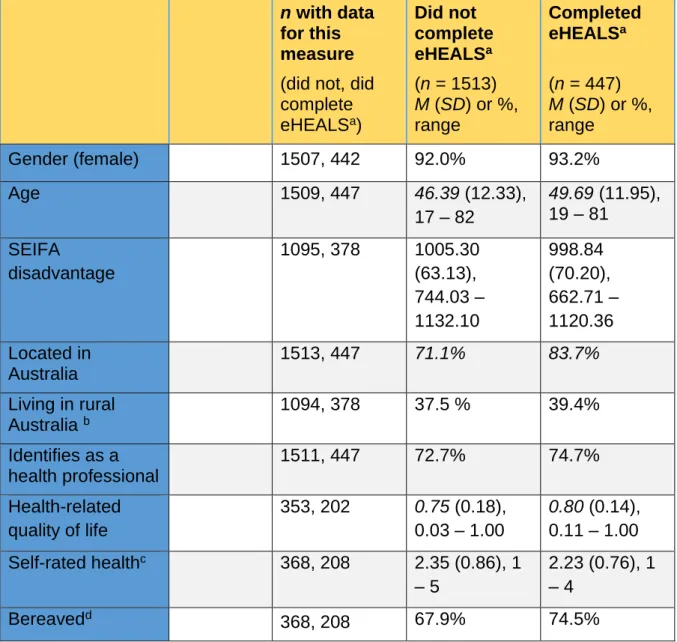
Relationships between eHealth literacy and socio-demographic characteristics and engagement in online learning: a quantitative study. However, for such resources to be effective, they must be easy for consumers to find, understand and use. E-health literacy—the ability to find, understand, and use online health resources—is becoming increasingly important in palliative care. This white paper reports on a study conducted to examine the relationships between eHealth literacy and sociodemographic and personal data. characteristics within a sample included in an online course on death and dying.
Yet, little is currently known about predictors of eHealth literacy in the context of death and dying, or how eHealth literacy relates to engagement with online healthcare resources. The purpose of this study was to examine the relationships between eHealth literacy and sociodemographic and personal. Previous research has not examined whether health-related quality of life might be relevant to e-health literacy.
In this study, we considered two additional personal characteristics that might influence eHealth literacy. Determining the sociodemographic and personal characteristics that predict eHealth literacy will provide us with information. However, other research suggests a more indirect or null relationship between eHealth literacy and eHealth technology use.
How does engagement in a MOOC on death and dying relate to participants' e-health literacy?
Results
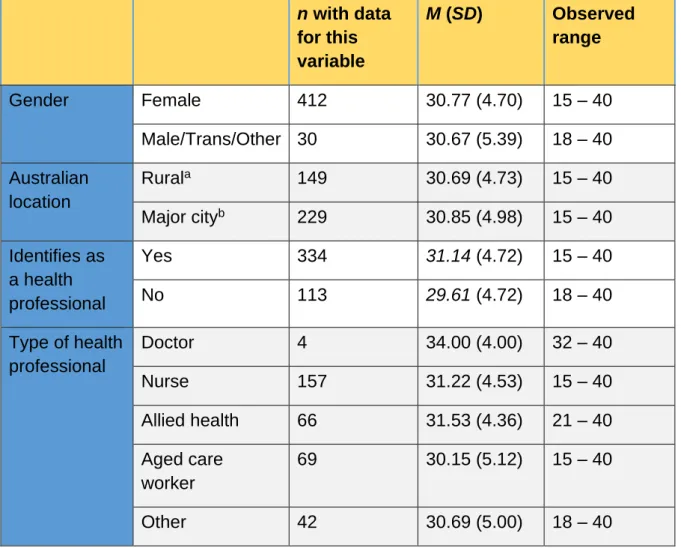
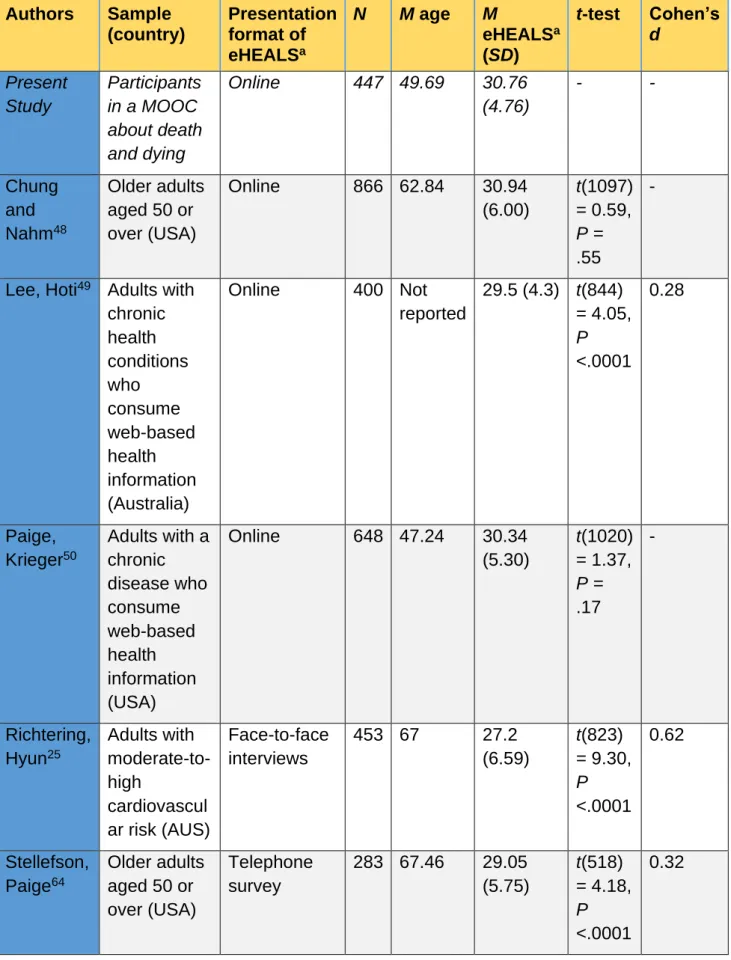
Response frequencies for the two supplementary eHealth literacy items indicated that 76.6% of participants felt that the Internet was useful or very useful in helping them make decisions about their health, and 84.9% thought it was important or very important for them to be able to access health resources on the Internet. Our eHealth literacy scores summarizing the 8 core scale items were compared with those of similar samples in the literature, with results presented in Table 2 . Thus, health workers had higher e-health literacy than non-health workers, and their e-health literacy did not differ by type of health worker.
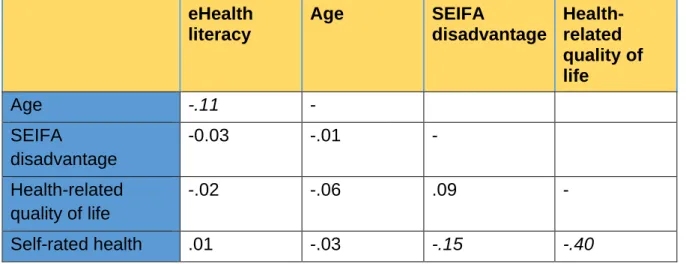
On average, participants who had undertaken university studies also scored higher than those who had completed some high school and those who had completed trade school or equivalent, although these differences did not reach statistical significance. Only age showed any relationship with e-health literacy; there was a significant, although weak negative correlation between age and e-health literacy (P = .02). Three multiple linear regressions were conducted to determine the strongest socio-demographic predictor of e-health literacy.
The remaining variables were not significant predictors, including age, which was significantly correlated to eHealth skills when considered alone. The second model included all socio-demographic variables: age, gender, highest educational qualification, Australian location (major urban/rural), SEIFA disadvantage score and health professional status. This model explained 5.3% of the variance in eHealth skills (R2 = .053), which was similar to the previous models, despite containing fewer variables.
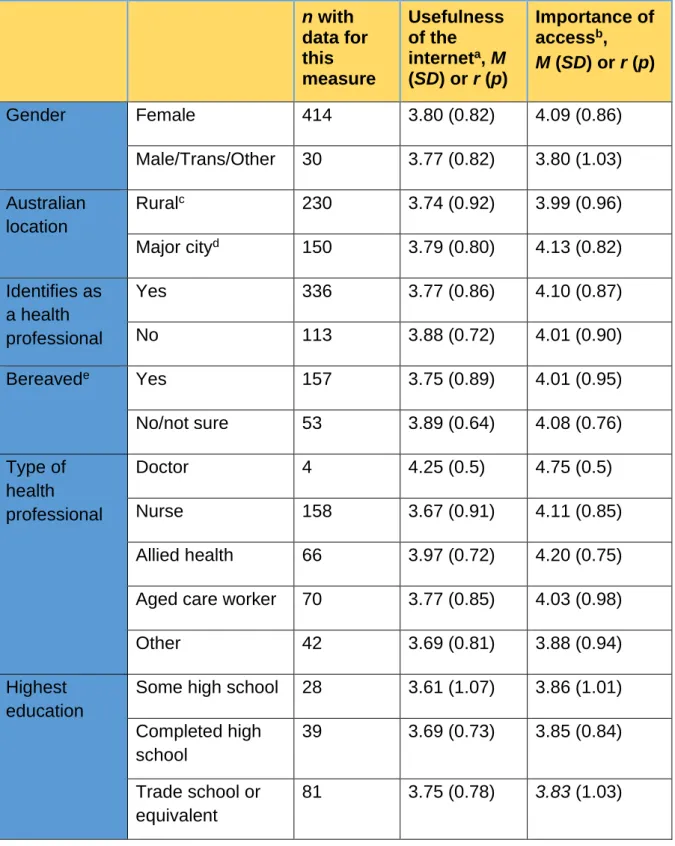
The relationship of socio-demographic and personal characteristics to responses to the usefulness of the Internet for making health decisions is summarized in Table 5. Younger people and people with poorer health-related quality of life found the Internet slightly more useful in helping them they make decisions about their health. Relationships of sociodemographic and personal characteristics to the usefulness of the Internet for health decisions and the importance of accessing health resources online.
Thus, online involvement was not related to perceived usefulness of the Internet for making health decisions. Information on how the importance of accessing online health resources is related to socio-demographic and personal characteristics is presented in Table 5. On average, participants who undertook university studies also scored higher than those who completed some high school and those who .
These results suggest that education level is positively related to the perceived importance of Internet access to health resources. Thus, the importance of accessing health resources online was not related to online engagement.
Discussion
This goes beyond thinking about image choice, accessibility considerations and social media messaging, to a fundamental consideration of the audience, digital access within target groups and their likely comfort with being able to find and use information online. The challenges of creating inclusive content for palliative care are beginning to be recognized.11, 69 Social determinants of digital health are likely to have a profound impact on potential users of online palliative care information, tools and courses.69-71 This can further. Without thinking about how we can meaningfully approach inclusive offerings and mechanisms to support and encourage awareness.
Limitations
Conclusions
Improving computer literacy and information retrieval skills: A rural and remote nursing and midwifery workforce study. Predictors of e-health use: insights into the digital divide from the health information national trends survey 2012. Acceptance and barriers to access to occupational e-mental health: cross-sectional findings from a health risk population of employees.
Drivers and barriers to the adoption of web-based follow-up care for patients in inpatient routine care: a cross-sectional study. Association of health literacy with health behavior and health care utilization in multiple sclerosis: a cross-sectional study. Assessment of quality of life in community-dwelling older adults: validation of the quality of life assessment instrument (AQoL) and comparison with the SF-36.
Evaluating health-related quality-of-life effects of cochlear implants: A prospective study of a cochlear implant program for adults.