PARTICIPATION OF RURAL WOMEN IN INCOME GENERATING ACTIVITIES IN AGRICULTURAL MODEL FARM PROJECT OF
SABALUMBY UNNYAN SAMITY (SUS)
ANWARUL HAQUE
DEPARTMENT OF
AGRICULTURAL EXTENSION AND INFORMATION SYSTEM SHER-E-BANGLA AGRICULTURAL UNIVERSITY
DHAKA-1207
DECEMBER, 2008
PARTICIPATION OF RURAL WOMEN IN INCOME GENERATING ACTIVITIES IN AGRICULTURAL MODEL FARM PROJECT OF
SABALUMBY UNNYAN SAMITY (SUS)
BY
ANWARUL HAQUE
REGISTRATION NO. 00842
A Thesis
Submitted to the Faculty of Agriculture, Sher-e-Bangla Agricultural University, Dhaka,
in partial fulfillment of the requirements for the degree of
MASTER OF SCIENCE
IN
AGRICULTURAL EXTENSION AND INFORMATION SYSTEM
SEMESTER: JULY-DECEMBER 2008
Approved by:
....………... ...……….
(Prof. Mohammad Hossain Bhuiyan) (Dr. Md. Sekender Ali)
Supervisor Co-Supervisor
………..
(Prof. M Zahidul Haque) Chairman
Examination Committee
CERTIFICATE
This is to certify that thesis entitled “Participation of Rural Women in Income Generating Activities in Agricultural Model Farm Project of Sabalumby Unnyan Samity (SUS)” submitted to the Faculty of Agriculture, Sher-e-Bangla Agricultural University, Dhaka, in partial fulfillment of the requirements for the degree of MASTER OF SCIENCE IN AGRICULTURAL EXTENSION AND INFORMATION SYSTEM, embodies the result of a piece of bona fide research work carried out by Anwarul Haque, Registration No. 00842 under my supervision and guidance. No part of the thesis has been submitted for any other degree or diploma.
I further certify that such help or source of information, as has been availed of during the course of this investigation has duly been acknowledged.
Dated:
Dhaka, Bangladesh. ---
(Prof. Mohammad Hossain Bhuiyan) Supervisor
ACKNOWLEDGEMENTS
First of all, the author wishes to extend all the praises to Almighty. The Great and the Merciful Allah, The supreme authority of the universe who has enabled the author to complete this study successfully.
The author is grateful to all of them who entirely guided, helped and cooperation during the research works although it is not possible to mention all by name.
The author likes to express his deepest sense of gratitude, sincere appreciated and immense indebtedness to his thesis supervisor Professor Mohammad Hossain Bhuiyan Department of Agricultural Extension and Information System, SAU, Dhaka for his scholastic/nobel guidance, valuable suggestions, continuous encouragement and all kind of support and help throughout the period of research work and also the preparation of manuscript.
The author also expresses his appreciation, gratitude and heartfull thanks to his co-supervisor Dr. Md. Sekender Ali, Associate Professor Department of Agricultural Extension and Information System, SAU, Dhaka. He inspired the author to undertake such as a study and assisted the author to build the foundation of the research project. He provided creative suggestions, proper guidelines, helpful comments and cordial co-operations throughout the period of this research work.
The author feels it a proud privilege to pay Begum Rokeya, Executive Director, Sabalamby Unnayan Samity (SUS), a compliment for allowing him conducting research work with Agricultural Model Farm(AFM) Project of SUS. The author expresses his immense gratitude to Mr. Shawkat Akbar Fakir, the Supervisor of AMF project of SUS who was always with him from beginning to end of the study without which it would be difficult for him to conduct the study. The author’s appreciation is due to concerned SUS personnel for their time to time kind cooperation with regard to research work. It is also a great pleasure to the author to express his sincere appreciation and indebtedness to the women of the study area for their cordial cooperation during collection of data.
Last but not least, the author would like to thank and remember his beloved parents, brothers and sister, all of his friends and relatives for their best help , endless love, whole –hearted inspiration, moral support prayer and sacrifice to pursue this study.
The Author
CONTENTS
Items Page
ACKNOWLEDGEMENTS i
LIST OF CONTENTS ii
LIST OF TABLES viii
LIST OF FIGURES ix
LIST OF APPENDICES x
ABSTRACT xi
CHAPTER I INTRODUCTION 1-10 1.1 General background 1
1.2 Sabalamby Unnayan Samity(SUS) and its activitiy 2
1.3 Agricultural Model Farm (AFM) project 4
1.4 Statement of the problem 5
1.5 Specific objectives of the study 6
1.6 Justification and scope of the study 7
1.7 Assumption of the study 8
1.8 Definition of important terms 9
CONTENTS (Contd.)
CHAPTER II REVIEW OF LITERATURE 11-22
Items Page
2.1.1 Age and participation 11
2.1.2 Education and participation 12
2.1.3 Family Size and participation 12
2.1.4 Farm Size and participation 13
2.1.5 Farming Experience and participation 14 2.1.6 Duration of involvement and participation 15
2.1.7 Cosmopoliteness and participation 15
2.1.8 Annual family income and participation 16 2.1.9 Extension media exposure and participation 17 2.1.10 Organizational participation and participation 17 2.1.11 Credit received and participation 18 2.1.12 Training exposure and participation 18 2.1.13 Participation and income generating activities 19
2.2 Conceptual framework of the study 22
CONTENTS (Contd.)
Items Page
CHAPTER III METHODOLOGY 24-34
3.1 Locale of the study 24
3.2 Population and sample 24
3.3 Instrument for data collection 27
3.4 Pre- Test 27
3.5 Collection of data 27
3.6 Measurement of variables 28
a) Independent variables 28
b) Dependent variable 33
3.7 Hypothesis of the study 33
3.8 Statistical analysis of data 34
CONTENTS (Contd.)
CHAPTER IV RESULTS AND DISCUSSION 35-53
Items Page
4.1 Selected characteristics of the rural women
35
4.1.1 Age 35
4.1.2 Education 36
4.1.3 Family Size 37
4.1.4 Farm Size 38
4.1.5 Farming Experience 38
4.1.6 Duration of involvement with SUS 39
4.1.7 Cosmopoliteness 40
4.1.8 Annual income 40
4.1.9 Extension media exposure 41
4.1.10 Credit received 42
4.1.11 Training exposure 43
4.1.12 Organizational participation 44
4.2 Extent of participation in AMF project activities 44
4.3 Relationship between selected characteristics of the rural women and their extent of participation in AMF project activities 45
4 .3.1 Age and extent of participation in AMF project activities 46
4.3.2 Education and extent of participation in AMF project activities 47
4.3.3 Family size and extent of participation in AMF project activities 47
4.3.4 Family farm size and extent of participation in AMF project activities 48 4.3.5 Farming experience and extent of participation in AMF project activities 49
CONTENTS (Contd.)
Items Page
4.3.6 Duration of involvement with SUS and Extent of participation in AMF
project activities 49
4.3.7 Cosmopoliteness and extent of participation in AMF project activities 50 4.3.8 Annual family income and extent of participation in AMF project activities 50 4.3.9 Extension media contact and extent of participation in AMF project
activities 51
4.3.10 Credit received and extent of participation in AMF project activities 51 4.3.11 Training exposure and extent of participation in AMF project activities 52 4.3.12 Organizational participation and extent of participation in AMF project
activities 53
CONTENTS (Contd.)
Items Page CHAPTER V
SUMMERY, CONCLUSION & RECOMMENDATION 54- 60
5.1 Summary of the findings 54
5.1.1 Selected characteristics of the rural women 54 5.1.2 Result of hypotheses testing 57
5.2 Conclusion 57
5.3 Recommendations 58
5.3.1 Recommendations for policy implication 58 5.3.2 Recommendations for further research 60
REFERENCES 62-72
LIST OF TABLES
TABLE TITLE PAGE
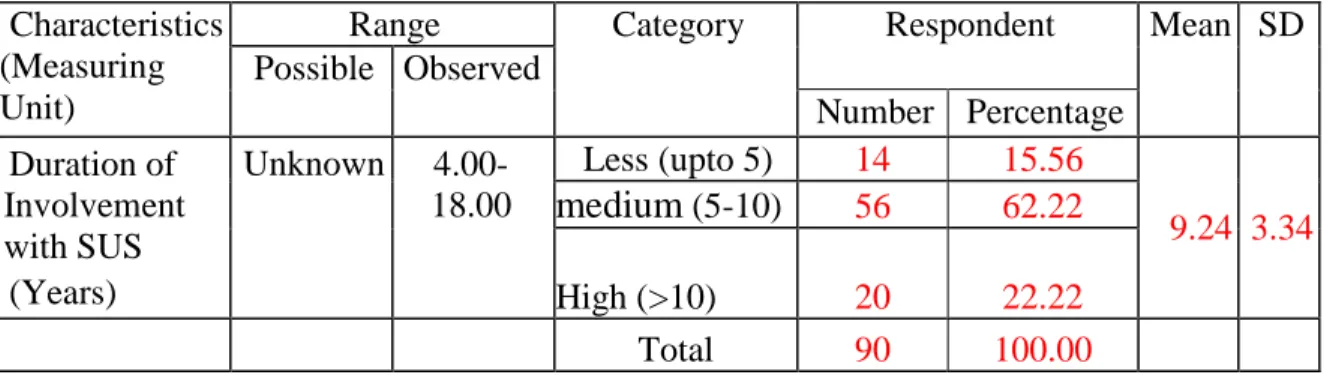
Table 4.1 Distribution of rural women according to their Age 36 Table 4.2 Distribution of rural women according to their education 37 Table 4.3 Distribution of rural women according to family size. 37 Table 4.4 Distribution of rural women according their farm size 38 Table 4.5 Distribution of rural women according to their farming experience 39
Table 4.6 Distribution of rural women according to their duration of Involvement
with SUS 39
Table 4.7 Distribution of women according to their cosmopoliteness 40 Table 4.8 Distribution of rural women according to their Annual Family
income 41
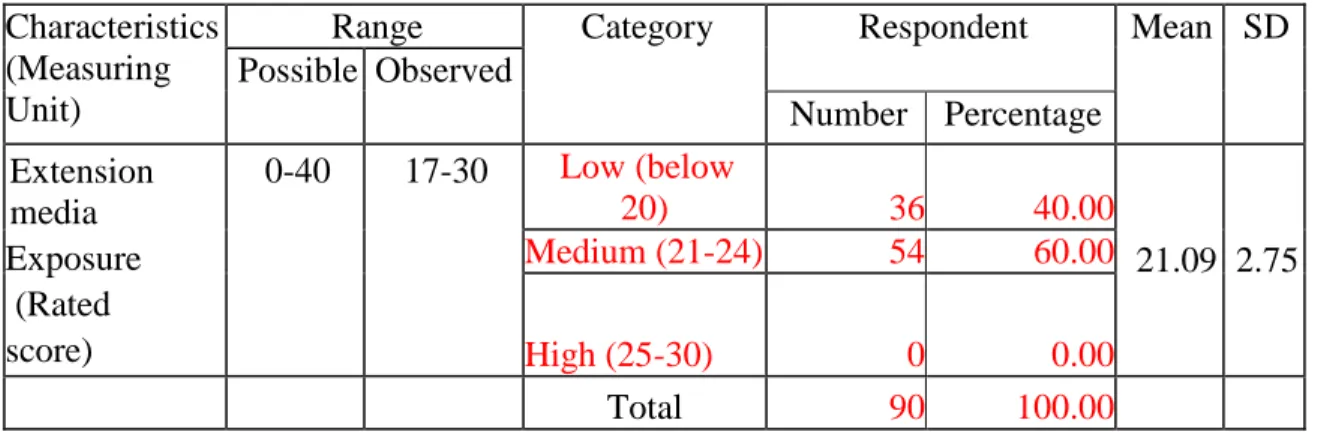
Table 4.9 Distribution of rural women according to their extension media
exposure. 41
Table 4.10 Distribution of rural women according to their credit received 42 Table 4.11 Distribution of rural women according to their training exposure 43 Table 4.12 Distribution of rural women according to their organizational
participation 44
Table 4.13 Distribution rural women according to their extent of
participation in AMF project activities 45
Table 4.14 Coefficient of correlation (r) between the respondents' selected characteristics and their Extent of participation in AMF project activities (N = 90) 46
LIST OF FIGURES
FIGURE TITLE PAGE
2.2 Conceptual model of the study 23
3.12 A map of netrokona district showing netrokona sadar upazila 25
3.2 A map of netrokona sadar upazila showing singher bangla and amtala union 26
LIST OF APPENDIX
APPENDIX TITLE PAGE
A An English version of the interview schedule 73 B Correlation matrix of the dependent and independent variable 77
PARTICIPATION OF RURAL WOMEN IN INCOME GENERATING ACTIVITIES IN AGRICULTURAL MODEL FARM PROJECT OF
SABALUMBY UNNYAN SAMITY (SUS)
ABSTRACT
This study was conducted mainly to have an understanding about the participation of rural women in income generating activities initiated by Agricultural Model Farm (AMF) project of Sabalamby Unnayan Samity (SUS). This also explained the relationship between extent of women participation in income generating activities initiated by AMF project of SUS and their selected characteristic. Data were collected from a sample of 90 rural women from 12 selected SUS groups in two unions namely Amtala and Singher Bangla of Sadar upazila of Netrokona district. Data were collected through interview schedule during 20 April 2008 to 20 May 2008. Majority (47.78 percent) rural women had favorable participation, while 36.67 percent had moderate favorable participation and there was no respondent under unfavorable participation. Findings also indicate that 80 percent rural women had high participation in AMF project activities, (81.11 percent) had medium training exposure, 60 percent had low extension media exposure, 75.56 percent had moderate cosmopoliteness and 91.14 percent had primary level education including can sign only. Correlation analysis indicates that the characteristics of the rural women such as age, family size, family farm size, farming experience, duration of involvement with SUS, cosmopoliteness, annual family income, extension media exposure, and credit receive and training exposure had no significant relationship with the extent of participation in AMF project activities. On the other hand, education and farming experience had positive relationship with their participation in income generating activities initiated by AMF project of SUS.
CHAPTER 1 INTRODUCTION
1.1 General Background
Women constitute nearly half of the total population in Bangladesh. The role of women in the economic development of Bangladesh cannot be over looked. Many reports show that women play a significant and crucial role in agricultural development including crop production, livestock production, horticulture, post harvest operation, agro-social forestry, fisheries and poultry. In a developing country like Bangladesh, the underemployed women labour force forms a vast reservoir of human resources. According to some historians women first initiated agricultural practices. They first domesticated crops and animals and developed art and sciences of farming. They were pioneers in plant domestication and planned agriculture (Childe, 1971). Ali et al. (1978) stated that women contribute significantly in various activities under homestead agricultural like composting, transplanting, sowing, weeding, harvesting, drying, homestead gardening, fruits and tree planting and the like.
Lovell (1991) states “Poverty particularly affects women. Traditionally poor women in Bangladesh rural areas have few rights, little choice about the courses of their lives and almost no opportunities to change their situations. They are often deserted when husbands cannot find income in the villages and move away to pursue work”. The UNDP reports also suggested making use of the full potentials of women to accelerate development in Bangladesh (UNDP, 1994). But by social custom Bangladeshi women are suppressed by men in all spheres of their lives.
The activities of women are mainly restricted within the household especially in taking care of children and other family members and maintaining homes. In addition the rural women also engage themselves in agricultural and non agricultural productive activities within the homestead (Halim and McCarthy, 1985).
Basic life support systems such as land, water, flora and fauna are conserved by women (Swaminathan, 1985). The nature and extent of women involvement in agriculture varies widely from region to region. But regardless of this variation, women mostly participated in processing and storage of food grain from ancient time. Equal and effective participation of men and women is essential to achieve sustainable development. More than 2500 NGO’s are working in Bangladesh (BBS, 2005). Sabalamby Unnayan Samity(SUS) is one of them.
1.2 Sabalamby Unnayan Samity(SUS) and its Activity
Involving women in the development activities many NGO’s including BARC, PROSHIKD, and ASA etc, who were incepted at different times. NGOs including BRAC, Proshika and ASA. They successfully incorporated women in their development programme. Sabalamby Unnayan Samity (SUS) is a NGO which is working at Netrokona, Sunamganj and Mymensingh district for the socio- economically deprived people and especially for the distressed rural women. SUS evolved in 1985 out of a small number of women initiatives, it started its journey through introducing careful interventions for improving socially and economically deprived section of society.
The Vision of SUS
People live and work in a harmonious society.
The mission of SUS
SUS is a NGO works with underprivileged and marginalized people especially women, children, adolescents and disables through a rights based holistic approach, with a prime focus on livelihood development of family.
SUS family believes in emphasizing an inclusive gender approach, community participation and is working towards integration and collaboration with the government and other relevant organizations to enhance the quality of women lives.
SUS will continue to distinguish itself as a development organization oriented to a holistic approach to meet the organizational and community need maintaining its professionalism.
Legal Status of SUS
Registration of social Welfare Departmen1:1986 Registration of NGO Affairs Bureau: 1990 Population coverage by SUS
25% population of working area.
Geographical coverage by SUS
Sl.No Name of the district Name of /IDF/Branch office/Upazila 1. Netrakona Netrokona sadar, Atpara, Modon, Kendua,
Purbadhala, Mohonganj, Barhatta, Kalmakanda, Khaliajuri and Shyamganj,
2. Sunamganj Dharmapasha
3. Mymensingh Mymensingh sadar , Guoripur and Ishwarganj Development is a continues process, which help to bring a better condition of individual, family and society from a vulnerable condition, considering the need of time. SUS was involved itself with sustainable development from 1988-2000.SUS works on right-based approach. Right is derived from values. The major elements of right are relation, respect, honor, morality demands, recognition, duties and responsibilities etc. So, we may define “Right” the opportunities to explore the personality of human beings that are accepted by the family society and state (SUS, 2002).
SUS works with underprivileged and marginalized woman, children, adolescence and disables through a holistic approach, with a prime focus on livelihood development. SUS is committed to bring about positive changes in the quality of lives of the deprived people by making available education, comprehensive health services micro credit as well as other social services that enable them to exercise socio-economic rights. To establish right-based approach SUS undertook many development projects. Agriculture Model Farm Project (AMF) is one of this, through which right of the women was established. The aim of this project was to bringing about changes in;
i) Attitude ii) Knowledge iii) Skill
iv) Decision
v) Making in family affairs vi) Income and social status
1.3 Agricultural Model Farm (AMF) Project
Agricultural Model Farm Project of SUS is a special task which was initiated in 1994. This project has taken to achieve sustainability in agriculture. Total area of the farm is 2.83 hectare. From these, rice is cultivated in 2.02 ha, vegetables are cultivated in 0.202 ha, fishes are cultured in 0.202 ha, local fruit orchard is in 0.101 ha and office room, training room, seed house, low shed, labor house etc. are in 0.303 ha. All the practices which are performed within the model farm are experimental. Because seeing believes, one believes that what he/she sees by his/her own eyes. Through these demonstration plots of AMF project SUS is able to build awareness, capacity among the target groups as well as encouraging producing jute, mustard and leguminous crops.
The main themes of AMF project are, organic agriculture, medicinal plant conservation, local fruits plantation, indigenous knowledge promotion, and my agriculture and culture conservation. These themes are taken to create a balance between the life of farming families and the environment where they live and work.
However, the main objectives of AMF project are mentioned below
i) To disseminate the appropriate and environment friendly technologies to the target people.
ii) To create scope for agricultural in come generating activities.
iii) To produce, preserve the local seed and reduces dependence on the genetically modified seeds
iv) Decrease use of chemical pesticides and fertilizers and promote to use of sustainable alternatives.
v) To initiate an active aware group against environmental threat and harmful state policies with scrotal interests and
vi) To aware beneficiaries for maximum use of their local resources.
The main reason is to involve women in SUS activities because women are disadvantageous class in Bangladesh, but women are involved in AMF project because the role of women can not be overlooked in the economic development of Bangladesh. Many reporters show that women contribute more labor to agriculture than men do.
1.4 Statement of the problem
Due to large number of population, Bangladesh is burdened with poverty which is responsible for slow pace of development. In this situation, to accelerate the pace of development women should participated in every sphere of development process. The government of Bangladesh is trying to make effort towards formation of policies aimed at bringing about significant socio-economic improvements to the people and ultimately self reliance for the nation by incorporating the women participation in the main stream of development process. Because women are the disadvantageous class of the society. Both government organizations and NGOs are working for women particularly rural Women development. Their participation in development activities is expected to affect their lives in personal. Social and economic dimensions by increasing their access to and control over the resources.
This can be achieved by improving their level of knowledge, increasing skills and awareness of wider environment and by modifying their controversy power in a variety of relationships and also by changing the way in which people perceive women and in which women perceive about themselves with reference to the impact of participation. SUS mostly deals with landless women , the disadvantageous class of the society , Many activities like , livestock , fisheries , poultry , vegetable cultivation, education, farming, planning , for extreme poor women development and AMF project etc, are being operated by SUS for the women . Among these activities AMF has been considered to achieve sustainability in agriculture through the involvement of women by practicing
ecologically friendly agriculture. The AMF project is performing various activities to achieve sustainability in agriculture since 1994. But a very few studies have been done to identify how far stated objectives of AMF project has achieved.
In view of the foregoing discussion the researcher undertook a piece of study entitled “Participation of rural women in income generating activities from Agricultural Model Farm Project of Sabalamby Unnayan Samity (SUS)” .The main purpose of the study is to measure the extent of rural women participation of income generating of AMF. So the study was conducted to know how they look at AMF and their consequences with following questions:
i) To what extent women participate and get income generating activities from AMF?
ii) What characteristics of rural women influence their participation of income generating activities from AMF?
iii) What relation exists between their selected characteristics of the women and their participation regarding of AMF?
iv) What are the problems faced by the rural women to be involved in AMF?
1.5 Specific Objectives of the Study
In view of the foregoing discussion, the following specific objectives were formulated for giving proper directions of the study:
1. To determine and describe the characteristics of rural women involved in agricultural model farm project of SUS. The characteristics are:
1) Age 2) Education 3) Family size 4) Family Farm size 5) Farming Experience
6) Duration of Involvement with SUS 7) Cosmopoliteness
8) Annual family income 9) Extension media contact 10) Credit availability 11) Training received
12) Organization participation
2. To find out the extent of participation of rural women in income generating activities from agricultural model farm project activities of SUS
3. To explore the relationship between women participation of AMF project of SUS and their selected characteristics.
1.6 Justification and Scope of the Study
Nowadays agriculture has to meet the needs of society as a whole producing food and other product while protecting natural resources i.e. sustainability in agriculture is the burning issue in Bangladesh. Keeping this in mind, Agricultural Model Farms have been established in different parts of Bangladesh under SUS.
Large numbers of rural women are involved in AMF. But women participation of in income generating activities from AMF is not widely known. As literacy rate of women is very low in general there arte many constraints in their involvement in AMF. However, the participation level of rural women may differ due to existing social values, norms, culture etc. and mostly intervention taken by different development organization. Therefore, the study was undertaken to determine the rural women participation of in income generating activities from AMF project of SUS.
The findings of the study will be expected to be of great value for research, extension providers, students and particularly planner in formulating and designing of AMF. The present study was initiated in order to have an understanding of participation of rural women regarding AMF of SUS. The findings of the study are mainly applicable to SUS area. However, finding may also be applicable for other areas of the country having similar physical, socio-economic, cultural and geographical condition of the study area.
Lastly, the researcher believes that the study will enhance the intellectual competence of the researcher and also contribute significantly to the development of AMF of SUS and those women who are involved in AMF.
1.7 Assumption of the Study
“An assumption is the supposition that an apparent fact or principle is true in the light of the available evidence” (Carter, 1945). The following assumptions were in the mind of the researcher while undertaking this study.
• The respondents of the study area were capable of furnishing all the desired information stated in the interview schedule accurately.
• Information furnished by the women included in the sample was representative of the all women in the AMF project of the SUS.
• The researcher who acted as an interviewer was well adjusted to the social and environment of the study area. Hence, the data collected by him from the women were free from bias and hesitation.
• The responses furnished by the respondents were reliable.
• The findings of the study are expected to be help to establish AMF in different parts of the county.
1.8 Definition of Important Terms
Agriculture: Agriculture is the art and science of crop, fish and livestock production. Agriculture comprise the entire range of technology association with the production of useful products from plants, animals including soil cultivation , crop, fish and livestock management and the activities of processing and marketing.
Model: A simple and imitable pattern of activities is commonly termed as a
‘Model’. Model is rigid and simple.
AMF: AMF stands for Agricultural Model Farm which was initiated in 1994 by SUS as a project. This project was taken to train the rural women for using their credit, time and resources effectively. AMF itself introduced organic farming
activities to reduce dependence on external resources. AMF also collected local varieties which are disappearing day by day.
Project: project is a set of interrelated activities created to produce specific outputs which together achieve the project objectives within specified resources constraints.
Participation: Participation referred to the extent of performing the development activities including crop development, livestock and poultry development, fish development, cottage industries, adult education etc.
SUS: SUS stands for Sabalamby Unnayan Samity which is a local rural-based Non Government Organization (NGO) at Netrokona district. SUS has been working in development sector. SUS was involved itself with service oriented activities form 1986-2000.In the year 2001, SUS felt necessity to newly thinking in development approach through previous experience and learning from service oriented activities. SUS will provide technical support to people’s organization.
Education: Education of an individual respondent was defined as the formal education received upto a certain level from an educational institute of the time of interview and measured in terms of actual years of successful schooling.
Family Size: Family size referred to the actual number of member in the family of the respondent including herself, her husband, children, brother, sisters, and any other permanent dependents that live and eat together with her.
Farm Size: The term referred to the hectare of land owned by herself or by her husband on which farming activities and family business and carried out.
Family income: It was defined as the total earning of the respondent women and other members of their family from crop, livestock, poultry, fisheries and other sources during the previous year.
Training exposure: It referred to the total number of days that a respondent received training in her entire life from different organization under different training programs.
Cosmopoliteness: It referred to the orientation or exposure or involvement of the respondent women external to her own social system.
Credit received: Credit received by respondents women were the total amount of money she received from SUS and other organizations as credit for performing different developments works.
Organizational participation: Organizational participation by the respondent women is referred to her contact with and participation in various organizations within a specific period of time. Women could take part in different activities of organizations within a specific period of time as ordinary member/executive committee member/ an officer (President, secretary, treasurer, etc). All these forms of participation were considered.
Rural women: Rural women in this study meant the married, unmarried, widow or divorced women living in the rural areas or villages as individual or families and engaged in agricultural Model Farm (AMF) Project of SUS.
Agricultural Knowledge: Agricultural knowledge was the extent of basic understanding of the respondent in different aspects of agricultural subject matters.
It includes the basic understanding of the use of different agricultural activities i.e.
crops, livestock and fisheries etc.
Income generating activities: Income generating activates referred to those activities through which the rural women could earn directly.
Respondent: Respondent referred to the rural women being involved in AMF project of SUS activities and included in sample.
CHAPTER 2
REVIEW OF LITERATURE
The study was conducted “Participation of Rural Women in Income Generating Activities from Agricultural Model Farm (AMF) Project of SUS”. It is relevant with the objectives of this study. Characteristics of the rural women were selected as independent variable of the study. Related literatures representing this study are not readily available. However, the researcher tried his best to collect needful information through searching relevant studies, journals and periodicals, bulletins etc. This enhanced the researcher’s knowledge for better and clear understanding and better handling of the study.
2.1.1 Age and Participation
Akter (1990) stated that there was positive correlation between age of the women and their participation in both agricultural and non-agricultural activities.
Dickerson (1992) in his study observed that younger women were concerned almost primarily with productive activities while older women were involved more in decision making within their households and they had to play extra domestic roles.
Faroque’s (1997) study on female rural youth in Mymensingh revealed that age had no relationship with their participation in homestead agricultural activities but age had significant positive relationship with their problem confrontation in selected issues.
Islam (1991) showed that age of the women was not significantly related their extent of participation in come generating activities.
Naher(2000) in her study found that there was no relationship between age and participation in income generating activities are mostly participated by the rural women.
2.1.2 Education and Participation
Ary (1979) on her study on women’s role in decision making in farms credit found that family education had no significant relationship with women participation in decision making.
Basak (1997) in his study found that education of the rural women under BARC had a positive significant relationship with their impact of participation in BARC rural development activities.
Begum (1998) in her study entitled “Poverty Alleviation of the Rural Women Organized by Association for Social Advancement” observed that education of the rural women had a positive significant relationship with their poverty alleviation owing to participation in ASA activities.
Devi(1995) found that own education of women had a significant positive impact in labour force participation.
Khan (1983) found that the rural women’s education level had a positive relationship with then participation in community activities and income generation projects in Bangladesh.
Saha (1997) found that level of education of the youth had significant negative relationship with their participation in agricultural activities but positively correlation with the income generating activities and problem faced by the rural youth.
2.1.3 Family Size and Participation
Akter (2000) reveled in his study that there was significant association between family size and the extent of participation in decision making role in the family with regard to development activities.
Basak (1997) found that the family size of the rural women under BARC had significant relationship with their impact of participation in BARC rural development activities.
Begum (1998) found that family size of the rural women had no significant relationship with their poverty alleviation owing to participation in ASA activities.
Naher (2000) reported that there was no relationship between family size and participation of women in income generating activities through agricultural practices but she found significant positive relationship between family size participation in post harvest practices.
Rahman (1995) observed that the family size of the Imams had significant positive relationship with their participation in rural development activities.
Rao (1994) reported that rural women’s participation in agriculture was negatively correlated with the size of their family.
2.1.4 Farm Size and Participation
Akanda (1994) in his study mentioned that farm size was one of the most crucial variables in the activities of rural family and it influenced all other variable. The rural women with bigger farm size had more participate in income generating activities. The reasons were that these families had more opportunities, more education, more agricultural knowledge and better extension contact.
Akter (2000) found that there was a significant positive relation between farm size of the women and their participation in decision making role in the family with regard to development activities.
Basak(1997) observed receive that farm area of the rural women under BARC had significant relation with their impact participation in BARC development
activities.
Begum (1998) observed that the farm area of the rural women had no significant relation with their poverty alleviation due to their participation in ASA development activities.
Nager(2002) in her research findings found that rural women with larger farm size had more participation in income generating activities like vegetable cultivation and post harvest activities but their participation in goat rearing was low . Hoverer, rural women of all farm categories participate in poultry rising. Further, rural women housewives with small farm size participate more in goat rearing than those big farm.
Rahman (1995) found that home-cum-farms size of the Imams had a significant positive relationship with their participation in rural development activities.
Saugwan et.al. (1990) conducted a study on participation of women in farming activities and found that involvement of women decreased in farm activities with increasing farms size.
2.1.5 Framing Experience and Participation
BARC (2006) observed that BARC individual contact of rural women had significant influence of their improvement of Knowledge, attitude and skills through farming experience.
Selim and Zaman(1994) found a significant positive relationship between BARC contact rural women and their knowledge .. They found that with the increase of BARC contact, knowledge level of rural women also increased.
Verma et.al (1989) conducted a study on gain in knowledge and change in attitude through farming experience. The study revealed that attitude of farm women changed significantly after farming involvement. They remarked that due to gain practical knowledge the attitudes become more favorable.
2.1.6 Duration of Involvement and Participation
Abdullah and Zeidenstien(2003) reported that women in rural Bangaldesh involvement for income generating activites. Women contribute to the financial support of the family for their won future security provided that women are economically motivated and active.
Miah et al. (2004) conducted a study to investigate the farming and non-farming activities performed by rural women along their allocation of time in this regard.
Finding revealed that the homestead area of the women had significant relationship with their duration of involvement in income generating activities.
2.1.7 Cosmopoliteness and Participation
Akanda (1994) found that non-located behavior or cosmopolite ness of rural women was negatively correlated with their participation in homestead vegetable cultivation, cultivation of fruit trees and non- farm household activities.
Amin and Pebley (1994) measured the impact of BRAC’s programme participation on an average of women’s status indication such as over household resources, mobility, autonomy, attitudes and aspirations, the study estimated programme’s impact on the measured of gender inequality. The findings indicate that even that even after about two years the programme had significant impact to minimize gender inequality within the household in terms of women’s participation in decision making and control over resources, women’s attitude and aspiration regarding marriage and education for their daughters.
Anwar (1999) found that the cosmopoliteness of the rural youth had no relationship with their participation and interest in agricultural activities and income generating activities. But he found that cosmopoliteness had significant positive relationship with the problem of the youth in job opportunities.
2.1.8 Annul Family Income and Participation
Akanda (1994) observed in his study that family income had significant positive relationship with their participation in the cultivation of fruit trees and non- farm household activities but not with homestead vegetable cultivation.
Anjana (1997) reported in her research study that income of the households under PROSHIKA project from sale of vegetables, fruits, poultry, and dairy products and agricultural employment increased substantially in the study area. Household income was reported to have increased by 72 percent from summer vegetables, 326 percent firm winter vegetables a d 640 percent from year round vegetables production. Overall labour absorption from non-agricultural sources increased by 74 percent for respondents after they came under PROSHIKA programme.
Increase of participation in decision making by women was reported to have increased by 137 percent.
Khandker and Chowdury (1995) reported that the levels of participating women’s consumption rose with increase of annual income.
Parvin (1998) found that annual income of Grameen Bank (GB) member households increased by 126 percent against the non-Grameen Bank members and income of Grameen Bank household was highly significant at 0.01 levels between the previous Grameen Bank household’s income and the current non- Grameen Bank household income. She also observed that monthly savings per family rose from 34.25 Tk. to 293.75 Tk. She further reported that family asset increased by 41 percent after their participation in Grameen Bank.
Paul(1996) conducted a study on the impact of livestock programme of BRAC in sadar thana of Mymensingh district the results the experiment revealed that a substantial positive change occurred in family income of the participants after their joining the much cow rearing and beef fattening programme of BRAC.
Premchander (1994)reported that increasing women’s income did not just benefit women’s themselves but also raised the nutritional and educational status of their families .Two approaches to raising women’s income: the employment approach , whereby women were employed in a production unit owned and ran by an NGO;
and the empowerment approach, which involved forming village groups and developing self confidence , and enabling women to increase their incomes through collective actions and group savings.
Rahaman (1993) studied the resource use efficiency income and employment generation of homestead agro forestry. The findings suggested that their income and employment and increased substantially due to their particular in the agro- forestry projects.
2.1.9 Extension Media Exposure and Participation
Islam (2005) found in his study that Extension media contact of farmers had no significant relationship with participation of both cause and remedies of Monga.
Sayeed (2006) observed that extension positive relationship between media contact of farmers and their participation of income generating activities from using manure towards INM for sustainable crop production.
Kabir (2002) observed that communication exposure had positive significant relationship with their participation of environmental upgradation.
2.1.10 Organizational Participation and Participation
Alom (2007) reported that organizational participation of the farmers had significant positive relationship with their participation of income generating activities.
Sayeed (2003) reported that organization participation of the farmers had no significant effect on their participation of income generating activities from using manure towards INM for sustainable crop production.
2.1.11 Credit Received and Participation
Basak (1997) in his study observed that the credit availability of the rural women under BRAC had significant relationship in BRAC rural development activities, though a positive trend was observed between the concerned variables.
Begum (1995) in his study found that credit availability of rural women had positive relationship with their income.
Begum (1998) in her study found that the credit availability of the rural women had a significant positive relationship with their poverty alleviation due to participation in ASA development activities.
Biswalo et al. (2001) observed women’s participation in income generating activities as well as their need for access to credit. a system for the provision of loans to the women which also incorporated ways of collecting loans and monitoring how loans were used , was presented.
Khandker et al.(1995) found in their study that the role of credit availability improved women’s participation in economic activities and observed significant negative relationship between credit availability and impact in terms of improved well- being.
Yunus (1993) argued that credit induced self employment was expected to have a spillover effect in the village labour market. Both participants and non- participants households responded to these changes and the impacts depended on these interactions. There were interrelated changes in village’s level employment and their impact on overall productivity.
2.1.12 Training Exposure and Participation
Basak (1997) in his study found that there was no significant relationship between training received of rural women and their impact of participation in BRAC rural development activities.
Estep (1985) reported the individuals having more technical knowledge and desire to seek actively for new information on improved practices were important factors relation to adoption improved farm practices.
Rahman (1999) observed that training exposure of the persons involved in Proshika activities and their change in income were significantly and positively related.
Verma et al. (1989) found that there was significant change in attitude of rural women from before – training to after – training in improved home making tasks.
They said that due to gain in knowledge the attitude become more favorable.
2.1.13 Participation and Income Generating Activities
Abudulai et al. (1993) reported that the Bawku East Women’s development Association’s (BEWDA) operations included the self organization of women into small informal groups undertaking self chosen food production and income generating activities. Members of BEWDA had also been afforded the opportunity to attend training programmes on literacy nutrition, agricultural extension and other relevant issues. Women assisted each other in home renovations, child care, and farming, food processing trading and other activities.
Ahmed (1987) in his paper “ Group approach to Empowering Women : An emerging paradigm for South Asia” –mentioned impact of various programme on women and states that significant change in income and employment of the participants takes place due to participation in rural development programme (RDP) activities. He found that real per-capita income of the participants increased by 116 percent between 1981 and 1987.
Begum et al. (1988) found that labour absorption for housewives in tailoring, teaching and other non-agricultural activities increased by 22 percent after their participation with RDRS.
Faroque (1997) found that the female rural youth had top preference for rearing g of poultry improved summer and winter vegetable cultivation in around the homestead, and vaccination of poultry.
Ghosh (1997) carried out study examine the households and agricultural activities performed by participating members to evaluate of PROSHIKA programmes on income, employment generation, enhancement of the status of women in decision making and problems faced by women in development activities. The finding showed that in general average per family total income under PROSHIKA programmes had increased by 164 percent and the total employment situation was better after participation of the respondents in PROSHIKA. She also observed that per family rice consumption increased by 55 percent, monthly savings increased by 229 percent .The overall value of assets possessed by household increased by 340 percent after their involvement with Proshika.
Halder (1995) observed that credit encouraged shifting from wage employment among the rural poor especially the women. Ninety two percent were used for productive purposes. Women’s participation in income generating activities affected their behavior pattern and raised their status self confidence.
Hussain (1988) found that women in households were economically active and had a great contribution in various activities related to homestead agricultural production. But these contributions were not duly considered in national income accounting because of faulty national statistical procedures. The socioeconomic backwardness and women illiteracy were also responsible for underestimation of their contribution. The areas of women contribution were identified as livestock production, duck and poultry production, horticultural crops poultry and livestock rearing and diseased management. The study also revealed that to increase women’s participation in economic activities, their skills must be improved.
Islam and Huq (1994) in their comprehensive study of duck chicken raising as well as cattle and goat raising in Bangladesh, showed different activities and gender wise management participation. It was found that women were more involved in purchase and sale of birds and meat (above 40 percent).
Lambert (1985) the phenomenon of commercial income generating projects, which are set up in recent years in Bangladesh by the large NGO’s in their product of greater financial self-reliance. It was inconclusive that that point but pointed out that these were attempts to aid some of the perspectives, which the NGO commercial enterprises in this country represented.
Mazunder era al. (1983) conducted a study on women participation in agricultural and non –agricultural activities in Bangladesh villages. It portrayed the pattern and nature of activities of the rural women along with their socioeconomic conditions in their study area. The study revealed that no housewife was a sole decision maker in the family affairs. They study further depicted that rural women on an average spent 19 hours in a day for agricultural and non- agricultural activities.
Saha’s (1997) study found that among 10 items in relation income activities to top three items were (i) cultivation of modern vegetable cultivation, (ii) cultivation of modern crop and (iii) small business.
Shehrawat and Sharma (1994) stated that the majority of the rural youth in India were interested in obtaining in crop production, farming, poultry farming, cottage and small scale rural industries , and tractor and operation and maintenance.
2.2 Conceptual Framework of the Study
Rural women in Bangladesh have enormous problems towards leading a peaceful life. Specially, the rural women are the most vulnerable one. Scarcity of cash money, low level working ability and education, low participation in socio- political or community activities contribute to low productivity of the farm families. With the low income earning capacity, they seem to be the most vulnerable group in the society. In order to find the sway out from this devastating trap some NGOs started to involve the rural women, with the policy-support from the GOs, in sorts of self- income generating activities.
Support is a must to mainstream rural women in development process through their self-employment generation. The supports might be the income generating activities based training, supervised credit, motivation and group-based consultation and cooperation. Both GOs and NGOs should work side by side to complement each other. While the perceived benefits of income generating activities, itself also need to be assessed. Organizational supports and perceived benefits of income generating activities may motivate to engage the rural women in income generating process. The role of involvement in societal activities and its organizations should also have impacts on such participation. The individual characteristics also shape their extent or nature of participation in income generating activities.
However, the study is undertaken to explore the causes behind the effective participation in income generating activities of rural women in the rural communities. Hopefully the cause-effect relationships and factors affective participation will lead to suggest some issues towards initiatives taken for this vulnerable and helpless rural women. The simple conceptual model of this work is presented below (Figure-2.2)
Figure2.2 Conceptual model of the study Training on Income
Generating Activities
Credit Support to conduct Income Generating Activities.
Income Generating Activities and their Characteristic
PARTICIPATION OF RURAL WUMEN IN INCOME GENERATING ACTIVITIES FORM
AMF PROJECT OF SUS
• Age
• Age
• Education
• Family size
• Farm size
• Farming Experience
• Duration of Involvement with SUS
• Annual family income
• Cosmopoliteness
• Credit availability
• Training exposure
• Extension media contact
• Organization participation Characteristics of Rural women
Perceived benefits of Income Generating Activities
Extent of participation in income generating activities of AMF Project.
CHAPTER 3 METHODOLOGY
To conduct this research work, the methods followed are described in this chapter.
Further, the chapter included the operational definition of various important concepts and variables used in the study. The statistical methods and their use have also been mentioned in the subsequent section of this chapter.
3.1 Locale of the study
The present study was conducted in Netrokona district where the SUS headquarter is present. In Netrokona, SUS started its activities in 1986. But Agricultural Model Farm (AMF) Project was initiated in 1994. Sadar Upazila of Netrokona district consists of 11 unions along with Netrokona municipality. Eight union of sadar Upazila are under the coverage of AMF project activities of SUS. Among these unions Amtala and Singher Bangala were selected as all of the activities of AMF are in full operation in the two unions. While the communication by road is easier in comparison to other unions of Netrokona sadar Upazila. The researcher could communicate to the study area very easily by rickshaw, auto-rickshaw or bus.
However, the related information about the study of the unions are given in table 3.1 A map showing Netrokona sadar Upazila has been presented in Figure 3.1 while the specific study locations under the Upazila have been shown in Figure 3.2 3.2 Population and Sample
Rural women involved in Agricultural Model Farm (AMF) Project of SUS in the study area were the population of the study. A list of population was prepared with the help of Project staff. In order to select the sample double stage sampling
method was used. Amtala union consists of 9 groups and Singher Bangla union consists of 7 groups while each group usually comprises 7-15 women. Thus, 7 groups from Amtala and 5 groups from Singher Bangla union were selected of which total number of group members stands to 115. So, a total of 90 women constituted the sample of the study.
3.3 Instrument for Data Collection
In order to collect data from the rural women of AMF project of SUS, an interview schedule was prepared. The schedule was prepared according to the objectives of the study. The interview schedule contained both open and closed form questions.
Simple and direct question scales, and statements were included in the interview schedule to obtain essential information. Suitable scales were developed to handle different variables of the study.
3.4 Pre- Test
The draft interview schedule was prepared and was pre-tested with 15 rural women. This pre- test result provided opportunity to the researcher to determine the appropriateness of different questions and statements in general. On the basis of pretest result, corrections and modifications were done in the interview schedule. The interview schedule was pre-tested with 15 rural women during 15 February 2008 to 17 February 2008. Necessary corrections, changes and modifications were made in the interview schedule in the basis of the prêt-test.
Than data were collected from the sampled rural women.
The English version of the interview schedule is presented in the appendix-A.
3.5 Collection of data
The researcher himself collected necessary data through personal interview schedule from the individual respondents during 20April 2008 to 20 May 2008 .Before starting collection of data, the researcher met the AMF project staff of SUS. He first established rapport with the respondents and explained the objectives of the study clearly by using local language as far as possible. While starting interview, the researcher took all possible care so that a respondent did not feel hesitation. Whenever any respondent felt and difficulty in understanding a question, the researcher took possible steps to explain and clarify the same properly. As a result the respondent furnished proper responses to the question and the statement without hesitation.
In some cases, the researcher in his first attempt failed to meet the respondents at their residence for interview In that case, the researcher attempted to contact them any repeating visits, No serious difficulty was faced in collecting data. Excellent cooperation was received from the respondents, AMF project staff, local leaders, and elites in various manners such as appointment for interview, locating houses etc,
3.6 Measurement of Variables
According to the objective of the research, the researcher selected 13 characteristics of the rural women of the AMF project were considered as the independent variables where participation of rural women in income generating activities under Agriculture Model Farm (AMF) project of SUS
a) Independent Variables
Definition of Independent Variables
In this study the selected independent variables are- Age
The age of the respondent was measured in terms of complete years from her birth to the time of interview on the basis of her response. A unit score was assigned for each year one’s age (Akter, 2003). This variable appears in question no. 1 of the interview schedule as presented in Appendix-A.
Education
Level of education of a respondent woman was measured by the number of years of her schooling. A score of one was assigned for each of formal schooling completed by the respondent (Sharmin, 2005). For example if the respondent passed the SSC examination, score was given as 10. This variable appears in the question no. 2 of the interview schedule.
Family size
The family size of a respondent was measured by the total number of her family members including herself, her husband, children and other dependent who eat and stay together. A unit score was given for each member of the family (Kabir, 2002).
This variable appears in the question no.3 of the interview schedule.
Farm size
Farm size of respondent was measured in hector in which the household of the respondent women had its entire dwelling unit including home, vegetable land, fruits land, poultry rearing, and cattle husbandry, ponds and others. The data were first recorded in terms of local unit and than converted to hectare. This variable appears in the question no.4 of the interview schedule as presented in Appendix-A.
Farming Experience
Farming Experience of respondent was measured by the number of years of farming practice. A score one was assigned for one year of farming practice. This variable appears in the question no.5 of the interview schedule
Duration of involvement with SUS
It was calculated in terms of years of the respondent’s response and as verified from SUS office. This variable appears in the question no.6 of the interview schedule.
Cosmopoliteness
Cosmopoliteness of a respondent was measured by computing a cosmopoliteness score on the basis of her frequency of visit made by her to the eleven different places external to her social systems as shown in the question no 7 of the interview schedule. The following scoring technique was used in computing the cosmopliteness (Islam, 2005).
Nature of Visit Scores assigned
Frequently 4
Occasionally 3
Often 2
Rarely 1
Not at all 0
The above mentioned weightage obtained from visit to each of the above categories of places were added together to get the cosmopoliteness score of a respondent. Thus, the total cosmopoliteness score of a respondent could theoretically range ‘0’ to ‘44’ where ‘0’ indicated no cosmopoliteness and 44 indicate highest cosmopoliteness.
Annual family income
The annual income of a respondent was measured on the basis of total yearly earning both from agricultural and non-agricultural sources (business, service, day labour etc.) earning by the respondent herself and other family members. The income from agricultural and other sources of a respondent added together to obtain her total annual income. A score of one was assigned to each of TK.1000.
The variable appears in the question no 8. of the interview schedule.
Extension media Exposure
Extension media exposure referred to the extent of contact of the respondent women with different information sources. It was assumed that the more contact of individual had with different extension media sources,. Extension media exposure score was computed for each respondent on the basis of her extent of contact with 10 selected media which is shown in item no.9 of the interview schedule. Each respondent was asked to indicate the frequency of her contact with each of the 10 selected media. The scale used for computing the extension media exposure score was as follows (Fardous, 2002):
Name of the communication media Score assigned Contact with AMF project staff per-week 0=Not even once
1=Once 2=Twice
3=3or more time Contact with Sub Assistant Agricultural
Officer(SAAO) per month
0=Not even once 1=Once
2= Twice
3=3or more time Contact with Agricultural Extension
Officer(AEO) per month
0=Not even once 1=Once
2= Twice
3=3or more time Contact with Upazila Agricultural
Officer(UAO) per year
0=Not even once 1=Once
2= Twice
3=3or more time Contact with Local leader per week 0=Not even once
1=Once 2= Twice
3=3or more time
Visited with Demonstration plot in the last year
0=Not even once 1=Once
2= Twice 3=3or more time Read News paper per week 0=Not even once
1=Once 2= Twice
3=3or more time Contact with NGOs Leader per month 0=Not even once
1=Once 2= Twice
3=3or more time Listen Farm Radio Talk per week 0=Not even once
1=Once 2= Twice
3=3or more time Watch TV programme on Agricultural
practices per week
0=Not even once 1=Once
2= Twice
3=3or more time
Extension media exposure score of a respondent was determined by summing up the scores of all the extension media. The extension media exposure score could theoretically range from ‘0’to ‘40’where ‘0’indicated no media exposure and ‘40’
indicated maximum media exposure. This variable appears in question no 9 of the interview schedule.
Organizational participation
Organizational participation of a respondent was measured on the basis of the mature of her involvement and duration of participation on different organizations.
Organizational participation was operated by using the following formula (Hossain, 2000).
Organizational participation score= Σ(A×D)
Where,
A= activities score D= Duration score
Activities score were assigned in the following manner
Nature of participation Scores assigned
No participation 0
Ordinary member 1
Executive committee member 2
Executive committee officer/president/Secretary/Treasure 3 Duration scores were assigned in the following manner
Duration of participation Scores assigned
No participation 0
Participation upto 3 years 1
Participation from 4-6 years 2
Participation above 6 years 3
Organizational participation score of a respondent was obtained by summing up scores of the six organizations according to the above mentioned formula for her activities in the respective organization. Thus, organizational participation score of a respondent theoretically ranged from ‘0’ to ‘54’ where ‘0’ indicated no Organizational participation and ‘54’ indicated maximum Organizational participation. This variable appears in question no 10 of the interview schedule
Credit received
Credit received of a respondent woman was measured in terms of the amount of money received by her as loan from SUS and other sources for implementation of AMF project activities. It was expressed in Taka. A score of one (1) was given for each thousand Taka. This variable appears in question no 11 of the interview schedule as presented in Appendix-A.
Training Exposure
Training exposure was computed by total number of days a respondent attended in different training programmes in her life from SUS and other organizations. A respondent received short term training in her entire life up to the date of interviewing. This variable appears in question no 12 of the interview schedule. A score of one (1) was assigned for each day of training attended.
b) Dependent Variable
The extent of participation of rural women in income generating activities from AMF project was dependent variable for this research. Participation in Agricultural Model Farm (AMF) project activities of a respondent was measured on the basis of the nature of her participation in 9 selected activities. The respondents were asked to mention their frequency of participation on 9 selected activities. A 5-point rating scale was used for computing participation in income generating activities of AMF project (Alam, 2003).
Pattern of participation Scores assigned
Regularly 4
Often 3
Occasionally 2
Rarely 1
No participation 0
The obtained scores for all activities were summated together to obtain the extent of participation in income generating activities of AMF project score of the respondent could range from ‘0’ to ‘36’. Where ‘0’ indicated no participation and
‘36’ indicate highest participation. Participation in the way that has been shown in question no 13 of the interview schedule.
3.7 Hypothesis of the Study
For statistical test it is necessary to develop null hypotheses. A null hypothesis states that “there is no relationship between the independent variables and dependent variable”.
The following null hypothesis was formulated to examine the relationship between the selected characteristics of the rural women and their participation in income generating activities from AMF projects of SUS.
3.8 Statistical Analysis of Data
At the end of data collection, data were coded, compiled, tabulated and analyzed in accordance with the objectives of the study. Qualitative data were transferred into quantitative data by means of suitable scoring techniques and local units were converted into standard units, The statistical measures such as number and percentage distribution were used for describing the variables. The coded data were put into the computer for statistical analysis. The SPSS computer package was used for processing and analyzing of data.
For describing the variable of the study, the respondents were classified into appropriate categories. In developing categories, the investigator was guided by the nature of data and general considerations prevailing in the social system;
For exploring the relationship between selected characteristics of the respondents and their participation. Person’s Product Moment Correlation Coefficient(r) was computed.
CHAPTER 4
RESULTS AND DISCUSSION
The findings and related interpretation are presented in four sections of this chapter according to the objectives of the study. The first section deals with the selected characteristics of the rural women in respect of their extent of participation of involvement in Agricultural Model Farm (AMF) Project. The second section deals with the rural women participation of involvement in AMF project. The third section deals with the relationship between the selected characteristics of the rural women and their participation of involvement in AMF project activities, while the final section deals with rural women constraints in involvement in AMF project activities.
4.1 Selected Characteristics of the Rural Women
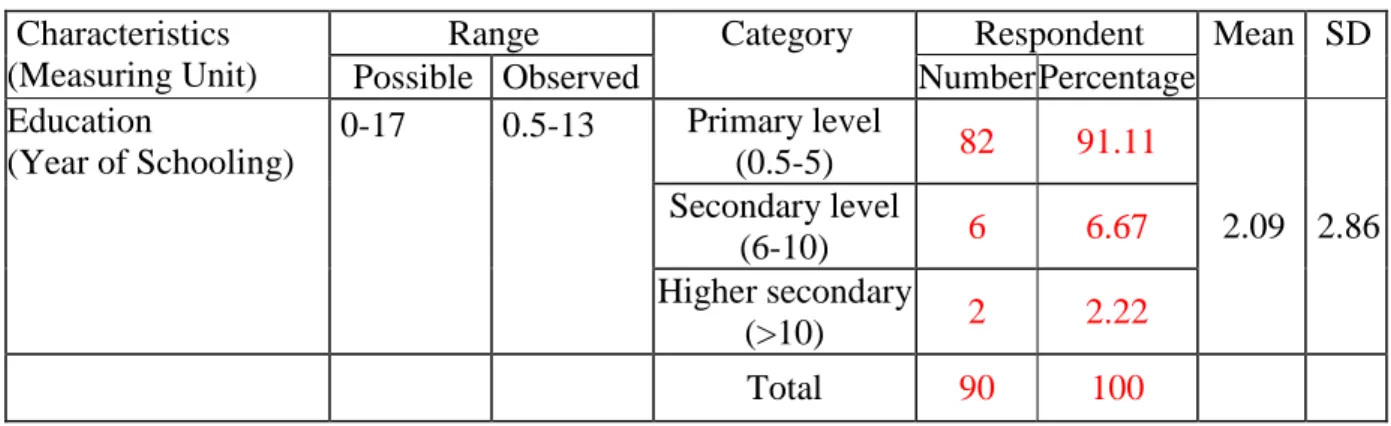
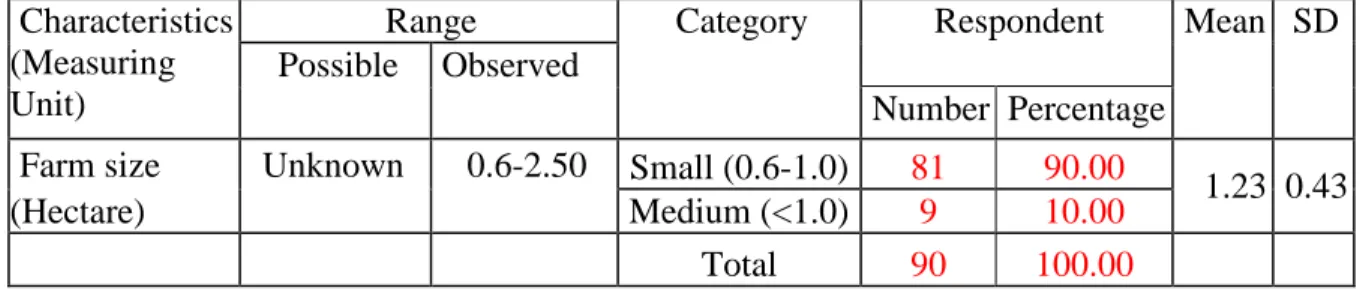
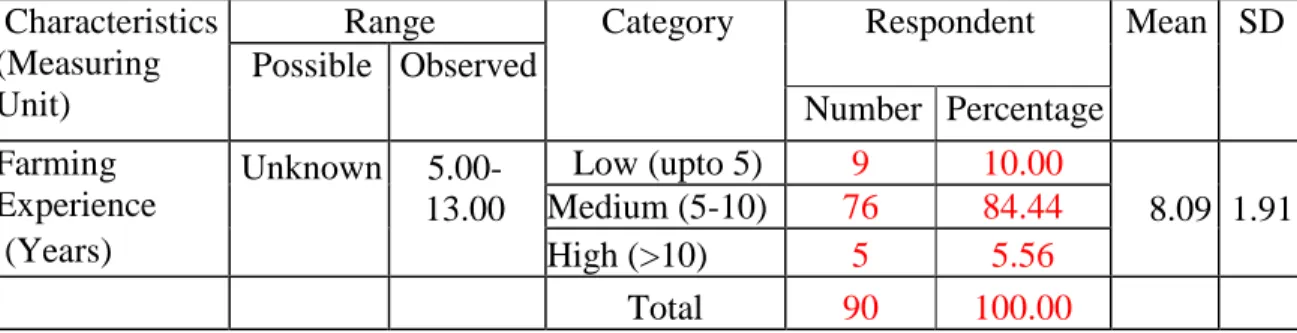
Thirteen selected characteristics of the rural women such as age, education, family size, family farm size, Farming Experience, Duration of involvement with SUS, extension media exposure, annual family income, cosmopoliteness, credit received, training exposure, organizational participation and Extent of participation in income generating activities of AMF project . The salient features of the characteristics of the respondents are presented in Table 4.1.
4.1.1 Age
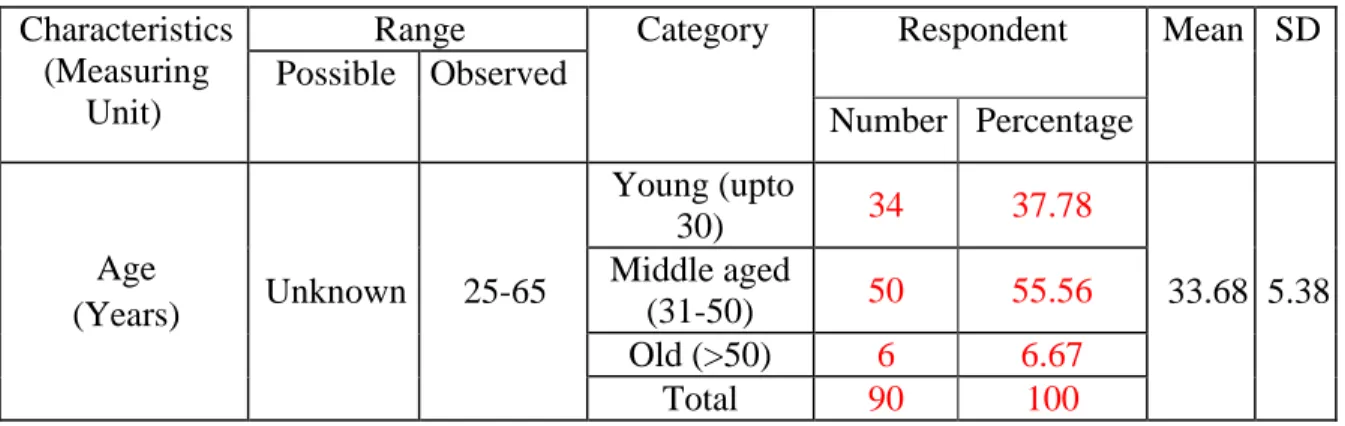
Age of the respondent women ranged from 25 to 65 years with a mean of 33.68 years and standard deviation of 5.38. Based on their age the rural women were classified into three categories as young, middle-aged and old. The Table 4.1 revealed that the highest proportion of the respondents (55.56 percent) were middle aged, while 37.78 percent were young and the remaining 6.67 percent old women were found among the beneficiaries of SUS.