BdBookBazzar BY
Tonmoy Saha Opi ID: 152-15-5932 Tithee Chakma Mama
ID: 143-15-4657
This Report Presented in Partial Fulfillment of the Requirements for the The level of Bachelor of Science in Computer Science and Engineering.
Supervised By Nusrat Jahan
Lecturer Department of CSE
Daffodil International University
Co-Supervised By Md. Zahid Hassan Assistant professor Department of CSE
Daffodil International University
Daffodil International University Dhaka, Bangladesh
April, 2019
ACKNOWLEDGEMENT
At the beginning, we disclose our gratefulness and our heartiest thanks to almighty Allah for His heavenly blessing causes us to be facile to complete the conclusive year project successfully.
Notwithstanding, this would not happen to make this possible without the help of abundant individuals, so we would like to propagate our sincere thanks to all of abundant individuals. In reality, we are thankful and need our profound our liability to supervisor madam Nusrat Jahan, Lecturer, Department of CSE Daffodil International University, Dhaka. She has deep perception and lot of interest in the field of “Web Application” that influenced us to take this project. Her endless assiduity, scholarly guidance, constant and energetic supervision, construct critique, valuable advice, continual encouragement, studying many inferior drafts and correcting them whatsoever stage have made it feasible to accomplish this project.
We would also like to wish our deepest heartiest gratitude to Prof. Dr. Syed Akhter Hossain Head, Department of CSE for his lot of deepest help to fulfill our final year project and also thanks to other faculty members and the employees of CSE dept. of Daffodil International University.
At last, we need to disclose our gratefulness towards our parents and supervisor Nusrat Jahan for their greatest co-operation, encouragement and gave us brave to successfully complete our project.
ABSTRACT
“BdBookBazzar” is a company that sells various kinds of paper books via its chain of several bookshops throughout the country. With the popularity of Internet and customer’s shopping habit has shifted to online, the company’s director board decides to expand its business to serve those online customers. A key strategy of its business movement is building a website that allows their customers to order the books they want while sitting at home. BdBookBazzar is the first online stage which deals with new and old books and late selling books, most selling books, most investigated books in all fields which directly show in the home page. Using this Website, the customer can purchase a book online instead of going out to a book store and wasting time. It makes easier for the customer to choose the best books based on the most selling books list, most investigated books. The ordered books will be shipped to the customer’s address in few days, and the customers pay cash upon receiving the books (Cash on Delivery or COD). In the backend, the company needs to maintain a group of people who put book’s information on the website and manages customer’s information along with their orders and book information, Category information, review information. After all, this Website is without mistake. Any client can utilize this site neighborly.
TABLE OF CONTENTS
CONTENTS PAGE
Acknowledgement iv
Abstract v
List of Figures viii
List of Tables ix
Chapter 1: Introduction 1-3 1.1 Introduction 1
1.2 Motivation 2
1.3 Objectives 2
1.4 Expected Outcome 2
1.5 Report Layout 3
Chapter 2: Background 4-6 2.1 Introduction 4
2.2 Related Works 4 2.3 Comparative Studies 4
2.4 Scope of the Problem 5
2.5 Challenges 6
Chapter 3: Requirement Specification 7-39 3.1 Business Process Modeling 7
3.2 Requirement Collection and Analysis 14
3.3 Use Case Modeling and Description 37
3.4 Logical Data Model 37
3.5 Design Requirements 37
Chapter 4: Design Specification 4 - 47 4.1 Front-end Design 40
4.2 Back-end Design 42
4.3 Interaction Design and UX 46
4.4 Implementation Requirements 47
Chapter 5: Implementation and Testing 48 - 66 5.1 Implementation of Database 48
5.2 Implementation of Front-end Design 51
5.3 Implementation of Interactions 56
5.4 Testing Implementation 60
5.5 Test Results and Reports 60
Chapter 6: Conclusion and Future Scope 67 - 68 6.1 Discussion and Conclusion 67
6.2 Scope for Further Developments 67
References 68
Appendices 69
LIST OF FIGURES
FIGURES PAGE
Figure 3.1.1: Business process model for Admin 8
Figure 3.1.2: Business process modeling for Admin 8
Figure 3.1.3: business process modeling for client/customer 9
Figure 3.2.1: Requirement collection and analysis 10
Figure3.2.2: Data flow diagram symbol 12
Figure 3.2.3: Data Flow Diagram. 13
Figure 3.3.1: Use Case Model for Administration 14
Figure 3.3.2: Use case model for Client/customer 15 Figure 3.4.1: Logical Data Model 37
Figure 3.5.1: Architecture Design 39
Figure 4.2.1: Hibernate Structure 44 Figure 4.2.2: JPQL Code Format 45
Figure 4.3.1: Interaction design and UX 46 Figure 5.1.1: Database Table Design 48
Figure 5.2.1: Homepage 51
Figure 5.2.2: Client Login page 51 Figure 5.2.3: Client Registration page 52
Figure 5.2.4: Search page 52
Figure 5.2.5: Book details and Client review page 53
Figure 5.2.6: Admin login page 53
Figure 5.2.7: Book management page 54
Figure 5.2.8: Category management page 54 Figure 5.2.9: Customer management page 55
Figure 5.2.10: Review management page 55
Figure 5.2.11: Admin user management page 56
Figure 5.3.1: Frontend 58
Figure 5.3.2: Backend 60
LIST OF TABLES
TABLES PAGE
Table 3.3.1: Use case description of create employee 16
Table 3.3.2: Use case description of Delete employee 16
Table 3.3.3: Use case description of Update employee 17
Table 3.3.4: Use case description of List of all employee 18
Table 3.3.5: Use case description of Create category 19
Table 3.3.6: Use case description of Delete category 19
Table 3.3.7: Use case description of List of all category 20
Table 3.3.8: Use case description of Update category 20
Table 3.3.9: Use case description of Create Book 21
Table 3.4.10: Use case description of update Book 22
Table 3.3.11: Use case description of delete Book 23
Table 3.3.12: Use case description of List All Book 24
Table 3.3.13: Use case description of Reviews 25
Table 3.3.14: Use case description of delete Reviews 25
Table 3.3.15: Use case description of update Reviews 26
Table 3.3.16: Use case description of update list all orders 27
Table 3.3.17: Use case description of update order 27
Table 3.3.18: Use case description of delete order 28
Table 3.3.19: Use case description of list all customer 29
Table 3.3.20: Use case description of delete customer 29
Table 3.3.21: Use case description of register customer 30
Table 3.3.22: Use case description of login customer 31
Table 3.3.23: Use case description of manage profiles customer 31
Table 3.3.24: Use case description of place order 32
Table 3.3.25: Use case description of view order details 33
Table 3.3.26: Use case description of add book to shopping chart 33
Table 3.3.27: Use case description of remove book from shopping cart 34
Table 3.3.28: Use case description of remove book from shopping cart. 35
Table 3.3.29: Use case description of remove clear shopping cart 35
Table 3.3.30: Use case description of remove search book 36
Table 5.1.1: Client 49
Table 5.1.2: Category 49
Table 5.1.3: Book 49
Table 5.1.4: Review 49
Table 5.1.5: Book order (master) 50
Table 5.1.6: Order detail 50
Table 5.1.7: Employee 50
Table 5.5.1: Registration 61
Table 5.5.1: Registration 62
Table 5.5.2: Login 62
Table 5.5.3: Update profile 62
Table 5.5.4: Search book 62
Table 5.5.5: Add Book to shopping cart 62
Table 5.5.6: Remove Book and clear the shopping cart 62
Table 5.5.7: Update shopping cart 63
Table 5.5.8: Order and shipping information 63
Table 5.5.9: Add review and comment 63
Table 5.5.10: Add Book 63
Table 5.5.11: Delete Book 64
Table 5.5.12 Update Book 64
Table 5.5.13: Add and Delete Category 64
Table 5.5.14: Update Category 64
Table 5.5.15: Add and Delete employee 65
Table 5.5.16: Update Employee 65
Table 5.5.17: Manage Orders 65
Table 5.5.18: Manage Client 65
CHAPTER 1 INTRODUCTION
1.1 Introduction
Current development now a day, is called heavenly time. The charm called innovation. Present day innovation has achieved all of the goals that were once dream to human. In this report we will clear up a stimulating voyage not far-removed of Web administrations application. From necessities to use cases, to database structure, to fragment frameworks, to UIs, we will cover each and every piece of system setup required to develop an application with network situated Web administrations. The inspiration driving why we picked online Bookstore web organization is everybody walking around the street has some idea with respect to book shops.
The objective of this endeavor is to develop an advanced book shop where books can be acquired from the comfort of home through the web. An online book shop is a virtual store on the Internet where client can scrutinize the stock and select books of interest. The picked books may be accumulated in a shopping basket. On the Check Out page, the client can audit the books she needs to arrange once more, and affirm the delivery data. As a matter of course, the delivery data is loaded up with client's enrolled data (name, phone, email, address, city, zip code and country). The client can refresh this data if necessary. What's more, this starting stage, the site acknowledges just installment by COD (Cash on Delivery). The client clicks “Spot Order” catch to present the request to the organization's staff, and after that she can check the request status by means of “My Orders” menu. The default status of a request is 'Handling' and just the organization's staff can refresh the request status. On the My Orders page, the client can see all requests she made through the site. The latest requests are appeared and she can snap to see the subtleties of each request. Right now, the client can't alter their requests once they are submitted. The site additionally enables the client to see their enlisted data (profile subtleties) and alter it. Note that the client can't change their enrolled email address, and their secret word won't be changed whenever left clear in the alter structure. Likewise note that when the client logs out, the data in their shopping basket is cleared. Whenever, the client can look through the books they need by composing a catchphrase in the inquiry box at the highest point of the site. The query item indicates books that have either title or depiction contain the predefined catchphrase. The client can add the book to truck straightforwardly in the query output.
1.2 Motivation
The essential goal of this venture is to make a “BdBookBazzar” that licenses customer to request and purchase a book online reliant on characterization, essayist and subject and furthermore by review top of the line books, most. The picked books are appeared and the customer can mastermind their books online through COD. The Administrator will have additional functionalities when appeared differently in relation to the typical customer [6].
The motivation to make this task has various sources –
• Interest to develop a better than average simple to utilize webpage with various online trades using a database.
• To extend my Knowledge horizon in developments like Java, SQL, CSS, HTML, JavaScript, JQuery, JPA, Hibernate, Servlet, JSP.
• To lessen time use, work necessities
1.3 Objective
To empower administrator to get to the system from anyplace.
To diminish information repetition and pruning equivocal information.
To process information in potentially least measure of time.
To secure the data and impede the entrance of unauthorized people.
To profit the data quickly sought after.
To examine the information for giving expository choices.
1.4 Expected Outcome
We expect the result from our task is completely right and explicit. From our application customer will be profited most. With our venture we need to help the books sweetheart to think about each book and they don't have to go outside to buy book. With our undertaking our customer can look through the book by name or writer name. Customer can pick the book dependent on top rated book and customer can likewise pick the book from most loved book list.
1.5 Report Layout Chapter 1: Introduction
In this section we have clear up beginning presentation, inspiration, destinations, expected result and report design of our venture.
Chapter 2: Background
In this section we have examined about working foundation of our task. We have additionally examined about the related works, comparatives think about like our undertaking, challenges, established issues and arrangements.
Chapter 3: Requirement Specification
This part is about the necessity investigation and gathering. We have talked about a lot of things like prerequisite accumulation and investigation, business process demonstrates, use case display, point by point use case and structure necessities.
Chapter 4: Design Specification
We have talked about pretty much every one of the plans of our task like front end configuration, back end structure, association and UX, usage of prerequisites.
Chapter 5: Implementation and Testing
This section contains database usage, front-end plans execution, collaborations of various pieces of the undertaking and the test consequences of the venture.
Chapter 6: Conclusion and Future Scope
This part is about the end and future extent of this undertaking. We have talked about what should be possible later on with this task.
CHAPTER 2 BACKGROUND
2.1 Introduction
Our framework will be an intelligent Web application which can be opened by any program.
In our application customer can enlist by his/her email. Enlisted client will get notice by means of their mail about our new books. Customer can likewise observe their buy history and furthermore can discover the smash hit books on our framework. What's more, customer likewise can alter their profile in the event that he/she need.
2.2 Related work
There are various online book shops like Powell's, Amazon which were organized using HTML. We have to develop a relative site using java, servlet, JSP, JavaScript, JQuery, JPQL, Hibernate, MySQL, CSS. Online Book store is an online web application where the customer can purchase books on the web. Through a web program the customers can scan for a book by its title and class, later can add to the shopping basket finally purchase using Cash on Delivery.
The customer can sign in using his record nuances or new customers can set up a record all around quickly. They should give the nuances of their Recipient Name, Recipient Phone, Order Date and Shipping Address. The books are isolated into various orders reliant on subjects like a social book, programming book, business book, etc [7, 6].
2.3 Comparative Studies
Our implemented application is different from the existing sites. This total system is observed by an admin.
My system will give following term:
System Administration
Clients:
Visitor client
Registered client.
Facilities to be given to the system administrator:
The system administrator will have easy to use offbeat GUI (Graphical User Interface) system.
To have the subtleties information of the request, normal selling rate, top-selling books information, week by week selling books information and so forth.[6, 8].
Facilities to be given to the registered client:
The client can pick and purchase any sorts of books effectively from this site just by registering.
The client can search for any sort of books from this website.
The client can without much of stretch access to this website
The client can add, update or drop his/her shopping cart inside a restricted time.
Client can give review and comment to each book.
Clients can contact the administrator.
Clients can complain about the website [6, 8].
Facilities to be given to the Guest client:
Clients can demonstrate all information about books.
Client can search for any sort of books from this website.
Clients can peruse a review of the books.
Clients can complain about the website.
Clients can contact the administrator.
2.4 Scope of the problem
The fundamental point of our venture is to give an online web based business on bookselling.
It will be a simple method to discover the needed book by means of our framework. Through this framework our customer will get customary help in the event that they face any sort of issue while looking or requesting books from our site.
We give fantastic security of information at each dimension of our customer framework collaboration. Our webpage will be useful for books darling to choose their books type and they will get the new book rundown and smash hit book list and most-favored book list when they touched base to BdBookBazzar site page.
2.5 Challenges
Client must have to register first.
Client must have to use valid email for login.
Must need internet connection to get the service.
Client must need to give a valid contact number for delivery service.
Client must need to give a valid shipping address.
Client must have to use unique email address.
CHAPTER 3
REQUIREMENT SPECIFICATION
3.1 Business Process Modeling
Business process displaying is a method for speaking to the business exercises, the data stream and choice rationale in business forms.
With the intensity of representation, it is utilized to impart data in regards to a procedure and the association it incorporates inside/between associations either among the people perusing a model or the people who make it.
It externalizes the business learning so as to concur and tie all partner in a portrayal that is shared inside an association and is reflected in its data frameworks.
It shows various granularity levels: from straightforward delineation of the work process to reproduction and execution.
It tends to unpredictability by underscoring on explicit perspectives and by reusing models.
It accomplishes a typical comprehension of business learning between an association and IT specialists and along these lines drives the structure and usage of programming frameworks.
Business Process Modeling are two sorts [9].
Dynamic Model Type: At whatever point a model sort should indicate process significant data that can be placed in an ordered, time subordinate way, this model kind is alluded to as a
"dynamic model sort". Every model kind that speak to a procedure stream are dynamic model sort.
Static Model Types: Static model sorts speak to structures that don't give time reliance. This incorporates the demonstrating of hierarchical structures, of data transporters like structures or the displaying of connections between business objects [6].
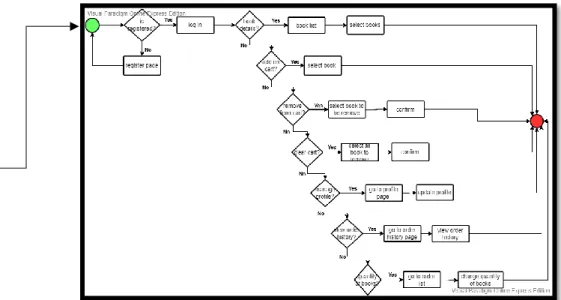
Figure 3.1.1: Business process model for Admin.
Figure 3.1.2: Business process modeling for Admin Admin
Admin
Figure 3.1.3: business process modeling for client/customer
3.2 Requirement Collection and Analysis [1]
Here we were using of waterfall model for requirement collection and analysis.
Figure 3.2.1: Requirement collection and analysis
The methodology we will use to develop the OTBMS is cascade display. Cascade display is Customer
one of the framework improvement life cycle (SDLC) models. Customers proceed to the accompanying stage in case and just if the present stage is done. Customers are not allowed to come back to past stages if there is any mistake so the model is named after the cascade display.
In Royce's exceptional cascade demonstrate, the cascade show at first involves seven phases which are Requirement specification
Analysis
Design
Implementation
Testing and Debugging
Installation and Deployment
Acceptance and Maintenance
Requirement specification:
Each and every believable essential of the system to be created are communicated in this stage.
Prerequisites are a ton of limits and constraints that the end customer envisions from the structure. The prerequisites are collected from the end customer and are dissected for their authenticity and the probability of going along with them. Finally, a need particular report is made which fills the need of a standard for the accompanying time of the model.
Software Design:
Prior to starting the genuine coding stage, it is exceedingly basic to appreciate the prerequisites of the end customer and moreover have an idea of how the last outcome ought to take after.
The essential details from the fundamental stage are analyzed here, and a framework design is prepared. The structure helps in deciding equipment and framework necessities and besides helps in describing the general framework engineering. The framework plan determinations fill in as a commitment for the accompanying time of the model.
Implementation and unit testing:
Execution and Unit testing on tolerating framework setup records, the work is disengaged in modules/units and genuine coding starts. The framework is first clarified into little ventures called units, which are composed in the accompanying stage. Each unit is created and strove for its convenience; this is insinuated as unit testing. Unit testing generally checks if the modules/units meet their determinations.
Integration and system Testing:
The units are as of now consolidated to outline a complete framework in the midst of the blend stage and attempted to check if all modules/units organize with each other and the framework all things considered continues as indicated by the particulars. After successfully testing the item, it is passed on to the customer.
Installation and Deployment:
The product is by and by associated by the customer to his/her own one of a kind system(s).
What the customer's needs to manage is his framework consenting to the base framework prerequisites of the product. He in like manner needs to manage any framework structures and reconfigurations on his side of the course of action. At the point when the product is honestly presented, he will begin correspondence with the dealers on a need-to-know reason and help report any bugs that occur.
Operation and Maintenance:
This time of the model is in every practical sense unending. Generally, issues with the framework (which are not found in the midst of the headway cycle) come up after its rational use starts, so the issues related to the framework are settled after its association. Few out of every odd one of the issues come into the picture explicitly, yet they develop occasionally and ought to be lit up; from now on this system is insinuated.
Data Flow Diagram:
Otherwise called DFD, Data stream outlines are utilized to graphically speak to the stream of information in a business data framework. DFD depicts the procedures that are engaged with a framework to exchange information from the contribution to the document stockpiling and reports age.
Information stream graphs can be partitioned into sensible and physical. The sensible information stream chart portrays stream of information through a framework to play out certain usefulness of a business. The physical information stream graph portrays the execution of the coherent information stream.
DFD graphically speaking to the capacities, or procedures, which catch, control, store, and circulate information between a framework and its condition and between segments of a framework. The visual portrayal makes it a decent specialized instrument among User and System fashioner. Structure of DFD permits beginning from a wide outline and extend it to
a progressive system of graphs. DFD has frequently been utilized because of the accompanying reasons:
Logical information flow of the system
Determination of physical system construction requirements
Simplicity of notation
Establishment of manual and automated systems requirements
There are four basic symbol which are used to represent the data flow diagram [8].
Figure3.2.2: Data flow diagram symbol
Figure 3.2.3: Data Flow Diagram
3.3 Use case modeling and description
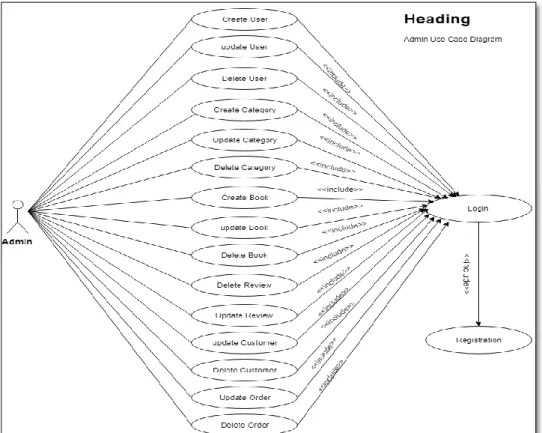
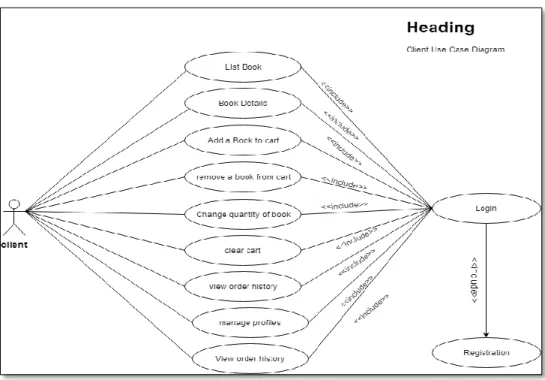
The going with figure exhibits the utilization case demonstrate for “BdbookBazzar”. Here two sorts of the customers are open. A head customer can play out all of the systems yet that needs a login for that. On the other hand, a run of the mill customer can simply draw a graph, Import and admission data. He furthermore ought to be marked in the system for organizations that I am giving.
Use Case Model for Admin:
Figure 3.3.1: Use Case Model for Administration Use case model for Client/customer:
Fig 3.3.2: Use case model for Client/customer
Table 3.3.1 portrays about “create employee” procedure of our venture and it gives us a seeing how the procedure functions in task. Create employee process has four essential ways they are enter email, full name, position, pass word and create employee. In this four essential way have three invalid ways that are client with email is as of now exist, invalid
administrator secret key, invalid administrator email.
Table 3.3.1: Use case description of create employee
Use Case Create employee
Pre-Condition Login
Actor Admin, Employee
Primary Path Enter Email
Enter Full Name
Enter Position
Enter Password
Invalid Path This user with email is already exist.
Invalid Admin Email
Invalid Admin Password
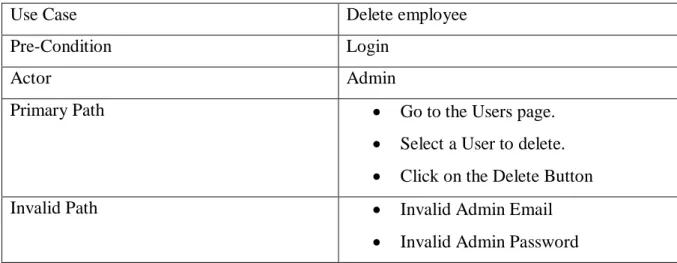
Table 3.3.2 portrays about “Delete employee” procedure of our task and it gives us a seeing how the procedure functions in venture Delete employee process has three essential ways they are go to client page, select client and snap erase catch. In this there are two invalid way they are invalid administrator email, invalid administrator secret word.
Table 3.3.2: Use case description of Delete employee
Use Case Delete employee
Pre-Condition Login
Actor Admin
Primary Path Go to the Users page.
Select a User to delete.
Click on the Delete Button
Invalid Path Invalid Admin Email
Invalid Admin Password
Table 3.3.3 portrays about “Update employee” procedure of our undertaking and it gives us a seeing how the procedure functions in venture. Update employee process has five essential ways they are go to client page, select client to refresh, click update catch, return email, secret phrase, and full name and snap spare catch to refresh. In this there are three invalid way.
Table 3.3.3: Use case description of Update employee
Use Case Update employee
Pre-Condition Login
Actor Admin
Primary Path Go to the Users page.
Select a User to Update.
Click on the Update Button
Re-Enter email, password, full name
Click the save button to update
Invalid Path This user cannot update. Because this
user with this email is already exist.
Invalid Admin Email
Invalid Admin Password
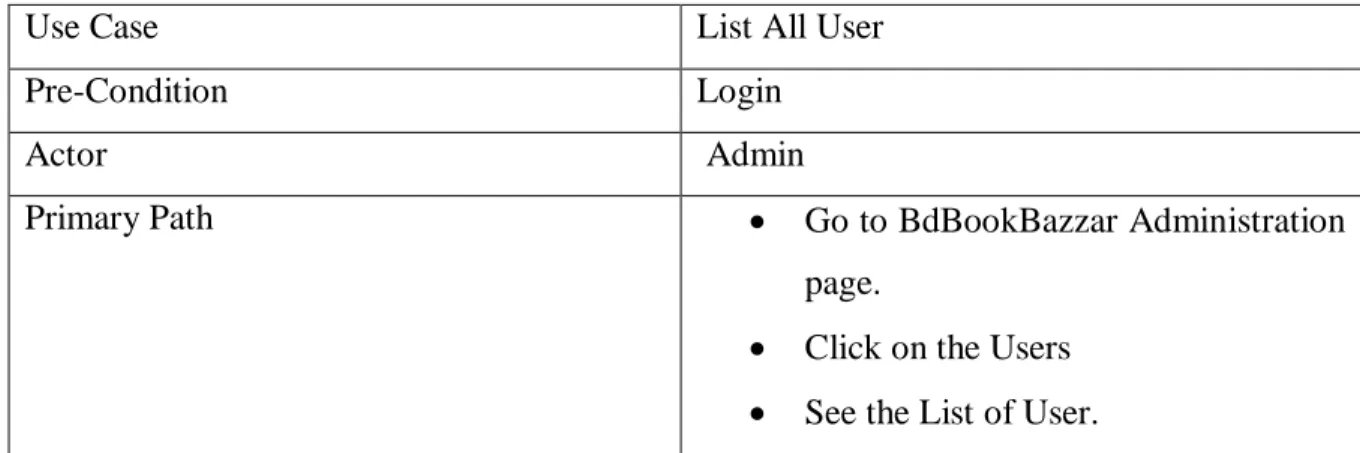
Table 3.3.4 portrays about “List of all employee” procedure of our task and it gives us a seeing how the procedure functions in undertaking. List of all employee process has three essential ways they are go to. In this there are three invalid way they are invalid administrator email, invalid administrator secret key.
Table 3.3.4: Use case description of List of all employee
Use Case List All User
Pre-Condition Login
Actor Admin
Primary Path Go to BdBookBazzar Administration
page.
Click on the Users
See the List of User.
Invalid Path Invalid Admin Email
Invalid Admin Password
Table 3.3.5 depicts about “Create category” procedure of our task and it gives us a seeing how the procedure functions in undertaking. Create category process has two essential ways they are enter class name and snap on make catch. In this there are three invalid way.
Table 3.3.5: Use case description of Create category
Use Case Create Category
Pre-Condition Login
Actor Admin
Primary Path Enter Category Name
Click on the create button
Invalid Path This Category Name is already Exist.
Invalid Admin Email
Invalid Admin Password
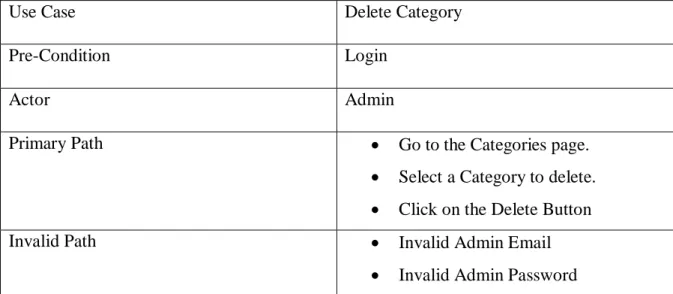
Table 3.3.6 depicts about “Delete category” procedure of our venture and it gives us a seeing how the procedure functions in task. Delete category process has three essential ways. In this there are two invalid ways they are invalid administrator email, invalid administrator secret word.
Table 3.3.6: Use case description of Delete category
Use Case Delete Category
Pre-Condition Login
Actor Admin
Primary Path Go to the Categories page.
Select a Category to delete.
Click on the Delete Button
Invalid Path Invalid Admin Email
Invalid Admin Password
Table 3.3.7 depicts about “List of all category” procedure of our venture and it gives us a seeing how the procedure functions in task. List of all category procedure has three essential ways. In this there are two invalid ways they are invalid administrator email, invalid administrator secret word.
Table 3.3.7: Use case description of List of all category
Use Case List All Category
Pre-Condition Login
Actor Admin
Primary Path Go to BdBookBazzar Administration
page.
Click on the Categories
See the List of categories.
Invalid Path Invalid Admin Email
Invalid Admin Password
Table 3.3.8 describes about “update category” process of our project and it gives us an understanding how the process works in project. Update category process has four primary paths. In this there are three invalid path.
Table 3.3.8: Use case description of Update category
Use Case Update Category
Pre-Condition Login
Actor Admin, employee
Primary Path Go to BdBookBazzar Administration
page.
Click on the Update Button
Re-Enter Category Name
Click on the Update button to update
Invalid Path This Category cannot update.
Because this Category with this name is already exist.
Invalid Admin Email
Invalid Admin Password
Table 3.3.9 Describes about “create book” process of our project and it gives us an understanding how the process works in project. Create book process has nine primary paths.
In this nine primary path have three invalid paths that are user with email is already exist, invalid admin password, invalid admin email.
Table 3.3.9: Use case description of Create Book
Use Case Create Book
Pre-Condition Login
Actor Admin, employee
Primary Path Enter Title
Enter Author
Enter Description
Enter ISBN
Enter Image
Enter Price
Enter Publish Date
Enter Publish Date
Enter Last Update Time
Invalid Path This Book with the title is already
exist.
Invalid Admin Email
Invalid Admin Password
Table 3.3.10 Describes about “update book” procedure of our venture and it gives us a seeing how the procedure functions in task. Update book process has two performers one is administrator and another is client. Also, this procedure has five essential ways they are go to book page, select book for update catch, reemerge all the portrayal and snap spare catch. In this there are three invalid ways.
Table 3.4.10: Use case description of update Book
Use Case Update Book
Pre-Condition Login
Actor Admin, employee
Primary Path Go to the Books page.
Select a Book to Update.
Click on the Update Button
Re-Enter Title, author, ISBN, image, price, description, Publish date.
Click the save button to update
Invalid Path This book cannot update. because this
book with this title is already exist.
Invalid Admin or User Email
Invalid Admin or User Password
Table 3.3.11 Describes about “Delete book” process of our project and it gives us an understanding how the process works in project. Delete book process has three primary paths.
In this there are three invalid path.
Table 3.3.11: Use case description of delete Book
Use Case Delete Book
Pre-Condition Login
Actor Admin, employee
Primary Path Go to the Books page.
Select a Book to delete.
Click on the Delete Button
Invalid Path This book is already deleted by
another admin or user.
Invalid Admin or User email
Invalid Admin or User Password
Table 3.3.12 Describes about “list all books” process of our project and it gives us an understanding how the process works in project. List all book process has three primary paths
book. In this there are two invalid path and they are invalid admin email, invalid admin password.
Table 3.3.12: Use case description of List All Book
Use Case List All Books
Pre-Condition Login
Actor Admin, User
Primary Path Go to BdBookBazzar Administration
page.
Click on the Books page.
See the List of Book.
Invalid Path Invalid Admin Email
Invalid Admin Password
Table 3.3.13 Describes about “list all reviews” process of our project and it gives us an understanding how the process works in project. List all reviews process has three primary paths. In this there are two invalid path.
Table 3.3.13: Use case description of Reviews
Use Case List All Reviews
Pre-Condition Login
Actor Admin
Primary Path Go to BdBookBazzar Administration
page.
Click on the Reviews page.
See the List of Reviews.
Invalid Path Invalid Admin Email
Invalid Admin Password
Table 3.3.14 Describes about “delete review” process of our project and it gives us an understanding how the process works in project. Update category process has three primary paths and they are go to review page, select review to delete, and click delete button. In this there are three invalid path.
Table 3.3.14: Use case description of delete Reviews
Use Case Delete Review
Pre-Condition Login
Actor Admin
Primary Path Go to the Reviews page.
Select a Review to delete.
Click on the Delete Button
Invalid Path This review is already deleted by
another admin or user.
Invalid Admin or User email
Invalid Admin or User Password
Table 3.3.15 Describes about “update review” process of our project and it gives us an understanding how the process works in project. Update review process has five primary paths and they are go to review page, select review to update, click on update button, re-enter headline, comments and click save button to update. In this there are three invalid path.
Table 3.3.15: Use case description of update Reviews
Use Case Update Review
Pre-Condition Login
Actor Admin, User
Primary Path Go to the Reviews page.
Select a Review to update.
Click on the Update Button.
Re-Enter – Headline, Comment
Click the save button to update
Invalid Path Invalid Admin or User email
Invalid Admin or User Password
Table 3.3.16 Describes about “list all orders” process of our project and it gives us an understanding how the process works in project. List all orders process has three primary paths and they are go to administration page, click on order page and all the order list. In this there are two invalid path and they are invalid admin email and password.
Table 3.3.16: Use case description of update list all orders
Use Case List All Orders
Pre-Condition Login
Actor Admin, User
Primary Path Go to BdBookBazzar Administration
page.
Click on the Orders page.
See the List of Orders.
Invalid Path Invalid Admin Email
Invalid Admin Password
Table 3.3.17 Describes about “update order” process of our project and it gives us an understanding how the process works in project. Update order process has six primary paths.
In this there are two invalid path.
Table 3.3.17: Use case description of update order
Use Case Update Orders
Pre-Condition Login
Actor Admin, User
Primary Path Go to BdBookBazzar Administration
page.
Go to the Orders page.
Select an Orders to update.
Click on the Orders Button.
Re-Enter – Shipping Address, Recipient Name, Payment Method, Order Total, and Order Status.
Click the save button to update
Invalid Path Invalid Admin or User email
Invalid Admin or User Password
Table 3.3.18 Describes about “delete order” process of our project and it gives us an understanding how the process works in project. Delete order process has three primary paths and they are go to order page, select order to delete and click delete button. In this there are three invalid path.
Table 3.3.18: Use case description of delete order
Use Case Delete Orders
Pre-Condition Login
Actor Admin, User
Primary Path Go to the Orders page.
Select an Order to delete.
Click on the Delete Button
Invalid Path This Order is already deleted by
another admin or user.
Invalid Admin or User email
Invalid Admin or User Password
Table 3.3.19 Describes about “list all customer” process of our project and it gives us an understanding how the process works in project. List all customer process has three primary paths. In this there are two invalid path.
Table 3.3.19: Use case description of list all customer
Use Case List all customer
Pre-Condition Login
Actor Admin, User
Primary Path Go to BdBookBazzar Administration
page.
Click on the customer’s page.
View List all the customers.
Invalid Path Invalid Admin or user Email
Invalid Admin or user Password
Table 3.3.20 Describes about “delete customer” process of our project and it gives us an understanding how the process works in project. Delete customer process has three primary paths and they are go to order page, select order to delete and click delete button. In this there are three invalid path.
Table 3.3.20: Use case description of delete customer
Use Case Delete customer
Actor Admin, User
Primary Path Go to BdBookBazzar Administration
customer’s page.
Click on the delete button.
Invalid Path Invalid Admin or user Email
Invalid Admin or user Password
Go to customer page
Use case Description for client
Table 3.3.21 Describes about “register” process of our project and it gives us an understanding how the process works in project.in this process there only one actor that so Customer. Register
process has four primary paths and they are entering mail, enter full name, enter password, re- type password. In this there are one invalid path.
Table 3.3.21: Use case description of register customer
Use Case Register
Pre-Condition none
Actor Customer
Primary Path Enter Email
Enter Full Name
Enter password
Enter Retype-Password
Invalid Path This customer with this email is
already exist.
Table 3.3.22 Describes about “login” process of our project and it gives us an understanding how the process works in project. Login process has three primary paths and they are enter mail, enter password, click on login button. In this there are two invalid path and they are enter wrong email, enter wrong password.
Table 3.3.22: Use case description of login customer
Use Case Login
Pre-Condition Registration
Actor Customer
Primary Path Enter Email
Enter password
Click on the login button.
Invalid Path Enter wrong email.
Enter wrong password.
Table 3.3.23 Describes about “manage profile” process of our project and it gives us an understanding how the process works in project. Manage profile process has three primary paths and they are go to profile, re-enter email, full name, password and click on the update button. In this there are two invalid path.
Table 3.3.23: Use case description of manage profiles customer
Use Case Manage Profiles
Pre-Condition login
Actor Customer
Primary Path Go to profile page
Re-Enter email, Full Name, password
Click on the update button
Invalid Path This customer with this email is
already exist.
Enter wrong email.
Enter wrong password.
Table 3.3.24 Describes about “place order” process of our project and it gives us an understanding how the process works in project. Place order process has eight primary paths.
In this there are two invalid path.
Table 3.3.24: Use case description of place order
Use Case Place Orders
Pre-Condition Login
Actor Customer
Primary Path Go to BdBookBazzar page.
Go to the Orders page.
Enter Shipping Address
Enter Recipient Name
Enter Payment Method
Enter Order Total
Enter Order Status.
Click the on the order button to order
Invalid Path Enter wrong email.
Enter wrong password.
Table 3.3.25 Describes about “view order details” process of our project and it gives us an understanding how the process works in project. View order details process has two primary paths and they are go to order details page and view order details. In this there are two invalid path they are wrong password and wrong email.
Table 3.3.25: Use case description of view order details
Use Case View Orders details
Pre-Condition Login
Actor Customer
Primary Path Go to BdBookBazzar Orders details
page.
See the Orders details.
Invalid Path Enter wrong email.
Enter wrong password.
Table 3.3.26 Describes about “add book to shopping chart” process of our project and it gives us an understanding how the process works in project. Add book to shopping chart process has two primary paths. In this there are two invalid path.
Table 3.3.26: Use case description of add book to shopping chart
Use Case Add book to Shopping Cart
Pre-Condition Login
Actor Customer
Primary Path Go to BdBookBazzar shopping cart.
Click on a book to added in shopping cart.
Invalid Path Enter wrong email.
Enter wrong password.
Table 3.3.27 Describes about “remove book from shopping chart” process of our project and it gives us an understanding how the process works in project. Remove book from shopping chart process has two primary paths. In this there are two invalid path.
Table 3.3.27: Use case description of remove book from shopping cart
Use Case remove book from Shopping Cart
Pre-Condition Login
Actor Customer
Primary Path Go to BdBookBazzar shopping cart.
Click on a book to remove from shopping cart.
Invalid Path Enter wrong email.
Enter wrong password.
Table 3.3.28 Describes about “change quantity” process of our project and it gives us an understanding how the process works in project. Change quantity process has four primary paths they are go to shopping chart, click on quantity update button, re-enter quantity and click save button. In this there are two invalid path.
Table 3.3.28: Use case description of remove book from shopping cart
Use Case Change quantity
Pre-Condition Login
Actor Customer
Primary Path Go to BdBookBazzar shopping cart.
Click on the quantity update button
Re-enter quantity.
Click save button.
Invalid Path Enter wrong email.
Enter wrong password.
Table 3.3.29 Describes about “clear shopping chart” process of our project and it gives us an understanding how the process works in project. Clear shopping chart process has two primary paths. In this there are two invalid path.
Table 3.3.29: Use case description of remove clear shopping cart
Use Case Clear Shopping Cart
Pre-Condition Login
Actor Customer
Primary Path Go to BdBookBazzar page.
Click on the clear button for remove all books from cart.
Invalid Path Enter wrong email.
Enter wrong password.
Table 3.3.30 Describes about “search book” process of our project and it gives us an understanding how the process works in project. Clear shopping chart process has four primary paths they are go to home page, click on search bar, enter book name, click on search button.
In this there are two invalid path.
Table 3.3.30: Use case description of remove search book
Use Case Search books
Pre-Condition Login
Actor Customer
Primary Path Go to BdBookBazzar home page.
Click on the search bar.
Enter book name.
Click on the search button.
Invalid Path Enter wrong email.
Enter wrong password.
3.4 Logical Data Model
Here represented the logical Data model of the whole project system.
Figure 3.4.1: Logical Data Model
3.5 Design Requirements
Frameworks configuration is the way toward describing the design, sections, modules, interfaces, and data for a system to satisfy showed necessities. In this part by and large system plan of our application has been showed up, where structural structure, use case graph, stream outline and data stream chart included. Whole structure of this task is customer neighborly.
Present day and refreshed plan instruments have been used for this task. In like manner, new thoughts have been considered to make it straightforward. In future any kind of modify is allowed as time stipends.
Both employee and client will create their respective account.
Both employee and client can be able to update their profile.
Client can place order.
Client can also cancel the order.
Client can add books on cart.
Client can also remove or clear cart.
Client can give review on product.
Client can also write comment on the books.
Client will get all the notification via his/her mail.
Client can see the book list.
Client can find out bestselling books.
Client can find out most favored books.
Client can see their order history.
Client can search books by book name, author name.
When client will be log out then he/she session will be destroyed.
Admin can see all the information.
Admin will monitor all activity if employee and client.
Architecture Design
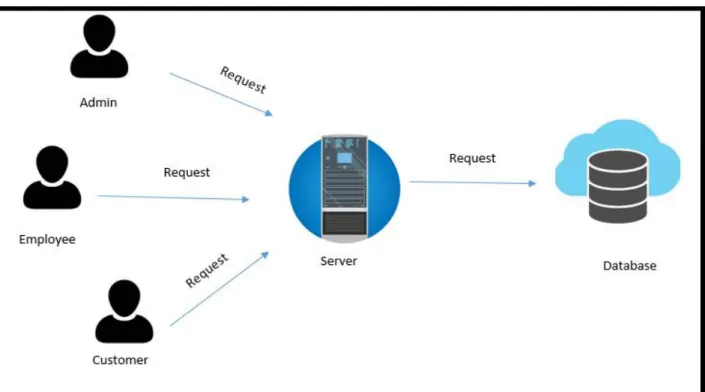
The architecture design of a system emphasizes the design of the system architecture that describes the structure, behavior, and more views of that system and analysis.
Our application’s architectural design shows that-
• User writes the web address of our application through the web browser.
• This link request goes to the web server.
• JVM Files fetch the data from database and the web page is showed to the user.
Figure 3.5.1: Architecture Design
Database configuration is the relationship of data according to a database demonstrate. The planner makes sense of what data must be secured and how the data segments interrelate. With this data, they can begin to fit the data to the database display. Database configuration incorporates gathering data and recognizing interrelationships.
Two essential settings for a database are:
➢ Primary-key: - The field that is novel for all the record occasions.
➢ Foreign-key: - The field used to set association between tables. Institutionalization is a framework to keep up a vital separation from excess in the tables [6, 7].
CHAPTER 4
DESIGN SPECIFICATION
Improvement of an online business site used the advances of both front and back end and the Front-End improvement allude to the web customers to connect with explicitly.
4.1 Front-end Design JSP:
JSP is being used as Front End as a result of its benefit and reasonableness. Java Server Pages (JSP) is a development for controlling the substance or presence of Website pages utilizing servlets, little program they are resolved in the Pages and continue running Online server to change the Page before it is sent to the customer who requested it. Sun Smaller scale systems, the architect of java, in like manner suggest the Jsp advancement as the Servlet application program interface (API).
There is abundance inclinations of using JSP. At the point when all is said in done, JSP empowers originators to easily scatter application convenience to a wide extent of page makers.
These scholars don't have to understand the Java programming language or know anything about making servlet code, so they can concentrate on making their HTML code while you center on making your articles and application method of reasoning.
JSP pages are incorporated progressively into servlets when requested, so page creators can without quite a bit of a stretch make updates to presentation code. JSP pages can similarly be precompiled at whatever point needed [5, 4].
JSTL:
JSTL has support for typical, assistant errands, for instance, cycle and conditionals, marks for controlling XML chronicles, internationalization names, and SQL names. It is like manner gives a structure to consolidating the present custom marks with the JSTL names.
To engage JSTL features, we'd have to add the library to our endeavor. For a Maven store, we incorporate the dependence in pom.xml record:
<dependency>
<groupId>jstl</groupId>
<artifactId>jstl</artifactId>
<scope>compile</scope>
</dependency>
With the library added to our project, the last setup will be to include the core JSTL tag and some other labels’ namespace document to our JSP utilizing the taglib order this way:
<%@ taglib prefix="c" uri="http://java.sun.com/jsp/jstl/core"%>
JSTL-version: 1.2 HTML:
Hypertext Markup Language (HTML) is the standard markup language for making site pages and web applications.HTML parts are the structure squares of HTML pages. With HTML assembles, pictures and distinctive things, for instance, natural structures, may be embedded into the rendered page. It gives an approach to make composed files by demonstrating assistant semantics for substance, for instance, headings, entries, records, associations, refers to and distinctive things. HTML segments are delineated by names, created using point segments.
Marks, for instance, <img/> and <input/> present substance into the page explicitly. Others, for instance, <p>...</p> envelop and give information about record message and may consolidate diverse marks as sub-segments. Projects don’t demonstrate the HTML names, be that as it may, use them to decipher the substance of the page [2, 6].
CSS:
CSS speaks to Cascading Style Sheet. Site masters that don’t use CSS for their structure what's more, advancement of locales are rapidly transforming into a relic of times passed by.
Moreover, it is clearly as basic to grasp CSS for what its value to know HTML.
CSS is organized basically to enable the unit of presentation and substance, checking edges, for instance, the structure, hues, and content styles. This segment can improve content receptiveness, give more prominent versatility and control in the specific of presentation characteristics, engage different HTML pages to share arranging by demonstrating the appropriate CSS in a different.css record and lessening multifaceted nature and excess in the essential substance. [2, 6]
JQuery:
JQuery isn’t a language, yet it is a very much made JavaScript code. As referred to on power jQuery site, it is a snappy and brief JavaScript Library that streamlines HTML document exploring, event dealing with, stimulating, and Ajax associations for quick web advancement.
JQuery is a lightweight, “create less, achieve more”, and JavaScript library. The explanation behind jQuery is to make it significantly less requesting to use JavaScript on your site. JQuery takes a lot of ordinary endeavors that require various lines of JavaScript code to accomplish, and wraps them into techniques that you can call with a singular line of code.
The 3 rule inclinations of jQuery are:
• Its light weight when stood out from other JavaScript frameworks.
• It has a wide extent of modules available for various express prerequisites.
• It is less requesting for a modeler to learn jQuery as it uses characteristic CSS language structure. JQuery is JavaScript for Designers [3].
4.2 Back-end Design Java:
Java is an all-around valuable, concurrent, object-arranged, class-based, and the runtime condition (JRE) which involves JVM which is the establishment of the Java organize
Java-rendition: 1.8 Servlet:
A servlet is a Java programming language class that is used to extend the limits of servers that have applications gotten to by strategies for an interest response programming model.
Notwithstanding the way that servlets can respond to request, they are commonly used to grow the applications encouraged by web servers. For such applications, Java Servlet development describes HTTP-express servlet classes.
Servlet-variant: 3.0
Hibernate:
Hibernate is an open source Java perseverance system venture. It performs astonishing article social mapping and question databases using HQL and SQL. Sleep is a phenomenal instrument for ORM mappings in Java. It can cleave down a lot of multifaceted nature and thusly surrenders too from your application, which may by one way or another make sense of how to exist. This is astoundingly help for architects with confined learning of SQL.
Then again, we can say, hibernate is a first class Object/Relational industriousness and question administration. Sleep is an open source object-social mapping (ORM) device that gives a structure to diagram arranged space models to social databases for web applications.
To enable Hibernate features, we'd have to add the library to our endeavor. For a Maven storehouse, we incorporate the dependence in pom.xml record [4]:
<dependency>
<groupId>org.hibernate</groupId>
<artifactId>hibernate-core</artifactId>
<version>5.2.12.Final</version>
<scope>compile</scope>
</dependency>
Figure 4.2.1: Hibernate Structure
JPA:
The Java Persistence API (JPA) is the Java standard for mapping Java things to a social database. Notwithstanding the way that prohibitive mapping things like Hibernate Top Link still exist, they are directly revolved around giving their convenience through the JPA API, empowering all applications to be minimal across over JPA executions. This record will give customers enough to fathom the fundamentals of JPA and start making JPA applications. It covers substances, identifiers, O-R mappings, using a component administrator, making and executing request, and setup of the persistence.xml report.
The explanations are portrayed in javax.persistence, so you'll need to import that group.
Entity: implies that a particular class is a component class. If the component name isn't equivalent to the table name, by then the @Table explanation is used; else, it isn't required.
Column: gives the name of the segment in a table if it is remarkable in connection to the characteristic name.
Id: means the essential key.
GeneratedValue: infers a method to dole out a stand-out motivation to your personality fields thusly. The sorts of frameworks available are IDENTITY, SEQUENCE, TABLE, and AUTO [4].
JPQL:
The sentence structure of the Java Persistence Query Language (JPQL) is essentially equivalent to the grammar of SQL. Having a SQL like a sentence structure in JPA questions is a basic good position in light of the fact that SQL is a very mind blowing request language and various engineers are currently familiar with it.
The principal differentiate among SQL and JPQL is that SQL works with social database tables, records and fields, while JPQL works with Java classes and things. For example, a JPQL question can recoup and return substance challenges instead of just handle regards from database tables, as with SQL. That makes JPQL all the more thing organized neighborly and less difficult to use in Java.
So as to characterize SQL to execute for a Servlet Data archive technique, we can explain the strategy with the @Namesqueries explanation — its esteem property contains the JPQL or SQL to execute.
Figure 4.2.2: JPQL Code Format
MY-SQL:
MySQL is an Oracle-upheld open source social database the official’s system (RDBMS) in perspective on Structured Query Language (SQL). MySQL continues running on for all intents and purposes all stages, including Linux, UNIX and Windows. Regardless of the way that it will in general be used in a wide extent of usages, MySQL is consistently associated with web applications and web appropriating. MySQL engages data to be secured and got to over various capacity motors, including InnoDB, CSV, and NDB. MySQL is similarly fit for reproducing data and isolating tables for better execution and strength. MySQL customers aren't required to adjust new headings; they can get to their data using standard SQL bearings.
It is easy to keep up.
It is exceptionally verified.
It can be coordinated with JSP very effectively.
It can bolster and deal with an extensive sum if information.
It is entirely versatile item and can bolster the same number of number of client as upheld by the foundation.
MYSQL- version: 5.7
4.3 Interaction Design and UX
Whole structure of this undertaking is anything but difficult to utilize. Present day and refreshed structure devices have been used for this task. Also, new thoughts have been considered to make it straightforward. In future any kind of change is allowed as time gifts. All the layers of the project which has been implemented by following MVC pattern.
Figure 4.3.1: Interaction design and UX
PROJECT DELIVERABLE'S
Task expectations are the yields from an undertaking that regularly give invaluable change.
Deliverable's can be process improvements, new or improved organizations, organization quality redesigns, picture and reputation ancient pieces, chance diminishing advantages, augmentations to the versatility or feasibility of staff or approach compliances.
4.4 Implementation Requirements
Prerequisites examination in frameworks building and programming structuring wraps those endeavors that go into choosing the necessities or conditions to meet for another or changed thing or task, surveying the maybe conflicting prerequisites of the distinctive accomplices researching, archiving, approving and regulating programming or system prerequisites.
Software: Software required for 'Online study framework' to make the working of the item is:
Operating System: Windows8.1, Linux, Ubuntu.
Development platform: Eclipse, Apache Tomcat, MySQL
Hardware: For 'Online review framework' equipment necessities for protection on the web will be same for both the gatherings which are pursuing:
Processor: Dual Core or above.
RAM: 1GB or above.
HD: 20 GB or above.
NIC: For each gathering Design and Implementation Constraints
General limitations for the system are given underneath:
The interface will be in English as it were.
The system is working for a single server.
Receiver
There is no practicality or reinforcement so accessibility will get influenced.
The system is a multi-client system
CHAPTER 5
IMPLEMENTATION AND TESTING
5.1 Implementation of Database
Pattern, the structure of a database framework, portrayed in a formal language bolstered by the database the board framework (DBMS). In a social database, the diagram describes the tables, the fields in each table, and the associations between fields what's more, tables. Constructions are generally secured in a data word reference. Despite the way that an example is portrayed in the substance database language, the term is as often as possible used to suggest a graphical outline of the database structure.
A database arrangement is a collection of secured data dealt with so the data essentials are satisfied by the database. The general target is to influence information to get to straightforward, remarkable, sensible and versatile for the customer. There are moreover some specific objectives like controlled reiteration from disillusionment, insurance, security and execution. Two basic setting for database:
Primary Key:
A primary key furthermore called a fundamental catchphrase, is a field that is one of a kind for all record event in a social database.
Foreign Key:
A foreign key is a fragment or a social event of areas in a social database table that gives an association between data in two tables. Standardization is a system to stay away from excess in the tables.
Figure 5.1.1: Database Table Design Database tables:
Note: The field in bold font indicate as a primary key, and italic font as a foreign key.
Table 5.1.1: Client
No Field Name Data Type
Minimum length
Maximum length
Required Unique
1 Customer ID Number Yes Yes
2 E-mail Text 10 64 Yes Yes
3 Full name Text 8 30 Yes
4 Address Text 10 128 Yes
5 City Text 3 32 Yes
6 Country Text 3 64 Yes
7 Phone Number Text 10 15 Yes
8 Zip Code Text 3 24 Yes
9 Password Text 8 16 Yes
10 Register date Date and time
Yes
Table 5.1.2: Category
No Field Name Data Type
Minimum length
Maximum length
Required Unique
1 Category ID Number Yes Yes
2 Category Name Text 5 30 Yes Yes
Table 5.1.3: Book
No Field Name Data Type Minimum length
Maximum length
Required Unique
1 Book ID Number Yes Yes
2 Title Text 10 128 Yes Yes
3 Author Text 3 64 Yes
4 Description Text 200 2000 Yes
5 ISBN Text 10 15 Yes
6 Image Image Yes
7 Price Float
number
Yes
8 Publish Date Date Yes
9 Last Update Time
Date time Yes
10 Category ID Number Foreign key to Category table Table 5.1.4: Review
No Field Name Data Type
Minimum length
Maximum length
Required Unique
1 Review ID Number Yes Yes
2 Book ID Number Foreign key to Book table 3 Customer ID Number Foreign key to Customer table
4 Rating Number
5 Headline Text 20 128 Yes
6 Comment Text 100 500 Yes
7 Review Time Date time Order Tables:
This requires two tables: master and detail.
Table 5.1.5: Book Order (master)
No Field Name Data Type Minimum length
Maximum length
Required Unique
1 Order ID Number Yes Yes
2 Customer ID Number Foreign key to Customer table
3 Order Date Date time Yes
4 Shipping Address
Text 20 256 Yes
5 Recipient Name Text 8 30 Yes
6 Recipient Phone Text 10 15 Yes
7 Payment Method Text 5 20 Yes
8 Order Total Float number
9 Order Status Text 5 20