CLASSIFICATION OF FOOD REVIEW SENTIMENT IN BANGLA LANGUAGE USING NLP, MACHINE LEARNING AND LSTM
BY
Shawon Talukder ID: 172-15-9846 MD. Mine Uddin Jowel
ID: 172- 15-9604
This Report Presented in Partial Fulfillment of the Requirements for the Degree of Bachelor of Science in Computer Science and Engineering
Supervised By
Dr. Fizar Ahmed
Assistant Professor Department of CSE
Daffodil International University Co-Supervised By
Ms. Nusrat Jahan Senior Lecturer Department of CSE
Daffodil International University
DAFFODIL INTERNATIONAL UNIVERSITY
DHAKA, BANGLADESH 18 AUGUST 2021
©Daffodil International University
ii APPROVAL
This Project titled “Classification of Food Review Sentiment in Bangla Language Using NLP, Machine Learning And LSTM”, submitted by MD. Mine Uddin Jowel, ID No:
172-15-9604 and Shawon Talukder, ID No: 172-15-9846 to the Department of Computer Science and Engineering, Daffodil International University has been accepted as satisfactory for the partial fulfillment of the requirements for the degree of B.Sc. in Computer Science and Engineering and approved as to its style and contents. The presentation has been held on 11 September, 2021.
BOARD OF EXAMINERS
________________________
Dr. Touhid Bhuiyan Professor and Head
Department of Computer Science and Engineering Faculty of Science & Information Technology Daffodil International University
Chairman
________________________
Abdus Sattar Assistant Professor
Department of Computer Science and Engineering Faculty of Science & Information Technology Daffodil International University
Internal Examiner
©Daffodil International University
iii ________________________
Md. Riazur Rahman Assistant Professor
Department of Computer Science and Engineering Faculty of Science & Information Technology Daffodil International University
Internal Examiner
________________________
Dr. Dewan Md. Farid Associate Professor
Department of Computer Science and Engineering United International University
External Examiner
©Daffodil International University
iv
DECLARATION
We hereby declare that this thesis has been done by us under the supervision of Dr. Fizar Ahmed, Assistant Professor, Department of CSE, and co-supervision of Ms. Nusrat Jahan, Senior Lecturer, and Department of CSE Daffodil International University. We also declare that neither this thesis nor any part of this thesis has been submitted elsewhere for the award of any degree or diploma.
Supervised by:
Dr. Fizar Ahmed
Senior Lecturer Department of CSE
Daffodil International University Submitted by:
MD. Mine Uddin Jowel
ID: 172-15-9604 Department of CSE
Daffodil International University
Shawon Talukder
ID: 172-15-9846 Department of CSE
Daffodil International University
©Daffodil International University
v
ACKNOWLEDGEMENT
First of all, we want to render our gratitude to the Almighty Allah for the enormous blessing that makes us able to complete the final thesis successfully.
We are really grateful and express our earnest indebtedness to Dr. Fizar Ahmed, Assistant Professor, Department of CSE, Daffodil International University, Dhaka, Bangladesh.
Profound Knowledge & intense interest of our supervisor in the field of “Machine Learning
& Deep Learning” make our way very smooth to carry out this thesis. His remarkable patience and dedication, scholarly guidance, continual encouragement, vigorous motivation, direct and fair supervision, constructive criticism, valuable advice, great endurance during reading many inferior drafts and correcting the work to make it unique paves the way of work very smooth and ended with a great result.
We would like to express our gratitude wholeheartedly to Prof. Dr. Touhid Bhuiyan, Professor, and Head, Department of CSE, for his kind help to finish our thesis and also to other faculty members and the staff of CSE department of Daffodil International University.
We would like to express thankfulness to the fellow student of Daffodil International University, who took part in this discussion during the completion of this work.
We would like to express our immense thanks to the Different food application to visible us user original review as a result we collected raw data to make our work possible.
We would also like to thank the people who provide the done by us to collect the market real information.
Finally, we must acknowledge with due respect the constant support and passion of our parents and family members.
©Daffodil International University
vi
ABSTRACT
In this era of Internet technology in Bangladesh the online food supply industry was still flourishing. Most individuals in Bangladesh's city region may easily order their food from several food suppliers during the epidemic for Covid-19. New consumer comfort doors are opened by a growing trend in food supply. People try to make meal choices based on ratings and feedback. The quality of meals is not only ranking. Rating is a mix of menu, delivery surveillance program and delivery attitude. Users must thus read every food remark.
However, this procedure takes time. Because every remark on different meals is tough to read. We sought to create an intelligent meal evaluation system for this purpose. For various online meal delivery applications, we have gathered around 840 Bangla phrases.
In our study we have utilized sentiment analyses and some classification algorithms such as KNN, Decision Tree, Support Vector Machine (SVM), and deep learning based LSTM algorithm. We utilized an algorithm to forecast which produced the highest precision and F1 score.
©Daffodil International University
vii
TABLE OF CONTENTS
CHAPTER 1: INTRODUCTION
PAGE NO.1-4
1.1 Introduction 1
1.2 Motivation 2
1.3 Problem Definition 2
1.4 Research Questions 3
1.5 Research Methodology 3
1.6 Research Objective 3
1.7 Report Layout 4
1.8 Expected Outcome 1.9 Summary
4 4
CHAPTER 2: BACKGROUND
5-82.1 Introduction 5
2.2 Related Work 5
2.4 Research Summary 8
2.5 Challenges 8
CONTENTS PAGE
Acknowledgements iv
Abstract v
List of Figure vii
List of Table ix
CHAPTER
©Daffodil International University
viii
CHAPTER 3: RESEARCH METHODOLOGY
9-143.1 Introduction 9
3.2 Data collection 10
3.3 Data Preprocessing 10
3.4 Data Analysis 3.5 Tokenization
10 10
3.6 Classification 11
3.7 Algorithm Implementation 3.8 LSTM Implementation
3.8.1 Training vs Validation Accuracy of LSTM 3.8.1 Training vs Validation Loss of LSTM
12 12 13 14
3.9 Evaluation 14
CHAPTER 4: RESULT ANALYSIS
17-224.1 Introduction 17
4.2 Experimental Result 4.2.1 KNN
4.2.2 Decision Tree 4.2.3 SVM
4.2.4 Random Forest 4.2.4 Naïve Bayes
17 18 19 20 21 22
CHAPTER 5: SUMMARY, CONCLUSION AND FUTURE WORK
5.1 Summary of the Research 24
5.2 Conclusion 24
5.3 Limitations 24
©Daffodil International University
ix
5.4 Recommendations 25
5.4 Future Work 25
REFERENCES 26
APPENDIX 28
PLAGIARISM REPORT 29
LIST OF FIGURES
FIGURES PAGE NO.
Figure 3.1: Methodology diagram 9
Figure 3.2 : Classification graph 11
Figure 3.3: Basic LSTM block 12
Figure 3.4: Training vs validation accuracy graph Figure 3.5: Training vs validation loss graph
Figure 3.6: comparison Between Real and Predicted Figure 3.6: Confusion Matrix
13 14 15 16 Figure 4.1: Different Score comparison graph of KNN 19 Figure 4.2: Different Score comparison graph of Decision Tree. 20
Figure 4.3: Support Vector 20
Figure 4.4: Different Score comparison graph of SVM 21
Figure 4.5: Random Forest Score Comparison 22
Figure 4.6: Different Score comparison of Naïve Bayes 23
©Daffodil International University
x
LIST OF TABLE
TABLE PAGE NO.
Table 3.2 Tokenization Table 11
Table 3.2 Parameter Usages Table 3.3 LSTM implementation
12 13
Table 4.1 Accuracy Table 17
Table 4.2 Different Score Matrix 18
©Daffodil International University 1
CHAPTER 1 INTRODUCTION 1.1 Introduction
In Dhaka and few other cities in the area, online food companies have witnessed remarkable development. The food internet market is currently nearly nothing in the year 2013, with a turnover of 1 million takas each day. HungryNaki, a local company, joined the group first in 2013, and then established the Bangladesh online food service platform.
[1] It allows Dhaka locals to check and discover restaurants and orders in the vicinity. A lot of internet meal delivery services have been implemented in a few years from 2013.
400% increase contributed last year to the expansion of other cities where individuals from other cities predict a good response[2].
It is believed that around 20,000 orders are being placed across Dhaka every day to acquire clear knowledge of this imperialism[2]. The average cost of every shipment is around 50, which implies that just Dhaka City has about US$11800 from an online food supplier.
From the information above, it is possible to say that a very prospective marketplace awaits an online meal delivery system in the near future. Any automated system will therefore play a very important function. We have developed an intelligent method to categorize the feeling of meal review in Bangladesh for this requirement. We employed the NLP and machine learning combinations for this job. For the string conversion, we utilize the TFIDF algorithm. And then several methods of machine learning were employed to classify every feeling. For training and testing, we employed varied data test rates. And this range has been established from 30% to 70%. Most of the time our model worked better with 30 percent test data. In all methods, we select the optimal model that provides the highest precision and score f1. After selecting the best model, we assessed the model with current data that had not previously been trained. Our approach also works quite well in the evaluation phase.
©Daffodil International University 2
1.2 Motivation
Every day in Bangladesh, the website for food sales grows. Most individuals feel extremely comfortable while purchasing food online. As a consequence of the coronary epidemic, this incidence is rising every day for food lovers. However, while ordering meals online, some restrictions are achieved. The topic of this study is food assessments. The meal review is an effective technique to get a basic impression of any food. But there's lots of time to spend. Each comment can often quite tedious to the buyer. From this conversation we can realize that something is needed to fix this problem, so that people may simply save time and receive their meal. We conduct our task because of these two restrictions. We would also want to decide to create an intelligence system to evaluate and divide the comment into good and bad categories. Classifications are now a distinct issue and the rating enables you to quickly locate the greatest cuisine on a site. There is, however, truly a separate parameter. For example, food quality, delivery time, the action of the delivery guy indicate this is the entire quality of the business of this firm. And to select a food for that reason is not a good method. And lastly, we chose to address this challenge utilizing NLP and Machine Learning. Algorithm knows it doesn't understand the string directly.
First we have to translate string into numeric form. In this case, we have used the TFIDF algorithm. And we used the algorithm for machine learning to classify all statements. We used different parameters for each algorithm. And we have picked the most efficient settings.
1.3 Problem Definition
Today, we are fortunate to live in an era where anything can be delivered without going to buy it. No exception is food. It's no longer a pizza when it comes to eating. In order to facilitate new things, the Internet has progressed massively. You can now acquire everything your hungry belly wants with only a few clicks. So, you may buy food online from different online services whether you are at home, workplace or anywhere and feel hungry, as well as sluggish, to acquire a few nibbles. We are just a few clicks away to make it easy to supply ready food. This firm has recently grown fast and is promising in our
©Daffodil International University 3 country. We visited various food sales websites for data collecting. And every comment of various foods has been collected. Negative and favorable comments were collected. Our featured information is this comment. We've gathered over 1660 comments from Bangla.
These are our crude data, which contain plenty of noise, such the double word mark and other emoji. We have eliminated all of this noise during preprocessing to properly learn our algorithm. We've used TFIDF to transform the string to numeric format after preprocessing is finished. We have chosen several classification machine learning algorithms after competing in numerical format, as our job is dependent on classification.
Every phrase is categorized as two: one positively and the other negatively. Following completion of our training, we evaluate our work by collecting untrained original data. Our algorithm works better in the assessment phase. We showed various graphs for each level.
1.4 Research Questions
➢ How is the dataset to be collected and compiled?
➢ Are there good definitions of positive and negative groups?
➢ How are they characterized as good and negative?
➢ Can positive and negative classes be predicted properly in machine learning?
➢ Is the implementation on the Internet possible?
➢ How can this work assist people?
1.5 Research Methodology
Our workflow will be detailed in this part, including data processing, data categorization, and algorithm implementation. Training model, evaluation of algorithms.
1.6 Research Objectives
• The negative and positive mood of the user is detected.
• We will save consumers time.
• We will strive to present the best food for our customers.
• We have developed a sophisticated Web app that shows the outcomes of every sensation of food evaluation.
©Daffodil International University 4
1.7 Research Layout
The substance of our study is as follows:
Chapter 1 Initial analysis in this first section is a key step. This chapter also shows how this analysis has influenced us. The most essential part of this chapter is the problem description. The part also includes the problem, the challenge.
Chapter 2 This includes an input analysis that gives a brief summary of the work in this field. This describes the remarkable effort involved in machine learning.
Chapter 3 A basic approach or a description of the procedure. It's donated. How were the analyzes carried out in this segment?
Chapter 4 It is in the evaluation of the findings. The findings of the graphical analysis are included.
Chapter 5 This is the closing section of the research. In this part, the model output is discussed. This part also shows the exactness of the relationship. This part also includes the idea and performance online implementation component. The chapter ends with a reference to the boundaries of the work. Also included is the potential study.
1.8 Expected Outcome
• We will identify the user's negative and positive feelings.
• We're going to save time to customers.
• We attempt to show best food according to the choices of the consumer.
• We have built a sturdy web application that reveals the result of a meal review feeling.
1.9 Summary
Chapter 1 presents the examination of this research. This first part is an important part of the first investigation. In addition, the results of this research have also been effectively shown in this chapter. The most essential aspect of this chapter is the problem definition.
Next, the study questions and predicted outcomes are in this chapter.
©Daffodil International University 5
CHAPTER 2
BACKGROUND STUDY 2.1 Introduction
Machine learning prediction has been investigated in many methods. Prediction is one of the most frequent machine learning applications. There have been several sentiment analyses. These investigations focused on problem solving and employed several learning machines. This chapter describes adequately the activity of several specialists in the previous field.
2.2 Related Works
Almost everything is web-based in the present day. People share their ideas on the internet.
The magnet frequently measures the sentiments of individuals. This topic was presented in various industries and languages.
The approach in the category of customer reviews is proposed by Omar Sharif et. al.[3].
Sense analysis was utilized to distinguish opinions in positive and negative categories according to restaurant reviews. They executed their suggested systems with 1,000 textual restaurant reviews in Bengali and got 80.48 percent precision utilizing the multinomial Naive Bayes.
The sentiment analysis used by Vallikannu et. al.[4] was used to collect comments from the public about tourism of Oman. You received comments on Twitter tourism for your country effort. The influence of quartet aspects: domain-specific ontology, entities-related opinions extraction, integrated lexicon-based method and conceptual sentiment analysis for Tweet Feeling Analyze on Oman tourism, were assessed. The investigation showed that by use of conceptual semantic feeling analysis, the domain was increased to 85.54%.
In order to create an automatic polarity identification system, Nayan Bank et. al.[5] worked with textual data from film reviews written in Bangladesh. They have collected data from groups, pages, Twitter tweets of well-known reviewers and Bangla Movie databases linked to Facebook film review. Their datasets included 800 film reviews, of which 400 were
©Daffodil International University 6 good and 400 were negative. The Naive Bayes (NB) and SVM (Support Vector Machines) classification methods were employed, where SVM improved with a precision of 0.86.
In Bangladesh, Nafis et. al.[6] created a profound learning model for a phrase. They have been categorized into three groups (good, negative and neutral) (strongly positive, positive, neutral, negative, strongly negative). In three and five label feelings, their suggested model successively delivered 65.97 percent and 54.24 percent accuracy. They also build methods to extract the expression from Banglade phrases as one of six essential emotions (anger, disgust, fear, joy, sadness, and surprise). They collected data from various YouTube videos from Bangladesh, English and Romanized Bangladesh.Two techniques were utilized for the first model with short-term memory (LSTM) and the second method was used by CNN.
In order to extract political and sport news from social networks, Lutfun Nahar et al.[7]
have developed an information system. They collected 1,000 items from different news websites and social media outlets. They also utilize an independent news corpus experimentally. The stop words have been removed to increase the uniformity of the data set. To minimize the size of a dictionary, bengali stems were created. It was used for the labeling of news, postings and comments written in Bangla using Naïve Bayes Classifier, Support Vector Machine and the Neural Networks. Naive Bayes has done more than three other algorithms.
A method to examine tweet consumer sentiments using the Twitter API was proposed by Paramita Ray et al.[8]. They have categorised the tweets as favorable, negative or neutral in order to assess the overall view of customers or customers on separate items or services.
A lexical method of categorization was implemented and a dictionary approach was developed.
Sentimental analysis on aspects is a way of selecting a single issue and analyzing the sentiments around it. Rahman et.al.[9] carried a study in Bangladesh using this method.
The feeling analysis progresses in the Bengali language and is regarded as a key concern of study. Because instruments like a well annotated data set are sparse, it is difficult in Bengali to analyze corporate language, read as part of the voice tagger etc. Their focus was
©Daffodil International University 7 on the restaurant review and usage for cricket views aspect-based study. In order to extract and detect polarity in Crickets and eateries, the SVM provided 71 and 77 percent.
Mittal et.al.[10] proposed a technique for Hindi analysis that yields 82.89 and 76.59 percent positive and negative validity. They chose to assess emotions and extend the data base coverage to make the database more consistent. This paper proposes an educational approach that examines the emotions of the Roman Urdu people, encompassing athletics, software, cuisine, theatre, and politics. It consists of 10,021 sentences of 566 online films.
This work has two objectives: 2) evaluating the sensing analysis of methods based on N- grams based on the rules (RCNN). (1) the creation of a human annotated body for Roman Urdu for sensational analysis.
Chowdhury et.al.[11] proposed to remove persons automatically, negatively or favorably, in the Bangladesh language, from the network. In its suggested procedure, SVM performed 93 percent with uniqueness of 1300 col-selected data. The Sentiment Analysis (SA) is a blend of views, sensations and texts. SA is now the most challenging job in the processing of natural languages. Social networking platforms like Facebook regularly exchange ideas about a single living individual. Newspaper released news about an occurrence and the user offered his information in news comments. Online product feedback is increasing daily.
Consequently, reviews and opinions are crucial to recognizing people's pleasure. This opinion mining is capable of finding details.
Modeling using this sort of network and its variations recently shown its performance in various downstream tasks of natural language processing, notably in a resource-rich language, such as English. However, these models were not fully investigated for the classification tasks in Bangladesh. The multilingual model for the transformer text classification in Bangladesh is improved. In order to interpret the texts expressed via analyzing in Bangladesh, alam etc.[12] presented to the Model Convolution Neural Network (CNN). With 850 data, 350 have been negative and 500 positive observations, CNN obtains 99.87% accuracy.
In online Shopping, knowledge of consumer demands is essential, but companies cannot be as aware as they need to be. C. Chauhan et.al. [13] have been using machine-learning
©Daffodil International University 8 algorithms to differentiate negative and optimistic feedback from a positive one for future users. They looked at several documents and found that Naïve Bayes produced positive results but that the outcomes vary with diverse aims in terms of setup and technique.
Tuhin et al. [14] proposed two ways in which different types of emotion are classified and identified from all Bangladeshi species. Those were happy, angry, sad, terrified, excited, and sensitive. Strategies are the topical solution and grouping technique in Naïve Bayes.
The data were used for 7400 Bangladeshi phrases and topical method produced 90% accu- racy. They then contrasted their work with two other publications that yielded 93 percent SVM and 83 percent document frequency. The emotions in all three pieces were of different parameters.
From the debate mentioned above, we discovered that no notable food review study was done in Bangladesh. By comparing this study, we can observe that our model has a bigger, very highly accurate dataset and has been in many categories. We can use our content on a web-based basis.
2.4 Research Summary
The aforementioned study is conducted in several research teams that indicate what research in the field of sentimental analysis has been performed. We have successful outcomes through analysis. While insufficient resources are available, each sector may be made more resourceful by adding information about the purchase of other items one day afterwards.
2.5 Challenges
The main problem during the work is to plan the data sets for later use. For the accuracy of our work and/or additional modification, we also employed sophisticated ML tools. In Bangladesh, we also have an issue of not finding enough money or jobs. One of our main challenges is when we try to use the ML paradigm on the internet.
©Daffodil International University 9
CHAPTER 3
RESEARCH METHODOLOGY
3.1 Introduction
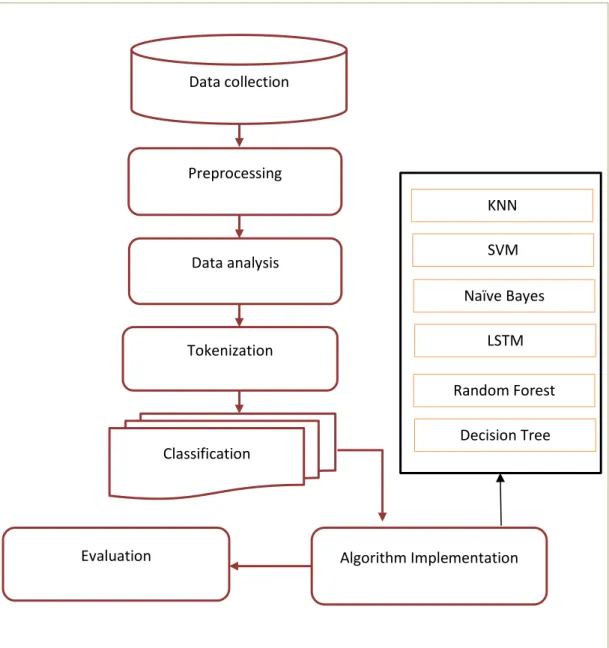
The technique includes five steps in collecting, performing algorithms, validating and implementing the web. Figure 3.1 shows the diagram of our work.
Figure 3.1: Methodology diagram Classification
Data collection
Preprocessing
Data analysis
Tokenization
Algorithm Implementation Evaluation
KNN SVM Naïve Bayes
LSTM Random Forest
Decision Tree
©Daffodil International University 10
3.2 Data Collection
Data gathering is the basic element of every study. Food evaluation is delicate information and is the core of all foodstuffs. We also have to gain a reliable source of our information.
The data of our study are food reviewers' remarks. This has been gathered on numerous websites of food sellers and on Facebook food assessment pages. We collected just Bangla comments as our work for Bangla alone.
3.3 Data Pre-Processing
Data pre-processing is a data mining method that makes raw data an useable and effective format. For the acquisition of knowledge, preprocessing of information is crucial. We have KDD-based functions. Data collection, data massaging, weighting and the same poling as outlined by Kamiran et are the main quatre techniques pre-processing. al.[15]. Our study mostly focuses on data communications techniques to generate useful data sets. We've deleted the terms and superfluous points from Bangla at this level.
3.4 Data Analysis
We have divided the dataset into two categories based on the review prospect (positive and negative). Since algorithms do not grasp string data explicitly. That's why our processed data need to be converted in binary form. We ran the TF-IDF (frequency-inverse frequency) method to achieve this goal.
Wi,j=tfi,j×log(N
dfi) (1)
With the TF-IDF (1) Wi,j is a TF-IDF score. tfi,j is the number of I in j incidents. N implies the number of papers. And dfi shows the number of papers, i.
3.5 Tokenization
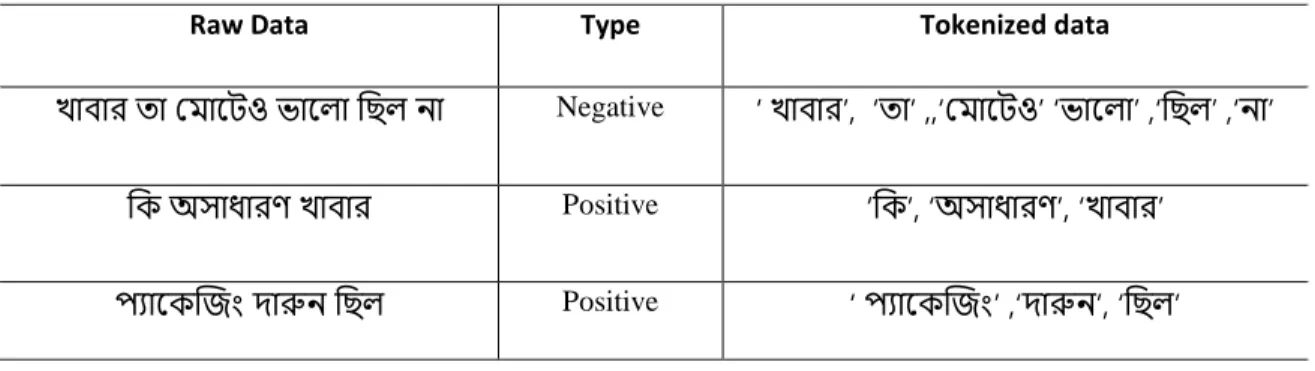
The tokenization in Pinto et. al[16] is defined as a form of distinct phrases of flag, which can be words and signals. Our dataset contains a number of sentences. Instead of a word label, we did not perform our work by sentence mark. Also essential is tokenization. We separate the entire phrase by reference. Tab 3.1 shows the tokenization process.
©Daffodil International University 11 Table 3.1 Tokenization Table
3.6 Classification
We have established two categories of Bangladesh review, which have resulted in our complete data set being categorized into two positively and negatively characterized groups with 0, 1.
Figure. 3.2 shows the whole dataset categorization. It is also stated the proportion of data per class.
Figure 3.2: Classification graph
Raw Data Type Tokenized data
খাবার তা ম াটেও ভাট া ছি না Negative ‘খাবার’, ‘তা’ ,,‘ম াটেও’ ‘ভাট া’ ,‘ছি ’ ,‘না’
ছি অসাধারণ খাবার Positive ‘ছি’, ‘অসাধারণ’, ‘খাবার’
প্যাটিজ িং দারুন ছি Positive ‘প্যাটিজ িং’ ,‘দারুন’, ‘ছি ’
©Daffodil International University 12
3.7 Algorithm Implementation
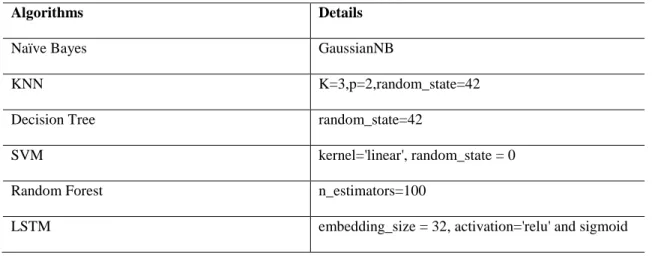
In the use of 30% of the test data after applying five methods indicated in Table 3 we discovered that logistic regression was most effective. 2 displays the settings and the various objects we used to execute the algorithms selected. Other algorithms were equally worthwhile. As Logistic Regression offers the greatest result, we decided to apply it to forecast the feeling of Bangla cuisine reviews.
Table 3.2 Parameter usages
Algorithms Details
Naïve Bayes GaussianNB
KNN K=3,p=2,random_state=42
Decision Tree random_state=42
SVM kernel='linear', random_state = 0
Random Forest n_estimators=100
LSTM embedding_size = 32, activation='relu' and sigmoid
The parameters and the different items we used to implement the selected Algorithms are shown in Table 3.3.
3.8 LSTM implementation
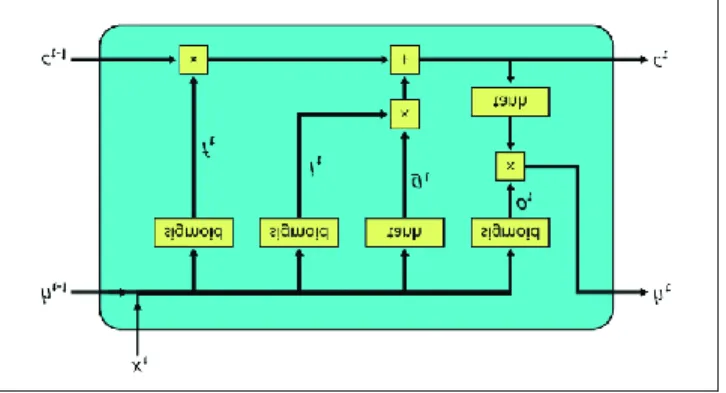
Figure 3.3: Basic LSTM block
©Daffodil International University 13 Long short term memory (LSTM) networks are a form of recurring neural network that may rely on sequence prediction issues to understand order dependency. In complicated problem areas, such as machine translation, speech recognition and others, this is a needed behavior.
LSTM is a complicated field of profound education. It can be difficult to figure how the LSTMs and how bidirectional and sequence-to-sequence terms connect to the field. In this article, the comments of researchers who created the methods and used them to address significant and novel challenges will be used to get understanding into LSTMs.
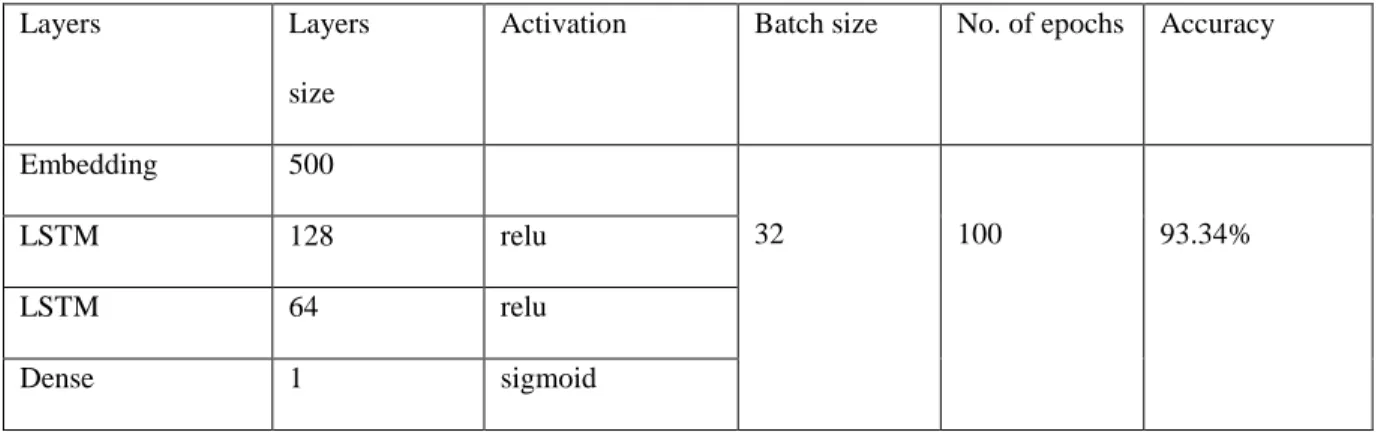
Table 3.3 LSTM implementation.
Layers Layers
size
Activation Batch size No. of epochs Accuracy
Embedding 500
32 100 93.34%
LSTM 128 relu
LSTM 64 relu
Dense 1 sigmoid
3.8.1 Training vs Validation Accuracy of LSTM
Figure 3.4: Training vs validation graph
©Daffodil International University 14 Figure 3.2 represents training vs validation graph of LSTM algorithm. We trained LSTM algorithm over 100 epochs. In figure 3.2 green color represents training accuracy and red color represents validation accuracy. Our training accuracy is near to 100 percent. And highest validation accuracy near 94%. And the difference between training and validation accuracy is very less that means our model produced very less over fit.
3.8.2 Training vs validation Loss of LSTM
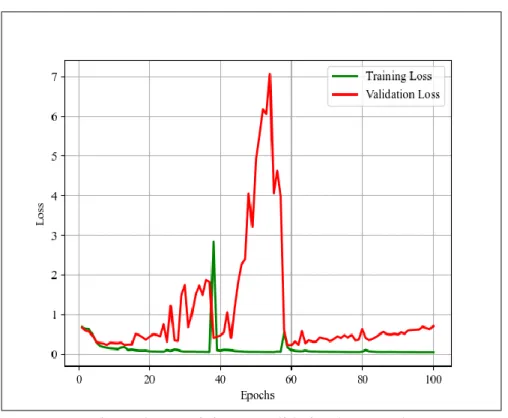
Figure 3.5: Training vs validation loss graph
Figure 3.1 represents training vs validation loss graph. Blue color represents training loss and red color represents validation loss. From this graph we can see that training loss is stable over 100 epochs but validation loss line produced zigzag line this incident represents learning rate is not perfect for this model.
3.9 Evaluation
We have evaluated our selected SVM method utilizing the real-time data estimation and uncertainty matrix. At first we collected 38 actual data that we did not learn from our model.
©Daffodil International University 15 For each of the selected classes various pages of online food sales websites and the Facebook Bangla food reviews have been taken.
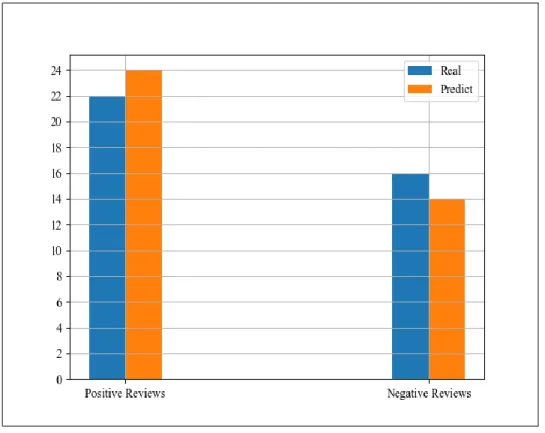
Figure 3.6: Comparison Between Real and Predicted
The actual and expected comparison as seen in Figure 3.3 Our dataset comprises 22 positive reviews and 16 negative reviews which can be found in green bars. The color bar Orange reflects the value expected prediction. For positive reviews our model produced only 2 errors that means 22 was positive but our model predict 24 positive. This is minor error produced by our SVM algorithm.
©Daffodil International University 16 Figure 3.7: Confusion Matrix
Accuracy = 14 + 22
14 + 22 + 2 +0 = 0.94 *100
= 94%
Error = 1 - 0.94 = 0.09*100 = 6%
Recall rate for positive:
22
22+2 = .916*100 = 91.6%
Recall rate for Negative: 14
14+2 = 0.875*100 = 87.5%
To detect overall findings for validation dataset, we employed the confusion matrix. The validation dataset confusion matrix will be displayed in Figure 3.4. 94% of the evaluation procedure is accurate. In addition, our approach is applicable for real and unseen data. The positive rates of recollection are 91.6% and the negative rates of remember are 87.5%. This is not a positive example of positive reviews for our model.
©Daffodil International University 17
CHAPTER 4 RESULT ANALYSIS
4.1 Introduction
This section depends primarily on empirical evidence and test findings in the analytical research. What is the outcome analysis initially when we assess the subject? Without interpretation or evaluation, the repercussions segment should be designed to provide the outcomes. The instructions can also be found under the University Papers section. The results are reported and the test is shown. We have also seen several algorithms and we will clarify which methods in 6 algorithms are superior. As a parameter for the calculation of data, we also picked precision, exactness, reminder and f1.
4.2 Experimental Result
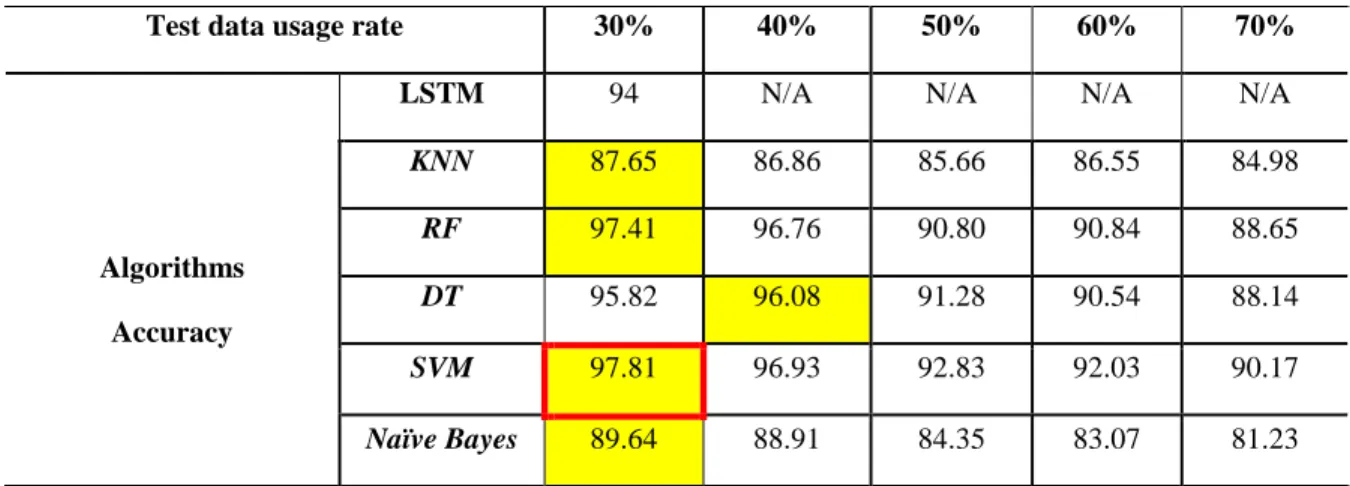
Table 4.1 Accuracy table
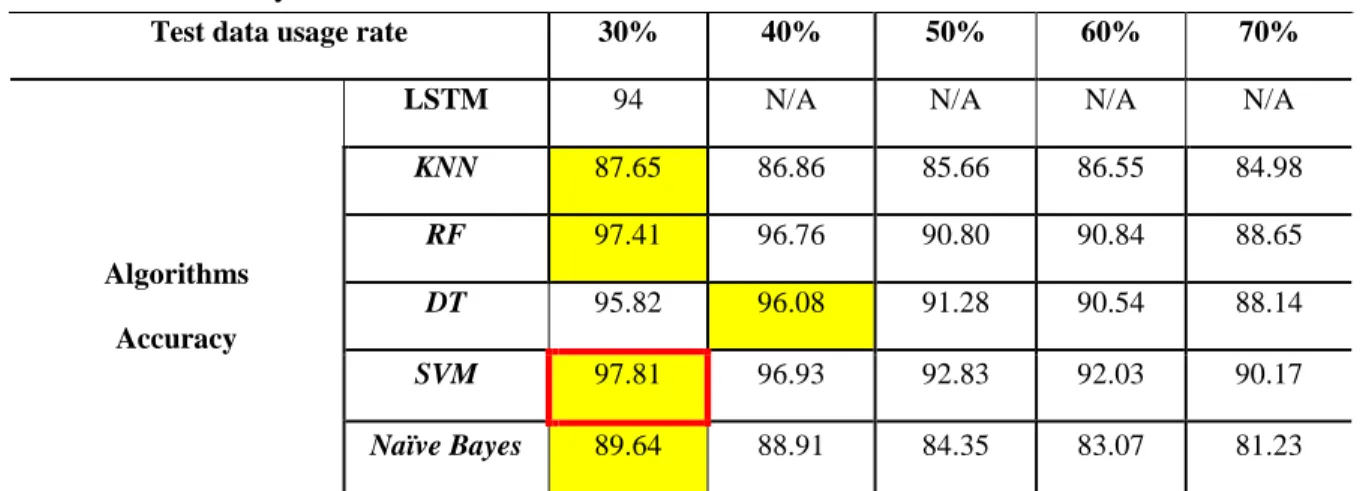
Table 4.1 shows the accuracy table. We utilized 30 to 70 percent test datasets to find out what is best. Yellow boxes represent the greatest accuracy of the test 30% for each algorithm. As observed in this table, most algorithms, except from Decision Tree algorithms, are best performed under 30 percent of the test outcomes. 96.08% of the Decision Tree use 40% test data. Using 30% of test information, the best accuracy is achieved with the SVM method, and accuracy is 97.81%.
Table 4.2 Different Score Matrix
Test data usage rate 30% 40% 50% 60% 70%
LSTM 94 N/A N/A N/A N/A
Algorithms Accuracy
KNN 87.65 86.86 85.66 86.55 84.98
RF 97.41 96.76 90.80 90.84 88.65
DT 95.82 96.08 91.28 90.54 88.14
SVM 97.81 96.93 92.83 92.03 90.17
Naïve Bayes 89.64 88.91 84.35 83.07 81.23
©Daffodil International University 18 Score
Matrix
Algorithms
KNN Naïve Bayes Decision tree SVM Random Forest
F1 Score 0.894 0.906 0.9611 0.9813 0.9750
Recall 0.891 0.857 0.966 0.9796 0.9632
Precision 0.897 0.961 0.956 0.9829 0.9574
Specficity 0.847 0.825 0.951 0.9713 0.9898
Table 4.2 shows the score matrix. We evaluated the score matrix for only 30 percent test data.
As the precision table indicate only precision based on genuine positive and true negatives, other qualities such as genuine negative, false positive, true positive, and false negative have been attempted to certify accuracy. The SVM's best accuracy check was carried out in all dimensions, i.e. F1 score, reminder, accuracy and specificity. Consequently, we picked SVM as the prediction method for this study.
4.2.1 KNN
The most popular machine study algorithm is this easy to use algorithm and suboptimum. [17]
The KNN method, which is easy to use and suboptimal. The most common master learning algorithm. The all parameter scores are shown in Figure 4.1. For the KNN model, we had a precision rate of 87% while the data rate was 30%. The KNN algorithm has no plan other than to save the complete data collection known as the training dataset. Data can be retained by many methods, however the most common KNN data structure is the k-d trees. It allows to rapidly and effectively look at and balance the latest trends.
©Daffodil International University 19 Figure 4.1 Different Score comparison graph of KNN
4.2.2 Decision Tree
Decision tree is a greedy method which uses local data to appropriately split every node. One of the consequences is that the divisional variables can modify a stronger tree. Trees are highly flexible and known to be minimal in their interactions. The disadvantage is that the tone, the high variance mentioned, understands the outcomes. Strong disparities also help to overfit with excessively optimistic tree predictions. The Decision Tree includes a complex dataset with excellent outcomes. [18] One outcome is that the divisional factors can be modified to produce a stronger tree. In their interactions, trees are highly versatile, called low distortion. The drawback is that the outcomes are learning the tone known as high variance. High fluctuations also help to overfit, with excessively optimistic assumptions from the tree. Figure 4.2 shows a maximum precision of 96% and a precision rate of 0.95% of decision tree algorithms.
0.87 0.89 0.9 0.89 0.84
H I G H E S T A C C C U R A C Y
F 1 S C O R E P R E C I S I O N R E C A L L S P E C I F I C I T Y
KNN Agorithm
©Daffodil International University 20 Figure 4.2: Different Score comparison graph of Decision Tree.
4.2.3 SVM
"Support Vector Machine" (SVM) is a master training approach which can be both utilized for regression and classification. However, it is mostly seen in issues of categorization. Every data object is identified in the N-dimensional SVM algorithm with the value of a fundamental teamwork as a point. Then we classify the plane which makes a very good distinction between the two groups.
Figure 4.3 Support Vector
0.96 0.96 0.95 0.96 0.84
H I G H E S T A C C C U R A C Y
F 1 S C O R E P R E C I S I O N R E C A L L S P E C I F I C I T Y
Decision Tree Agorithm
©Daffodil International University 21 The aid vectors are basically independent co-ordinates of observation Figure4.3. SVM is a border which most separates the two groups.
Figure 4.4: Different Score comparison graph of SVM
We have seen the best SVM algorithm performance. 97 percent were the greatest accuracy, with other results close to accuracy. Figure 4.4 illustrates all the scoring matrix
4.2.4 Random Forest
Random forest is a flexible algorithm that is readily employed and generates remarkable success most of the time, even without the usage of hyper parameters.
It is also a popular algorithm since it is easy and varied (it can be used for both classification and regression tasks). In this post we will learn how the RFAl works, what changes and how different algorithms are employed. It builds "forests,"
usually trained in "sacking," with decision-making tree. The fundamental premise of the box method is that a mix of learning models improves the end outcome.
Both the classification and regression tasks may be utilized for random forests.
0.97 0.98 0.98 0.97 0.97
H I G H E S T A C C C U R A C Y
F 1 S C O R E P R E C I S I O N R E C A L L S P E C I F I C I T Y
SVM Agorithm
©Daffodil International University 22
Random forests are 96% precise and 0.95 accurate as seen in figure 4.5 in our classification test.
Figure 4.5: Random Forest Score Comparison
4.2.4 Naïve Bayes
An method which employs Bayes theory for classifying things, is a naïve Bayes classifier.
Naive Baye classifiers presume that data points characteristics are strongly or naively independent. Spam filters, text analysis and medical diagnosis are common uses of naive Bayes classifiers. These classifiers are used extensively for machine learning, because they are easy to use. Naive Bayes is a model for machine learning used for big data volumes, even if the method you suggest is Naive Bays with data containing millions of data records. In terms of NLP tasks like sensational analysis, this produces extremely good results. The classification algorithm is fast and simple. Figure 4.6 represents the different score comparison of naïve Bayes algorithm. The highest accuracy of this algorithm is 89%. Precision rate also 0.89.
0.96 0.97 0.95 0.96 0.98
H I G H E S T A C C C U R A C Y
F 1 S C O R E P R E C I S I O N R E C A L L S P E C I F I C I T Y
Random Forest Agorithm
©Daffodil International University 23 Figure 4.6: Different Score comparison graph of Naïve Bayes algorithm
0.89 0.9 0.89 0.85 0.84
H I G H E S T A C C C U R A C Y
F 1 S C O R E P R E C I S I O N R E C A L L S P E C I F I C I T Y
Naïve Bayes
©Daffodil International University 24
CHAPTER 5
SUMMARY, CONCLUSION AND FUTURE WORK
5.1 Summary of the Study
Much research has been done on machine learning, although in Bangladesh the amount of study is extremely restricted. While predictive style work is prevalent in computer education, this is not yet known. In recent years, this type of study has changed dramatically in our machine life as a result of these works. For the benefit of this type of study we have some intriguing real-life applications. However, not much study is being done in the subject of the Bangladesh economy. However, we hope that other scholars from several nations have conducted study in this area.
5.2 Conclusion
With over 1600 aggregate data, we assessed restaurant reviews in Bangladesh. Further evaluation of the data reveals that our approach may properly recognize the correct feeling or remarks of Bangladeshi reviews. In select few popular methods of classification, the Naive Bayes KNN decision tree. SVM has done remarkably with 97% accuracy. Our suggested approach will reduce customers price while purchasing online, given the good and negative feedback ratio between past customers of the food inspection system. It might also help the vendor to detect food problems and provide consumers better services.
5.3 Limitation
There is much of work on NLP in English and numerous automated techniques, and some procedures or approaches are used by robotic systems. But in Bangladesh, NLP is extremely little. In our study we simply apply the Bangladesh machine teaching algorithm.
However, when we assess it, we find that there are many banglish comments on the various food webpages. We did not train this kind of language in our algorithm, though. So the Banglish language cannot be found in our system. And this is the primary constraint of our job.
©Daffodil International University 25
5.4 Recommendations
There are a few remarkable suggestions for this:
❖ Improving the dependability of data gathering to produce better study outcomes.
❖ The amount of data is much lower in this work. Data must be at least 3 million in order to obtain a better outcome.
❖ It would be better if Deep Learning is used for review analysis.
5.5 Future Work
The future guidance on the development of this work is given bellow:
❏ We want to explore in Bangladesh the feeling of sarcastic comment.
❏ In the presence of sarcasm, the emotion conveyed in the summary part appears normal. Sarcasm on a computer isn't simple to predict, therefore this remark has a different sensation in a particular examination. In the future, we are thus developing a system which can also recognize phrases of sarcastic kind.
❏ We are presently working on a web-based API to describe the analytical feelings to do this.
❏ We carried out our job with an algorithm of machine learning. In the near future we will develop a deep learning intelligence system.
❏ We exclusively work on Bangladesh phrases. However, the client also comments Banglish. In the near future, we will also be training Banglish sentence to recognize Banglish remark from our system.
©Daffodil International University 26
REFERENCE
[1] https://www.dhakatribune.com/business/2019/05/26/meteoric-rise-of-online-food- business [2] https://www.thedailystar.net/business/foodpanda-bd-pathao-online-food-delivery-services-getting-
popular-1714402
[3] O. Sharif, M. M. Hoque, and E. Hossain, "Sentiment Analysis of Bengali Texts on Online Restaurant Reviews Using Multinomial Naïve Bayes," in 2019 1st International Conference on Advances in Science, Engineering and Robotics Technology (ICASERT), 2019, pp. 1-6: IEEE.
[4] V. Ramanathan and T. Meyyappan, "Twitter text mining for sentiment analysis on people’s feedback about oman tourism," in 2019 4th MEC International Conference on Big Data and Smart City (ICBDSC), 2019, pp. 1-5: IEEE.
[5] N. Banik and M. H. H. Rahman, "Evaluation of naïve bayes and support vector machines on bangla textual movie reviews," in 2018
[6] International Conference on Bangla Speech and Language Processing (ICBSLP), 2018, pp. 1-6: IEEE.
[7] N. I. Tripto and M. E. Ali, "Detecting multilabel sentiment and emotions from bangla youtube comments," in 2018 International Conference on Bangla Speech and Language Processing (ICBSLP), 2018, pp. 1-6: IEEE.
[8] L. Nahar, Z. Sultana, N. Jahan, and U. Jannat, "Filtering Bengali Political and Sports News of Social Media from Textual Information," in 2019 1st International Conference on Advances in Science, Engineering and Robotics Technology (ICASERT), 2019, pp. 1-6: IEEE.
[9] M. Rahman and E. Kumar Dey, “Datasets for Aspect-Based Sentiment Analysis in Bangla and Its Baseline Evaluation,” Data, vol. 3, no. 2, p. 15, May 2018.
[10] N. Mittal, B. Agarwal, G. Chouhan, N. Bania, and P. Pareek, "Sentiment analysis of hindi reviews based on negation and discourse relation," in Proceedings of the 11th Workshop on Asian Language Resources, 2013, pp. 45-50.
[11] S. Chowdhury and W. Chowdhury, "Performing sentiment analysis in Bangla microblog posts," 2014 International Conference on Informatics, Electronics & Vision (ICIEV), Dha-ka, Bangladesh, 2014, pp.
1-6, doi: 10.1109/ICIEV.2014.6850712
[12] M. H. Alam, M. Rahoman and M. A. K. Azad, "Sentiment analysis for Bangla sentences us-ing convolutional neural network," 2017 20th International Conference of Computer and In-formation Technology (ICCIT), Dhaka, Bangladesh, 2017, pp. 1-6, doi: 10.1109/ICCITECHN.2017.8281840.
©Daffodil International University 27 [13] C. Chauhan and S. Sehgal, "Sentiment analysis on product reviews," 2017 International Conference on Computing, Communication and Automation (ICCCA), Greater Noida, In-dia, 2017, pp. 26-31, doi:
10.1109/CCAA.2017.8229825.
[14] R. A. Tuhin, B. K. Paul, F. Nawrine, M. Akter and A. K. Das, "An Automated System of Sentiment Analysis from Bangla Text using Supervised Learning Techniques," 2019 IEEE 4th International Conference on Computer and Communication Systems (ICCCS), Singa-pore, 2019, pp. 360-364, doi:
10.1109/CCOMS.2019.8821658.
[15] Kamiran, F., Calders, T. Data preprocessing techniques for classification without discrimina-tion. Knowl Inf Syst 33, 1–33 (2012). https://doi.org/10.1007/s10115-011-0463-8
[16] A. Pinto, H. Gonçalo Oliveira, and A. Oliveira Alves, "Comparing the performance of dif-ferent NLP toolkits in formal and social media text," in 5th Symposium on Languages, Ap-plications and Technologies (SLATE'16), 2016: Schloss Dagstuhl-Leibniz-Zentrum fuer In-formatik.
[17] J. M. Keller, M. R. Gray, J. A. J. I. t. o. s. Givens, man,, and cybernetics, "A fuzzy k-nearest neighbor algorithm," no. 4, pp. 580-585, 1985.
[18] S. R. Safavian, D. J. I. t. o. s. Landgrebe, man,, and cybernetics, "A survey of decision tree classifier methodology," vol. 21, no. 3, pp. 660-674, 1991.
©Daffodil International University 28
APPENDIX
The first was to describe the methods for the analysis we faced with so many challenges.
The first one was the report. In addition, nothing was achieved in this area before. In fact.
It wasn't traditional work. Our supervisor helps us when we fetch any problem. Another obstacle was the gathering of data, which was a massive challenge for us. We could not find an open source Bangla text pre-processing tool, so we developed a data collection corpus. We have started to collect data manually. In addition, it is another challenge to classify the different posts. After a long period of hard working, we could do it.
©Daffodil International University 29