A project report submitted to the Department of Civil Engineering, Khulna University of Engineering and Technology (KUET), Khulna, Bangladesh partially fulfilled the requirements for the degree. The author sincerely thanks all the respected professors of the Department of Civil Engineering for their cordial cooperation in the successful completion of this project work at all stages. KUET and all the employees of Civil Engineering Department for their valuable help in making the project work successfully.
The operation and maintenance of the developed treatment unit is simpler and more user-friendly. It was observed that the clogging of the unit did not occur more than eight months of its successful operation. 4.1 .5 Total Dissolved Solids and Total Solids Removal Efficiency 34 4.1.6 Performance Study of the Developed Treatment Unit 35.
Chapter One
Introduction
- General
- Objectives of the Project Work
- Scope of the Study
- Organization of the Project Paper
Thousands of pond sand filters (PSF) in the southwest of the country are out of use due to lack of maintenance. Most people in that region use pond and river water for drinking without any treatment. Most rural residents are illiterate and they have developed the habit of drinking water from hand hoses over the past thirty years.
To study the performance of the laboratory developed unit for some selected water quality parameters. Detailed laboratory analysis, model tests and evaluation of the removal efficiency of bacteria, color and turbidity with synthetic raw water. This project document presents the detailed analysis, results and findings of the study in five chapters and appendices as shown below.
Literature Review
- Available sources of water in Bangladesh .1 General
- Surface water
- Ground water
- Rainwater
- Criteria for Selection of Suitable Water Purification Technology
- Criteria for Water source selection
- Water quality selection
- Requisite of Different Filter
- Slow Sand Filter
- Rapid Sand Filter
Cost: Most of the people in our country live in villages and are not financially solvent. The choice of the source determines the reliability of the adequacy and the quality of the water supply. Whenever possible, the highest quality raw water source economically available should be selected, provided its capacity is sufficient to meet the water supply needs of the community.
The effects of some of the impurities on water and human health cannot be ignored. Some of the water quality parameters respond to the human senses of sight (turbidity, color), taste (saltiness, offensive) and smell (odor). Kibret (1986) has shown that the dry filter is one of the alternatives that can be applied for iron removal and the process uses the self-cleaning capacities of iron bacteria.
Pilot plant research has shown that the iron removal process by dry filtration depends on the hydraulic load, filter depth, filter material size, microorganism development and raw water iron concentration. However, complete iron removal with a dry filter is feasible if the best possible favorable combinations of factors on which iron removal depends are found. The flow is initiated by opening a valve located slightly above the bottom of the upper bucket to prevent the flow of settled mud into the lower bucket.
The floc formation is caused by the hydraulic gradient of the rotating water in the tank. The iron content of the iron coated sand was found to be 25 mglg sand. In general, slow sand filters have filtration rates of up to 0.4 mlhr. The low filtration rate causes long retention times of the water above the sand and within the sand bed.
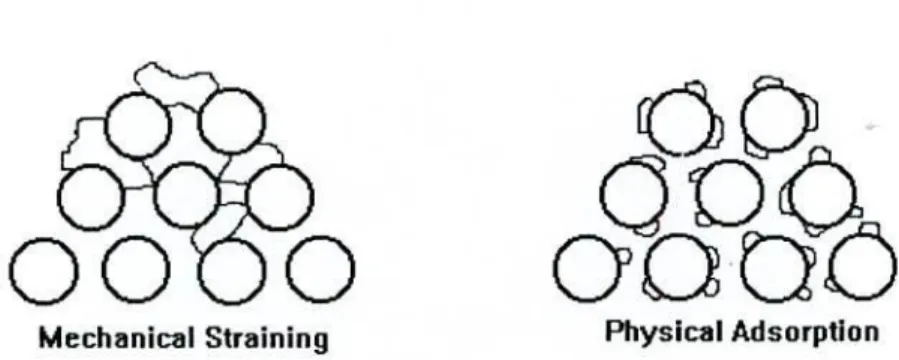
Slow sand filters work by forming a gelatinous layer (or bioflim), called the hypogeal layer or Schmutzdecke, in the top few millimeters of the fine sand layer. Water fills the pores of the filter medium and the impurities are adsorbed to the surface of the granules or trapped in the openings.” (Culp, page 91). The main difference with slow sand filtration is the fact that biological filtration is not part of the purification process in fast filtration.
Chapter Three
- Selected processes for the treatment Unit
- Design Criteria of the Treatment Unit
- Materials used for developing the Treatment Unit
- Functions of the Materials
- Dimension of the Filter Unit for Laboratory Study
- Specifications for the treatment unit
- Operation and Maintenance
The construction cost of the filter unit must be within the affordable limits of the users. The materials and equipment required for the development of the household surface water treatment unit were-. During that time, the removal efficiency of the filter increases as the biological layer grows [Ref 15].
Turbidity, or the amount of suspended particles in the water, is also a key factor in the function of the filter. It should be relatively free of suspended particles to prevent premature fouling of the filter. If the flow rate is too slow, there will be an insufficient amount of treated water available from the filter to meet the needs of the users.
Correct construction and correct operation of the filter will result in a constant water level over the break periods. Changes in the water depth above the sand surface will cause a change in the biological zone that interferes with the effectiveness of the filter. As the water depth increases, the oxidation and metabolism of the microorganisms in the biological zone decreases.
Proper operation of the filter requires a constant water level approximately 5 cm (2") above the surface of the slow sand during pause periods. This is necessary to prevent disturbance of the sand surface when raw water is poured into the filter. A wooden diffuser plate was used in the first column. to protect the surface of the sand from rubbing.
Over time, continuous use of the filter causes the pores between the sand grains to become clogged with debris.
Laboratory Tests and Analysis
Laboratory Tests and Analysis using Pond Water .1 General
- Micro-organism (TC & FC) Removal Efficiency
- Variation of pH of the Treatment Unit
- Removal Efficiency of Turbidity and Color
- Total Dissolved Solids and Total Solids Removal Efficiency
- Performance Study of the Developed Treatment Unit
- Reserve Filtered Water Quality Test
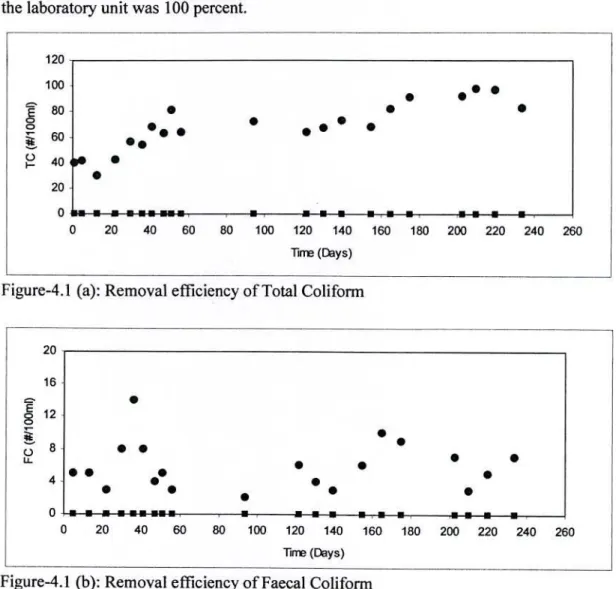
During the bacteriological test, a small number of faecal coliform bacteria was observed in the synthesis raw water of approx. 5 pieces. The pH value of synthesis raw water was gradually increasing in nature after passing through the filtration media of the treatment unit. This may be due to the presence of some calcium substances in the sand grain in the fast and slow sand filter beds inside the first and second columns, respectively.
The minor change in pH of the synthesis raw and treated water of the laboratory unit in Figure 4.1 (c) indicates a pH increase of about 3% after filtration. Clear and sparkling treated water was found in the developed treatment unit, although the synthetic raw water had high color and turbidity values. After treatment, the results showed that the average value of color and turbidity of the treated water was within 7 pt-co units and 1.5 NTU respectively.
Thus, the color and turbidity removal efficiency of the laboratory unit was found to be sufficient and it was more than 90. The color and turbidity removal efficiency of the treatment unit are shown in Figure 4.1(d) and Figure 4.1(e), respectively. It can be seen from Figure 4.1 (f) and Figure 4.1 (g) below that the amount of total dissolved solids and total solids in the synthesis raw water was within the acceptable limit.
These give the microorganisms in the biological layer time to consume the pathogens in the water, increasing the hydraulic conductivity of the filter. If the pause period is extended too long, it will result in a marked reduction in the removal efficiency of the filter. Because the main issues regarding the prospects for the technologies and for sustainable use are the risk of bacteriological contamination and the acceptability of the technologies for potential users [Ref 19].
Thus, it could be concluded that the filtered water should not be stored after a week for better operation of the unit and also to ensure safe drinking water quality.
Filtration Rate Analysis
After observing the successful treatment capacity with the calculated filtration rate, the pond water was changed to river water to study the performance of the unit considering the worst case condition. The study of the treatment unit using river water is in progress to find out the total life of the unit before it becomes clogged.
Laboratory Tests and Analysis using River Water .1 General
- Bacteriological quality Test (TC & FC Removal)
- Color and Turbidity Removal Efficiency
- Variation of pH and Dissolved Oxygen
- Performance study of the Treatment unit using River Water
It was found from the results that the turbidity and color value of filtered water were reduced by 98% and 97% respectively after passing through the treatment unit. Dissolved oxygen levels in the treatment unit indicated that aerobic conditions prevailed throughout the laboratory unit's treatment operations. It was observed that the treated water in the unit always showed a value greater than almost 6 mg/l.
The observed pH value of the purified water of the laboratory unit was always below 8.5. A developed study of a surface water treatment unit in the laboratory using river water is in progress.
Engineering Significance and Economic aspect
The cost of all other locally available materials used to make the unit is Tk. After plugging both columns, the unit bed materials could be replaced with new materials. The available domestic technologies for the treatment of contaminated groundwater in the country are divided into types of arsenic and iron removal.
It was noted that these removal technologies have improved significantly over the past few years, but reliable, cost-effective and sustainable treatment technologies have yet to be identified and further developed to meet the requirements [Ref 05]. The main issues related to the prospects for the technologies and for sustainable use are the risk of bacteriological contamination and the acceptability of the technologies to future users [Ref 19]. The good achievement for the developed domestic surface water treatment filter unit is that the treated water produced in the unit is completely free from bacteriological contamination.
Thus, from an engineering point of view, it could be concluded that the developed unit is a cost-effective, sustainable and user-friendly processing unit. For customers who rely on private surface water sources for household use, the developed unit can be an effective choice for purifying water for their domestic purposes.
Conclusion and Recommendation
- Conclusion
- Recommendation for future work
- Sutherland et al, (2001) A rapid assessment of nine household level arsenic removal technologies in Bangladesh
- UNICEF report 1988
- UNICEF report 1998
The treated water always had the color value less than 15 pt-co unit and turbidity value less than 2.3 NTU for both pond and river water. The level of dissolved oxygen in the treated river water from treatment processes showed that aerobic conditions prevailed throughout the treatment operations. Based on the performance study of the developed treatment unit, the following recommendations can be made for future work:.
To study the performance of the developed unit on a mass scale under different surface water quality conditions.
Elaborated Recommendations
Line joint graphical representation of different water quality parameter