B.Sc. in Mechanical Engineering Thesis
Fabrication of A Waste Water Treatment Plant
SUBMITTED BY
Capt Md Shafiqul Islam 201118001 Lt Sk Md Omar Faruq 201118006 Lt Md Billal Hossain 201118010
SUPERVISED BY
Brig Gen Md Lutfor Rahman Head of the Department
Department of Mechanical Engineering MIST
Department of Mechanical Engineering
Military Institute of Science and Technology
(MIST)
CERTIFICATION
This thesis paper titled “Fabrication of a waste water treatment plant”, submitted by the group as mentioned below has been accepted as satisfactory in partial fulfillment of the requirements for the degree B.Sc. in Mechanical Engineering in December 2014.
Group Members:
Capt Md Shafiqul Islam
Lt Sk Md Omar Faruq
Lt Md Billal Hossain
Supervisor:
---
Brig Gen Md Lutfor Rahman Head of the Department
Department of Mechanical Engineering MIST
CANDIDATES’ DECLARATION
This is to certify that the work presented in this thesis paper, titled, “Fabrication of a Waste water treatment plant”, is the outcome of the investigation and research carried out by the following students under the supervision of, Brig Gen Md Lutfor Rahman Head of the Department, Mechanical Engineering Dept. MIST
It is also declared that neither this thesis paper nor any part thereof has been submitted anywhere else for the award of any degree, diploma or other qualifications.
Capt Md Shafiqul Islam 201118001
Lt Sk Md Omar Faruq 201118006
Lt Md Billal Hossain 201118010
3
ACKNOWLEDGEMENT
We are thankful to Almighty Allah for his blessings for the successful completion of our thesis. Our heartiest gratitude, profound indebtedness and deep respect go to our supervisor, Brig Gen Md Lutfor Rahman Head of the Department, Mechanical Engineering Dept. MIST, for his constant supervision, affectionate guidance and great encouragement and motivation. His keen interest on the topic and valuable advices throughout the study was of great help in completing thesis.
We are especially grateful to the Department of Mechanical Engineering (ME) of Military Institute of Science and Technology (MIST) for providing their all out support during the thesis work.
Finally, we would like to thank our families and our course mates for their appreciable assistance, patience and suggestions during the course of our thesis.
Dhaka Capt Md Shafiqul Islam
December 2014 Lt Sk Md Omar Faruq
Lt Md Billal Hossain
ABSTRACT
About one-fifth of people on earth lack the access to safe drinking water, a condition that resulted in the death of 2.2 million people in 2004, as per the records of United Nations. Clean water use being a prime concern in many communities of developing countries. Contaminated water plays significant role in taking numerous lives in these localities, for which a number of efforts are being made for accessing safe purified drinking water. Fortunately, efficient and cheap water purification systems are being utilized and being tried to be accessed worldwide for easy access to clean water.
In the following project we have tried to develop a “Fabrication of A Waste Water Treatment Plant” using the basic ideas of Slow Sand Filter, some locally available filter material like sand, bone char, crashed stone, modified sand, clay, ziolite and try to improve the methodology using Activated Carbon Filter and Micro filter mechanism. Main focus was removal of iron from surface water or waste water in industries by adsorption and oxidation followed by precipitation technique. Among all the adsorption media used, modified sand proved to be a good adsorbent in removal of iron and other particle.
Three in number stainless steel tank with locally collected sand and crashed stone was prepared which also proved to be effective for removal of turbidity, but may be due to rigorous use of the filter or any manufacturing defect, there were cracks developed on its surface So we need to be very careful while using this plant.
5
CONTENT
Chapter no.
Title
Page no.
Cover page 1
Certification 2
Candidates’ Deceleration 3
Acknowledgement 4
Abstract 5
Content 6,7i List of Fig, List of Table 7ii
1. Introduction 8
1.1 General 9
1.2 Objective 10
2. Literature review 12
2.1 History of water treatment plant 13
3. Waste water 17
3.1 Waste water constituents 18
3.2 Wastewater quality indicators 18
3.3 Waste water Treatment 19
3.4 Industrial Waste Treatment 20
3.5 Surface water treatment 20
4. Waste water treatment plant 22
4.1 Treatment process 23
a) Primary process 23
b) Secondary process 23
c) Tertiary process 23
5. Sand based water treatment plant 24
5.1 Slow sand & Rapid sand water treatment plant 25
6. Model development 27
6.1 Water treatment plant Model Development 28
7. Methodology & Material used 29
7.1 Method of working 30
7.2 Material and equipment used 30
a) Crashed stone 30
b) Plain sand 31
Requirements for sand 32
Preparation 32
c) Ziolite 33
Properties and occurrence 34
d) Stainless Steel cylindrical tube 36
Type of water treatment plant design Construction of Sintered Material Features & Benefits
e) pump 38
f) Pipe 39
g) Gate valve 40
h) Pressure gauge 40
i) Micro filter 41
j) Basement 42
k) Internal arrangement 43
8. Our Project 44
8.1 Working principle 45
8.2 Flow rate 47
8.3 Turbidity 48
8.4 Effectiveness 48
8.5 Physical observations 49
9. Result 50
9.1 Result obtained from treatment plant 51
10. Standard of drinking water 52
10.1 Drinking water quality standard 53
10.2 Range of standard 54
10.3 Parametric value 54
10.4 Australian standard 54
10.5 European standard 54
10.6 United States standards 55
10.7 World Health Organization guidelines 56
10.8 Comparison of parametric values 57
11. Cost Analysis 58
11.1 Cost of the waste water treatment plant 59
12. Discussion, Problems & Further Analysis 60
12.1 Drawbacks 61
12.2 Difficulties 61
12.3 Recent Developments 62
12.4 Further implementation of waste water plant 62
13 Conclusion 63
Reference 65
List of Figures
Fig no. Fig Name Page no.
Figure 1 Surface Water Treatment process 21
Figure 2 Primary treatment 23
Figure 3 Secondary treatment 23
Figure 4 Water treatment plant model 28
Figure 5 Crashed stone 30
Figure 6 Plain sand 30
Figure 7 Ziolite 34 Figure 8 Stainless steel cylindrical tank 36
Figure 9 Pump 38 Figure 10 Pipe used in the project 39
Figure 11 Gate valve 40
Figure 12 Pressure gauge 40 Figure 13 Micro filter 42
Figure 14 Basement 43
Figure 15 Internal arrangement 43 Figure 16 Working cycle of the plant 46 LIST OF TABLE Table no. Table Name Page no. Table 1: Typical treatment performance Of conventional water treatment plant ……… 16
Table 2: Typical differences between slow sand Purification plant and rapid sand purification plant. ………26
Table 3: Efficiency measuring………51
Table4: Measured Mineral Composition ……… 51
Table5: Cost analysis ………59
Chapter – 01
Introduction
8
1.1 General:
Purified water is essential for living a healthy life as such everyone should have access to it.
Drinking water conditions have great impacts on people’s everyday life, especially in the rural and remote areas where access to safe drinking water is very crucial. Surface water often is the only source, thus water contaminations are difficult to avoid due to rigorous and reckless use of surface water. Most of the people in third world countries do not have easy access to clean drinking water. While safe drinking water is essential for living, lack of access has resulted in many water related diseases.
Unsafe drinking water may result in fatal diseases. Statistics shows that these diseases resulted in ninety percent of all deaths of children under five years old in developing countries, due to low immunization of children to infections.
Despite of fulfillment of requirement of drinking water standards, the municipal water in used in developing countries is being improved and cost efficient water filtration techniques are being developed commonly used to improve taste or to eliminate any undesired matters. Various types of filters have been designed to be more suitable for the rural areas of the countries, but the cost as well as the filter effectiveness is still not satisfactory and further improvement is still required.
Drinking water is being the biggest issue nowadays in Bangladesh. Most of the people in the rural areas are not able enough to use water filters or buy mineral water bottles. To overcome this problem many efforts have been done due to which cleaning water may become an affordable Commodity. Every house hold should be able to develop its own drinking water purification system; this should be the aim of development of any low cost water purification technique. In this context a number of contributions that has been made where the filter media varies from a layer of simple cotton cloth to composite nano materials. Some of the typically used water Purification methods in Bangladesh have been discussed here.
In some of the village, women use cotton cloth layers for water filtration. This method is cheap, cost effective in removal of sediments or any suspended solids, but may be not completely suitable for drinking purpose. Some places people are using simple plastic bottles with open end, inside which a layer of bone char followed by a layer of sand and a layer of pebble on both sides of the bone char layer is being used through which water will be passed for filtration. This kind of filtration process is capable of removing sediment and microbes effectively from water.
Solar distillation and solar sterilization are the recent but convenient technologies developed as a low cost water purification process. In this process water filled clean plastic bottles are left in sun for several hours so that the UV radiation and the heat generated will be able to kill the microbes Present in water causing many water borne diseases. Now these methods are improvised by
using thermal indicators inside the bottle letting the users know when it will be safe to drink the
water. But despite of being cheap and effective, this method is a function of availability of solar light. So maybe not abundantly used in water purification process. In comparison with solar sterilization, the solar distillation technique is even capable of purifying muddy water or salty water through the process of evaporation and condensation.
Among widely used naturally occurring adsorption media, bamboo charcoal provided with base gravel layer also is very effective in purifying water with the advantages of being low cost, environment friendly and requires minimum maintenance. Activated carbon, silver beds, charcoal, sand is being widely used in portable filters for disinfection and filtration of water.
Bone char is proved to be very efficient in removing heavy metal ions from water, the excess amount of which can cause many fatal renal and cardiac diseases and high blood pressure.
Stainless steel filters provided with sand, ziolite, micro filter in the shape of pots are very much efficient in microfiltration which removes suspended solids and microbes to great extents. The main disadvantage is for small house hold purpose where pressure filtration is not an option; it has to be used for gravity filtration and thus the rate of filtration will be very much less and the filter requires continuous maintenance.
Recently IITM has developed an effective low cost water purification model specifically meant for rural areas which uses a cheap plastic mesh which is capable of removing 98 percent of impurities from water including pathogens. The cost of the filter is somewhat taka 900 to 1000 and very easy for reuse. Another recent development of IITM is development of composite nano material used as a filter media which capable of removing toxic metal ions as well as killing the pathogens. The filter is worth rupees taka 500 excluding the cartridge. Another attractive feature of this filter media is that the cartridge can be reused by simply boiling in water or rubbing with lemon juice which is easily available in common households.
Ultimate aim of the development of our water purification plant model should be operate with minimum energy, minimum maintenance, cost effective, environment friendly, Implementable with ease and can be developed from local artisans. This will subsequently inspire the people to put hygiene in to habit and of course will help in the social and economic growth of the country.
1.2 Objective:
The scope of this project is to study the existing water filtration methods, and use the knowledge to design a wastewater treatment plant. This water purification system will focus on Cutting down the cost while maintaining filters effectiveness. By providing affordable water purifier for the rural and remote areas, military purpose in UN mission, flood effected area etc. It will greatly improve people’s quality of living, and reduce the risk of any waterborne diseases therefore saving lives.
10
The basic objectives of the project are as follows:
This purpose of this study was to investigate the effectiveness and the performance of the Sand base waste water treatment plant in Bangladesh.
This water filtration system will include a water filtering components with three cylindrical containers, a jar to hold clean water and a valve for easy access of water.
Manufacturing facility arrangement will also be examined and planned
Removal of iron from water by using different adsorption media which are locally available at a low cost
Development of a steal body water purification plant and studying the efficiency of removal of turbidity
Designing a simple household setup for water purification focusing on removal of iron and turbidity
Cost estimation of all the adsorption media used as well.
Analysis of filtration effectiveness in removal of iron for different purification media.
The water filtration system is designed to provide safe drinking water for households of 20 to 25 people per hour.
Target manufacturing cost is around 25 K.
Use of simple technology and readily available materials are the prime consideration needed to insure production of the filters in the local area.
Water samples are analyzed at a licensed laboratory to demonstrate the effectiveness of the filter design.
Chapter- 2
Literature Review
2.1 History of waste water treatment plant
Waste water purification system by sand have filtration rates of 10m/h. Slow sand plants have been used to deliver portable water to the public since the early nineteenth century. The first recognized use of slow sand filtration for water supply was in Paisley, Scotland in 1804 when John Gibbs set up an experimental slow sand filter to supply his bleachery and sold excess treated water to the townspeople.
By 1852 the health advantages of filtered water were so evident that the Metropolis Water Act required all Thames River water to be filtered before use by Londoners. The 1854 Broad Street cholera outbreak further reinforced the need to filter public supply. Since then slow sand filters have been adopted by many major European cities including London, Amsterdam and Zurich for potable water treatment and are still in use today as a secondary filtration step (Baker, 1981).
The development of slow sand filtration in the United States, in contrast with the European experience, was slow (Logsdon and Fox, 1988). The year 1832 saw the first slow sand filtration plant in the United States built in Richmond, Va. In 1833, the plant had 295 water subscribers.
The next US plant to open was in Elizabeth, N.J., in 1855. Slow sand filters were introduced in Massachusetts in the mid-1870s. Sand filters and other treatments were primarily designed to improve the aesthetic quality of water. It took major developments in bacteriology during the 1870s and 1880s to demonstrate that microorganisms that exist in water supplies can cause human and animal diseases. This led to the realization that water treatment could help prevent disease.
In the 1890s filtration was gaining recognition for not only straining out undesirable particles, but also removing deadly germs. Towns and cities along the Hudson River in New York State hat used filtration for water purification had fewer outbreaks and incidences of typhoid than communities that did not filter the Hudson River water. Installation of both slow rate and rapid rate filtration plants took place in the 1890’s and 1900’s, but shortly thereafter, rapid filters gained popularity. By 1940, the United States had about 100 slow sand water purification plants, whereas nearly 2300 rapid rate plants had been constructed (Baker, 1981). A number of factors may have been involved in this shift in interest. River water that was muddied by runoff from clay soils could be treated successfully with properly designed and operated rapid rate filtration plants. Such waters, on the other hand, clogged slow sand filters. Additional advantages for medium-sized and large water utilities were the reduced land requirements in populated areas and the lower labor requirements in operations and maintenance.
In the late 1970’s and early 1980’s, the potential for application of slow sand filtration in the United States was reconsidered. Increase in outbreaks of waterborne giardiasis in the USA throughout the 1970’s played an important role in the renewed interest in slow filters. Most giardiasis outbreaks had occurred in places where the raw water was of low turbidity and therefore appeared suitable for treatment by slow sand filtration. Although there was plenty of evidence that slow sand filters remove bacterial and viral contaminants, there was no data to verify that slow filters remove Giardia cysts. As a result, the U.S. EPA sponsored several
research projects in the early 1980’s to determine the capabilities of slow sand filtration, which includes controlling Giardia cysts in surface waters (Graham, 1988).
The success of these projects led to a program of research in slow sand filtration at institutions such as Iowa State University, Ames; Colorado State University, Fort Collins; Syracuse University, Syracuse; Utah State University, Logan; University of Washington. There was also evaluation of slow filters in the state of New York, and the province of British Columbia in Canada. Limitations for use by large water utilities were recognized, but the process was considered for use by small systems, where requirements for land and labor would not be a serious drawback.
In 1980, the United Nations declared the beginning of the International Drinking Water Supply and Sanitation Decade. Provided that water demands were not too high and that sufficient land was available, the only water treatment considered reliable and recommended for developing nations was slow sand filtration .
In 1985, the Surface Water Treatment Rule (SWTR) was passed in the United States; this regulation requires filtration and disinfection as minimum treatment for surface water. Although only about 50 slow sand filtration plants were in operation in the United States in 1991, more plants may be built as small communities.
Catherine in 1988 studied the control of biological iron removal from drinking water using oxidation-reduction potential. In this study a pilot plant was used for treating raw water with pH 5.7 for biological removal of iron to produce drinking water. Here oxidation- reduction potential was used as a tool for evaluation and determination of relationship with dissolved oxygen and residual iron concentration in the infiltrate by using a biological filter.
William, in 1992 studied the impact of dissolved organic carbon on the removal of iron during water treatment. He used the iron removal process by oxidation and coagulation method. Humic and fulvic acids, tannic acid and oxalic acid were estimated in the organic content. Potassium permanganate, chlorine dioxide and free chlorine were used as oxidizing agent
.
Tomotada studied the Current bioremediation practice and perspective in 2001. In the method he used in-situ fluorescence hybridization (FISH), in situ PCR, and quantitative PCR for removal of contamination by bioremediation .In this method the detection and reorganization of bacteria and pathogens is very vivid and these are being directly related to the rate of degradation of contaminants.
Wang, et al. in 2003 studied the removal of heavy metal ions from aqueous solutions using various adsorbents with minimal cost. He used various low cost adsorbents like Fe2O3, Fe3O4, FeS, steel wool, Magnesium pallets, Copper pallets, Zinc pallets, Aluminum pallets, Iron pallets, coal, GAC for removal of heavy metal ions like cobalt and zinc from ground water
.
Choo, studied in 2005 the removal of iron and manganese in ultra filtration and also the process of membrane fouling. He also examined to remove the residual chlorine due to pre-chlorination which is opted as a convenient option for safe drinking water. The membrane fouling was caused due to the oxidation of iron and manganese which was also visualized thoroughly at microscopic level and the steps for eradicating the degradation of membrane were proposed.
Takerlekkopoulou, studied in 2006 the physio-chemical and biological iron removal from potable water. He used the technique of trickling filter and constructed a model for it including the pilot-testing. The main mechanism was physio-chemical and biological oxidation of iron.
The detailed chemical reaction and extent of each oxidation was studied. Experimentation was done with specified temperature, optimum feed iron concentration and volumetric flow rate. First order kinetics and Monod-type kinetics was observed in physiochemical and biological oxidations respectively.
Gupta studied in 2006 the non-conventional low-cost adsorbents for dye removal. He studied an extensive number of adsorbent for filtration and in the review he showed the critical analysis of these materials, characteristics, advantages, limitations and mechanisms of adsorption. He used activated carbon of agricultural solid waste, industrial by product, clay and materials containing silica.
Bordoloi, in 2007 studied the removal of iron from water using the ash produced from banana residue. Ashes from different materials like dry banana leaf, pseudo stem, rind, bamboo, rice husk were produced by controlled combustion. The mechanism of removal includes oxidation of iron at high pH or alkaline medium produced by potassium present in banana due to subsequent formation of potassium hydroxide. The study included analysis of chemical composition of banana ash and its efficiency in removal of iron from prefabricated water. Further it has been used in a low cost household water purification model in which after treated with ash, the water is being filtered with a cotton cloth and being used for drinking.
Ganvir, in 2011 studied the removal of fluoride from groundwater by aluminum hydroxide coated Rice husk ash. Activated aluminum hydroxide has been used for activating the RHA surface which forms a complex with fluoride ion in water and accelerates the process of removal.RHA was obtained by controlled burning of dry and crushed rice husk and treating with hydrochloric acid before activation.
Chaturvedi in 2012 studied the removal of iron for safe drinking water. He used the methods of iron removal from drinking water such as electro coagulation; oxidation filtration, ion exchange, lime softening, adsorption by activated carbon, BIRM media, Anthracite, green sand, pebble and sand mixture, ultra filtration etc have been discussed.
15
Simonis in 2012 studied the manufacturing a low-cost ceramic water filter and filter system for the elimination of common pathogenic bacteria and suspended solids. A micro porous ceramic water filter in which clay was mixed with rice husk in a ration 2:1 by weight and a cylindrical shaped filter was manufactured by tradition oven drying and then burning in kiln at specified intering temperature. After being coated with silver nitrate solution for preventing the growth of microbes, the filter was tested for removal of suspended solids and pathogens.
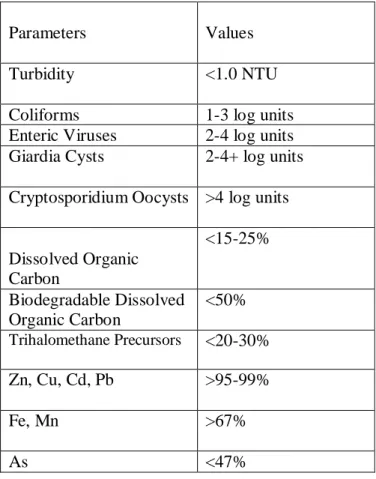
Although slow sand purification often has been replaced by faster and more advanced high-rate Purification methods, its low cost, ease of operation, minimal maintenance requirements, and success in removing pathogenic microorganisms make slow purification and attractive option for rural communities and developing nations. The following table shows the typical treatment performance of conventional slow sand water purification plant.
Table 1: Typical treatment performance of conventional water treatment plant
Parameters
Values
Turbidity <1.0 NTU
Coliforms 1-3 log units
Enteric Viruses 2-4 log units Giardia Cysts 2-4+ log units Cryptosporidium Oocysts >4 log units
Dissolved Organic Carbon
<15-25%
Biodegradable Dissolved Organic Carbon
<50%
Trihalomethane Precursors <20-30%
Zn, Cu, Cd, Pb >95-99%
Fe, Mn >67%
As <47%
16
Chapter -03
Waste water
3.1 Wastewater constituents
The composition of wastewater varies widely. This is a partial list of what it may contain:
Water (more than 95 percent), which is often added during flushing to carry waste down a drain;
Pathogens such as bacteria, viruses and parasitic worms;
Non-pathogenic bacteria;
Organic particles such as feces, hairs, food, vomit, paper fibers, plant material, humus, etc.;
Soluble organic material such as urea, fruit sugars, soluble proteins, drugs, pharmaceuticals, etc.;
Inorganic particles such as sand, grit, metal particles, ceramics, etc.;
Soluble inorganic material such as ammonia, road-salt, sea-salt, cyanide, hydrogen sulfide, thio cyanates, thio sulfates, etc.;
Animals such as protozoa, insects, arthropods, small fish, etc.;
Macro-solids such as sanitary napkins, nappies/diapers, needles, children's toys, dead animals or plants, etc.;
Gases such as hydrogen sulfide, carbon dioxide, methane, etc.;
Emulsions such as paints, adhesives, mayonnaise, hair colorants, emulsified oils, etc.;
Toxins such as pesticides, poisons, herbicides, etc.
Pharmaceuticals and hormones.
3.2 Wastewater quality indicators
Any oxidizable material present in a natural waterway or in an industrial wastewater will be oxidized both by biochemical (bacterial) or chemical processes. The result is that the oxygen content of the water will be decreased. Basically, the reaction for biochemical oxidation may be written as:
Oxidizable material + bacteria + nutrient + O2 → CO2 + H2O + oxidized inorganic such as NO3-
or SO4—
Oxygen consumption by reducing chemicals such as sulfides and nitrites is typified as follows:
S-- + 2 O2 → SO4 --
NO2-
+ ½ O2 → NO3-
Since all natural waterways contain bacteria and nutrients, almost any waste compounds introduced into such waterways will initiate biochemical reactions. Those biochemical reactions create what is measured in the laboratory as the biochemical oxygen demand (BOD).
Such chemicals are also liable to be broken down using strong oxidizing agents and these chemical reactions create what is measured in the laboratory as the chemical oxygen demand (COD).
Both the BOD and COD tests are a measure of the relative oxygen-depletion effect of a waste contaminant. Both have been widely adopted as a measure of pollution effect. The BOD test measures the oxygen demand of biodegradable pollutants whereas the COD test measures the oxygen demand of oxidizable pollutants.
3.3 Waste water Treatment
There are numerous processes that can be used to clean up waste waters depending on the type and extent of contamination. There are two basic approaches: to use the waste in the water as a resource (such as constructed wetlands) or strictly as pollution (such as the majority of today's treatment plants). Most wastewater is treated in industrial-scale energy intensive wastewater treatment plants (WWTPs) which include physical, chemical and biological treatment processes.
However, the use of septic tanks and other On-Site Sewage Facilities (OSSF) is widespread in rural areas, serving up to 20 percent of the homes in the Bangladesh.
The most important aerobic treatment system is the activated sludge process, based on the maintenance and recirculation of a complex biomass composed by micro-organisms able to absorb and adsorb the organic matter carried in the wastewater. Anaerobic wastewater treatment processes (UASB, EGSB) are also widely applied in the treatment of industrial wastewaters and biological sludge. Some wastewater may be highly treated and reused as reclaimed water.
Increasingly, for most wastewaters ecological approaches using reed bed systems such as constructed wetlands are being used. Tertiary treatment is being increasingly applied and most common technologies are micro filtration or synthetic membranes. After membrane filtration, the treated wastewater is indistinguishable from waters of natural origin of drinking quality (without its minerals). Nitrates can be removed from wastewater by natural processes in wetlands but also via intensive microbial denitrification, for which a small amount of methanol is typically added to provide the bacteria with a source of carbon. Ozone wastewater treatment is also growing in popularity, and requires the use of an ozone generator, which decontaminates the water as ozone bubbles percolate through the tank but is energy intensive. Latest and very promising treatment technology is the use aerobic granulation.
3.4 Industrial Waste treatment
Disposal of wastewaters from an industrial plant is a difficult and costly problem. Depending on the type of industry and the nature of its wastes, industries must utilize methods such as those used for advanced treatment of sewage to purify wastewater containing pollutants such as heavy metals and toxic chemicals before it can be discharged. Industries are permitted to discharge directly to receiving waters under the National Pollution Discharge Elimination System (NPDES) permit system or to municipal sewers under the Industrial Pretreatment Program.
Pollution prevention programs are very effective in helping industries reduce discharged pollutants, by eliminating them at the source through recycling or through the substitution of safer materials. More and more industries are approaching or attaining zero discharge by cleaning and reusing their water over and over.
3.4 Surface water treatment
Due to the high cost of drinking water and the fact that water is not always available, more and more industries and municipalities use treated surface water. Normally the surface water needs to be treated before it has the required water quality. Surface water typically contains a high suspended solids content, bacteria, algae, organic matter, creating bad taste and odor. In some areas, like river estuaries, surface water can be brackish, reaching up to 8000 mg/L of salts.
Two processes are commonly used to treat surface water:
1. Conventional treatment including clarification (coagulation/flocculation, sedimentation or dissolved air flotation), sand filtration, activated carbon adsorption and disinfection.
2. Advanced treatment based on ultra filtration technology.
20
There are several ways for surface water treatment. Bellow given a proper way of surface water treatment.
Fig: Surface water treatment process
21
Chapter-04
Wastewater
Treatment plant
4.1 Treatment process
Wastewater treatment refers to the process of removing pollutants from water previously employed for industrial, agricultural, or municipal uses. The techniques used to remove the pollutants present in wastewater can be broken into biological, chemical, physical and energetic.
These different techniques are applied through the many stages of wastewater treatment.
a) Primary treatment usually includes the removal of large solids from the wastewater via physical settling or filtration. The first step in primary treatment is screening.
Fig: Primary treatment
b) Secondary treatment typically removes the smaller solids and particles remaining in the wastewater through fine filtration aided by the use of membranes or through the use of microbes, which utilize organics as an energy source. Energetic techniques may also be employed in tandem with biological techniques in the secondary phase to break up the size of particles thus increasing their surface area and rate of consumption by the microbes present. A common first step in the secondary treatment process is to send the waste to an aeration tank.
Fig: Secondary treatment
c) Tertiary treatment involves the disinfection of the wastewater through chemical or energetic means. Increasing the number of steps in a wastewater treatment process may insure higher quality of effluent; however employing additional technologies may incur increased costs of construction, operation, and maintenance.
Chapter -05
Sand based
Water treatment plant
5.1 Slow sand purification plant and rapid sand purification plant
Slow sand water purification plants is operate at very low filtration rates, use very fine sand, and usually function without pre-chlorination. The low filtration rate results in long detention times in the water above the plants sand, and within the bed of the sand. The long detention time results in
substantial biological life in the slow sand filtration process.
Rapid filters have short detention times and are often operated with pre-disinfection so that no significant biological life is sustainable. Hence, rapid purification plants use physical straining to trap solids in the pores between sand particles. While rapid purification can only remove particles larger than the void space between the sand particles, slow sand purification plant can remove particles smaller than the space between sand particles.
Also, slow purification particle removal occurs mainly at the surface of the sand bed with minor removal within the bed. Rapid purification particle removal occurs mainly within the bed over a substantial depth.
In addition, rapid purification plants required to clean every day or two days interval. When terminal head loss is reached. To clean the filter, flow is reversed through the plants bed at a high rate that fluidizes the bed, actually expanding the spaces between sand particles and flushing trapped material to waste. Slow water treatment plant using backwashing system .
As a rapid sand purification plant would create havoc with the biological layer because fluidizing of the bed would damage the biofilm and disrupt the intricate interrelationships of sand and microscopic life. Slow plants usually are returned to operational status by scraping and removing the top layer of sand because that is where the clogging takes place. Compared to rapid sand purification plant, there is a net savings of water as large quantities of backwash water are not required.
Rapid sand purification plants are suitable for large urban centers where land scarcity is an issue.
Slow sand Purification plants are suitable for developing countries and small rural systems, where sufficient land is available.
Slow sand purification plant is simpler to operate than rapid filtration, as frequent backwashing is not required. Therefore, in terms of level of operation and maintenance, rapid sand purification plants requires a technically qualified operator whereas operating a slow sand purification plant requires little technical skills.
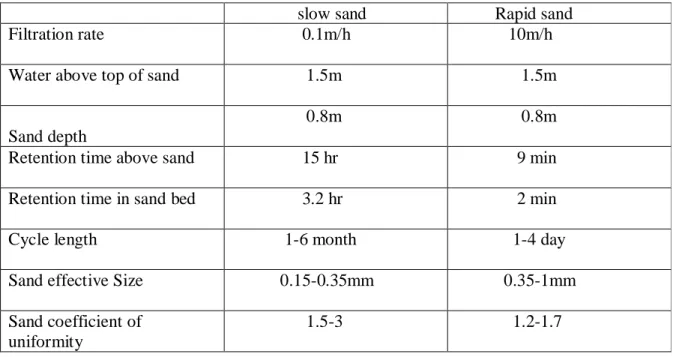
Table 2: Typical differences between slow sand purification plant and rapid sand purification plant
.slow sand Rapid sand Filtration rate 0.1m/h 10m/h Water above top of sand 1.5m 1.5m
Sand depth
0.8m 0.8m Retention time above sand 15 hr 9 min Retention time in sand bed 3.2 hr 2 min Cycle length 1-6 month 1-4 day Sand effective Size 0.15-0.35mm 0.35-1mm Sand coefficient of
uniformity
1.5-3 1.2-1.7
Chapter - 06
Model Development
6.1 Water treatment plant Model Development
In our project here we have used 3 in number simple cylindrical filtration tube shown in the fig below with the following dimension,
Length = 42 inch
Internal diameter = 14.5 inch Outer diameter = 14.9 inch
Base is covered with stainless steel plate of 14.10inch diameter.
In the first tube we have given big sand particle.
In the second tube we have given small sands.
In the third tube we used given ziolite.
All the tubes are inter connected with plastic pipes.
With that piping arrangement there are also some systems for backwash.
With the first tube a pump is connected for waste water intake from different sources like, boiler water in industries, flood water, water from river or canal etc.
A micro filter is used after the 3rd tube for better treatment and for getting pure water.
A extended pump is also attached for backwash purpose.
At the bottom there is a basement with wheel for carrying the plant.
Some electric board and connections are also there for running the pumps.
The diameter of the pipe is 1.5 inch.
In the proposed design of the model, the prefabricated water of known iron concentration was passed through the inlet pipe above. Inside the cylinder, different adsorption media of specified thickness were placed with proper gravel support. Then after filtration, the filtered water was collected through the conical part in a beaker and the final iron concentration was measured in the Atomic Absorption Spectrometer (AAS). The rate of filtration was noted and for each adsorption media, three samples were tested and average iron concentration was considered for analyzing filter effectiveness.
28
Chapter -07
Methodology
And Material Used
29
7.1 Methodology
We have made this treatment plant for doing job in two methods. The first method is removal of iron and big particle by adsorption technique, different adsorption media were used for iron removal and big particle removal. We have used plain sand, crashed stone. Which are locally collected at a very cheap cost.
In the second methodology, ziolite and micro filter used for removal microorganism from water.
7.2 Material used
In our waste water treatment plant we have used crashed stone, plain sand, ziolite, Micro filter and some other equipment. Details are given below.
a) Crashed stone
Crushed stone or angular rock is a form of construction aggregate, typically produced by mining a suitable rock deposit and breaking the removed rock down to the desired size using crushers. It is distinct from gravel which is produced by natural processes of weathering and erosion, and typically has a more rounded shape.
Crushed stone is one of the most accessible natural resources, and is a major basic raw material used by construction, agriculture, and other industries. Despite the low value of its basic products, the crushed stone industry is a major contributor to and an indicator of the economic well-being of a nation.
The demand for crushed stone is determined mostly by the level of construction activity, and, therefore, the demand for construction materials. So many types of crashed stones are used in the water treatment plant for purifying the water. For our waste water treatment plant we have also used crashed stone which is very small in grade. It is kept in the first cylindrical tank.
b) Plane sand
Sand porosity is an important factor relative to the formation of the filter cake and the biologically active zone. Sand porosity depends on the size and shape of the grains. It increases with the size of the grains and with the homogeneity of grain size and shape.
Fine sand and gravel are naturally occurring glacial deposits high in silica content and low in soluble calcium, magnesium and iron compounds are very useful in sedimentation removal. But here the media is used for iron removal from drinking water.
High porosity leads to high flow rate and low probabilities of collisions between particles in water and the sand grains. Low porosity will bring about low flow rate and clogging. Therefore, a moderate porosity is required for optimal operation of the BSF. The porosity is small enough to trap particles in the water and large enough to let the water through and allow some room for iological growth. Here for the experimentation plane sand passing through 425 micron and 600 Micron IS sieve were used
.
Fig: Sand
Requirements
The following are requirements for the type of sand appropriate for use in a water treatment plant.
1. Hard, durable, angular grains free from loam, clay and organic matter. Angular grains decrease porosity and increase resistance to flowing water.
2. An effective diameter (d10) range of 0.15-0.35mm.
3. A uniformity coefficient (Cu) of less than 3. Uniformity coefficient is a ratio calculated as the size opening that will just pass 60 percent (by weight) of a representative sample of the filter material divided by the size opening that will just pass 10 percent (by weight) of the same sample. This implies a fairly narrow range of grain sizes with an almost even distribution between the smallest 10% and the largest 10% and with most of the grains being a size in the middle. This distribution of sizes decreases the porosity of the sand, increasing the surface area per volume and the likelihood of collisions in the top portions of the sand.
Preparation
There are several steps to the preparation of the sand and gravel.
1) Locating source of gravel and sand
Sand from a crushing operation is pure, clean and relatively uniform in size and shape. It requires the least preparation and is the best possible sand source. In the absence of a manufactured source, it is necessary to locate a natural hillside sand deposit. If there are no other choices, one could use riverbed sand. This is not highly recommended because riverbed sand could be contaminated from animal wastes. In addition, riverbed sand grains are more rounded and smooth (as opposed to angular) in their shape, which decreases the effectiveness in trapping contaminants. Sand from high on a riverbank where there is no visible contamination should be used in preference to river bottom sand.
2) Biological quality testing
Each sand source needs to be tested for its biological quality. A sand source that is regularly used should be tested every 6 months. The following is the recommended procedure
1. Boil about 1 liter of the cleanest and purest water available (not distilled, mineral, or chlorinated water) for about 5 minutes.
2. Let the water cool to room temperature
3. Test a sample of this water for microbial contamination. This is used as a control.
4. Add 5g of sand to 100ml of water. Stir to mix, cover and let sit indoors or in the shade for 12 hours.
5. Decant the water into a clean container.
6. Test a sample of this water for microbial contamination.
The boiled water should show negative results. If it does not, there has been a sampling error or the water was not boiled long enough. Positive results in the water with sand sample means the contamination is coming from the sand. Sand from this sand source is not suitable for use in the filter; however it could be used for the construction of the concrete body. More sand sources should be sought out and tested for biological quality as outlined above until a clean source is found . Alternatively, the sand could be disinfected by boiling or spread out in the sun .
3) Sifting
Sifting is required to separate coarse and fine sands from under drain gravel and larger rocks. A total of three different size screens are needed: 12mm screen for under-drain gravel, 6mm screen for the coarse (or supporting) sand, and 1mm screen for the fine (or filter) sand.
4) Cleaning and Flow Rate Test
The sand must be free of dirt, clay fines, and organic matter. Slow sand filters are not backwashed so after the sand is placed in the filter beds, it cannot be cleaned quickly or easily.
Therefore, sand must be washed and impurities removed before placement in the filter.
5) Installing
Gravel and sand are then put into the shell according to the layer heights specified in Figure.
c) Zeolite
zeolite is used in removing microorganism from water .it decrease health hazards.
Zeolites are micro porous, alumino silicate minerals commonly used as commercial adsorbents and catalysts.
The term zeolite was originally coined in 1756 by Swedish mineralogist Axel Fredrik Cronstedt, who observed that upon rapidly heating the material stilbite, it produced large amounts of steam from water that had been adsorbed by the material. Based on this, he called the material zeolite, from the Greek ζέω (zéō), meaning "to boil" and λίθος (líthos), meaning "stone
Zeolites occur naturally but are also produced industrially on a large scale. As of October 2012, 206 unique zeolite frameworks have been identified, and over 40 naturally occurring zeolite frameworks.
Properties and occurrence
A form of thomsonite (one of the rarest zeolites) from India. Zeolites have a porous structure that can accommodate a wide variety of cat ions, such as Na+, K+, Ca2+, Mg2+ and others. These positive ions are rather loosely held and can readily be exchanged for others in a contact solution.
Some of the more common mineral zeolites:
Areanalcime, chabazite, clinoptilolite, heulandite, natrolite, phillipsite, and stilbite. In our waste water treatment plant we have used natrolite. The formula for natrolite. is: Na2Al2Si3O10·2H2O.
“Natrolith” are from Poland. Conventional open pit mining techniques are used to mine natural zeolites. The overburden is removed to allow access to the ore. The ore may be blasted or stripped for processing by using tractors equipped with ripper blades and front-end loaders. In processing, the ore is crushed, dried, and milled. The milled ore may be air-classified as to particle size and shipped in bags or bulk. The crushed product may be screened to remove fine material when a granular product is required, and some pelletized products are produced from fine material.
Fig: Natrolite zeolite
Currently, the world’s annual production of natural zeolite is about 3 million tones. The major producers in 2010 were China (2 million tons), South Korea (210,000 t), Japan (150,000 t), Jordan (140,000 t), Turkey (100,000 t) Slovakia (85,000 t) and the United States(59,000 t).
The ready availability of zeolite-rich rock at low cost and the shortage of competing minerals and rocks are probably the most important factors for its large-scale use. According to the United States Geological Survey, it is likely that a significant percentage of the material sold as zeolites in some countries is ground or sawn volcanic tuff that contains only a small amount of zeolites.
Some examples of such usage are dimension stone (as an altered volcanic tuff), lightweight aggregate, pozzolanic cement, and soil conditioners.
Natural zeolites form where volcanic rocks and ash layers react with alkaline groundwater.
Zeolites also crystallize in post-depositional environments over periods ranging from thousands to millions of years in shallow marine basins.
Naturally occurring zeolites are rarely pure and are contaminated to varying degrees by other minerals, metals, quartz, or other zeolites. For this reason, naturally occurring zeolites are excluded from many important commercial applications where uniformity and purity are essential.
Zeolites are the aluminosilicate members of the family of micro porous solids known as
"molecular sieves." The term molecular sieve refers to a particular property of these materials, the ability to selectively sort molecules based primarily on a size exclusion process. This is due to a very regular pore structure of molecular dimensions.
The maximum size of the molecular or ionic species that can enter the pores of a zeolite is controlled by the dimensions of the channels. These are conventionally defined by the ring size of the aperture, where the term "8-ring" refers to a closed loop that is built from eight tetrahedral coordinated silicon (or aluminum) atoms and 8 oxygen atoms.
These rings are not always perfectly symmetrical due to a variety of effects, including strain induced by the bonding between units that are needed to produce the overall structure, or coordination of some of the oxygen atoms of the rings to cat ions within the structure. Therefore, the pores in many zeolites are not cylindrical.
Zeolites transform to other minerals under weathering, hydrothermal alteration or metamorphic conditions. Some processes are:
The sequence of silica-rich volcanic rocks commonly progresses from:
Clay → quartz → mordenite–heulandite → epistilbite → stilbite → thomsonite–
mesolite-scolecite → chabazite → calcite.
The sequence of silica-poor volcanic rocks commonly progresses from:
Cowlesite → levyne–offretite → analcime → thomsonite–mesolite-scolecite → chabazite → calcite.
d) Stainless Steel cylindrical tube
Stainless steel filter cartridge will help us to keep dust from coming out of the top of a hopper.
The mesh filter might get clogged up over time and the dust vibrated or shaken free. In our waste water treatment plant we have used 310 size stainless steel cylindrical tubes.
Fig: Stainless steel tube
Overcome the temperature and compatibility limitations of fabric or synthetic fiber cartridges by replacing them with these stainless steel wire cloth elements. They're good up to 500 °F instead of the usual 250 °F, and they are unaffected by most caustic fluids. Made entirely of 304 or 316 stainless steel, they are cleanable and reusable, and can withstand differential pressures up to 60 psi. (500 psi units are also available.) We can choose particle retention ratings as fine as 5 microns. Element surfaces can be plain cylindrical, or pleated to increase surface area. Pleated units rated 100 microns or finer have an underlying support layer of coarser mesh to prevent pleat collapse. We have done fabrication is by welding and crimping; no silver brazing or epoxy bonding is used. Normally all stainless steel pleated & cylindrical filters are supported with coarser filter media to ensure any direct damages to main filtering media under process upsets. A bubble point tests has done to certify that no opening larger than the specified pore size exist in product joints or seams. No media migration due to stainless steel material. It is suitable because these elements can be back washed & reused.
Type of tube:
1. Stainless steel wires mesh type.
2. Stainless steel sintered metal type.
3. Stainless steel random fiber / Sintered metal fiber type.
From there we have chosen for our project Stainless steel sintered metal type.
Type of water treatment plant design
Plain cylindrical design.
Pleated configuration design.
In our project we have used plated configuration design.
Construction of Sintered Material
The composite fiber material is then sintered together with a wire mesh under vacuum conditions and rolled to mats of a specific thickness. Stainless Cartridge can be wrought into tubes, cartridges or disks, plain, pleated or according to customer requests.
Features & Benefits
Stable pore shapes.
High permeability.
Low pressure drop.
High dirt-holding capacity (longer lifetime).
High temperature resistance.
High differential pressure with stand capacity.
Strong corrosion resistant.
Back flushing.
Excellent mechanical strength.
No media migration.
Size customization.
e) Pump
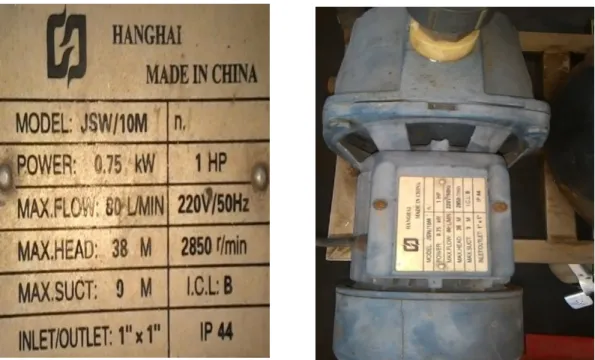
In our project we have used two centrifugal pumps. One in for intake purpose and another one is for back wash purpose. Centrifugal pumps are used to transport fluids by the conversion of rotational kinetic energy to the hydrodynamic energy of the fluid flow. The rotational energy typically comes from an engine or electric motor. The fluid enters the pump impeller along or near to the rotating axis and is accelerated by the impeller, flowing radially outward into a diffuser or volute chamber (casing), from where it exits. The fluid gains both velocity and pressure while passing through the impeller. The high pressure pump supplies the pressure needed to Provides dependable service. In this Cast iron electric pump has a powerful 220 Volt, 1 HP and ½ HP motor. Both the pump is having 1in number inlet and outlet ports.
This type of pump is having common uses include water, sewage, petroleum and petrochemical pumping. The reverse function of the centrifugal pump is a water turbine converting potential energy of water pressure into mechanical rotational energy.
Fig: Pump used in water treatment plant
f) Pipe
In our waste water treatment plant for connecting the cylindrical tank we have used PVC pipe with some sequential arrangement. At first the pipe has connected to the pump where a metallic pipe is there. Then a circuit has been maintaining with the second cylindrical tank and third cylindrical tank. And with the pipe there are also good arrangements for back washing. The assembly of the piping system is given below.
Fig: Arrangement of piping
g) Gate valve
While making waste water treatment plant we have used four in number gate valve gate .Who all are kept for maintaining the flow properly. And they have some good job while doing the back wash for cleaning the plant.
Fig: Gate valve used in our plant
h) Pressure gauge
In our waste water treatment plant we have used for in number liquid pressure gauge. Liquid filled gauge are generally preferred over dry gauge for two reasons: performance and ROI.
Liquid filled gauge are filled with a liquid, usually glycerin or silicone oil are designed to perform optimally in less than ideal conditions. They are also capable to perform in high heat, pulsation or vibration any difficult condition.
Fig: Pressure gauge
The primary reason for gauge failure is vibration. In traditional dry gauges, delicate links, pivots and pinion are prone to damage from vibration, leading to inconsistent performance .In a liquid filled gauge the fluid fill effectively dampens system pulsation, making the gauge pointer easier to read.
In the dry gauge there are also humidity, moisture problems. Condensation can make a gauge difficult to read or in some cases, can cause failure due to icing. Liquid filled gauges are sealed to prevent internal condensation, and by keeping moisture out of the system, gauge movement is protected during icing conditions.
The choice of fill fluid is based on the application, but glycerin is typically used for room temperature applications and silicon oil is commonly used for extreme temperature applications, especially when icing is a problem. Oil with insulating properties is ideal if the system has exposed electrical contacts.
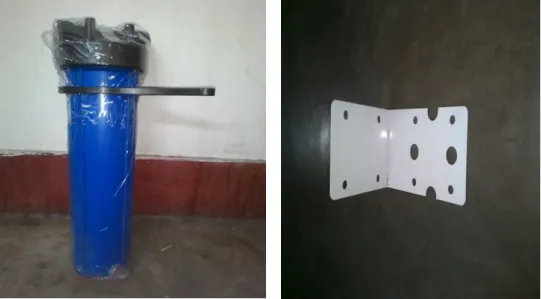
i) Micro Filter
Microfiltration is a type of physical filtration process where a contaminated fluid is passed through a special pore-sized membrane to separate microorganisms and suspended particles from process liquid. It is commonly used in conjunction with various other separation processes such as ultra filtration and reverse osmosis to provide a product stream which is free of undesired contaminants.
Microfiltration usually serves as a pre-treatment for other separation processes such as ultra filtration, and a post-treatment for granular media filtration. The typical particle size used for microfiltration ranges from about 0.1 to 10 µm. In terms of approximate molecular weight these membranes can separate macromolecules generally less than 100,000 g/mol. The filters used in the microfiltration process are specially designed to prevent particles such as, sediment, algae, protozoa or large bacteria from passing through a specially designed filter.
More microscopic, atomic or ionic materials such as water (H2O), mono valent species such as Sodium (Na+) or Chloride (Cl-) ions, dissolved or natural organic matter, and small colloids and viruses will still be able to pass through the filter.
The suspended liquid is passed though at a relatively high velocity of around 1–3 m/s and at low to moderate pressures (around 100-400 kPa) parallel or tangential to the semi-permeable membrane in a sheet or tubular form.
Fig: Micro filter & Links.
In our waste water treatment plant we have used a micro filter for better treatment of water.
Pump is fitted at the beginning of the process. Then the processing equipments like three tanks will allow the liquid to pass through the membrane filter. A differential or regular pressure gauge is attached to measure the pressure drop between the outlet and inlet streams.
The most abundant use of microfiltration membranes are in the water, beverage and bio- processing industries .The exit process stream after treatment using a micro-filter has a recovery rate which generally ranges to about 90-98 %.
In our plant we have used a micro filter which is 22 inch in length and 6.5 inch in diameter.
There is also a inlet and outlet unit. With some physical arrangement we have attached the micro filter with the plant.
j) Basement
We have used a box shaped stainless steel based basement for carrying the cylindrical tank. This is having four in number wheel for supporting this. Within this four wheel two is having controlling break and two is without break. Break is having a great advantage for holding the water treatment plant. We have attached this basement by assembling a number of stainless steel bars by cutting them and attaching them by welding.
Length of the basement: 48 inch.
Breadth of the basement: 18 inch.
Fig: The basement used in plant
k) Internal arrangement
In our waste water treatment plant we have used some internal arrangement for water flow and filtration purpose. In each tank at the top and the bottom there are two holes. The diameter of each holes are 1.5 inch. In both the hole we have attached two cylindrical pipe .The length of the pipe is 10 inch. Total 06 in number pipe is used for flowing water in side our waste water treatment plant. All the pipe has been cut in such a way so that water can pass through the cylindrical tank without any obstruction.
Fig : Pipe with the hole arrangement Fig : Internal arrangement with tank
Chapter – 08
Our Project
8.1 Working principle
Every water treatment plant has some process to work. So according to that we have also designed our own way. And according to that design we have arranged all the equipments and get connected. Bellow the working procedure is given,
The main working principle of our waste water treatment plant is –
First, with the help of a iron pipe the waste water treatment plant is connected to th water source.
Iron pipe is fitted with the intake pump.The pump is operated by the electrical switch.Which is connected with a operating board with electrical supply.When the switch is turned in ON position ,then tha pump will start .Pump will suck the waste water and delivers the water to the first cylindrical tank.
In between the pump and the first water tank a pressure gauge is placed.which will show the rate of flow of water through the pump to the first water tank.
The waste water will enter to the first cylindrical tank with the top pipe fittings.This tank is halfly filled with big particle sand with crashed stone.
Then the waste water will pass through the sand with crashed stone.Where the big particles and some garm will be arrested by them.
Then from the first cylinder the water will go to the second cylindrical tank with the inner fitting pipe fitted at the top.In this cylinder we have kept small and largely densed sand.
In between the first and second cylindrical tank we have kept one pressure gauge for observing the flow rate of the water.
In the second tank waste water is going to purify with help of sand and activeted carbon placed at the bottom of the cylinder.
Then the 50 % clean water will go to the third cylindrical tank by the help of bottom pipe fitted at the lower part of the tank.
There is also a pressure gauge in between the second and the third cylindrical tank.
In the third cylindrical tank we have given ziolite at an amount of around 30 kg.
The purpose of giving ziolite is to remove microorganism from the water .Which decrease health hazards.
Then by passing through the ziolite the water is being purified. But for better purification we have used a micro filter. This is fitted just after the third cylindrical tank.
In between the micro filter and the third tank we have also kept a pressure gauge for understanding the flow rate of water from the third tank to the micro filter.
Then the water is being purified in the micro filter and we can use that water for drinking.
After using few month we need to clean the pipe arrangement because by flowing waste water the pipe my get blocked or rate of flow of water may reduce. For that reason we have kept some arrangement for back flow. This will be operated by a pump. Here we have used 0.5 HP capacity pump.
The pump will blow water with large force and with that force waste material may come out from the system.
While doing this back wash process we need to remember about the locking of gate valve.
Gate valve will prevent the waste material to get inside the cylindrical tank.
Waste water treatment plant working cycle is given below.
Fig : Plant development