Faculty of Engineering
Department of Textile Engineering
“Study on Quality Control in Sports Cap Manufacturing’’
Course Title: Project (Thesis) Course Code: TE-4214
Submitted By
S.M. Golam Kibria Rifat ID: 151-23-4096
Md. Shoive Akter ID: 151-23-4252
Supervised By
MOHAMMAD ABDUL BASET Assistant Professor
Department of Textile Engineering Daffodil International University
This Report Presented in Partial Fulfillment of the Requirements for the Degree of Bachelor of Science in Textile Engineering.
Advance in Apparel Manufacturing Technology
Letter of Approval
27-05-2019 To
The Head
Department of Textile Engineering Daffodil International University
102, Shukrabad, Mirpur Road, Dhaka 1207
Subject: Approval of Project Report of B.Sc. In TE Dear Sir,
We are simply writing to tell you that this task report titled as "Study on Quality Control in Sports Cap Manufacturing" has been set up by the understudy bearing ID 151-23-4252 and 151-23-4096 is finished for definite assessment. The entire report is readied in light of the best possible examination at UNIMAS SPORTSWEAR LTD. Furthermore, intrusion through basic examination of observational information with required possessions. The understudy was straightforwardly associated with his undertaking exercises.
Therefore, it will highly be appreciated if you kindly accept this project report and consider it for final evaluation. Yours Sincerely
Engr. Mohammad Abdul Baset Assistant Professor
Department of Textile Engineering
ACKNOWLEDGEMENT
Above all, first we thanks to Almighty Allah who gives us ability and power to complete this thesis and research work. With sincerity, we extend our warm and deep appreciation and gratitude to our supervisor, Mohammad Abdul Baset, Assistant Professor, Department of Textile Engineering of Daffodil International University for his guidance and support to come up with this research work. Been working with him, we have not only earned valuable knowledge, but was also inspired by his innovativeness which helped to enrich our experience to a greater extent. His ideas and way of working was truly remarkable. We believe that this research could not be finished if he did not help us continuously. We would like to express our heartiest gratitude to „Prof. Dr. Engr. MD. Mahbubul Haque, Head of the Department, Textile Engineering of Daffodil International University‟ for his kind help to finish our project and also to other faculty members and the staffs of „TE Department of Daffodil International University‟. We would like to thank our entire course mate in Daffodil International University, who took part in this discuss while completing the course work. The support and encouragement rendered by, “Unimas Sportswear Limited” Stuffs were very vital in the completion of this project, their guidance and encouragement played a key role in the planning and completion of this project. Finally, we express our sincere gratitude to our parents and friends for their continuous support, ideas and love during our studies.
Dedication
At first we want to dedicate this report to Almighty Allah (ALHAMDULILLAH) for giving us the opportunity to prove ourselves. Without His help nothing would be possible.
DECLARATION
We hereby declare that, this report has been done under the supervision of Mohammad Abdul Baset, Assistant Professor, Department of Textile, Daffodil International University.
We also declare that neither this internship report nor any part of this internship report has been submitted elsewhere for award of any degree.
Submitted by:
S.M. Golam Kibria Rifat ID: 151-23-4096
Department of Textile Engineering Daffodil International University
Md. Shoive Akter ID: 151-23-4252
Department of Textile Engineering Daffodil International University
Faculty of Engineering
Department of Textile Engineering
Approval Sheet
This research entitled “Study on Quality Control in Sports Cap Manufacturing”, at Daffodil International University, A. Y. 2019‟‟ prepared and submitted by Md. Shoive Akter ID: 151- 23-4252 & S.M. Golam Kibria Rifat ID:151-23-4096 in partial fulfillment of the requirement for the degree of BACHELOR OF SCIENCE IN TEXTILE ENGINEERING has been examined and hereby recommended for approval and acceptance.
Muhammad Abdul Baset Assistant Professor
Department of Textile Engineering
ABSTRACT
This project is „Study on Quality Control in Sports Cap Manufacturing’of “Unimas Sportswear Limited” Garment manufacturing is quite different from any other conventional manufacturing. It is not a continuous production method. Each style is a different product that requires a different type of fabric, color, buttons, thread, etc. Quality control process is one of the most important stages in labor intensive cap manufacturing. Quality faults occurring during this process adversely affect the product quality and product efficiency, and also increase the production cost. The aim of this study is to investigate whether the cap production process is under control and to detect the processes with the highest rates of finishing process in finishing department and finally to make suggestions for improving the quality control. Also, the processes with highest amounts of sewing faults and the effects of these processes on fault rates were investigated.Articles of cap manufacturing examination is profoundly related with expense. To expend the cost, it is critical to recognize the deficiency and recuperate it. Generally, generation cost would be rise which causes an incredible harm for the business.
So as to deliver a quality item, it is essential to investigate the item with appropriate consideration. Review could be spare more generation harm.
The principle motivation behind investigation is to satisfy the purchaser necessity in this way, Inspection ought to be done according to the purchaser prerequisite. We are also mentioning remedies for specific reasons which all are included in this project report.
Table of Contents
Chapter-01 Introduction… ... 1
1.1 Introduction… ... 2
1.2. Aim of Project… ... 2
1.3. The main objective of the study ... 3
1.4. Methodology ... 3
1.5 Limitations… ... 3
Chapter:02 literature survey ... 4
2.1 Quality...5
2.2 Importance of Quality ... 5
2.3 Quality Control… ... 6
2.3.1 Objective of Quality control… ... 6-7 2.3.2 Quality Assurance ... 7
2.3.3 Types of Quality Control… ... 7-8 2.3.4 Tools of Quality Assurance ... 8-9 2.4 Terms of Quality Control… ... 9
2.4.1 Testing...9
2.4.2 Inspection… ... 9
2.5 Quality and Assurance ... 9-10 2.6 Quality Management System… ... 10
2.7 Total Quality Management… ... 10
2.8 Inspection System… ... 10
2.9 4 point System…...10-12 2.10 AQL ... 12-13 2.11 How to Maintain Quality in Cap Factory ... 13
2.12 List of Major Defects Found in Finishing Section… ...14
2.13 The Sewing Faults and Their Remedies… ... 14-15 2.13.1 Uncut Thread… ... 15
2.13.2 Oil Spot… ... 15-16 2.13.3 Fabric Hole… ...16
2.13.4 Broken Stitches ... 16-17 2.13.5 Skip Stitch… ... 17
2.13.6 Raw Edge ... 18
2.13.7 Fabric Faults… ... 18-19 2.13.8 Satin ... 19
2.14 Final Table Inspection(sewing)… ...20
Chapter-03 Experimental Details… ... 21-22 3.1 Experimental Data-1 ... 23-24 3.2 Experimental Data-2 ... 25
3.3 Experimental Data-3 ... 26
3.4 Experimental Data-4 ... 27
3.5 Experimental Data-5 ... 28
3.6 Experimental Data-6 ... 29
3.7 Experimental Data-7 ... 30
3.8 Attachment of End Line Inspection Report… ... 31
3.8.1 End Line Inspection Report-1… ... 31
3.8.2 End Line Inspection Report-2… ... 32
3.8.3 End Line Inspection Report-3… ... 33
3.8.4 End Line Inspection Report-4… ... 34 Chapter-4 Result and Discussion… ... 35-36 4.1 In line Inspection Data-01… ... 36-37 4.2 In line Inspection Data-02… ... 37-38
4.3 In line Inspection Data-03… ... 38
4.4 In line Inspection Data-04… ... 38
4.5 In line Inspection Data-05… ... 39
4.6 In line Inspection Data-06… ... 39
4.7 In line Inspection Data-07… ... 39
4.8 Analysis of End Line Inspection Report of 10 days… ... 40
4.9 Data Analysis Report of 10 days… ... 41
Chapter 5 Conclusion… ... 42
5.1 Conclusion… ... 43
References… ... 44
List of Table and Graphical view
Table 2.10: AQL Chart ... 12-13 Table 3.1 Experimental Data-1… ... 23-24
Table 3.2: Experimental Data-2 ... 25
Table 3.3: Experimental Data-3… ... 26
Table 3.4: Experimental Data-4… ... 27
Table 3.5: Experimental Data-5… ... 28
Table 3.6: Experimental Data-6 ... 29
Table 3.7: Experimental Data-7 ... 30
Table 3.8.1: End Line Inspection Report-1… ... 31
Table 3.8.2: End Line Inspection Report-2… ... 32
Table 3.8.3: End Line Inspection Report-3… ... 33
Table 3.8.4: End Line Inspection Report-4… ... 34
Table 4.8: Analysis of End Line Inspection Report of 10 days… ... 40
Table 4.9: Data Analysis Report of 10 days… ... 41
Chapter-1
Introduction
1.1. Introduction
A thesis paper referred to as research paper that provides the reader with sufficient information about particular topic. Thesis is a document submitted in support of candidature for an academic degree or professional qualification presenting the author's research and findings. Our thesis paper introduced as “Quality inspection in different stages in Cap production”. We realized that it is too much important to maintain quality in textile sector as well as garments production, so we choice this type of topic and try how to improve quality in garments production. we working in one garment manufacturing industry named Unimas Sportswear Ltd, that is 100% export and import industry. At first we have to know about sequence of garments production.
1.2. Aim of Project
The study requires a systematic procedure from selection of the topic top final report preparation. In this study, exploratory research was undertaken to gain insights and understanding of causes of frequently different stages knit garments production and their defects & remedies. To perform the study data sources Ire identified and collected, Ire analyzed, interrupted and presented in a systematic manner and key points are found out.
This overall process of methodology is given in below that has been followed in the study.
1.3 The main objective of the study
To know the overall cap manufacturing process.
To know the causes of defects occurred in finished cap and its remedies.
To know the daily reports of cap finishing process.
To know the causes of defects occurred in cap finishing process and its remedies.
To know about the inspection process of finished cap.
1.4 Methodology
• Textile industry
• Inspection related book
• Practical information from factory
• Class lecture note
1.5 Limitations
•
Time constraint•
Lack of experience•
Lack of proper guide from industryChapter-2
Literature Survey
2.1. Quality
Quality means customer needs is to be satisfied. Failure to maintain an adequate quality standard can therefore be unsuccessful. But maintaining an adequate standard of quality also costs effort. From the first investigation to find out what the potential customer for a new product really wants, through the processes of design, specification, controlled manufacture and sale.
American Society for Quality Control (ASQC) defines quality as: “A systematic approach to the search for excellence”.
According to International Organization for Standardization (ISO):
“Quality is the fulfillment of the specified requirements for a product or service”.
HoIver, quality also means much more, they include: The degree of excellence that an item possesses, meeting a specification, Product with no defect found, Meeting customer expectation.
2.2. Importance of Quality
Every product feature functional characteristics as Ill as some other aspects related to its shape, size & design. Consumers always demand following expectation of the purchased product:
The product must satisfy the consumer in terms of beauty, attractiveness, taste, shape, design
& longevity etc. depending on the type of product. A product devoid of quality has no demand among consumers & as such, has no sale ability. Excellent quality characteristics enhance sale ability of the goods & are the keys to profitability for the manufacturer or the seller. Most importantly, some criteria of customer‟s satisfaction are negotiable but quality is such a factor that it is not at all bargain able.
2.3. Quality control
Quality is of prime importance in any aspect of business. Customers demand and expect value for money. As producers of apparel there must be a constant endeavor to produce work of good quality.
Quality control can be characterized as the checking, confirmation, and guideline of level of brilliance of a trait or property of something. The operational systems and exercises that are utilized to satisfy necessities of value.
Quality control means meeting or exceeding customer expectation on a continuous basis.
This means that in order to control quality one must know the customer‟s expectation.
Quality is usually made into board room.
In the piece of clothing industry quality control is rehearsed directly from the underlying phase of sourcing crude materials to the phase of last completed article of clothing. For material and attire industry item quality is determined as far as quality and standard of strands, yarns, texture development, shading quickness, surface plans and the last completed article of clothing items. However, quality desires for fare are identified with the kind of client sections and the retail outlets.
2.3.1. Objective of quality control
Reduction cost- To bring about a Reduction in per unit cost.
Use of crude materials-To accomplish better Utilization of crude materials, man and machines.
Maintain Quality- To take necessary corrective steps to maintain the Quality of product or services.
Decreases client grievances to accomplish more prominent consumer loyalty by lessening client grumblings. Identify faults- To identify deferent types of faults.
To maximize the production of goods within the specified tolerances correctly the first time.
To achieve a satisfactory design of the fabric or garment in relation to the level of choice in design, styles, colors, suitability of components and fitness of product for the market.
2.3.2. Quality assurance
The decisions, plan and actions that are necessary to provide adequate confidence that a product or service will satisfy given requirement for a particular quality. The purpose of QA to ensure certain quality.
Quality affirmation alludes to the building exercises actualized in a quality framework so prerequisites for an item or administration will be satisfied. It is the precise estimation, correlation with a standard, observing of procedures and a related criticism circle that gives mistake aversion. This can be diverged from quality control, which is centered around procedure yields.
2.3.3. Types of quality control
It is divided into 2 types:
1. Process control and 2. Product control.
1. Process control:
The strategy picked for procedure must be furnished with the important precise parameters.
In each stage pH ought to be kept up earnestly.
2. Product control:
The control which is utilized to diminish inadequate things inside various heaps of created merchandise is known as item control.
Again Process control can be divided into the following steps:
(a) Online quality control.
(b) Offline quality control.
(a) Online Quality control:
We have to always very concern about the quality of the product. So, the knit grey fabric from the best quality yarn & utilizes technical evaluation in every stage of the production, as we know the quality product depends on the raw material quality.
This sort of value control is performed in procedure arrange i.e, ceaselessly the creation procedure, amid the generation running time, the naturally tests the varieties and makes quick move to correct the variety.
Checking and rectification of variation/fault in processing stage is known as online quality control.
Example:
-
Inline inspection
-During production (Du-Pro) inspection.
(b) Offline Quality control:
This type of quality control is consisting of laboratory tests which are done by stopping the production process.
Here necessary steps are taken according to test result.
Example:
-Pre final inspection conducted by factory people.
2.3.4. Tools of Quality Assurance
1. 1.Focus on the client(Internal/outside): Services ought to be planned in order to meet the needs and desires for customers and networks.
2. 2.Focus on system and Processes: Providers must understand the service delivery system and its key service processes in order to improve them.
3. Focus on measurement: Analyze processes, identify problems, and measure performance.
4. Focus on teamwork: Quality is best achieved through a team approach to problem solving and quality improvement
2.4 Quality Control
Quality control is the operational techniques and activities that are used to fulfill requirements for quality. On the other words, a system applied to manufacturing operations to monitor & regulate production process continually so that products meet specification.
To control the quality of garments or products two techniques are followed, such a:
• Testing and
• Inspection
2.4.1 Testing
To those engaged in the production, distribution and consumption of textiles, testing can be a valuable aid provided tests are made the results must be studied carefully so that the right course of action may be taken. Testing instruments cannot make decisions and in the end some person has to interpret the data and issue the necessary instructions for future action.
2.4.2 Inspection
The inspections are done to control the quality is means by examining the products without any instrument. To examine the fabric, sewing, button, thread, zipper, garments measurement and so on according to specification or desired standard is called inspection. There are so many facilities for inspection in every section of garments industries. The aim of inspections is to reduce the time and cost by identifying the faults or defects in every step of garments making.
2.5 Quality Assurance
To carry out all those planned and systematic actions necessary to provide adequate
Quality assurance. On the words, this is a system to assure that product & services meet customer requirements.
2.6 Quality Management System
Quality Management System (QMS) is a set of interrelated techniques, measures and management system designed to prevent defects from occurring or if they occur at all.
Countermeasures are adopted immediately so that they do not recur. QMS takes recourse to preventive as well as remedial measures.
2.7 Total quality management
This is one of the latest concepts of management that can ensure the highest standard of quality and productivity ensuring good for all of the workers, management and society. In this system, quality of management and actions are ensured by assuring quality at all stages from vision, planning, purchase, store, cutting, sewing, inspection, packing, administration, welfare, personnel motivation etc. TQM envisages high work standard, work-environment, managerial standard, motivation etc. Thus, comes the concept of production system with minimal or zero de-fact.
2.8 Inspection System
There are various fabric inspection systems as listed below. However, we will discuss only the 4point system because it is used most widely.
1. 4- Point system 2. 10- Point system 3. Graniteville 78 system 4. Dallas system
5. Textile distributors Institute (National Federation of Textiles-1955) system 6. 4- Point system- Revised.
2.9 4 Point System
The 4- Point system also called the American Apparel Manufacturers Association (AAMA).
In this method, defected points are found out in 100 square Yds. Of fabric must be rejected if the defected points are greater than 40.
Points
Up to 3” 1
3 ~ 6 2
6 ~ 9 3
Above 9 4
Defects area for holes and opening
Points
1 or less That 1 2
Above 1 4
Note: It must be remembered that, defected point must not be more than 4 in each yard.
For example: for 100 square Yds. Inspection.
Defects length No of faults No of points
Up to 3 10 10 X 1 = 10
3 ~ 6 5 5 X 2 = 10
6 ~ 9 2 2 X 3 = 6
Above 9 0 0 X 4 = 4
Total = 26
2.10 AQL (Acceptable Quality Level)
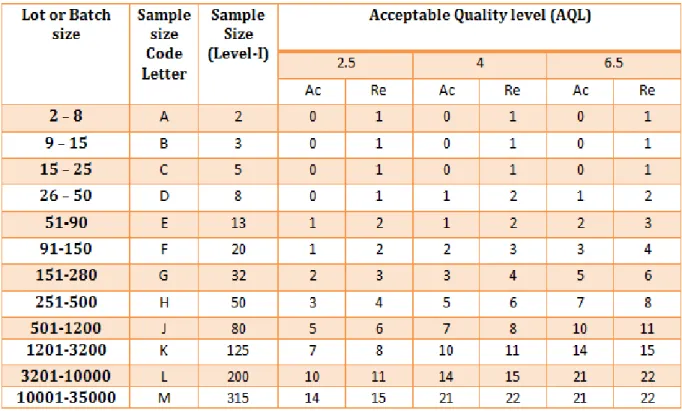
The AQL is the greatest percent deficient that to test examination can be viewed as agreeable as a procedure normal. At the point when a client assigns some particular estimation of AQL for a specific imperfection or gathering of deformities he demonstrates to the provider that his (the clients) acknowledgment examining plan will acknowledge the extraordinary lion's share of the parcels or clumps that the provider submits, gave the procedure normal dimension of percent flawed in these parts or groups is no more noteworthy that the assigned estimation of AQL. In this manner, the AQL is an assigned estimation of percent inadequate that the client demonstrates will be acknowledged more often than not by the acknowledgment testing methods to be utilized. The AQL is commonly communicated in percent (%). The AQLs most generally utilized in attire industry are 2.5, 4.0, 6.5, and 10.0 relying upon the cost and thing. For instance, for low value things and childrens wear AQLs of 6.5 and 10.0 might be very fitting; be that as it may, for more expensive rate things AQLs of 2.5 and 4.0 might be suitable.
Table 2.10 AQL chart
2.11 How to Maintain Quality in Cap Factory:
Pattern making inspection
Marker making inspection
Cutting inspection
Sewing inspection
Pressing and finishing inspection Packing and cartoning inspection
2.12 List of major defects found in finishing section :
1. Brand: care or size label missing
2. Shading
3. Wrong color
4. Hole in fabric Damage
5. Conspicuous repair
6. Poor construction
7. Conspicuous soil age (inside or outside)
8. Conspicuous abrasion marks from wash process
9. Wrong printing
10. Buttons, snap defect
11. Sweat label missing
12. Wrong T/R stay used
13. Poorly trimmed garments threads
14. Broken stitches
15. Skipped stitches
16. Open seam
2.13 The sewing faults and their remedies
1. Uncut Thread 2. Oil Spot
3. Fabric Hole/Reject 4. Broken Stitch 5. Skip Stitch 6. Raw edge 7. Fabric fault 8. Satin 9. Pleat
11. Puckering 12. Hole defects
13. Variable stitch density
14. Bobbin or looped thread breakage 15. Needle thread breakage
2.13.1 Uncut Thread
Causes:
It appears due to improper trimming or finishing.
Remedies:
Garments finishing should be checked properly and cut the extra thread.
Fig 2.13.1 Uncut Thread
2.13.2 Oil Spot
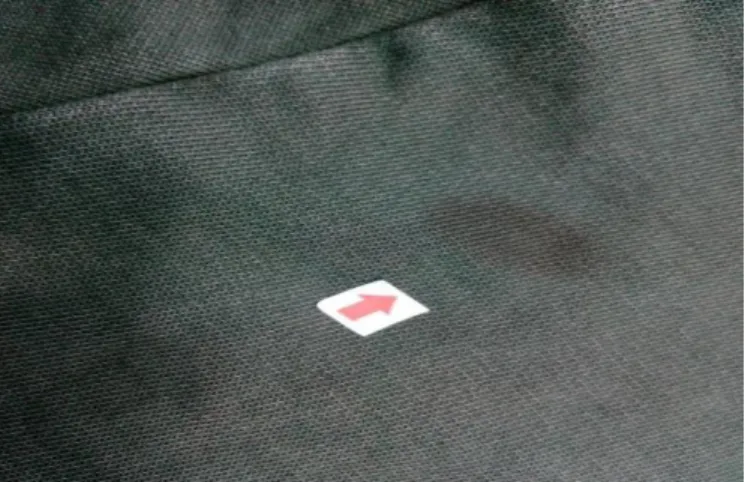
Causes:
By creating machine problem Remedies:
Fig 2.13.2 Oil Spot
2.13.3 Fabric Hole/Reject
Causes:
Its occurred by shearing. Or when cutting thread if body cut then it happened.
Remedies:
Sewing operator should be active on their work when scissoring or cutting thread.
Fig 2.13.3 Fabric Hole/Reject
2.13.4 Broken Stitches
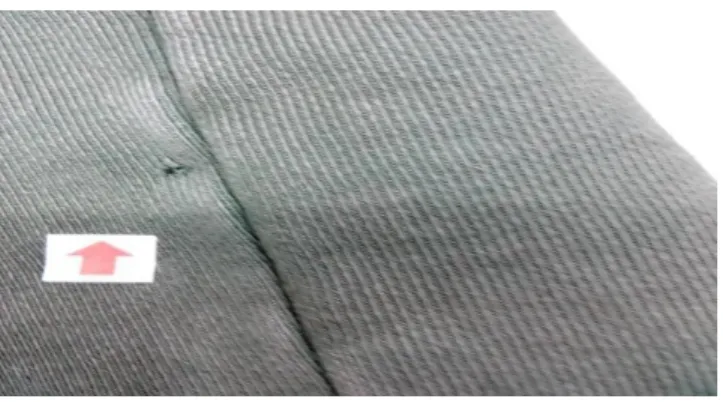
Causes:
It appears due to improper trimming or machine usage.
Remedies:
1. Proper machine 2. Proper trimming.
Fig 2.13.4 Broke Stitch
2.13.5 Skip Stitch
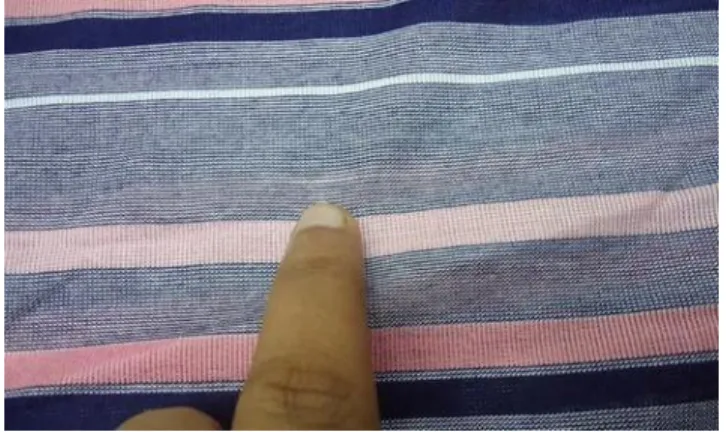
Causes:
It causes of not adjusting needle & lopper properly.
Remedies:
Needle should be change. Lopper sets on the right place.
Fig 2.13.5 Skip Stitch
2.13.6 Raw edge
Causes:
Operators fault.
Remedies:
1. Stitching should be proper
2. Folders/temperatures may be used.
Fig 2.13.6 Raw edge
2.13.7 Fabric fault
Causes:
1. This issue emerges because of uneven extending on to utilizes of texture amid sewing. Ill-advised string strain, wrong sewing string choice, dimensional precariousness of the employs of texture and so on.
Remedies:
1. Machine feed component must be better quality 2. Sewing string must be chosen property
3. Thread pressure must be kept in utmost.
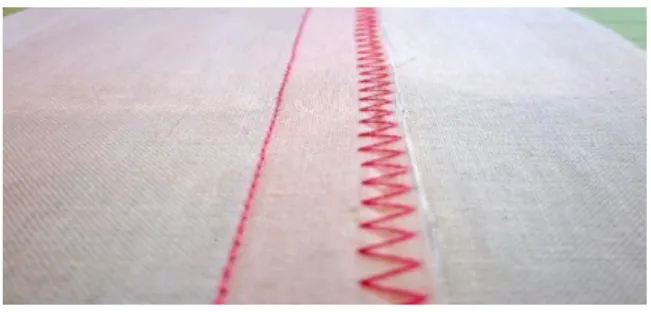
2.13.8 Satin
Causes:The pull of thread is not compensated.
Remedies:
1. Proper digitization by use of appropriate underlay stitches, high stitch density, and using different pattern.
2. Thread s pull can be compensated by overlapping fill and satin border stitch.
3. Use proper topping.
Fig 2.13.8 satin
2.14 Final Table Inspection (Sewing)
• To guarantee the nature of the pieces of clothing and to recognize the deformities if there any and correct those if conceivable.
• Quality Controller is in charge of usage of conclusive review framework and confirms the examination.
• Final Table Quality inspection received garments from assembly section and is responsible to check 100% garments quality.
• The garments are inspected from inside and outside for stitching defects as explained in Sewing Defect Standard.
• Using Arrow Stickers identifies defect and the defected garments are segregated. The Results are recorded on table on table Alteration report.
• On hourly basis Quality Controller will verify the final Table Quality Inspection by re checking the segregated defected garments on random basis and sign to Table Alteration Report.
• Once the in-line Controller have verified the Line Supervisor will take the defected garments for repair, and there are re-inspected with normal production.
• End of the day Quality Inspector will calculate the defect percentage for every line and record on Table Alteration Report.
Chapter-03
Experimental Details
3.0 Data Collection:
We have collected for 10 days‟ data in „UNIMAS SPORTSWEAR LTD‟. And finally calculated production percentage from different line in sewing department. A factory should set different modern quality procedure and quality management process for the improvement of RMG sector. Open seam, broken stitch, skip stitch, uneven stitch, over stitch, uneven shape, dirty stain, oil stain, incorrect measurement, shading, bad tension, incorrect SPI, incorrect size label, missing trim, unmatched S line, incorrect needle hole, without Bar tack etc.
we visited for collect information in Unimas Sportswear Ltd. We know how to inspect garments and Collected many information about Garments Inspection form different sector in-line inspection, End line inspection, finishing inspections, various defect and also learn how to reduce it.
3.8 Attachment of End line inspection Report:
3.8.1 End Line Inspection Report-1
A copy of end of the end line inspection report is attached that we have collected from the
“Unimas Sportswear Ltd”.
Table 3.8.1: End Line Inspection Report-1
3.8.2 End Line Inspection Report-2
A copy of end of the end line inspection report is attached that we have collected from the
“Unimas Sportswear Ltd”.
Table 3.8.2: End Line Inspection Report-2
3.8.3 End Line Inspection Report-3
A copy of end of the end line inspection report is attached that we have collected from the
“Unimas Sportswear Ltd”.
Table 3.8.3: End Line Inspection Report-3
3.8.4 End Line Inspection Report-4
A copy of end of the end line inspection report is attached that we have collected from the
“Unimas Sportswear Ltd”.
Table 3.8.4: End Line Inspection Report-4
Chapter 4.0
Result and Discussion
4.0 Result and Discussion
we have analyzed on different stages cap production and we found different types of frequently occurs fault might‟s in various causes.
4.1 In Line Inspection data-01
In this report we can see that all visible and invisible parts of a cap are checked.
Measurement of cap, sewing, tension balance of machine, accuracy of join different parts.
Here total quantity is 400 pieces. Total inspected quantity as per report is 50 pieces. From AQL chart number of acceptable defective point is 3 for cap. If the defect point is more then 3, then the product is failed to pass in quality check.
Total pieces checked:50 Rejected:3
Major defect: Fabric defects,Skipped stitch Result: Pass
Sewing defects:
Like open seams, wrong stitching techniques used, same color cap, but usage of different color threads on the cap, miss out of stitches in between, creasing of the cap, erroneous thread tension and raw edges are some sewing defects that could occur so should be taken care of.
Skip Stitch
Causes:
If the distance between one loop to another loop is more.
It the hook cannot pick the thread timely.
If the tension varies in lopper and needle thread.
Remedies:
The timing of hook or lopper with needle should be adjusted properly.
Adjust tension properly.
4.2 In Line Inspection data-02
QC department inspect this data when a production of particular style finished. For the cap the quantity of order is so smaller as compared to readymade garments. So the inspection also done in a little number of quantity.
Here total quantity is 450 pieces. Total inspected quantity as per report is 50 pieces. From AQL chart number of acceptable defective point is 3 for cap for 50 piecces. If the defect point is more then 3, then the product is failed to pass in quality check.
Total pieces checked:50 Rejected:4
Major defect: Fabric defects,Skipped stitch, broken stitch Result: Pass
Sewing defects:
Broken Stitch
Causes:
Used lower quality thread.
The improper unwinding of thread from the package.
Remedies:
Used higher quality thread.
The Proper unwinding of thread from the package.
4.3 In Line Inspection data-03
QC department inspect this data when a production of particular style finished. For the cap the quantity of order is so smaller as compared to readymade garments. So the inspection also done in a little number of quantity.
Here total quantity is 2016 pieces. Total inspected quantity as per report is 125 pieces. From AQL chart number of acceptable defective point is 7 for cap for 125 pieces. If the defect point is more then 7, then the product is failed to pass in quality check.
Total pieces checked:125 Rejected:3
Major defect: Fabric defects,Stains,Long Threads Result: Pass
4.4 In Line Inspection data-4
Total pieces checked:80 Acceptable:5
Rejected:3
Major defect: Fabric defects, Stains, Long Threads Result: Pass
4.5 In Line Inspection data-05
Total quantity:864 Total pieces checked:80 Rejected:4
Major defect: Fabric defects, Stains, Long Threads Result: Pass
4.6 In Line Inspection data-6
Total quantity:864 Total pieces checked:80
Rejected:3
Major defect: Fabric defects, Stains Result: Pass
4.7 In Line Inspection data-7
Total quantity:864 Total pieces checked:80
Rejected:2
Major defect: Fabric defects, Stains Result: Pass
Production Target
20000 18000 16000 14000 12000 10000 8000 6000 4000 2000 0
4.8 Analysis of End Line Inspection Report of 10 days:
Production Target:
Figure 4.8: Graphically show total number of production target of a day.
Discussion:
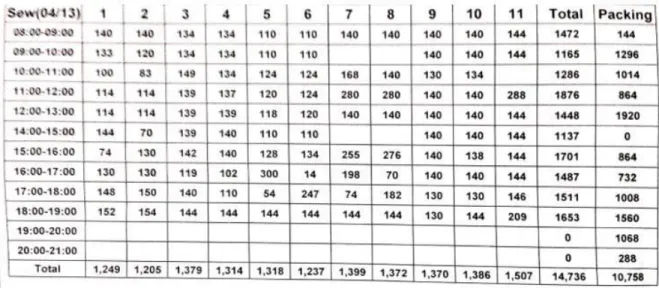
By the total number of production quantity, the production floor giving target for 11 line to filled up their target. From the above graph we clearly see the production target of individual 11 line. In that graph the highest target is 17050 pieces.
Production
3500 3000 2500 2000 1500 1000 500
0
L1/2 L3/4 L5/6 L7/8 L9/10 L11/12
4.9 Data Analysis Report of 10 days:
Figure 4.9: Graphical show of daily production report of 11 line.
Description: In this graph we can see that the individual line total finishing products. From this graph the lowest production gets from line 11-line 12 and on the other hand the highest position gets from line 5/6 and line 9/10.
Chapter 5.0
Conclusion
Conclusion
The suggestive tools developed in this project cover a comprehensive series of aspect is increase and fulfill the target of production floor of apparel industries by ensuring quality production. The importance of the textile industry in the economy of Bangladesh is very high. The explosive growth of the RMG industry in the country, however, has not been enough supported by the growth of backward linkage facilities. So manufacturing the quality product is mandatory to sustain in this global competitive market. Quality is ultimately a question of customer satisfaction. Good Quality increases the value of a product or service, establishes brand name, and builds up good reputation for the garment exporter, which in turn results into consumer satisfaction, high sales and foreign exchange for the country. The perceived quality of a garment is the result of a number of aspects, which together help achieve the desired level of satisfaction for the customer. However, we should bear in mind that 1% defective product for an organization is 100% defective for the customer who buys that defective product. The project clearly indicates that by eliminating non-productive activities like uncut thread, open seam, skip stitch, oil stain, dirty spot, etc in the apparel industries time as well as cost is saved by ensuring quality production which have an important impact on overall factory economy.
References:
1.https://en.wikipedia.org/wiki/Quality_control
2.https://asq.org/quality-resources/quality-assurance-vs-control
3.https://www.graphicproducts.com/articles/quality-control-in-manufacturing/
4.http://www.sacmi-packaging-beverage.com/SacmiBeveragePackaging/Chinaplas.aspx 5.http://database.dife.gov.bd/index.php/factories/alliance-assessed/details/4/1698